Ain’t no butterfly style

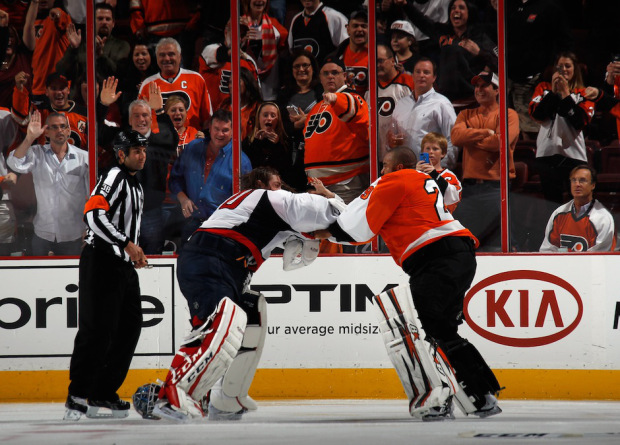
Washington Capitals v Philadelphia Flyers

Toughest active NHL goalies

By Elliot Chan, Opinions Editor

Formerly published in the Other Press. Nov. 2013

Philadelphia Flyers’ Ray Emery has a reputation: he’s a fighter and a competitor, which are quality traits for any professional athlete—most of the time. He’s bounced back from avascular necrosis, a disease that interrupts blood supply to joints, to win the Stanley Cup and the Williams Jennings Trophy, along with Corey Crawford, as a member of the Chicago Blackhawks. There is no doubt that Emery is as tough as they come, but despite all his achievements, his legacy might simply be the hotheaded bully who strayed too far from the crease.

While others debate whether “Sugar Ray” Emery’s actions—which include an altercation with his then team trainer in 2009 when he was with the Atlant Moscow Oblast, and recently instigating a fight against a passive Braden Holtby of the Washington Capitals—are appropriate for the sport of hockey, I can’t help but wonder, if goaltenders were to enforce each other, whom would I choose to go 20 rounds, fist to fist against the undisputed heavyweight of goalies.

5. Mike Smith: The Phoenix ‘tender is known for having an aggressive style in net—and for pulling Flames’ right winger David Jones’ hair after the player crashed into Smith. More often than not, Smith lets the opposition know when they are too deep in his crease by giving them a slash or a trapper to the face. He doesn’t wait for the defencemen to come in to protect him. Smith is always a part of the kerfuffle around the net.

4. Tim Thomas: After his yearlong sabbatical, the goalie we remember so well from the 2011 playoffs has returned to the NHL as a Florida Panther, only to be injured early in the season. Although he isn’t at his healthiest state, I believe his track record can speak loudly for him. Thomas is as blue-collared as a goalie can get, and he has often made claims to being a big fan of mixed martial arts. When it comes to his style, he’s as active in the crease as he is out of it. He has scrapped with the likes of Alexandre Burrows, Sean Avery, and Jason Chimera—all tough guys.

3. Jonathan Bernier:  The Toronto Maple Leafs finally have a tough goalie. Gone are the days of Vesa Toskala, Mikael Tellqvist, and Jonas Gustavsson. Although his only NHL fight was against the often tepid Ryan Miller of the Buffalo Sabres in a preseason game, Bernier showed that he indeed has some tenacity. He is young and so is his career, but I foresee many more bouts involving him.

2. Carey Price: The Montreal Canadiens’ goaltender has never shied away from confrontations, and his spunky attitude has both won and lost approval from fans. The days of him mocking the home crowd are now replaced with him standing up for his teammates. Price has matured as a player and is no longer simply looking out for himself. His most recent fight with our number four ranked Thomas showed off Price’s strength, when he pulled Thomas’ jersey over his head and dragged him a few feet across the ice. As tension builds in games, I’m no longer surprised to see Price drop the mitts and throw some hits.

1. Semyon Varlamov: The Avalanche’s goalie has never been in a fight, but due to the charges he is currently facing, I feel he deserves to be first on the list—if for no other reason than to picture him being pummelled by Emery. Varlamov may not have fought any opposing hockey players, but he did allegedly kick his girlfriend, Evgeniya Vavrinyuk, in the chest, knocked her down, and then continued to stomp on her. On October 30, he turned himself in on charges of domestic violence, including second-degree kidnapping and third-degree assault. So, wouldn’t we all like to see this tough guy get what’s coming to him?

Repeat in Russia

Will Canada strike gold in Sochi 2014?

By Elliot Chan, Staff Writer

Sports_Sochi-hockey

Formerly published in the Other Press. Aug. 6, 2013

Remember that day in February 2010? Remember the city—the country bursting with jubilation? Wouldn’t it be great to relive it?

Sure, the Olympics in Sochi is months away, but it’s never too early to talk about international hockey—especially since the NHL has now confirmed that its players will be able to compete in the prestigious tournament.

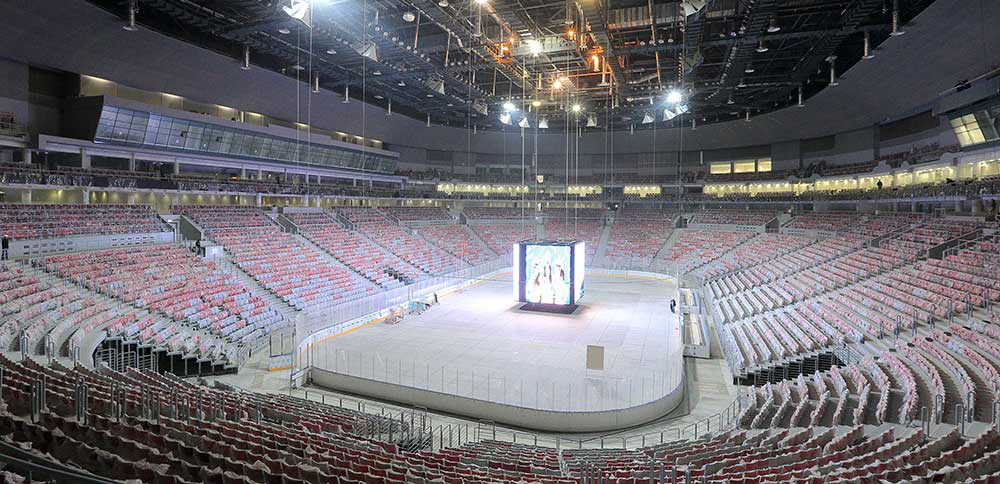
The most notable change in Sochi in comparison with Vancouver is the rink size. The two Canadian ice hockey gold medals in 2002 and 2010 were won on NHL-sized ice (61m by 26m). In Russia, the Canadians will be competing on international-sized ice, which is (61m by 30.5m). Rink sizes have posed challenges before, especially against speedy teams like Russia who can take advantage of the open ice.

The home team is the favourite going into the tournament, but Canada, Sweden, and the United States shouldn’t be intimidated by the jeers they’re expecting when they step onto the ice against superstars such as Pavel Datsyuk, Alexander Ovechkin, and former NHLer turned KHLer Ilya Kovalchuk.

Since the days of the Soviet Union and the Unified Team in 1992, Russia itself has never won a gold medal. But there was a period in history when the red army dominated international ice. But like the Cold War, those days are long gone and though Russia has a barrage of talent, they haven’t been able to make the podium since 2002.

The question that hangs on everyone’s lips is will Canada be able to repeat? I hope I eat my own words, but I don’t believe they will. There hasn’t been an Olympic ice hockey repeat since the Soviets did it in the late ‘80s. Canada might be good, but we have never been dominant. The fact that we won in 2010 was not a miracle, but it was definitely a hard fought game that came down to one key moment. We could easily be talking about USA’s chance of repeating right now if it wasn’t for Sidney Crosby’s heroics.

In 2006, Canada followed up their gold medal victory in Salt Lake City with a demoralizing seventh place finish in Turin. By relying on players that had experience, but were way past their prime like Kris Draper, Adam Foote, and Todd Bertuzzi, the team was doomed from the start. Selecting the perfect team is difficult, since it’s about assigning roles to elite players. With Mike Babcock, head coach of Detroit Red Wings returning to serve another term as team Canada’s bench boss, the players and fans will know they are in good hands. Sidney Crosby, Jonathan Toews, and Shea Weber can all be expected on the roster come February 12, 2014, but the number one goaltender is still unknown.

Martin Brodeur will also be stepping down this year from the international limelight. Roberto Luongo will likely get a few games just because of his reputation, while Carey Price, Cam Ward, and Marc-Andre Fleury will fight for the last two spots.

As excited as I am for the beginning of the NHL season, there is something about Olympic hockey that can make a grown man giddy. The NHL season will pause their schedule from February 9 to February 25 for what should be some epic games in the Motherland.

All eyes on new realignment

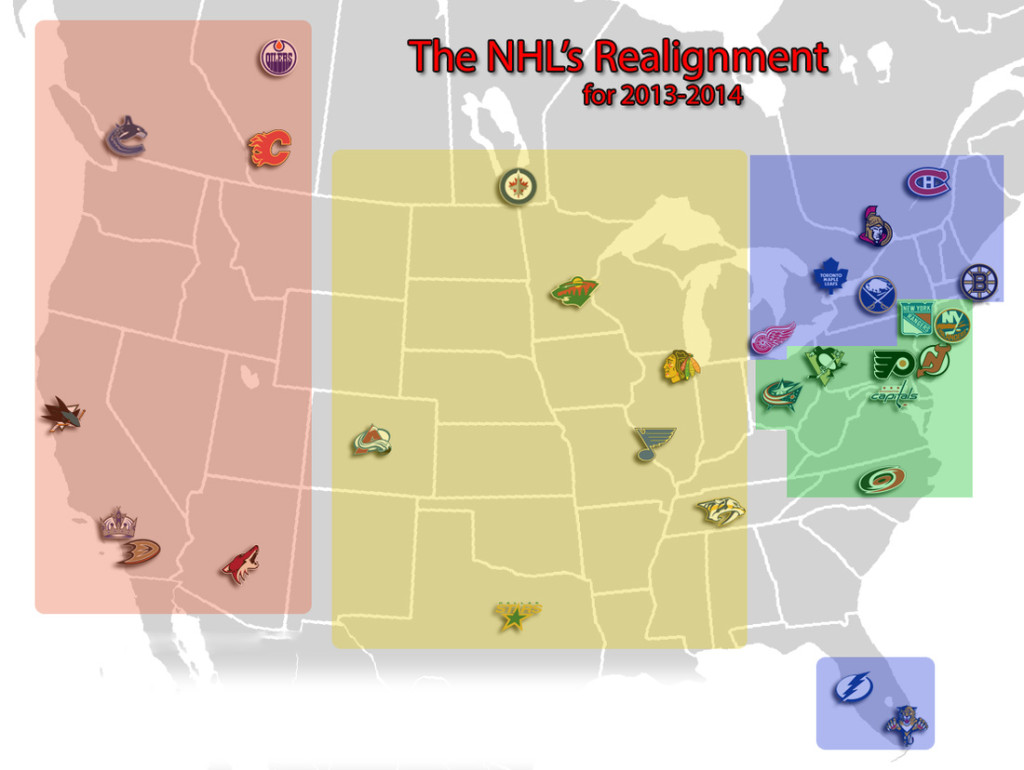
Sports_NHLs-new-regions-1024x770NHL’s new division format intensifies geographical rivalries

By Elliot Chan, Staff Writer.

Formerly published in the Other Press. Aug. 6, 2013

The Vancouver Canucks and the rest of the Western Conference are saying goodbye to Detroit and Columbus, and hello to the Winnipeg Jets.

This time last year, we were all anticipating a NHL lockout; the scenario this season is much more hopeful. As summer ends and the hockey season commences, all eyes are on the year-long experiment—the realignment. The NHL board of governors approved the new divisions and playoff format in July when the 2013/2014 schedule was released.

The Western Conference will now have 14 teams split geographically into the Pacific and Central divisions. The Eastern Conference will have 16 teams split into Atlantic and Metropolitan. The most significant change is Detroit joining the Atlantic division facing-off with three other original six teams, Montreal, Toronto, and Boston. Columbus and Winnipeg swapped conferences, with the Blue Jackets now playing in the Metropolitan division against Sidney Crosby and the Pittsburgh Penguins and Alexander Ovechkin and the Washington Capitals. The West Coast will get a few more chances to see the young Jets team and BC born players Evander Kane and Andrew Ladd.

The two main objectives for the realignment is to shorten travel times and build rivalries. It’s hard to see a downside to this change, since it was inevitable.

“It’s much better for us,” said Dallas Stars defenseman, Stephane Robidas. “It’s less travel, fewer trips out west—the time zones, the amount of time you spend on the plane after games. You don’t have to wait in [Los Angeles], you can come back after games. It’s all little things in the long run I think will help our team.”

The only two teams separated from their division in terms of geography are the two Florida teams. The Lightning and the Panthers are in the Atlantic division, but they have the whole Metropolitan division separating them from the rest of their division rivals.

“From a business standpoint, I think this is probably really good for both Florida teams,” said Commissioner Gary Bettman. “Competitively they may have their own issues, travel-wise they may have issues, but based on where Florida is from a geographic standpoint, whatever we did wasn’t going to be perfect.”

For the Canucks, it’ll be interesting seeing them battle for a post-season spot against consistent playoff contending teams such as the LA Kings, San Jose Sharks, and the Anaheim Ducks.

The Stanley Cup Playoff’s intensity may stay the same, but the route getting there is going to be slightly different. Eight teams in each division will make it to the post-season. The top three teams in each one will take the first 12 spots and the other four will try to land the wildcard position regardless of their divisions.

Though the stage for this season is set, many still see problems in the geographical layout of the league. The main problem lies in the Western Conference, where all the teams are scattered. I foresee (and hope) for a two-team expansion. Perhaps we will see another change next year with, dare I say it, a team in Seattle and Portland?

Vigneault to go

Sports_Canucks-Vigneault

Formerly published in The Other Press. June 4 2013

By Elliot Chan, Staff Writer

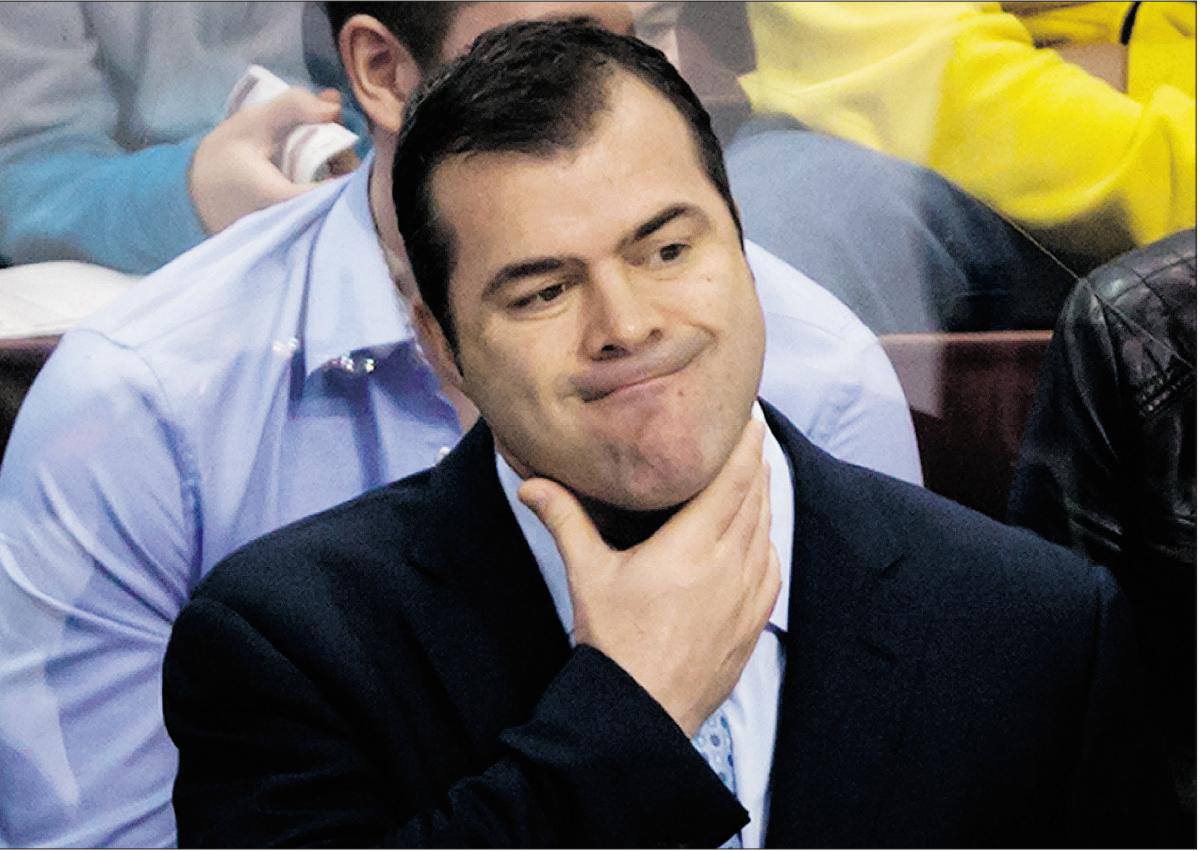
The argument is not whether or not Alain Vigneault’s seven years with the Vancouver Canucks was a failure. After all, he is the winning-est coach in franchise history and the recipient of the 2007 Jack Adam Award. He coached two Presidents’ Trophy teams and got the Canucks all the way to game seven of the Stanley Cup finals. He has done everything possible, except win the cup and that is why it’s his time to go.

With Vigneault’s leadership, the Canucks have become a tough team to cheer for. An undisciplined team that whines over every call and flail like soccer players at every check. “We deserve it,” felt like the mentality of the Canucks these past few seasons, instead of most other teams’, which is, “we’ll earn it.” They expected everything to be handed to them and that made them consistently lose in the playoffs despite having such an elite team. The Canucks might be straight-A students in the classroom, but out on the playground they are incompetent.

He is always diplomatic and polite, but he never had any fire. In his press conference after game four of the 2013 Stanley Cup quarterfinals against San Jose, Vigneault looked absolutely defeated as he answered questions. Meanwhile, his players were in the locker room complaining about a bad penalty against Daniel Sedin in overtime. It was a pathetic image, far worse than getting swept in the first round.

The Canucks have never been a team with killer instincts. A long history of losing to bad teams and playing well against good teams made Vancouver an incoherent group. Leadership has always been a problem with the Canucks from the days of the soft-spoken Markus Naslund to “unable to do much because he’s a goalie,” Roberto Luongo, and then to the other soft-spoken Swede Henrik Sedin. The team needs a passionate leader that doesn’t only lead by example, but also by exclaiming it. Vigneault was not the type of man that gets his team fired up, he couldn’t rock the boat and he never won a championship.

Vigneault might have squandered the best years of the Vancouver Canucks, and any coach after will be working with the remains of a first-class team, but there are a few Head Coach-calibre candidates out in the market that may be suitable for our deteriorating Canucks squad. Former Rangers bench boss, John Tortorella has a quality that might just force the team to the next level. His fiery attitude is exactly what this undisciplined team needs, and he would do wonders when it comes to short-term goals, such as winning the Stanley Cup.

Another candidate would be Lindy Ruff, who for many years has been waiting to join a competitive hockey team. Renounced as one of Canada’s top coaches year after year, it would be interesting to see what he could bring to a team that has metaphorically been colouring within the lines for so many years.

Vigneault was not GM Mike Gillis’ organic choice. He was the hand-me-down of former GM Dave Nonis, and although they had a successful six-year partnership, Gillis will now search for a coach that can lead with an iron fist and not just a courteous smile.

Double dare

DSCF2872

Summer sports you should do

Formerly published in The Other Press. May 8 2013.

By Elliot Chan, Staff Writer

As the snow on the mountains melts away, sporty individuals will now turn their sights on all summer has to offer. For those of us who have spent the winter months hibernating, it is time to shake off the rust and put the rest and training into effect. Now that the city has thawed, grab that bucket list and get to work.

Hiking: British Columbia is home to some of the best hiking trails in the world. From mountain ranges to seascape, we often forget how vast this province really is. Take a drive to the island and embark on the West Coast Trail, a 75-km backpacking route that takes you along the edge of the Pacific. Or challenge the Stawamus Chief, a short two-hour commitment that will lead you up to the peak of Squamish. If nothing more, then try to beat or set your best time on the Grouse Grind.

Whitewater rafting: A roller coaster ride that you can control. If you’re not yet ready to kayak down Hell’s Gate, but are sick of canoeing at Trout Lake then it’s time to see whether you’re made to sink or swim in the world of extreme water sports. All whitewater rafting sites offer different levels of rafting intensity, choosing between a motor-powered raft to a paddle one. If you need a reason to gather a group of friends and head on a road trip up to Whistler or Kumsheen Resort where the Fraser and Thompson rivers fork, let whitewater rafting be one of them.

Bungee jumping: If falling can be considered a sport, then I’m in pretty good shape. I took the dive at Whistler Bungee last year and never regretted it. If given the chance, I would be back on that bridge saying my prayers again. There’s something about taking a leap of faith that is simply unforgettable.

Mountain biking: Biking in any form is a great way to exercise. But why not bombard down a mountain, feeling each stone and root that juts from the earth? Navigating through nature and seeing the world pass you by from the handle bar is one of the most exhilarating things to do. BC is full of trails for all skill levels from beginners to championship-winning professionals. A quick search on the Internet can yield a hundred different paths to bike through.

From spur-of-the-moment adrenaline rushes to weeklong experiences, find opportunities to get outside this summer and try something new.

The Sole Goal

SPORTS_Player-AwardsSidney-Crosby1

Best players of the 2013 NHL season


Formerly published in The Other Press. Apr. 16 2013

By Elliot Chan, Staff Writer

For a moment there in early January, hockey fans were ready to call it a year; but after a significant portion of the season, the lockout is now fading in the rear view mirror. Still, the shortened season has produced some magnificent performances from some of the games most experienced players and young up-and-comers. It will not only be an interesting playoff run, but also a tight race for the players’ trophies awarded at the end of the year.

Hart Memorial Trophy: Despite breaking his jaw in a game against the New York Islanders, Sidney Crosby is the prime candidate for the NHL’s version of the MVP. But if voters are feeling generous, they might turn their sights to an unexpected candidate: Columbus Blue Jackets goalie Sergei Bobrovsky. After losing star forward Rick Nash in the summer, Bobrovsky has displayed heroic numbers with a 2.01 goals against average, a .932 saves percentage, and a record of 16–10–6. If the Blue Jackets are able to sneak into the playoffs, consider him the contender.

Calder Memorial Trophy: The top rookie award is a three-player race between Florida Panther’s Jonathan Huberdeau, Ottawa Senators’ Cory Conacher, and St. Louis Blue’s Jake Allen. Huberdeau and Conacher have been neck and neck all season. The league can flip a coin on those two young forwards and do no wrong, but the wild card is Allen. The 22-year-old goalie has carried his team at various points throughout the season, while veterans Brian Elliott and Jaroslav Halak were coping with injuries and poor play. The Blues would not be in playoff contention if it weren’t for Allen’s 9–4–0 record.

James Norris Memorial Trophy: Many would be surprised at the beginning of the season if one were to say Sheldon Souray and Francois Beauchemin of the Anaheim Ducks would be considered among the best defensemen of 2013. But that is exactly what they are. Beauchemin is spotting his first positive plus minus season since 2006-07 with a +24. But other teams are not forfeiting the title to the Ducks so hastily. Often awards are given not just by performance, but also by reputation—and few have a better reputation than Boston Bruins’ Zdeno Chara while others believe that P.K. Subban from the Montreal Canadiens has a good chance, leading all defensemen with 32 points.

Frank J. Selke Trophy: Awarding a player based on how they consistently perform in games, rather than on statistical prowess, is a hard one to select… in theory. But there’s no denying that Pavel Datsyuk of the Detroit Red Wings is the main candidate. Few players can play like Datsyuk, with his shifty style he can steal a puck, finesse it, and score a goal before the opposition even knows what happened.

Lady Byng Memorial Trophy: It would be a surprise for Patrick Kane of the Chicago Blackhawks to be rewarded the player with best sportsmanship, mainly because of his past reputation. But his miniscule four minutes of penalty and 46 points proves that he is a maturing player, focusing more on winning games than showboating. Another player worth recognition is Matt Moulson from New York Islanders, who has 37 points and also four minutes of penalties.

Vezina Trophy: This is the year where back-up goalies have come into full form. Although Bobrovsky is the touted favourite, Tuukka Rask from Boston is really calling for attention in the league with a .928 SV% and a 1.95 GAA. Ray Emery of Chicago Blackhawks may be the dark horse, but with a 14–1–0 record in the season so far, how can anyone deny his proficiency?

What’s the big deal?

Image of Jarome Iginla playing for Pittsburg Penguins via Pittsburg Penguins Facebook page

Formerly published in The Other Press. Apr. 9 2013

NHL’s lacklustre trade deadline

By Elliot Chan, Staff Writer

“I’m proud to be a Vancouver Canuck,” were Roberto Luongo’s words after the trade deadline on April 3. “I love it here and I love my teammates. I would love nothing better than to win a Stanley Cup here.”

There was no way for Canucks general manager, Mike Gillis to give a discount for one of the top goalies in the league, even if he is currently a backup. Early in the season, rumors about Toronto and Florida’s interest for the Canucks’ goalie surfaced, but Gillis refused to consider his team as one selling away players. Luongo is the ace in Gillis’ hand, and it would be a shame if he simply folded. “It was tough to make trades today,” Gillis tweeted moments after the deadline.

The Canucks managed to make one significant move, adding 29-year-old centre Derek Roy from the Dallas Stars for young prospect and former Vancouver Giant Kevin Connauton. Roy should be able to give a solid contribution on the third-line when Ryan Kesler returns from his injury.

Elsewhere, trade deadline day was anti-climactic, since Jarome Iginla was shipped out of Calgary to Pittsburgh earlier in the week. The New York Rangers were busy prior to the deadline landing highly-touted forward Ryane Clowe from the San Jose Sharks. Clowe is full of intangible talent that any playoff team could use in the playoffs. The Rangers also dealt Marian Gaborik to the Columbus Blue Jackets. Since grabbing Rick Nash from the Blue Jackets in the summer, the Rangers have been going through a revolving door of forwards. Perhaps they finally have the championship team they were looking for, but with a constant flux, the Rangers should be wary of their team chemistry.

The Boston Bruins also made a move, picking up veteran forward Jaromir Jagr from the rebuilding Dallas Stars. Jagr has been trade bait for many years and for good reason. Not only does he have more experience than any other play in the NHL, he was also the scoring point leader for the Stars. The Stars are in a clear rebuilding state since trading away captain Brendan Morrow to the Pittsburgh Penguins.

Another rebuilding team who lost their long time captain are the Calgary Flames, who many expected were also going to trade goaltender Mikka Kiprusoff or defensemen Jay Bouwmeester. Turns out it was the defensemen that had to go. St. Louis Blues acquired Bouwmeester for draft picks, a defenseman, and a prospect goaltender.

The teams vying for the championships also turned out their pockets on trade deadline day. The Anaheim Ducks snatched up speedy winger Matthew Lombardi from the Phoenix Coyotes while the Chicago Blackhawks added to their offensive depth with Michal Handzus from the San Jose Sharks. And the Minnesota Wilds, a team sliding under the radar, picked up Buffalo Sabres’ captain, Jason Pominville.

The theme this year is team captains jumping ships for a chance to win the Stanley Cup. Although fans usually feel the heartbreak, players understand that deadline day is all business.

“I wish we had more success over the past few years,” said Iginla, as he reminisced about his time in Calgary. “I know it wasn’t lack of effort from the organization.”

Often torn between loyalty and regret, team captains have to step down as the face of an organization to win the cup. The worst thing that can happen is for a player to over stay their welcome. All eyes are on Gillis, wondering what status Luongo will be in next season.

Less is more

Photo by Marianne Helm/Getty Images

Formerly published in The Other Press. Apr. 3 2013

NHL plans to reduce size of goalie pads

By Elliot Chan, Staff Writer

On March 20, NHL general managers gathered in Toronto for the annual spring meeting. With discussions aimed at improving the game, plenty was on the agenda. But a key topic was about the shrinkage in goalie pads. For the past decade, executives in charge of the sport have been avidly trying to increase the hockey entertainment—in other words, they want to produce more goals.

Since the days of Tony Esposito and Patrick Roy, goaltenders have adapted a new form in stopping pucks, thus changing the equipment. Goalie gears are currently built to give players an advantage when they go into the butterfly position. Dropping down to their knees, goalies are able to cover up their five-hole with the help of their pads, which takes up 55 per cent of the space between the knees to the pelvis. The present debate is to decrease 10 per cent of the space, which is approximately the size of a hockey puck. While some managers are tired of arguing the topic, others believe it is unavoidable if NHL wants to increase goals and heighten entertainment.

“When we’ve done it in the past, you’ve got to make sure we don’t expose goaltenders to injury,” said Colin Campbell, the league’s senior executive vice-president of hockey operations. “They play now to their equipment and how their equipment is fitted. That’s what we want to attack. It’s a frustrating project, but it’s something that’s really affected the game the last 10 years.”

Hockey should be a showcase of athletic ability, so it is arguably cheating if a player has an upper hand because of their equipment. Former goalie and current goaltending supervisor, Kay Whitmore, suggested that safety was not a big factor, “I watch games every night,” he said. “You see goalies playing [with] well under what they are allowed. Some of our best goalies are playing in that size equipment and they’re playing safely.”

While some players choose smaller pads for flexibility in the stand-up position, others require heightened safety for their style of play. Winnipeg Jets’ goalie, Ondrej Pavelec believes that it is the different styles and options that make the game interesting. “How many times are they going to change the rules? I don’t think it’s that fair,” said Pavelec. “If you take something away from the goalies, you have to take something away from the players too. Okay, so we’re going to get small gear, we [should] give players wood sticks.”

Decreasing the size of pads might increase more goals, but many believe that fans are more interested in rivalries and competitiveness, rather than high scoring games. “I think it’s the speed, the skill, the passing. As long as the game is fast, I think it’ll be exciting,” said Chicago Blackhawks’ Corey Crawford. “Just because we get 10-8 hockey games doesn’t mean it’s going to be an exciting game.” He also added, “Shots keep getting harder, but for some reason, goalie equipment has to go down. Whatever. Whatever they do, just try to adjust to it.”

If fair is fair for Pavelec, Crawford, and other NHL goalies, then nothing will change. But until the day modern goaltenders go back to wearing those hotel pillows around their shins to stop pucks, few are going to have sympathy for them. So the debate continues and the new rule is developing and may be in effect as early as next year.

Growing pains

ryan-miller-patrick-kaleta

Formerly published in The Other Press. Mar. 26 2013
Are athletes helping teammates by pointing fingers?

By Elliot Chan, Staff Writer

On Sunday, March 17, the Buffalo Sabres benched 26-year-old Patrick Kaleta after he served his five-game suspension. Irritated about being a healthy scratch and his team’s under achievement, Kaleta spoke with the media before the game against the Washington Capitals.

“They don’t need me right now, I guess. I’ve been pissed off watching for the past couple weeks,” said Kaleta. “No matter if you’re a fan or a player, you guys know what’s going on. You should be pissed off. You should play with a little piss and vinegar. You shouldn’t be happy. We’re not in position we want to be in. We have to work harder, come in, and do something about it.”

Ryan Miller, Buffalo’s goaltender, was not pleased by his teammate’s comments after losing 5–3. “That’s just drama and he needs to just grow up,” said Miller. “He doesn’t have to go to you guys and say that stuff. I’m addressing it now and I’ll go and talk to him about it. There’s no reason to say that.”

Dressing room conflicts are a common aspect of sports. But are peer disciplines helpful for team and player development? Miller is a well-respected leader, but when it comes down to it, he has no great superiority over Kaleta. They might as well be two co-workers in an office firm bickering over sales. Two wrongs don’t make a right. Although Kaleta should have sucked up his pride when benched, Miller should also know his role, which is to stop pucks, not authorize his teammates’ comments.

Relocation is an easier solution to resolution. If you’re not a good teammate, you’re a good opponent. Kaleta’s negative comments toward his teammates might have just bought him a trip out of Buffalo, but with the way things are looking, that might be exactly what he wanted.

The game is full of selfish players, but their dirty laundry doesn’t need to be aired out for the public to see. We don’t notice the problems occurring behind the scenes of our favourite restaurants, our local market, or even our classrooms. Not everyone reacts obediently to judgment and helpful criticism; sometimes those guiding actions can cause a defiant reaction.

On the same night as Miller and Kaleta’s war of words, Nashville Predators’ forward Sergei Kostitsyn lost control of a puck during a game against the Edmonton Oilers. The play caused an odd man rush heading the opposite direction, and instead of chasing after the opposition, Kostitsyn opted for a line change. The Nashville bench was livid with his indolence and he knew it. “I made a mistake. I went to change, I should have back-checked, but didn’t see the second guy was coming there,” said Kostitsyn after the 3–2 loss. “Even if it was a one-on-one, I should go back, it doesn’t matter if I was tired. I should have gone back and pressured him from behind.”

Hockey is a team sport, and it requires players to take onus of their own actions, whether it is on or off the ice. It might seem like a good strategy to point the finger and command someone to do better, but pointing out errors is counterproductive. Growth comes from communication and trust, and no team will fully develop by playing the blame game.

Canucks Corner: The halfway mark

schneiderpulled

Formerly published in The Other Press. Mar. 29 2013

By Elliot Chan, Staff Writer

More than half of the season is over, and the Canucks are teetering uncomfortably in the standings. On one hand, they are leading the division with a slight edge over the Minnesota Wild; on the other hand, the slightest slip up will send them plummeting out of the playoff picture.

The Western Conference has always been competitive, but with six points separating 13 teams, the shortened season has made the race to the finish line even more dramatic. Few teams love drama more than the Canucks. So if we expect them to pull their game together and race away from the pack to join Chicago and Anaheim as un-touted division champions—don’t, because things are about to get messy.

Failing to exceed expectations, the Canucks are playing cool with all their unfinished business, namely the business in the crease. Cory Schneider is having a respectable season sharing the net with Robert Luongo, but respectable is not winning complete confidence from upper management. As trade deadline looms around the corner, everybody is anticipating the inevitable. But will it happen in April or will it happen in June? Luongo’s stock hasn’t been higher since the season started and that’s usually a sign that something will happen sooner rather than later.

It’s also apparent that the Sedins won’t be challenging for any scoring titles this year with their underperformance on the top line—an area the Canucks have to look at as they plan for the future. Jordan Schroeder has shown potential of one day becoming an elite forward, but it is a work in progress. And since Mason Raymond, Zack Kassian, and David Booth are all having a horribly-mediocre season, Canucks fans can only hope that someone in the organization will step up or a team with a top offensive prospect will be enticed by Luongo.

For a while, it looked as though the team could thrive without Ryan Kesler’s leadership and grit, but with so many games ending in one or two goals, the Canucks are hoping there is no delay with his healing foot. But the question is worth asking: will Kesler be the same player he was before? Will he go the extra mile to finish his checks? Will he have the same intimidating net presence? All questions aside, it is time for him to adjust his style. The ever-changing Canucks need him to become less of a two-way player and focus more on powering through opposition’s defense—as well as photo bombing his teammates during interviews.