HOCKEY: A GUIDE TO CANADA’S PASTIME

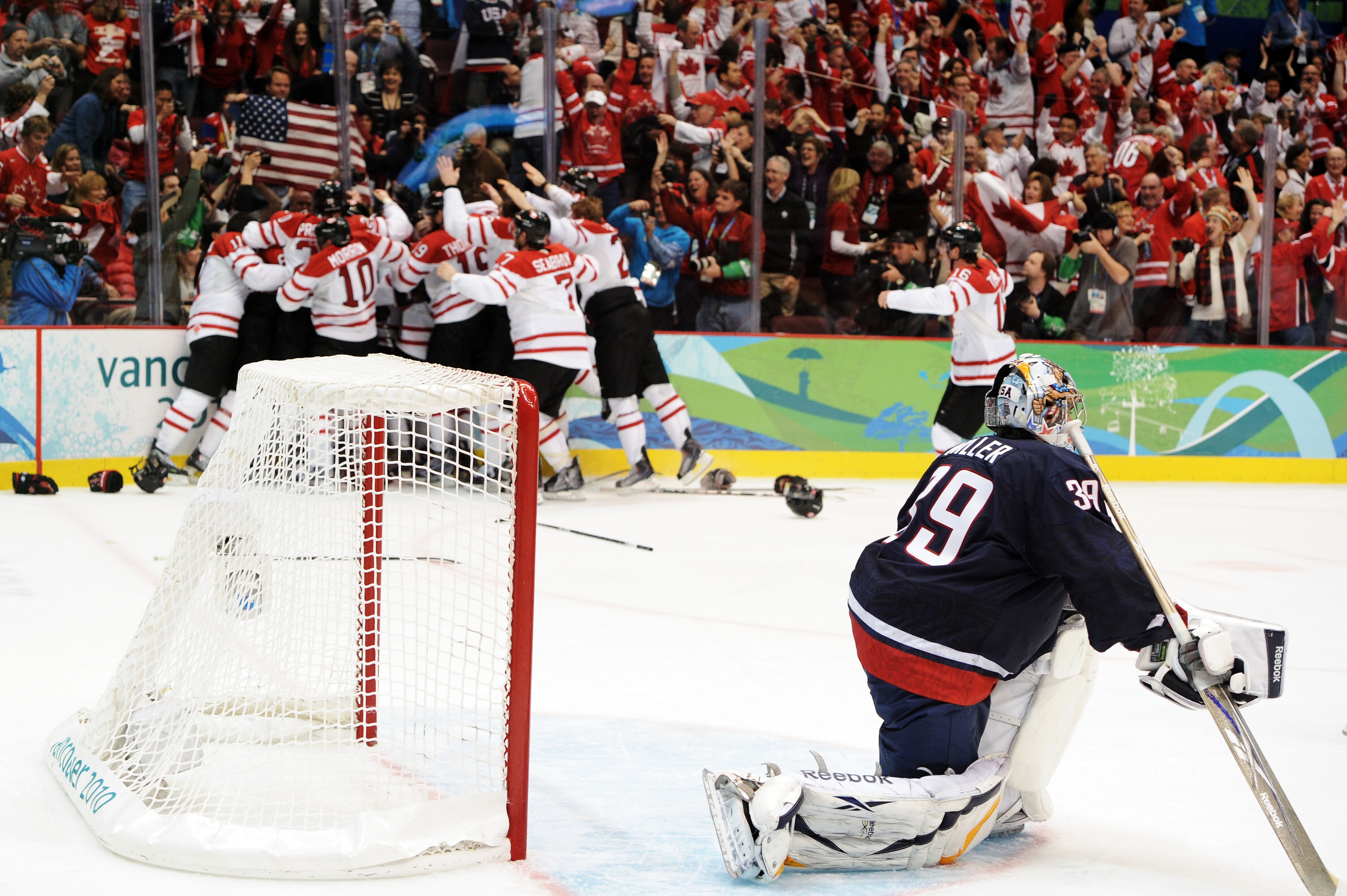
Ice Hockey - Men's Gold Medal Game - Day 17

 Formerly published by MeetVanCity.com

Saturday February 9, 2013

Hockey is considered to be a violent sport with its high physical contact. And that’s why we love it. On the ice, players can reach speeds exceeding 30 miles hour and the hockey puck can travel over 100 miles an hour. It is not hard to explain why hockey is referred to as “the fastest game on earth.”

Created outdoors during the icy northern winters, hockey is more than a sport for Canada.
It is a tradition and a culture. Hockey combines the act of ice-skating with shooting
a rubber puck into the opposition’s net with a curved stick. Each successful attempt is called a goal and it is worth one point. The team with the most points is the winner.

On the Ice: A game of hockey requires two teams with five skaters (a line) and
a goalie each. The National Hockey League (NHL) has 30 teams, seven from Canada
and 23 from the United States. A team is usually constructed with four lines of
three forwards and three lines of two defensemen and two goalies, one starter
and one back up (should the starter be unable to play).  A game consists of three 20 minutes periods. If the 60 minutes end in a draw a five-minute four-on-four overtime is played. If no deciding goal is scored in the allotted time, then a best of three penalty shots is required.

The Process: In the NHL a hockey season consists of 82 games (with exception to lock-out years) with the 30 teams separated by two conferences: Western and Eastern. Each conference is divided into three divisions with five teams in each. The Eastern
divisions are Atlantic, Northeast and Southeast. The Central, Northwest and Pacific are the Western divisions. The majority of the games are against teams within the geographical divisions. Each win is worth two points, and if a game goes into overtime, the winning team earns two points, while the losing team will get a one-point consolation. At the end of the regular season, the top eight teams in each conference will contend for the Stanley Cup in the playoffs.

The Prize: The Stanley Cup is Canada’s Holy Grail. Etch around its rim are the years and names of pass winning teams, players and coaches. It is more than a trophy– it is a history book. Considered as the toughest championships, the Stanley Cup Playoffs consist of 16 of the 30 teams. Split up by the conferences, the playoffs are a four round best of seven series competition.

Whistle Whistle: Unlike most team sports, fighting is a distinctive element of hockey. Although players may choose to fight, they are still not exempt from punishment.  Fighting is a major penalty that forces players out of the game and into the penalty box. Penalties are categorized by the infraction’s severity. A minor penalty is worth two-minute, double minor charges four and a major is worth five minutes. Different levels of suspensions are also dispensed to players whose offense contributed to injury or can be considered as an attempt to injure.

The Frozen Surface: A hockey rink is a rounded rectangle with lines and circles used to indicate various spots on the ice. Two blue lines mark a neutral zone, which separates the offensive and defensive zones. The blue line are also used to identify offside calls (where a player on the offensive can not be past the blue line without the puck passing first.) There are nine face-off dots on the ice, two in the attacking zone, two in the defensive zone and five in the neutral zone.

Hockey is a complicated game to play, but a simple game to watch. It is fast-paced and high action. There is nothing like the crisp air of an ice rink, the sound of crashing bodies, and the intensity of a game. But as a spectator, remember to pay attention, because with slap shots, big checks and heated competition anything can end up in the crowd during a hockey game.

Henrik versus Linden

M~ Sun092502 Canucks READ

Formerly published in The Other Press. Feb. 26 2013
Will there ever be a new Captain Canuck?

By Elliot Chan, Staff Writer

On February 15, in a game against the Dallas Stars, Henrik Sedin surpassed Markus Naslund’s franchise record in points scored with 757. Although the Canucks eventually lost the game 4–3, it did not spoil the debate concerning the greatest Canuck of all time.

Among fans, there is no argument: Trevor Linden is still the idol in Vancouver. But realistically, what can Sedin do to over take him? The answer is simple: win a championship. The only way for any player to step out from Linden’s shadow is to reflect the light with the Stanley Cup. Then again, Sedin has done everything Linden did in less games played. Statistically, the only major area that Linden has the upper hand is in goals scored. Henrik is a playmaker, though he did show off his abilities to score in 2010 when his brother, Daniel went down with a leg injury. So, is it really so unfair to have this discussion?

Sedin has won the Art Ross and the Hart Memorial trophy, and led the Canucks to the Stanley Cup finals. But the term “led” is used loosely, because he has a notorious reputation of not showing up during pressure games. For most, it doesn’t matter what players do in the regular season, great players must bring their skills to do-or-die situations. Great players are clutch players. Unfortunately, Linden falls into the same category as Sedin. Both captained losing teams in the Stanley Cup Finals. The mirroring post-season experiences keep them on par with each other.

Besides coping with heartbreaking losses and being top draft picks, Sedin and Linden don’t have much in common. Sedin is Swedish, where as Linden is Canadian. I can’t speak for everyone, but in an international game where Canada is playing against the Swedes, it is a little difficult to cheer against Sedin. It plays a big part in Vancouver fans’ psyches. As shallow as it sounds, the best Canuck shouldn’t be a foreigner for that reason.

The other thing working against Sedin in respect of being the best Canuck is that he played most of his career with his identical twin right beside him. I’ve cheered them on for 13 years and still can’t tell them apart. For the longest time the debate was, who’s the better Sedin? They were neck and neck with points for so many years. One would pass and the other would score. Only recently did Henrik overtake Daniel in the race and earned recognition aside from being the other half of a scoring combination. Henrik Sedin will never be the greatest Canuck, because then what would Daniel be? They relied so heavily on each other their whole career it would be unfair to split them in such fashion.

Linden rose up the ranks, earned respect, and went through trials and adversity all on his own. That is why he is and always will be Captain Canuck to the city of Vancouver and Henrik Sedin, although he is currently wearing the “C” for captain, will always be paired up with his brother Daniel.

North by northwest

Sports-North-Western-NHL

Formerly published in The Other Press. Feb. 19 2013

The worst division in the NHL

By Elliot Chan, Staff Writer

Since the inauguration in 1998, the Northwest Division has only produced one Stanley Cup champion and three Presidents’ Trophy winners. From the glory days of the Colorado Avalanche to the current dominance of the Vancouver Canucks, the great Northwest has always been a one-horse race. Minnesota, Calgary, and Edmonton sneak into the playoffs on several occasions and have been memorable contenders, but the success was temporary. The failures of the division however seem permanent.

It is hard to stay optimistic watching each team struggling despite improvements. Edmonton has collected first-round draft picks and has developed a team with a youthful core, but still no notable growth can be seen.

Meanwhile, Minnesota went through some dramatic changes adding more of an offensive touch with players like Zach Parise, Dany Heatley, and Devin Setoguchi, but positive results haven’t been immediate.

For Calgary and Colorado, both are struggling through a period of transition as prominent players like Jarome Iginla and Milan Hejduk are taking on lesser roles in their waning days. There’s really no surprise that Vancouver is waltzing through the shortened year with their eyes set on another division title, their sixth in seven seasons.

For the fans of Northwest Division teams, patience is a virtue. It is a shame that some of the most passionate supporters of the sport have to suffer with subpar teams. Perhaps there is a greater expectation from proud hockey fans, but the truth of the matter is that the teams just aren’t that good. The way it looks at the moment, Vancouver might be the only team in the division entering the playoffs. There is a slim chance that Edmonton or Minnesota may upset another and sneak in, but with the stiff competition in the Western Conference’s bottom eight seeds, the odds are not in their favour.

As of the moment, this is good news for Vancouver fans. With the majority of the games against weaker opposition, the Canucks may have the easiest route to the playoffs. Then again, the spoils of having incompetent opponents may hinder their chances come do-or-die games. Teams that often do well in the playoffs are those that feel the pressure of making the post-season. Last year the Los Angeles Kings won the championship as an eighth-seed underdog, so it goes to show that no team cruises to glory. As weak and pathetic as the division looks at the moment, the Northwest have made the Stanley Cup Finals three times in the last 10 years, no better or worse than any of the other divisions in the Western Conference.

The ball’s in our court

Formerly published in The Other Press. Jan. 29 2013

Canada versus Spain in Davis Cup 
By Elliot Chan, Contributor

Since Milos Raonic was knocked out by Roger Federer in the fourth round of the Australian open, he has turned his attention back home in preparation for the Davis Cup. The Ontario native will team up with BC’s Vasek Pospisil, Niagara Falls’ Frank Dancevic, and Canadian tennis veteran Daniel Nestor to compete against the first seeded nation, Spain, at the Doug Mitchell Thunderbird Sports Centre at UBC on February 1–3.

Though the Spanish team will be missing the prestigious Rafael Nadal due to injury, they are still a formidable group. Nicolas Almagro, the 11 seeded singles player, former doubles champions Marc Lopez and Marcel Granollers, and 51 seeded Albert Ramos will be a handful for the Canadians.

“Spain is going to be a real challenge,” said Canadian team captain, Martin Laurendeau. “They are the top team in the world with incredible depth. They have 13 players in the top 100 alone so no matter what team they’re bringing, it will be stacked with talent.”

The winner of the three days will advance to the quarterfinals in April. Meanwhile the loser will fall into a survival bracket, where they will play a must-win tie in order to compete in the World Group in the next Davis Cup tournament in 2014.

The Canadians’ main cause for apprehension is Raonic’s health. He was showing signs of a foot ailment during his lost to Federer. But Laurendeau assured that it was nothing to be concerned about. “He’s fine, no worries about Milos,” he said.

It has been 22 years since Canada faced Spain. It was the only time the two nations had contended against each other in the competition. The result went in favour of the Europeans, who won the tie 4–1 in Murcia, Spain. Although the Spanish team had won 10 out of 14 ties in their homeland, traveling abroad has been a problem. They lost in the finals 2–3 last year against the Czech Republic team in Prague.

Canada, on the other hand, is entering the competition on a positive note. They defeated South Africa 4–1 in September to keep their position in the higher tier. The same quartet that secured their spot in the World Group last year is entering the same challenge this year. Should Canada upset Spain in the first round, they will have an opportunity to face Croatia or Italy in the quarterfinals.

Two singles matches are scheduled for Friday the first, a doubles match on Saturday, and finally a reverse singles on Sunday, where players swap opponents. Tickets are now being sold for both individual days and as a three-day package. There is also a 10% off special for students.

The must-haves in your 2013 fantasy team hockey pool

Formerly published in The Other Press. Jan. 22 2013

By Elliot Chan, Contributor

The first week of the NHL season is underway, and that means our fantasy teams are gearing to go. After listening to the experts and analyzing the rosters, we step back and await the results.

For those who chose the Penguin’s captain, Sidney Crosby, this year in the first round— I’ll say congratulations. But I’m going with Steven Stamkos of the Tampa Bay Lightning as my top centre. After all, the 22-year-old was the first player to score 60 goals in a season since Alexander Ovechkin did in 2007–2008. His individual success had been overshadowed by his team’s failure, but playing alongside Martin St. Louis and Ryan Malone will always guarantee production from the young sniper.

Now, I might not have selected Crosby, but I did pick up his Russian counter-part and last year’s Hart Trophy winner, Evgeni Malkin. With the absence of the captain last season, Malkin had the best year of his career, stepping up in every aspect of the game. Finishing with 109 points, the most in the league, the man teammates and fans refer to as “Geno” will make a big impact, regardless of Crosby’s condition.

Although his stock has decreased immensely this year, Ovechkin is still a great pick, and cheaper than ever. With 40 points in 31 games in the KHL this season, Ovechkin would be on route to a 100-point year should the games and stats be combined. That would make it his first triple digit season since 2009–2010. He is still a phenomenal player and I wouldn’t be surprised if he elevates his performance this year to prove he is still in the same class as Malkin and Crosby.

On defense there was no hesitation, I took Erik Karlsson from the Ottawa Senators. With 78 points in 2011–2012, nobody expects the 22 year-old Swede to replicate the dream season. But with a seven-year contract and a Norris trophy, expectations are higher.

I could have chosen Shea Weber or Zdeno Chara as my second top line defenseman, but instead I went back to the Penguins and selected Kris Letang. Often flying under the radar on the team, Letang is one of the leagues most consistent D-men. With a plus/minus rating of +26 in six NHL seasons, Letang is reliable in all big game situations, including shootouts.

Finally, my number one goalie will be none other than Vancouver Canucks’ Cory Schneider. Regardless of Roberto Luongo’s situation, pressure is high for Schneider. Fortunately his first year as a starter is in a shortened season. With a total of 68 games in the NHL, the season will still have a familiar backup feel for Schneider.

As for some dark horses, on offense I chose Pittsburgh’s Pascal Dupuis, Buffalo’s Cody Hodgson, and Edmonton’s Magnus Paajarvi. On defense I picked up, Detroit’s Kyle Quincey and Tampa Bay’s Victor Hedman. As for my backup goalie I went with Michal Neuvirth of the Washington Capitals.

That is my team for this year. I’m sure by February I’ll be regretting most of my picks. But until then, best of luck and hockey pool responsibly.

Rising up down under Milos Raonic not among the elites… yet

Formerly published in The Other Press. Jan. 22 2012

Milos Raonic not among the elites… yet
by Elliot Chan, Contributor

After a shaky first round in Melbourne, Canada’s golden boy of tennis, Milos Raonic, defeated Czech Republic’s Lukas Rosol in straight sets advancing him to the third round in the Australian Open. Overcoming the scorching 40 degree Celsius heat, Raonic rallied through a first set tiebreak and then cruising to a 7–6 (7–2), 6–2, 6–3 victory. Although he is a win away from matching his best grand slam performance, should he succeed he would end up facing Roger Federer in the fourth round.

“It was a little tough,” said Raonic, addressing the heat and not about the prospect of facing Federer, “you found yourself getting light-headed. Other than that it didn’t seem that hot. The sun was covered by clouds. But the air was thick, it was hard to catch your breath.”

It might help Raonic breathe a bit easier knowing that he defeated Rosol, who got most of his fame from ousting Rafael Nadal at Wimbledon last June. But with Nadal’s absence from the tournament, there really isn’t a point comparing him to Federer, Novak Djokovic, or Andy Murray. After all, they are the top dogs; the finals without the presence of two of them will be a surprise. But the idea of an upset might not be too far-fetched.

We can all agree that Federer is not the player he once was or that competition had stiffened against him. Either way, with pink shoelaces, the Swiss second seeder defeated Russian Nikolay Davydenko as the sunset in Melbourne last Thursday. After a 6–3 6–4 6–4 win, Federer heads into third round preparing to face home country favourite Bernard Tomic. Tomic had risen rapidly up the ATP standings. At 18 years old, the 71 seed Australian is the youngest player to reach the top 100.

For now, Raonic cannot worry about Federer. He has to focus on Saturday, when he takes on German, Philipp Kohlschreiber. But for fans, all eyes are towards the horizon, wondering what lies in store for Canadian tennis. It is hard to think about tennis in January, but the sport has been gaining popularity for years. With so many alternatives to hockey during the summer, it seems the powder keg is going to blow. With advancing victories from Milos Raonic, he might just be the one to light the fuse.

Sport-starved city

Formerly published in The Other Press. Jan. 15 2013

A Dark Age for Vancouver sport fans
By Elliot Chan, Contributor

April 22, 2012 marked the last Vancouver Canucks game. September 9, 2012, the Vancouver Canadians concluded their season. November 1, the Whitecaps were defeated and knocked out of their first MLS playoffs. November 18, 2012 was the disappointing last game for the BC Lions. And the Vancouver Giants, with a current record of 11-28-0, are unworthy of being considered entertainment. Needless to say, the city has been in a sports drought. And after gorging ourselves on the brief World Junior Championship, most of us still feel unsatisfied, like having eaten candy for dinner. Now that the NHL is back, the banquet is served. But let’s not forget the other sports and other leagues around the world. Just because we’re sports fans doesn’t mean we can’t be cultured.

Not far beyond the horizon, our American neighbours are enjoying their bounty in NFL playoffs and NBA midseason. With the Super Bowl held in New Orleans this year on February 3, you know it will be a grand spectacle, regardless of the teams in the final. As for NBA, the big three of LeBron James, Dwyane Wade, and Chris Bosh are proving their worth, leading the conference and eager to defend their title. But all eyes are on the usurpers. Kevin Durant looks to be the key to success in Oklahoma City, and Chris Paul and Blake Griffin of the LA Clippers look posed to do some real damage overtaking the Lakers as the Los Angeles team to root for. The current unpredictability of the two America-based sports makes it worthwhile to check out.

On January 14, 2013, the Australian Open tennis championships begin in Melbourne. The opportunity to see Novak Djokovic and Roger Federer face each other in a rematch is a good enough reason to stay up late. And if those two take up the top spots, then Andy Murray will be a respectable number three. After reaching the finals in two of the last three years, it seems that Murray always saves his best for the Aussies. Since he won the gold medal at the Olympics in his British homeland against Federer, Murray is expected by many to finally surpass his long-time rival and top seed, Djokovic.

Across the pond, the UEFA Championship round of 16 has been set and there are some key games leading up to the May 25 finals: Manchester United against Real Madrid on February 13 and March 5, AC Milan versus FC Barcelona on February 20 and March 12, and Arsenal taking on Bayern Munich on the same days. With memories of Chelsea winning 4–3 on penalty kicks after a 1–1 draw against Bayern Munich at the finals in Germany, an epic tension is building up because of the finals being held at Wembley Stadium in England. Bayern would love to make their tenth appearance in the deciding game, but with so many quality teams in the mix it seems unlikely to see an England-Germany rematch.

Although there might not be a whole lot going on north of the 49thparallel, like tropical fruit in January, there are always exports from other countries to enjoy.

Changes for the Canucks


Formerly published in The Other Press. Jan. 15 2013

Will the results be different?
By Elliot Chan, Contributor

For several years, the Vancouver Canucks have been a notoriously slow-starting team. But somehow by mid-season they pull a few winning streaks together and suddenly at the end they are on top of the league and Presidents’ Trophy winners. This year, with 48 games scheduled, every game becomes so much more important. Although the core of the team is still intact, several key areas of the Canucks’ lineup may require some tinkering. And if they are unable to find chemistry off the bat, then a short season will feel a lot shorter.

The most crucial problem is the absence of Ryan Kesler. After a shoulder and wrist surgery in the summer, the Canucks’ most valuable two-way forward is still recovering. With no schedule set for his return and Kesler refusing to risk any setbacks, the team will simply have to cope without him for the time being. Left winger Chris Higgins will be the most likely candidate to replace Kesler as the second-line centre. But concerning points, David Booth, Jannik Hansen, and Mason Raymond will be expected to pick up the slack.

Despite everything Roberto Luongo has done, Vancouver still remains a goalie graveyard. Amidst the skeletons of Dan Cloutier and Felix Potvin, Cory Schneider will now take the spotlight as the number one goalie in town. During his rise through the Canucks organization, fans have developed a bond with the 26-year-old Massachusetts native. But with Luongo’s departure imminent, how many chances will the fan base offer before the faith in Schneider, like that in his predecessor, runs dry?

While GM Mike Gillis was fairly idle with free agent signings this past summer, there was a notable newcomer: Jason Garrison from the Florida Panthers. With a six-year contract in place, Garrison is taking on big shoes replacing Sami Salo on the blue line. For some, the lockout was a blessing and that was just the case for the White Rock native. Garrison had been nursing a groin injury when he was signed, but now the 28-year-old player is ready to hit the ice with his new team.

The Canucks’ depth has been one of the team’s strengths for many years and this one will be no different. But since it is a tighter schedule don’t expect to see as many line changes and swaps with the farm team. Alain Vigneault needs to see the big picture and get the team to the playoffs; that means relying on the core. Daniel and Henrik Sedin must produce points, Alexander Edler and Dan Hamhuis will need to contribute on the power play, and Corey Schneider must elevate his game and become the new face of the franchise. No pressure, or anything.


Canadian crease

cc7d2feaf7c825340730d3e2c22ca033

Formerly published in The Other Press. Jan. 8 2013

The future of goaltending for Team Canada

By Elliot Chan, Contributor

Imagine a golfer trying to sink a par three putt on a football field with a game in progress. In a sense, that is what goalies are—individuals playing their own sport in a larger game with all the pressure that nobody notices until they make or break. It is a unique position that requires mental and physical stability and that is what makes it difficult to pinpoint a consistent future for these athletes.

Malcolm Subban was the first goalie to be touted as the bona fide number one starter for Team Canada in the World Junior Championship since Carey Price in 2007. Needless to say, quality goaltenders don’t emerge often. Even when one does well in the World Juniors it doesn’t necessarily mean success in the NHL. For example, in 2006 Justin Pogge won the MVP and helped Team Canada capture their twelfth gold medal in the tournament, only to end up being shipped around from Toronto to Phoenix in his professional career without ever achieving the same level of accomplishment. Few goaltenders are able to savor a lengthy career, but those who do become legends.

As Martin Brodeur’s career wanes, all eyes are seeking the new fixture in Canada’s crease for the upcoming Olympics and World Championship tournaments. With the memories of Roberto Luongo’s 2010 gold medal performance tarnished by his inability to win the Stanley Cup, hockey fans can turn their attention to others remaining on the top notch. Cam Ward of the Carolina Hurricanes has a Stanley Cup ring, a Conn Smythe Trophy, and a gold medal from the 2007 World Championships. Marc-André Fleury also has a Stanley Cup ring and was the third string goalie in the 2010 Olympics. Many suspect that it will be his turn to take the helm and solidify his legacy as the starter in Sochi 2014. Finally, there is heavily ridiculed BC boy Carey Price, famous for mimicking Patrick Roy and telling hometown fans to relax. His stats aren’t as prestigious as the others, but I believe that team Canada would benefit from his fiery attitude.

Like any other profession, good consistent performance is what sets those who are great from those who are merely decent. Goaltending is no different. But when it comes down to a one game winner-takes-all, even the best rely on luck. On January 3, 2013, the USA defeated Canada in a 5-1 slaughter at the World Juniors. Subban was pulled after allowing four goals on 16 shots during the second period, far from top prospect caliber. For now, the Boston Bruins’ draft pick remains a prospect, but with mental and physical conditioning, I foresee Subban making a big impact with the Canadian squad for many years to come.

Other top goaltending prospects for Team Canada’s future include Braden Holtby of the Washington Capitals, Mike Smith of the Phoenix Coyotes, Devan Dubnyk of the Edmonton Oilers, Corey Crawford of the Chicago Blackhawks, Jonathan Bernier of the LA Kings, and Brian Elliott of the St. Louis Blues. The competition for Canada’s crease has never been so openly contested and it’ll be interesting to see who will step up and face the privilege of ultimate pressure.

The triumphant return of Georges St-Pierre


Formerly published in The Other Press. Nov. 27 2012

By Elliot Chan, Contributor

Canadian UFC fans all across the country were holding their breath as Georges St-Pierre returned to the octagon after a 19-month absence. After tearing his ACL while training for a welterweight title defense against Nick Diaz in UFC 143, GSP began his long road to recovery that involved surgery.

On November 17, St-Pierre and interim welterweight champion Carlos Condit headlined UFC 154. Condit replaced GSP in the fight against Diaz and took the unanimous decision. Condit had been waiting patiently for months for GSP to recover and at the Bell Centre in front of a packed house in Montreal, he finally had a chance to take home the undisputed title.

“Somebody asked me in the locker-room, ‘How’s Georges looking?’” said St-Pierre’s striking coach Phil Nurse prior to the event, “you know what? The last time I saw him like this is when he flattened Matt Serra at the same arena.”

Without missing a beat and appearing in full athletic form, St-Pierre took the valiant contender to five rounds, dictating the fight with a formidable ground game and regaining the title in unanimous fashion. Condit was only able to defend against St-Pierre’s take downs one in eight attempts.

“Obviously that’s not where I wanted to be, I didn’t want to be under Georges taking elbows,” said the challenger after the fight. An early strike to the temple caused Condit to bleed profusely late in the first round, when St-Pierre effortlessly got through his guard. However, despite looking like a horror movie victim, Condit did not back down. In the third round, he snuck in a high kick after a series of jabs. The left leg struck St-Pierre in the head and knocked the welterweight champion down to the mats. He would have lost the title then and there, had it not been for his flexibility and strength. “I thought I had him there,” said Condit.

But St-Pierre had spent many hours honing his ju-jitsu just for that situation. Eventually, the champion’s wrestling over matched Condit’s and he managed to get back to his feet with only visible damage to his face. But it was St-Pierre who landed the majority of significant strikes 71–36.

“I’m sure he feels like he got hit by a bus right now. I’m not even going to talk to him about it for a couple of weeks,” commented Dana White, President of UFC, when asked about the potential super fight with GSP against middle weight champion Anderson Silva. But he adds, “I think we can get it done.”

For years now, the debate has been raging on about who is in fact the best pound for pound fighter. Most loyal GSP fans will not change their mind, but Silva has yet to be challenged in his own weight class the way St-Pierre had with Condit. Although I am certain White could make the event happen, I don’t believe the match should. As skilled as St-Pierre is at the moment, a challenger like Silva may be too overwhelming, especially after an injury. I suggest that instead Silva should raise his weight to 186 lb and face light heavy weight champion Jon “Bones” Jones.