The good will always win

4n4ce

At least that is what the winners will tell us

By Elliot Chan, Opinions Editor
Formerly published in The Other Press. March 17, 2014

To paraphrase Winston Churchill, or whomever he originally heard it from, “History is written by the victors.” Regardless of who said it first, the idea is probably as old as history itself—and still the statement is ever so true. We just need to look at contemporary situations to understand that we are in a constant flux for power, and there is no simple, peaceful solution in sight; examples could be found on every continent (omitting Antarctica, of course). But should we, as outside observers, acknowledge that whether the result may be good or bad for us, the winners are still winners and should therefore be respected?

We all want to change history for the better, but what might be better for us may be worse for someone else. Let’s look back to the birth of our nation—the genocide of aboriginals. We are of course now living in a society that is the consequence of that act. For us, it no longer feels like that big of a deal, because we weren’t there suffering or struggling through the backlash of the incident.

The same goes with the Chinese head tax, which was a fee introduced in 1885 to discourage Chinese immigration. Although, I’m of Chinese descent and feel the redress offered in 2006 was a small step in the right direction, it was far from resolution. But I also feel slight passivity to fight for that cause, knowing the struggle it takes to get any recognition from the government, let alone an apology.

The people in power today are ploughing forward without taking a look back at the mess they’ve made. We are not learning from our history, but not only are we not learning from it, we are using the history itself to intimidate. The winners of the past have become bullies of the present and that is evident in the Crimean crisis in Eastern Europe.

With so many diverse groups living together and such rich history on all sides, no one is willing to back down. Will there ever be harmony in that small patch of the world? Perhaps. But if we just glance slightly to the south and a smidgen to the east and see the endless dispute in the Middle East, we can say that resolution may never happen, because a victor is never crowned. Peaceful solution simply doesn’t exist, it cannot exist. I’m not just saying this because I’m pessimistic about the human race, but because history is not built upon handshakes and compromises—it’s built upon winners and losers.

The downfalls of Pol Pot, Adolf Hitler, Fulgencio Batista, and Saddam Hussein, to name a few, are all examples of how the losers have paved the way for the winners. There were no handshakes—there were only executions and suicides. Ask yourself, is it likely that Kim Jong-Un and the North Korean dictatorship will simply wake up one morning and submit to Western democracy? That’s unlikely. If we want people to behave a certain way, we can rather ask or we can force. One is of course more effective than the other.

We North Americans are lucky to be living in the aftermath, as we clean up our own country and observe the destruction of others. The destruction, as our history has shown, is inevitable. We must also remember that the problems of others are not our fight. We have fought our battle and now they must fight theirs. They must, in a sense, establish their own winners and losers—and it won’t be pretty.

The Report Card: Non-fiction reads

Opinions_Fiction-vs-non-fiction

By Elliot Chan, Opinions Editor
Formerly published in The Other Press. March 18, 2014

Now and then, I step away from my science fiction, contemporary dramas, and classic coming-of-age novels to enjoy something more factual. Non-fiction books allow me to touch base with the world I’m living in through historical texts, biographies, memoirs, and self-helps. I choose these readings of my own accord; they are not textbooks or instruction manuals—but they can sometimes feel like something assigned by an instructor. Non-fictions are never really the sweets for me, they’re the vegetables, and the nutrients I know I need more of. But, which do I relish in, and which do I spit in disgust?

Pass: Memoirs

Only recently did I start reading memoirs. I used to think the ramblings of a famous actor, politician, athlete, or public figure weren’t worth my time. I would rather spend an afternoon reading about wizards or revisiting my homework than reading about someone else’s success. Hell, if I wanted to know more about the person, I would read their Wikipedia page, right?

Not that I’m wrong, but memoirs offer a subjective lens into the person’s life that is otherwise lost in a biography, or Wikipedia page. Reading the words of someone not known for their writing ability is quite an evocative experience; it’s as if you are hearing their story through their own lips. You can see the way they colour an aspect of their life, while hiding details in another. You can feel what matters to the person in that moment, what they wanted to communicate about themselves to the public. And if the memoir is done well, it can definitely inspire.

We all possess the power of choice, and whether we like the memoirists in the real world or not is up to us. The magic of a memoir is that, even if we dislike the person, we can see through their eyes for a moment and recognize the struggle they went through to achieve what they have. A good memoir highlights the failures along with the successes, and proves to the reader that what they’ve done might not be achievable for everyone, but it was for them—after all, they lived to tell the tale.

Fail: Self-helps

I’m having trouble buying into the billion-dollar industry of self-help books. I’ve read many in my life thinking that it was the solution to my problems. I believe many other people pick them up for that same reason. Whether you’re trying to live in the moment or explore a diet, reading a book is not going to help you do it. Self-help books are temporary distractions by design. They might provide guidelines for achieving goals, but they do little to convince you you’re doing it right or that your efforts are working. The books don’t even get you to put in effort at all—their motivational power is limited.

You cannot read a manual on fixing computers and instantly become an expert. Your brain simply can’t retain all that information; same goes with self-help books. You cannot read a book and ask if you are happy, or if you’re fit, or if you should have children, and find the answer. Self-help books are someone else’s ideals and reality presented to you in the form of a product—you’re just buying it first and then being convinced after. You wouldn’t join a cult just because it tells you that it can make you happy, right?

There is a lot of value in self-help books, but it’s the presentation that ruins it. Success is not a chapter-by-chapter thing; it’s more of a choose-your-own-adventure and learn-from-your-mistakes kind of thing—and that is what self-help books are not.

The boob tube

 Opinions_Boob-Tube

Television’s bait and switch tactics are working too well

By Elliot Chan, Opinions Editor
Formerly published in The Other Press. March 19, 2014

Any good salesperson knows that in order to sell a product, they first need to catch the consumer’s attention. Television, for lack of a better word, is a marketplace and you’re the customer who’s passing through. Since you’re just passing through, or channel surfing if I may, you don’t have time to linger and enjoy six seasons of anything, let alone one with multiple character arcs and complicated plot twists. Solution: nudity!

Sex sells. It’s not just a phrase used in advertising, but a legitimate formula for commercial success. But by applying this tactic repeatedly, like so many independent broadcasting networks and entertainment providers are choosing to do, the content itself turns into one of two things: pornography or satire.

Don’t get me wrong, I love nudity. I can appreciate a well-photographed love scene and smut on different levels. But I also believe there is a time and place for it. The audience should be able to control their own intake of controversial images. Once I’m hooked to the storyline, there is no reason to overindulge me with unrelated nude scenes. I care more about the progression of the storyline, the plot, and the characters’ expositions, than some attractive female lusciously draped over the screen—at least for now.

No, I’m not a prude or immature, but we all have a perv-side to us—that’s why sex sells. We have all experienced sitting down as a collective to enjoy a show with explicit nudity peppered throughout. When nipples appear on the screen, a few things could happen: either the room hushes up with slight discomfort, or someone will break the silence with a blatant statement addressing said nipples, and laughter might or might not ensue. Regardless, that little pulse of misplaced horniness is harmful to the storytelling.

Sure, it might be the artistic direction to include sensible nude scenes; there are many reasonable situations to showcase boobs, etc. But it’s clear that certain producers, with the intention of getting the largest viewing audience possible, are jeopardizing the artistic craft of filmmaking by pumping more nudity into the shows, thus turning an adult drama into soft-core porn.

Naked women should not be used as props to engage an audience. They should not be strategically placed in the background, while main characters discuss betrayal. They should not appear randomly to seduce the leading man only to disappear, never to be seen again. They should not be used to arouse or tease an audience without justified reasons. Am I angry that sometimes they are? No, not that angry, but when I see some of my favourite shows subjected to these low level bait-and-switch tactics to garner more viewers, I feel ashamed to like the show—and I know that true fans are not watching to see Lena Dunham naked or the next Westeros femme fatale.

We love the stories, we love the characters, and we love the fact that the show isn’t some homogenized Canadian show about life in the Prairies. Television producers should understand that by using nudity as a lure for viewers, they are only misguiding people, offering them something that is unsustainable on television and that there is already so much of on the Internet.

Advertisement, a reason to sell-abrate

opinions_youtubeads

An Opinions article brought to you by the ‘Other Press’

By Elliot Chan, Opinions Editor
Formerly published by The Other Press. March 18, 2014

I’m not an easy sell and I’m not a compulsive buyer. I can’t be—I wouldn’t survive if I was.

I work hard to earn my money and I choose to spend it on the things that I enjoy and with the people who I like. But I’m also reasonable; I budget wisely and do my best to avoid falling into debt. Many may consider it a marketers versus us game of tug-of-war with our paycheques, but I don’t see it that way.

I appreciate advertisements, because they aren’t pick-pocketing me on a busy street. They’re presenting the value of a brand in a way that might or might not attract my attention. Sure, advertisements are biased and appeal on many different levels, but as someone who understands the value of a dollar, you better appeal to me or I’m not buying.

Advertisers are not competing against us, but against other brands. So where some people say there’s too much product placement, I say good. It should be survival of the fittest. After all, advertising is art with a clear purpose.

I know it’s annoying to sit through those five seconds of commercial before your YouTube video, and I know it sucks to listen to the rambling of voices attempting to sell you something on the radio when all you want is some Beyoncé, but the alternative is having to pay for the services. God forbid I cough up my lunch money for a monthly subscription of YouTube, Google, Facebook, or any other free-to-use platforms that sustain themselves on advertisements. If you ask me, I think we are getting a pretty sweet deal.

Companies hate spending money on advertisements, and they hate it as much as we do when those ads are ineffective and annoying. Brands need to know their audience better and thanks to the technology of search engines, they are getting improved results.

I hope one day all marketing strategies will be targeted advertisements. If you show me something I actually want, I’ll appreciate it; if you show me something that is completely useless to me, like a diaper commercial, I’m just going to wait patiently for the baby to finish falling over and acting cute.

It does feel a little bit like Big Brother, knowing everything you do is recorded by a league of marketers. Still, if Big Brother knows that I’m searching “how to fix my plumbing” on YouTube, then Big Brother can rightly assume that I’ll need to find a good hardware store nearby, as well.

Our privacy is compromised regardless. Don’t be fooled, even your dirty Snapchat pictures can be recovered if you tried hard enough. But this is just the world we live in now and we can’t meet every technology and intelligence with paranoia.

Public places used to be train stations, shopping malls, office buildings, and school campuses, but now the Internet is a public setting as well. Advertisements are going to extend from the billboards you see on the streets to the iPhone app you look at before you go to bed. Embrace it. Adapt to it. And celebrate that we live in a time where we have a choice—because we are the ones with the power, not the brands.

The Report Card: Education

By Elliot Chan, Opinions Editor
Originally published in The Other Press. Mar. 11, 2014

Education is akin to medicine, nutrition, and fitness; it’s a vital part of being a person. But knowledge is not about being smarter than the person beside us, it’s about mutual support. In post-secondary, we are forced to think and learn with a competitive mindset—we’re all battling for the best life possible, after all. But for other students, it’s more than simply getting good grades, graduating with honours, and applying for work: it’s about surviving and creating normality. Blessed or cursed, the willingness to learn is what defines us in the end.

Pass: Supporting inmates

We all make mistakes—some more haunting than others—but we must be afforded the opportunity to redeem ourselves since capital punishment is not an option. If you think it’s hard to bounce back after your GPA drops, try bouncing back after receiving a criminal record. Certain doors are closed after that, so it’s even more important to support our inmates as they attempt to make the transition from criminal to lawful civilian.

The current correctional and educational services offered by the Canadian government are available in institutions of all levels (minimum to maximum security). Everything from teaching basic grade school-level knowledge that helps inmates deal with daily problems to vocational education that teaches them certain trade skills.

These initiatives help inmates put their best foot forward the day they leave their correctional facility.

We, as poor college students, may often feel the injustice of having to take student loans and work extra shifts to pay for our own education—leaving us exhausted and in debt; we also begrudge the fact that our tax dollars are paying for the education of criminals. That is a disgusting thought to many people. But that notion in itself is disgusting. Poverty and crime go hand in hand, and the solution for both is education. The same way we offer shelter and food for the poor, we must also offer education and support for the troubled.

Fail: Pressuring prodigies

Our strengths give us pride. Those are the attributes we showcase to employers, friends, and especially our parents. But focussing only on our strengths at a young age, in the way prodigies are often treated, causes the loss of a lot of substances and the sensation of growing up in a modern world.

Today, it’s less about what you know and more about who you know. I believe the prodigy model is fading. Young geniuses are often introverted and reserved, and have shown signs of autism and other social deficiencies in addition to their brilliance. Organizations today are built not with a nucleus, an overruling boss who makes all the decisions, but rather a functioning support staff that contributes to finding solution for every problem that arises. Prodigies not only need to understand complex mathematical concepts or the majesty of music, they must also learn how to interact with others. Therefore, we should avoid pressuring prodigies.

We must nurture talent, but talent does not have to be a single-lane career path. A talent can also be a hobby or an enjoyable pastime. We often preach, “Do what you are good at,” but I believe we should do more than we are good at, we must attempt what we are shitty at as well. We must teach modesty, keep prodigies grounded, and avoid positioning them on a pedestal. Teaching talented individuals to overcome adversity in the form of challenges is support in a different way, and is equally valid.

Only (child) the lonely

By Elliot Chan, Opinions Editor
Formerly published in The Other Press. March 4, 2014

I was a late-bloomer, in the social sense. As a child, most of my time was dedicated to television, artworks, or other solitary enjoyments. My parents were too busy with work to entertain me, and my cousins lived too far away for weekday visits. Yes, being an only child was a lonely endeavour. If it wasn’t for my imagination and my ability to outgrow my shyness, I would not have been able to survive my teenage years, let alone my adult years.

As I watch my parents age and my own responsibilities pile up, I wish I could turn to someone for support; a person who could relate to my family’s erratic behaviour and me; someone to talk to without having to explain a lengthy life story; someone who understands mom and dad’s expectations and their tendencies; someone to vent to without feeling the judgmental reverberations.

My parents rely on me for many things, and often times it seems unfair that all their hopes and dreams are now placed upon my shoulders. As an only child, I’m all the eggs in one basket—and they know it as well as I do. I know that having siblings comes with minor annoyances: you’ll have to wake up early to fight for the bathroom, you might not get seconds for dinner, and you might need to move out earlier because your parents can no longer support all of you financially. Those who are an only child face a psychological challenge. I call it “I never asked to be born” syndrome, where the child has to decide whether to do what their parents want them to do or to live their own life. That syndrome is evermore present in only children.

I’m well-aware that when mom and dad are gone, I might be the last branch extending out in an obtuse direction from our family tree. That’s a scary thought, one that only those without siblings can understand. All the affection, all the care, all the attention we received our whole lives will vanish. Memories of family dinners, vacations, and other snippets of normality growing up will be lost—should I allow it to be.

Now, I’m not saying that I want a brother or a sister. That is not a decision for a son to make, nor did I ever pressure my parents to conjure up a playmate for me. From my experience, it’s a flip of the coin on whether you’ll actually get along with your siblings. Regardless, I think a bond between siblings is sacred; they endure the test of time. I find myself attempting to replicate that relationship with my friends and my cousins, but since most of my friends and cousins have siblings and families of their own, the sensation is far from authentic.

A family has a gravitational force that pulls all the beings together. An only child suffers the fate of orbiting alone, like the moon around Earth. Insignificant to the universe, but vital to the planet, we can only wonder what life would be like if there was another.

The Report Card: A righteous kill

Formerly published in The Other Press. Feb. 25, 2014

By Elliot Chan, Opinions Editor

Our deaths will define us, regardless of how we live our lives. Whether we fade to black in our sleep or go out in a blaze of glory, we want the last moment to be honourable, courageous, and respectable. Sadly, not everyone gets to choose their ideal death, and oftentimes the responsibility falls to the people who care for us—those who love us and will continue to live without us. Live or let die, the choices can lead to compromising consequences.

Pass: Baby Iver

The news of Robyn Benson’s tragedy echoed across the nation and caused many to consider the ramifications of life versus death. Benson was declared brain dead during her 22nd week of pregnancy. In order for her child to have a healthy delivery, medical staff needed to keep Benson on life support, buying more time for the unborn child. Baby Iver was born 12 weeks prematurely, but alive—sadly his mother faced the inevitable.

Such an event reminds us of the fragility of life and the power of medical technology. It not only tests our ingenuity, but also our humility. Regardless of your beliefs, pro-life or pro-choice, we can all agree that every life is precious. And when a mother is faced with such peril, it’s a blessing to even have the option of life support, a solution that enables us to save a life instead of losing both.

I could only imagine the painful experience of looking over a human incubator, a mother dead, but the baby alive. It still sounds like a science fiction story to me, but I guess that’s the time we live in now: an age where tragedies and miracles can occur side by side.

Posthumous motherhood is far from a sure thing. It’s a gamble to everyone involved, from medical staff to the family. It could lead to lifelong psychological damages. But to not take a chance would be a greater shame.

Fail: Marius the giraffe

Many animal-lovers around the world are still wondering why Copenhagen Zoo’s healthy giraffe had to die so gruesomely. On February 9, Marius the giraffe was euthanized, dissected in front of a crowd of adults and children, and fed to the zoo’s lions. In order to avoid inbreeding, Marius and his genetic make-up had to go.

Despite the fact that multiple organizations and zoos were willing to take Marius in, the management of the Danish zoo still insisted on the public autopsy. Marius’ fate was publicly frowned upon, but it wasn’t unique. Hundreds of animals around the world are euthanized annually due to reasons like health, age, or accommodating space. Sometimes killing a surplus animal is just the best solution.

But I disagree: killing an animal should be the last solution. Zoos explain that in order for the herd to flourish, individuals must be sacrificed. No, wrong! Although I am a proud supporter of zoos and think overall they do more good than harm, I disagree with this approach. Zoos should be sanctuaries for animals, especially those they are trying to foster, and not a place of scientific exclusion. I don’t mind simulated reality, creating wilderness inside a controlled zoo environment; I’m against the human interference, the playing God aspect of these zoos that take initiatives to eliminate those animals that are considered unnecessary.

Perhaps the problem is not with the animal, but with the breeding system of the zoos. Or maybe we should just design zoos like a beef slaughter house—kill two birds, am I right?

‘Don’t let it hit my beautiful face’

19-goalie

An interview with the world’s most shamed/famed goaltender

By Elliot Chan, Opinions Editor

Formerly published by The Other Press. Feb. 17, 2014

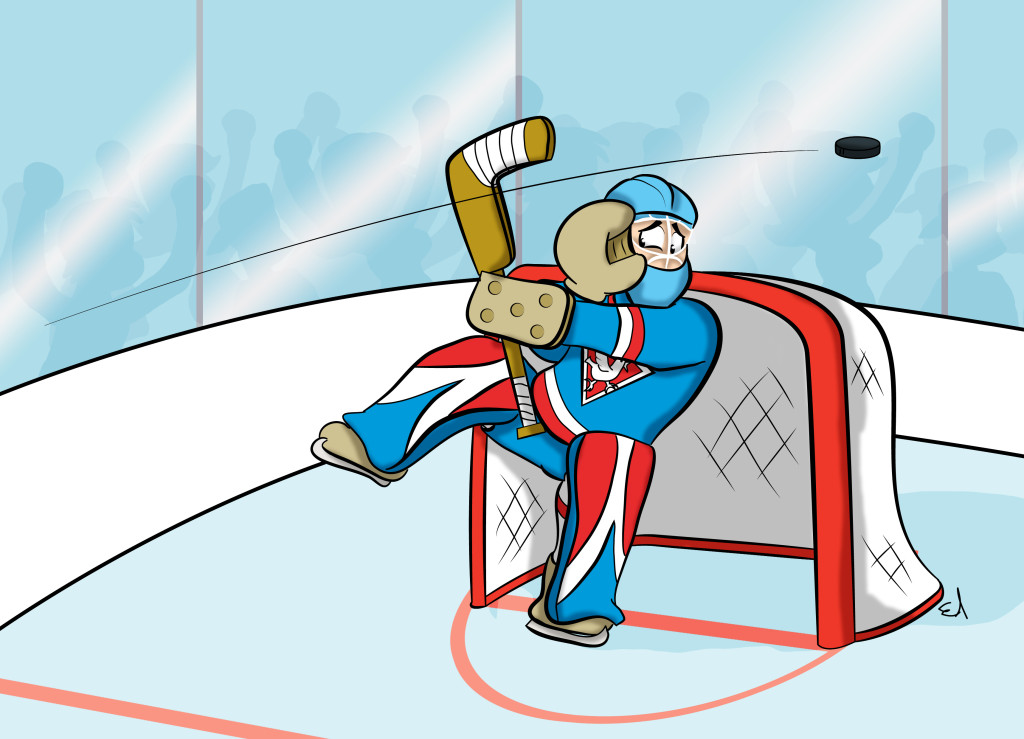
I first met Charlie Winston on a rainy day at a coffee shop in Tsawwassen, British Columbia. I approached the man and bought him a cup of decaf. We sat in the back corner—we had to, for fear he’d be recognized—and he told me about the most traumatic moment of his life.

It all began in third grade when Winston was just a fragile little prepubescent boy with an afro: “There are two things kids do when they are growing up in Canada,” he told me in a hushed voice as if he were gossiping about the homeless man at the adjacent table. “One, we don’t talk about Fight Club, unless we mention how great Edward Norton is in it. And two, we play hockey.”

Such a statement left me caressing my soul patch, a personal project that I don’t care to mention in anymore depth. As I began encouraging him to delve further into his deep dark memories, he shuddered, almost breaking down into tears, recovering enough only to excuse himself to go to the bathroom.

Winston left me at the table for 45 minutes before he returned. What he was doing is still unknown.

“Every recess, while all the girls made up rumours about me,” said Winston, “I would be alone, making rumours about them.”

“Strange,” I thought, before vocalizing that same sentiment—“Strange.”

“Yes, very strange,” he agreed before continuing. “One day, the boys saw me sitting there on a tuffet, eating my curds and whey. They shyly walked over and asked if I wanted to play hockey with them or talk about Edward Norton. I told them that I thought Norton deserved an Academy Award for his performance and they agreed.”

According to Winston, the boys were satisfied by his opinions about the acclaimed actor and left him alone; he continued eating his food and gossiping to himself. Suddenly another boy appeared out of nowhere and asked if he would like to join them in a game of hockey. Never thought of as athletic, Winston declined.

“Pleeease!” said the boy. “You’d make such a good goalie.”

Never athletic, but always easily wooed, Winston agreed.

“Before I knew it I was standing there in front of the net feeling like Little Miss Muffet,” said Winston. “I was so vulnerable, more so when they started shooting rubber discs at me. I freaked! See, I didn’t really understand the rules of hockey at that time, so I thought they were trying to kill me with a thick novelty flying disc. I had to defend myself, you see! I could not die this way! They had to die!”

One save, two goals against, three fatalities, and 17 injuries were the result of Winston’s first game in net.

“I can still remember the screams,” he told me as his voice dropped to a secretive level. “I’m not sure if it was me screaming or the children—but I heard it: ‘Don’t let it hit my beautiful face!’ It still haunts me to this day.”

At the end of our interview, I stood up and shook the man’s hand. And then it dawned on me: I was shaking Charlie Winston’s hand.

Charlie Winston, the simple man, the murderer, and the new starting goalie for the Vancouver Canucks.

The Report Card: Sport spectators

Opinions_Watching-Sports

By Elliot Chan, Opinions Editor
Formerly published in The Other Press. Feb. 17, 2014

When it comes to our favourite teams and athletes, no matter how poorly they do, we must stick by them, because that’s what a good fan does. But sporting events are polarizing experiences: whatever happens, 50 per cent of the spectators will inevitably be disappointed. So, what is the most enjoyable way to view a game, an event, and a championship tournament and still get your money’s worth?

Pass: The comfort of a home/bar

For the price of admission, you can throw yourself and your fellow sports fanatics one hell of a house party. Not that you need an excuse, but game nights are the perfect reason to get a good group of friends together. Win or lose, at least you got to spend some quality time with people who share a common interest with you.

I believe that each sport is an art form, but unlike a concert, a theatre performance, or a slam poetry reading, you don’t have to be there in person to enjoy it. That is why there are channels dedicated to sport highlights, yet none dedicated to live Shakespearean productions. The same way music can be a backdrop to a party, so too can a sporting event. It might even give you a reason to cheer at the end.

If finances are a problem (they’re always a problem), then home viewing may just be the obvious choice, but it doesn’t make for any less of a spectacle. Bars are also accommodating alternatives. Some even offer incentives on game night: for each goal scored, you’ll get a free drink or an opportunity to win a prize at the end of the night. If the odds are with you, your team might not be the only winners.

Fail: Live from the nosebleed section

Who wouldn’t want to be there live during a game seven or an Olympic gold medal game? The pandemonium of victory is an exhilarating feeling that cannot be recreated in any other form. There’s nothing like 30,000 people cheering for the same reason. But is the frenzy worth it? Personally, I don’t think so.

Live games have become a supply-and-demand market, and the price for key games are often raised to an unreasonable price. Just for an example, the price for the Heritage Classic, a regular season game between the Canucks and the Senators played in an outdoor rink at BC Place, start at $104.20 and goes as high as $324.70. It’s an once-in-a-lifetime experience, it’s a moment you’ll remember forever, but mostly it’s a publicity stunt—an obvious gimmick—and it’s a successful one.

Fans take pride in being diehards, and in order to be considered a diehard, one must buy season tickets and attend every game religiously, decked out in authentic apparel. A diehard must be succumbed by the capitalistic culture of the sport, right?

No! Sport is not scientology; if you have more money, that doesn’t make you holier or your team better. Sure, the only way to keep the team afloat is to attend the games, thus paying the athletes and their luxurious lifestyle, but that’s not something the fans should worry about—the fans aren’t the marketing team. The fans’ only job is to cheer wholeheartedly, and they can do that with the money in their pocket, at home, with a moderately priced beer in their hands.