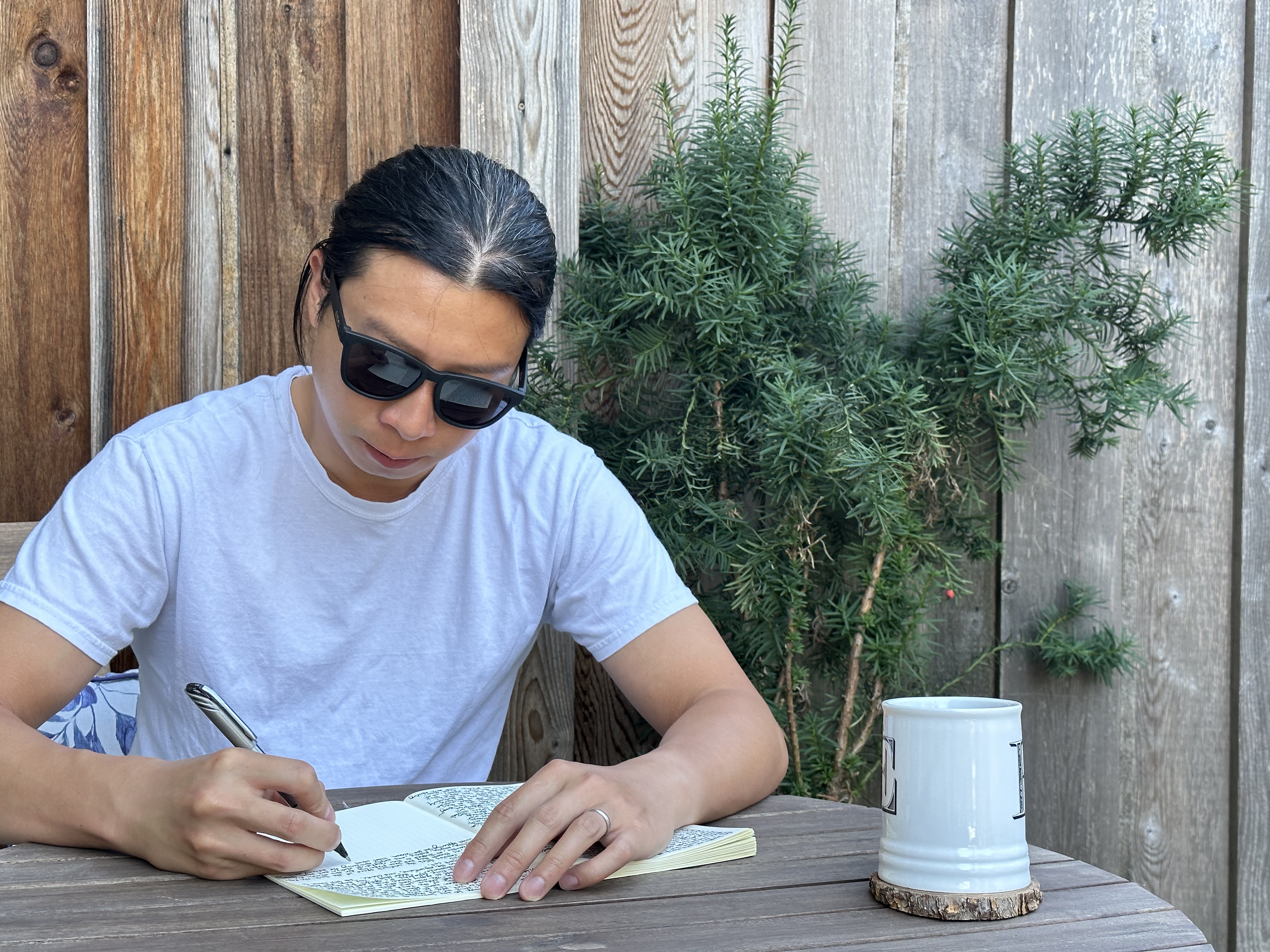
I Outlined My Novel and Immediately Diverged from It. What’s the Point of Outlining?

I’m currently working on a trilogy, and I’m well into the first draft of book 3. 

I don’t usually outline my stories. And when I wrote the first drafts of book 1 and 2, as you may recall from these articles, I pants them… hard. 

I see myself as a discovery writer. I have outlined in the past, but I don’t particularly like relying on it to write, because I find that it often creates restrictions in my workflow and I can’t be as fluid. I have to keep checking in on the outline to make sure I didn’t skip any key detail. 

So why did I decide to outline this time? 

Honestly, I don’t have much time these days to work on my creative projects. And with only a short amount of time available each day—like 3 to 4 sessions a week—I didn’t want to wait for inspiration to strike. With an outline, I can see where I left off and get straight to work on creating scenes, figuring out what happens next, or writing dialogues.

At least, that was my plan. But outlines are hard to follow and all it takes is for me to make one change and like pulling out a Jenga piece from the bottom, the whole tower is shaky and if I make too many changes, the whole thing collapses, rendering the outline useless. 

Right now, I’ve completed nearly half of the first draft, and what I’m noticing is that, yes, I’m making changes. The specifics about the characters and events are definitely shifting from the outline. However, I also have a clear idea of where the story should ultimately lead. So, even if I veer away from what I initially planned, it’s not a problem. I can take detours, explore new ideas, be creative, enjoy the process, and eventually return to the important story beats I need to include.

For instance, I need my character to return to his hometown to kick off the second part of the story and then participate in a big battle during the third part. I have a good sense of the crucial scenes that need to happen between those points, but the way I choose to write those scenes is where I have room to experiment without feeling restricted by the outline.

That’s precisely what the outline provides me with. If I were journeying across the globe, the outline would represent all the flights I must catch in between destinations. What I do once I touch down is subject to change, but eventually, I’ll need to return to the airport and catch my next flight. The outline serves as my travel itinerary, not the schedule for every day of the trip.

I’m not particularly fond of using outlines, but I do need to bring this project to a conclusion at some point. By having the outline, I’m aware of the destinations I must reach to ultimately wrap this up. Now, if you’ve been keeping up with my progress, you’d be aware that I’m taking my time with this endeavor. But even though I’m not in a rush, it doesn’t mean I lack the desire to finish. During a journey, there comes a moment when you feel an urge to leave the beach and embark on a different activity. That’s where the outline comes into play. It tells me that I’ve lingered here too long and it’s time to get going to the next scene. 

This is how I keep myself from getting too frustrated when I deviate from my outline. I don’t discard it entirely; I still find value in using it. Its central elements are what I require. I’m free to modify scenes as much as I want, but I must hit those key plot points. The crucial thing is staying on track to hit those points. I’m in control. I can always guide my story back on course even if I stray off it.

That’s where I stand currently. I’m exploring as I work on the first draft of book three. I’m mostly enjoying this drafting process for the final time in this trilogy, because after this step, there’s going to be a lot of editing ahead. As much as I’m anticipating that phase, the first draft has always been the part I’ve enjoyed the most. This is another reason why the outline holds significance. It will push me beyond my comfort zone to see it through.

Join my YouTube community for insights on writing, the creative process, and the endurance needed to tackle big projects. Subscribe Now!

For more writing ideas and original stories, please sign up for my mailing list. You won’t receive emails from me often, but when you do, they’ll only include my proudest works.

How Chuck Palahnuik Adds Texture to His Writing

Chuck Palahniuk, the author of Fight Club, Choke [Amazon], and Invisible Monster [Amazon], is widely regarded as one of the most influential writers of our generation. His remarkable talent lies in seamlessly blending raw storytelling with captivating language. In his memoir, Consider This: Moments in My Life After Which Everything Was Different [Amazon], he not only shares pivotal moments from his career as an author but also imparts invaluable writing advice from the perspective of a seasoned instructor.

I highly recommend this book to all writers, as it offers a level of actionable advice that I haven’t encountered since Stephen King’s On Writing [Amazon]. Palahniuk’s insights provide a true master-class experience. One notable technique he discusses is the concept of adding texture to your writing.

Texture, much like the indescribable appeal of a catchy song, often goes unnoticed while reading. However, when executed skillfully, incorporating texture into your writing infuses it with the same cadence, melody, harmony, pitch, and tempo that music possesses. This captivating quality firmly grabs hold of your readers and keeps them thoroughly engaged.

But what exactly is texture when it comes to writing? Palahniuk breaks it down into seven distinct forms: 

  1. Point of view (first, second, and third)
  2. Big voices vs little voices
  3. Attribution
  4. What to say when there’s nothing to say
  5. Passage of time and lists
  6. Repetitions
  7. Paraphrasing vs quoting

In this video, I will dissect each of these techniques and provide a concise summary of how to use them effectively, so you to incorporate texture into your writing.

Let’s go! 

1. Point of view

When it comes to writing, there are three types of points of view: first person, second person, and third person.

“I am a writer” is first person

“You are a writer” is second person

“Bill is a writer” is third person 

Palanuick encourages you to shift between these three POVs—not constantly—but rather as the situation demands. So, when is it appropriate to do so? When you want to evoke control, authority, intimacy, or change the pace of your story. 

2. Big voices vs little voices

Big voices are comments and introspections: they manifest as monologues, soliloquies, or the inner thoughts of a character.

In contrast, little voices are the immediate, moment-to-moment actions within a story.

For instance, a character’s contemplation of murder can be conveyed through the Big Voice, while the simple act of the character entering a store and purchasing a knife can be expressed through the Little Voice. Striking a balance between these two approaches will enable you to craft textured narratives.

Palahniuk cautions against excessive use of big voices, as an abundance of philosophical musings may undermine the overall texture of the writing.

3. Attribution

Texture often presents itself in the actions and behaviors of characters, particularly in the moments between their speech. Take a moment to observe the daily gestures of yourself and those around you. How do you instinctively move your hands after uttering something distressing? How does your friend shift his legs following an expression of frustration? Compile a collection of these wordless, swift movements and assign them to your characters. This approach will color them with greater dynamism and lend a textured quality to your writing.

4. What to say when there is nothing to say 

While a story naturally progresses from beginning to end, there are moments where no forward movement occurs. Like breaks in the narrative, these are instances when characters confront impasses, such as deadlock arguments.

Life is replete with such moments, where regardless of the character’s efforts, the situation remains beyond their control. It could be a character being emotionally affected by something strange they witness on TV, noticing food on a fellow diner’s face, or the struggle of holding in the need to use the bathroom. In these moments, there may be no words exchanged, but their actions speak volumes about them as individuals. 

Palahniuk advises us to compile a list of these paused moments, or what he refers to as placeholders. He then encourages us to strategically insert these moments into our stories, like jump cuts in a film.

5. Passage of time 

The most straightforward method to convey the passage of time is through the use of space breaks. However, Palahniuk cautions against relying too heavily on this approach. An alternative way to indicate the passage of time is by stating the specific time and then providing a concise account of the events that have transpired.

But, it is important to avoid creating a mundane list. If the character has just reached their destination, refrain from listing every single thing they passed on the journey: the school, the police station, the store, and so on.

Instead, envision the list as a montage. Picture the character following the same route each day: turning left at the school, attentively observing the school children, slowing down as he passes the police station, muttering a prayer for all the solitary shoppers, before finally arriving at the bar. Condense the time by employing montages and lists.

Photo by Christin Hume on Unsplash

6. Repetition

Similar to a mantra or the recurring chorus of a song, repetition serves as a powerful tool for creating texture. Palahniuk advises viewing repetitions as rituals. Observe how organizations, cults, and religions employ repetitive elements. What phrases or ideas are reiterated in a sermon? What concepts are repeated during an office meeting? In your own storytelling, craft something that can be echoed throughout the narrative.

One notable example from Palahniuk’s own work is the First Rule of Fight Club: “We Don’t Talk About Fight Club.” Adopt this approach and allow the repetition to take root in the minds of your readers. Let them anticipate its recurrence and allow it to be ingrained in their memories.

7. Paraphrasing vs quoting

When a character speaks, there are two distinct approaches we can employ to convey their lines. Both methods serve the purpose of delivering the necessary information, yet they offer contrasting experiences.

If you wish to highlight your character’s uniqueness and imbue them with greater personality, enclose their dialogue within quotation marks. On the other hand, if you intend to downplay your character’s significance or diminish their authority, you can rephrase or summarize their words. This technique may be subtle, but it proves highly effective in creating textured writing.

And there you have it—these are the seven techniques you can use to infuse texture into your writing. I’m curious to know: which method do you use the most? Additionally, which technique piques your interest? Feel free to share your thoughts in the comments.

For more writing ideas and original stories, please sign up for my mailing list. You won’t receive emails from me often, but when you do, they’ll only include my proudest works.

Join my YouTube community for insights on writing, the creative process, and the endurance needed to tackle big projects. Subscribe Now!

Will I Ever Finish My Novel? – Writing a Trilogy: 3 Years Later

I got distracted. But it’s not a bad thing. 

For the past four months, I’ve been editing a collection of short stories I wrote last summer. You might remember this video entitled: Why I Write Short Stories As A Break From My Novel 

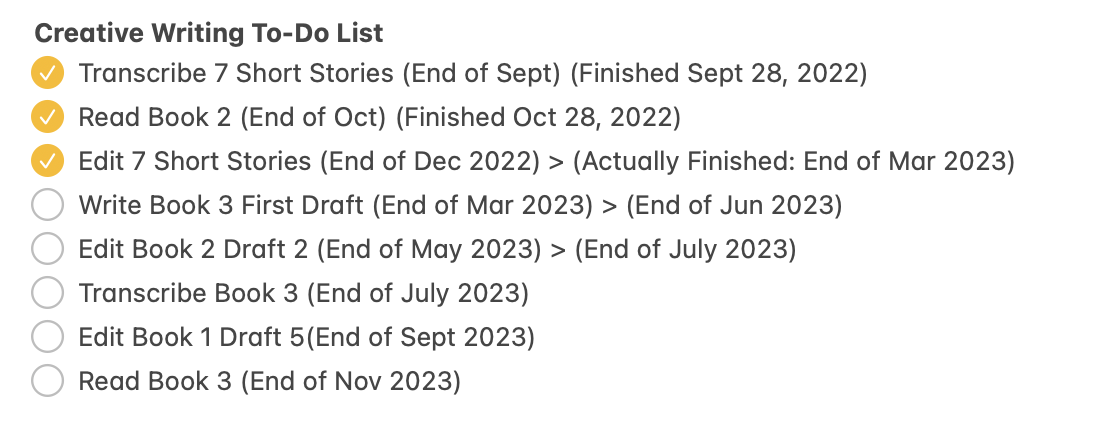
I had this checklist made around August to help me prioritize everything I wanted to do: 

As you can see, things got delayed, but it’s not so bad. I just had to push a few tasks back 3 months. But the hope is by the end of this summer, I’ll be back on track.

The cause of all this is that editing each individual 5,000-6,000-word story took longer than I expected. 

While time-consuming, writing seven short stories wasn’t a bad idea. But in terms of completing my trilogy, I didn’t make any progress since last fall. 

However, I am working on a series, and there is a lot of world-building involved. These short stories are fun exercises at expanding the world through other storylines in different regions and at different times in history. This creative expedition allowed me to explore the world I’m building more deeply and introduce some lore. 

It’s also nice to have written seven completed short stories. Having shorter works at my disposal allows me to stay active and attempt to get them published in a literary magazine or anthology. I don’t know, but there is something to be said about getting your work to a level where you feel comfortable sharing it. 

Additionally, I’m also going to start looking for an editor for my series. The strategy is to use these short stories to audit editors and test different marketplaces. Whether I end up selling it or publishing it on my own, it’s good to have polished stories ready. 

There is so much I can do with these shorter pieces that I don’t really feel like I’ve wasted my time even if nothing comes of them. Or perhaps this is the justification of a delusional man, and I’ve only added more layers to this already too-big project. In one way, I’ve doomed myself to failure. But in another way, I’m still working on it—all of it—so as long as I don’t stop… it’s not a failure. 

Yes, it’s quite a predicament I’ve found myself in. I don’t recommend doing it this way, but if it works it works. I’m slowly chipping away at a giant project that just keeps growing. But I’m also comfortable at this speed. A lot is happening in my life, and I want to make sure I have time and energy for those things. Reading, exercising, and making these videos don’t come easily. I would love help, but getting help can sometimes be more work if I’m not ready to handle it. This year, I feel I’m going to reach that new level where I’m ready. I’ve created a solid foundation. I’m plateauing, so I need to push myself to the next level. 

That’s very exciting. 

Last year, I felt a lot of pressure to get this project launched. But this year, I plan to enjoy the process more. And by enjoying it, I hope to take more risks. Last year, I was so stressed. I was frustrated and angry. I still am in many ways, but this year, I want to get out of that state and not lean on my creative projects so much for my happiness. It sounds strange, but if it doesn’t have to be enjoyable, I can just enjoy it. 

There’s a lot to do, and I’m on a long journey… so we’ll see what happens. This project has been with me through three crazy years, so I don’t feel a reason to stop. In many ways, I’m getting more fond of it. I haven’t lost any motivation to work on this project, I’m just mentally tired from the past few years, and I need to pace myself to avoid burning out. Little by little, I hope to get it done. We’ll see. That’s the theme of the rest of 2023: We’ll see. No pressure.

For more writing ideas and original stories, please sign up for my mailing list. You won’t receive emails from me often, but when you do, they’ll only include my proudest works.
Join my YouTube community for insights on writing, the creative process, and the endurance needed to tackle big projects. Subscribe Now!

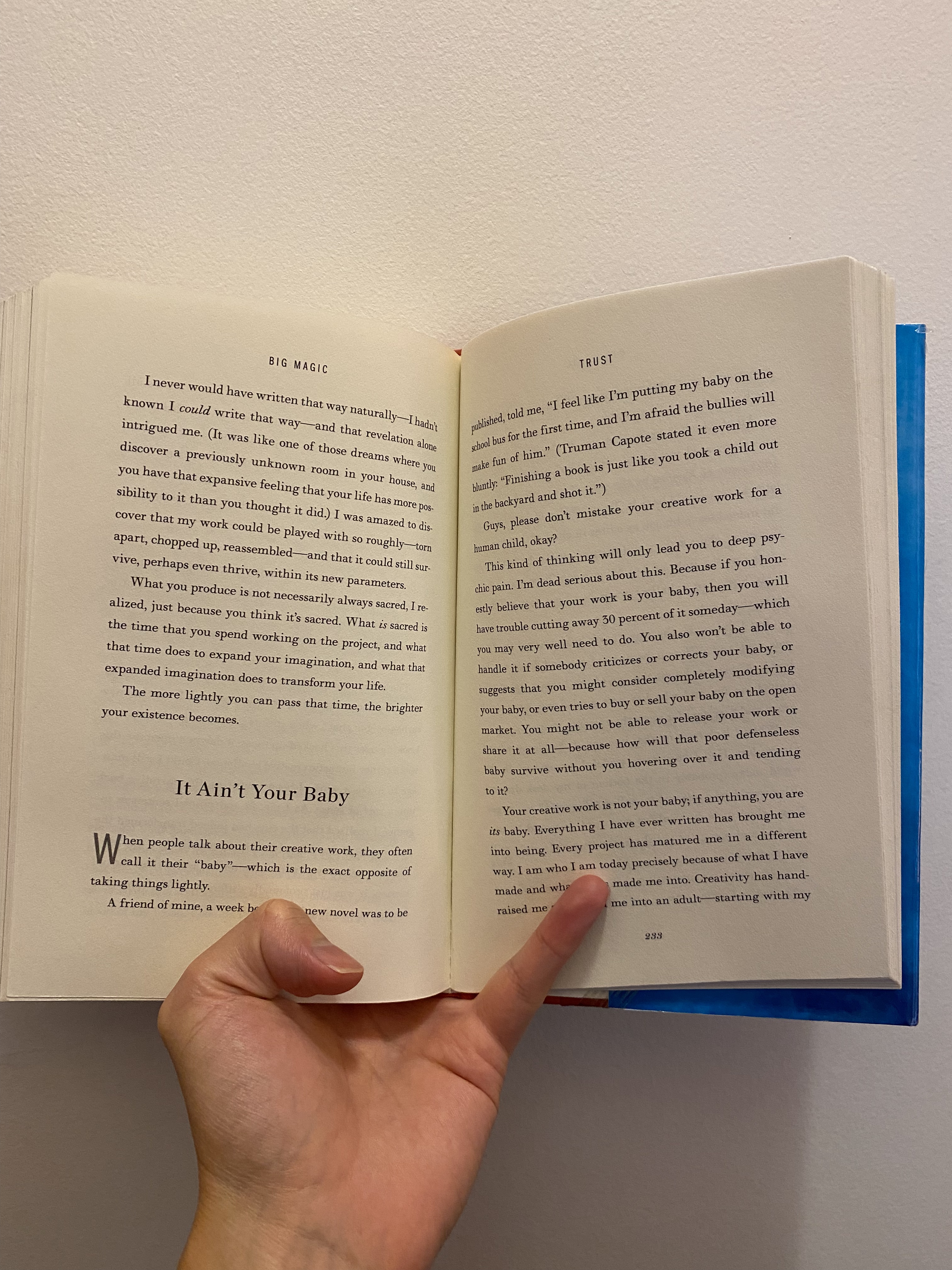
Why Your Creative Writing is Not Your Baby

Nine months. That’s how long it takes to give birth to a baby. Writing a book can take much longer. The commitment to have a child has obvious correlations with creativity; they both bring something new into the world. Additionally, children and art are two ways we find fulfillment in life. However, human life and a creative project should not share the same level of seriousness. 

In Elizabeth Gilbert’s Big Magic (Amazon), she references a Truman Capote quote: “Finishing a book is just like you took a child out in the backyard and shot it.”

She then cautions us not to mistake our creative work for a baby. Associating creativity, career, or a personal purist with a living being will cloud our judgments. 

As they say, you become too close to it. When you’re too close to your creative work, you don’t know what to change—or worse—you wouldn’t want to change anything. You probably heard the phrase: kill your darlings. This famous quote reminds us that in order to improve our work, we’ll need to cut out the parts we love the most. 

If your work is as precious to you as your newborn, you won’t see all the imperfections. You nurture it and nurture it, but it doesn’t get better, and you wouldn’t create anything new because you spend all your time focused on polishing your one gem. You’d be reluctant to build, mold, and transform your work because it’s comforting the way it is, and there’s an expectation to love it unconditionally.  

Have you ever seen a mother look at her ugly baby? She doesn’t think it’s ugly. She loves the child and genuinely believes that the hideous thing will grow to be a movie star or a supermodel. If you were to go up to the mother and criticize her infant, she would most likely bite your face off. 

If you compare your creative work to your baby, you may not be able to see all her flaws. If you can’t see the problems, you can’t help. When called upon, you won’t be able to cut 30 percent of your work. When someone criticizes or corrects your child, you’d reject their words or go into a guilty, shameful spiral. Imagine someone telling you that your kid needs a facelift before they are willing to buy her. 

Parents want to protect their babies; it’s instinctual. And while your creative work needs some nurturing, you may also coddle it for too long. Your reluctance to send it out will hinder your growth as a writer, and your work will never improve. But the reality remains. If you treat your work like a human, you can end up sheltering it in your drawers or on your hard drive for 18 years or more. By that time, you would have missed out on a lot of opportunities.  

We give our blood, sweat, and tears to our creative work. We put everything we had into it. We sacrificed and endured to create a piece of art the same way we would for a son or daughter. Describing our work as our baby gives it a deeper meaning. In a way, it sounds endearing. You cast a soft light on your creation. You’ve put a lot of care into it, and that’s how you want to market it. This baby is handmade with love, not manufactured.  

But on the backend, it causes too much emotional connection to the piece. Like a helicopter parent, this can end up doing more harm to the child than good. 

Elizabeth Gilbert tells us to consider ourselves the baby to the creative work instead. We are not the ones who need to give birth and raise our creativity; it’s the creativity that gives life to us. It’s the creative act that teaches us, helps us grow, and shows us how to live. Each project we work on and complete becomes a snapshot of that moment. We become what we’ve made. We are not giving birth to our creative work; our creative work is giving birth to us—over and over again. As we look back, we see a trail from where we’ve come. 

This way of thinking eliminates the pressure of a parent and offers us a chance to explore our childhood desires and express ourselves. We can be curious again. We should treat every project as a lesson, a continuum. It took that piece to get me here and it’ll take this piece to get me there. 

Your creative work is not your baby. Your creative work doesn’t need to grow up to be a doctor, lawyer, or engineer. It doesn’t need to take care of you when you’re old. If you kill it, you won’t go to jail. Nobody will even notice. So lose that pressure. Finish your book, take it to the backyard, and enjoy the outdoors together. Nobody needs to shoot anything. 

Join my YouTube community for insights on writing, the creative process, and the endurance needed to tackle big projects. Subscribe Now!

For more writing ideas and original stories, please sign up for my mailing list. You won’t receive emails from me often, but when you do, they’ll only include my proudest works.
The Sunk Cost of Writing

The term sunk cost refers to the resources we’ve invested into a project that cannot be recovered. And the sunk cost fallacy is our reluctance to abandon a project because we’ve already put in so much. This mistake can cause us to spend more money, time, and effort on a piece that we have no pleasure working on and with costs continuing to add up. 

A common sunk cost fallacy I face is when I start a book and feel the need to read it cover to cover. The thing is, if I’m reading something that I don’t enjoy or get value from, I’m not reading something that can actually benefit me. Persisting through isn’t the best use of my time and energy.

Sunk cost is more painful when it comes to writing. Writing takes much more effort than reading, and therefore, we invest so much more of ourselves into it. I have written so many stories that I kept tearing them apart over and over again trying to make them work. I tell myself one more time, revise it once more and see what happens. At some point, I question why I’m still working on that story. I have a million ideas in my head that I want to get to. When is it time to move on to something new?

Internally, there is a constant battle between reducing sunk cost and persistence. Whenever I return to a project I’ve invested a lot into already, I ask myself why I’m working on it. Am I working on it because I’ve already put in so much work, or am I working on it because I still believe in it? It’s not only a matter of mindset; it’s a matter of prioritization. Is it important for me to keep watering a plant that won’t grow, or is it worth sowing new seeds? 

Managing sunk cost is desperately personal because time is so valuable to us. We cannot get more, no matter how hard we try. Investing in the wrong areas can end up killing us slowly. It’s easy to look at our writing and think, “Oh my god, I’ve wasted my life.” But remember, time was going to pass either way. And it wasn’t all wasted. Now you have a few drafts, a snapshot of your life. Go and do something else if that is what you want, but dwell on the sunk cost. You’ve brought it here, it exists, and you can always come back to it when the time is right. 

Photo by Thought Catalog on Unsplash

Whenever I’m debating whether to abandon a project—especially a significant one that would only cost me more and more time—I remember all the expensive Hollywood projects that don’t see the light of day. Production companies would often develop a pilot episode to test whether it has any viability in the market before they make more. That is because the networks want to make something that audiences would watch and, more importantly, be profitable if they were to make more episodes. 

One recent example is The Game of Thrones spin-off called Bloodmoon. This prequel was supposed to take place 8,000 years before the events involving Jon Snow and Tyrion Lannister—and cost $30 million to produce. Yes, $30 million. 

How could HBO abandon such an expensive project? The Chief Content Officer said that the show would require more innovation. Bloodmoon didn’t simply require scripts, actors, and cameras, it required the whole network to figure out how to make it—and then make more. Additionally, this new show had a different feel from the original, which required more setup and may not appeal to some returning viewers. The risk was huge. Who knows how it would have all played out, but HBO decided to focus their attention on House of the Dragon. Which, in many ways, was a safer bet. 

That’s how I see my projects now. I work on something, get it to a point where it’s good enough to show someone, and then send it out on a test—like a television pilot. When it comes back to me, with whatever feedback attached, I decide whether I want to take the gamble of revising it or focusing on another project. While it may be frustrating to be losing constantly like someone on a cold streak at a roulette table, I find joy in always having chips to make another bet. 

Regardless of what project I’m working on, I’m grateful to be able to play the game. Maybe I won’t bet on the same horse every time, but it’s reassuring that I still have the time and money to do so. I can manage my sunk cost while persisting. I’m doing both. I’m HBO trying to make six different Game of Thrones spinoffs at the same time to determine which one to invest in long-term. It’s nice to know that one day I can make $30 million decisions around my work, but today, I just need to decide whether I want to put my novel on the shelf or return to it for another edit. 

I’ll leave you with this. Whether you want to keep going or abandon your work, there is a quote, often attributed to Leonardo Da Vinci that really helps me, and it goes: Art is never finished, only abandoned. 

I like it because, eventually, you’ll need to stop working on everything. So don’t feel so guilty when you abandon something. It’s bound to happen in one form or another. 

Join my YouTube community for insights on writing, the creative process, and the endurance needed to tackle big projects. Subscribe Now!

For more writing ideas and original stories, please sign up for my mailing list. You won’t receive emails from me often, but when you do, they’ll only include my proudest works.

Write a Story Using These Five Narrative Modes

Is a scene not working? Are you failing to create intrigue, establish tone, or captivate an audience? Consider what narrative mode you’re using to tell your story. 

If words are the building blocks then narrative modes are the design of your story. Whichever ones you pick will yield a different construction, and therefore, a different experience for your readers. 

There are five narrative modes: description, dialogue, action, thought, and exposition. Today we will look at these five forms and how you can experiment while editing to determine which works best. 

To put it in context, we’ll explore how different authors use varying narrative modes to start their stories—but this approach works anywhere: beginning, middle, or end. If something isn’t working, change the narrative mode and see what happens. 

Let’s get into it! 

Description  

Descriptions are great for establishing a setting or character

It’s most effective if it’s an intriguing image. If you waste too many words describing something obvious or mundane, you won’t hook your audience or keep them turning the pages. To write effective descriptions, activate the senses: what do you see, hear, smell, feel, or taste? What’s unusual? 

Alternatively, you can use descriptions to establish context, for example, a before or after image. Take the beginning of The Hitchhiker’s Guide to the Galaxy by Douglas Adams (Amazon). He starts the story with a description of an average house before the chaos and destruction: 

The house stood on a slight rise just on the edge of the village. It stood on its own and looked out over a broad spread of West Country farmland. Not a remarkable house by any means — it was about thirty years old, squattish, squarish, made of brick, and had four windows set in the front of a size and proportion which more or less exactly failed to please the eye.
– The Hitchhiker’s Guide to the Galaxy by Douglas Adams

Dialogue

Starting a story with dialogue can grab the reader’s attention. It jumps right into the middle of a scene, introducing a character and building a connection. Hearing a character speak makes them more personable and is often more engaging than having the writer paraphrase what’s been said. When it’s well-written, dialogue can give a sense of who the character is, where they are, and what they want. 

However, bad dialogue can confuse readers because they don’t know who’s talking or why they should care. Don’t begin with your characters making small talk or a boring conversation that the reader may have in their own life. If you’re opening your story or maintaining narrative momentum, make sure the dialogue is compelling. If you want to hit your reader with something unexpected, dialogue is a great way to do it. Check out how Douglas Coupland opens his novel Jpod (Amazon):

“Oh God. I feel like a refugee from a Douglas Coupland novel.”

“That asshole.”

“Who does he think he is?”

“Come on, guys, focus. We’ve got a major problem on our hands.”

– Jpod by Douglas Coupland 

Action

In medias res is Latin for “in the midst of action” and that’s what you should consider when writing an action scene. Start your scene in the middle of an event and create stakes, tension, and strong pacing that will hook your reader while still giving them relevant details like time and place. It doesn’t mean you begin at the climax or the most intense part. It means you place your readers at a link in the continual chain of cause and effect: Because this is happening, this is happening — and because that happened, this is now happening. 

In an energetic action sequence, use active voice and remove filter words, such as saw, felt, and thought. Writing a good action scene doesn’t need to include characters, although a goal or a conflict is necessary. Action is great, but always ask: Why should the readers care? 

Take a look at this opening to The Bourne Identity by Robert Ludlum (Amazon). 

The trawler plunged into the angry swells of the dark, furious sea like an awkward animal trying desperately to break out of an impenetrable swamp. The waves rose to goliathan heights, crashing into the hull with the power of raw tonnage; the white sprays caught in the night sky cascaded downward over the deck under the force of the night wind. Everywhere there were the sounds of inanimate pain, wood straining against wood, ropes twisting, stretched to the breaking point. The animal was dying. – The Bourne Identity by Robert Ludlum

Photo by Jonas Leupe on Unsplash

Thoughts

A story that opens with a thought, is a story that opens in the past, a reflection, a flashback. How is this effective? 

Thoughts allow the readers to understand a character. By seeing how they think or relive a significant memory, readers learn about their motivations and personalities. We view the conflict from their perspectives. Thoughts allow the author to convey the theme quickly. With thoughts, you can establish a pivotal scene, like a murder, a love loss, or an important lesson, and have that guide the character for the rest of the story. 

A great example of this is The Great Gatsby by F Scott Fitzgerald (Amazon). The narrator, Nick Carraway’s thought has nothing to do with the plot directly, but it shows his principles. The opening gives him the integrity he needs to tell the story and for us to trust him.  

In my younger and more vulnerable years my father gave me some advice that I’ve been turning over in my mind ever since. ‘Whenever you feel like criticizing anyone,’ he told me, ‘just remember that all the people in this world haven’t had the advantages that you’ve had.’ – The Great Gatsby by F Scott Fitzgerald

Exposition

We are told that expositions should be avoided because they’re info dumps. Unskilled authors use them to give the readers all the information they need to understand some convoluted plot. Think of the opening crawl of any Star Wars movie where the floating text sets the stage for the galactic confrontation. Phantom Menace literally begins by explaining the details of space tax and trade routes. 

While exposition has a bad reputation for pushing the readers out of an emotional or visceral experience, it’s a reliable mode for explaining a character, a historical event, or a critical mission. With that said, here are a few notes to consider when using expositions for your story: 

  1. Make sure the details are intriguing: don’t share information that the reader can assume. 
  2. Create a sense of place: ground your story and connect it with a specific scenario. 
  3. Pay attention to the tone and mood: Just because it’s an info dump, doesn’t mean it should take the reader out of the story. When writing ask: how do the characters feel about these details? Is it dark and scary, or is it hopeful like at the beginning of The Five People You Meet in Heaven by Mitch Albom (Amazon)? 

This is a story about a man named Eddie and it begins at the end, with Eddie dying in the sun. It might seem strange to start a story with an ending. But all endings are also beginnings. We just don’t know it at the time. – The Five People You Meet in Heaven by Mitch Albom

Whether you’re editing the beginning, middle, or end of your story consider the narrative mode. Remember, you are not tearing down your house, you’re redesigning it so that everything works better together. If you’re stuck and a section isn’t working, consider changing how you deliver the information. Switching the narrative modes can give strength to different aspects of the story; you change the pace, mood, and intensity. Practice each one, because you never know when a dialogue scene can work better as an exposition, or an action can become a thought.

For more writing ideas and original stories, please sign up for my mailing list. You won’t receive emails from me often, but when you do, they’ll only include my proudest works.

Join my YouTube community for insights on writing, the creative process, and the endurance needed to tackle big projects. Subscribe Now!

Write the First Draft of a Novel in 3 Steps

For some people writing the first draft is the easiest part, but for others, a first draft is never complete. First drafts are where so many of my projects die. Recently I’ve been able to push past that stage and get my projects closer to completion — or at least publication. 

I break my first draft writing process into three different steps so that I can finish the story, get it down on paper, and make sure I’m ready for the second draft. 

Step 1: Write Longhand

When working on a first draft, I find that turning on a computer, locating the file, opening it, scrolling down to the part I left off (which doesn’t take long, but every second counts), and then finally starting is a long time between going to write and writing. This friction daily is enough to throw me off. 

That is one reason why I prefer to write in a physical notebook. All I have to do is open it and continue where I left last. I don’t get distracted by the Internet, I get to take a break from screens, and above all, I can’t easily hit the delete key and erase everything I wrote. 

Writing a novel takes a long time, and when you’re working on the first draft, your goal is getting the story written. You can’t do that if you’re deleting ideas at this step. You need to keep moving forward and figure it out as you go. If you have an outline, keep following it until the end. 

Photo by Nick Morrison on Unsplash

Step 2: Transcribe to Computer 

Now that I have the first draft on paper, I can prep it for the second draft. Some may consider transcribing the story onto the computer as writing the second draft, but I don’t. I don’t plan to make any major changes because I don’t want to put that pressure on the process. My main goal is to experience the story for the first time as an active audience member, not as a critic. 

However, during the transcribing phase, I may fill in blanks or make small changes that I couldn’t focus on while I wrote. When I’m writing, I need to move fast. While I still move quickly in the transcription stage, I do have a bit more time to look around. Updates such as changing characters’ names, attributing dialogue to different characters, or removing repetitions are all small changes I can make without delaying the process. 

While transcribing, I don’t spend too much time editing. But when something critical comes to mind, that’s great! I’ll add it and let future me smooth it out later. Nevertheless, the primary objective of this phase is to get it onto the computer in an editable format. 

Step 3: Read, Highlight, and Comment

Once all the words are on the computer, I can start the second draft and go into making changes. But wait. Editing a novel is a massive project that can be very discouraging. This is a process that will take weeks, if not months. I want to prepare and go in with momentum and a clear idea of what to do each time I sit down to work.

In this step, I read through the whole novel and make comments along the way. Anything that occurs to me, I’d leave a note. This can be something along the line of “describe more” or “rewrite sentence” or “cut” or “can I move this earlier in the story?” 

I don’t need to make the changes at that very moment or touch the delete button at all. I just need to mark down how I felt while reading. I can come back to work on the draft later and get a second opinion. Do I still feel the need to cut or make the change? Or does it read better on the second visit?

Comments and highlights give you a focus when you sit down to work. Without that focus early in the editing phase, you may get stuck adding and removing commas for hours. 

Writing the first draft may sound easy. It’s just one task, write. While that may be true, I believe a process with multiple steps helps me move forward and reach the bigger milestone. Not only do I want to get it done, I also want to prepare it for the next phase. I want to set it up so well that if I die, another person can take all my notes and work on it the way I wanted them to. I see it as creating a plan for myself in the future. And with personal projects, the future me is another person. 

There you have it! That’s my first draft writing process: Finish it, make it editable, and prep it for the second draft. Remember, there are as many ways to write the first draft as there are writers. The key is to find a method that works for you. If you’re stuck, give this approach a try or check out these videos here. 

For more writing ideas and original stories, please sign up for my mailing list. You won’t receive emails from me often, but when you do, they’ll only include my proudest works.

Join my YouTube community for insights on writing, the creative process, and the endurance needed to tackle big projects. Subscribe Now!

What To Do When You Write Yourself Into A Corner

In an interview with Ali Abdaal, Brandon Sanderson, the author of Mistborn and The Way of Kings, shared productivity tips for writers. One that stood out to me was “outline backward, write forward.” By outlining backward, he knows how his story will end, and he can work to fill in the middle and the beginning to get there. This way, when drafting, he will always have forward momentum. 

I love this tip because it’s so effective, especially when working on a complicated storyline like a murder mystery or a thriller with a big reveal. This method allows you to lead your readers to that critical moment while misdirecting them with red herrings and weaving a story full of twists and turns. The better you know your direction, the better you can deliver a satisfying yet surprising ending. 

By outlining backward and writing forward, you have a destination on a map, which is what you want before you leave for a big trip — or start a big project. 

This links with another piece of advice I love, which is that “writing is like traveling at night, all you need is for your headlight to see a short distance ahead, and gradually you will get to your destination.” 

Photo by Christin Hume on Unsplash

As a pantser, I’ve written many stories traveling by a dim light. All I needed was to know where the next chapter was going, and eventually, I’d get to the end. When I write, I don’t always have a destination. I just set out and go. I like it. It’s exciting. When traveling, I like getting lost in a new city. Sometimes that’s the most thrilling experience. Other times you wander into a sketchy neighbourhood and need to get out quickly. The same goes when writing without an outline. It could lead to fun exploration or anxious backtracking. 

Most recently, I’ve been using outlines when I get stuck and write myself into a corner. When people ask me what’s the hardest part of writing, I like to say “Act 2”. The beginning flows easily, and the ending is exciting to write, but the middle is the bridge that holds the whole story together. The thing about my bridge is that it can split off into a bunch of exits, causing me to stray off course. That is if I didn’t have a map. 

When I get stuck, that’s when I’ll outline and figure out how to reach the end from the midway point. Often, I find that I’m not too far off. I’m usually four to five major scenes from getting to the climax or conclusion. What a relief. I’m not as lost as I thought. Thank God for the map for that peace of mind. Otherwise, I might’ve given up. 

Outlining backward and writing forward is not only a great method for starting a project, but it’s also a great tool for getting unstuck. It’s a lifeline that I rely on, regardless of the scope of my story. 

As a discovery writer, I can work on a story forever. I can keep sending the protagonist off on bigger adventures, adding more characters, and giving them more obstacles to overcome, but what’s the point if it doesn’t lead anywhere? 

If you’ve ever watched a tv series and found the first few episodes encapsulating, but then in the middle, it felt repetitive, and by the time you reached the end, your interest was gone? That’s usually the cause of a meandering second act. If you’re not careful with your second act, you can go from building tension and increasing the stakes to repeating scenarios that don’t add to your characters or plot. 

The second act is an excellent point to outline backward and ensure you’re on the right track to wrap up your story. I believe that a piece of solid advice can work in balance with another piece of solid advice. You increase your arsenal of writing tools and knowledge, so regardless of what you want to use, you are well-practiced in using them. 

If you’re a discovery writer like me and you sneer at the idea of starting with a complete outline, consider this: start writing, go as far as you can and discover all the twists and turns along the way, but once you reach the middle, once your character is deep in a crisis, jump to the end and outline backward. See where you want to finish, and wrap up your story. 

Much like being lost in the real world, sometimes it’s better to stop and think. We can keep writing and writing, hoping that more words can get us out of a jam, but even if we do, it’ll be a pain later during the editing stage. To avoid cutting out large passages, outline backward and write forward from the midway point. When it comes to stories, it doesn’t count unless they are finished. So get to the finish line and bring your story home. 

For more writing ideas and original stories, please sign up for my mailing list. You won’t receive emails from me often, but when you do, they’ll only include my proudest works.

Join my YouTube community for insights on writing, the creative process, and the endurance needed to tackle big projects. Subscribe Now!

Why Censorship Can Be Good for Creativity

Censorship destroys ideas. Take, for example, a creative writing workshop where a small group deems a topic offensive and out of bounds. When that happens, a line is drawn, and the room for exploration is limited. Ideas that could’ve been will never be. In this new world where we’re redefining how we should speak and what subjects are appropriate, we writers need to walk that fine line without stepping on others. 

This type of sensitivity within a trusting group doesn’t only harm writing workshops but also workplaces, friendships, and even families. When one side is considered correct and the other wrong, even in the realm of creativity and art, the fun of creation is gone. But is it? 

In an interview with J Thorn on the Writers, Ink podcast, author Chuck Palahniuk describes how this type of censorship caused the demise of a writing group he had been a part of that lasted almost thirty years. 

“It’s a tragedy,” said Palahniuk, “but nothing lasts forever.” 

Values, words, or perspectives that you considered appropriate today can be offensive in the future. All it takes is a culture shift. 

Palahniuk recalled that after 9/11, transgressive fiction fell out of favor. Transgressive fictions are stories that focus on characters that feel oppressed by conformity and the expectations of society. Stories like Trainspotting by Irvine Welsh, American Psycho by Bret Easton Ellis, and, of course, Fight Club by Chuck Palahniuk (Amazon) are all examples of transgressive fiction. 

In early 2000, the culture no longer wanted to be associated with a whole genre — not just a word, but an entire creative style. These novels suddenly looked terrorist-y, and anyone reading them would appear to be promoting real-world violence. Authors were worried about being labeled terrorists because of themes in their books, much like how someone today can come across as racist, sexist, homophobic, or body-shaming because they used a word or phrase. Transgressive fiction faded from the shelves, but as Palahniuk illuminated, in its place came horror fiction. 

Photo by Freddy Kearney on Unsplash

Transgressive fiction also fell out of style at the end of the ‘60s. While serial killers such as Charles Manson and the Zodiac killer were terrorizing society, the public tried to come to terms with those events. This climate led to a slew of paranormal horror, slasher, and thriller movies. When there is a void, creativity will fill that space. People will always be curious about the darkness within a person’s soul. And while some genres make it raw and blatant, horror focuses less on the subject and more on the emotions during those frightening times.

Those who wrote transgressive fiction to share their message could now communicate through horror. Horror fiction acts as a cloak for those darker themes without directly reflecting the realism of current events. 

We can approach all censorship the same way. 

“A certain amount of censorship is creative,” said Palaniuk. “Because it does allow writers to veil their message. So their message needs to be a little more indirect.” 

Should your work ever be targeted by censorship, know that it’s not a war you could win. Instead, learn to cloak your message so it’s palatable for a greater audience. Your idea gets shared, but it’s not a confronting act. 

Give it a shot. If you’re exploring a topic that is frowned upon — something you wouldn’t talk about at a party — something political, religious, or your readership would be sensitive to, try to hide the message below the surface. Make your point without screaming it at the top of your lungs. Refrain, cloak, and see if you can write great work that makes a point without doing more harm. 

There is a lot of evil out in the world today. Although censorship might not be the cure for all of it, censorship can be a bandage that helps people heal. You don’t need to be the one to pull it off. But you can tell your story without causing scars. Do that by masking your message within another genre and allowing your creativity to conceal the reality of our troubled times. That way, you can convey your ideas and explore the topic you’re interested in, and nobody gets hurt in the process. 

Good art comforts the disturbed and disturbs the comfortable. Good art does not do unnecessary damage. Learn to dance with censorship and see it not as the enemy of creativity but as a road less traveled. 

For more writing ideas and original stories, please sign up for my mailing list. You won’t receive emails from me often, but when you do, they’ll only include my proudest works.

Join my YouTube community for insights on writing, the creative process, and the endurance needed to tackle big projects. Subscribe Now!

5 Productivity Tips For New Creative Writers

New creative writers, if you’re struggling to find the balance between living life and writing, I’m with you. I’ve been chipping away for a while, and most recently, I got into a good writing flow, producing a lot of work and making solid progress. I wrote these five tips as a reminder for myself in those moments when I need to grind, but I hope you get value from them, as well.

1. Don’t Wait:

If you’re waiting for the perfect time to write? Don’t. A perfect time may never come. You’ll need to work with imperfect time. The time you can sneak in. That’s the best way to finish a big project, bit by bit, a little every day. Be consistent, and over the course of a year, those hours will add up, and you will look back and see the progress you’ve made. But you won’t make any progress if you wait.

2. Always Be Learning:

At many points in the journey, you’ll feel doubt, like an imposter, but I assure you, those feelings are normal. In those moments, don’t be discouraged. Stay humble. There is no secret formula for what you’re pursuing, and it’ll take experimentation: trial and error. Through the successes and the failures, you’ll learn. And from there, your craft will improve. Have compassion for yourself and always be learning.

3. Schedule It In:

When working on a personal project, you’ll need free time. The thing about free time is that it can fill up fast if you don’t prepare for it. When Saturday comes along, and you don’t have any commitment, it’s easy to get distracted by chores, errands, and outings with friends. While you can still do those things, you must set aside time to work on what you had wanted to do all week. Be disciplined with the time you’ve set aside for your side project. Schedule it in. If you find that your free hours are constantly slipping away, mark them down in your calendar and block them off.

Photo by Zan on Unsplash

4. Set Small Milestones:

Chipping away at a big writing project can mean going days and weeks without seeing any progress in your work. That can be discouraging. Too many days where you feel like you’re going in a circle can cause you to quit. But don’t. Instead, take a step back and view your project as a whole. Then break it up into smaller, manageable milestones that you can hit on a foreseeable deadline. Once your start reaching milestones, you gain confidence and see progress. By seeing progress, you will have evidence that you can achieve your goals

5. Be Unborable:

In any Rocky movie, the training montage is the shortest part of the film. When in fact, it should have been the longest part of the film. Imagine if Stallone decided to make that sequence in real time. You’d probably be bored. That’s the thing about training: it’s long and tedious. But it’s an essential part of the journey. Life is not a movie, and you can’t just have Eye of the Tiger playing in the background, and once the song is over, you’ll have reached the next level. You cannot expect your work to exist in a short montage burst. You must be present, enduring the struggle, battling the bureaucracy, and overcoming the boredom of work.

For more writing ideas and original stories, please sign up for my mailing list. You won’t receive emails from me often, but when you do, they’ll only include my proudest works.

Join my YouTube community for insights on writing, the creative process, and the endurance needed to tackle big projects. Subscribe Now!