The Creative Triathlon: How I Stay Motivated with Art, Video & Writing

I think a lot about how momentum works. Not just in training—although yeah, I do love a good triathlon—but in creativity too.

When I’m training for a triathlon, I’m not just running every day. I swim. I bike. And I run. Each discipline works different muscles, keeps things fresh, and somehow… they all support each other. Like, I come out of a bike ride with stronger legs for the run.

And that’s kinda how I’m approaching my creative life too.

I don’t just write. I don’t just draw. I don’t just make videos. I move between all of them—and doing that actually helps me stay motivated and inspired. If I’m stuck in one, I switch to another. If I’m tired of reading, I pull out my camera. If I can’t sit down to draw, I cut up footage and express my creativity in a whole new way.

So today, I’m sharing something I call the Creative Triathlon. It’s a predetermined length of focused time on three different creative practices: illustrating, video creation, and writing.
One discipline at a time. No pressure. No multitasking. Just a way to find time to do what you enjoy. 


First leg: illustration. For the past 4 years, I’ve been working on this massive personal project—drawing every single Pokémon. Yeah. All of them. It’s been slow-going, not because I don’t love it, but because finding the time is hard. Life piles up. Other projects take priority. And as strange as it sounds, drawing Pokemon doesn’t pay the bills. 

But when I do this creative triathlon, it forces me to carve out time for it. Even just 25 minutes. And honestly? It’s kind of like swimming. At first, it takes a while to get ready. But once I start? I don’t want to stop. It’s peaceful. It’s focused. And there’s something really satisfying about seeing one more little creature take shape.

This leg always reminds me why I started this project in the first place: because I love it. Because it brings me back to that kid part of myself that used to draw these things on notebooks. 

I’m almost at 1000 Pokemon. I really want to finish before they add more. If you are interested in see the rest, check out this video in the cards and the instagram in the link in the description. 


Second leg: video creation. Right now, I’ve been making a series of YouTube Shorts where I highlight key takeaways from books I’ve read. It’s honestly become one of my favorite creative outlets.

What I love about it is that it’s a true mashup of all my past-time activities—reading, thinking, writing, editing—it all comes together in these tiny videos. It makes everything I do feel active. Reading no longer feels like a passive intake of ideas. By turning it into a video, I get to spend more time with what I’m reading. I get to sit with the concepts, rephrase them, visualize them. And because of that, the lessons stick. They become part of me. A little snapshot of my life.

Video creation is great that way. It lets you experience your own thoughts in a completely new medium. You go from absorbing to articulating, from quiet reflection to something that moves and speaks. Seeing an idea come to life on screen—it just never gets old. 


Final leg: writing. I’m currently editing the fifth draft of the first book in a trilogy I’ve been working on for years. And yeah—it’s a slog. A meaningful one, but a slog nonetheless.

It’s such a big project that most days, I’m just chipping away at it. I don’t always see progress. There’s no big “aha” moment, no flashy breakthrough. It’s slow, repetitive work. And honestly, it feels a lot like running. Not a sprint—a marathon. You get tired. You want to stop. But you don’t, because the work is worth it. The fatigue is part of the point. It’s what builds endurance. It’s what makes the story matter.

Working on something this big, this long—it becomes part of your life. It’s something you carry. And the beautiful thing about creativity is that it’s not like sports… there’s no finish line in the same way. It doesn’t end. But that’s why I love this Creative Triathlon practice—because it does give me small finish lines.

Instead of focusing on finishing the book, I just focus on finishing a session. That’s it. One 25-minute block. And when it’s done, I get this little burst of relief, a sense of accomplishment. Like I’ve closed a loop. It’s such a good feeling—being able to look back at my day and say, “I did something today.” No guilt. No disappointment.

So that’s my Creative Triathlon. Three disciplines, 25 minutes each for me today. It could be more on other days, but today was only 25 minutes. Which is enough to get a good chunk of work done. Know this, though, it’s not about finishing a masterpiece in an hour and a half—it’s about movement. It’s about momentum.

Just like in a real triathlon, each leg has its own rhythm. Some feel strong. Some feel slow. But they all carry me forward.

If you’re someone who loves multiple creative things—or if you’re feeling stuck—try this. Treat your creativity like a triathlon. Mix it up. Work different muscles. Let each practice breathe new life into the others.

Thanks for hanging out with me today. If you decide to try your own Creative Triathlon, let me know how it goes! And if you already have a different combo that works for you—maybe it’s music, painting, and cooking—drop it in the comments. I’d love to hear what you’re working on.

Join my YouTube community for insights on writing, the creative process, and the endurance needed to tackle big projects. Subscribe Now!
For more writing ideas and original stories, please sign up for my mailing list. You won’t receive emails from me often, but when you do, they’ll only include my proudest works.

How I’m Writing a Novel with Only 30 Minutes a Day

Winter nights have a particular kind of silence that makes everything feel slower. This year, that quiet has become my writing time. I’ve had to face the fact that I only have 30 minutes a day to work on my novel. Between a busy job, taking care of Petey—my newly adopted dog—and the general rush of life, there’s no extra time to spare. But I’ve made it work, and consistency has been the secret.

Petey is a sweet soul who’s been through his own rough chapters. Between training sessions, walks, and making sure he’s not chewing on our blankets, my evenings belong to him. By the time he’s snoring at my feet, it’s close to bedtime. That’s when I sit down, put on Game of Thrones in the background, and dive into the fifth draft of my novel.

This draft is all about fixing inconsistencies and aligning the story with the rest of the trilogy I’m building. Every sentence I tweak and every plot hole I patch has to fit into the larger picture. With only 30 minutes a day, progress is slow but steady. Some nights I manage to rewrite an entire scene; other nights, I just have the energy to read a few paragraphs. But it’s not about how much I get done in one session—it’s about showing up every day.

Here’s how I’ve made the most of my limited time:

  1. Plan Ahead: I end each session by anticipating what comes next. That way, when I sit down the next night, I know exactly where to pick up. I give a purpose for each session, am I reading, am I leaving comments, or am I making the edits? When I know what comes next, I can take action. 
  2. Set A Timer: I don’t only say that I’m going to write for 30 mins, I actually set a timer to ensure that I do. And at the end of the timer, I can stop or I can push through a little more. Often, I will end up doing a little more than 30 mins, but rarely do I do less. 
  3. Find Motivation in the Routine: Writing at the same time every night has turned it into a habit. Even on days when I’m tired, my brain knows it’s time to write. It’s the last thing I do. A final burst of energy, the kind you would do in a HIIT workout. 
  4. Tracking Your Streak: I find that marking down the days that I write really helps me stay committed. By marking it down, I can see how many days in a row I have been writing and then that gives me a little boost of motivation. 

If you are hard-pressed to find time, often what you need is to feel committed. I know I’m always pushed to start and keep going when I have committed to a project, a program, or even a person. 

If you are looking for that little extra push, you should check out Reedsy’s events and memberships. It’s a fantastic source to get your questions answered by publishing professionals, including literary agents and editors at Big 5 publishers. With the membership, you’d receive 12 months of exclusive access to events with bestselling authors and top publishing professionals from the Reedsy Marketplace. 

If you are interested, check out the link here to learn more about the events and memberships. 

This winter, I’ve learned that consistency is more powerful than long stretches of time. Petey reminds me of this in his own way. For dogs, in order to train them, they need to do the same things every day. Consistency. He’s grown so much since I adopted him, but it’s happened gradually, with patience and daily effort. The same is true of this novel. Each night I sit down, I’m inching closer to the story I’ve been imagining for years.

If you’re struggling to find time to write, my advice is simple: make the most of what you have. Whether it’s 30 minutes a day or even less, commit to showing up. Plan your sessions, set small goals, and trust the process. One day, you’ll look back and realize how far those tiny steps have taken you.

Join my YouTube community for insights on writing, the creative process, and the endurance needed to tackle big projects. Subscribe Now!
For more writing ideas and original stories, please sign up for my mailing list. You won’t receive emails from me often, but when you do, they’ll only include my proudest works.

Bryan Cranston’s Advice That Every Writer and Job Seeker Needs to Hear

Bryan Cranston—you know, the guy who gave us Walter White—once shared some advice for actors going into an audition. But this advice felt bigger than just acting. He said: “know what your job is

At first, it sounds simple, almost too simple. But then he elaborates:

“I was going to auditions to try and get a job. That is not what you are supposed to do. An actor is supposed to create a compelling, interesting character that serves the text, you present it in the environment where you audition. And then you walk away. And that’s it. Everything else is outside your control, so don’t even think about it, don’t focus on that. You’re not going there to get a job. You’re going there to present what you do. You act. And there it is. And you walk away and there’s power in that.”

Cranston’s not saying “Don’t care about the outcome.” He’s saying, “Care about what you can control.” For him, it’s about crafting a character that serves the story. For us—whether we’re writers, marketers, or creators—it’s about honing our craft and delivering it with intention.

I remember a time when I was deep in job applications, obsessing over every detail, trying to predict what each company wanted. The constant second-guessing, the tweaking of synonyms and punctuations—it was exhausting. My job wasn’t to convince them I was perfect. My job was to show up and be myself—to present what I do best. 

The same rule applies when you’re already on the job. Showing up every day isn’t just about ticking off tasks or meeting deadlines. It’s about knowing what’s at the heart of your work. If you’re a writer, your job isn’t just to write—it’s to tell a story that connects. If you’re a marketer, it’s not just about ad campaigns—it’s about creating something that leads to action.

But here’s the thing—the pressure to get it “right” can mess with your head. You want the recognition, the results, the wins. That’s why Cranston’s advice feels so important. He’s saying: let go of what you can’t control. You can’t control how people respond to your performance, your draft, or your campaign. But you can control the effort and care you put into it.

So, how do you do this in real life? First, focus on the process. Instead of asking, “Will they like it?” 

Ask: “Am I proud of this? Does it serve the purpose?” 

Second, detach from the outcome. Present it and move on. 

And third, redefine success. It’s not just about landing the job or nailing the project—it’s about the growth that comes from the work itself.

Rejections sting. Constructive criticism can break me down. And negative comments are hard to ignore. But when you focus on what’s within your control, you start to find a different kind of power. You’re less tied to the highs and lows, and more grounded in the work you’re doing every day.

So, whether you’re pitching ideas, crafting stories, or designing campaigns, take Cranston’s advice: “Know what your job is.” Show up. Do the work. Let go of the rest. There’s freedom in that.

For more writing ideas and original stories, please sign up for my mailing list. You won’t receive emails from me often, but when you do, they’ll only include my proudest works.

Join my YouTube community for insights on writing, the creative process, and the endurance needed to tackle big projects. Subscribe Now!

My Key Takeaway from Discipline is Destiny by Ryan Holiday (For Writers and Creatives)

Having completed “Discipline is Destiny” by Ryan Holiday (Amazon), I want to highlight a couple chapters that truly stood out.

Just Show Up, Just Work

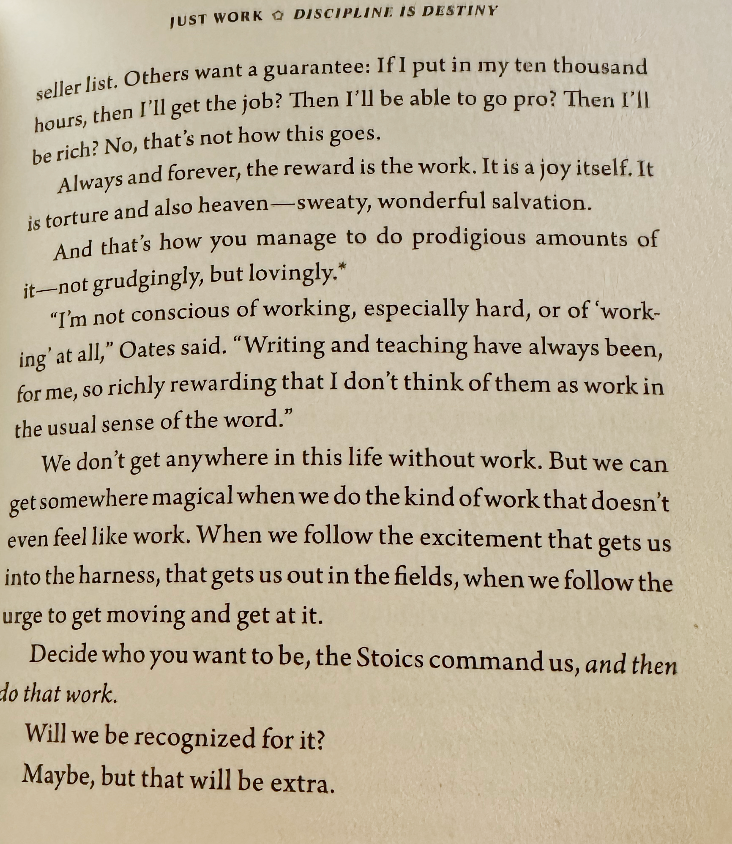
Show up.
… when you’re tired.
… when you don’t have to.
… even when you have an excuse.
… even if you’re busy.
… even if no one will notice.
… even if it’s beating you down.

Once you start, you can build on it. Once you act, momentum can grow. Showing up is the key—because when you show up, you can do.

Over a nearly 60-year career, Joyce Carol Oates wrote novels, stories, poetry, plays — millions of words. If she can show up every day, you can get on the treadmill. Pick up the violin. Answer emails. Write a scene. Lift some weights. Cross one thing off your list. 

It doesn’t matter what it is—all aspects of life improve when you work on them daily.

The Greeks have a word for this: philoponia—a love of hard work.

So, show up. Do the work. Not for perfection, but for progress. The grind pays off.

Join my YouTube community for insights on writing, the creative process, and the endurance needed to tackle big projects. Subscribe Now!
For more writing ideas and original stories, please sign up for my mailing list. You won’t receive emails from me often, but when you do, they’ll only include my proudest works.

My Key Takeaway from Ryan Holiday’s “Courage is Calling” (For Writers and Creatives) 

After finishing reading, “Courage is Calling” by Ryan Holiday (Amazon), I want to leave you with one chapter that really stood out to me.

Just Start Somewhere. Just Do Something.

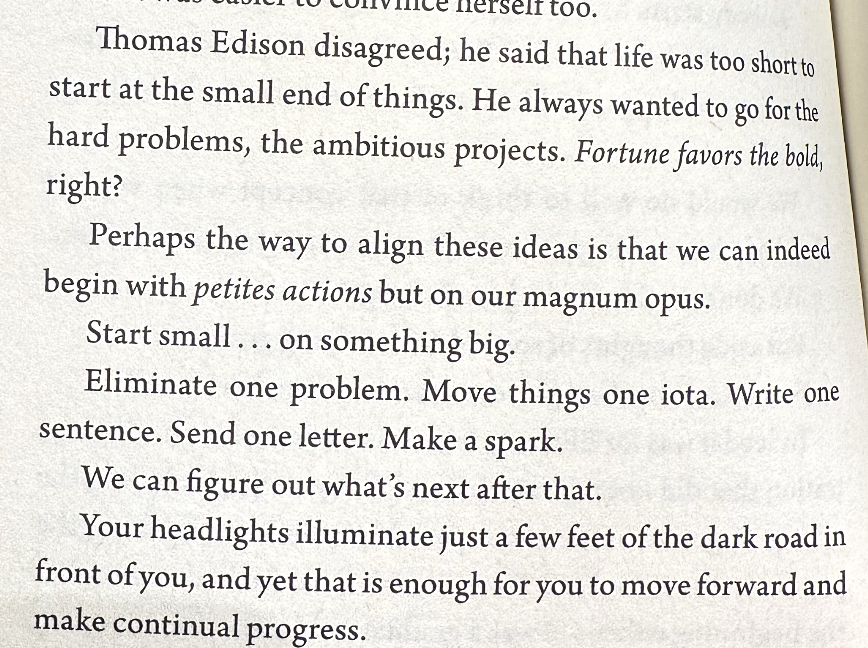
“Go for the hard problems, the ambitious projects. 

Start small… on something big. 

Begin with petites actions but on your magnum opus. 

Eliminate one problem. Move things one iota. Write one sentence. Send one letter. Make a mark.

We can figure out what’s next after that.” 

I find the analogy of headlights illuminating a dark road particularly inspiring. This gentle glow may only reveal a short distance ahead, but little by little, even in pitch darkness, you can reach your destination this way. 

It’s tempting to hold out for the perfect moment to write, the ideal concept, or the right conditions. Yet, what truly matters is building momentum, cultivating confidence, and checking off those small tasks. This is how you train, practice, and grow.

Don’t hesitate. Begin now. Do what you can, where you are, with what you have. Write. Create. It all adds up.

Join my YouTube community for insights on writing, the creative process, and the endurance needed to tackle big projects. Subscribe Now!
For more writing ideas and original stories, please sign up for my mailing list. You won’t receive emails from me often, but when you do, they’ll only include my proudest works.

How to Emotionally Handle Major Setbacks in Writing and Creativity? | Harnessing Optimistic Nihilism

Imagine you’re working on a novel that just isn’t coming together. You’ve invested years into making it perfect —or at least presentable—but it still feels off. The feedback you’ve received points out flaws: one-dimensional characters, awkward dialogue, a meandering plot. You’re frustrated and tempted to give up.

But instead of quitting, you decide to push through. You might think, “It doesn’t matter if the characters seem flat or the dialogue is stiff. Maybe things will improve if I keep going.” And somehow, you continue working on it.

Have you ever had a similar experience? Then you might have experienced a sense of optimistic nihilism.

I’m currently reworking my entire project that I began 4 years ago, and at times, it feels incredibly demoralizing—like being sent to prison, getting released for good behavior, and then immediately committing another crime to be sent back.

I’m essentially redoing everything from scratch, revising scenes, reworking characters, and rethinking the plot. But instead of seeing this as a setback, I’m trying to view it as an opportunity. Every rewrite, every change is part of the creative journey. The novel’s transformation mirrors my growth as a writer. It’s not just about fixing flaws but about embracing the process of evolving and refining my work.

I know I sound delusional, and maybe that’s kind of what optimistic nihilism is about. 

In practical terms, optimistic nihilism helps keep you moving forward, especially in creative work. It’s easy to doubt whether your efforts will pay off or if anyone will even notice. It’s like a tree producing apples that might fall and rot without being tasted. Does it matter if the apples are sweet if no one eats them?

From an optimistic nihilist perspective, the rotting apples are part of the process. They had their moment, and that’s valuable in itself. This mindset helps me see that the act of creating is worthwhile, regardless of the outcome.

You see, my goal is to write and create for as long as possible. To be a tree to bear fruit, regardless of the taste. Regardless of being planted in a spot where someone will come and pick them. Writing is the thing I want to do hopefully for the rest of my life, whether anyone will read my work or not. That’s the purpose I’m establishing for myself. 

Optimistic nihilism supports the idea that I can create my own meaning, which helps me reframe my project. Every day that I continue to work on it, despite setbacks, brings me a sense of empowerment as I shape my life according to my values and interests. Not someone else’s, not some higher power. Simply put, I’m someone who is finding time to do what he loves. 

You might find yourself in a similar situation someday, where all your hard work seems futile and you begin to question whether it’s worth continuing. Viewing it through the lens of optimistic nihilism can help. Stay hopeful that you’ll eventually reach your goals, and find peace in the understanding that, in the grand scheme of the universe, it may not ultimately matter.

Want to learn more about optimistic nihilism and creativity, check out this video right here. 

For more writing ideas and original stories, please sign up for my mailing list. You won’t receive emails from me often, but when you do, they’ll only include my proudest works.

Join my YouTube community for insights on writing, the creative process, and the endurance needed to tackle big projects. Subscribe Now!

What I Should Have Done Before Writing My Novel | Novel Planning

I gave myself a lot of freedom when I started writing my novel four years ago, and it’s been great! Yes, four years is a long time, but I began this project with the intention for it to last. I’ve enjoyed every step — even though there were some dark times in between — but mostly, I love that I get to keep working on it. It’s a pleasure to see it evolve.

The project is a trilogy, totaling over 300,000 words. I’ve drafted all three books, and now it’s time to tie everything together. And I mean: EVERYTHING. The story has changed a lot since I started, so I need to go back and ensure consistency. It would have been ideal to get everything right the first time, but better now than never.

Yes, three separate manuscripts down and now going back to revise. That’s where I am. I’m all about slow progress with this project. But I understand not everyone is with theirs. 

It’s crazy to recommend that other people take on something so big with complete abandonment like I did. But I really started working on this giant project without a blueprint and kinda just made my way as I went. I’m still alive and I’m confident that it’ll end up being something I’m proud of, and I have the patience and stamina to get it there. But if you are starting your journey, or you had done what I did, know this, it’s never too late to pause and do some planning. 

Today, I’m going to share with you what I did when I started working on this project and talk about what I should have done. All of this will be framed around what is known as the 5 P’s of planning a novel. 

If you are interested in learning more about the 5 P’s  and how to fully complete a novel, check out this course by Reedsy. The folks at Reedsy had been friendly enough to reach out to me and allowed me to get a preview of this course and it definitely sparked a lot of ideas for me. Please use this affiliate link, if you want to learn more. Thank you so much!

The five P’s are key elements of your novel that you should consider before starting. You can dive in without any planning, as I did, or you can do the bare minimum to organize your thoughts. In my opinion, that means simply making some notes on the five P’s.

Now, you are probably asking what are the five P’s? Don’t worry, I’ll get to that. Let’s start with the first one: The Pitch. 

The Pitch: 

What I Did

I didn’t really think of the pitch when I started this novel process. I built my story around an event. Not the character or setting, but an event. A moment of intensity. The inciting incident. It all starts with a character losing a competition and then biting his competitor. From there the world falls apart around him. What does that mean? I did not know until I started writing.

I think this is exactly the reason why I swayed and had my story go in a broad direction. That’s why it grew in the telling, out of control. 

I did not have a pitch. I didn’t even want to think about the pitch. The thought of marketing my story in anyway would have probably turned me off from writing it. But I was thinking of the pitch the wrong way.

What I Could Have Done

Yes, while the pitch is ultimately how I would be communicating the story to Netflix or people I’m stuck on the elevator with, it’s more than that. It’s understanding what my story is actually about. 

The pitch is about story, not about theme or style.  It’s about clearly defining the beginning, middle, and end of your book. A pitch is the most basic of outlines for the story, and a story is about change—what transformation does the character go through in the narrative? 

A strong pitch is specific and driven by conflict. What is stopping the character from reaching those changes? If the outcome is uncertain, with a difficult choice at its core that adds tension and intrigue, that will be the ingredient that keeps the reader turning the pages.

While it’s certainly much easier to write now after I have my draft, what I should have done at the start was distill my novel into a few short sentences that served as a north star. Arguably, the most important sentences of our project is the pitch, but no pressure. 

Here’s the pitch of book one of my trilogy: 

“When a boy with dreams of glory loses a critical competition to his rival, his anger triggers a hidden power that shakes the very fabric of his confined world. As his uncontrollable abilities make him the prime suspect in a series of mysterious events, he becomes a target for those who see him as both a weapon and a threat. Torn between clearing his name and controlling his newfound powers, he must decide whether to embrace his role in an impending rebellion or risk losing everything he holds dear.” 

The Protagonist: 

What I Did

I started this project as a way to vent during the pandemic, so I didn’t need to delve too deeply to develop my protagonist. In many ways, the protagonist was my response to the world—a way to throw a tantrum without hurting anyone. Every bad thing I put the protagonist through as a writer, I experienced and responded to as myself.

What I Could Have Done

While I was pulling a lot of inspiration for my protagonist from my personal experience, what I should have identified was less of how my character would react to circumstance, but rather what were his wants and needs. 

Understanding that would have helped me uncover the goals that drove him forward.

‘Want’ is something the character believes they deserve—often a false driver that can mislead them. It might push them down the wrong path, which acts as fuel for conflict in the story.

‘Need,’ on the other hand, is what the character fundamentally desires, even if they’re not fully aware of it. This deeper need may eventually compel them to change their goals and, in doing so, evolve as a person.

For example, my protagonist wants glory and power, but what he truly needs is to feel cared for and valued.

When it comes to character profiles, I didn’t focus on them until after I wrote the first draft. Surprisingly, I found this process enjoyable. Sometimes, I even took it a step further by imagining a famous actor playing the role. This helped me visualize the character more clearly and kept them consistent throughout the story. It would have been incredibly useful to do this during the planning stage, but I’m glad I discovered it along the way.

The Plot: 

What I Did

I never really considered the plot in its entirety. Instead, I allowed the story to develop organically. I knew I wanted to bring the characters together in a dramatic, action-packed scene at the end, but I hadn’t thought about how I’d get there until I started writing. The only thing I was certain of was that the character would bite his rival, leading to chaos. Beyond that, I wasn’t sure what would happen next.

To be honest, I think too much planning would have made me stop writing altogether. The writing and discovery process was therapeutic for me, and if I had planned the plot in detail, the experience would have been different. It was the process itself that I enjoyed the most.

What I Could Have Done

Novels offer the freedom to structure stories in ways that aren’t always possible in movies or television shows, and I love that. I used to be caught up in traditional writing structures, like the hero’s journey, but I’ve realized that approach doesn’t work for me if I want to write freely.

Now, I have a new way of thinking about plot: it’s a symphony of change. Change is the protagonist’s journey, and by the end of the novel, the protagonist should be a different person. Understanding this process of change helps build the framework for the story..

The protagonist wants X, achieves X, but realizes it’s not enough. They learn that what they need Y, and ultimately achieve Y.

My protagonist wants glory and power, he achieves that, but realizes glory and power are not in his control. He learns that what he needs is friends, families, and allies. He ultimately finds people who care enough to save him from a dire situation. 

Point of Views: 

What I Did

I chose to write in the first person past tense. Although I sometimes consider this choice, I’m firm in my decision not to change it.

Writing in the first person was essential for me, especially during uncertain times. It allowed me to actively express myself. Was first person the right choice for storytelling? I honestly believe so. Without it, the story might have expanded into something entirely different. The first-person perspective imposed some limitations, keeping the narrative firmly within the character’s point of view.

Although I frequently think about the possibility of switching to third person, it’s tempting but not something I want to pursue. The first-person viewpoint compels me to be creative in how my main character discovers information, which I believe contributes to the unique style of the story. Of course, this is all in hindsight.

I felt most comfortable writing in the past tense. I knew that if I tried writing in the present tense, I would trip myself up. The project is just so big, and I needed to make it as easy as possible for myself. That’s all I considered when I picked POV and tense. What’s the easiest? 

What I Could Have Done

Like I said, I didn’t spend much time considering the point of view initially, but I now realize I should have weighed the pros and cons of each POV and tense more thoroughly.

When deciding, it’s important to consider the balance between immediacy and depth. For me, depth is the more crucial factor. I value a deeper, more immersive exploration of the character’s inner world over the immediate impact of the narrative.

But all of that is based on my personal opinion. What I should have done was test it out a bit. 

One useful exercise would be to write a few paragraphs from different viewpoints to see how each one affects the story. Does the chosen POV feel like the right fit? Answering that will bring so much clarity. 

Of course, it’s something I can still experiment with, and it could serve as an interesting short story exercise. But it would have been nice to get that confirmation at the start, because at this point, I’m not going back to change the POV and tense. NOT GOING TO HAPPEN!

Although, I still wonder what if… what if I did write in third person…? That temptation of changing it still lingers because I never got that assurance. 

The Place: 

What I Did

My story grew in the telling, and so did the setting. Partway through drafting, I embarked on a world-building journey, which continues as I write and edit subsequent drafts today. It’s such a great experience seeing all of it come to life and get clearer and clearer.

Although my novel writing process began during the pandemic, it is not a pandemic story. I wanted to create a setting that was more challenging for the main character than the world of 2020. Therefore, I chose a dystopian, post-apocalyptic post-war future as the backdrop. What did that mean to me? I’m still trying to figure that out. 

What I Could Have Done

I took some inspiration from the real world, but my world was fully fictional. And that left a lot of holes to be filled in and made things hard, especially while writing in first person. I would use metaphors but then go, wait… does my character know that? 

To address this, I could have taken steps to better understand what my character knew or didn’t know by really getting some clarity of the setting. For example, I should have asked: What global events occurred prior to the story? What is the state of technology? What is the culture of the people? How close is he to a body of water? What is the weather like? 

I also should have experimented with taking a real-world setting and making it fictional. Although I considered this approach, I didn’t delve deeply into the research and detail, so I abandoned it. Moving forward, I need to decide if my world is set on a fictional version of Earth or another planet altogether. 

Either way, I should have started by gathering some inspirational pictures of real places and blending it with some fictional motifs on mood boards. Additionally, taking notes and involving some of the other senses, such as smell. For example, at one point I decided that the atmosphere in my setting is polluted and breathing is hard. How does that affect everyone who lives there? 

There you have it, those are the Five P’s you should consider before starting your big project. If you found these tips helpful, I got them from the How to Write a Novel course by Reedsy. If you’re interested in learning more, check out the link in the description. 

Even though I’m not a planner by nature, I found this planning exercise to be very helpful at my current stage, even though I’ve already completed the first drafts. For me, the real work happens during the editing stage, and now I feel better equipped to tackle it. 

It might seem like the long way around, and perhaps if I had done this planning before starting, I wouldn’t be in this situation. But as you embark on your own journey or take time to regroup, you’ll find that there is no perfect method—what works is unique to you. So, I don’t dwell on missing any steps, because unlike assembling IKEA furniture, writing a novel isn’t so straightforward. Take what works, leave what doesn’t, and be flexible enough to move steps around.

Planning is valuable, but it doesn’t have to be confined to the beginning. Gaining insight at any stage is useful. That’s why it’s beneficial to check in and get advice from courses now and then, as they offer strategies and approaches to regroup after major milestones or writing sessions. So do check out this one from Reedsy!

For more writing ideas and original stories, please sign up for my mailing list. You won’t receive emails from me often, but when you do, they’ll only include my proudest works.

Join my YouTube community for insights on writing, the creative process, and the endurance needed to tackle big projects. Subscribe Now!

When Creative Writing Takes on a Life of Its Own: The Tale Grows in the Telling

When J.R.R. Tolkien started working on The Lord of the Rings [Amazon], he thought it would be a straightforward sequel to The Hobbit [Amazon]. What began as a continuation of Bilbo Baggins’ adventures turned into an epic saga filled with new races and vast, unexplored lands.

George R.R. Martin experienced something similar with his A Song of Ice and Fire [Amazon] series. He initially envisioned a trilogy, but as he wrote, the story expanded into a massive, sprawling narrative with countless plots, rich histories, and a large cast of characters. It’s a story he has yet to finish—come on, George!

These legendary authors show us that sometimes, no matter how well we plan, our stories have a mind of their own. As we pour our thoughts onto the page and let our creativity run wild, something magical and sometimes maddening happens—the tale grows in the telling.

But what does that mean, exactly? It’s when your story expands beyond your initial vision, which often stems from a character, an event, or a theme. This organic growth can be a sign of your creativity flourishing, but it can also lead to a narrative that feels unwieldy and unfocused.

When you want a story to have a structured hero’s journey, a neatly tied-up beginning, middle, and end, and a fast-paced narrative, letting your story grow in the telling can be a bad thing. 

But I love Tolkien and Martin. Creating something as expansive, rich in characters, and full of unpredictability as their worlds is what I aspire to do. It’s all about finding the right balance—allowing the tale to grow in the telling while staying the course and not getting too sidetracked. Tolkien and Martin definitely got sidetracked, telling stories about characters that don’t even influence the main plot but add another layer that the audience wasn’t previously invested in. 

For example, while the main story of A Song of Ice and Fire focuses on the battle for the Iron Throne and the threat of the White Walkers, Martin decides to split A Feast for Crows and A Dance of Dragons, allowing the events in each book to happen simultaneously. This allowed Martin to introduce a whole batch of point of view characters that branched off from the original story. This brought in characters such as Aegor Rivers. 

While Aegor was a great topic for discussion in online forums, with all his backstory, his role in the Blackfyre Rebellion, his founding of the Golden Company, and all his personal vendettas and ambitions. But does he really impact the main plot? Does his story even matter in the context of the current struggle for the throne or to any of the other characters that we spent 3 books getting invested in?

Perhaps he didn’t belong in A Song of Ice and Fire. If Tolkien had written it, maybe he would have stuck him in the Appendices. Either way, as a writer, it’s all about deciding what you want to do with extraneous details that don’t impact the plot. Think, director’s cut or deleted scenes for a movie. To make an informed decision, the first thing you need to do is understand key aspects that can expand as your story develops. 

Here are five common areas that will grow as you write: 

  1. Characters As you write, your characters may take on new dimensions. They might develop unexpected backstories, acquire new traits, or form relationships you hadn’t planned. A minor character might suddenly demand more attention, becoming central to the plot. In “A Song of Ice and Fire,” Theon Greyjoy starts as a relatively minor character, but as the series progresses he becomes a significant player in Westeros.
  2. History The world you’ve created has a past, and as you write, you become an archaeologist digging up new discoveries. You might find yourself exploring the origins of a society, the lineage of a royal family, or ancient events that shape your current narrative. Tolkien delves deep into the history of Middle-earth, especially with the tales of Númenor and the ancient conflicts between Sauron and the free peoples. This rich history provides a backdrop, but it’s also a rabbit hole.
  3. Subplots New subplots can emerge organically as you write. These secondary storylines can add depth to your story, providing additional layers of intrigue and conflict. The storyline of Brienne of Tarth’s quest to find Sansa is a compelling B-story to “A Song of Ice and Fire.” Her journey and personal code of honor compliments the political and military strategizing of the main plot. A palate cleanser between major events.
  4. Themes As your story evolves, themes can deepen or shift. You might start with a simple exploration of love but find yourself delving into themes of sacrifice, betrayal, or remorse. While the initial theme in “The Lord of the Rings” might be the fight against evil, deeper themes such as the corrupting influence of power, the importance of friendship and loyalty, the dangers of industrialization on the natural world, and the possibility of redemption (as seen in characters like Gollum) emerge.
  5. Settings The settings of your story might expand, with new locations coming into play. A single city could become a sprawling world with diverse regions, each with its own culture, unique history, political dynamics, and conflicts. “A Song of Ice and Fire” begins in Winterfell but soon expands to include the Wall, King’s Landing, the Free Cities of Essos, and places beyond the Narrow Sea. 

As you can see, these additions made the two epic sagas more captivating and engaging. It opens up more questions for the audience, enticing them to learn more. The key is finding that balance between intriguing and overwhelming. You must stick up for what you want to hold and at the same time not be afraid to cut when you need to. 

But even when you cut, it doesn’t mean it needs to be deleted forever. Still we can learn from Tolkien and Martin. 

Tolkien’s world-building in “The Lord of the Rings” laid the foundation for The Silmarillion [Amazon], a compendium of myths and legends that detail the ancient history of Middle-earth. Similarly, Martin’s extensive lore in “A Song of Ice and Fire” led to companion books like Fire & Blood [Amazon], which chronicles the history of the Targaryen dynasty from its inception in Valyria to its conquest and rule over Westeros.

In addition to “Fire & Blood,” Martin expanded his world with A Knight of the Seven Kingdoms [Amazon], a collection of three novellas following the adventures of Dunk (Ser Duncan the Tall) and his squire, Egg (the future King Aegon). Set nearly a century before “A Game of Thrones,” these stories provide a glimpse into a different era of Westeros.

And Tolkien had his fair share of companion novels as well including Beren and Lúthien [Amazon] and The Children of Húrin [Amazon], both of which were published posthumously. 

What is written is never wasted. What is written can stand the test of time. So, when you trim your work, when you prune the gardens, don’t just throw away the discarded bits. They may be beautiful flowers worthy of a different venue, a different vase. 

Extract subplots or character backstories that don’t fit your main narrative and develop them into standalone short stories. These can provide additional context and depth to your main work. Compile them as a collection or publish them independently. Short stories are also a great way to attract a new audience or re-engage old ones. 

Use the expanded history and settings as lore to enrich your world-building. This can serve as background information that deepens the reader’s immersion. Build a Wiki for your world and open it up for dialogue, that is what good history does. 

When the tale grows in the telling, it can lead to some of the most beautiful and unexpected moments in your writing. It’s a dance between structure and spontaneity, between planning and discovery. Embrace this growth, shape it, and let it enhance your story.

Having your world unfurl freely, as Tolkien and Martin did, allows you to create from a place of passion and authenticity. Even if the audience’s expectations aren’t fully met, the creative satisfaction you gain from exploring your story in depth can be invaluable. In the end, it’s your creative journey. Trust yourself, trust the process, and remember that every twist and turn is part of the adventure. Happy writing!

For more writing ideas and original stories, please sign up for my mailing list. You won’t receive emails from me often, but when you do, they’ll only include my proudest works.

Join my YouTube community for insights on writing, the creative process, and the endurance needed to tackle big projects. Subscribe Now!

Rewriting My Novel: 4 Years of Work Down the Drain?

Nearly four years I’ve been working on this project, and it just feels like I’m getting started. It’s a crazy feeling and I know I should be somewhat demoralized, but I’m actually more excited than ever because my story is actually starting to make sense. 

During the midst of the pandemic, I wanted to work on a big project, something that will be with me through the good and bad times, a place I’m always welcomed, characters that can stay with me, a story that I can build upon and evolve as I do. I did that. The pandemic came and went and here I am now with pages upon pages of words. Three books in a trilogy. All at different stages of completion.

As I wrote, I loaded so many ideas into the story. It was something of a journal. It was therapy. Anything that I was feeling, anything that was happening in the world, anything that I wanted to learn more about, I put it into the story. Naturally, things went in many different directions

One can say that I was undisciplined, unorganized, and simply writing by the seed of my pants, and that was all true. I started writing with only one idea, and as I sent the character through trials and tribulations, more and more ideas arised. And I embraced it all, because — even though I had a sense of where I wanted it to end — I didn’t know how I wanted to get there, and more importantly, I was experimenting with the tone and style and flavor of the story. 

Now that I have all the drafts in front of me, I see what I want to do clearly. Not only do I know how to style this project, I know what my next projects will be and beyond. But before all of that, there is a lot of work left on this one. Like I said, although there are thousands and thousands of words on the page, many of those words are not the right ones. I think of them as stand-ins for a more specific story that I want to tell. A story that is more focused, more clear. A story that doesn’t meander around like someone at a supermarket with nothing they need to buy. 

In other words, I am going to be rewriting everything. From book one which I last left off at draft five to book three which I have just finished writing the first draft long hand and am now transcribing. 

I am going to go from beginning to end, from the first word to 300,000th word and make sure that it is all serving the main story that I want to tell. The skeleton is there. It took me 4 years to get it, and it was necessary, because without it, I would have nothing at all. And I cannot say that I could have gotten to this point without all the work I’ve put in previously. So, no, I don’t think that 4 years of work is down the drain, although a more pessimistic side of me would certainly want me to think that. 

About a year and a half ago, I came close to abandoning this project, like I have done for many before. But after getting the ending down, and really thinking through what kind of writer I want to be, and what stories I want to tell now and in the future. I’m rejuvenated. I have never felt more clarity than I do now with my creative projects. And I just want it all to happen fast. 

Then I remind myself that it took 4 years to get here, and it might take another 4 years to get to the finish line. Which gives me a bit of peace. There is no rush. Maybe some of you out there are waiting for it, but heck, there is a lot of other stuff to read in the meantime. So patience. 

Most importantly, I’m enjoying the process again. This project is my highest priority and I’m glad to be able to spend even a few minutes working on it every day. Little by little. Which is all I can ask for as I try to balance work, exercise, mental health, and rest with everything else in life. 

I know it’s not interesting to hear someone talk about their unfinished project for over 4 years, but hey, that’s the creative process that is often rarely acknowledged. It’s not exciting. It’s a slow grind. It’s endurance. It’s doing it even when everything else is telling you to stop. 

So, that’s where I am. I know where it needs to go now, more than ever. I know the path to take. I know all that. It’s just about going all the way back to the beginning and doing it all over again. Like an actor taking it from the top, so it goes with this project. 

Join my YouTube community for insights on writing, the creative process, and the endurance needed to tackle big projects. Subscribe Now!

For more writing ideas and original stories, please sign up for my mailing list. You won’t receive emails from me often, but when you do, they’ll only include my proudest works.

My Battle with Negative Self-Talk (8 Things the Negative Voice in My Head Tells Me)

I have this voice in my head. Everyday, I wake up and it starts talking at me. Sometimes the voice sounds like my parents, sometimes it sounds like a teacher, sometimes it sounds like the bully in high school, but most of the time, it disguises itself as a well-intentioned friend. But this voice is not friendly. This voice is not caring. This voice is hurtful, destructive, and patronizing. 

Every day, I battle this voice in my head. Some days, I win and some days, there is no victory, there is only survival, and I come to the end of the day wounded and weak, only capable of going to sleep and hoping to go to war again the next day. 

Today, I’m going to share what the negative voice in my head tells me, as an act of recognition, of retaliation, and then share approaches to silence them. These tactics don’t always work, but as much as we need to focus on honing our craft and developing hard skills, we also need to strengthen our mental muscles. Doing so enables us to break free from the self-fulfilling prophecy that society has conditioned us to accept, which keeps us weak and compliant. I hope this helps you.

1. Everyone hates you:

It’s easy to fall into the trap of believing that everyone is against you, that the world is conspiring to bring you down. But pause for a moment and consider: Is it truly everyone? Or is it perhaps a few voices amplified by your own insecurities? Remember, perception isn’t always reality. 

Don’t waste energy trying to win favors or impress those that will never be on your side. An away team doesn’t try to get the fans in the arena to cheer for them, they know that they are playing for the people back home. And so it goes, find your home team. Instead of dwelling on imagined hatred, focus on nurturing genuine connections with those who uplift you. 

2. You’re not good enough:

Ah, the relentless refrain of self-doubt. The voice in my head loves telling me how I’m not as good as this person and that I’m not as rich as that person, and that so-and-so did that when they were half my age. 

Yes,  it’s easy to get caught up in the comparison game, measuring our worth against arbitrary standards of success. But here’s the thing: My value isn’t contingent upon accolades or achievements. While what’s her name or whosits did this or that, they haven’t lived my life, gone through my struggles, overcame my challenges, and done everything that I’ve done. What is good enough anyways? I want to ask the voice. It’s human nature to always want more. That’s why we must embrace our strengths, acknowledge our flaws, and remember that enough is enough.

3. Everyone is laughing at you:

My special power is that I don’t get embarrassed, however, when you are laughed at in public, it really affects your social standings. Suddenly, you become the butt of jokes and your opinions hold no sway. 

That’s why the voice in my head reminds me that being laughed at is awful and that I should question my every move. But here’s the truth: Most people are too preoccupied with their own lives to spend time laughing at yours. And even if someone does find your actions, your dreams, and your ambitions funny, their opinions hold no power over you either. Embrace vulnerability, knowing that it takes courage to be authentic in a world that often values conformity. 

4. You should apologize for what you did:

All my life I have gotten in trouble because someone with authority thought that I was out of bounds. Their voices echo in my head today, demanding that I feel shame for merely existing and that I should apologize to anyone and everyone around me as my life is a nuisance. 

Owning up to our mistakes is a vital part of personal growth, but there’s a fine line between accountability and self-flagellation. I continue to walk this line everyday, knowing that any misstep I take may be called out and suddenly I’m back in sixth grade detention. The fact of the matter is, I will make mistakes and I may never do better. The voice in my head knows this and it tortures me. But… I’ll try… I’ll try to be kind to myself as I try to learn from my mistakes. And for that I’m not sorry. 

5. You haven’t accomplished anything: 

Feeling stuck, like you’re not going anywhere while others move forward, can be suffocating. In a world where success often means achieving specific goals, it’s easy to think your efforts are pointless if you haven’t reached those milestones. 

But success comes in different forms, and it’s not just about getting awards or recognition from others. It’s not about owning a house or getting some fancy title at work. It’s not about having kids in some prestigious university or traveling the world. 

Take a moment to think about your journey so far. Maybe you haven’t achieved everything you hoped for, but think about the tough times you’ve gone through, the obstacles you’ve conquered, and the lessons you’ve learned. Every experience, whether good or bad, has helped shape who you are today. The voice in your head tends to overlook those things when criticizing you. 

6. Stop bragging:

Oh the voice in my head loves telling me to stop talking about everything I’ve done, because god forbid someone else feels jealous. I enjoy speaking of my achievements, who doesn’t? But the voice in my head does a good job diminishing my work, especially having heard countless people tell me throughout my life not to be such a show-off. 

Only now, I’m reminding myself that celebrating your achievements isn’t bragging; it’s acknowledging your hard work and resilience. Don’t shrink yourself to make others feel comfortable. Your successes are worthy of celebration, and sharing them can inspire others to pursue their own dreams. Remember, humility isn’t about downplaying your accomplishments; it’s about recognizing that we’re all works in progress, learning and growing along the way.

7. You always give up:

The voice of defeat can be the loudest of them all, convincing us that we’re destined to fail before we even begin. Yes, it’s true, I have given up on a lot during my years. I have made choices and I’ve often associated them with failures. But setbacks are not synonymous with failure; they’re new opportunities. Detours aren’t the wrong way, it’s just another way around. Perseverance isn’t about never faltering; it’s about picking yourself up each time you stumble and pressing onward with renewed determination. 

8. You’re wasting your time:

The insidious whisper of doubt, telling you that every effort expended is futile, every moment spent a wasted opportunity. Even as I’m working on this project, there is the voice in my head saying, “Why are you even making this video, you could be resting. You could be watching tv. Nobody is going to watch this anyways. They will be watching something better on Netflix. Go watch Netflix!”   

But wouldn’t watching Netflix be a greater waste of time? I ask. This usually shuts the voice up for a bit and it reminds me that time is not merely a currency to be spent, but a precious resource to be savored and invested wisely.

Pause and reflect on the moments that have brought you joy, the pursuits that have ignited your passion, the connections that have enriched your life. Are they truly wasted, simply because they aren’t how other people want to spend their time? Whether anyone watches my videos, reads my stories, or sees my illustrations, it doesn’t matter. The value of an experience isn’t measured solely by its tangible outcomes, but by the intangible lessons learned, the memories made, and the growth nurtured along the way.

The voice in my head has a lot to say, but you know what? So do I. And while my battle against my negative self-talk will likely be a lifelong endeavor, I won’t give up. On top of that, I’m going to keep talking. I’m going to keep doing what I do. I’m going to try new things that excite me and pursue projects with no end in sight. I’m going to drown out that little voice with everything I do. The voice in my head will not shut me up. 

What does the voice in your head tell you? What do you do about it? Let me know in the comments. 

For more writing ideas and original stories, please sign up for my mailing list. You won’t receive emails from me often, but when you do, they’ll only include my proudest works.

Join my YouTube community for insights on writing, the creative process, and the endurance needed to tackle big projects. Subscribe Now!