Smartphones and dumb phobia

Sooner or later, you’ll have a smartphone

By Elliot Chan, Opinions Editor
Formerly published in The Other Press. July 3, 2014

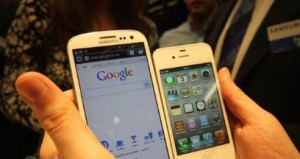
One in five people currently owns a smartphone on planet Earth. That is quite remarkable, since five years ago I was convinced that I might never get one. I personally didn’t want to be a slave to my phone. But once I felt the sleek design of the iPhone 4 and engaged with the user-friendly interface, I knew that I wasn’t going back. I’m not sure if I’ve gone to the dark side or not, but my life has gotten significantly easier with a smartphone in my life.

Embrace technology. Believe it or not, we’re already slaves to it. We rely on technology for every little thing in our lives, from making a cup of coffee to saving people from traumatic injuries. Technology is the hammer and nails that built our houses, as well as the app that tells us how to get to our friends’ houses. It’s true that hammers can be used maliciously just as the Internet can be, but as long as the number of good uses is greater than the number of bad, we can’t really argue with it.

As mobile devices and wearables get more advanced in our society, it’s important for us to utilize it and learn as much as we can. The sooner we know how to operate it, the better off we’ll be. Technology does not have to be an addiction. Technology can also be a good habit to help you live a better, healthier life.

Have you ever seen a child operate an iPad more proficiently than their parents or grandparents? It’s cute, but that bar is also being raised every day. Soon we’ll be the inept parents and grandparents, unable to update to the next version of iTunes on our Google Glass. We’ll be asking our kids and grandkids to help. While that might seem like the inevitable passing of the torch, I don’t believe our generation will suffer that fate if we continue to progressively learn and use new technology as it comes along.

Sure, it doesn’t make sense for software and Facebook to change every few months for no real immediate purpose, but we shouldn’t judge technological leaps upon their inception. While many designers, engineers, and manufacturers are still working out the kinks for wearables, such as smartwatches and Google Glass, we should be excited for these new innovations—disruptive as they are.

Everyone will have a smartphone one day, because it will become the standard as innovations continue to make strides. If you’ve been resistant to new technology for so long now, you probably won’t be convinced by me, but I’m just saying that the longer you go without it the more handicapped you’ll be should smartphones be imposed on you one day.
The Impact of Smartphones and Social Media on Our Ability to Make and Keep Plans

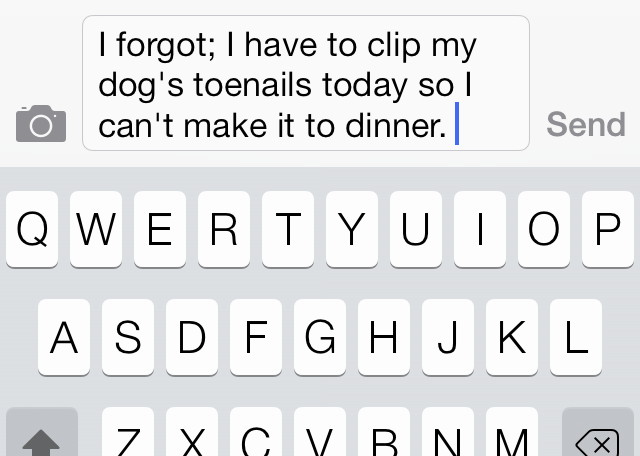
Initial planning or planning ahead means nothing anymore. Scheduling events and then adjusting them as the date approaches have always been common, but it has become so convenient that all the communication leading up to the big date does not even really matter. With a click of a button—without an excuse or a doctor’s note—we can bail thanks to the flexibility liberated by technology and the flakiness of the new generation.

My expectations, when I make plans, have changed significantly since I started using Facebook. I was a latecomer to the social networking platform; I was going through this phase where I didn’t want to “conform” with those simply interested in a new fad. Who knew at the time that Facebook would become such a significant part of my life?

What finally got me to sign up was the fact that I felt forgotten. People weren’t inviting me to events because I wasn’t on Facebook. I was left feeling rejected because it was such an inconvenience for others to pick up the phone and tell me the time and place of the event. My friends would be out having fun, while I would be alone, doing whatever I did before Facebook. It was high school all over again.

I gave in. I got Facebook and rejoice. I got invites again.

Flash forward seven years later, now I’m bombarded with invites monthly: My musician friends inviting me to their shows, my semi-close friends inviting me to their birthday parties and even Facebook itself is suggesting events for me to attend. The thrill of receiving an invitation is lost—it feels a bit like spam—and technology began to foster the flakiness of the new generation.

We now live in a world where “Yes” means “Maybe,” “Maybe” means “No” and “No” means “The Hell With You! I’m Way Too Important!” So how can we over come this problem? How do we get people out to our events without sounding like a party-Nazi?


Make Plans For Yourself First, Then Invite People

Just because other people are flaky doesn’t mean you can’t have a good time doing what you want.

Example: You really want to see a band. Well, buy your ticket to the concert first and then let your friends know. Odds are, seeing your commitment will convince them that the event is worth going to and therefore they will purchase their own ticket and meet you there. If not, well, this might just be a great opportunity to meet new people that share the same interest or you can sell your ticket for a fair price.


Flexibility Won’t Please Everybody, So Be Firm

No matter how many times you adjust the schedule, there will always be problems. You cannot please everybody and you’ll be doomed if you try. Give a few options that work for you, and if a few people are left stranded—so be it—there will be other events in the future.

The more you reschedule the more you’ll test people’s already limited patience and the less likely anybody will show up at all. Be firm!


Assign Responsibility So Attendees Feel Needed

Whether it’s with friends, families or colleagues, getting together for an event should be teamwork. You can instantly weed out the flakers from those who are reliable by assigning certain tasks to people.

Generally speaking, people like lending a hand, and they’re more likely to show up when they are feeling needed and their presence really matters.


Avoid Breaking Plans You’ve Made Yourself

Events are something people look forward to, so if you need to cancel for whatever reason, do so as soon as possible. The least you can do is allow your friends to salvage their day. But know that every time you cancel or bail on a plan you made yourself, you become less credible in the eyes of your guests.

They will see your flakiness and mirror it, and that might be the root of all the problems.

25 Innovative Technology Companies Showcase Talent and Celebrate Community At NextBC

On May 15, the top 25 tech companies in BC gathered together on the second-floor concourse of The Telus World of Science to showcase their latest innovative breakthrough and to celebrate the influencers and visionaries of the future.

NextBC, presented by DigiBC, the Digital Media and Wireless Association of BC, invited out a diverse collection of game/life-changing companies, from experienced money managing tools [Payfirma] to digital health advances [Conquer Mobile] to HD cameras in the exosphere, shooting perfect images of the Earth [Urthecast].

“At DigiBC we recognize that technology is changing our lives in so many ways,” said Howard Donaldson, President of DigiBC. “Our objective is to promote innovation and that is really what inspired this event.”

NextBC was designed not only as a conference with keynote speakers and panelists, but also as an award show, highlighting the company that has excelled and continues to show great potential.

The top 25 companies, at the end of the night, were chiseled down to five. From there a panel of judges were selected to ask important questions that focuses on four factors that include; breakthrough or rapidly advancing technology, the potential for broad impact, the potential for significant economical impact, and disruptive impact that transform how people work and live. The five companies chosen were: General Fusion, D-Wave Systems, Avigilon, Urthecast and CapTherm Systems.


How many years from commercialization do you think you are?

“Eight years,” responded General Fusion’s representative. “We want to build a power plant; that is not something you can whisk up in an afternoon.”

“Hopefully in the next few years we’ll demonstrate the physics that the power plant is based on, which when we compress this very hot gas, we can make fusion energy,” he continued. “Demonstrating that will take around two years, but this will not be a power plant, this will be a test that can show that it can be done. After that we need to build a piece of hardware, which will take some years and a lot of money, and just raising the money will be difficult to build a power plant like that.”


What is disruptive about your business model?

“We have the ability to stream data from space in utterly new and innovative ways, disrupting how it was done for everyone else,” said Urthecast’s representative. “We can democratize the view of Earth for free for anyone with Internet connection. That free platform that we put out to everyone in the world allows us to generate huge numbers of eyeballs. And those eyeballs can in turn be monetized much like the classic model of Internet companies.”

“I’m happy to say that we are very profitable,” said Avigilon’s representative, “and we are the fastest growing software company in North America. We go to market through certified Avigilon dealers. We directly sell to them and they sell to stadiums, transportations, etc. That’s pretty disruptive because a lot of our competitors mass produce to market distributors, and they dilute their product and their pricing model.”


Why are you here in Vancouver?

“From a national level, the support for research and development in Canada is second to none,” said CapTherm’s representative. “We feel really fortunate for the support we received from national research councils and scientific research and experimental development. We do utilize the ETC tax credits, we got a substantial portion off the pie last year and overall I couldn’t find a better place to run the company out of.”

“As you might imagine quantum mechanics take some pretty smart people to do what we are doing,” said D-Wave System’s representative. “So when we started the company here, we were able to attract some of the world’s best physicists to work on the dream that we had. People have come from all around the world: a lot of European countries, all over the States and across Canada. They always had this dream and that’s why they are here.”

When it was all said and done, the tension had built and the drum roll had fizzled out, General Fusion was awarded the Gold honours, D-Wave System with the Silver and Avigilon with the Bronze—and Fusion Pipe Software Solutions took the People’s Choice Award.

Bad Data, a Usability Gap, and the State of the Wearable Economy

Consumers demand the most out of their wearables. From the days of simple prescription-reading glasses to the Google Glass of the present—if it’s going to exist, it needs to work seamlessly with our lifestyle. But at this early stage, consumers may be expecting a sophisticated Xbox One when their wearables are at an adolescent-Atari stage.

During Wearable Wednesday Vancouver on April 23, moderator, Redg Snodgrass CEO of Wearable World, a couple groups of panelists and a large crowd of innovators, entrepreneurs, designers and investors gathered together to discuss the state of the wearable economy.

While some big companies, such as Nike are bowing out of the wearable-tech arms race, the doors are open for smaller companies to make the next innovative leap.

“The fact that Nike is leaving this market is a compliment to the market,” said Nikola Obrknezev, Technology and Partnership Lead at Fatigue Science. “Consumers are telling the manufacturers what they want and what they don’t want. It is our belief that wearable devices are going onto a platform, be it the iWatch, Android or Samsung. So they are going to build within an ecosystem. I mean [Apple’s CEO] Tim Cook wears a Nike Fuelband; he sits on the board—the fact that [Nike is] getting rid of the hardware team—they didn’t say anything about the software team. Who knows what they are building behind the scenes.”

While wearable developers are transitioning from constructing hardware to creating platforms, the ecosystem shifts into the next phase as data accumulates. But the challenges and the model of development remains the same: prototype, measure and learn.

“Putting something on a person’s wrist—making something that they are actually going to wear—is incredibly complex,” Liz Dixon, CEO of MIO added. “I think people get hammered all the time for making technology that is far too complex to use. Nobody likes to read instructions.”

There is a general public demand for wearables, we can all use another innovative way to communicate, etc. But there is also a demand for wearables in a niche market that includes security and medical. Mike Morrow, CEO of CommandWear, is seeing a lot of potential for technological growth between different sectors.

“Once we know that police and security buy into it and start using it—guess who they work with: Fire, EMS, medical, industries, utilities and on and on, and it grows,” said Morrow. “Of course, as we grow we capture the attention of the big boys. We are already working with Motorola for example. They are more focused on the backend systems, they’re in with police, and they are interested in the big data and analytics side of this business. They are hungry for data feeds from the field.”

Still the gap between innovative technologies, integration between platforms and devices and the usability is one that will take time to close. And it cannot be done when marketable and actionable dishonestly occurs, a mistake that many pioneering manufacturers made.

“Right now we have a lot of devices out there that are being marketed as doing A, B, C, D and—people look at it and say ‘Wow, I really want that,'” said Bayan Vandrico, Lead Researcher and Hardware Engineer at Vandrico. “But they buy it and realize it wasn’t really what they thought it was. That’s because those products aren’t really actionable.”

Collecting data is one thing, turning that data into something useful is another. If a wearable device wants to stay on our wrist or on our face it must serve a greater purpose than telling us how many steps we take or how much we sleep. If our habits don’t change, then the wearables have to.

But with so much data entering the ecosystem, distorted information is blended in with the accurate ones. Tracking location is an example of something that sounds so simple in a technological sense, but is incredibly complicated in a data-heavy ecosystem. It has evolved significantly since GPS tracking to cell tower triangulations to WiFi RSSI and advancements still continues.

“To me the trajectory is figuring out the broad solution,” said Shane Luke, Chief Product Officer at Recon Instruments, “and having someone that really focuses on that problem. It’s okay for it to take awhile; you can still do a lot, even with data that is not quite right.”

Luke added, “It’s an important principal, if you are in this space and you are building stuff, to look around at what others are doing and what they spend all their time on. They are going to do it better than you if you only spend 25% of your time on it, guaranteed.”

Wearable tech currently stands on the threshold of something very exciting. With so much new data, ideas, devices and platforms appearing in the local, national and global economy, partnerships are bound to take the state of wearables to the next level—a stage where wearables will be of the time and not a relic of technological trial and error.

New Canadian App Encore Helps Concert Fans Relive Memories Of The Epic Nights

13227073075_575e8a8667_o

The bass drop, the drum beat and the roaring applaud and cheers of the crowd, urging the band back on stage for just one, maybe two more songs: those are the fleeting moments of a concert.

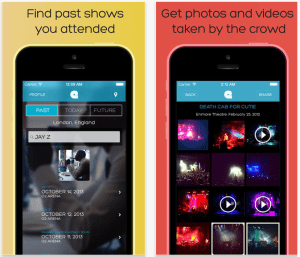
Those moments are what Toronto-based Encore is hoping to save for fans and concert lovers all across the world. The new app will act as a storage bank containing photos, videos, set lists, past and future shows and other sharable content, as well as the convenience and accessibility to purchase tickets and invites friends.

According to Encore’s Summer 2013 Survey of concertgoers between the ages of 18 and 30, 72% will take pictures, 49% will post it to Facebook, 41% will film videos, and 35% will tweet about it. Concerts are spectacles that fans will wait months and years for, and there is little doubt that it is worth remembering.

“We know everyone needs a good concert app,” Nicholas Klimchuk, co-founder at Encore told Techvibes. “We know what a good concert app entails. We don’t think people have designed it well. What makes Encore different from other concert apps is that we don’t just focus on upcoming shows—we focus on the past.”

“Users add every concert that they’ve been to and we suck in all the photos and videos, so you have a time capsule of the experience,” he continued. “And then it’s really cool to see a profile of every concert you’ve been to.”

Nostalgia is an important element of being human. The ability to recall the past and feel the warmth of a memory is something unique to us. But people evolve too and habits change. There was a time when concertgoers would keep their ticket stubs and place them with their collection after the show. They would keep it all in a box, an album or make a collage, frame it and hang it on the wall—some still do that, but most have transitioned into the digital age… and Encore is embracing them.

Yes, gone are the days of raised lighters, sign of the horns and peace signs, instead people are holding up recording mobile devices during the performance. Although the percentage shows that the majority is behaving this way, the act itself is still a little irritating to other attendees.

“It is kind of annoying that you have an iPad in my face and I can’t see the artist,” said Klimchuk. “There are ways to do it where people get used to it or it’s less annoying. But I think it makes a great beginning line for Encore, because people click through things they hate and people hate phones at concerts. Even if you don’t like the product, this will get people to click through.”

Encore puts the photo taking pressure on someone else. We have all tried getting the perfect shot through the crowd and even if we are competent iPhone photographers, the result may be a little disappointing. Sure, we put a higher value on the photos we take, and Encore is not trying eliminating that, what it is doing is sourcing the crowd and collecting the images and videos from the audience as a whole, allowing you just to enjoy the show in the moment, and the pictures after, should you choose.

“If you look at the past seven Beyoncé concerts, all the different angles and photos, they all look the same,” said Klimchuk. “I can a take a photo from the England concert and say it was the Toronto concert and no one would be the wiser. But the interesting thing is that people prescribe a higher value knowing that that is the Toronto concert and I was there.”

We continue to anticipate concerts and reminisce about them long after it’s over. It’s not just about the music, the venue or the artist, but the memories we share with the people we went with. If you live in a big city, odds are there is a concert you would like to attend every other day; this leaves a lot of possibilities. Whether you end up going or not, Encore knows that we all need a moment now and then to recollect our thoughts, think about the good times and prepare ourselves for the next one—whether it is the opener, the headliner or the encore.

It’s Time to be More Concerned About Our Eyes and Less About Our iPhone

If you are a hardworking technophile like me, you may want to start addressing the fact that you are working too hard, relying on too much on technology, and staring at a computer/iPhone/Kindle screen for too long.

Odds are, you’re not reading this in a paper form, but on a screen—even though this is your break from work. News, entertainment and correspondence all happen on a computer screen; there is no avoiding it today.

But just because the zeitgeist has changed, does that mean our strained eyes are doomed as well?

Computer vision syndrome has proven my mother’s worries to be accurate: I might not go blind from watching a Mad Men marathon on my iPad but exhausting my vision and causing it to labour intensively over hours of work is not healthy.

Vision loss is often associated with aging and computers screens are not linked to any permanent damages to the eyes, but Canadians are still burdened by the financial weight of vision correction. According to the Public Health Agency of Canada, $2.7 billion is spent annually on vision care. There are laser-eye surgeries and “retina” displays, but I believe it won’t technology that saves our vision, but rather our own habits in areas of work, play, and sleep.

To avoid straining your eyes and exhausting your ability to work, I introduce “the three B’s” to aid you in your seeing endeavours and to keep your eyes in “peek” condition.

BLINK

It’s been proven that those staring at a computer screen for a period of time will have longer intervals between blinks. This effect will cause the eyes to feel dry and irritated. Blinking lubricates the eyes, and that is a good thing regardless of what level you’ve achieved in your mobile game or how many typos you’ve found in your Word document.

Blink regularly while working; you may need to consciously remind yourself to do so.

BRIGHTNESS

It’s a balancing act; the amount of light in a room versus the brightness of your computer screen versus the extraneous light and glare seeping in through your office, home, or coffee shop window. Having a balanced lighting can reduce the strain and fatigue your eyes feel.

You want your computer screen’s brightness to match the brightness of the room. So move away from the window when you are on your computer. Extraneous light and glare will force your eyes to work harder than they have to, thus exhausting them faster. Consider drawing the curtains at various point of the day or purchasing an anti-glare screen filter.

BREAKS AND COMFORT

Taking breaks are important because the human eye is not built to stare at a screen for many hours. Experts recommend that workers take a 20 second break every 20 minutes by staring at something 20 feet away; this is known as the 20/20/20 rule. Find an object in the distance, maybe a tree or a painting and just check up on it occasionally. Who knows? Perhaps you’ll find inspiration in it.

While you are taking these breaks, consider your comfort and make sure your working environment is as ergonomically pleasing as it can be. A few things to note are the monitor’s height and distance. The best height is five to nine inches below your horizontal line of sight. Or in another word, you should be able to look right over the screen. In regards to the distance, if you can sit back in your chair and touch the screen, you are sitting too close.

No matter how hard working you are, neglecting your health is never okay; after all, an office job can be lethal. Sometimes you’ll just need to rest, and if your friends and family can’t convince you to take a break once in awhile and get away from the screen—well, hopefully your eyes can.