Autosave

Opinions_Memories1 

The memory on our hard drive versus the memory in our head

By Elliot Chan, Opinions Editor

Formerly published in The Other Press. Sept. 2013

About 200 years ago, the first photograph was taken and a new human obsession was born. The fascination with capturing “the moment” has travelled through time and led us here to a digital world where Facebook contains over 240-billion photographs. So what is it like living on a planet where 350-billion photos are taken annually worldwide in addition to the over 3.5-trillion already in existence? My guess is that those poses, those beautiful views, and those first steps by little baby Susan will inevitably be lost beneath all the other mundane images out there.

Remember Kodak moments, when every photo taken was an investment for the future and a memory worth sharing? I do. When I was young, my family only brought out the analogue camera for special occasions such as birthday parties, vacations, or school performances. I wasn’t allowed to touch it until I was 10-years-old, because memories were precious and my mother would always fear overexposure. Film was pricey, developing it even more so—my parents knew certain things were worth the cost and others weren’t.

Hard drive spaces are cheap and getting cheaper. Soon we’ll be able to upload our lives onto a terabyte external hard drive, plug it into to a projector, and have all our memories play out during our funeral. Our loved ones can gather around crying and laughing about our tomfoolery and our bits of achievements. But what substance do those images really have for us during the course of our lives?

Sometimes I look at pictures of myself; it might be me during a night out with friends, or maybe a group photo with my family. Oftentimes, I come away with a vague memory, like waking up in the morning and trying to recollect a dream. There are just so many—how can I be certain that I’m even remembering correctly?

We have all become photojournalists, reporting on and documenting our own lives. But can it be that the more we capture to showcase, the more we are losing for ourselves? The more we rely on the memories of a machine, the more we inhibit the capacity of our own brains.

During a vacation to Kelowna this year, my mother insisted that I take as many pictures as possible—for the sake of my family. I was unenthused by the idea of being my mother’s personal cameraman. Instead of enjoying the scenery or the moment, she was too busy trying to capture “the moment.” There is still a slight social stigma for those who hurry about taking pictures in situations that don’t call for it, but the taboo is quickly fading. The moments are becoming less and less valued, because apparently they’re everywhere now. The food we eat, a ray of sun through the trees, and of course little Susan’s first steps are now all worth the same 8.4 megapixels, but how do they really measure in our memories?

All the photography apps on our smartphones are making it harder and harder to keep track of which images we want to frame and which are disposable. Find time, sit down, go through all the pictures in your life, and ask yourself, “Do I remember this?” Then separate the images into two piles: the yes and the no. See which one you have more of, because certain things shouldn’t be automatic.

Utilizing Douglas College’s free peer tutoring service


Improving your grades with a little help from a friend

By Elliot Chan, Staff Reporter

NEWS_Peer-Tutor

Formerly published in The Other Press. Sept. 6, 2013

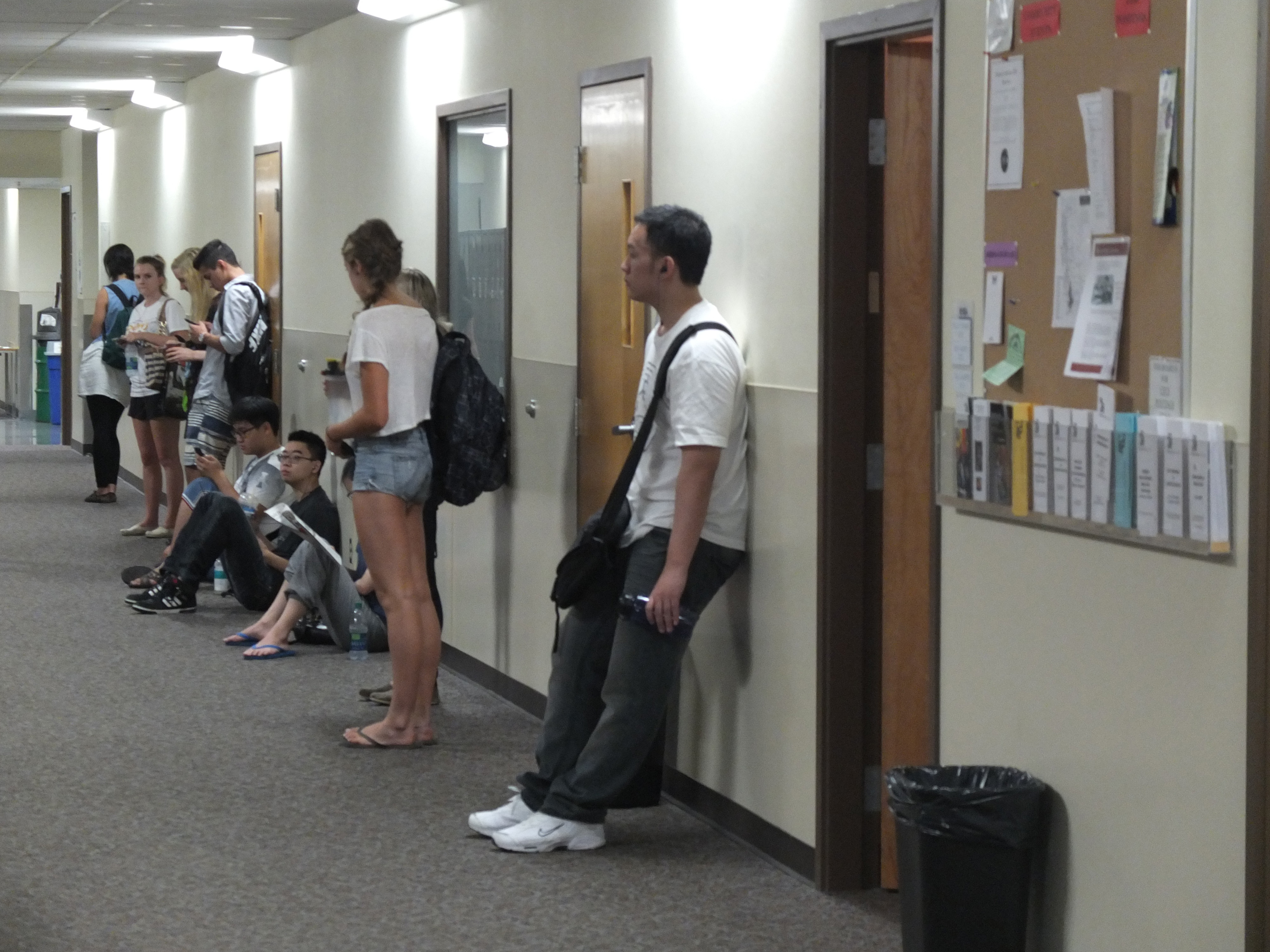
The Douglas College Learning Centre starts off every semester by recruiting new peer tutors. The number fluctuates between 20 and 35 peer tutors, which means there is often a waiting list for students who need assistance. The Learning Centre hires accordingly, depending on the courses offered at the college. Biology 1000, Chemistry 1000, and English 1130 tend to require extra-curricular help, and the centre often seeks students with expertise in those areas.

“My opinion of a quality peer tutor is one who is very high achieving,” said Holly Salmon, Learning Centre coordinator. “They are independent learners or someone who loves to learn. But when I ask peer tutors who they want as a part of their team, they say they want someone fun, has a lot of team spirit, and someone who is serious about school.”

The service is free for any students enrolled in a credit course at Douglas. Peer tutors offer two types of sessions: the weekly one-hour session allows students and peer tutors to sit down once a week to go over homework, assignments, and lecture notes. These one-hour meetings are limited, and sometimes require a waiting list. The other option is a “Quick Question” 25-minute drop-in session that offers students the opportunity to ask one key question about their studies.

“Our expectation is that you come in when you hit a wall,” said Salmon, “and you want help.”

Students who have high academic standards and want to share it with the community can also apply to be a peer tutor before or after receiving recommendations from an instructor.

“We have students that come in to apply and we ask them to provide names of two faculty references,” said Salmon. “I get emails from instructors a lot actually, ‘so and so came in and talked to me and I support them.’”

The Learning Centre has certain requirements for students who want to be peer tutors, such as being a registered student in at least one credit course at Douglas, and a B-average or better in 12 credits in Douglas College or equivalent courses.

“We have two weeks of training before you can tutor,” said Salmon. “You have readings, activities, and you sit in on other sessions to observe more experienced tutors. After that I speak with you and ask how you are feeling and see if you need more training—nobody ever says they need more training. By the time they are done they are ready to sit with a student. Throughout the term they get 2 and a half more hours of training every week.”

Peer tutors receive benefits for their assistance, including $11.20/hour, health and welfare, and a College Reading and Learning Association certificate, which is a professional certificate in three levels that allows peer tutors to tutor independently or at other institutions without extra training.

Application forms and more information about becoming a peer tutor can be found online at http://www.douglas.bc.ca/services/learning-centre/about/tutor.html. Job postings can be found on the Douglas College job board.

If you are seeking a peer tutor to help with you academic needs, please visit http://www.douglas.bc.ca/services/learning-centre/tutoring.html for more information.

Bell Media Launches New One-stop Car Resources Website, Autofocus.ca

Formerly published in Techvibes. 

On July 24, Bell Media announced the launch of their new Autofocus website, Autofocus.ca. The site offers research, review tools, and consumer resources in both English and French.

Whether you are a first time car buyer or an experienced gear head, Autofocus is built to enhance your car shopping experience in Canada. The easy-to-use and visually-pleasing website supplies helpful assistance auto experts, including advices and reviews, car buying tips and tricks, coverage of major auto shows, consumer reports, leasing and financing guides.

Autofocus also includes integrated research tools, user community profiles and social tools to help with the sometimes-overwhelming process of selecting a vehicle.

“Not every car buyer makes a purchase with the same level of knowledge or experience. With this in mind, Bell Media set out to build an automotive resource that offers a tailored car shopping experience with a best-in-class user interface,” said Catherine MacLeod, Senior Vice-President, Specialty Channels, Bell Media. “Informative and engaging, Autofocus is reinventing how people manage their car shopping experience. Autofocus is a valuable and convenient resource for Canadians making a new purchase, thinking about changing models, or just simply interested in cars.”

Autofocus has created a community of car owners helping each other make the best decision with the big purchase. Not every vehicle is suited for every person’s lifestyle and individual needs. With reviews, news, photos, videos and how to advices all in one location, Autofocus can help drivers find some wheels without any regrets and frustration.

Autofocus has picked out a team of auto experts and award-winning contributors and auto writers from Automobile Journalist Association of Canada: Jil McIntosh, Antoine Joubert, Matt Bubbers, Nadine Filion, Benoit Charette, Daniel Rufiange, and Howard Elmer. With their expertise and guidance you’ll be able to hit the road and get where you need to be without any detours—at least none in the purchasing process.


Android Users Can Now Channel Surf with Telus’ New Optik TV Remote App

Formerly published in Techvibes. 

This week, the Optik Smart Remote app developed by Telus became available for Android devices.

Searching for quality television can often be an ordeal. You often leap from one channel to the next without ever settling on anything. You mash the buttons on your remote, scrolling down the guide hoping that something of quality would appear—maybe it does or maybe it doesn’t, but either way what was supposed to be a relaxing evening on the couch becomes a stressful, indecisive night.

Telus Opitk Smart Remote app will replace the traditional guide on the TV. Instead of using the remote control that came with the television or the digital box, you can simply swipe your Android phone and browse the guide and tap on your desired channel to watch your show.

Optik Smart Remote app allows you to track your favourite shows and see what is the most popular. You will also be able to navigate through the interactive program guide on your device, search IMDB, Wikipedia and Youtube without interruption.

SEE ALSO: Telus Brings TED Talks to Optik TV

“With Optik Smart Remote, it’s quick and easy to find the best thing to watch—and it’s now available for both Apple and Android devices,” said David Fuller, Telus’ chief marketing officer. “Our goal is to continue providing our Optik TV customers with a richer TV experience. Optik Smart Remote takes that experience to the next level. A tap or swipe of the fingers on your smartphone or tablet lets you control your TV without interrupting or missing a moment of your favourite program, plus you can easily set and manage your recordings at home or on the go, meaning you won’t miss out on any of your favourite shows even if you’re away from home.”

The free app is now available for Apple and Android devices and contains multiple enhancements, including new channel scroll bar, PVR recording enhancement that gives users the capability to filter and sort shows by dates, series or titles.

Currently Telus Optik TV offers over 620 channels, including 160 HD channels.

The waiting game

Popular courses force students into waiting list purgatory

By Elliot Chan, Staff Reporter

NEWS_Waitlist

Formerly published in the Other Press. Sept. 6, 2013

Before each semester, students rally for a good registration spot and a seat in the classes of their choice. The problem is, popular and prerequisite courses are attractive. With limited space in each class, students who register late or have a later registration date often miss the cut-off of around 37 students per class. This leaves many abandoning the prospect and applying for less appealing or relevant courses, thus prolonging their time at Douglas and other post-secondary institutions.

Watching your ranking on a waiting list is a frustrating ordeal. Once on a waiting list, Douglas College recommends that students check their status daily and drop themselves from the list if they lose interest.

Although the system at Douglas tries to be as fair as possible, the result may not always be favourable. Odds are you’ve already figured out whether you’ll be attending a course or not, but if you missed the chance this time, here are some tips to avoid the same outcome next semester.

“If students want a better registration time, they will need a better GPA,” the registrar’s office suggests. “They should also register on the day to avoid disappointment—and even then sometimes courses just fill up.”

Popular classes like Biology 1103 often reach the waiting list maximum of 100 students. After the first week, the waiting list shrinks to around 60-70. Even so, the prospect for attending the class becomes rather daunting.

The registrar’s office recommends that students on a waiting list attend the first day of class and email the course’s instructor. Most professors won’t mind students sitting in on the inaugural class while they gauge interest, potential for dropouts, and ability to increase workload. It is then the instructors’ choice to override the class limit or stay the course.

When sitting in on a class, it is important to respect the other students who have already registered and paid for the course. Understanding that the room may already be full, common courtesy is often a better route than eagerness. Speak with the instructor, let them know your condition, and accept a seat if one is offered for the time being.

If the instructor ends up offering you a seat in the course, you must pay the tuition immediately: i.e. 23.75 hours after the offer has been sent. Failure to do so will drop you off the list completely.

Planning ahead of time will give you an upper hand when it comes to getting the most beneficial courses. Research the courses you want to take and mark down the registration time, tuition fee payment deadlines, and any important dates to consider in relation to the course(s).

Registration for Winter Semester 2014 goes from November 14 to 28, 2013, with the tuition fee payment deadline for domestic students on December 9, 2013. Classes commence in the New Year on January 6, 2014.

Textbooks: the other tuition

The relationship between students and their textbooks

By Elliot Chan, Staff Reporter

Formerly published in the Other Press. Aug. 13, 2013

NEWS_texbooks_final

As Douglas College classrooms fill up for a new academic year, students are emptying out their wallets for the exact same reason. Regardless of how much students organize their educational finances, the textbook monopoly will take a big chunk out of their limited funds. It’s the way the game is played—but are textbooks a good investment, or are they simply a luxury tax? A 900-page burden, or an instructional baton waiting to be passed on to the next wary student seeking discounts?

Postings for used textbooks cover the bulletin board on the first floor at the New Westminster campus. It’s obvious that most students have little intention of keeping their expensive textbooks for future reference. Students are simply doing what students do best—being obedient.

“I want to spend as little as possible,” said third-year business student Haleen Mullhi. “But I’ll end up spending between $300 and $400, which adds up to $2,000 each semester.”

Music and accounting have consistently produced some of the priciest textbooks in the store. But the bookstore itself only receives a 25 per cent margin, which Ryan Hill, bookstore supervisor, considers low.

“We are retail, but we are also a service department in the college,” said Hill. “After covering shipping and overhead, the bookstore makes a low profit.”

It’s not always easy to see the gain in textbooks when all you hear about are students trying to offload them and the bookstores accepting refunds.

When asked whether or not she will sell her textbook at the end of semester, Mullhi confidently said, “Yes, I’ll post it out on the board and see if anyone wants them.”

Students don’t have many options when the course is done. The textbooks age and become irrelevant, so even though they might not be studying marketing, they still have to be salespeople and attempt to make some money back while clearing off their bookshelves. Many consider open postings on the bulletin board, but be forewarned: although that option might feel like a free-for-all, it can also be a stressful bidding war. Buybacks are the alternative, but students often find the compromise of 10 per cent or less insulting—that’s if the bookstore even decides to take it back.

“We don’t run any stats, so it is tough to say which program has the most textbooks returned,” said Hill. “It is all pretty balanced, because I believe most students have the same mentality—rather they have found another source or they dropped a class.”

The current refund policy only allows for students to return their books in the first month of the semester, within 14 days of their purchase. They must have the sales receipt and may need picture ID.

It’s difficult to tell which program yields the most returns, but Hill noticed that ESL textbooks often come back because of the language barrier and classes are commonly mistaken.

Although price is a deterrent, most students really don’t mind investing in a textbook if they know the course will put it to good use.

“If teachers actually read the textbook and assign homework from them,” said Joyce DesLauris, a first-year nursing student, “and give them credit—it would be worth having.”

Repeat in Russia

Will Canada strike gold in Sochi 2014?

By Elliot Chan, Staff Writer

Sports_Sochi-hockey

Formerly published in the Other Press. Aug. 6, 2013

Remember that day in February 2010? Remember the city—the country bursting with jubilation? Wouldn’t it be great to relive it?

Sure, the Olympics in Sochi is months away, but it’s never too early to talk about international hockey—especially since the NHL has now confirmed that its players will be able to compete in the prestigious tournament.

The most notable change in Sochi in comparison with Vancouver is the rink size. The two Canadian ice hockey gold medals in 2002 and 2010 were won on NHL-sized ice (61m by 26m). In Russia, the Canadians will be competing on international-sized ice, which is (61m by 30.5m). Rink sizes have posed challenges before, especially against speedy teams like Russia who can take advantage of the open ice.

The home team is the favourite going into the tournament, but Canada, Sweden, and the United States shouldn’t be intimidated by the jeers they’re expecting when they step onto the ice against superstars such as Pavel Datsyuk, Alexander Ovechkin, and former NHLer turned KHLer Ilya Kovalchuk.

Since the days of the Soviet Union and the Unified Team in 1992, Russia itself has never won a gold medal. But there was a period in history when the red army dominated international ice. But like the Cold War, those days are long gone and though Russia has a barrage of talent, they haven’t been able to make the podium since 2002.

The question that hangs on everyone’s lips is will Canada be able to repeat? I hope I eat my own words, but I don’t believe they will. There hasn’t been an Olympic ice hockey repeat since the Soviets did it in the late ‘80s. Canada might be good, but we have never been dominant. The fact that we won in 2010 was not a miracle, but it was definitely a hard fought game that came down to one key moment. We could easily be talking about USA’s chance of repeating right now if it wasn’t for Sidney Crosby’s heroics.

In 2006, Canada followed up their gold medal victory in Salt Lake City with a demoralizing seventh place finish in Turin. By relying on players that had experience, but were way past their prime like Kris Draper, Adam Foote, and Todd Bertuzzi, the team was doomed from the start. Selecting the perfect team is difficult, since it’s about assigning roles to elite players. With Mike Babcock, head coach of Detroit Red Wings returning to serve another term as team Canada’s bench boss, the players and fans will know they are in good hands. Sidney Crosby, Jonathan Toews, and Shea Weber can all be expected on the roster come February 12, 2014, but the number one goaltender is still unknown.

Martin Brodeur will also be stepping down this year from the international limelight. Roberto Luongo will likely get a few games just because of his reputation, while Carey Price, Cam Ward, and Marc-Andre Fleury will fight for the last two spots.

As excited as I am for the beginning of the NHL season, there is something about Olympic hockey that can make a grown man giddy. The NHL season will pause their schedule from February 9 to February 25 for what should be some epic games in the Motherland.

All eyes on new realignment

Sports_NHLs-new-regions-1024x770NHL’s new division format intensifies geographical rivalries

By Elliot Chan, Staff Writer.

Formerly published in the Other Press. Aug. 6, 2013

The Vancouver Canucks and the rest of the Western Conference are saying goodbye to Detroit and Columbus, and hello to the Winnipeg Jets.

This time last year, we were all anticipating a NHL lockout; the scenario this season is much more hopeful. As summer ends and the hockey season commences, all eyes are on the year-long experiment—the realignment. The NHL board of governors approved the new divisions and playoff format in July when the 2013/2014 schedule was released.

The Western Conference will now have 14 teams split geographically into the Pacific and Central divisions. The Eastern Conference will have 16 teams split into Atlantic and Metropolitan. The most significant change is Detroit joining the Atlantic division facing-off with three other original six teams, Montreal, Toronto, and Boston. Columbus and Winnipeg swapped conferences, with the Blue Jackets now playing in the Metropolitan division against Sidney Crosby and the Pittsburgh Penguins and Alexander Ovechkin and the Washington Capitals. The West Coast will get a few more chances to see the young Jets team and BC born players Evander Kane and Andrew Ladd.

The two main objectives for the realignment is to shorten travel times and build rivalries. It’s hard to see a downside to this change, since it was inevitable.

“It’s much better for us,” said Dallas Stars defenseman, Stephane Robidas. “It’s less travel, fewer trips out west—the time zones, the amount of time you spend on the plane after games. You don’t have to wait in [Los Angeles], you can come back after games. It’s all little things in the long run I think will help our team.”

The only two teams separated from their division in terms of geography are the two Florida teams. The Lightning and the Panthers are in the Atlantic division, but they have the whole Metropolitan division separating them from the rest of their division rivals.

“From a business standpoint, I think this is probably really good for both Florida teams,” said Commissioner Gary Bettman. “Competitively they may have their own issues, travel-wise they may have issues, but based on where Florida is from a geographic standpoint, whatever we did wasn’t going to be perfect.”

For the Canucks, it’ll be interesting seeing them battle for a post-season spot against consistent playoff contending teams such as the LA Kings, San Jose Sharks, and the Anaheim Ducks.

The Stanley Cup Playoff’s intensity may stay the same, but the route getting there is going to be slightly different. Eight teams in each division will make it to the post-season. The top three teams in each one will take the first 12 spots and the other four will try to land the wildcard position regardless of their divisions.

Though the stage for this season is set, many still see problems in the geographical layout of the league. The main problem lies in the Western Conference, where all the teams are scattered. I foresee (and hope) for a two-team expansion. Perhaps we will see another change next year with, dare I say it, a team in Seattle and Portland?

Smart phones for dummies

Are smart phones a necessity or an addiction in school?

By Elliot Chan, Staff Writer

recultured

Formerly published in The Other PressAug. 6, 2013

Smart phone ownership has grown significantly in the past few years. In a survey conducted by Google, 56 per cent of adults are now using smart phones—a 33 per cent increase from last year.

This comes as a result of the way we live now. We wake up, roll out of bed, and instantly have our phone in our hands before a toothbrush or a cup of coffee. It might sound alarming to be so reliant on a device that commonly runs out of battery halfway through the day, but is it an addiction or is it a tool? Where does a smart phone rank with the other important things in our lives, especially for students?

Let’s admit it; most of us aren’t business executives conducting big money deals. Most students just use smart phone for casual communication and research.

“Smart phones are not really necessary for school,” said Jordan McChesney, an Asian Studies student. “All we really need is an Internet connection.” He added, “I intentionally leave my phone at home sometimes so I can’t be contacted. I can use Facebook messenger.”

Although some can detach themselves from a smart phone, others find the technology to be a multipurpose solution to everyday monotony. A smart phone is not a textbook. It is something we enjoy looking at, it is a relief for students during the trails of a school day.

“I cannot go on transit without my music,” said Chris Pereira, hospitality management student. “I’ve run home before and missed the bus.”

“It is an addiction for me,” admitted Solange Valverde, university-transfer student. “I use my phone a lot.”

Smart phones can be considered an addiction, but for now they are merely a lifestyle choice. Eight out of 10 smart phone users admit that they will not leave their house without their phone. The average smart phone user has approximately 30 apps installed and uses about 12 consistently in a month.

“It helps with involvement for sure,” said McChesney. “It helps with involvements in clubs and allows you to be more social. You can also use it to prove the teachers wrong.”

Although it may seem rude to be texting or scrolling through Facebook while in a real life conversation with someone else, nobody will condemn you for it—not yet, at least. We have already banned handheld devices while driving, in theatres, and in certain classrooms and workplaces, but when will we start treating it like a real addiction? No texting three metres in front of doorways, no tweeting at the dinner table, and no Instagramming during working hours— can there be any mitigation for smart phones’ eventual take over?

Technology is constantly evolving, and with the new Google Glass gadgets gradually making their way into consumers’ homes we should all address the consequences of the tech-dependent lifestyle to which we are adopting.

“A smart phone is not food or air,” said McChesney. “It can make you more socially-active and give you more options to contact people, but it is like a cup of coffee. We don’t really need it.”

Wagepoint Launches Pay, a New Online Payroll App

There are no jobs more important than making sure every worker gets correct payment for their time and efforts. HR managers and business owners across the country will agree that managing salary and hourly pay, while subtracting benefits and such without proper tools is a complicated task.

Luckily, Toronto-based payroll software company Wagepoint has launched a new online application that will make the painstaking process a more bearable and—dare I say— even enjoyable endevour. The fully automated, cloud-based payroll software can be set up with just a few clicks.

There are two plans that users can choose from. The Free plan offers the fully featured app as an alternative to the CRA calculator. But for a $20 base fee and $2 per employee per payroll, users with the Pro plan are allowed to use the direct deposit feature, enabling administration to deposit funds straight to the employees or contractors’ bank accounts. Also the Pro plan takes care of the government remittances and issues T4s at the end of the year.

Wagepoint’s Pay offers many more features that separates it from the common spreadsheets and data entry software administration uses to manage wages. These features include employee self-service, which reduces paper trails and waste, while allowing employees to access their electronic paystubs anytime.

Another one of Pay’s features is helping to manage the different type of workers that needs to receive compensation: hourly versus salaried and employees versus independent contractors. With Pay all the data will be centralized so all workers will receive the appropriate amount with less errors and confusion.

After the first payroll with Pay, businesses can choose to use the Auto-Run Payroll feature to manage their payments if there is nothing new to report. This feature can be turned off at anytime, but if left on it will automatically send payments to employees and the government at the appointed time.

Wagepoint makes the payroll task light and easy, but they also understand the critical importance of security. Pay’s data is encrypted using 128-bit secure socket layer (SSL) encryption. Wagepoint utilizes state of the art firewall and backup technology and the data is kept in a high-security, access-controlled Tier 3 facilities.