Bad Data, a Usability Gap, and the State of the Wearable Economy

Consumers demand the most out of their wearables. From the days of simple prescription-reading glasses to the Google Glass of the present—if it’s going to exist, it needs to work seamlessly with our lifestyle. But at this early stage, consumers may be expecting a sophisticated Xbox One when their wearables are at an adolescent-Atari stage.

During Wearable Wednesday Vancouver on April 23, moderator, Redg Snodgrass CEO of Wearable World, a couple groups of panelists and a large crowd of innovators, entrepreneurs, designers and investors gathered together to discuss the state of the wearable economy.

While some big companies, such as Nike are bowing out of the wearable-tech arms race, the doors are open for smaller companies to make the next innovative leap.

“The fact that Nike is leaving this market is a compliment to the market,” said Nikola Obrknezev, Technology and Partnership Lead at Fatigue Science. “Consumers are telling the manufacturers what they want and what they don’t want. It is our belief that wearable devices are going onto a platform, be it the iWatch, Android or Samsung. So they are going to build within an ecosystem. I mean [Apple’s CEO] Tim Cook wears a Nike Fuelband; he sits on the board—the fact that [Nike is] getting rid of the hardware team—they didn’t say anything about the software team. Who knows what they are building behind the scenes.”

While wearable developers are transitioning from constructing hardware to creating platforms, the ecosystem shifts into the next phase as data accumulates. But the challenges and the model of development remains the same: prototype, measure and learn.

“Putting something on a person’s wrist—making something that they are actually going to wear—is incredibly complex,” Liz Dixon, CEO of MIO added. “I think people get hammered all the time for making technology that is far too complex to use. Nobody likes to read instructions.”

There is a general public demand for wearables, we can all use another innovative way to communicate, etc. But there is also a demand for wearables in a niche market that includes security and medical. Mike Morrow, CEO of CommandWear, is seeing a lot of potential for technological growth between different sectors.

“Once we know that police and security buy into it and start using it—guess who they work with: Fire, EMS, medical, industries, utilities and on and on, and it grows,” said Morrow. “Of course, as we grow we capture the attention of the big boys. We are already working with Motorola for example. They are more focused on the backend systems, they’re in with police, and they are interested in the big data and analytics side of this business. They are hungry for data feeds from the field.”

Still the gap between innovative technologies, integration between platforms and devices and the usability is one that will take time to close. And it cannot be done when marketable and actionable dishonestly occurs, a mistake that many pioneering manufacturers made.

“Right now we have a lot of devices out there that are being marketed as doing A, B, C, D and—people look at it and say ‘Wow, I really want that,'” said Bayan Vandrico, Lead Researcher and Hardware Engineer at Vandrico. “But they buy it and realize it wasn’t really what they thought it was. That’s because those products aren’t really actionable.”

Collecting data is one thing, turning that data into something useful is another. If a wearable device wants to stay on our wrist or on our face it must serve a greater purpose than telling us how many steps we take or how much we sleep. If our habits don’t change, then the wearables have to.

But with so much data entering the ecosystem, distorted information is blended in with the accurate ones. Tracking location is an example of something that sounds so simple in a technological sense, but is incredibly complicated in a data-heavy ecosystem. It has evolved significantly since GPS tracking to cell tower triangulations to WiFi RSSI and advancements still continues.

“To me the trajectory is figuring out the broad solution,” said Shane Luke, Chief Product Officer at Recon Instruments, “and having someone that really focuses on that problem. It’s okay for it to take awhile; you can still do a lot, even with data that is not quite right.”

Luke added, “It’s an important principal, if you are in this space and you are building stuff, to look around at what others are doing and what they spend all their time on. They are going to do it better than you if you only spend 25% of your time on it, guaranteed.”

Wearable tech currently stands on the threshold of something very exciting. With so much new data, ideas, devices and platforms appearing in the local, national and global economy, partnerships are bound to take the state of wearables to the next level—a stage where wearables will be of the time and not a relic of technological trial and error.
Nir Eyal Advises Canadian Entrepreneurs to Develop Habits, Not Addictions

Posted by Elliot Chan on Apr 23, 2014
Formerly published in Techvibes Media.

Screen-Shot-2014-02-17-at-5.10.41-PM
On April 16, author and entrepreneur Nir Eyal approached an intimate group of Vancouver entrepreneur with a series of important questions. As a part of the Hooked Workshop sponsored by Work At Play, Eyal explored the concept of habits and addictions in regards to technology. Then he asked us all questions that steered us in the direction of creating habit-forming technology:

“Is your product a vitamin or a painkiller?” Eyal asked. “People want to invest in painkillers. Because painkillers address a burning need. They stop the user’s pain. They have a quantifiable market, they address a clear need and investors want to hear that your product is addressing a painkiller. As oppose to a vitamin—vitamins are ‘nice to haves.’ We don’t know if that vitamin we are taking every morning is actually doing its job.”

Technology is a part of our lifestyle now, whether it is built to alleviate pain or to generate pleasure. But what caused us to Google without considering the alternatives or to log onto Facebook when we should actually be getting work done? According to Eyal, there is only two reason we formed those habits: the frequency of use and the change in attitude. As a business model, that is a good thing.

“First, habits create higher customer lifetime value,” said Eyal. “If a customer uses our product for a longer period of time, then suffice it to say, they are also adding to our bottom line.” Then he added, “Second, we have greater pricing flexibility if the customer forms a habit. So when a user depends upon a product and it becomes a part of their normal routine, we have greater flexibility in changing our pricing structure.”

Growth is vital to a company’s success, but going viral—but being unable to engage customers—turns your company into a “leaky bucket business.” A product must keep customers coming back and through that consistent use, they can’t help but develop a slight loyalty to the product.

Why do we use Google? Because it’s the best right? Not necessarily—stripped of logos and banners, most people can’t even tell the difference between Google and the number-two search engine, Bing. But since we have been using Google for so long, we make ourselves believe that it must be better, because why would we use an inferior product, right? That is how strong habit-forming technology increases defensibility against competitors.

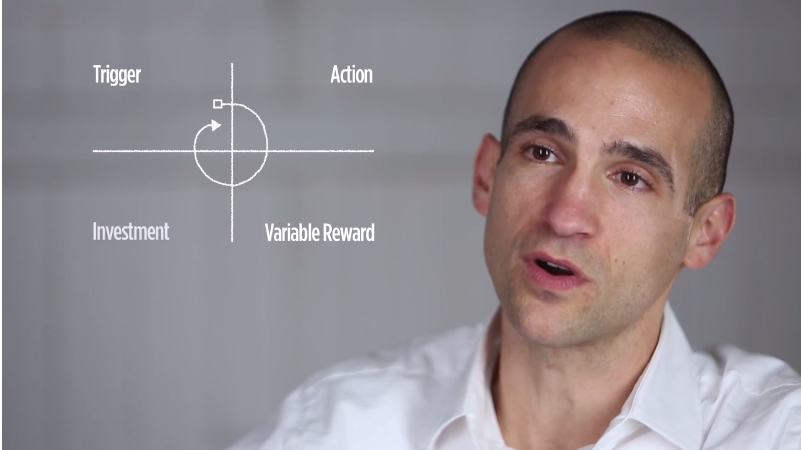
Eyal presented to the crowd the Hook Model, an infinity sign with arrows starting from the top left corner and looping around in a figure eight. This model is designed to assist entrepreneurs and designers aiming to create a habit-forming product, with the hypothesizing process of building a prototype. The Hook Model consists of four phases: Trigger, action, reward and investment.

Eyal quotes the co-creator of Twitter, Jack Dorsey at this point as he explains the method of understanding internal and external triggers of a customer. “[If] you want to build a product that is relevant to folks, you need to put yourself in their shoes and you need to write a story from their side.” So why is someone using your product? What is the trigger? How do you make them use your product as a solution?

According to BJ Fogg, behaviours occur when there is a motivation, an ability to act and a trigger that enables the action to occur. “Here is a key question for us considering how we design our products,” Eyal said. “Should designers move motivation or ability first?” The answer might not be obvious, but Eyal strongly encourages us to move ability first. Making things easier for consumer is always a plus if you want them to do something.

After the action is completed, the user will anticipate the reward. You search Google, you sit and wait for the results to pop up—perhaps your search is over, perhaps you are not so lucky and you need another keyword. “The unknown is fascinating,” said Eyal. That is why we read books, watch sporting events and develop relationships. Variability is a good thing and it helps increase the reward factor for customers.

At last we reach the investment phase of the Hook Model. At this point Eyal suggested that we all consider how we can get costumers to invest in our product after feeling the reward. How do we get them invested? “The investment phase stores value and improves the product with use,” said Eyal. “Because unlike products in the physical world: laptops, phone, the furniture in your house, your car. All these things in the physical world depreciate over time. The more you use them the less valuable they become. They age. However, habit-forming technology, when done correctly have the opportunity to appreciate. The more we use it the better it becomes.”

For example, the larger our library is in iTunes, the more value it has. The more followers we have on Twitter, the more visible our tweets become. And the more we comment on Quora and get up-voted, the more legitimate we are.

So for your next product consider the customer’s daily usage, the habit they’ve formed and the Hook Model Eyal presented in guiding your product into the lives of millions.

FIXO Manages the Communication Between Property Managers and Their Tenants

FIXO-3

Home. It’s where our heart is—or at least it’s where our things are.

Regardless, it’s pretty important. So it only makes sense that the care for the house and the livability aspect is something that property owners, private landlords and tenants should be able to communicate without having to play cat and mouse.

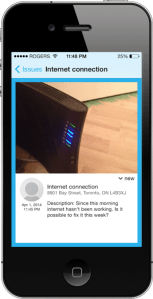
FIXO, a new communication app designated for residential property managers and their tenants is eliminating the lost messages and the neglected bulletin board postings of a bygone time. Having an accessible mobile solution to such an old relationship is proving to create many new opportunities for both parties that otherwise might have been ignored.

As a participant in The Next 36, a SFU business student, and an aspiring property manager, FIXO’s co-founder, Chantelle Buffie, wanted to take part in a project that she herself will find value in. “The biggest complaint is that tenants don’t see a resolution or their maintenance issues fixed right away,” Buffie tells Techvibes Media. “And a lot of that comes with the inefficiency of current communications tools used by property managers.”

While Buffie recognizes the complexity of being a property manager, her business partners and fellow co-founders of FIXO, Jonathan Yam and Armin Mahmoudi have seen the problems from the tenant’s perspective. It’s not easy living with a predicament, addressing it to the property manager in an email and then feeling forgotten due to a messy inbox. With no on-the-go and easily accessible tool, property managers are challenged when it comes to prioritizing issues and inquiries, in addition to organizing documents and contracts. FIXO establishes mutual respect by bringing the needs of residents and renters out of the junk folder.

But FIXO is not only a platform for tenants with “complaints”; it also works as a communication centre between a property manager and all his or her tenants. FIXO is a paperless option for building notices, a chore often left to the property managers, security guards and the friendly door guy/concierge/whatever his actual title is—whatever he’s nice.

“If something is happening in the building, you’ll want to know,” said Buffie. “That is why we are working to incorporate building notices and mass-group notices across the platform, or just general inquires. At the end of April we will be testing [FIXO] out with a student residency in Toronto. Our focus is going to be student residency first, because students live on their phones.”

Hear ye! Hear ye! As our communities grow, town crier jobs are harder and harder to get. Yet the number of communication tools will increase. Even property managers have multiple options when it comes to performing their duties: CRM software, web apps, customized portals, emails and of course, in-person communication.

“Where we see having the advantage is that a lot of them don’t focus on having a mobile application,” said Buffie. “What we want to do is have instant real time communication, where we can get Push notifications instantaneously. For instance, if there is a fire alarm testing you as a property manager can send out a quick notification in the app and it’ll get Pushed to the tenants automatically, so they won’t have to fish through their emails and they won’t have to read a notice on the door.”

Prezi Rethinks the PowerPoint with Engaging Presentations for Better Storytelling

The recruitment team at UBC understands that boring slideshows and unmemorable PowerPoints just aren’t doing it anymore. For their presenters whose goal is to engage the next generation of innovators, they need to be innovative themselves. That is why they have turned to Prezi, a cloud-based presentation platform.

Prezi captures landmarks, directing the audience from one checkpoint of knowledge to the next and then back to the central idea. In another word, instead of telling the story from a linear perspective, Prezi performs more like a tour guide leading the spectators through the presentation from one key point to the next. More like a blueprint, less like a timeline.

“What we are learning now is understanding how our brain works,” said Peter Arvai, CEO and cofounder of Prezi. “Let me illustrate this with a question to you: If I was to ask you what kitchen appliances you have in your home right now.”

Microwave, kettle, a toaster oven…

“Right,” Arvai continued, “and I guess what you just did was first imagined your kitchen, and then you imagined the counter in your kitchen. You zoomed in to your microwave. And then to remember the other things, you took a step back, you zoomed out and you looked at another part of the kitchen. And you remember the other things there.”

“Now, it’s equally important to observe what you didn’t do,” he added. “What you didn’t do is what you often see in PowerPoint slides. You didn’t have a list of words organized alphabetically or in another way.”

Prezi has figured out that people rely on landmarks to remember important information, whether it is navigation or trivial facts. Landmarks helped cavemen leave the caves to hunt and gather during the dawn of time, and now landmarks are helping presenters reach out to a wider audience. UBC have seen the value in Prezi’s ability to create landmarks and have been relying on it since to recruit new students from all around the world.

Two years ago, UBC made a conscious decision to switch from their customized Flash-based presentations to Prezi. Whether they are showcasing at high schools, community events, etc. the presentation is the main tool for the recruiters when appealing to perspective high school students.

“Depending on the group of student watching the presentation,” said Steve Taylor, prospective student marketing communications and social media specialist at UBC, “it’s really important that they have the ability to customize the presentation and tailor it a little bit for the group.”

The ability to modify on the fly is a big advantage for presenters since their audience are different every time. The cloud-base solution enables users to change aspects of the presentation on the way to the event and present it on any operational platforms. This allows for a more collaborate workflow that gives every member on the team a chance to chip in in real time. Flexibility, reliable support and visual appeal were the three aspects that made swapping over to Prezi worthwhile for the UBC recruitment team.

“The biggest thing for us is that the recruiters need to feel comfortable with the tools that they have when they are out on the road, because it is the most important thing they are bringing with them,” said Taylor. “And we feel Prezi fits that bill.”

At this moment, Prezi is currently working on features that help companies collaborate more effectively as a team, in addition to developing more seamless functionality between platforms, since users are creating presentations on tablets, smartphones, laptops, PC, etc.

“We’re deepening the user experience,” said Arvai. “We are adding important things that enable people to focus on the ideas and avoid having to spend energy on the technology.”

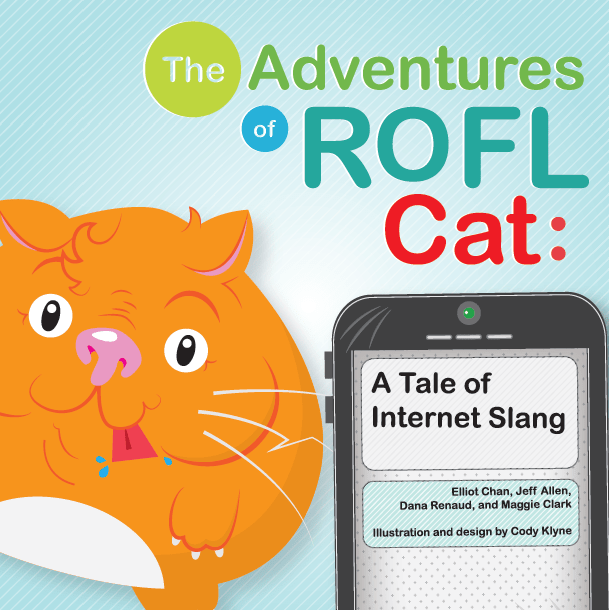
The Adventures of ROFL Cat: A Tale of Internet Slang

In late 2013, I had an opportunity to work with Jeff Allen, Dana Renaud and Maggie Clark, as well as the talented Cody Klyne, in bringing to life an idea I had stowed away in my head for many years. For that I say, thank you.

rofl

When you produce content regularly, not every piece of work stands out. Time passes and some fade away without any recollection—in fact, sometimes I don’t remember writing a piece at all when I reread it over the course of a couple months. I don’t think I’ll have to worry about forgetting ROFL Cat anytime soon… it is a project I can genuinely say I’m proud of. Not just because it was an idea that sat passively and patiently with me for so long (ideas are known to vanish before I get a chance to write it down), but also because those that contributed to the book did such an amazing job. I’m sure my pride for it is justified.

If you have not seen the works of Avery Monsen and Jory John, search them up. They are authors of the hilarious illustrated series All Your Friends Are Dead and K Is For Knifeball: An Alphabet of Terrible Advice. Those hardcover children’s book with adult humour was what I wanted ROFL Cat to be like: funny, in an adorable and rude kind of way.

Since the book is produced as a part of my professional writing program at Douglas College, we were offered limited printing. I would love for everyone to have a copy of ROFL Cat on the coffee table and bookshelf, but that simply doesn’t seem possible at the moment, as the demand is quite low—that being said, I still want to share it.

Here is the product of a bunch of talented people working together on one of my silly ideas:

ROFL

The Adventures of ROFL Cat: A Tale of Internet Slangs


– Elliot Chan, April 21, 2014

Highlights of 2012-2014: Memories of a young writer

10261738_10100261539296113_907550627_nHere are a few of my proudest work from 2012 to 2014. Enjoy!

The art of being alone
Nothing in life is permanent
A love letter to the capital cursive G
As POF Eliminates Intimate Encounters, Ashley Madison Makes Them Easier Than Ever
The calm before the glitter storm: profile of Top Less
Got too much on your plate?
Curse those cussing kids
The boomerang generation
What is love? Baby, don’t hurt me

Flash back to 2012: It has been five years since I graduated high school and four years since I graduated film school. The momentum I had after graduation in 2008 had faded, and I was still on the perimeter of the entertainment industry.

Sure, I have successfully landed a few auditions, got myself an apprentice status in UBCP and written and directed a few short films that I couldn’t help but be proud of, but realistically I was just fooling myself into thinking that I actually wanted to climb that ladder.

First rung: I worked as a background performer. Second rung: I did two years of stand up comedy. Third rung: I acted as production assistant for multiple companies and productions for literally four days. Fourth rung: I performed in some student films. Nope, it wasn’t a stepladder I was climbing—it was a Stair Master. I was going nowhere and I needed to get off.

Bam!

It happened all in one single night. I might have been in bed, but for dramatic reasons lets have me pacing through a rainstorm. I was drenched from head to toe and the only sign that I was still alive was the streetlights illuminating the next few steps I was going to take. There in the depths of my quarter life crisis I asked myself: What do I still want to do? Acting, Directing, Standup, Kitchen Prep, Writing.

It wasn’t an epiphany—I don’t get those—it was more of a “duh!” moment. Writing was the fuel that powered all my other previous passion from directing to standup. It was something I did without ever taking credit for because it was a mean for something else. I took it for granted. And it was a bit upsetting to realize all that wasted time was for not.

I don’t know what it’s like to have a divorcé, but I do know what it was like to call it quits on a dream and start all over. I know what it was like to say bye to a childhood passion and welcome a slightly more mature (but not really) alternative.

I still wonder what I would be doing if I didn’t make that conscious choice to become a writer. But I like to think that I haven’t given up on being a filmmaker. Life, after all, is quite long—or it could be—I’m just taking another route, an elevator. And it’s one that I’m currently enjoying. A lot.

I have spent the past two years with some of the most inspiring and generous people. Attending Print Futures at Douglas College and working at the Other Press has introduced me to a world of writing I wouldn’t have discovered otherwise. It took me out of my comfort zone, introduced me to new challenges and presented me with opportunities I could not have found from the comforts of my own home. It gave me confidence and made me adventurous. Failure was inevitable, but I wasn’t doing it alone anymore. More important than my education and my skills, I now have supporters. People whom I can turn to when I mess up a line or miss a grammatical error. I’m safe now. I’m on the right path… the climb continues.


– Elliot Chan, April 17, 2014

Foko Promotes Photo Taking at Work To Strengthen Communication and Solve Problems

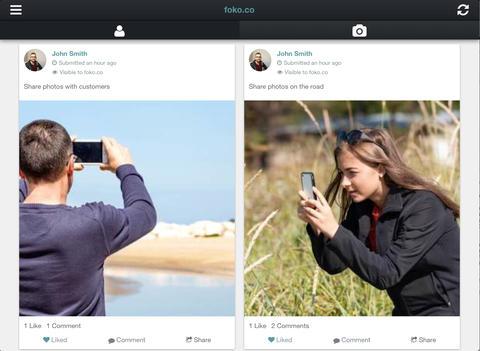
Ottawa-based Foko understands that photographs are the new quick, text-free way to communicate.

Whether it’s sharing our vacation photos, showcasing our accomplishments or taking a quick pic of our afternoon snack, our pictures can tell a story worth a thousand—maybe—more words. And that experience should not be withheld in the workplace.

Communication within an organization is paramount to the workforce, but recent trends have shown that internal communication platforms such as Intranets garner little traction. “There is around 10% [of employees at a given company using Intranets],” said Foko’s cofounder and CEO, Eric Sauve. “If you get 20% you are a hero. I came to a conclusion that companies are really missing out on connecting their employees.”

Simplicity became Foko’s focus as they tried to understand the barriers of communication in an enterprise environment. The result is a familiar Instagram-like app that enables workers, employers and all other members of the company to recognize each other through a medium that is easy to use.

“We came to photos,” said Sauve, “because you don’t need to know English and you don’t need to be a good writer; you just need a [camera] phone and you can participate. Photo sharing is the consumer Internet, from web apps (Pintrest and Imgur) to social networks to new services—the ones that are growing the most are photo centric—like Instagram and SnapChat. So let’s bring it to companies in a way that they can get everyone involved.”

Entering an ecosystem with so many different photo-sharing platforms, Foko finds its uniqueness in terms of privacy, security, and exclusivity. In another words, Foko caters to a corporate-audience. Ones that understands that when dealing with the behind the scenes photography of Fortune 100 companies, a few potential problems need to be addressed, such as HR problems, IT leaks issues, etc. Foko builds the community around the workers; only allowing those associated with the company the ability to view activities within.

This internal communication enables stores and offices in different geographical areas to work together to strengthen merchandise sales, etc., and colleagues with different schedules to catch up and discuss the happenings at work. In addition, Foko also helps enterprises share and promote events and occasions that stems from the workplace, such as charity events, volunteer opportunities, conferences and company parties. Photos are also a friendly way of introduction and acknowledgement, especially in big companies where workers seldom see each other. The ability to welcome a new employee or to acknowledge an old one is something every company, large or small, should have the capability to do.

The use of social media and other consumer platforms are often frowned upon at workplace. If you spend your time posting pictures on Instagram at work, you are probably wasting time, but if you post something on Foko while working, you are building workplace cohesion.

“It’s all in how you used the social media,” said Sauve. “It’s the fact that it’s private that makes all the difference. If you take a picture at work and share it on Instagram: are you sharing secrets, are you sharing embarrassing stuff about the store and does it meet with the branding guidelines of how we interact with the public? But if you share it internally, nobody cares about that stuff.” Sauve added, “Sharing within a constrained group really changes the nature of social media.”

In the upcoming week, Foko is also introducing the private messaging feature to their application, enabling workers to communicate with individuals in the company. Instead of sending a photo to the entire company, you can select the co-workers you would like to receive the picture and reach out to them privately. Say, they forgot their mints at work, well what better way to notify and reassure them that it’s still there—untouched— than with a fresh picture of it?

Sacred cinema

The bible shouldn’t be Hollywood’s only source for religious inspiration

By Elliot Chan, Opinions Editor
Formerly published in The Other Press. April 8, 2014

I belong to a growing demographic of non-religious North Americans. Although I came from a Buddhist heritage and live in a country with a large Christian population, my curiosity stems further than my beliefs, my family’s beliefs, and my neighbour’s beliefs.

I have always been a sucker for stories, even if they have a moral at the end, and some of the greatest stories ever told are locked within sacred text: the Bible, the Qur’an, Sanskrit, Torah, etc. Tapping into these ancient texts will open our eyes to a world we are often ignorant of, and I believe that will be a significant step toward global tolerance.

We North Americans enjoy watching comforting movies, stories that we’re familiar with. But exploration is equally as entertaining. Noah offers a lot of epic scenes that make the job for the marketing team easy, but I also know that there are millions of other stories based in other religions that could contain the same amount of drama, special effects, and even Russell-Crowe-in-sandals scenes. As someone who has no defined religion, I’m more inclined to see a movie about an unfamiliar story than one constantly used in analogies.

I don’t believe religious movies are meant to convert someone’s beliefs. I believe that they’re simply created to entertain, earn a profit, and start a conversation about something that is losing effect in Western culture.

Religion turns a lot of people off these days, which is upsetting since religion is a significant part of the human identity. We should embrace it. Not just one religion (Christianity), but all of them. If we want to be a global community, we should explore all cultures, heritages, and of course, religions.

Harmony needs to start at home, and movies have always been a medium to bring people of all classes and beliefs together. Hollywood has made many weak attempts in telling stories from foreign sacred texts; that’s because they always try to find a Western perspective. It’s true, casting Keanu Reeves in a story about Buddhism is a recipe for chuckles. The key to adapting a story properly is honesty. Instead of catering to an audience, the filmmaker needs to simply tell the story the way it’s meant to be told, while finding the cinematic appeal.

Hollywood needs to team up with those of other cultures to create these impactful movies. They have to find the soul of it—the heart of the religion. By communicating the essence of those stories, the audience will be able to see how unique tales can shape so many different people from all reaches of the world. In our own comfortable way, we will be enlightened. It might not change our mindsets, but for a brief moment we can see from another’s point of view, and isn’t that what filmmaking is all about?

When you can’t find the needle in the haystack

Should mysteries end without resolution?

By Elliot Chan, Opinions Editor
Formerly published in The Other Press. April 8, 2014

It has been one of the biggest mysteries of our generation: the TV show-like disappearance of Malaysian Airline’s MH370. After roughly a month of searching, speculation, and outrage, the airliner carrying 239 people on board is still lost. Although the search team consisting of 25 countries has narrowed the area of disappearance to somewhere between Kazakhstan and the South Indian Ocean, the searchers have nothing to show for it. So, I must ask: can we move on without closure?

The history books are full of unsolved mysteries: from serial murders to paranormal activities to geographical phenomena such as the Bermuda Triangle. I’m aware that giving up on MH370 might not be an option—not with so much tension built, and not with such a tantalizing storyline following it. Perhaps it might even be found by the time you’re reading this.

Regardless, once the initial shock of the tragedy has dissipated, I think we can all appreciate the suspense of a good mystery. But while we, the distant and detached, continue living our lives and checking in occasionally, the family members, the search teams, and the people affiliated with the lost airliner are living in the aftermath of (pardon my language) a shit storm.

“Never give up hope” is a common saying when challenges seem insurmountable. But then again, we also say, “Let’s cut our losses.” There is no timeline at the moment for the search, but I believe one needs to be implemented soon. The longer we keep searching with no results, the harder it’ll become to give up. Like gambling, we’ll have placed too much on the line to walk away. When all we’re playing for is less than breaking even, I can’t help but feel that regardless of finding the airliner or not, the sensation will still be the same—it’ll be sorrow.

We must continue with our own lives, and not let the loss diminish our happiness. The world is full of inexplicable mysteries. Why do bad things happen to good people? Why do we work so hard for nothing? What is the meaning of life? These are all questions without answers that we live with every day. Although it might bum us out every now and then, we still wake up in the morning, put on clothes, and face the cruel reality. I’m sorry to say, but “What happened to MH370?” might be another one of those questions to keep us up at night.

It’s human nature to seek resolution. Discovery is a great triumph and it can define a generation, but unsolved mysteries are not defeats; they are proof that life on Earth is more than problems and solutions. Life is full of wonders, conundrums that keep us guessing and imagining. If we consider ourselves gamblers in a celestial casino called Earth, we must also remember that we are playing by house rules. Sometimes we need to know when to fold.