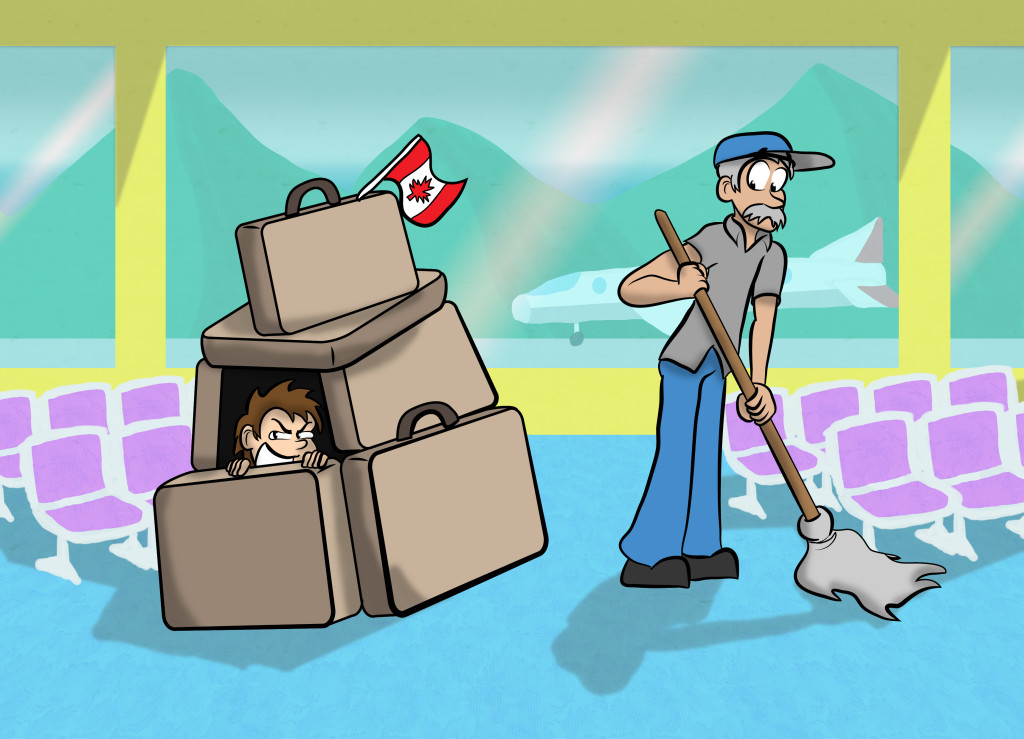
Terminally Chill

LS_Airportfinal-1024x739

Surviving airport purgatory

Formerly published in The Other Press. May 8 2013

By Elliot Chan, Staff Writer

No matter how well you prepare for traveling, delays and cancellations are bound to happen. You can huff and puff all you want, but it won’t get that plane in the air any faster. I have suffered through many days and nights at airports far from home, sometimes due to finicky air traffic control, other times caused by my own stupidity. I know exactly how Tom Hanks’ character felt in The Terminal, wandering around an empty airport, with nobody but custodians and airport security eyeing you. They know how harmless you are, but their pitiful reproaches are pinpricks to the ego.

When faced with a long airport stay, you have two options: you can choose to leave the airport, get a hotel room, and pass the time in the world outside. But if you’re like me and didn’t budget for inconvenience, you might rather just hunker down at the airport and wait for the tides to turn. If that’s the case, I’ve supplied some tips that will help you not only pass the time, but make the best of it.

Move around: Don’t be bound to the little comfy corner you found for yourself. An airport is a big place; there are many places to roam around. By staying active, you can avoid the monotony of airport cabin fever. And if you do have a corner you like, odds are few people are going to compete for that little secluded spot. Most people are coming and going; few linger like we do.

Be productive: Music, books, movies, and even companions can all be rendered useless at an airport. There is only so much you can do before boredom kicks in and you lose the will to focus on meaningless enjoyments. Stay productive instead. Start researching activities you want to do when you reach your destination or catch up on work. Grab a piece of paper and make a list of the chores you would like to accomplish when you get home. Turn the dreary hours of waiting into constructive and creative time well spent. Don’t resist getting work done just because you are on a trip. There is a satisfying feeling when you accomplish something out of the blue.

Eat, rest, and get better: After you get over the initial disappointment and frustration, it is time to regroup. Grab some food and rest. People-watching is a great way to forget about your own troubles. See them hustle down the concourse toward baggage claim, know that for the moment you can just chill. People will generally be friendly when you try to strike up a conversation—for most people, travel is an exciting thing. Simply ask where they are from and where they are going, and you can tell by their tone whether or not they are eager to continue with the conversation. If not, move on. They probably aren’t going anywhere interesting anyways.

Whether you missed a connecting flight or other unforeseen circumstances kept you from flying, know that waiting is not the worst thing that can happen abroad. No matter how restless you get, remember that traveling is a privilege. So what if you lose an hour, a day, even a week of traveling; safety is the most important thing. Keep track of your belongings and take care of yourself. The airport might never be heaven, but it definitely doesn’t have to be hell.

The Sole Goal

SPORTS_Player-AwardsSidney-Crosby1

Best players of the 2013 NHL season


Formerly published in The Other Press. Apr. 16 2013

By Elliot Chan, Staff Writer

For a moment there in early January, hockey fans were ready to call it a year; but after a significant portion of the season, the lockout is now fading in the rear view mirror. Still, the shortened season has produced some magnificent performances from some of the games most experienced players and young up-and-comers. It will not only be an interesting playoff run, but also a tight race for the players’ trophies awarded at the end of the year.

Hart Memorial Trophy: Despite breaking his jaw in a game against the New York Islanders, Sidney Crosby is the prime candidate for the NHL’s version of the MVP. But if voters are feeling generous, they might turn their sights to an unexpected candidate: Columbus Blue Jackets goalie Sergei Bobrovsky. After losing star forward Rick Nash in the summer, Bobrovsky has displayed heroic numbers with a 2.01 goals against average, a .932 saves percentage, and a record of 16–10–6. If the Blue Jackets are able to sneak into the playoffs, consider him the contender.

Calder Memorial Trophy: The top rookie award is a three-player race between Florida Panther’s Jonathan Huberdeau, Ottawa Senators’ Cory Conacher, and St. Louis Blue’s Jake Allen. Huberdeau and Conacher have been neck and neck all season. The league can flip a coin on those two young forwards and do no wrong, but the wild card is Allen. The 22-year-old goalie has carried his team at various points throughout the season, while veterans Brian Elliott and Jaroslav Halak were coping with injuries and poor play. The Blues would not be in playoff contention if it weren’t for Allen’s 9–4–0 record.

James Norris Memorial Trophy: Many would be surprised at the beginning of the season if one were to say Sheldon Souray and Francois Beauchemin of the Anaheim Ducks would be considered among the best defensemen of 2013. But that is exactly what they are. Beauchemin is spotting his first positive plus minus season since 2006-07 with a +24. But other teams are not forfeiting the title to the Ducks so hastily. Often awards are given not just by performance, but also by reputation—and few have a better reputation than Boston Bruins’ Zdeno Chara while others believe that P.K. Subban from the Montreal Canadiens has a good chance, leading all defensemen with 32 points.

Frank J. Selke Trophy: Awarding a player based on how they consistently perform in games, rather than on statistical prowess, is a hard one to select… in theory. But there’s no denying that Pavel Datsyuk of the Detroit Red Wings is the main candidate. Few players can play like Datsyuk, with his shifty style he can steal a puck, finesse it, and score a goal before the opposition even knows what happened.

Lady Byng Memorial Trophy: It would be a surprise for Patrick Kane of the Chicago Blackhawks to be rewarded the player with best sportsmanship, mainly because of his past reputation. But his miniscule four minutes of penalty and 46 points proves that he is a maturing player, focusing more on winning games than showboating. Another player worth recognition is Matt Moulson from New York Islanders, who has 37 points and also four minutes of penalties.

Vezina Trophy: This is the year where back-up goalies have come into full form. Although Bobrovsky is the touted favourite, Tuukka Rask from Boston is really calling for attention in the league with a .928 SV% and a 1.95 GAA. Ray Emery of Chicago Blackhawks may be the dark horse, but with a 14–1–0 record in the season so far, how can anyone deny his proficiency?

Uploaded: a profile of Andrew Huang

Formerly published in Ricepaper Magazine.

by ELLIOT.CHAN on Apr 27, 2013 • 4:23 pm

Andrew Huang’s musical mystique is an exploration. Different environments conjure different personalities, different auras and different sounds. Like a chameleon, he is able to instinctually morph to suit his surrounding, whether it is the soulful rhythm of a heartbreaking ballad or the fast-pace delivery of a tongue-tying rap song. One scroll down Huang’s YouTube channel and you could witness his musical range.

“I made my YouTube account in 2006,” he said, “just because I thought I should have one. But I didn’t put anything on it right away.” Now with over 260 videos, Huang had fully embraced the platform and not only does he consider it to be a jumping board to higher achievement, he feels YouTube might just be the next grand artistic movement. “I started seeing how fast an audience can grow there, because there was already a community. It started making sense.”

Limitation is the stratosphere determined by artists’ platforms. While some are trapped within a glass jar, Huang feels he could reach the stars with his creative freedom. Marching to his own beat, he focuses his attention away from creative roadblocks such as administrative, logistical work. “If I want to upload 10 videos in a month, I can do that. You can publish stuff anytime you want,” he said, “and anyone on the Internet can just stumble upon it.”

Despite all the fun, it is still a livelihood. The business demands a lot of him and the effort it takes to produce a product do not always yield a gratifying or satisfying profit. Huang is a brand, and he understands the dark side to marketing. “The question of how much you can get back from it is a question of how much you can engage a community and reach new people,” he said, “At the end of the day, I can be doing the exact same amount of work, but for whatever reason I get twice the subscriber base and in theory there would be twice the people downloading my songs.”

The Internet is an intimidating place, especially when artists are uploading such vulnerable pieces of work. Huang takes chances—a lot of them. Although he is fueled by positive reinforcement, a negative comment can drain the tank pretty quickly. Still, there are few put downs and snarky remarks that can keep Huang down. In a piece where he took a viewer’s ideas to use a 1000 pairs of jeans to formulate a song, he was met with a sarcastic comment asking, “how much time do you have?” To which Huang replied, “24 hours in a day like everyone else… I just have a more interesting job.”

“If you are getting any amount of views on YouTube, it is hard to avoid those hateful and ignorant comments,” said Huang, “I usually ignore it and focus on the positive. But every once in a while someone will bring up a point that I feel is good to response to.”

Feedback is vital to all artists and the same goes for Huang. But he doesn’t allow it to interrupt his creative progress. While writing a song or filming a video, the little critiquing voice in the back of his head can be an asset and a torment. “This part of the video someone is going to make fun of or the fact that I decided to wear this, someone is going to call me a name,” he said, “These things occur to me, but I don’t change the work I am doing because of those thoughts.” Huang takes compliments and criticisms when they come, but none of it is precious.

Forward is the only direction for Huang. Moving from one project to the next, he has few motives except to create. “The stuff that I’m most proud of I’ll go back… I mean I’m proud of most of it, but the stuff I really love—it is nice to be able to enjoy it from a distance,” he said. “But for a lot of it when it is done, I am ready to move on to the next project.”

But being so prolific comes with its own downfall, and for Huang it’s organization. “I love having an organized space,” he said, “but the actual sorting out where things have to go and cleaning up. And organizing in terms of events and productions.” Being a jack-of-all-trades requires him to juggle many tasks at once from printing CDs and vinyl to corresponding with other artists for collaboration projects. “It has to be done, so I do it.” If Huang isn’t bouncing from one instrument to the next in his studio, he’s on the Internet, rather emailing or searching up the latest trends.

Creativity and curiosity is the air Huang breathes. From the computer to the microphone to different instruments, if there is a blockage in inspiration, all he has to do is shift gears and keep going. “I enjoy so many different types of things,” he said, “I’m working in video and music, but I’m also doing different types of music and video. Within the world I work in different genres. The fact that there are so many different things I could be doing keeps me from those creative blocks. It’s a constant state of creativity or emailing.”

As a morning person, Huang takes advantage of the longer day, spending anywhere from eight to 12 hours being creative. But despite working such long hours, his craft is still an unknown. “It’s kind of tricky,” he described the complexity of explaining his work in a social situation, “It depends on the type of person I’m talking to. I might introduce myself as an independent musician or I might introduce myself as an Internet content creator. Or I just call myself a musician.” Regardless of what Huang sees himself as, it is always a process communicating his job to others. “I make YouTube videos for a living,” he said with an air of pride, “but there are certain preconceived notions of what that can mean.”

The Internet is a forest of celebrities, from great Sequoias to plain Danaes. With acres upon acres of content to explore, Huang believes it is the new world of entertainment. “All these people who have hundred of thousands and millions subscribers, they aren’t on TV, they aren’t in the magazines, they can walk down the street and not be recognized,” he smiled about the oasis he created for himself, “maybe one day it’ll be more than saying, oh I make stuff for the Internet.”

Canadian Startup eBounties Launches, Makes Getting What You Want Easier

Unlike Craigslist or Kijiji, eBounties puts the buyers in charge.

While the Internet is full of sellers trying to dispose of their merchandises and prize possessions, buyers end up searching through pages and pages attempting to locate what they want. How is anyone supposed to find that needle with all those haystacks? Well, eBounties puts the onus on the public to get you what you want and offers a reward or a bounty as an incentive.

Ebounties is a free service, but pre-approved payment through PayPal is needed to confirm that the money is available when someone finds what you are looking for. The user will only pay for results.

Last week, Toronto-based eBounties launched in Canada, as well as the US, the UK, and Australia. Allowing users to tap into the collective knowledge of the crowd, the possibilities are endless. Scavenger hunting is a realistic job. Users browsing will not only help someone find a rare collectable or help a company find a suitable employee, they will also be making a little spending money.

Users can claim a bounty in a couple of ways. The first is by providing the exact knowledge, service, item or connection that a buyer is seeking; the second way is by connecting the buyer with someone else who has those knowledge, items or etc.

“If the average person knows just 300 people,” says Luke Chao, founder and CEO, “100 people know 30,000. You absolutely need crowdsourcing to find a person (or an item, or information) that is rare.”

Headhunters, matchmakers, antique dealers and other traffickers of privileged information and connections garner a lot of money, yet they don’t have any special requirement. Ebounties is hoping to start a revolution, one that allows anybody with informative knowledge or highly touted items to make money.

Google searches don’t always yield the information we want, so the Canadian startup encourages users to be creative. One user offered a $15 bounty to anyone who can find a local nut-free Chinese restaurant, while a Toronto-based hypnosis centre offered $75 to anyone who can bring in new clients.

A Tofu Review: The Eatery – Modern Sushi in Vancouver, B.C.

109230

Formerly published in TofuMag.com.

Published on April 26th, 2013 | by Elliot Chan

Modern artist Andy Warhol was famous for his paintings of Campbell’s soup cans and distorted celebrity photographs, so if he was to open a sushi restaurant one can only imagine that it would mirror the flare of The Eatery in Vancouver. Contrary to the traditional vibe and décor, The Eatery lacks the usual paper walls, wooden panels and thin cushions of an authentic Japanese restaurant, instead it has papier-mâché monsters hanging from the ceiling, glow in the dark figurines standing sentinel on elevated shelves and Astroboy portraits on any remaining surfaces.

Initially the restaurant’s atmosphere rushes you, like entering a nightclub after a couple hours of pre-drinking, but then you take a moment and adjust to the candlelight illuminating from the Dad’s Root Beer bottles and listen the audio melding of jovial conversations and boisterous music. Suddenly, you are ready for anything — but you are here for sushi.

For all those indecisive folks who read menus like textbooks, The Eatery is a dining experience that you shouldn’t study for. Don’t try and cram, the more you evaluate each selection the more disheveled you’ll become. Deep breath. Ignore the fact that you are ordering food, look at the artwork the menu offers and embrace the possibilities. After all, with names like ‘erotica roll’, ‘drunken monkey roll’ and ‘x-rated roll’, how can you go wrong?

Two special rolls lured me. One was the ‘crazy-spice roll’, because whenever something claims to be crazy — I’m intrigued. The next was the ‘Godzilla roll’, my strange childhood obsession with the Tokyo destroying monster had followed me to adulthood and now it is controlling the food I eat. Go figure. eaterysmall

Over the years of eating sushi, I’ve learned to strategize my meal accordingly. If I take a bite from a piece with an overwhelming taste, I follow it up with one that is subtler. Coincidently, the ‘crazy’ and ‘Godzilla’ paired nicely. While the ‘crazy’ supplied the gentle singe of any good spicy tuna and salmon, ‘Godzilla’ followed up with the gentle cleansing of crab, avocado and unagi eel. It seems a little contradictory that ‘crazy-spice roll’ was the one causing havoc and ‘Godzilla roll’ was the one to sooth the palette. But I guess in the funky dimension where The Eatery’s artistic chefs craft their work — the plate as a canvas — sculpting with rice, painting with sauce and slicing each piece into a mosaic, there is no boundary for creativity. Each meal evokes a story, but do I dare say it leads to a happy ending?

The classic model for Japanese desserts is usually mango and green tea ice cream. Although sometimes you might have a laugh misleading sushi-novices to believe a spoon of wasabi is ice cream, after time the novel prank wears off. Time for something new. Instead of staying culturally conservative, The Eatery branches off when it comes to sweets. Such simple carnival delights like deep fried Mars bars and root beer floats are available as well as more exotic selections. Dreaming of summer, I chose a showstopper in a steel martini glass, ‘Caribbean Fantasy’. Here’s a phrase to remember, bananas sautéed in rum and brown sugar. If ice cream is sunshine for the taste bud, the ‘Carribbean Fantasy’ might as well be a supernova. There is a lot happening for such a small serving. Individually, the saccharine flavour is too much to handle, but with the neutralizing effects of vanilla ice cream, suddenly the dessert is gone – black hole.

Sushi always had a futuristic aura, but now it has entered a post-modern phase. It has gone to a place where it no longer needs to be associated with serving plates shaped like boats or bento boxes. In this brave new world, sushi is the pizza, burger and burrito. In Vancouver where so many restaurant march to the same beat of knife to cutting board and Hobart machines, it is refreshing to know that there is a place breaking the mold. Warhol would be proud; then again, he might just say it was The Eatery’s 15 minute of fame.

The Eatery is located at 3431 West Broadway, Vancouver BC.

For more information visit their website at http://theeatery.ca.

Vancouver’s Fatigue Science Develops New Technology to Help Sleep

Sleep: we spend a third of our lives doing it—or at least we should.

In our stressful 24/7 world with deadlines and overtime, sleep deprivation is a common problem for many people. Whether you are a student or a professional athlete, society demands us to function at our best and Fatigue Science knows that in order to give our top performance we must be well rested and fully charged.

In 2007, Vancouver-based Fatigue Science was founded with the goal of creating a more effective world by applying science and technology to assist sleep, optimize performance, reduce risk and improve lives.

Fatigue Science understands that scheduling for sleep is not always as simple as closing your eyes. “Studies show that in the United States, 30% of adults sleep less than 6 hours per night,” FatigueScience.com states, “and 65% of adults have sleep problems at least a few nights a week.”

The new ReadiBand technology is hoping that informative personal data will reduce the risk and improve the quality of sleep. The wrist worn device was first developed in part by the US Military, where functioning through fatigue is a fact of life. Now government professionals use ReadiBand, as well as corporations around the world and even professional sports teams such as the Vancouver Canucks.

The ReadiBand measures day-to-day sleep quality, quantity and timing. The sleek black wristwatch measures and analyzes the wrist movements to distinguish sleep/wake patterns. Data shows that this virtual sleep assessment has 93% accuracy, the same as a sleep lab polysomnography. Statistics gathered from the ReadiBand can then be processed through a patented and validated computer model to evaluate fatigue risk levels.

Busy work schedules are important, but the body clock is not something we can ignore. Fatigue does not only affect workplace performance. Lack of sleep is dangerous in all areas of life. In the last five years, according to the Canadian Council of Motor Transport Administrators, 21 per cent of motor vehicle collisions have been the cause of fatigue. The result is about 400 deaths and 2,100 serious injuries every year.

To avoid these critical accidents, Fatigue Science also developed a tool to help employers and employees chart their schedules. FAST, or the Fatigue Avoidance Scheduling Tool, is a software application which calculates fatigue risk, reaction time and other variables to help people properly schedule their work and sleep during a course of a week.

Most adults require seven to nine hours of sleep to have a fully effective day. To most of us that sounds like a luxury, but sleep should be a requirement—a responsibility. Too often, we sacrifice rest to fit more activities into our day and adjust our sleep pattern on the fly.

Fatigue Science shows that many people are poor at judging and managing their alertness level. Too little or too much sleep can attribute to a less than healthy lifestyle. With the help of Dr. Steve Hursh, who has 23 years of experience at the Pentagon, Fatigue Science created a model by comparing fatigue to blood alcohol content.

Gym memberships, organic diets and now Fatigue Science; there will always be new advancement to healthy living. But as long as we find the balance between work and rest, we can mitigate weariness and continue fulfilling our responsibilities and doing the activities we love to our full capacity.


BlackBerry Founder Mike Lazaridis Supports BBM’s Move to iOS and Android

Will iOS and Android users respond to the BlackBerry Messenger applaunching for iPhones and Androids this summer? Mike Lazaridis, founder and former vice chairman of BlackBerry believes they will.

“BBM is by far the most compelling wireless experience and wireless social-networking environment,” Lazaridis said at the Bloomberg Canada Economic Summit in Toronto last week. After stepping down as executive and co-chairman of BlackBerry in 2012 and leaving the board in March, Lazardis feels his successors are taking the company in the right direction.

“What he’s [BlackBerry CEO Thorsten Heins] doing now is really speaking to the confidence he has in the platform, the products,” said Lazardis. “Not only is BlackBerry back in a big way with BB10, he has also shown that he can expand that vision to other platforms.”

Sixty million BlackBerry customers are currently using the free BBM service and rely on it daily. While some consider the transition inevitable, others consider the risk of BlackBerry losing control of their most valuable services. Profit has still yet to be determined, but with new BBM channels with chat rooms focused on specific topics and themes, many advertisers may seek the company for sponsoring opportunities.

SEE ALSO: BlackBerry 10 Now Has 120,000 Apps

It has been awhile since BlackBerry has fallen from the smartphone pedestal. If it wasn’t for companies and government agencies’ reliance on the existing BBM service, survival may not have been possible. Now as BlackBerry dust itself off and return for glory, will costumers support their comeback? BBM has a daunting mountain to climb to regain relevance, competing with other instant messaging applications such as WhatsApp, iMessenger, Facebook Messenger, Google+ and many more cross-platform messengers.

Since WhatsApp has over 200 million active users and iMessanger with over 140 million, BlackBerry will have to do more than simply avoid extinction to get noticed. But still, Lazardis believes that the unique BBM experience will win over the public. BBM has many positive attributes and their loyal costumers can tell iPhone and Android users all about BBM Group and the messenger’s immediacy, with almost half of all messages read within 20 seconds of being sent.

RELATED: BlackBerry Unveils the Q5

BBM’s move to other platforms may be their return to the top of the smartphone rankings or it may be their initiative for their own demise. By making BBM available for all platforms, current BlackBerry users may just take this convenient opportunity to transition as well.

WHAT IS THAT IN VANCITY: THE FIRST NARROWS “LIONS GATE” BRIDGE

Formerly published in MeetVanCity.com.

Tuesday April 9, 2013

lions-bridge-stanley

Branching out of Stanley Park, stretching across the Burrard Inlet and linking to the
North Shore, The First Narrows Bridge is arguably the most scenic route commuters
can take in Metro Vancouver.

Construction began in 1937 to accommodate with the city’s growth. But having the
structure in such a prime location caused many concerns. Some thought it would
create an uncontrollable flow of traffic through the park, thus urbanizing the natural
environment. Others were worried about the activities on the water, resulting in
problems on the ports located all along the coast of the inlet. Adapting to the bridge
took some time, but now, it has become more than a simple means of transportation.
The First Narrow Bridge and the view it offers are attractions for all visitors and
those in transit.

As popularity grew, the bridge took on a new name and a new image. The Lions Gate
Bridge refers to the entry point of the Lions, a pair of mountain peaks located in
North Vancouver. The bridge is now a symbol of beauty and pride, a collaboration of
modern day engineering and natural landscape.

Today, over 60,000 vehicles cross The First Narrow Bridge daily. The three lanes
separating traffic are reversible, and during rush hour the middle one swaps in
order to manage the different traffic patterns. On a nice day, bikers and pedestrians
may choose to cross the bridge and enjoy the viewpoints on the decks located at
each support tower.

At night when the chaos of a day is over, the cables suspending the bridge
illuminates and changes colours. The Guinness family donated this decorative
innovation to the city in 1986. Since then, BC Hydro has transitioned to LED lights.
Although the bridge has gone through many changes since its resurrection, few
things have not—it still brightens a city that never ceases to shine.

Don’t get disconnected

 OPINIONS_Communication PART 2

Alternative means of communication should be mandatory

Formerly published in The Other Press. Apr. 16 2013

By Elliot Chan, Staff Writer

Admit it: you’re an important person. People rely on you, and it doesn’t matter if your cellphone is out of battery power or if you’re out of town—they still need to contact you. Technology is so accessible now that it would be ridiculous to not embrace it.

Some worry that social networks may become an addiction and a waste of time, but the truth is, if you’re a procrastinator, you’ll have more than Facebook and Twitter to contend with. Distractions come in all forms, and to blame it on one thing is a lie.

Like everyone else, I too was initially reluctant to join an online community linking me to all my friends, colleagues, classmates, and even reproachable family members, but it’s a simple way of keeping them in my life. You might not share their love of cats or inspirational quotes, and they might not care about your vacation pictures or status updates—but that’s not the point. The point is that you know they are there, and vice versa.

If a cellphone is your only lifeline to the world, then you might end up a castaway. News travels fast. If you only get social updates from word of mouth, then odds are it’s already old news. Very few social engagements are arranged face-to-face or even over the phone. Usually there is one person organizing the event, which is a strenuous job in itself, but inviting people is often even more troublesome. Simply being present makes their job a lot easier. If you want to be properly invited, then allow yourself the opportunity. That way, no feelings will be hurt.

Privacy is a problem we all deal with in social media. You don’t want your employers seeing your party pictures, and you don’t want disdainful individuals creeping your page. These are circumstances we all have to face alone. The same way you wouldn’t leave your front door open for intruders, you also shouldn’t leave your Facebook accessible to just anyone. We’re all on different levels of security, so it’s important to recognize the unsavoury ones.

In the same way that foregoing insurance is irresponsible, dismissing forms of communication is inconsiderate of yourself and others, whether they depend on you to show up for a coffee date or to meet a deadline. Technology is good. It’s the new generation, and though I might be preaching to the choir, I would also like to suggest that it’s important to teach these means of communication to the elderly. It might seem horrid seeing our parents on the Internet, browsing through our Twitter and reading our blogs, but hey, why should we hoard a good thing? They fill out census forms and they pay their taxes, so why shouldn’t they be reachable to the wider world? After all, your home makes you a resident of your community, your job makes you a member of an organization, and your online presence makes you a citizen of the technological world.

Canadian Startup Enginuity is a Social Search Engine That Requires a Membership

Enginuity Search Media is Durham, Ontario resident Daniel Gardiner’s brainchild.

His objective is to create a new search engine that ranks search results based on social shares. By connecting links from social networking sites like Facebook and Twitter, Enginuity allows people to measure usefulness of links more effectively. After each search, a bar will appear beside the results showing the traction it has with social sites.

Liking posts and sharing contents has become a popular trend in online media and Gardiner recognizes the benefits. “We’re very picky on what we share, so I think that really counts,” Gardiner said in an interview with DurhamRegion.com. “It shows someone really valued that information versus something that’s gotten no shares at all.”

Enginuity also offers a more advance search review by allowing viewers to separate basic searches into categories. Unlike common search engines such as Google or Bing, Enginuity requires a membership.

There is no fee to use the search engine; however, a premium member will have additional perks. These additions include viral searching, where users can track trending content through social sharing, as well as social commentary rating for an insight on the public’s thought about any given search result. Premium membership is $11 per month. A free trial is available.

Gardiner, CEO of Enginuity Search Media is a software engineer with 12 years of experience behind him. He understands that marketing is changing and in order for growing companies to get recognition they must be aware of trending and trendy content.

By keeping pace with what is current and viral, businesses can target advertisements more effectively. Enginuity is hoping to help that process by eliminating the filler from searches and focusing on the most popular results.