Lost Vegas

by Elliot Chan

I was somewhere on Las Vegas Boulevard heading south from my hotel, which seemed like a mirage in the distance. I was 18 years old, too young to enjoy any standard entertainment and too old to tag along with my family.

OLYMPUS DIGITAL CAMERA

Vegas was a sad place for a family vacation. My father and I would hop about from one slot machine to the next, fearful to commit, but too curious to worry. My mother would attempt to wrangle us all together for quality time. At night we would see shows and eat buffets, but the days were long and there weren’t much for an adolescent boy to do.

OLYMPUS DIGITAL CAMERA

We weren’t staying long, just four nights. And in that short amount of time, I managed a lot of walking—but I refer to it as an urban hike. On my own I wandered the promenades searching for something spectacular. There weren’t many streets like it in the world. There were landmarks on every corner and swarms of tourist crisscrossing, traveling from one hotel to the next with no intention of staying.

OLYMPUS DIGITAL CAMERA

The day was hot and I was already too far-gone. I would enter a hotel for rest, savoring the theme of each casino as if it was some novel location. I enjoyed the idea of a place in the world where nobody really lived in, where everyone was just visiting. A part of me feels like this is how every city should be, how all citizens should be—Nomadic, just aimlessly wandering, winning and losing.

OLYMPUS DIGITAL CAMERA

Outside I could only locate myself by the signs and building structures. Bellagio, MGM Grand and Treasure Island, everything seemed so close at a glance, but that was Vegas’ greatest illusion. The city is deceptively big, and my attempt to visit every hotel on the block was a failure.

OLYMPUS DIGITAL CAMERA

I took a wrong exit out of MGM and ended up on a highway. I went back in, wandered around for a bit, looking the proper exit and for the prize lion they have locked up behind glass, but the cage was being cleaned and all that was there were two maintenance men. I eventually found another exit that didn’t look familiar. It was too late though; I was already on the move.

OLYMPUS DIGITAL CAMERA

I left the strip and was struck with a moment of fright when I crossed through a construction site. A new hotel perhaps, should be ready for accommodations the next time I visit. Until then, I needed to find my way back to my current hotel, miles away.

The gulls it takes to call a place “paradise”. A man hands me a couple prostitute trading cards. How delightful. I tuck it into my pocket and continue on my way. I arrive at a courtyard at Caesars Palace. I snap some pictures of statues and monuments and realized what I was doing. I was fooling myself into believe I was some place special. I was in Rome, New York, Paris, and Egypt. Vegas is a travelers’ lie. Too frightened to travel? Don’t want to deal with language barrier or snooty locals? Well Vegas.

OLYMPUS DIGITAL CAMERA

For vacationers, Vegas can be a terrific all-inclusive experience, but for travelers, Vegas is a warm up, an appetizer or even just a menu. Nobody really gets lost there, they just get returned.

 

SOS Canada

 shutterstock_199724069-500x375c

Should the Canadian consulate rescue troubled citizens abroad?

By Elliot Chan, Opinions Editor

Formerly published in The Other Press. Jan. 28, 2014

Travellers know the danger of visiting a foreign country; it’s the little extra spice in travelling. They hear stories on the television about political unrest, radical rebels, and petty criminals. Still, their desire to see the world is not dampened by the risks. Travellers know if something happens to them abroad, their citizenship is enough for them to get noticed. Someone back home will care about and miss them. Their government will do whatever it takes to get them back. But what if the travellers were the troublemakers? Should they be brought back home and punished as Canadians?

We all get that anxious feeling when we cross the security checkpoint at airports. Sure, we know that we haven’t committed any crimes and that we aren’t packing any contraband, yet we still worry because the alternative of being guilty is so scary. Put yourself in the shoes of a smuggler; put yourself in the shoes of a smuggler being detained; then put yourself in the shoes of a smuggler sentenced to death. So, I ask again, should Canada save you?

Currently, the Canadian consular office provides detainees the ability to communicate with their home country, presents proper nutrition, and connects them with a legal representative, but it does not get them out of jail or post their bail or make travel accommodations for their family. Although some countries have transfer of offender arrangements—including Brazil, United Kingdom, and Thailand—many other countries don’t. The Canadian Department of Foreign Affairs, Trade, and Development has a lot of limitations when it comes to another country’s judicial system.

Travellers are not just Canadian citizens; they must also be citizens of the world. To say that they don’t know the law in another country isn’t a good excuse. That is just ignorance and deserves to be punished. The same way you wouldn’t jump into an ocean if you don’t know how to swim or what lies beneath, you shouldn’t dive into a foreign country if you don’t know what will pose harm for you, the locals, and your country’s image.

Remember that when you’re abroad you’re a representative of your homeland, regardless of where you’re from and what your background is. As much as you want to have an awesome time and make wonderful memories, it’s also important to respect other people’s home and country. Remember that you’re a guest and that you’re not entitled to anything. Be respectful and treat Cambodia, Cameroon, and Colombia the way you would treat Canada. If you follow ethical behaviour wherever you go—you know, the kind of stuff your mother taught you—you likely stay out of trouble.

Terminally Chill

LS_Airportfinal-1024x739

Surviving airport purgatory

Formerly published in The Other Press. May 8 2013

By Elliot Chan, Staff Writer

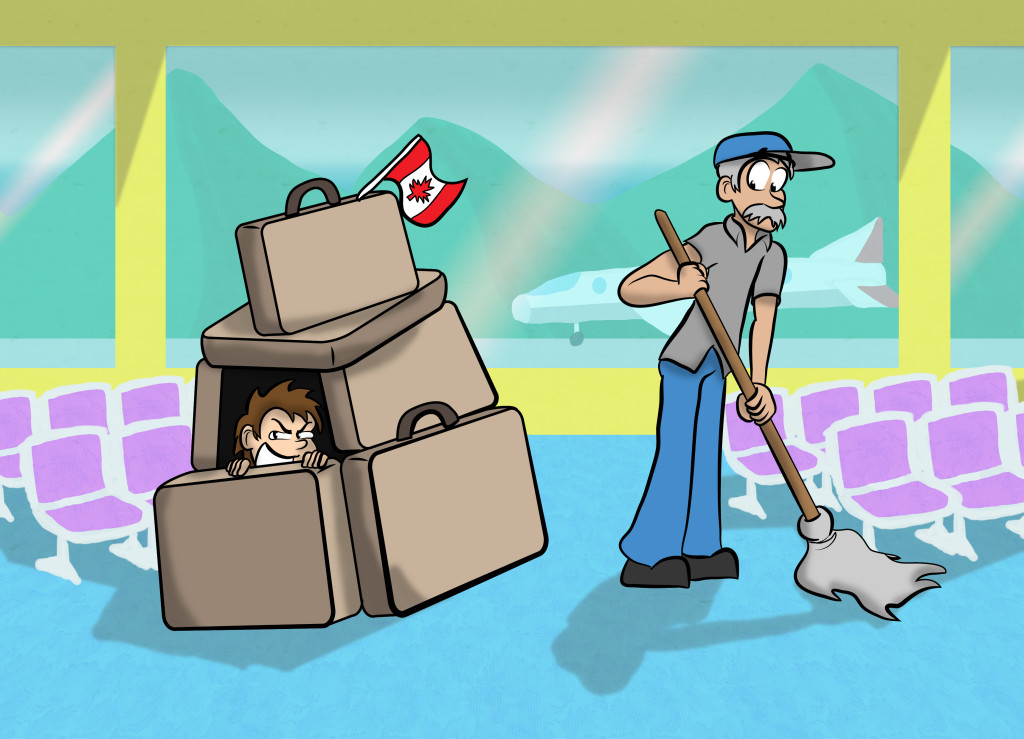
No matter how well you prepare for traveling, delays and cancellations are bound to happen. You can huff and puff all you want, but it won’t get that plane in the air any faster. I have suffered through many days and nights at airports far from home, sometimes due to finicky air traffic control, other times caused by my own stupidity. I know exactly how Tom Hanks’ character felt in The Terminal, wandering around an empty airport, with nobody but custodians and airport security eyeing you. They know how harmless you are, but their pitiful reproaches are pinpricks to the ego.

When faced with a long airport stay, you have two options: you can choose to leave the airport, get a hotel room, and pass the time in the world outside. But if you’re like me and didn’t budget for inconvenience, you might rather just hunker down at the airport and wait for the tides to turn. If that’s the case, I’ve supplied some tips that will help you not only pass the time, but make the best of it.

Move around: Don’t be bound to the little comfy corner you found for yourself. An airport is a big place; there are many places to roam around. By staying active, you can avoid the monotony of airport cabin fever. And if you do have a corner you like, odds are few people are going to compete for that little secluded spot. Most people are coming and going; few linger like we do.

Be productive: Music, books, movies, and even companions can all be rendered useless at an airport. There is only so much you can do before boredom kicks in and you lose the will to focus on meaningless enjoyments. Stay productive instead. Start researching activities you want to do when you reach your destination or catch up on work. Grab a piece of paper and make a list of the chores you would like to accomplish when you get home. Turn the dreary hours of waiting into constructive and creative time well spent. Don’t resist getting work done just because you are on a trip. There is a satisfying feeling when you accomplish something out of the blue.

Eat, rest, and get better: After you get over the initial disappointment and frustration, it is time to regroup. Grab some food and rest. People-watching is a great way to forget about your own troubles. See them hustle down the concourse toward baggage claim, know that for the moment you can just chill. People will generally be friendly when you try to strike up a conversation—for most people, travel is an exciting thing. Simply ask where they are from and where they are going, and you can tell by their tone whether or not they are eager to continue with the conversation. If not, move on. They probably aren’t going anywhere interesting anyways.

Whether you missed a connecting flight or other unforeseen circumstances kept you from flying, know that waiting is not the worst thing that can happen abroad. No matter how restless you get, remember that traveling is a privilege. So what if you lose an hour, a day, even a week of traveling; safety is the most important thing. Keep track of your belongings and take care of yourself. The airport might never be heaven, but it definitely doesn’t have to be hell.

Before you go

Image via the Toronto Sun

Formerly published in The Other Press. Apr. 16 2013

The preparation and apprehension of travelling

By Elliot Chan, Staff Writer

So you’ve decided to trade in the comforts of home for the adventurous world abroad. Good choice, but there is more to travelling than just hopping into a car or stepping onto an airplane. Sometimes we get so focused on the beaches, foods, and activities we forget that we are not entering a big playground; we are entering someone’s home, natural habitats, and a different functioning society. These are important things to take into consideration before you depart.

While some friends would look at you with envy, others will eye you with trepidation, worried that you might not return. You can spin a globe around as long as you want and never land on a perfect country. Every place has their own unique problems, whether it is poverty, political disputes, natural disasters, or all of the above. It is true we are fortunate to be living where we are, but bad things can happen anywhere at any time. Despite this, it is important we make choices that sustain personal growth. I remember a conversation I had with an older man on a connecting flight in Salt Lake City. I asked him where he was going and he said, “Atlanta, Georgia to visit my family.” Then he asked me the same question and I replied, “Quito, Ecuador, to check it out.” “Check it out? You don’t just go some place to check it out!” He seemed outraged by my response, as if I had irresponsibly booked a flight to the moon. The old man’s disapproval stayed with me for a while, but he was wrong… life is all about checking stuff out.

Now that you have your passport renewed, required visas, vaccinations, traveller’s insurance, plane tickets, and packed bags there are few less tangible necessities that you should consider. Make sure you are physically healthy. I know you are a trooper, but believe me the smallest aggravation can ruin your long-awaited vacation. Any teeth, joint, or head pain should be properly assessed before departure. Your travel companions do not deserve to be your nurse for the length of the trip. And unless you are staying at an all-inclusive five-star hotel, try to get into reasonable shape. You won’t be running marathons, but sightseeing can be a strenuous activity.

Next, you must do some research about the culture. Wherever you end up going, understand that people don’t always agree on the same customs. Tourists often feel immune to the law and plea ignorance, but that is not right. Just imagine someone coming to your hometown and vandalizing your property because it was okay where they grew up. Odds are your bad habits will look bad in any country. Don’t spit, don’t cuss, and don’t fight.

Not all locals enjoy tourists waltzing around their city. Most will gladly help you, but keep in mind that they too have busy schedules. They don’t have all day listening to you fumble with words to communicate. Have a communication strategy if you don’t know the language. Bring a translator or a phrase book and attempt to learn. You might feel like an ignorant fool, but it is part of the process. Plus, you are not as good of a charades player as you think you are.

Boarding time is approaching, and you are anxiously anticipating the trip of a lifetime. Always be aware that the worst-case scenario is just right around the corner—but it probably isn’t, so have fun.