I Did My First Sprint Triathlon, Here’s What Went Right and What Went Wrong

In September 2023, I participated in my first sprint-distance triathlon in Vancouver’s Stanley Park. The race comprised a 750m swim starting from Second Beach, followed by a 20k bike ride—two laps around Stanley Park—and concluding with a 5 km run to Burrard Bridge and back to Second Beach.

Before training for this race, I had close to zero experience with all three disciplines. I had swimming lessons when I was a kid, but I was only good enough to save myself from drowning… temporarily. That’s about it. Like many, I came into the sport most nervous about the first leg of the race: the swim. 

However, my cycling history wasn’t much better. I didn’t grow up with a bike; I learned to ride one at the age of 13 while hanging out with schoolmates. My most vivid cycling memories involve biting off more than I can chew—whether it’s renting a bike on vacation and venturing too far up a volcano or commuting too far in the city and finding myself needing to navigate a sketchy, heavy-traffic route home. Naturally, I associate cycling with near-death experiences. But I was really more concerned about the mechanical aspect of the sport. 

Finally, there is the run. I’m not particularly fond of running; I used to jest that the only way to get me to run was by giving me a bus to chase. Running for anything more than a quick sprint didn’t appeal to me, and I certainly didn’t take it seriously. Before registering for the triathlon, I had only participated in one 10k race—that’s the extent of my running experience.

So, that was my background before the triathlon. Not only was I a novice in the sport, but I was essentially a beginner in all three disciplines. I found a certain charm in that. I didn’t have to pick favorites; there was a wealth of learning in each of them, and learn I did. In my rebellious manner, I learned through making mistakes. While, yes, there were errors, there were also some small wins along the way.

Today, I’m going to share three things that went right during my training and race, and three things that went wrong. 

The first thing to go right is that…

I gave myself a lot of time in training

As mentioned, the race took place over Labor Day weekend in September, and I registered for it in March, providing me with a little over 180 days to prepare. It took about a week or two to find my comfort zone on the bike and a couple of months to control my breathing technique in the swim. Not only that, it gave me time to recover from pushing my body like I have never before. The sudden training led to shin splints, sidelining me from hard running for a week in March.

Having enough time on my hands also let me join a few smaller races in between. I did a 10k in April, a 5k in June, and another 10k in August. These races were great for getting used to the mindset of competing with others, which is tough to simulate in regular training. It helped me figure out how I’d respond when someone faster passes me—would I speed up? I wanted to practice the mental side of things too, and that required real-life experience. 

I’d say, if you are starting out. Give yourself as much time as possible. Commit to it early on and just make a year out of it. 

Now let’s talk about something that didn’t go well: 

Going too fast on the swim during choppy water

Everyone told me to go easy on the swim. I heard that advice, and I was planning to follow it. The only issue was, I wasn’t exactly sure how slow I should go, and I didn’t know what might happen if I didn’t follow the advice correctly. Sometimes there’s only one way to find out. 

On race day, the water was unusually choppy. I had practiced swimming the race course three times before the event, and each time, I felt quite comfortable. However, on that particular day, the conditions were wild.
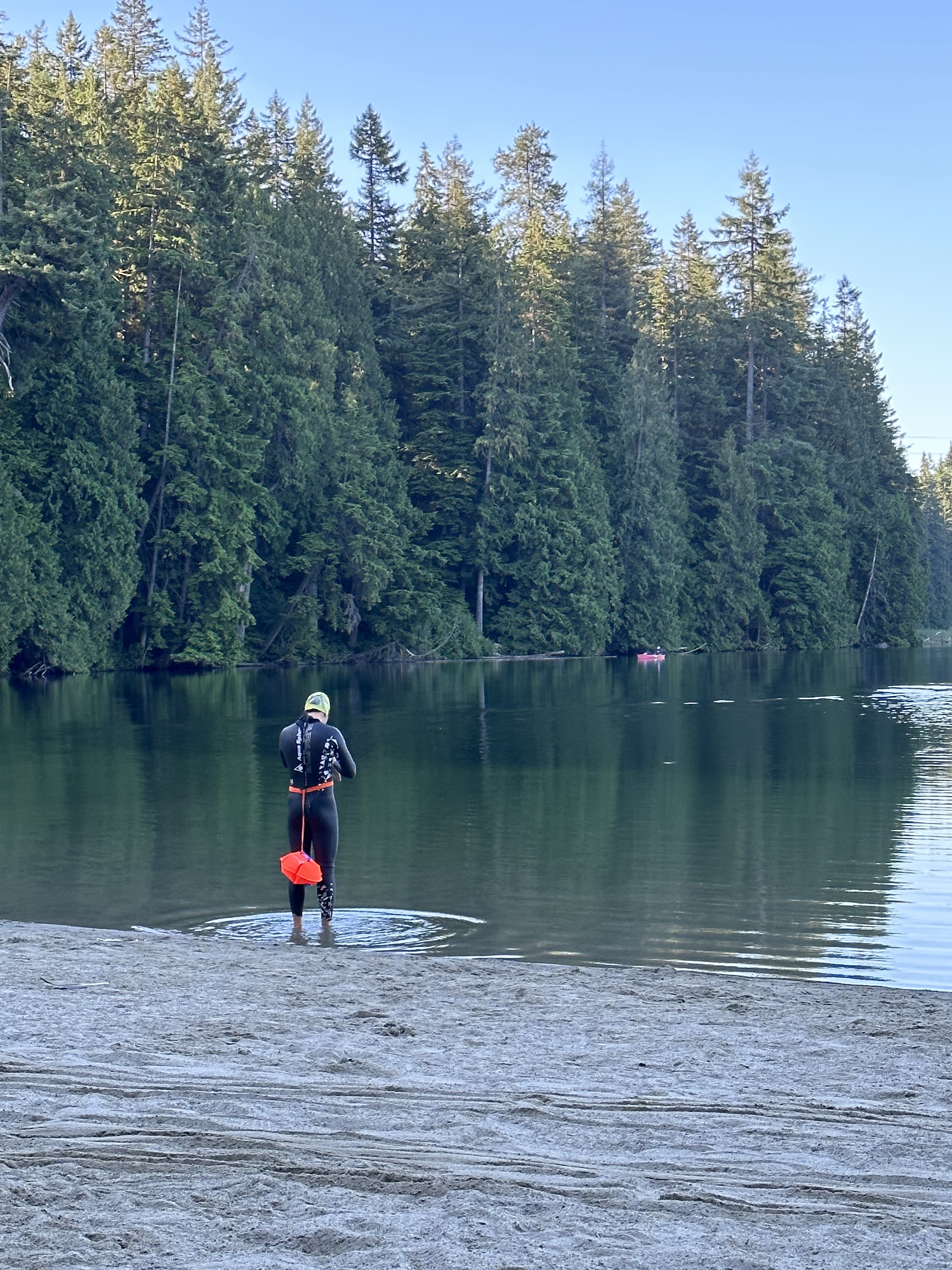
Still, I wasn’t discouraged. When the race began, I joined the group at the starting line and just went for it. The first 200m went well, and I felt great keeping up with everyone. But things changed at the first turn; there was a bottleneck, and a wave hit me, making me swallow a lot of salt water. Despite people swimming around me, I had to keep moving, but getting around the corner was tough with the waves beating on me. I got exhausted and struggled to breathe. This was the result of starting too fast; I didn’t have the energy to recover. 

After making the turn, I was now swimming with the waves hitting me from the side I usually breathe on, my left side. It was a critical moment in the race, and I thought about stopping many times. But I remembered all the hard work to get to this point. Quitting after just a 300m swim wasn’t okay. I had to keep going. It was a struggle, but eventually, I turned back toward the beach, and the waves helped propel me forward. The worst was over, and I made it through.

Now for something that went right… and this is a big one: 

I finished the race

That was the only goal I had going in. Finishing the race. Getting that benchmark time and having a better sense of what needed improving. 

Many things could have gone wrong and stopped me from finishing. The tough swim was one worry, and my bike falling apart was another. I also had the fear of getting disqualified in my mind.

During the race, there were times when things could go wrong. I saw someone crash on the bike course, which affected me mentally, and the first kilometer of the run was painful, and I had to adjust a lot. The interesting part was figuring out how to balance everything rather than just pushing hard all the way to the finish.

Something that went wrong that I didn’t anticipate or practice was: 

Racking my bike… 

Returning to transition after the cycling portion of the race, I had to put my bike back onto the rack. I had so much trouble getting it on. First off, not that this was a problem, but I noticed that my bike saddle was crocked when I got to the race. I’m not sure how it got damaged. It might have been because of a crash a few weeks before (I’ll get more into that later). 

Anyway, I recall standing there, grappling with my bike, rolling it over my wetsuit and attempting to get it back onto the rack. Not only did I waste 10-20 seconds doing that, but I also expended a considerable amount of energy. To add to the chaos, I entered through the wrong side of the rack. Once I finally managed to rack my bike, scratching up my new shifter in the process, I had to run around to put on my running shoes. My transition 2 was not impressive.

Sticking with another thing that went wrong: 

My bike itself… 

Look, I still think I made a good decision getting the bike I did because I was close to getting an even worse bike. 

I didn’t want to invest in a pricey bike only to discover that I wasn’t fully committed to the sport.

This is a $500 hybrid bike, also the nicest bike I’ve owned so far. I pushed this bike to its limits during training, and a few components began to show wear, with the shifter being the most notable. Approximately a month before the race, every time I hit a bump, the left shifter would unexpectedly drop gears, which became super annoying.

My initial plan was to complete my first two races with this bike and then upgrade to a road bike. I’m honestly relieved that it managed to hold up and get me through the race. Because a week after, I noticed a clunking sound every time I pedaled. It turned out that the freewheel had broken.

I must have pushed it too far during the race itself. 

This little bike had a lot of action in a short amount of time and I’ve paid a lot since to maintain it. But after my first race, I decided to retire it from racing and purchase an entry-level road bike to take over. As for my old one, I use it as a commuter bike and it’s great for that. Despite not everything going perfectly, and a few stressful days, I wouldn’t change a thing.

Something that went right from beginning to end was my pleasure for 

Tracking progress

I got into this sport because it’s not just about fitness and gear; it’s also analytical. I enjoy tracking each workout, noting improvements or areas to work on. Using this data helps me adjust my effort and tweak my plan. Seeing myself get better gradually—swimming, cycling, and running longer and faster over time on a spreadsheet—brings me an abnormal amount of joy.

Second only to enjoying a beautiful summer day outdoors, observing my progress is my favorite aspect. It’s incredibly motivating to reflect on the beginning and recall how challenging it was to swim 200 meters. I vividly remember that version of myself, and it’s astonishing that in less than a year, I’ve gained so much more confidence in the sport. 

Without a doubt, if I hadn’t tracked my progress in some way, it would have been harder to remember where I came from and my commitment would have waned, and I likely would have given up, or at the very least, not signing up for another race.

That’s correct—I’m currently fully invested in triathlon as my recreational pastime. It’s been a welcome counterbalance to the extensive time I spend at a computer. I recommend it to most people with a sedentary job.

If you’re thinking about signing up for a triathlon and haven’t before, just know it’s a commitment. Starting with nothing, I spent at least $2000 getting ready for my first race, but the time I put into training made it worthwhile. It’s become a stress reliever I look forward to, and it broke up my day nicely. 

It can become quite an obsession, but when you’re working on a novel like I am, it’s more pleasant to share that you’re doing a triathlon rather than writing a novel. Both are braggy lines you can boast about, but at least with the triathlon, you don’t have to bore people with the details of your dystopian fantasy.

Well, those are three things that I believe I did well and three things that didn’t go as expected when I signed up for a triathlon. If you’re feeling inactive, going through an existential crisis, or just frustrated with the world, consider giving triathlon a try. Above all, it has been therapeutic, and I think that’s a good thing. 

For more writing ideas and original stories, please sign up for my mailing list. You won’t receive emails from me often, but when you do, they’ll only include my proudest works.

Join my YouTube community for insights on writing, the creative process, and the endurance needed to tackle big projects. Subscribe Now!

Why Finishing My Creative Work Isn’t My Goal

DNF. It stands for Did Not Finish. In a race, those three letters haunt all athletes. In the creative world, not finishing carries the same weight of shame. 

For many of us, creativity is something we often have to pursue in our personal time. We may steal moments early in the morning or stay up late into the night to work on our creative projects. The specific goals of these endeavors aren’t as important as the fact that we consistently dedicate time to them, with a focus on long-term progress.

However, life can unexpectedly consume our days and nights. Work, personal commitments, and unforeseen opportunities may arise, and we need to seize them. When this happens, time can slip away, and even when we do find time, we may lack the energy.

When the pandemic began, my schedule opened up in a way I hadn’t experienced since my school days. I felt like I had ample time to dedicate to my projects, and I made the most of it. I made significant progress on my novel, invested more hours in my video creations, practiced illustrating and animating, and honed my audio recording skills. I pressed down on the accelerator for three years.

But at the end of 2022, I fell into a bit of a depression. Personal struggles and painful childhood memories resurfaced, and I realized that during my free time, I was mostly sitting in front of a computer. I was rather working or laboring on my creative projects. My mind wandered into dark places, and I began to lose touch with myself. While I was writing my stories, I was also rewriting my own history, and it wasn’t a happy one.

During my darkest moments, I believed the only way to escape the pain was to complete my creative work. But there’s no such thing as truly finishing your work. The goal is consistency, doing a bit each day. There’s no destination; the journey continues. My healthy creative habit had become distorted, and I expected something grand to emerge at the end.

There was a moment when I recognized I needed to step away from the computer. It wasn’t that I wanted to stop working on my projects, but I had to balance that intense effort with other aspects of my life, including confronting my troubled memories.

Around this time, I had also become quite inactive. I’d stopped playing hockey since the beginning of the pandemic, and I wasn’t sure where to go next. I love hockey, but it was a time-consuming sport with a rigid schedule. Additionally, as a goalie, it was one of the most stressful positions.

I needed something I could control, something I could pick up on my own terms. My wife is a marathon runner. And endurance sports intrigued me. Surely it was a better alternative than self-harm. But I’d convinced myself that I wasn’t an endurance athlete. I labeled myself a quitter, and that is the theme of this narrative.

There were many mornings when I woke up and my wife was already out for her run. She would be gone for hours on end. I wasn’t sure if I could do that. But still, I needed something to replace hockey. So I kept thinking. I might not want to run every day, but what about adding cycling and swimming to break the monotony? For a few weeks, I contemplated attempting a triathlon, even though I had minimal, negative experiences with running, cycling, and swimming in the past.

As I considered these new challenges, my old, self-limiting stories were retold over and over in my head. I told myself, “Look at all those bad experiences; you don’t want to do that. Plus, with your history of quitting, you’ll just give up anyway, so why start?”

The more I repeated those stories to myself, the more I realized before I could finish my projects, I needed to rewrite my life. What would the next ten years hold for me? Would I become a bitter writer, endlessly struggling at my desk and resenting my creative work? Or would I seek new experiences?

I remember a passage from Haruki Murakami’s memoir, “What I Talk About When I Talk About Running.”[Amazon]  

“Some writers who in their youth wrote wonderful, beautiful, powerful works find that when they reach a certain age exhaustion suddenly takes over. The term literary burnout is quite apt here. Their later works may still be beautiful, and their exhaustion might impart its own special meaning, but it’s obvious these writers’ creative energy is in a decline. 

This results, I believe, from their physical energy not being able to overcome the toxin they’re dealing with. The physical vitality that up till now was naturally able to overcome the toxin has passed its peak, and its effectiveness in their immune systems is gradually wearing off. When this happens it’s difficult for a writer to remain intuitively creative. 

The balance between imaginative power and the physical abilities that sustain it has crumbled. The writer is left employing the techniques and methods he has cultivated, using a kind of residual heat to mold something into what looks like a literary work—a restrained method that can’t be a very pleasant journey. Some writers take their own lives at this point, while others just give up writing and choose another. 

If possible, I’d like to avoid that kind of literary burnout. My idea of literature is something more spontaneous, more cohesive, something with a kind of natural, positive vitality. For me, writing a novel is like climbing a steep mountain, struggling up the face of the cliff, reaching the summit after a long and arduous ordeal. You overcome your limitations, or you don’t, one or the other. I always keep that inner image with me as I write.” 

Inspired, I bought a bike, got a community pool pass, and signed up for my first sprint triathlon.

I eased up on my creative projects and made room for training, which turned out to be a rejuvenating addition to my day. Knowing I had a run, bike ride, or swim to look forward to made sitting at my desk more bearable.

Creative writing, too, is like a triathlon – it involves writing, editing, and publishing— three different disciplines. I saw threes in everything. A story is structured with a beginning, middle, and end. I find all the metaphors in this sport reassuring. As if this was meant to be. By temporarily pausing my projects, I can reflect on my life, much like a swimmer surfaces from the water to sight where he is going and where he has come from. 

Creativity is so subjective. There are no clear winners or losers. There are no rankings you can compare with others. And I think that is a blessing. 

While I do need to be evaluated and ranked to feel some sense of accomplishment, I don’t have to put that burden on my creative work. I can put that on something a little more objective — like athletics. My competitive energy, I can direct towards my sports. My creative energy, I can protect and keep for my art. While this spreads my energy across a wider surface of my time, I’m also happier this way. This is the new story of my life. I don’t have to be a writer locked up in a room, hammering away at a manuscript that maybe nobody will read and feel angry about it. I can write freely. And then go run freely. 

I do feel guilty for not dedicating as much time to my projects as I did last year, similar to the guilt I feel for not spending more time with friends, or the guilt I feel for not having travelled to Japan yet. However, I remind myself that this guilt is just a story as well. 

We are on a journey of healing, much like climbing a mountain or training for a race. Every day, we confront our limitations, whether we’re writing or standing at the starting line. Guilt is a toxin that can deplete our energy, so we must incorporate various disciplines in our lives to keep it at bay, enabling us to focus on what matters.

I might not be great at everything I do, but with this mindset, I’m able to do more and keep at it. I’m not going to be a professional athlete and I might not be the next best seller. But nobody can stop me from trying. I pursue it all now little by little. My athletic triathlon and my creative triathlon. Each time I sit down to write, I’m excited. Each time I go out to swim, bike or run, I’m energized. 

The dread of the DNF is gone. Because finishing is no longer the goal.

Join my YouTube community for insights on writing, the creative process, and the endurance needed to tackle big projects. Subscribe Now!

For more writing ideas and original stories, please sign up for my mailing list. You won’t receive emails from me often, but when you do, they’ll only include my proudest works.

It’s how you say it

Image via Thinkstock

Talking down to friends, family, and teammates can only weaken the links

By Elliot Chan, Opinions Editor
Formerly published in The Other Press. October 21, 2015

The act of belittling another verbally, whether it’s in a work environment or in a social setting, is so offensive that often I regret not responding physically. True, we might have messed up, dropped a ball here or there, but regardless of the situation, neither you nor I should be talked down to. However, we must also be cautious to not ridicule and belittle others.

We’ve all had to work with someone who didn’t have the same level of skill in a particular task as we did. When I say work, I also include other team activities such as sports. Life is all about teamwork, and the old adage rings true: “You’re only as strong as your weakest link.” While you may think that calling out another’s shortcomings or ridiculing them publically in front of their peers is an effective way of motivating them to improve, it is not!

What you must understand is that not everyone shares the same level of interest or passion as you in any given project. Believe me, if you shame someone enough times, especially in a team environment where trust and loyalty is paramount, you’ve lost them. They’ll find new friends, get another job, and avoid you completely. Nothing you do is special enough to mistreat others over. People will get fed up, angry, and often retaliate. This can be incredibly destructive.

If you think that others should pick up the slack, you should really look in the mirror and ask yourself: Are you the top performer? Are you the best on your team? Are you literally better than everyone else you work with? If you are, what the hell are you doing with these losers? Go pick on someone your own size. If not, then shut up! This looking down on people is the same vain and arrogant way of thinking that makes you ugly, regardless of how you look.

There is only so far you can push other people before they push back. If you don’t establish camaraderie first, then there is no balance between the team. There is a reason why in every creative writing class students are encouraged to note something good before mentioning something bad. It’s not because we are sensitive and we need things sugarcoated. It’s because we are human and we have feelings. We are all equals in the grand scheme of things.

We all know how it feels to be talked down to. You may have been on the receiving end of a situation I described above, with a team member or friend telling you you weren’t good enough. As a younger adult, like many college students are, I often feel that the older generation—those with full-time jobs, children, and a retirement plan—cannot help but lecture me. I’m not talking about helpful advice; I’m talking about critical, judgmental assessment of my values, pursuits, and character. Some of them speak as if I’m entitled, inconsiderate, disrespectful, ungrateful, or unmotivated. Ultimately, a conversation with these older people becomes a vicious assault of guilt and shame.

Life is too short to spend your time being put down by an employer, spouse, boyfriend or girlfriend, or teammate. Life is too short to be spent with people who don’t appreciate you for your efforts. If you find yourself in defence mode all the time, get out of the situation now. The best way to retaliate to those talking down to you is to leave, completely.

Top questions of the 2015–16 NHL season

Photo by Jeff Vinnick via http://thescore.com

By Elliot Chan, Opinions Editor
Formerly published in the Other Press. October 6, 2015

Here’s to another year of hockey, and, like the start of every school year, we have to wonder who will excel, what surprises will occur, and how all the changes will affect the grand scheme of things. Overtime storylines will play out on the ice, and we’ll learn the answers. Until then, these are the top question entering the 2015–16 NHL season:

Will Connor McDavid lead the Oilers to a playoff berth (and beyond)?

McDavid is marketed as the next Sidney Crosby, but will Edmonton—with its poor development system and defensive support—drain the talents of another first overall draft pick? Will McDavid be able to do what Nail Yakupov, Ryan Nugent-Hopkins, and Taylor Hall couldn’t? It took Crosby three full seasons before captaining the Penguins to a championship. How long will it take McDavid? No rush. The bar is low. For now, synergistically, Edmonton as a whole can aim for the next level and make it into the playoffs. Easy.

How will three-on-three overtime affect the overall standings?

The shootout has not been eliminated, but with three-on-three overtime, it might as well have been. I love this new tie-breaking format, however, I’m disappointed to see the end of four-on-four—if only there was some way to integrate that. Needless to say, with opening the ice for key players and reducing the flip-of-the-coin factor of shootouts we can see more skilled teams earning points. For example last season the Los Angeles Kings won 2 of 10 overtime shootouts. Those lost points could have ultimately gotten the former Stanley Cup champions into the playoffs, where they would have surely dominated.

Can coaching changes turn the tides for underachieving teams?

Mike Babcock to Toronto, Peter DeBoer to San Jose, Dan Bylsma to Buffalo, and Todd McLellan to Edmonton—these are a few of the high profile coaches standing behind new benches this season. The only reason coaches are moved is because their old teams are failing to achieve certain goals and their new teams have limited options. I don’t believe any coach can singlehandedly turn a franchise around, and as great as their track records are—especially for Babcock and Bylsma—I believe it’ll be a few years before they can make their mark. The thing is, will their new teams be so patient?

Will the Western Conference dominate the East again in the finals?

For five of the past six years, the winner of the Stanley Cup playoffs has been from the Western Conference. On top of that, those five victories were from two teams, the Los Angeles Kings and the Chicago Blackhawks. These two “dynasty” teams will be hard-pressed to continue this pattern as many of the Eastern contenders have seen improvements. This might be the year the New York Rangers, Pittsburgh Penguins, or Tampa Bay Lightning learn from their tribulations and win four series in a row. There are also a few dark horse contenders with generational players—Alexander Ovechkin and Jonathan Tavares both have optimistic teams ready to face-off—ready to take their legacy to supremacy. This year, I believe the two teams matched in the finals will be turning the page on the Kings’ and Blackhawks’ dominance.

Why NHL in Vegas is a low-stakes gamble—but is it most deserving?

nordiques-1024x714

The ‘best’ cities for NHL expansion

By Elliot Chan, Opinions Editor
Formerly published in the Other Press. Oct. 1, 2015

The National Hockey League has kept their cards close to their chest in terms of when and where the next expansion franchise—if there is one—will be. As far as competition goes, Las Vegas and Quebec City are the two frontrunners, being the only two cities to submit their $10 million application fee. While eyes are on the prize, both of those cities have things working against them when it comes to adopting a NHL franchise.

Las Vegas, known for its sultry heat and abundant amount of entertainment, may seem like a bizarre place to watch hockey. In addition, having never been home to a major sports team, Las Vegas doesn’t inspire a lot of confidence. Bets are on for whether such a venture would be successful or not. We would hate to see it become another inescapable desert disappointment, (cough cough) Phoenix, I mean, Arizona.

All I can say is that the heat will not be what harms their chances; it will be the fan base. At the moment, Hockey Vision Las Vegas, an organization seeking committed hockey fans to buy tickets, is aiming to convince the league that there is a strong desire for hockey. I believe there is a fan base in Vegas, but not necessarily from the locals.

Las Vegas is a vacation hotspot with 40 million people visiting in 2014—many of whom came during the winter season, i.e., hockey season. This is a perfect opportunity to lure in spectators who would not have an opportunity to see hockey otherwise.

I know that Vancouver fans will happily drop $500 for flights and an all-inclusive trip to Vegas to see a Canucks away game against the Las Vegas team. But would those living in the Sin City bother seeing their own team? The fact is that any Canadian hockey fans would be excited to see their team in Vegas, but if that’s the case, why not have the expansion take place closer to home?

Seeing Winnipeg get a team back in 2011 must have given Quebec City a lot of hope. The reason they lost the Nordiques in 1995 to Colorado was because their facilities could not match the new NHL standards. That’s all changed now; the Videotron Centre gives the city some legs to stand on when trying to earn the NHL’s attention. It’s designed with hockey as its sole purpose. With that being the case, it’s just a matter of time before hockey returns to French Canada.

However, Quebec could get a franchise again via a different route: the Carolina Hurricanes have been rumoured to be on the move. This means the former Hartford Whalers franchise could possibly move north of the border… wouldn’t that be nice?

Las Vegas and Quebec City are as different as cities come, but for hockey, I believe these two places are apt choices. Nevertheless, I hate seeing so many NHL franchises concentrated on the East Coast. We are due for a couple of purely western teams. For selfish reasons, I would rather see an expansion team in Seattle or Portland before a team in Quebec City. One thing lacking for Vancouver fans is an opportunity to go on road trips to see our regional rivals. If Seattle can make a push when the next expansion round comes around, that would be exciting news. But for now we’ll take what we can get, and be happy we don’t live in Atlanta.

Rotating goalies make 2015 playoff interesting

Andrew Hammond photo by Harry How

Young and veteran goalies trade off chances in net

By Elliot Chan, Opinions Editor
Formerly published in The Other Press. May 4, 2015

Twenty-four goalies entered play in the first round of the 2015 NHL Stanley Cup Playoffs. With 75 per cent of the teams using more than one goalie, it makes competition ever more unpredictable. Goaltending has always been hailed as the defining factor when it comes to the playoffs. A goalie can steal a game and win a series all on his own. And this year quality goaltending remains an important ingredient for any team’s success.

While rotating goaltenders can get you to the finals—remember when the Philadelphia Flyers with Michael Leighton and Brian Boucher lost to the Chicago Blackhawks—it rarely wins you the championship. The script this year is a bit different though for a number of teams. The Ottawa Senators and the Vancouver Canucks earned playoff berths this year all because of the valiant play of their backup goalies. Sadly when it came down to crunch time, (i.e., a seven-game series) Andrew Hammond and Eddie Lack were unable to pull off any miracles.

However, it was interesting seeing the veterans step in to salvage the series. Number one goalies Craig Anderson of the Senators and Ryan Miller of the Canucks, ended up starting their respective game six elimination games. One might believe that if the coaches were to start their number ones initially the result might have been different, however, with such stellar performances from the rookies and sophomore goaltenders the fans might have been outraged to see that. Hindsight is only so useful in hockey.

The result was perhaps inevitable. You need your number one goalie to perform like a number one goalie if you want to win the Stanley Cup. If you bet on your number two, it’s a huge gamble. There are exceptions of course. In 2006 Cam Ward of the Carolina Hurricanes came in to replace Martin Gerber early in the playoffs to lead the Hurricanes to the championship.

Teams with sound goaltending like New York Rangers, Anaheim Ducks, and Montreal Canadiens are the undeniable favourites this year. Having consistency on the backend does more for a team than build confidence. With solid goaltending, a team can intimidate the opposition. In a sense, with a goalie as consistent as Carey Price or Henrik Lundqvist, opponents are down a point before the game even begins.

Of the teams that have advanced to the second round, the Calgary Flames and the Chicago Blackhawks are the two most notable teams that have succeeded with a rotating goalie strategy. While it has worked so far, if one goalie does not step forward and take the sole responsibility—have reliable performance day after day—then they will surely be eliminated. The Blackhawks are facing the Minnesota Wild with Devan Dubnyk, who has really come into form since escaping Edmonton. It’s hard to bet against the experience of the Blackhawks, but going with the theme, inconsistent goaltending may end up being their downfall.

TeamSnap Assists League and Club Organizers With All-Star Communication and Management Tools

For the longest time, team sports have had reputations as being poorly organized.

It was not because the coaches were incompetent or because the players were disorganized; it was because there was a lack of easy-to-use tools. In addition, the market for communication, management, and scheduling apps is as crowded as a defensive zone in the fourth quarter.

TeamSnap, an application designated for teams and clubs management, has a simple philosophy to break away: elite customer service and great user experience.

Team communication is paramount, whether it’s on the field, on the rink, or even on the way to practice. People need to know where to be, when to get there, and what to bring before they can score goals, make saves, and win big.

“We need to let people know about what’s happening in the way they want to be informed,” said Dave DuPont, CEO of TeamSnap. “If they want to use email, fine. We send 40-million emails a month now. If they want a text message, that works too. If they prefer Push, that’s cool. If they just want to use the native mobile app—we were one of the first in the industry to introduce that—then they can use the native mobile app.”

It’s not uncommon for venue and game time to change last minute. There isn’t always time to inform every person individually, and mass messaging on certain platforms will be neglected because the player or participant is already on the road.

Most of us understand the pain and hassle of organizing an event. Most of us also know the headache when a certain aspect falls through. But with TeamSnap, all the organizer or coach has to do is change—for example—the time of the event on the TeamSnap calendar and every member will be informed in the manner they desire.

Another element of a successful team is accountability. Because of the leniency of technology, people have gotten a little flakey or unresponsive when it comes to invitations. One of TeamSnap’s popular features is the “availability.”

“We make it super easy for folks to say if they are coming,” said DuPont. “They can confirm if they are coming, they can confirm if they are bringing the orange slices and beer. And that is all tabulated and everyone can see it, if the organizer wants everyone to see it. And it can be changed automatically. That is just the sort of thing that makes everybody’s life a lot easier.”

With over seven million users and an infrastructure that informs people, TeamSnap is taking it to the next level by broadcasting in-game experiences. Chat, scores, and highlights can all be crowd sourced during the game. Everybody on the sidelines can contribute and offer an experience for those who aren’t there.

Unlike Twitter, TeamSnap is a private social network. Only those accepted by the team’s inner circle will be able to receive updates, stats, and conversations.

While the experience on TeamSnap is familiar across the board, different sports require different approaches for a fine-tuned experience. Every game and every league has little subtleties and TeamSnap accommodates by allowing organizers to modify templates.

“We are most valuable for folks that are particularly sensitive to saving time and having great communications,” said DuPont. “A hockey team in general is going to be more sensitive to that issue than a pick-up baseball or pick-up football team. If you have a certain ice time, you want to make sure everyone is there on time.”

Having hit critical mass in such markets as Vancouver (2,200 teams and the third largest in Canada), TeamSnap is aiming to add more value to the users involved by providing goods and services related to sports. The data stored in TeamSnap, such as experience level, type of sport, and start of season, can all be utilized by brands to offer products and services that fit the players and the teams’ needs. A coach can inform a brand of the team colour, and in return the brand can recommend shoes and jerseys of that colour for the players.

DuPont added: “We take an altruistic view of this. We aren’t trying to maximize pageviews or anything like that—we just want to be the indispensible tool for teams.”

The Olympics that no one wants

Freestyle Skiing - Winter Olympics Day 13

Why world-class cities opt out of hosting

By Elliot Chan, Opinions Editor
Formerly published in The Other Press. October 21, 2014

And then there were two: Almaty, Kazakhstan and Beijing, People’s Republic of China. How on Earth did this happen? Is it because hosting an Olympic event is such a drain on a country’s economy, or is it because people just don’t care about the Winter Olympics?

When Oslo, Norway—the frontrunner to host the 2022 Olympics—withdrew its bid on October 1, many fans, organizers, and athletes awoke to a realization: the Winter Olympics was just not worth the trouble. For too long, the International Olympic Committee (IOC) had been the popular girl at prom, but now she might have a profile on Plenty of Fish.

The problem is not necessarily the Olympics’ attractiveness, but rather its high standards. The IOC is demanding, and that was the greatest turn-off for the Norwegians. After all, the committee did send over a 7,000-page handbook and requested alterations of traffic and airport customs just for the officials, in addition to a cocktail party with the Norwegian royal family. Such pompous demands say a lot about the organization’s culture. And it’s not too surprising to see that Norway wanted nothing to do with it.

With that being said, there is prestige from hosting the two-week event. Just look at the result of the 2010 Winter Olympics here in Vancouver, and you’ll see that the event elevated the city into the world-class standard. It put us centre stage and we astounded the world, in addition to proving many skeptics wrong. We can all agree that Vancouver’s infrastructure, traffic, and tourism economy has taken a step in a positive direction since.

The global situation is that not many cities are capable of becoming world-class cities. Sochi, for example, struggled with the event to the very last moment, and tourism is not exactly flourishing there now. Recessions across many European countries also make the opportunity to host risky.

The most likely event now is that the IOC will select Beijing as the host of the 2022 Olympics—it’s the most reasonable choice. The second possibility is that the committee will offer the opportunity to a country that has proven experience hosting recent large-scale events. What the committee needs to establish is six to 10 world-class cities across the globe that can host the Olympics should a newcomer fail to meet the exceptionally high standards. The United States, the United Kingdom, Japan, Canada, South Korea, Italy, France, Russia, and whoever else the IOC deems suitable should be added to their little black book.

No doubt having a list of suitable candidates will reduce the status of the IOC, but is that such a bad thing? What’s the alternative? Waiting by the telephone, hoping that a rich country will call? The IOC should know better: the Winter Olympics is not to be compared with the World Cup or the Summer Olympics. People just don’t need it as much.

‘Don’t let it hit my beautiful face’

19-goalie

An interview with the world’s most shamed/famed goaltender

By Elliot Chan, Opinions Editor

Formerly published by The Other Press. Feb. 17, 2014

I first met Charlie Winston on a rainy day at a coffee shop in Tsawwassen, British Columbia. I approached the man and bought him a cup of decaf. We sat in the back corner—we had to, for fear he’d be recognized—and he told me about the most traumatic moment of his life.

It all began in third grade when Winston was just a fragile little prepubescent boy with an afro: “There are two things kids do when they are growing up in Canada,” he told me in a hushed voice as if he were gossiping about the homeless man at the adjacent table. “One, we don’t talk about Fight Club, unless we mention how great Edward Norton is in it. And two, we play hockey.”

Such a statement left me caressing my soul patch, a personal project that I don’t care to mention in anymore depth. As I began encouraging him to delve further into his deep dark memories, he shuddered, almost breaking down into tears, recovering enough only to excuse himself to go to the bathroom.

Winston left me at the table for 45 minutes before he returned. What he was doing is still unknown.

“Every recess, while all the girls made up rumours about me,” said Winston, “I would be alone, making rumours about them.”

“Strange,” I thought, before vocalizing that same sentiment—“Strange.”

“Yes, very strange,” he agreed before continuing. “One day, the boys saw me sitting there on a tuffet, eating my curds and whey. They shyly walked over and asked if I wanted to play hockey with them or talk about Edward Norton. I told them that I thought Norton deserved an Academy Award for his performance and they agreed.”

According to Winston, the boys were satisfied by his opinions about the acclaimed actor and left him alone; he continued eating his food and gossiping to himself. Suddenly another boy appeared out of nowhere and asked if he would like to join them in a game of hockey. Never thought of as athletic, Winston declined.

“Pleeease!” said the boy. “You’d make such a good goalie.”

Never athletic, but always easily wooed, Winston agreed.

“Before I knew it I was standing there in front of the net feeling like Little Miss Muffet,” said Winston. “I was so vulnerable, more so when they started shooting rubber discs at me. I freaked! See, I didn’t really understand the rules of hockey at that time, so I thought they were trying to kill me with a thick novelty flying disc. I had to defend myself, you see! I could not die this way! They had to die!”

One save, two goals against, three fatalities, and 17 injuries were the result of Winston’s first game in net.

“I can still remember the screams,” he told me as his voice dropped to a secretive level. “I’m not sure if it was me screaming or the children—but I heard it: ‘Don’t let it hit my beautiful face!’ It still haunts me to this day.”

At the end of our interview, I stood up and shook the man’s hand. And then it dawned on me: I was shaking Charlie Winston’s hand.

Charlie Winston, the simple man, the murderer, and the new starting goalie for the Vancouver Canucks.

Will Virtual Sports Ever Win Their Way onto the Olympic Podium?

Virtual sports, like many Olympic events, require endurance, determination, precision and hours upon hours of training. But in the athletic community, the idea of video games being placed into the same category as hockey, track and field and gymnastic is laughable. There is a notion that any sport where the participant can compete while sitting on their couch or computer chair cannot be considered a real sport.

Still, all around the world, fans and spectators gather to watch the best video game players battle it out for virtual sports supremacy. These pro-gamers can earn accolades and up to six-figures playing the games they love.

Now with big name corporations such as Microsoft and Sony integrating online streaming platforms such as Twitch, video game fanatics can subscribe to channels and watch gamers compete, the same way sport fanatics would watch hockey and soccer games. With over five million people viewing these channels a day, there is no doubt that video games have a larger demographic than many other forgotten sports currently in the Olympics (handball, anyone?).

Concentration, rapid reflexes and well-thought-out strategies are the foundation of any good athlete and so it goes with gamers. While video games might not be physically draining, it does require a lot of mental stamina, like the kind it takes to play poker or chess, which has been recognized as a mind sport.

But the unique problem that video games face is that the games are constantly changing. Video games are a product of technology and technology evolves, quickly. New innovative games are being created everyday. And since Olympics only occur once every four years it’s hard to determine which games is deemed worthy of competition.

After all what games are timeless like chess, soccer, and high jump? The answer is none; even the most popular games go out of fashion and replaced by the new generations. That is why there are 20 versions of Need for Speed, over 10 different series of Street Fighter, and every year EA Sports produces a new sport game. Video games are ephemeral, like a book or a movie, when it’s done you put it on the shelf and anticipate the next one.

On the other hand, Olympic sports are subjected to minor changes every four years. Even though the athletics are the same, the course, the judging and the rules are often adjusted for practical reasons. For example, this year in Sochi, Russia, the hockey games are played on international-ice size (61m by 30.5m), meaning it’s 4.5 metres wider than the previous Olympic in Vancouver where it was NHL size (61m by 26m). Regardless, the athletes competing are on the same surface, and the objective is still to put the puck in the net.

It’s the same with video games. Sure, maybe there won’t be a specific game chosen for the Olympics, but there could definitely be a genre of games. Racing games never change, shooting games never change, fighting games never change—when you look at the big picture, video games often follow the same structure. You have to be first or to kill as many zombies, soldiers, or aliens as possible.

In the Olympics, different racing distances are rewarded different medals. You don’t categorize the sprinters with the marathon runners. Virtual sports can also be split up into different groups, one event can test gamers’ strategic planning such as StarCraft, one can test the gamers’ handling and maneuverability skills such as Grand Turismo, and one can test gamers’ accuracy and precision such as Wolfenstein 3D (remember Wolfenstien 3D?). Different factors can determine the best players, whether it’s through real-time strategy, first-person shooter, or even a basic fighting game like Mortal Kombat.

To the jock’s chagrin, video game manufacturers are starting to integrate physical aspects to video games. Since the dawn of Dance Dance Revolution, Guitar Hero and Nintendo Wii, gamers are starting to be more engaged with video games that motivate them to get up and moving. Xbox Kinect and other motion sensing input devices are changing the way people play video games. Perhaps these games can one day alter certain people’s opinions and debunk the stereotype that only fat, lazy and pathetic people play video games.

It’s true: not everyone can hit a homerun, catch a touchdown pass and score a game-winning goal. But then again, not everyone can be an elite video game player. There is a skill set required and a learning curve to over come.

To many the idea of virtual sports being a part of the Olympic Games is insulting, but then again, technology advancement is inevitable—so you never know, we might be celebrating an Olympian in Mario Kart come 2020.