There’s always another word. Another sentence. Another book.
The hope is that I get to do this for as long as possible. That’s the real goal. And honestly, it feels endless right now—and that actually gives me a sense of calm. A few years ago, that feeling used to scare me. I was daunted by the idea that this project might never end. I became obsessed with reaching some finish line. But when I think back to why I started this during COVID, I remember I wanted the opposite. I wanted something that would take a long time. Something I could grow alongside.
When you commit to a project that stretches across years, you evolve with it. I haven’t looked at the first draft of the first page of the first book in a long time, but if I did, I doubt I’d recognize it. The beginning wasn’t really the beginning. And it shouldn’t have been.
What’s changed isn’t just the writing—it’s how I work. This month, I finally upgraded my setup. For years, this project lived in notebooks and on a single laptop screen. And now—nearly six years in—I added a second monitor. It sounds small, but it matters. I’m deep in the editing phase, and being able to see two documents at once—comments on one side, the manuscript on the other—makes the process feel more deliberate. Two versions of the same thing, existing at the same time.
That upgrade marks a new phase of the project. And this is the phase where the grind really shows up.
I’m right in the middle right now—editing the middle of book two of the trilogy. I can’t think of a harder place to be if you’re trying to stay motivated. Especially because this is a second draft. And second drafts are brutal.
This is where you confront all the things you told yourself you’d “figure out later.” This is where you reread sloppy sections and resent the version of yourself who rushed through them. The momentum I had in the first draft now comes in fits and starts. There’s a lot more reading than writing. The work is slower—at least it feels slower.
This month, I wrote every day for twenty-five minutes. And in that time, I edited chapters nine through eleven. Two chapters in a month. About twelve and a half hours of work.
This book has twenty-six chapters. And then there’s book three.
Yeah… doing that math was a mistake.
Sometimes I think I should speed things up. And now you know why this project is taking so long. Part of me wants to pour everything I have into it. But I also know that I can’t. Not while working full-time, training for a triathlon, making YouTube videos, and still trying to have something that resembles a normal life.
And strangely, I like this balance. When I stop thinking about needing to finish, I feel better. I feel at peace with the project. It becomes a routine. Something I return to. Which I think I talked about in my last video.
It’s hard to explain what writing is to me now. It’s something nobody really cares about. It’s something I barely talk about, because no one wants to hear about a project this vague and this long. Friends and family want something recent to cheer for.
But writing feels more like a birthday. It’s something you come back to every so often and celebrate the fact that you’re still doing it. You’re still here. You haven’t quit. You’re still creating. Still breathing. Another trip around the sun. A little more progress.
And sometimes, as the world turns, you get small upgrades along the way. This time, it was a new monitor—something to make the journey slightly easier. Which is good, because the work itself isn’t getting easier.
It’s about recognizing when things are hard. And accepting that when it’s hard, it’s going to move more slowly. I curse the writer I was two years ago for leaving me with this messy draft. I curse him for not thinking things through. For making it up as he went.
But… isn’t that life? Making it up as we go.
I think this project is in its adult stage now. I understand that it’s a daily grind. No one is going to finish it for me. If I abandon it, it dies. If I keep showing up—even in small ways—it keeps growing.
Like me.
And honestly, I don’t think there’s another upgrade that will suddenly make this easy. I don’t need a third monitor. Sometimes you already have everything you need, and what’s left is just the work. It’s like buying a faster bike but still being afraid to descend. The upgrade only matters when you’ve leveled up.
It’s like that old saying: When the student is ready, the master appears.
For now, it’s about maintaining inertia. Keeping momentum. Filming myself every day helps. And knowing there’s a break at the end helps too. You learn these little tricks as you get older. You learn how you work. And at this stage—when things feel the hardest—this is enough.
For more writing ideas and original stories, please sign up for my mailing list. You won’t receive emails from me often, but when you do, they’ll only include my proudest works.
Join my YouTube community for insights on writing, the creative process, and the endurance needed to tackle big projects. Subscribe Now!
It’s good to be back. After taking a month off from editing my novel trilogy, it feels great to return to it with fresh eyes. The last few months of summer were hectic, and I was running on fumes. As much as I wanted to power through, I knew a break was better than burning out.
Over the last few years, I’ve made a ton of progress — getting drafts of all three books down on paper was a huge milestone. But now I’m deep in the editing phase, making sure each story flows not just on its own, but as part of a bigger arc. Think of it like this: each book has its own beginning, middle, and end — but together, books one, two, and three form one larger story with the same structure.
It’s exciting, but it’s also a grind. I’m chipping away at it day by day while balancing the rest of life. By the end of summer, I was training for my triathlon and working full-time, and something had to give. I believe you can do everything — just not all at once. So, for a while, writing took a backseat.
I’ll admit, I was nervous about stepping away. I worried I’d lose momentum or that this would be the moment my project quietly died — that fear every long-term creator knows: put something down for “just a bit,” and never pick it up again.
But working on this project has been part of my life for five years now — it’s built into my routine, like cleaning the house or tending the garden. When I take a break, it’s not like quitting; it’s more like letting the plants grow wild for a bit. Eventually, I’ll come back to prune and tidy things up.
I didn’t even stop at a neat checkpoint — I was mid-edit, right in the middle of Chapter 3 of Book 2. That actually made it easier to return. There wasn’t a buildup or mental block. I just jumped back in where I left off.
So yeah, it might feel like starting over, but it’s not. It’s more like reconnecting with an old friend. You know that feeling when you haven’t seen someone in ages, and you wonder if it’ll be awkward — but then, as soon as you meet, you pick up right where you left off. That’s what returning to my writing felt like.
And as the saying goes, absence makes the heart grow fonder. I’m more excited about this project than ever. Is it going to be the greatest thing ever written? Probably not — but that’s not the goal. Nobody visits Italy thinking, “I’m going to be the best person to ever visit Italy.” You go because you love the experience. Writing is like that for me. With each revision, I see the story sharpen and come alive. I’m polishing the stone, adding color to the outline, and watching my vision take shape.
So here’s what’s next: to stay accountable, I’m starting a new monthly series documenting my progress — the writing, the challenges, the little breakthroughs.
It won’t be easy, but I’m committed. I feel refreshed, inspired, and ready to keep going. This years-long journey still fills me with an energy I can’t quite put into words.
My name’s Elliot. I make videos about the endurance of creativity and life in this wild, dystopian world.
If you’re working on your own story and want some support and inspiration along the way, follow this series, check out the playlist, and don’t forget to subscribe.
For more writing ideas and original stories, please sign up for my mailing list. You won’t receive emails from me often, but when you do, they’ll only include my proudest works.
Join my YouTube community for insights on writing, the creative process, and the endurance needed to tackle big projects. Subscribe Now!
What happens when writing gets hard? When the excitement, the energy, the motivation you had at the start begin to fade?
Because here’s the truth: it will fade. And when that inspiration well runs dry… what do you do? Do a rain dance? Give up entirely? Or do you go out and start hunting for it again? Searching, gathering, and collecting new fuel.
You can’t keep pulling inspiration from the same place forever. That’s the trap we fall into, especially with big, long-term projects. We tell ourselves we have to remain close to the original spark, to keep circling the same seed that started it all so the story stays “authentic.” But what if the thing that got you here isn’t enough to get you there?
Sometimes the original inspiration is just the beginning — not the whole map.
For me, books alone stopped being enough. I needed more. So I started paying attention to other things — film, music, food, movement, architecture, nature, silence. I stopped searching for the one thing that would spark my writing and started letting it come from everything else.
Because art is about blending. The visual and the emotional. The structured and the chaotic. The outer world and the inner world.
What helped me jumpstart my writing again was realizing that inspiration isn’t a straight line — it’s a mosaic. And the more pieces I add, the richer the story becomes. Staying inspired is still a challenge. But I’ve learned how to refill the well — piece by piece, day by day, source by source.
Books were my starting point.
It started with fantasy — big worlds, bold stakes, magic and myth. That’s what I loved, and that’s what I set out to write. But as I kept drafting, I realized the story needed more dimension.
So I started reading more dystopian books — stories where things feel heavy and tense. They helped me think about what it’s like to live under control, when people don’t have real freedom, and how that kind of pressure affects every little choice a character makes.
Then came sci-fi, which cracked open ideas around memory, time, and identity.
That led me to survival stories — gritty, grounded, visceral — where every decision matters.
And finally, humor. Writers like Terry Pratchett reminded me that even serious stories need light. That levity brings depth. It’s about giving the reader space to breathe. Especially in a long, heavy story, humor makes the darker moments hit even harder.
Each genre added a new tone, a new layer. And the more I read, the more I started to see the overlap — like a Venn diagram where themes echoed across genres. And that’s how my story stayed alive — not by staying in one lane, but by blending them all.
Then I started watching movies differently.
It wasn’t a passive experience anymore. I’d rewatch films I always loved, but with new eyes. Not for the story, but for the spaces between it. The quiet edits. The way light falls. A shot that lingers just long enough.
Movies taught me a lot about pacing—especially those by the Coen Brothers. Fargo showed me how tension can thrive in seemingly quiet moments: a snow-covered highway, a character’s lingering glance, the distant hum of a TV in another room. It revealed how absurdity and violence can exist side by side, and how even the driest humor can be stretched out until you don’t know whether to laugh, cringe, or sit in silence.
Inside Llewyn Davis offered slow, looping melancholy. The story doesn’t build; it drifts. But the mood is so specific, so textured, it stays with you. There’s music, but it’s mournful. There’s struggle, but no resolution. That tone — lost, searching, slightly bitter — helped me lean into the emotional ambiguity in my own work.
And then there’s No Country for Old Men. I’d seen it before, but rewatching it while thinking about my writing, I focused on the silence. No score. Just footsteps down the hall. Then, gunshots in the distance. It made me ask: what happens when I let the quiet moments breathe in my own scenes — when I make my characters sit in the tension and feel every beat of a stressful moment?
Music became my outline.
From film, I turned to music.
It stopped being background noise and started becoming the outline. I didn’t just write to songs — I wrote from them, using them not to establish a scene, but to lead to a feeling.
“The Spiderbite Song” from the album The Soft Bulletin by The Flaming Lips stayed with me because of its deeply personal metaphors — a wound from addiction mistaken for a spiderbite.
The line: “Cause if it destroyed you, it would destroy me” really struck a chord. It changed how I see fantasy: it doesn’t always need dragons or kingdoms. Sometimes the magic lives in the metaphors themselves — in the way grief and love can exist together in a single sentence.
Then there’s “Love Is a Laserquest” from Suck It and See by Arctic Monkeys. I love this song, because of its mix of jadedness, wistfulness, and strange romance — like someone trying to ask a serious question behind a smirk. It made me think about growing up not as gaining wisdom, but as watching your idealism slowly fade. That mood helped me shape characters haunted by who they once were and what they still wish could be true.
Finally, “Under Glass” from Thin Mind by Wolf Parade hit me like a rush of energy. It’s fast, frantic, filled with building dread — like someone running toward something unknown. The lyrics feel trapped, like banging against the edge of an invisible barrier. It reminded me that dystopia isn’t always about strict regimes or harsh rules — sometimes it’s the slow, personal panic of realizing you can’t escape. That feeling became the emotional core for some of my most intense scenes.
I began shaping chapters like tracks on an album — letting rhythm set the pacing, letting lyrics echo through dialogue. Each chapter could stand on its own, like a song, but together they built something larger. An album. A whole. This was especially useful when the plot refused to move in a straight line.
Art gave me images when words wouldn’t.
Sometimes, when words stop flowing, I take a break and turned to art. One image — just one — can shake something loose. I’ll scroll through a gallery or flip through an old art book until something catches. It doesn’t have to make sense. In fact, it’s better when it doesn’t.
Surrealist art is great for that. I went through a Dali phase, and one piece I remember growing fond of was The Hand.
The giant, distorted hand extended over a vast, dream-like landscape, with just a few individuals scattered below. Who is the strange figure that belongs to? Is he a statue of some past ruler, or was the hand reaching out to beg? Who is that strange woman smiling behind like a lover past? Whatever it means, to me, this piece feels like authority, guilt, and longing all rolled into one.
That tension and imbalance seep into my writing: characters who reach for something they can’t quite hold, worlds where power feels both disembodied and dangerously close. These moments of visual stillness create scenes not through plot, but through emotion, space, and question.
Alongside classic surrealism, I also turn to the vivid art of Magic: The Gathering cards. Each card is a microcosm — a warrior mid-battle, a sorceress unmoved by swirling storms, a ruined temple glowing with latent power. A single illustration can spark inspiration for an entire chapter.
Whether it’s Dalí’s hand demanding something unseen, or a fantasy card hinting at ancient magic, these images become a little excursion away from the pages on the screen, which allows me to come back fresh.
Food reminded me to use my senses.
We talk about “show, don’t tell,” but nothing expands a story like taste. The sharp burn of wasabi that hits your nose, the fiery punch of hot sauce lingering on your lips, or the unexpected bitterness of dark chocolate that makes you pucker.
Some flavors comfort, like a warm bowl of miso soup or tangy kimchi, but others sting—like the sour bite of fermented mustard greens or the acrid edge of bitter melon. It’s hard to describe it, but these tastes strangely resemble old painful memories.
Food can also be surprisingly divisive — what’s a comfort to one person might be unbearable to another. A perfectly balanced hot sauce awakens the senses, but overdo it, and it hurts. Bread fresh from the oven is soft and inviting, but stale or burnt, it turns tough and abrasive, changing the whole experience.
I find that transformation inspiring. It reminds me that even the best things can shift with time, care, or neglect — just like characters and stories. How something changes, for better or worse, adds layers of complexity that I try to bring into my writing.
Architecture showed me how space shapes story.
As my search for inspiration deepened, I found myself drawn to architecture from around the world — from the stark brutalist towers of Eastern Europe to the half-sunken temples in Cambodia, to neon-lit apartments in Tokyo.
I began imagining my characters moving through these spaces, experiencing the subtle shifts as they step inside and out. The cool air inside a stone temple after the scorching sun outside. The hollow echo of footsteps in a concrete hallway of a Soviet-era building. The sudden flood of neon light in a cramped Tokyo stairwell.
That feeling of crossing thresholds — walking through a doorway or stepping into a new room — changes everything. The way the air smells, how light bends and shifts, the sounds and textures that greet you. The high ceilings. The tight quarters
Architecture has the power to shape mood, tension, and stories. It can be a sanctuary or a cage. And that’s the kind of atmosphere I try to bring into my writing when creating an environment.
Working on a long project requires both inspiration and motivation. Motivation keeps you showing up, day after day, page after page. But it’s inspiration that gives your motivation direction—it lights the path forward when the road feels long.
This story is mine, and most importantly, I’m enjoying the process again—filling the well as I go. When you return to the page, start with one source of inspiration. But then, let it grow, let it fill your character, your world, your story. If you get stuck, don’t push too hard—go fill your well.
For more writing ideas and original stories, please sign up for my mailing list. You won’t receive emails from me often, but when you do, they’ll only include my proudest works.
Join my YouTube community for insights on writing, the creative process, and the endurance needed to tackle big projects. Subscribe Now!
Show up. … when you’re tired. … when you don’t have to. … even when you have an excuse. … even if you’re busy. … even if no one will notice. … even if it’s beating you down.
Once you start, you can build on it. Once you act, momentum can grow. Showing up is the key—because when you show up, you can do.
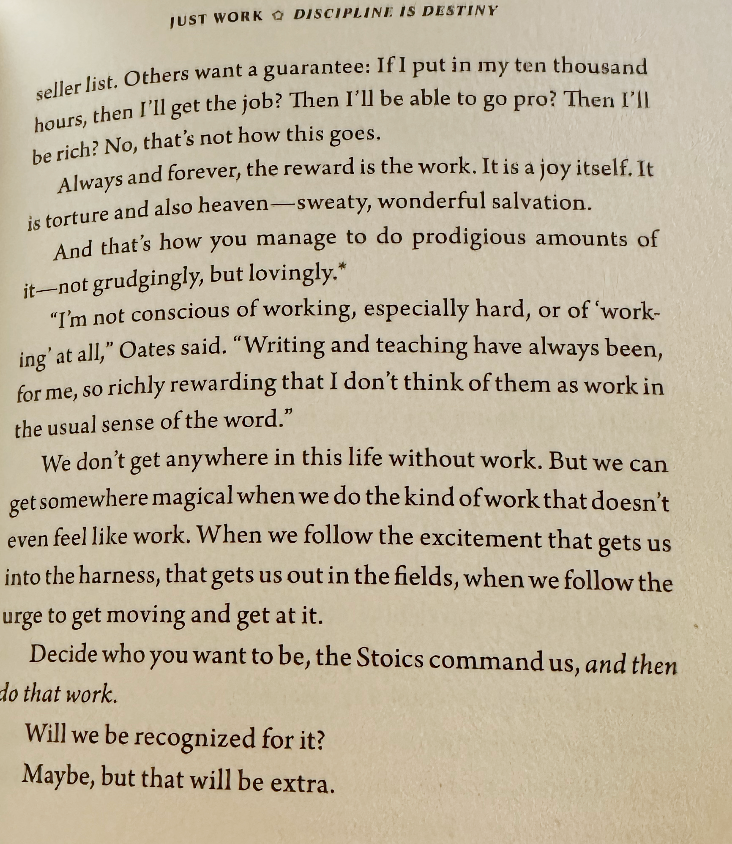
Over a nearly 60-year career, Joyce Carol Oates wrote novels, stories, poetry, plays — millions of words. If she can show up every day, you can get on the treadmill. Pick up the violin. Answer emails. Write a scene. Lift some weights. Cross one thing off your list.
It doesn’t matter what it is—all aspects of life improve when you work on them daily.
The Greeks have a word for this: philoponia—a love of hard work.
So, show up. Do the work. Not for perfection, but for progress. The grind pays off.
Join my YouTube community for insights on writing, the creative process, and the endurance needed to tackle big projects. Subscribe Now!
For more writing ideas and original stories, please sign up for my mailing list. You won’t receive emails from me often, but when you do, they’ll only include my proudest works.
I am a notoriously slow reader—almost to the point of embarrassment. When I read with someone else, I often pretend to be finished, even when I’m not, just to appear as though I’m keeping up with their speed. Of course, I have no idea what their speed is; I just get so self-conscious that I find myself staring blankly at the page or the plaque or whatever it is I’m trying to read.
That’s not to say that I don’t read; I actually read more than the average person—usually around 20 to 30 books a year. However, to achieve that, I need to set aside a lot of time for reading, which I enjoy. But something changed this year.
I got busy!
That’s right; up until September, I had only finished three books—three books! That is unacceptable. Granted, I’m over 60% through one long collection of short stories by Alastair Reynold (Amazon) and 50% through the third book of the Wheel of Time series (Amazon), both massive tomes, but still… I am way below my yearly average for 2024.
So, I decided to change that. With a few months left in the year, I wanted to get back on track and finish as many books as I could. To achieve this, I needed to challenge myself properly. I wasn’t just going to set a random goal of reading ten books by the end of the year. No! I needed something more structured.
You see, if I want to read more books in the time I have left this year, I can either schedule more time to read or read faster—or even better, do both!
However, reading faster will require some practice, and that requires a process. If there’s one thing I’m good at, it’s building a process to help myself stay consistent.
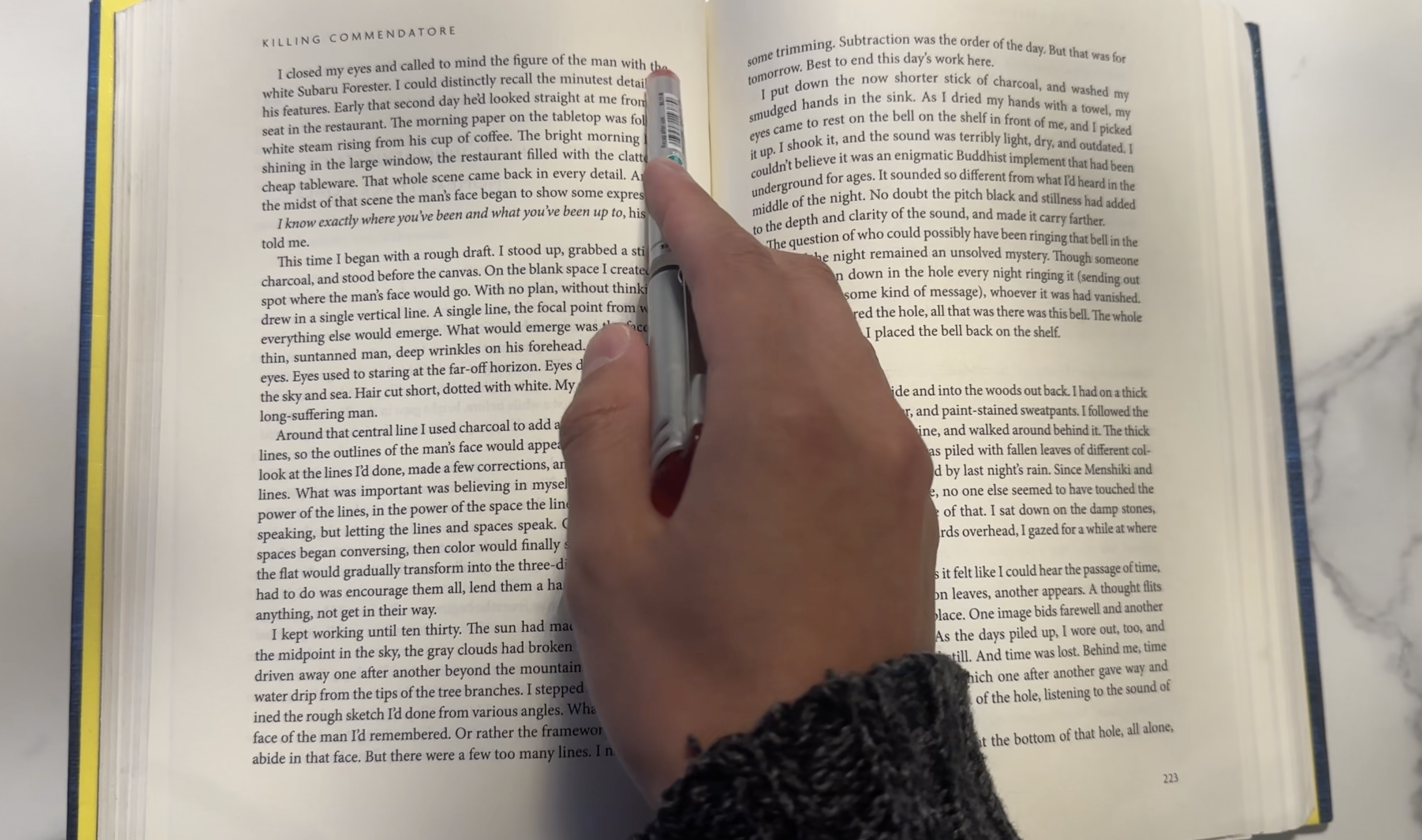
I went to the library and picked a book. It could have been any book, but I ended up choosing one bigger than I intended: Killing Commandatore(Amazon) by Haruki Murakami, which is about 680 pages long. My goal is to finish reading it before it’s due, and I plan to do that by speed reading.
As for the process. First, I need to set a specific amount of time—let’s say 30 minutes per day. Next, I need a technique to practice; for me, that’s speed reading.
After doing some research, I discovered that the easiest technique to start with is using a pen to guide my eyes. This helps me focus on the next word in the line without letting my eyes dart around, which is a natural tendency. This is often why I find myself rereading sentences and paragraphs.
Lastly, I need a way to hold myself accountable. The best way to do this is by keeping a record of my practice, and there’s no easier way than filming myself and posting it as an Instagram story. Yes, it may seem a bit odd to showcase myself reading, but I know that external pressure can be one of the most powerful motivators.
So off I went. The objective was clear: I needed to finish this 680-page book before it’s due. The Vancouver Public Library has a borrowing period of 21 days from the day you check out. Which means I need to read an average of over 32 pages every day.
According to Marc Brysbaert from Ghent University in Belgium, who analyzed 190 studies on reading rates, silent-reading adults average 238 words per minute, while adults reading aloud average 183 words per minute.
With a quick calculation, at 350 words per page, I’ll need to read about 11,333 words each day in 30 minutes, which comes out to approximately 378 words per minute.
Of course, I didn’t expect to reach 378 words per minute right away. I anticipated that it would take some practice to get used to it. However, I hoped that I would eventually get there, increasing my average reading speed in everyday life while still maintaining a level of comprehension—and, of course, enjoyment.
So, off I went!
Day 1: I read 19 pages. I didn’t use the pen today—just my bookmark. This gives me a good starting point for my reading speed. Day 2: I bumped it up to 23 pages! I started using the pen, and I felt the difference right away. My eyes were following the words much easier. Day 3: Another 23 pages. It seems I’ve found a new baseline. Day 4: I managed to read 28 pages! Now that I know the technique works, it’s all about pushing myself a bit faster. I need to average 32 pages, after all, which means I have some ground to make up.
Today I passed the 100-page mark!
Day 5: I read 29 pages today. I’m still pushing myself, but it feels like I’ve hit another plateau. Day 6: Finally broke through with 31 pages! This is my first day hitting the 30+ mark, and it feels great. Using the pen to guide my eyes is becoming second nature. Day 7: I only managed 27 pages today. A little regression is totally normal, though. I was tired, and sometimes you just need to recover after a big push during the week.
Today I past the 200-page mark!
Day 8: I hit 31 pages again! This shows me I can get back over 30 pages in 30 minutes. It really boosts my confidence that I can step it up when I need to. Day 9: I reached 32 pages—new personal best! I’m feeling pretty confident that I can hit my goal if I just keep up this pace. Plus, I still have about two weeks left! Day 10: Sticking with it at 31 pages today. Day 11: 31 pages again! Looks like the low 30s are my new comfort zone. It’s going to take a little extra effort to break through, while I’m trying to keep my comprehension up as well.
Halfway through the book!
Day 12: I read 32 pages! I’m halfway through, and I can really feel the improvement. It feels good! I’m ready to pick it up. Day 13: I pushed it to 34 pages. I started reading a bit later in the evening today, and I think the quiet atmosphere helped me focus. Plus, it felt great to hit a new personal best! Day 14: 37 pages today! This is a big milestone for me. I was really feeling it, so I pushed myself a bit more, moving my pen and guiding my eyes just a bit faster. It’s all about gaining confidence in reading the words together instead of just one by one. Day 15: I managed to replicate yesterday’s effort with 36 pages. It felt good, like reaching a new level in weightlifting. Adding just five more pounds on top of 300 is significant, right? We call that marginal gains. Day 16: 37 pages! I’m super proud of my consistency lately. I’ve really shown progress! With less than a week to go, it’s crunch time.
Today I passed the 500-page mark!
Day 17: I read 33 pages today. Not as good as before, but there was a time when 33 pages would have blown me away! Progress is about looking back and seeing how far you’ve come. Day 18: Another 33 pages today. At this point, consistency is key. The fact that I’ve read every day is what matters—it’s like chipping away at a big project. It doesn’t have to be a home run; sometimes you just need to get on base. Day 19: I hit 38 pages—new record! Some days, everything just clicks, and reading feels easier, whether it’s from having more energy or focus. Day 20: I managed 33 pages again. I can feel the finish line coming, and I know I’m going to hit my goal. It’s all about finishing strong and making the most of this time. Day 21: I only needed to read 21 pages to complete the book, and I did it! I finished on the exact day it was due!
If you are familiar with Haruki Murakami’s writing, you know it’s full of beautiful prose and surreal imagery. And this one is no different. If I was to compare it with another one of his novels, I’ll say it’s kind of like The Wind-Up Bird Chronicle (Amazon). So if you like that, check out Killing Commadatore. There’s no way to show my comprehension of the book in this video and I’m not going to give it a proper review. But I do want to share my favorite passage:
“When you’re locked up alone in a cramped, dark place, the most frightening thing isn’t death. The most terrifying thought is that I might have to live here forever. Once you think that, the terror makes it hard to breathe. The walls close in on you and the delusion grabs you that you’re going to be crushed. In order to survive, a person has to overcome that fear. Which means conquering yourself. And in order to do that, you need to get as close to death as you possibly can.”
This year, like I mentioned, has been a bad year for reading, but the year isn’t over yet. And next year is just around the corner. I’m getting back on the horse. I’m not going to let the excuse of being too busy slow me down from my reading goals anymore. If I can’t create more time in the day, I just need to read faster. And now knowing that I can read at 377 words per minute at a somewhat comfortable pace, means I will be able to finish books at a rate hopefully a quarter of the time faster… if not double the time faster.
But there is a lot more practicing for me. A muscle only stays strong if you keep using it. So…
I’m going to keep borrowing books from the library with the intention of finishing them before the due date arrives.
Yes, often times, I will be able to renew the book, but… if the library thinks I can read a book in 21 days… then hell… I’ll do my best.
Join my YouTube community for insights on writing, the creative process, and the endurance needed to tackle big projects. Subscribe Now!
For more writing ideas and original stories, please sign up for my mailing list. You won’t receive emails from me often, but when you do, they’ll only include my proudest works.
Nearly four years I’ve been working on this project, and it just feels like I’m getting started. It’s a crazy feeling and I know I should be somewhat demoralized, but I’m actually more excited than ever because my story is actually starting to make sense.
During the midst of the pandemic, I wanted to work on a big project, something that will be with me through the good and bad times, a place I’m always welcomed, characters that can stay with me, a story that I can build upon and evolve as I do. I did that. The pandemic came and went and here I am now with pages upon pages of words. Three books in a trilogy. All at different stages of completion.
As I wrote, I loaded so many ideas into the story. It was something of a journal. It was therapy. Anything that I was feeling, anything that was happening in the world, anything that I wanted to learn more about, I put it into the story. Naturally, things went in many different directions.
One can say that I was undisciplined, unorganized, and simply writing by the seed of my pants, and that was all true. I started writing with only one idea, and as I sent the character through trials and tribulations, more and more ideas arised. And I embraced it all, because — even though I had a sense of where I wanted it to end — I didn’t know how I wanted to get there, and more importantly, I was experimenting with the tone and style and flavor of the story.
Now that I have all the drafts in front of me, I see what I want to do clearly. Not only do I know how to style this project, I know what my next projects will be and beyond. But before all of that, there is a lot of work left on this one. Like I said, although there are thousands and thousands of words on the page, many of those words are not the right ones. I think of them as stand-ins for a more specific story that I want to tell. A story that is more focused, more clear. A story that doesn’t meander around like someone at a supermarket with nothing they need to buy.
In other words, I am going to be rewriting everything. From book one which I last left off at draft five to book three which I have just finished writing the first draft long hand and am now transcribing.
I am going to go from beginning to end, from the first word to 300,000th word and make sure that it is all serving the main story that I want to tell. The skeleton is there. It took me 4 years to get it, and it was necessary, because without it, I would have nothing at all. And I cannot say that I could have gotten to this point without all the work I’ve put in previously. So, no, I don’t think that 4 years of work is down the drain, although a more pessimistic side of me would certainly want me to think that.
About a year and a half ago, I came close to abandoning this project, like I have done for many before. But after getting the ending down, and really thinking through what kind of writer I want to be, and what stories I want to tell now and in the future. I’m rejuvenated. I have never felt more clarity than I do now with my creative projects. And I just want it all to happen fast.
Then I remind myself that it took 4 years to get here, and it might take another 4 years to get to the finish line. Which gives me a bit of peace. There is no rush. Maybe some of you out there are waiting for it, but heck, there is a lot of other stuff to read in the meantime. So patience.
Most importantly, I’m enjoying the process again. This project is my highest priority and I’m glad to be able to spend even a few minutes working on it every day. Little by little. Which is all I can ask for as I try to balance work, exercise, mental health, and rest with everything else in life.
I know it’s not interesting to hear someone talk about their unfinished project for over 4 years, but hey, that’s the creative process that is often rarely acknowledged. It’s not exciting. It’s a slow grind. It’s endurance. It’s doing it even when everything else is telling you to stop.
So, that’s where I am. I know where it needs to go now, more than ever. I know the path to take. I know all that. It’s just about going all the way back to the beginning and doing it all over again. Like an actor taking it from the top, so it goes with this project.
Join my YouTube community for insights on writing, the creative process, and the endurance needed to tackle big projects. Subscribe Now!
For more writing ideas and original stories, please sign up for my mailing list. You won’t receive emails from me often, but when you do, they’ll only include my proudest works.
The term speculative fiction (aka spec fiction) covers many genres, including fantasy, science fiction, alternate history, and horror. In a world that already feels so surreal — where we can’t distinguish truths from lies — we must ask, why read spec fiction?
Fantasy and science fiction are two of my favorite genres. From ancient mythology that I grew up on as a kid like the Chinese epic Journey to the West (Amazon) to the modern-day high fantasy A Song of Ice and Fire (Amazon) to space operas such as The Hitchhiker’s Guide to the Galaxy (Amazon). When seeking out a story, I usually gravitate to something that takes me to a place far away from the realms of reality.
Yes, I love it for the escapism, but I also pick up spec fiction for the same reason I’d read a sad drama, I want to have a cathartic experience. There’s nothing like a post-apocalyptic or dystopian story to put things in perspective. These stories make me feel the numbing dread of existence and remind me that this little life I have is fragile, and therefore, should be handled as such.
Speculative fiction is fake, but only in the way that looking in a convex mirror is fake — it distorts the image back at us. That’s not what we actually look like, but in the wide-angle reflection, we see more than our naked eyes could. We see the consequences of our actions and it broadens our view in a way that realism or biographies cannot.
The following are four reasons why I think you should read spec fiction.
An Intro to History
One way to learn about history is by reading textbooks. You can learn all about Ancient Rome or the Great Wars this way. You can learn about the dates and times, and other trivial details. Odds are, if you were introduced to a topic via a textbook, the likelihood of you getting super interested in it is low. After all, how many people claim that it was in school that they lost their passion for reading?
Alternate history and fantasy can be a gateway to diving deeper into real-world events.
The Leviathan Trilogy (Amazon) by Scott Westerfeld made me want to learn more about World War 1 through the lens of steampunk and biopunk. By creating a fictional depiction of the Allied forces versus the Central Power, where war machines battle genetically modified beasts on the European battlefield, I grow more curious about the actual events.
Watchmen (Amazon) got me interested in the politics of Richard Nixon, A Song of Ice and Fire introduced me to the War of the Roses, and Slaughterhouse-Five taught me about the bombing of Dresden. Spec fiction sparks your curiosity as a well-marketed history lesson that hooks you and asks, “if you’re interested in this, guess what craziness really happened.”
Prepare Us For The Future
Genres such as science fiction and dystopian give writers license to share their worldview in the most empathetic way they can, through the perspective of a protagonist. This allows us to see their version of the future, whether it be startling, hopeful, or pessimistic. In doing so, we’re forced to question our own values: how will we defend them and how will we react when our familiar world is put to the test.
The Road (Amazon) by Cormac MacCarthy asks, “How will we survive at the end of it all?” The Stand (Amazon) by Steven King asks me which side I’d choose when I’m forced to pick. 1984 (Amazon) by George Orwell reminds me that we can be controlled by fear. A Brave New World (Amazon) by Aldous Huxley reminds me that we can be controlled by pleasure.
Every modern-day question we have about our values could be put to the test when we read spec fiction. No, these books don’t contain the answers we need to fix our current realities, but they are apt warnings, a little fire drill within ourselves that prepares answers for: What will you do when the time comes? What will you do when you need to act?
Confront Our Fears
From censorship to monsters to the afterlife, spec fiction creates an arena in our imagination where we can confront our fears like a gladiator against a spaceship of aliens. Like the boggart from Harry Potter in our brain, we conjure up what terrifies us, so that we and the protagonist can face them in a world where we won’t get hurt. Win or lose, when we read spec fiction, we do it bravely. And with that bravery, we can bring it to the real world where we have to face overcomeable fears such as taxes, stubborn bosses, and missile launches from North Korea.
Whether you’re reading about the end of the world or a battle against a giant spider, spec fiction brings you to the shadow realms, so you can gain the confidence to stand strong in the face of real challenges.
Exercise For The Mind
While a mystery novel can be a puzzle, spec fiction can also test the mind by forcing us to paint an image in our head that we reference from reality. This is especially true for spec fiction that has yet to be adapted to film or television.
Reading a spec fiction book where you haven’t seen any concept art, and the only visual you have is the cover, you as the reader become as much the creator as the author.
As you read, your mind expands to a scale that cannot fit within any confines of the real world. You dive into the heads of characters and out into a fantastical land with mountains, rivers, and oceans, and then further out to galaxies far far away.
You gain the empathetic skills to communicate better and you increase your curiosity to explore deeper and further in any direction. The more you read, the stronger your mind gets, and like going to the gym, you get what you put in.
By reading speculative fiction, we learn about the environment, human nature, politics, technology, and the supernatural all through the protective filter of fiction. Sure, on the surface it might just seem like wizards, aliens, and battleships, but when you turn the pages, you realize that there is so much more.
For more writing ideas and original stories, please sign up for my mailing list. You won’t receive emails from me often, but when you do, they’ll only include my proudest works.
Join my YouTube community for insights on writing, the creative process, and the endurance needed to tackle big projects. Subscribe Now!
Weight, volume, speed, and time: there are many aspects of daily life that we have to measure in order to function and communicate with those around us.
An agreed-upon unit of measurement is essential in society, and the way we measure things says a lot about our culture. It’s only natural that when we start writing and world building, we feel encouraged to invent our own type of measurements to create a more unique society. It’s much like creating a new language.
The thing is, in order to have an immersive world, we need to understand how different units of measurements are invented. We can do this by learning about the history of some units of measurements.
In this video, I take a quick leap back in time to get some inspirations… and then I take a crack at explaining the ones I created in my epic novel. I hope this video can show you what works and what doesn’t work when inventing units of measurements.
Fiction writers face many challenges: plots, settings, and lack of coffee. But one specific writing quandary has been puzzling established and emerging writers alike, and there doesn’t seem to be an easy “brew” button to solve it: what is the range of liberties writers have when they dare to construct characters outside of their cultural understanding?
For example: is it kosher for a Caucasian writer to write about an Asian war veteran? Some would say, “Absolutely! It’s just a story,” while others would say, “Absolutely not! It’s not their story to tell.”
In a recent New York Times article, Roxanne Robinson, author of Sparta—a novel set in war-torn Iraq, a place she fictionalizes for her tale—reminds us that the line between fact and fiction, even in creative writing, is not always clear and should be approached with caution, empathy, and research.
Are you a writer? What are your thoughts on this subject?


 Elliot Chan