Another beautiful day in Vancouver—cold, though. It’s just barely above freezing today. Still, any day in January without rain or snow? I’ll take it.
This week, I finally got around to tallying up all my metrics from 2024. Tracking data is something I genuinely enjoy, which is one reason I love triathlon so much—it’s basically an excuse to collect data. If I can quantify what I’m doing, it makes consistency feel so much easier. I bring that same philosophy to my creative work. Every day — or nearly every day — I track my creative writing and video creation the same way I track my workouts. I’m obsessed with my spreadsheets.
Here’s how 2024 shaped up:
I swam 90,325 meters in 44 hours, 20 minutes, and 26 seconds (5% less than 2023).
I cycled 3,901.07 kilometers in 175 hours, 21 minutes, and 32 seconds (22% more than 2023).
I ran: 621.44 kilometers in 67 hours, 11 minutes, and 29 seconds (23% less than 2023).
The big jump in cycling is thanks to our new indoor bike, which I added to my routine last year—it made all the difference. As for swimming, I swam less because I spent extra hours in 2023 learning how to swim, so naturally, I didn’t log as much distance in 2024 because I didn’t have that huge learning curve. For running, I held back intentionally to avoid overdoing it and risking more injuries.
2024 was my sophomore year in triathlon. While I packed the calendar with races, I’d call it more of a “slump year” training-wise. But seeing the data laid out, I know I’ve built a solid foundation. This year, I want to build on that thoughtfully—not just by chasing bigger numbers. These annual stats are a nice way to reflect on the work I’ve put in, but they don’t tell the full story. What matters to me this year is how well I’m performing in training and races.
Take swimming, for example. For my birthday, my amazing wife got me a game-changing gift: FORM goggles. If you haven’t heard of them, they’re like a smartwatch built into your goggles. They show data like pace and stroke rate while you swim. Even cooler, they give feedback on things like head position while breathing and overall swim efficiency.
After my first swim with them, I got a score of 40 out of 100. Plenty of room for improvement, but I’m excited to see how much I can progress.
With that said, I’m heading into year three of this triathlon journey. While improvement is always a focus, the real priority is maintaining the habit. I don’t even think of triathlon as a hobby anymore—it’s just what I do.
Before my training plan officially kicks off in a few months, I’m taking this time to maintain my routine and base fitness. There is no point in tiring myself out. This is my no-pressure, fun part of the year, and I want to enjoy it. And I definitely want to do a weekend ride. So I’ve decided to explore some parts of the city that aren’t great for structured training but are worth a visit.
Today, I’m riding to the West End of Vancouver to check out some of the greenways, including the Comox-Helmcken Greenway. Thanks to this project, there’s been a 49% boost in cycling trips and a 35% decrease in car trips in the neighborhood. While the greenway was originally planned to stretch across the entire city, only the Comox phase has been completed so far.
And since no ride into Downtown Vancouver is complete without detours, I got sidetracked by the demolition of the 115-year-old Dunsmuir building. It’s been a hotel, military barracks, and a shelter over the years, and now it’s making way for something new. From there, I’ll take a trip down the world-famous Granville Street.
Enjoy the ride.
For more writing ideas and original stories, please sign up for my mailing list. You won’t receive emails from me often, but when you do, they’ll only include my proudest works.
Join my YouTube community for insights on writing, the creative process, and the endurance needed to tackle big projects. Subscribe Now!
I’m Elliot, and I’m here to improve my cycling skills. To achieve this, I’m embarking on a project I call FTP Builder, inspired by the workout I’ll be taking on in Rouvy. This series will be told in five parts. This is the conclusion, entitled: The Gains
We’ve made it! What a journey. At last, we are here at the final part of this project. When I began, I was confident that after going through this training plan and racing the race, I would emerge as a better cyclist. I knew that if I put in the work, I’d see positive results in the end.
But as we know with sports, there are no guarantees. You can trust in the process and do every workout perfectly, but the only thing that matters is what happens on the day. And that’s what I love about it.
So, I returned to Stanley Park, both the virtual version and the real one, after a couple of weeks of recovery. In Part 2 of this series, I ran two time trials, to give myself a baseline number of one lap around the Stanley park course. As you may recall, I am training for a race later this year that will require me to do four laps of this course. So this remains to be appropriate training.
The goal in this episode is to do the time trials all over again and then compare my results. Did I improve? Do I have a proper strategy for when I have to do this in a competitive environment with other racers around me? What areas of my cycling abilities should I focus on after this? Where are my weaknesses still? These are all questions I have in the back of my mind as I return to the start line of the Stanley Park course.
Let’s begin!
Here I am once more in Rouvy. Last time I took on this course in the virtual environment, I had a feeling that I might not have given it my 100%, that in the end, I might have left a bit in the tank. Of course, in the moment, I was probably thinking about pacing appropriately, building up as I went, and aiming for a negative split.
This time, I wanted to try something different. I started off a little more aggressively, aiming to hold a steady pace for the whole course.
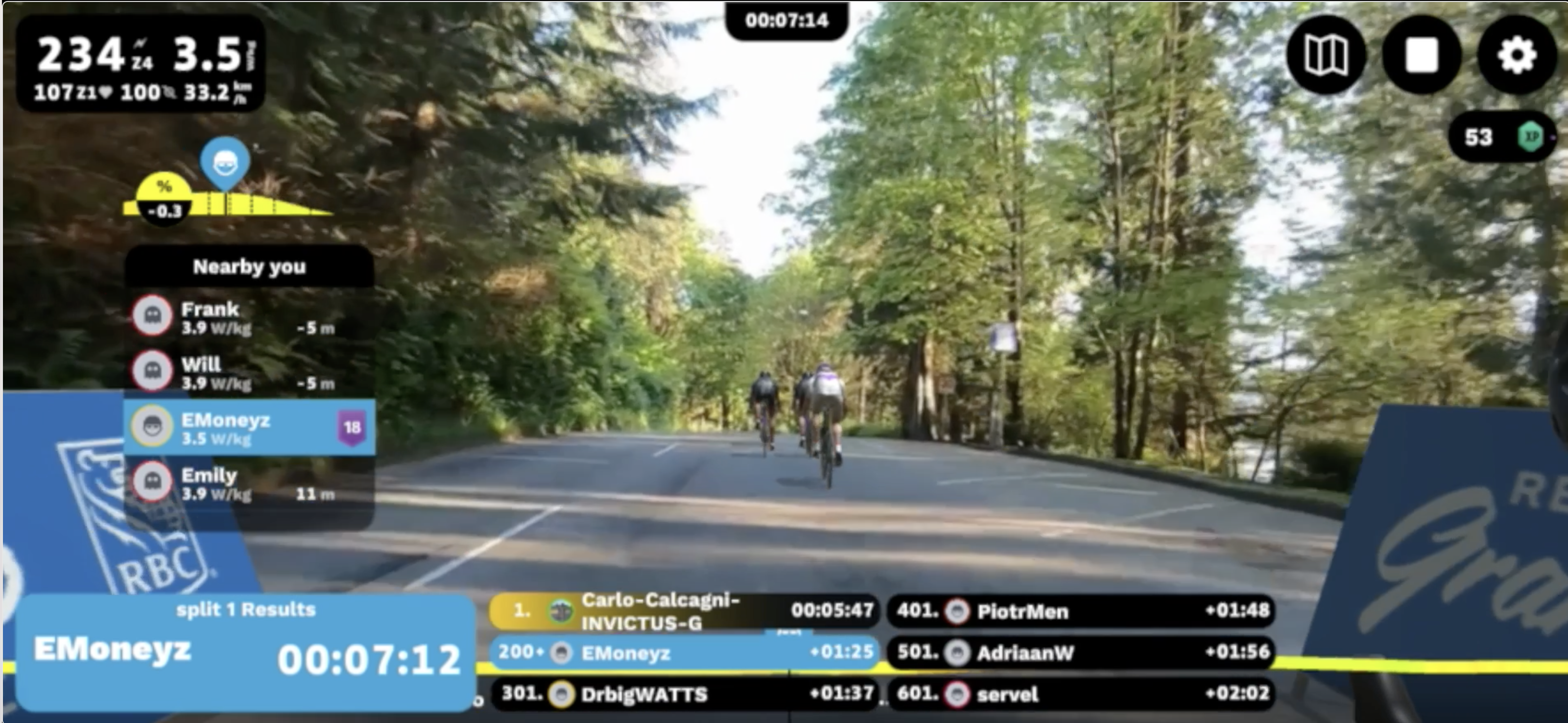
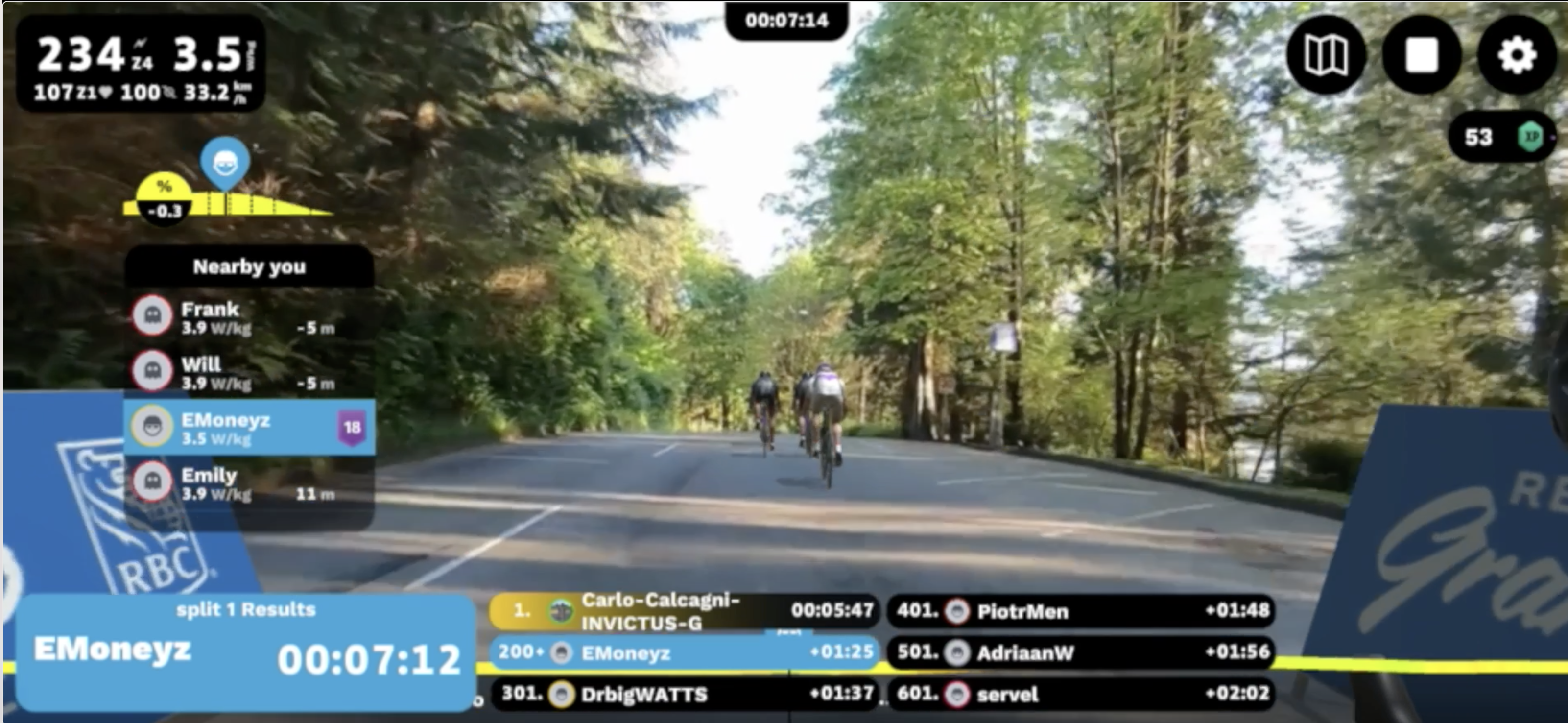
I immediately got my watts into the 200s, aiming for around 220, which is just around my FTP. This was about 40-50 watts faster than my first attempt. Things were looking good!
About 3 minutes into the time trial, I was just under 200 meters ahead—not far enough to feel comfortable. My ghost could still catch up, even though I was pushing much more power. But as more time passed and I maintained the pace, I was able to keep building the gap, which was exactly what I intended to do.
One interesting point to note was my heart rate. During my first attempt, my heart rate was about 15 bpm faster than in my second attempt, even though I was pushing harder the second time. This was good news, though it could also mean my heart rate monitor wasn’t working properly. Who knows?
I reached the first split at 7:12 in my second attempt, 42 seconds faster than my first attempt, which was 7:54. I was on pace to break my record and still felt relatively good as I approached the hill.
There was no sign of me slowing down at this point—I was full steam ahead. At the climb, my heart rate rose, but compared to my first attempt, it was still at a moderate zone 2 level. Yeah, something must not have been right, so we’ll take that metric with a grain of salt.
It’s incredible to see the difference in the power I was putting in. I remember that during the climb in my first attempt, I decided to turn it on, pacing myself for most of the race but pushing it now. I did the same in my second attempt. Finally, my heart rate shot up to 177, reaching zone 6 by the end of the climb. It seemed to at last calibrate appropriately. I was indeed giving it my all as I approached the descent, where I continued to put down the watts. I wanted to ensure there was no denying that I had improved.
By the end of the climb in my first attempt, my heart rate was only in zone 4. There was no doubt I had some left in the tank, and I had picked this point to really increase my effort. But it was too late. There is something to be said about being able to go steady and hard the whole way through.
In my second attempt, I was almost done by the time my first attempt finished the climb. I flew down the descent and finished at 15:17.9, beating my previous record of 16:38.7 by 1 minute and 21 seconds. I was on average 3 km/hour faster and pushed an average of 37 watts more. It’s safe to call it an improvement.
But wait, the experiment is not over. What about the real world?
So much had happened in the two months between the two attempts. Yes, I went through the training plan, but I also had a couple of crashes that messed up my confidence. I had low expectations this go. I knew beating my original time was possible, but I wasn’t willing to do anything too risky. My arm, although it felt much better, still wasn’t 100%, and I couldn’t shake the image of myself crashing on the descent. Nevertheless, I approached the start line with determination to try my best. It was all I could do.
Like my indoor ride, on my second attempt outside, I went out a lot harder at the start. If my training worked as it had shown, I shouldn’t hold back as much. I needed to go for it! This was especially true if I anticipated being a bit nervous on the descent later on. I wanted to give myself as much running room as possible.
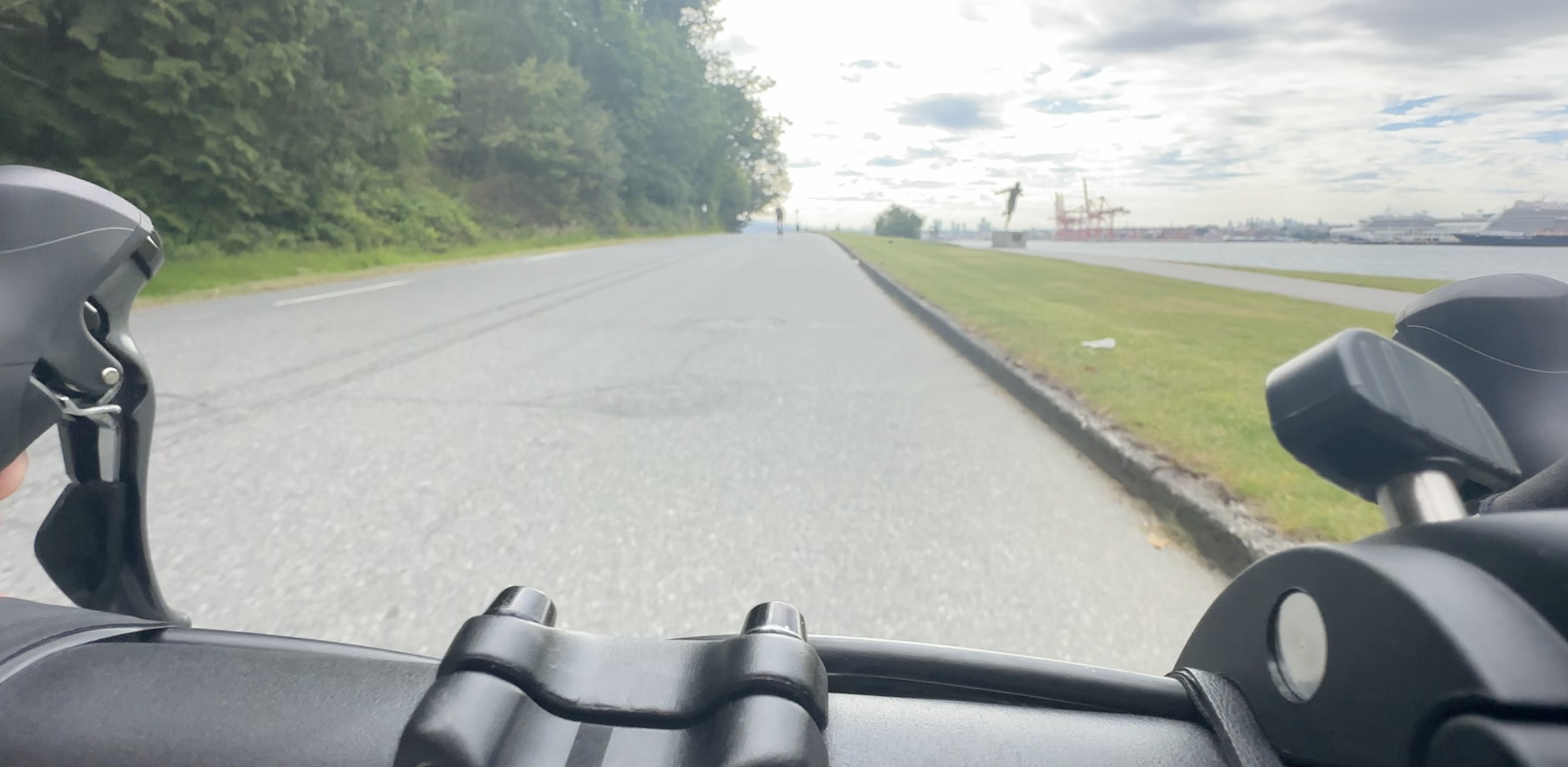
My first checkpoint was the turn into Stanley Park, where I had to slow down a bit to anticipate traffic. I counted that I was about 8 seconds faster than my previous time. If I continued at this pace, I could build upon it, so I kept rolling.
I could feel myself moving a lot faster this time, but I also knew it was not going to be easy. Unlike my first indoor time trial, the last time I rode the course outdoors, I really was giving it my all.
Luckily, there were a few riders that day on my second attempt who were really flying, especially this guy. I used him as a bit of a carrot to chase, and he actually helped pace me. That guy was going fast, and if I could at least keep him in sight, I knew I could beat my previous record. But he was moving. It goes to show that as much as I have improved, there are still so many people who are better.
At the midway point, I counted about 20 seconds ahead of my previous time. This gave me a slight bit of comfort, but like I mentioned, the hard part was still to come: the hill.
Thanks to all my training, the hill didn’t seem that hard this time. Yes, it was still hard, and you can hear it in my breathing, but I managed to catch the guy who had zoomed ahead of me, and that made it feel easier. I knew I was on pace, I just couldn’t blow up now.
Looking at this footage, it’s interesting to see how green the park got in the past few months. That’s something that certainly isn’t replicated in the virtual version.
I got to the top of the hill about 36 seconds faster than my previous attempt. That hill climb allowed me to extend my lead by an additional 10-15 seconds. Now all I needed to do was stick the landing, get down the descent at a moderate pace, and I would beat my time. Good thing the guy I passed on the climb passed me again. It was nice to have him on the descent because it made the experience feel less lonely. Then another rider joined us. We were a group now, which really erased all my worries, and I could just follow their lead.
I did it! Got all the way down and I ended up beating my time by 45 seconds, finishing at 20:13 compared to 20:58. This was far better than I expected! I thought I was only going to squeak through with a few seconds left, but 45 seconds is substantial.
So in a matter of a couple of months, I improved my indoor time by nearly a minute and a half and my outdoor time by almost a minute. After my crashes, a part of me thought I might give up completely and find a new hobby where I could stay inside bubble-wrapped. I am thrilled that I stuck with it and saw an improvement. But I know this is only the beginning. There is so much more to learn and improve on. What fun projects I have ahead!
Thank you all for joining me on this journey. I hope you enjoyed the ride with all its ups and downs. I assure you there is more to come in my triathlon adventures, so if you don’t want to miss it, please subscribe.
Join my YouTube community for insights on writing, the creative process, and the endurance needed to tackle big projects. Subscribe Now!
For more writing ideas and original stories, please sign up for my mailing list. You won’t receive emails from me often, but when you do, they’ll only include my proudest works.