Conquer Mobile the First Company to Join Health Tech Connexx Incubator

Formerly published by Techvibes. 

Earlier this month, the city of Surrey announced the start of the Innovation Boulevard and Health Tech Connexx (HTC), an incubator that will provide lab spaces and services to those in the tech industry seeking solutions for real-world problems.

The first company to join this innovative collective is Vancouver-based Conquer Mobile, best known for their collaboration with GenomeDX and NGRAIN.

Upon joining HTC, Conquer Mobile’s goal is to develop virtual reality simulation for medical experts practicing their craft of lifesaving. Conquer Mobile and other companies that will join HTC will work with Kwantlan Polytechnic University to help advance the technology and education in the medical field.

“Innovation Boulevard offers a space for high-technology companies to get together, to create a critical mass—of over a hundred,” Aaron Hilton, CTO and co-founder of Conquer Mobile told Techvibes. “This critical mass is really important because it allows meet-ups, group activities and anything else like that to be convenient for everybody. We can all start trading ideas with each other and have a rich mix of surgeons, nurses, trainers and the whole structure of health care plugged in with the high-tech people.”


RELATED: Canadian iPad App Helps Physicians Diagnose Prostate Diseases


Conquer Mobile and the other companies that will join HTC are projected to be moving into the newly built office and lab spaces in the spring of 2014. Until then Conquer Mobile continues to develop innovative solutions to problems in the medical field and the most pertinent one is applying virtual reality to help and educate doctors, surgeons and other medical professionals as they prepare for high-risk procedures.

“We are trying to avoid the bubble-think phenomenon,” said Hilton. “If you search for the same stuff, you’ll only know a certain amount—you don’t really get a broad understanding of it. Our objective with the simulation and training is to test your limit. We need to know the broad stuff. You can’t just think about the ordinary. When things go smoothly, that’s great. That’s basic training. But what happens if you knick a vain and the patient is bleeding? What do you do—right away? You need to get everyone on the same page.”

An overwhelming amount of medical professionals are now relying on technology to improve their practice. Hilton suggested that all doctors and surgeons today are using iPads to perform their duties. Of course iPads are a consumer product, nothing too special. With technology more accessible to patients than ever, many of those with ailments are diagnosing themselves or meeting the doctors with great knowledge—but with untrained errors.

“[Educated patients] is just a reality doctors have to deal with,” said Hilton. “Not all your patients are idiots and you’ll have to keep up. It’s kind of interesting, the next generations of doctors are going to start leveraging tools.”

As HTC and Surrey’s Innovation Boulevard prepares for accommodation, Hilton is welcoming innovators and virtual reality enthusiast to Vancouver VR, an event showcasing new virtual reality gears and opening dialogue about the future of digital health.


 

Vidoyen Offers Answers Without the Hassle of Reading

Formerly published by Techvibes. 

Toronto-based Vidoyen is innovating the way we exchange knowledge through social media.

Amidst all the rambling rants, self-brags, and gossips comes trustworthy and stimulating video content from experts in the world of politics, business, academics and other respected professions.

“We [Vidoyen] are like TedTalk meets Twitter,” founder and CEO of Vidoyen, Arshia Tabrizi explains to Techvibes. “We are a site that provides two-minute videos that’ll inform and inspire. And for the experts we have built a custom social media platform for them to engage with their audience in a much more authentic way.”

We are all bombarded with information and content daily. There is an overwhelming amount noise out there; on social media platforms where there are no moderators or curators, it’s often the loudest voices that get heard—and they aren’t necessary the most valuable.

Vidoyen has filtered out the nonsense and assembled a group of contributors with expertise. These contributors are selected through an application process where certain aspects are assessed including established reputation and knowledge in a particular field. Unlike YouTube and other user-generated content sites, Vidoyen only publishes videos with helpful and reliable answers to compelling and sometimes complicated questions.

“Anybody who is busy would not want to spend a lot of time scouring the Internet,” said Tabrizi. “They want smart, short-form video content that they can trust.”

Vidoyen has developed a one spot create, review and share platform, which allows both the creators and audience to push the content out to all social media channels. While the questions for the experts can be complex, the usability and the content must be short and simple.

“People are tired of reading text,” said Tabrizi. “We are constantly reading stuff on our mobile phone—a lot of reading devices have small screens—so no matter what we do it’s still hard on the eye. People are looking for different kinds of media to consume. We believe that video is great for communicating and retaining information in the way that distinguishes itself from text.”

On a text-heavy planet, it’s easy to disconnect ourselves from the people around us. Often times we forget that there is another person on the other side of a text message or an email thread. Vidoyen stresses the value of personalities and the significance it adds to the information and opinions being offered. The tiny human element that is often lost in words can be captured in video, especially when you witness the passion behind the person speaking about a subject that really matters to them.

The Internet has become a megaphone for people with something to say, but the freedom of speech has lowered the standard of legitimacy. While some are shouting into the void of YouTube, others can be found on Vidoyen chiming in and offer their insights to questions worth answering and commentary worth hearing.

“We insure quality,” said Tabrizi, “we are about quality over quantity.”

For those who wish to contribute to Vidoyen the next round applications will be opened until December 15.

Nice Guys Can Lead Startups, Too

Formerly published in Techvibes. 

Here you are, straight out of grad school on a pervious entrepreneurial endeavour. You have been warned about the trials and tribulation of managing your own business, leading a team, and branding your ideas against a thousand other brilliant ideas.

The ecosystem is more competitive than ever and nobody has to tell you this again. Still, you believe in yourself, your team and the company culture—but do you have the guts to say “no” when it really counts and still be compassionate?


IT’S HOW YOU SAID IT

With the advances of technology came the decline of alpha male CEOs; startups can no longer function as a dictatorship. The majority of communication today is done through text, emails and social media: there isn’t the same opportunity to be bold and ruthless with big decisions.

Leaders are merely members of the troop and even though certain responsibilities fall upon their shoulder, they should not forget that the company comes first. Albeit the original concept may have been their brainchild, it took a team effort to bring it to life—even though it might still be in its infancy.

It’s easy to be blindsided as you company expands, especially when investors show interest and competitors take notice. You consider all that to be good. Somewhere along the lines you have shaken the right hands and smiled the right way. The reason for such success may be your company’s appeal, but it’s probably your passion.

Communicating your company’s vision with enthusiasm is the best way to be likeable. But then you listen to others responses and they throw in their two cents and start making criticisms. You reevaluate your objectives and here is where good leaders stand up with their company’s conviction.

Be adaptive, but also assertive. The worst thing a leader can do is to lose focus of the company’s ultimate goal. Good leaders will take opinions into consideration, but they will not be easily swayed or led astray.


COOK UP SOMETHING GOOD

Humbled by the fact that you need your team as much as they need you, you check your ego at the door every day and work hard to grow and scale your business. You play by the rules, offer a slice of pie to everyone on the team and wait for the $3 billion offer from Facebook or Google or whoever is willing to drop some crumbs down to you.

Sounds a little pathetic, huh? But believe it or not, we are all after the same crumbs—there is nothing glamourous about this area of business.

Gratitude is an important value not just as a leader, but also as a human being. Your company’s journey will hopefully be a long one and that means your employees, like all people will get complacent. Acknowledging achievable milestones and creating incentives when they are reach is a way of showing your team how much you appreciate their efforts in an authoritative manner.

You might be after the crumbs—but you can offer some, too.


FULL STEAM AHEAD

In journalism it’s often known as the scoop; it’s intelligence that few know. As the leader, you are often rewarded with key information that you can choose to share or keep to yourself. Quality leaders need to know how to stymie gossip and inform others.

But not everything should be communicated. Leaders should be able to recognize certain discouraging data that may ultimately stress the staff. Turbulent times will test you leadership qualities best. If bad news surfaces within the collective, do address it by holding a meeting or through email, connecting in some way will allow you to refocus the group on the company’s goal and finding a solution to the problem.

People want to talk. But when the talking ends, you must make a clear decisive decision. If it fails, the collective fails—if it succeeds, the collective succeeds. You made the decision, but it’s not about you.

It’s best to leave the group out of the daily mundane worrisome junk that every business has to deal with. Don’t forget that you are captaining the ship and it’s important to keep moving forward. As a leader it’s your duty to take some of the pain during though times. You may feel like a push over and that you don’t deserve the emotional beating, but remember pressure is a privilege. Take ownership and rise above it.


NICE GUYS FINISH LAST

If you don’t succeed, you might use this old saying as some comfort. “At least I’m nice,” you’d say to yourself.

Nonsense. Ignorance finishes last, miscommunication finishes last, belittling other’s ideas finishes last—nice guys and nice leaders are reasons the startup industry is so appealing. It’s what makes entrepreneurs who have failed try again.

So: nice guys out there who have paid their dues and still haven’t reap the rewards, I advise not to change your attitude, because nice guys will always get second chances, while the bad guys might just have to go for broke.

What’s on tap?

 Opinions-beersnob

Quit your “wine-ing”—it’s just beer

By Elliot Chan, Opinions Editor

Formerly published in the Other Press. Nov. 2013

Wine drinkers are often associated with distinguished sophistication—and a bit of pretentiousness. At one point or another, we have heard a wine snob complaining about Merlot’s dry taste, or how they can’t tolerate the sweetness of Chardonnay. Well, it looks like alcohol snobbery affects more than just wine. Since the rise in craft beer’s popularity, beer snobs have taken the judgmental reins in house parties, bars, and poker tables all across the country—and they need to put a cork in it.

Ever since I acquired the taste for beer, it has been my go-to choice at most social events. There’s a simplicity to beer drinking. You don’t need to mix, or shoot, or anything like that—whatever is in the glass, bottle, or can is good to go. Sure, there are fancy choices, like the “Rolls-Royce” Wild Rose, or the “Louis Vuitton” La Fin Du Monde; but more often than not, I just want to be financially responsible and go for the “Honda Civic“ Molson Canadian or “H&M” Kokanee.

On average, booze prices in BC are some of the highest in Canada, and it isn’t even worth comparing to our neighbours down south. Whether the government decided to tax alcohol so heavily to help funding or to discourage drinking is irrelevant—the point is that if we want to enjoy a beverage, it’s going to cost us.

The truth is, I’m a beer-lover and I enjoy the fancy craft beers and microbrews as much as any other enthusiast, but the same way I don’t go and have a medium-rare steak at The Keg every night, I don’t splurge on the “la-dee-da” imports every time I order a drink, either. Whatever is on tap will be just fine for me. After all, I’m on a student budget. I don’t need you to remind me about that. So stop acting so high and mighty—it’s just a drink.

Some people consider drinking a bad habit; I consider it a relaxing way to pass the time with friends. Snobbery and unfair judgment, on the other hand, I do consider a bad habit. Truth is, beer snobs are usually unaware of their snobbery, because they’re blinded by their passion. That way most music snobs think only alternative music is relevant? Beer snobs feel the same way about beer.

Instead of being snobby about others’ choices, beer snobs/aficionados should share their knowledge and explain why they made the premier or the unconventional choice. Be generous and offer others a sip. The diversity of beer is astounding and it shouldn’t be a solitary exploration. Not everybody can afford to be adventurous every time they go out, so be respectful. After all, good beer doesn’t equal good times, but good friends do. Cheers.

The test of time

Opinions_retirement

Longer life expectancy means less financial stability in the latter years

By Elliot Chan, Opinions Editor

For those still in their roaring 20s, let’s think longterm for a moment—say, 40 years from now. The world has changed and so have you. You have a family, a mortgage, car payments, a stable job, ailing parents, credit card debt, medical bills, and multiple other financial responsibilities to worry about, yet retirement is around the corner. You ask yourself, “Am I ready for it? Have I saved enough? Or will the next 20 years be as gruelling as the first?”

Don’t act so surprised when I tell you that most millennials aren’t thinking about retirement—not because they don’t want to, but because they might not get one. We have been crippled by so many different factors, including increased taxes and cost of living, disappearing pensions, high educational debt, and a competitive job market. At this point, it’s hard to imagine life as a 40-year-old, let alone a 70-year-old.

It’s rare to see people hang up their work clothes at 55 nowadays. According to Statistics Canada, the average retirement age in 2011 was 63.2 for men and 61.4 for women. There are simply too many financial burdens, so every extra year of work adds a buffer to the savings account. If baby boomers are having such difficulty retiring, what about the millennials?

I’m not saying that we should call for a crisis or have the government hold our hands through this lifelong ordeal, but what would benefit us is a bit of systematic assistance. I suggest a mandatory test every decade to help with the retirement mathematics. The test would examine multiple factors, including financial stability, health, and family status. Although privacy is important, it’s critical that we learn to take care of ourselves, lest we become burdens on our family, friends, and society. This will break our fears and reluctance of taking out the “retirement calculators” and finding out how many dreadful zeros we’ll need in order to survive.

Retirement funds aren’t a problem we millennials can solve now. What we can do is stay the course, and even if there aren’t any implemented tests to assess our stability, we can still manage that ourselves. Don’t waste your youth worrying, but it never hurts to consider the necessities of your long life. A survey done by Pentegra Retirement Services found that 62 per cent of 18 to 34-year-olds think $500,000 is enough for their retirement. The consensus is that number is too low. According to Statistics Canada, the current annual spending cost of a couple over 65 is $51,000, but for an enjoyable retirement they’ll need as much as $60,000 a year. The price will undoubtedly increase for us.

It might seem completely bleak at the moment, but allow us to go back to the short-term; we’re still young and we have full control of our lives. We’re packed with potential and opportunities are still knocking. If we don’t want to be eating peanut butter and jelly everyday in our old age, we can change that. Now is the time to get the upper hand. Rainy days and debts are inevitable, but hey, there’s a silver lining to those looming golden years.

The right to bear religious symbols

Opinions_Religous-attire

Attire, accessory, and attitude don’t change your religion

By Elliot Chan, Opinions Editor

Formerly published in The Other Press. Oct. 2013

How does one practice their religion? Do they practice in their house, church, temple, or cathedral—or could they do it while commuting to work? Surely they don’t practice at work, right? Of course I’m talking about Quebec’s charter of values and how, if it passes, civil servants will no longer be allowed to wear religious articles of clothing including turbans, kippas, and overt crucifixes.

Religion has played a large role in my life, and it’s not my intention to argue against it. I’m not against religion. In fact, I wish I had faith. Sadly, although I was brought up as a Buddhist, I cannot honestly call myself one.

What I do want to express is a social commonality. That doesn’t mean tolerance or intolerance, or being anti- or pro- anything; it simply means a culture we can all agree upon.

For example, my father is a smoker. When the regulation passed to have smoking banned in public areas, he became a monster and he’s not—he’s just a dude trying to relax. People who wear religious articles aren’t monsters either, they’re simply expressing their faith and practicing a tradition that they’ve known since they were young. It upsets some, but so does a bit of cigarette smoke.

“Suck it up,” some smokers said initially—the same thing those advocating religious symbols in public sectors are saying now. “It’s not harming anybody.”

Harm is not the point. Commonality is the point; a mutual understanding is the point. If you entered an Asian person’s home, you would graciously take off your shoes. That’s a custom and an understanding. Your shoes are clean and it doesn’t hurt anyone for you to keep them on, yet you do it out of respect.

Canada has an ambiguous culture. It’s more of a mosaic than a mixing pot, and different communities have different conventions. That’s great, that should be cherished, and people should be delighted that we have such diverse communities.

But we need commonality as well to help establish a general culture as our cities, provinces, and country continues to grow. The mindset of Quebec isn’t to alienate. Instead, they’re trying to develop a central place to bring everyone together, where everyone feels welcome, and where no animosity is displayed. This is a good thing. And this is the first step towards having a province that really understands itself. It might feel ruthless, but in generations to come, you’ll see that it’ll bring them closer together.

I worked at Starbucks for over a year and I had to wear a green apron. I wasn’t thrilled, because green isn’t my colour. But I was under Starbucks’ roof, I was being paid Starbucks’ money, and the Starbucks customers recognized the standards—that was how they knew I worked there. It didn’t make me who I was, it didn’t change my beliefs that capitalism is just another form of slavery, but I accepted it because that was the corporate culture.

We might think that commonality is harmful; that it will cause us to lose our heritage and roots, but I believe it’ll help us to understand our history better. Why do we do certain things “just because”? Commonality allows us to question our traditions, habits, ethics, and values and ask the ultimate question: are we doing the right thing? Am I actually less of a person—less myself—if I go without certain things? Does it benefit the hive and not just the honeybee?

All through life, I have mistaken my wants with my needs. I get my priorities mixed up, and I feel many others have as well in regards to this religious symbols debate. Your ideals don’t have to change, your personality doesn’t have to change, and if it helps the general population approach civil servants with ease, I don’t see why they shouldn’t appeal to them. After all, have a little faith.

Art attack

 Bad-Artist

Judge the art, not the artist

By Elliot Chan, Opinions Editor

Formerly published in the Other Press. Oct. 2013

I always wonder what Hitler would have created if he had made it into that art school.

All throughout history, bad people have created brilliant artwork. There doesn’t seem to be a correlation between artistic ability and common courtesy. Musicians, painters, filmmakers, and all other artists are just average people, and people are complicated creatures. Sure, we might condemn a person for an unforgivable act, but is it right to boycott or banish the art they produced? Are we horrible people for enjoying the work of monsters? Shouldn’t the work of art have a life of its own?

In modern times, there are several despicable individuals who have created such a substantial body of work that we cannot help but admire. The first that comes to mind is Kanye West. Although I don’t know the man, I do know his work and his reputation. His arrogant persona often makes entertainment headlines and causes a stir. I for one don’t care how he behaves or what he does, as long as he continues creating evocative and enjoyable music. His 2010 album, My Beautiful Dark Twisted Fantasy, is one of my favourite albums, and I couldn’t imagine it without the hit single “Runaway, where Kanye acknowledges the fact that he is a douche-bag.

In 1977, Roman Polanski, director of classic films including Chinatown andRosemary’s Baby, was arrested for raping a 13-year-old girl. Fleeing from America to France to avoid imprisonment, Polanski went on to direct some of the most thought-provoking films of the past three decades. The Pianist, which received theatrical release in 2002, still remains one of my favourite World War II movies. Polanski was detained when he tried to attend the Zurich Film Festival in 2009, where he was to receive a lifetime achievement award for his work.

Anti-Semitism and racism have been the muses of many artists throughout history. From the works of Joseph Goebbels to TS Eliot to DW Griffith, all have had an impact on history—despite their bruised reputations.

Goebbels developed some of World War II’s most appalling and brilliant pieces of cinema, all of which were used in some form or another as wartime propaganda. He was therefore known as one of the most influential people during the Third Reich.

Many consider TS Eliot to be one of the greatest poets of all time, but that doesn’t mean he didn’t find inspiration from his prejudice. In a piece entitled “Burbank with a Baedeker: Bleistein with a Cigar,” Eliot uses a classic stereotype to compare the Jewish people with vermin: “The rats are underneath the piles. The Jew is underneath the lot. Money in furs.”

My last example is DW Griffith, who was best known for directing American masterpieces The Birth of a Nation and Intolerance: Love’s Struggle Throughout the Ages. The silent films made in 1915 and 1916 told the stories of the American Civil War, but through the eyes of Griffith’s racist ideals. Although the Old South bias stained the cinematic experience, the movie led the way in filmmaking and storytelling innovation and changed cinema for the better.

It seems as though art is a lawless occupation, where quality entertainment offers immunity. In a world where any other professional would lose their job, an artist can survive, because creating art is akin to creating life—the art lives on honestly, while the hateful person dies shamefully.

The shame game

Opinions_Drinking-games

I’m just here to drink

By Elliot Chan, Opinions Editor

Games aren’t my thing, but I do enjoy company and a beverage now and then. I’m what you call a passive social drinker: I don’t care what you do, but let me do what I want to do. Hopefully I won’t ruin your good time and you won’t ruin mine.

I’ve never understood the purpose of drinking games, because I came to drink, not to prevent myself from drinking. The argument is that people who play drinking games tend to get drunker. I don’t necessarily disagree, since it’s house rules, so BYOB. But it’s not my intention to simply get drunk.

When a game of King’s Cup or I Never breaks out, I sit to the side while other partygoers try to wrangle me into the group. Eventually, I’ll notice that everyone has gathered around a table or in a circle on the floor, scattering a deck of cards around. I give an exasperated sigh and express my lack of interest. I continue to receive indignation and encouragement from the group, but I can feel their loathing.

I have two options now: to be alienated from the party, or indulge my friends in a game I want no part of. Feeling like a sourpuss, I always choose the latter.

I don’t really care for games. They stress me out and cause me to think, which is the last thing I want to do when I’m relaxing with company, enjoying a conversation, and consuming alcohol responsibly. Now, I’m not saying I’m against drinking games; I don’t care what others do. Just because I don’t want to participate doesn’t mean I should be shunned for being a spectator. I conform to many things, but why should I spend my precious free time doing something I don’t want to do? I appreciate the invite, but I respectfully decline. Competition is fine, just not while I want to relax.

To me, sitting idly by is more enjoyable than trying to think of something I’ve never done, or remembering what rule correlates to the six of diamonds. The worst part about being a passive social drinker in a drinking game is that I will always end up being the loser, because I don’t pay attention. I forgot to put my thumb on the table or I miss a rhythm—whatever.

But drunks are hard to convince.

A simple solution: if you want people at your parties, don’t force activities onto them. This extends further than drinking games: if you want lasting friendships, you shouldn’t shame others into doing what you want.

I’m aware that I’m not the most valuable person at a party. I bring a six-pack and a bag of chips and mingle—that is my ideal party. It’s what I want to do after a long week of work. Let me have that without stressing over Truth or Dare. Please, let there be a mutual understanding. Because, hey, I don’t force you to come to karaoke night, do I?

Facebook down

Opinions_Facebook-blackout

The effects of a social media blackout

By Elliot Chan, Opinions Editor

Formerly published in The Other Press. Oct. 2013

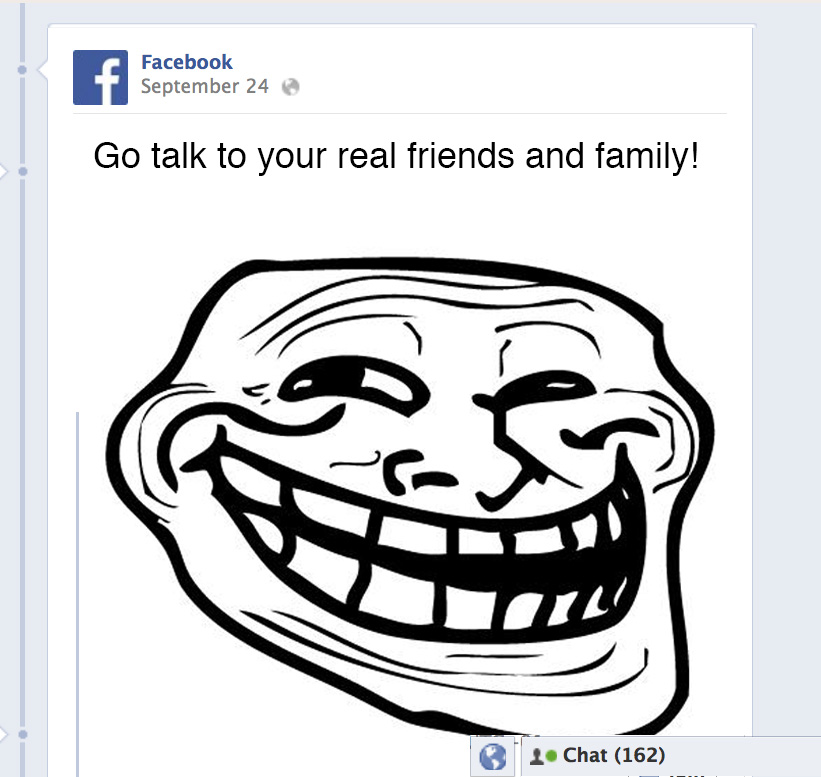
On October 21, Facebook users experienced a brief outage caused by network maintenance. Although recovery was swift and the team at Facebook was quick to apologize, I couldn’t ignore the uproar of such an occurrence. Am I crazy to be concerned about such a minuscule problem?

I need to step back for a moment and remember my life before social media: before Twitter, LinkedIn, Myspace, and even Nexopia. I was a 14-year-old high school student waiting patiently for a phone call on a Saturday afternoon. I was in grade eight, procrastinating over homework by watching television and taking naps. But how would I behave now, a decade later? Would my life be any different?

Facebook is more than just a tool to communicate with friends and plan events: businesses use it to market, and people use it as a news source. There is a lot of other noise buzzing about on social media, like adorable cat pictures, inspirational quotes, and public displays of affection, and these would be the greatest loss; Facebook allows us to share little slices of life any time we want.

Social media is a casual means of communication. Phone calls have become too intrusive, emails feel too professional, and meeting in person is too time-consuming. For me, the first real consequence of social media’s demise would be a sudden increase in text messaging.

As time passed and Facebook remained broken, I’d begin to lose contact with certain people. Those “friends” and “followers” who aren’t affecting my real life would fade away. That random girl at the bar, my science fair partner in high school, and the manager at the restaurant where I worked for a few months one summer would all be gone. You might be a “friend” on Facebook, but if you don’t have my number, we’re not really friends in my book. Sorry.

Because of social media, the act of verbally catching up is virtually obsolete: job promotions, new relationships, and exotic vacations are all displayed online for everyone to see. Without this, people at parties would spend more time indulging others with “what’s new,” and less time simply saying, “Oh, you know.” No, I don’t know—how would I know?

There is no doubt that my Facebook persona is much cooler than the real me. That’s because I only publicize good things. I have full control, where I don’t have full control of real life. The Internet is a marketplace and I’m the brand. I have to make my Facebook page cool. I go on trips and take photographs, I share interesting content and creations, and I interact with my “friends” even though I barely ever get to see them. I make all those things happen.

I’d like to believe that without Facebook, I’d still act the same. To me, the platform is nothing more than a scrapbook. Sure, it’s nice to look back and see what other people have been up to, but I’d rather look ahead. Because in the future, there might be a solar flare that would erase all the material online—then what will we “like?”

Revo Mortgage Collaboration System Helps Brokers Close More Deals

Formerly published in Techvibes. 

The old survival tactics of mortgage brokers used to be an independent way of living: brokers venture out of their office, find clients, secure a deal, fill out the paper work and follow up—essentially the broker will be in charge of everything start to finish. The new way of living is different.

Today the mortgage broker industry is a team environment. And Calgary-based Revo Mortgage Collaboration System is a new dashboard platform assisting all team members in communicating effectively and staying organized.

“Mortgage brokers are hunter and gatherers,” explains Philip Slen, president of Revodoc Inc., in an interview with Techvibes. “They bring in the business and in house assistance, underwriters or administration will take care of the rest. That frees up the mortgage associate’s time to have more customer face-time, more sales activities to generate more business and to do what they do best, which is selling mortgages and advising customers—instead of being tied down with paperwork.”

“Our system came about because there are no tools to help them collaborate on deals,” he added.

Deals get passed around from one member of the team to another, then back to the clients and then handed off to another member. Often times with no successful way of organization, certain works get lost or misremembered. Revo is designed to keep every member associated with the deal in the loop. So when the customer calls in, the brokerage team will have the information at the fingertips, instead of having to deal with the heinous chore of ruffling through file folders.

Security is a prime concern for most mortgage brokers and emailing documents is not always the wisest choice in communication. The Revo platform enables brokers to send customers secure-links, which will allow the customer to access information, not as a downloaded source, but from the actual deal.

Each deal, condition and customer is different, so that makes communication key. Important notes are taken all through the process and brokers will now be able to use Revo to underwrite these key information where applicable so that in-house underwriters and assistance will already have that information captured.

“There has been origination systems for a long time, but those are just systems where you route your application to a lender,” says Slen. It doesn’t allow you to do anything more; there is no workflow, no progress tracking, etc. It makes it very difficult for the brokerage team to collaborate when they are working on deals.”

Revo jumped upon the demand and created a standard for mortgage brokers. Before this platform has been created, Slen had noticed that many brokers were simply using different systems to address different situations, such as using Outlook calendar to send reminders or Excel spreadsheets to do tracking.

“Whatever database they have,” notes Slen, “they create it on their own. The tools are really only for proprietary use. It’s not an enterprise system that is cloud-based where everyone can have access. Our system allows them to grow and scale without having any influence with IT.”

Many consider mortgage to be a complicated undertaking and there is often gratitude for those who can simplify the task—Revo Mortgage Collaboration System may create many grateful brokers in the future with their workflow and organization system. After a brief tour through the dashboard I noted the many different conditions and categories to handling a mortgage deal, as well as the importance of clear, concise communication.