You might like me when I’m angry

Rage Room

Why the ‘rage room’ is a therapeutic blessing

By Elliot Chan, Opinions Editor
Formerly published in the Other Press. September 16, 2015

We live in a society where we have to walk in line, talk politely, and eat with our mouths closed. We put so much pressure on ourselves to stay civilized that often we forget that we are animals. The way we bottle up our rage, stress, and frustration is one of the reasons why we have such an internalized, yet explosive, brand of suffering. When we erupt we do it in the most self-destructive ways: we burn bridges, sabotage ourselves, and mostly likely hurt our loved ones. Talking only does so much, writing in our journals only does so much, and even drugs and alcohol can only mute the pain temporarily. What we need is a safe environment to let it all out.

The rage room is the latest trendy stress-relief activity and I think it’s about time. Toronto has its very own, and I think Vancouver should venture into that market as well. Basically, the rage room is a confined space where you, the paid participant, can release your anger on inanimate objects. The same way dogs love to chew and cats love to scratch, humans have an innate desire to see things break and go boom.

Why not go to yoga, relax in a hot tub, or get a nice massage? If you like trendy, why not go lie down in a float spa? Why not go exercise for an hour or two to get the sweat out? While those activities will relieve stress, it offers a solution from one side of the spectrum. Relaxation has a certain flavour and destruction has a different one. It’s like wanting a White Castle burger and settling for a hotdog from Hot Dog Heaven.

Let’s say your favourite hockey team lost and you feel pissed. You don’t want to go do yoga. You want to smash this lamp here. Let’s say you found out that your ex-girlfriend is dating a richer, nicer, better-looking guy, you don’t want to read a nice book in the bathtub, you want to smash this lamp here. Of course we—controlled, well-mannered humans—never actually follow through with our destructive thoughts, but the fact that many of us have them makes me believe that we need a place to release it.

While a rage room is a fairly new concept, and may only be advertised as a fun thing to do on a Tuesday afternoon, I believe that there should be a rage space for every coffee shop. Just a place where we can walk into, bring something we want to destroy, and leave with the satisfaction that we can still make an impact in this world. We can still alter the outcome of a physical entity, without hurting another human being, of course.

Not everything in life will go your way. Sometimes the Canucks will lose. Sometimes your boss will not acknowledge your efforts. Sometimes your partner will belittle you at a party. Sometimes your life will seem like it’s spinning out of your control. That’s because we are forced to place meaningless objects on pedestals. We worship objects. We shouldn’t. Smash it. Smash it before you find yourself downtown smashing the window of The Bay or flipping over a cop car.

The gravel is always grayer

opinions_luxury-items-1024x683

Don’t be pressured to purchase by the snobby world around you

By Elliot Chan, Opinions Editor
Formerly published by The Other Press. Sept 10, 2015

I won’t do it. I won’t spend eight hours a day, 251 days a year working to buy an expensive car or a fancy-ass watch or anything that I don’t need. I won’t do it to impress an employer, I won’t do it to impress friends, and I won’t do it to impress family. Life is so much more than being frivolous. Even if I am wealthy, I will not blow my paycheque on items that are supposed to catapult me to the next social class. Fuck that!

Today everyone is a connoisseur of some sort. Fashion, food, drinks, and so on. Everybody thinks they are experts at something and therefore are encouraged—nay, expected—to judge it. This type of snobbery extends from music, to food, to transportation, to neighbourhoods.

We have all behaved like snobs at one point or another. Most of us don’t even notice it. The reason is that we all have our own interests, and we live in a democracy where many around us don’t share those same values. Someone who is interested in beer and wine would know the lengthy details of how the drinks are produced, and which are “better.” Someone who is interested in cars would tell you that he or she would never go back to driving anything with a six-cylinder inline engine after leasing a vehicle equipped with a V6. Some who are interested in luxury handbags would tell you that it is so much more than a container for make-up products; it’s a statement on the social climate. I get it. We all have our things.

Learn to tell the difference between good and bad of course, but stop yourself from trying to discover good from great. Great is not that great. Great does not make you happy. Great is meaningless luxury. Great can be sustenance, yes, but it is also wasteful. Great is a lie you tell yourself so that you don’t feel bad paying double for a bottle of wine or a pair of shoes or a meal.

Having a palette for good things and appreciating them is much healthier than constantly demanding the finest. You deserve to be happy, but if happiness is having the best things in the world, you are just getting ripped off, my friend.

“Don’t be pressured into doing something you don’t want to do.” I feel like an elementary teacher told me this, but it was probably some television PSA I saw. Nevertheless, that statement stuck with me. But I don’t live by it. I do many things that I don’t want to do. I don’t like cleaning, but I do it. I don’t like waiting in long line-ups, but I wait. I don’t like paying taxes, but I have to. That’s just life. However, what I can control is what I want to spend my money on and I don’t have to spend it on what you want me to spend it on.

Dislike button

Hate Technology

How social media creates a vortex of outrage with no solution

By Elliot Chan, Opinions Editor
Formerly published in The Other Press, Sept 4, 2015

Cecil the lion, the drowned Syrian boy, and even Kony 2012: it seems as though social media today is a place where we air our grievances. Yet, after we’ve blown enough hot air at a topic, we move on to the next one. Social media is a great place to gain an audience, but it seems as though awareness is as effective as a like button.

There is so much misguided information floating around the Internet today that we aren’t solving critical problems intelligently; we prefer a mob mentality. After the death of Cecil the lion, the online world became outraged by the act of trophy hunting—and in a way, all hunting in general. With obvious nearsighted Western thinking, many couldn’t see the positive side to controlled hunting, hunting as a way to sustain national parks and control the population of potentially dangerous or pesky animals. Instead of educating themselves, we publicly demanded the head of a Minnesota dentist. It’s this type of thinking that makes many appear hypocritical.

Social media as a vessel to bring awareness to the masses has created an audience of self-righteous pundits that happily add to the noise, but do little to end it.

Pointing the lens at an overlooked crisis, social media decided to over-share the image of a drowned Syrian boy washed on a Turkish shore. It’s obviously a terrible sight, especially slotted in between newsfeed favourites: vacation pictures, selfies, and images of food. Many weren’t only outraged by the migrant crisis in Europe, but also by the fact that social media is now the platform people use to upset, guilt, and shame.

Yes, we are all nodding our head saying that what has happened is awful, but there is so much horror in the world, why share it with our morning cup of coffee? Why create activists out of people who are clearly only capable of being idle? Why shove it down our throats?

I’m not a proponent of censorship, but I am a strong supporter of context. So many people who’ve seen the dead Syrian boy are oblivious to the current crisis. They see a dead toddler and they react without thinking. Blinded by rage, all they are able to do is condemn whatever wrongdoing is taking place in the world. This is our crisis. This is a problem. The world of social media has become so easily manipulated that we are now zombies to whatever power of persuasion the networks want to use against us. People are reading misinformation sourced by other misinformation, and that leads to a vicious cycle of misguided points-of-view. We don’t know what we’re talking about, and, when we do, we have no way of acting, no solution, just stealth-shaming others.

There needs to be a change in the way we consume and discuss content and crisis online. Is a comment thread the best way to have an intelligent discourse? I don’t think so; I think it’s more of a toilet bowl we are all vomiting into.

Faceless Day: Gimmicky office stunts won’t increase productivity or ease stress

Image by Vincent Diamante via wikimedia

By Elliot Chan, Opinions Editor
Formerly published in The Other Press. Aug 4, 2015

On July 14, Woffice, a Chinese property service company located in Handan, took part in an exercise that appeared to be quite similar to Halloween. Employees were given the choice to wear a black-and-white mask at the office, in an effort to reduce stress. With faces hidden behind thin plastic, workers could focus on their duties without worrying about the pressures of smiling, the stigma of yawning, and the boorishness of rolling their eyes. So, what mask did all the workers chose? For the day known as Faceless Day, employees at Woffice chose the character No-Face from the beloved anime, Spirited Away, and Guy Fawkes from V for Vendetta.

Now, it might just be me, but I am not sending my resumé to Woffice anytime soon. If a business needs to use masks to ease tension within the workforce, I can’t imagine the monotony of working there any other time of the year. True, unorthodox exercises such as Faceless Day are gaining popularity in offices all around the world, but how about something less juvenile?

I hate the idea of dress codes. I hate it at fancy restaurants, I hate it at nightclubs, and I sure as hell hate it in the workplace. Yes, there is an emphasis on professionalism, but having to wear a suit and tie does not make you a productive worker. It’s funny that wearing jeans to work for a day is considered a perk in some offices.

For a year and a half, I was a Starbucks barista. Starbucks has a relatively strict dress code where male employees have to wear black or beige pants—excluding jeans and sweat pants—while on the floor. I always wondered why the fabric mattered. Who is peeking behind the bar, looking under my green apron, and at my pants? I don’t know, but apparently what I wore made your mocha taste better and myself a leaner thinker.

Needless to say, I wore black jeans for most of my employment and nobody (except the manager) made a big deal about it. Well, a few co-workers pointed it out, but they were merely inspired, and a bit frightened, by my rebellious ways. Don’t even get me started on Fridays at Starbucks. During my stint, only the day partners were allowed to wear T-shirts instead of collared shirts. Ignore my sarcasm, but that was a real privilege.

I believe many companies waste too much time, money, and effort trying to find creative (and not so creative) ways to motivate and calm their employees; Faceless Day is creative, while laid-back dress code days aren’t. Ultimately though, these efforts are not going to see much, if any, return of investment. Don’t enforce rules and then take them away, expecting the workers to be more relaxed. Don’t be gimmicky. A workplace is for grown-ups, so treat employees as such; let them make their own decisions. And if you really want them to relax after a hard product sprint or dinner rush, buy them a beer, give them a day off, or take them on a retreat. Don’t give them something else to wear.

Pricing Your Product Properly Matters

Before you sell your products or market your services you must first identify the cost. Understanding the price will give you a better perspective of your potential revenue, competitors  and target customers. Pricing your product is a defining mark for your company and should not be taken lightly. Follow this five-part series to understand the complexity, trickery, and science behind pricing.

Originally published on Control. March 12, 2015

Part One: Cost-plus Pricing or Value-based Pricing

cost-value-01-01

There are two general principles to pricing your products and services. You can rather implement the cost-plus or the value-based pricing method. Whichever one you choose, it will not only define your product but your company as a whole.

So what’s the difference?

Continue reading

Part Two: 7 Free Tricks To Pricing Your Product

free-advice-01

The Good, The Bad, And The Ugly

Shoppers are inherently programmed to compare prices. If you place a $20 T-shirt next to one that costs $50, it is instantly clear which one is more affordable. However, if the $20 one is made to be far less desirable and—for what you are getting—is still quite pricy. That’s because the intention is not to sell the $20 product, but to get people to opt for the more expensive deal for the reason that it’s actually worth it.

Continue reading

Part Three: Tiered Pricing Can Take Your Product To The Next Level

tiered-pricing-01

Tiered pricing gives people choices—and we all know that people love choices. When it comes to payment, choices may bring more value to your customers. Why not let them choose how much they want and how much to pay for it? After all, when you go to the coffee shop you want the freedom to pick Small, Medium, or Large. This ideology can work for your product or services too.

Continue reading

Part Four: 6 Ways To Conduct An Effective Discount Promotional Campaign

discounts-01

After the free samples and 14-days trial period, you may be pressed to earn more leads and gain more revenue. Without adjusting your standard price, you’ve decided that implementing a discount or promotional campaign is the best avenue to take. However, there are no fixed rules when applying discounts or generating coupons. You can hand out flyers on the street, but all that effort may be wasted time. Here are six tips to conducting a successful discount promotional campaign.

Continue reading

raising-prices-01

Odds are at one point or another you’ll want to increase the price of your product. Investors, competitors, your internal team, and even the public may be urging you to do so. You yourself know that the current price is under valuing your product and this path is no longer sustainable. There are many reasons why raising the price makes sense, but the question is not why you should hike prices, but how to do it effectively without losing customers and decreasing your conversion rate.

Continue reading

Pack an extra change

Image via http://www.thestar.com/

Naked tourists need to respect sacred rules—even if rules are ridiculous

By Elliot Chan, Opinions Editor
Formerly published in The Other Press. July 7, 2015

Travelling is all about taking risk. The whole idea of travelling is built upon adventure. What travellers forget—especially Western travellers—is that our vacation grounds are other people’s homes.

On May 30, a group of Canadian, Dutch, and British tourists visiting Malaysia decided to strip down on Mount Kinabalu for photographs. The mountain was considered the most sacred peak in the country. The act was not only considered disrespectful, but also thought to be the cause of a magnitude 5.9 earthquake that ended up killing 16 people.

It’s hard to argue that the earthquake and the obscene act had any correlation. In my mind, the two events were just an unfortunate coincidence. The movement of tectonic plates—not tits and penises—causes earthquakes. Nude photography is a popular trend; just ask the celebrities who have had their phone hacked. We all love thrills and what is more exciting than nude pictures and travelling? It’s totally a memory worth having, right?

There’s nothing wrong with naked pictures if you are willing to take full responsibility for them. For the tourists in Malaysia, they paid for it heavily. It became a criminal offence and it cost lives. Anytime you disrespect sacred rules and suffer immediate consequences that must cause some remorse. It reminds us that while travelling we are guests in someone else’s country; we need to acknowledge their rules and customs and abide by them.

Getting in trouble abroad is every tourist’s nightmare. So why put yourself in a bad situation? I don’t blame those tourists for “angering the Gods and causing an earthquake.” They were just behaving like idiot tourists and got linked to a tragedy.

If you are travelling and you want to be adventurous, be sure you learn the rules first. General laws and ethics are not universal. You can be certain if something is deemed sacred that the rules are stricter. Don’t fuck around. It’s okay to break through your comfort zone and do something daring, but breaking the rules can put you in a tough position, especially where language barriers are involved.

There are plenty of places to be naked in this world, plenty of places to act the fool. The key is to know where and when that is okay. Being a good traveller is not just about being adaptive, but also intelligent and aware of the ever-changing rules.

Burning bridges

Image via BC Gov on Flickr

Why closing public infrastructure for amusement is always a poor idea

By Elliot Chan, Opinions Editor
Formerly published in The Other Press. July 7, 2015

June 21 was a day of many activities. It was Father’s Day, National Aboriginal Day, and of course, International Yoga Day. In Vancouver, the plan was to close off the Burrard Bridge and have one of the biggest outdoor yoga events in the world. Om the Bridge, sponsored by lululemon, YYoga, and AltaGas, received enormous backlash as the big day approached. Celebration turned into hostility and mockery—at one point, Premier Christy Clark posted a photo of herself in front of a Tai Chi centre with a caption calling out “yoga haters.” Not surprisingly, the event collapsed as sponsors bailed.

I don’t have any problems with large gatherings of people doing yoga as long as I’m not required to participate. What tends to bug me is the misuse of public infrastructure and taxpayers’ money. Needless to say I’ve never been a big fan of parades, and the money spent on an event like Om the Bridge could be better used maintaining the bridge itself. It’s not because I’m not flexible or that my Chaturanga pose needs significant work, I just think that if you want peace and harmony, closing off a major artery on a busy day is a bad idea.

That is not to say that all International Yoga Day events are failures; in fact, many large cities with greater congestion than Vancouver pulled them off. Paris hosted their event beneath the Eiffel Tower. New York yoga fanatics joined together in Times Square. It’s a little ridiculous both how chill and how stuck-up our city is. Vancouver is like a spoiled brat. You throw a party for it and it’ll just end up throwing a tantrum back, stating that it deserved more gifts and cakes.

This city just can’t handle large-scale events, because Vancouver always has to create mountains out of molehills. Remember when the Canucks were in the Stanley Cup Finals against the Boston Bruins, and the city decided to build a big outdoor screen so that we could all gather together to cheer for the team? The result was billions of dollars of destruction and four goals in the Canucks’ net.

One of Vancouver’s most annoying traditions is the Celebration of Light. For years, residents of the West End have had to deal with hundreds of thousands of rambunctious people coming into their neighbourhood, taking up parking spaces, blocking off streets, and making a mess. All for what? A few nights of bullshit fireworks, polluting the sky with smoke, and disrupting the peacefulness of summer. It’s true that the Celebration of Light is a great opportunity to get your friends together, spend the day on a crowded beach, and then mosey on home via two hours of transit, but it’s really just a large-scale corporate handshake.

A city functions through organized chaos. Someone is always unhappy with something, be it transit, the weather, or some dumb event. I love this city, it’s full of diverse people, but somehow whenever we try to plan a party, a group has to cry and make it all about themselves. Our events become more polarizing—alienating instead of building the community.

Flavour Feud – Peanut butter: smooth

11226925_10155731838735455_2355144511280174646_n

Originally published in the Other Press, June 2, 2015

By Eric Wilkins, Assistant Editor

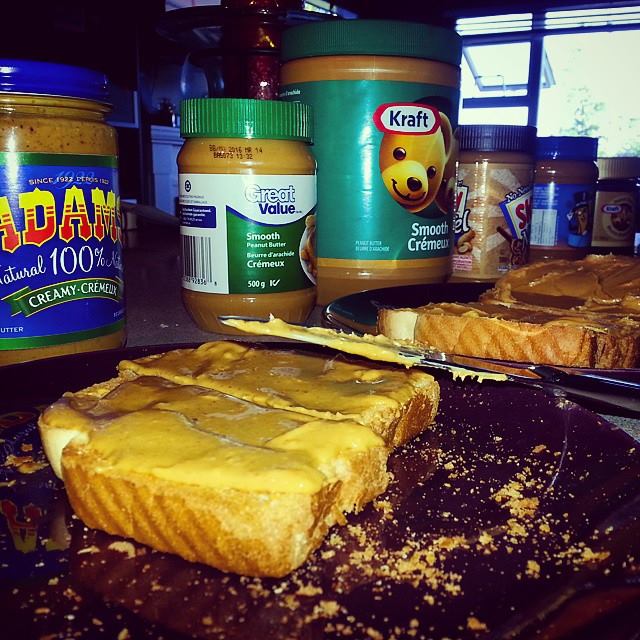
Peanut butter is one of the staples of the snacking and easy sandwich world. Along with frozen waffles and instant noodles, it’s a mainstay in students’ food arsenals. But with so many to choose from, how’s one to know which protein boost will go down easiest? Sure, you may be the betting type, but in this case, you just genuinely want the spread. So, without further ado, Flavour Feud this week presents the peanut butter edition. To keep things even, we’ve restricted the choices to smooth PBs and made exclusive use of Wonder Bread as our neutral pairing. Now stop deciding which cup you’re going to use and pour the milk already. 

Kraft Smooth (retail price $4.57/500g): This has always been my grandparents’ go-to PB. If I wanted a sandwich, I knew that modestly designed green label with a teddy bear or two on it would be staring back at me momentarily. The product itself is much like the label. No muss, no fuss; doesn’t try to do anything fancy. You take a hefty chomp out of your simple combo and you know it’s a solid PB. Kraft is your second-line centre. It may not be the top dog, but it’s more than capable of carrying the load and with some star power to boot.

Skippy Natural Smooth (retail price $4.97/500g): Until this article, I’d never had a jar of Skippy in my life. I did know, however, that the logo bore their iconic squirrel. And for that reason, I’d always felt in the back of my quality-advertising-driven mind I would grab Skippy’s if I ever felt I needed to make a switch. That day has never come, but the opportunity to grab it has, and lo and behold when it did, I was horribly disappointed. The one reason: that delightful cartoon squirrel wasn’t upon the label; in its place was a messy collage of branding and cartoon peanut butter, as if consumers weren’t already blatantly aware of what they’re purchasing. It was like showing up to a pre-2005 Falcons game with Michael Vick not playing. Sure, it’s still peanut butter, but now its main draw isn’t there. To make matters worse, my childhood hopes for the brand were further shattered when my mouthful revealed Skippy to be nothing more than another mediocre PB. It has slightly less buttery texture than Kraft. Not that different to be honest, but enough of a step down to notice.

Planters Smooth (retail price $3.47/500g): Planters is a fairly new player on the market, coming out in 2011. It should come as a shock to all that it took the peanut giant that long though, seeing as it was a match seemingly made in heaven. That in mind, it would have been quite easy for the company to fail to meet the high expectations set by PB lovers everywhere. Fortunately for Planters, they met those expectations. It’s a richer peanut butter, but without being overbearingly so. It’s a tad thicker but it washes down easily with the standard beverage pairing of milk.

Adams Creamy (retail price $4.97/500g): I grew up primarily on Adam’s Crunchy, so naturally, I felt this could be the one for me right from the start. I wasn’t wrong. Adam’s is the only true natural peanut butter in this lineup and it makes for a distinctly different experience. Ninety-nine per cent peanuts with no added sugar, colour, or preservatives, zero trans fats. And then that gorgeous thick layer of oil that lets you know you’ve got the real deal on your hands. My mother always used to turn the jar over to deal with the oil but I’ve been a fan of mixing it in myself; there’s something deliciously enjoyable about watching the PB change before your eyes. It’s like cooking for those who have no cooking ability. Getting back to the peanut butter itself, it’s a fantastic gooey mess. Despite the initial oily topping, it mixes surprisingly well for an excellent texture. It tastes like a quality peanut butter and each bite was left wanting only by the fact that the consumption of this nutty goodness had to temporarily be halted as the previous scarfing was downed.

Great Value Smooth (retail price $2.97/500g): I feel the need to state here that none of these are bad choices. That said, to my exceptionally refined peanut butter palate, Great Value (Wal-Mart’s brand) comes up short against the competition. It’s good, not great. Tasty, but not exactly leaving you lusting after more. There’s a bit of a frosting feel to Great Value and it comes off a bit cheap.

Kraft Peanut Butter with Chocolate (retail price $4.57/500g): This selection really has no business being here. It’s not really a peanut butter. You’re not going to amble down the aisle looking for nutty brown goodness and pick up this little number. PB with chocolate is Kraft trying to be Nutella. And in a contest to see which product is more like Nutella, Nutella will obviously take the punch. Not that chocolatey, not that peanut buttery. A very disappointing product trying to compete in a niche already dominated by a brand that’s got it down pat.

Verdict: Although it was a true challenge discerning the different tastes initially, by the end of it, my stomach knew what it wanted: Adam’s. The natural PB brand just brings something unique to the table, and that uniqueness is of the good variety. Planters draws a close second, with Kraft in the middle, Skippy fourth, and Great Value bringing up the rear.

By Elliot Chan, Opinions Editor

Kraft Smooth: Everybody loves those two cuddly bears on the packaging; we’ve grown up with it after all. In almost every household there is Kraft Peanut Butter, an easy-to-get, mediocre option. Peanut butter is hard to differentiate. They’re all good. But I fear this taste test may have inspired me to migrate away from it as the go-to choice. Kraft, in fact, sets a pretty low bar.

Skippy Natural Smooth: Terrific consistency, but lacklustre taste. Often recognized as a big player in the mid-tier of the peanut butter, it’s surprising to see that the price is as high as it is. Skippy is an apt choice for those who want a nice feeling of peanut butter as it melts in their mouth, but it’s hard to consider it a first choice.

Planters Smooth: Not surprising that a brand known for its peanuts would in fact do peanut butter so well. What is surprising was that it existed at all. Not easy to find, but worth looking for, Planters’ authentic peanut taste and savoury consistency makes it a worthy and noticeable contender.

Adams Creamy: Highly touted, but often messy, Adams doesn’t win the battle with flavour, but with an experience. The 100 per cent natural selection is anything but hoity-toity. The peanut butter does not stick in your mouth, it lingers allowing the subtle taste to fade on your tongue.

Great Value Smooth: If you are in Wal-Mart, with a budget, looking for peanut butter, don’t hesitate to get the Great Value. Indeed, it is. For a fraction of the other peanut butter choices, you are getting an unpredictably delightful taste of peanut butter that goes down as easily as many of the other selections.

Kraft Peanut Butter with Chocolate: The wild card, Kraft Peanut Butter with Chocolate is as much peanut butter as Nutella is peanut butter. For those who like to jump around with spread, Kraft Peanut Butter with Chocolate is worth trying—however, it is not peanut butter. The taste is not as sweet as peanut butter and fainter than Nutella. If you are yearning for a chocolate spread, it really is a one horse race—but that is for another Flavour Feud.

Verdict: This was one of the toughest taste tests of my life. You literally cannot go wrong picking a peanut butter. There is good and there is great, sure, but in the grand scheme of things, they’re all great. As you know, many elements that go into peanut butter; a lot of the preference has to do with personal taste. For me it all comes down to flavours, the taste of peanuts. So the winner is Planters.


Lend a hand and a liver

Photo of Eugene Melnyk via Sean Kilpatrick / THE CANADIAN PRESS

Celebrity status is fair game in organ donation

By Elliot Chan, Opinions Editor
Formerly published in the Other Press. June 2, 2015

How can you tell whether or not the world cares for you? You know when people are willing to band together and offer a critical part of themselves to keep you alive.

When the owner of the Ottawa Senators, Eugene Melnyk, was diagnosed with liver complications and needed a new one to survive, he and his supporters reached out to the public. Crowd sourcing for an internal organ is in many ways taboo—shameless even—but realistically there is no shame in wanting to stay alive. With one in three people dying during the donor-waiting process, time was a luxury he didn’t have.

The criticism was that Melnyk used his celebrity status to leapfrog other candidates awaiting transplants. Such behaviour was unethical. But how can you blame a dying man for using what he had created his whole life—his status—to stay alive. Placed in the same life-or-death situation, you would do the same. You should do the same.

The matter was that Melnyk was never a part of the general waiting list. He created his own list from people who would have otherwise not have become donors. Five hundred people came out of the woodwork to save this man. Only one volunteer was needed, but more than 20 said they would continue the process, donating their organs to someone else in need. It was not Melnyk’s intention, but for a small moment he was able to place the spotlight on an often-forgettable circumstance.

I don’t believe any person is more deserving of life than anyone else. But if I were diagnosed with any organ complication and needed a donor, I would like to think that I would do more than wait patiently. I would pull out your liver and use it as my own if I could. I would pull out your liver and give it to someone I love if I could. We are designed to care about those who are most close to us and those who have influenced us positively. It’s not that we idolize or worship these people, it’s because they matter to us. Let it be our way of thanking them for enriching our lives.

Thinking of asking for such an important aspect of someone’s life—an organ—to stay alive really makes me rethink the way I treat those I love around me. Should I become ill, will I receive such an outpouring of love? Will 500 volunteers come forward to save me? Will they for you? Then pause, really ponder, and ask yourself: why wouldn’t they?

O ‘it’s not a big deal’ Canada

Image via AP / Petr David Josek

Russians walk off the ice, Canadians should shake it off

By Elliot Chan, Opinions Editor
Formerly published in The Other Press. June 2, 2015

We won. They acted like poor sports—or as they put it, they made a “mistake.” After the annual World Hockey Championship, with the Canadians beating the Russians 6-1, the majority of the losing team skated off the ice as “O Canada” began to play. Whether it was an act of disappointment, bad sportsmanship, or political displeasure, it didn’t look good for the organization and the individual players. Still, there is nothing more awful than being forced to watch someone else celebrate, especially after getting plastered.

I have played hockey games—not at the international level, but still competitively—and I know how it feels to want something and then have someone beat you for it. Fuck them, right? I’ve shaken their hands, I’ve congratulated them, and now you want me to stand patiently while they sing their silly national song? We lost. Let me leave. What more do you want?

I get it. There is a patriotic aspect to international sports; that is why the Olympics and World Cups are so popular. But we don’t need the opposition to look sad while our song plays. Generally speaking, I’m not a big fan of national anthems at sporting events altogether. I’ve heard “O Canada” and “The Star-Spangled Banner” so many times they’ve lost all meaning.

The act made the team look like they had “no class” as Don Cherry would say. We all know what type of player Ilya Kovalchuk is, and the fact that he led the way was no surprise. But let’s not forget about the players that stayed on the ice, including superstars Alexander Ovechkin and Evgeni Malkin. Hockey is a team sport, but sportsmanship is an individual game. If you are going to punish anyone, punish the players individually, not the whole organization.

Then again, what punishment would fit, especially during this heated tumultuous time between North America and Russia? Hockey may be the glue that keeps people together, but it is not a Band-Aid for international problems. Punish players, but don’t punish the game of hockey. It’d be a shame to see Russia banned from the tournament next year. It would be a shame if we couldn’t beat them again next year.

For now, I’m happy giving the Russians the benefit of a doubt. In the heat of the moment, people do things that are in poor taste, but in the long run, nobody was hurt. So whatever, our national anthem wasn’t for them anyways.