There are two types of writers, there are those who take time before they start writing to outline their work, and then there are those that just get right to it.
For the longest time, I thought I was in the latter camp. I would start writing and then, through the majesty of imagination, my story will end up exactly where I intended it to end up.
That was rarely the case, most often I meander from scene to scene without a clear focus, guiding myself to an often unsatisfying climaxing and a lackluster conclusion.
In my more youthful years, I had all the free time in the world to write. I would pull all-nighters just for fun. Yes, fun! I would write all day long. That luxury is so far in the past that it now feels like someone else’s life. I don’t have a whole day to write anymore and the idea of staying up all night for fun is laughable.
As a content writer, it is important that my time is used wisely in the office. I have only a certain amount of time to produce a piece of content worthy of being published. It is not a creative feat, but it is an exercise in efficiency.
If you know what you are doing at the very early stages, if you know where you are going, you can start mapping out your day a bit better. An outline is an essential piece in accomplishing that. I can’t imagine writing a blog post without some sort of outline (albeit, I did not outline this one), and now, I can’t imagine doing the same for a novel with multiple parts.
I have so many abandoned, half written pieces of work from short stories to novel length manuscripts. I blame my haste to write and my neglect to outline for those unfinished works.
So here is to a new me, going forward, I am most certainly going to outline my work, especially one as epic. I give myself the permission to diverge from the outline should I see fit, but in order to keep myself on schedule and focused on the job at hand, I need to be organized.
Start with the outline or at least have a clear direction. If I did, I might have written my second or third book in the series by now. Or… I might not have started the first one at all. It’s hard to look back and say, but going forward, this is what I’ll do first. Outline.
Check out my YouTube channel for more on my novel writing journey.
“When technology fell, the catastrophe threatened human existence.”
That is the first sentence of my epic trilogy. It won’t be forever, but it has been for a while now. It’s not great. There are many areas to improve.
But during the first draft, I wanted to simply get my idea on paper. The first sentence, if I over thought it, could have caused me to hesitate enough that I wouldn’t even start. In the beginning, I wouldn’t worry about the quality of the first sentence, I simply needed to start.
However, during the editing phase that is where I can go back, look at the first sentence and ask myself: is this a good first impression for my readers?
In this episode of The Other Epic Story Vlog, I took a look at the first line writing resources and examples from classic and contemporary works. Then I returned to my attempt at a first sentence and gave it my best crack.
I wanted to dig deeper. The words like “technology,” “catastrophe,” and “threatened” in my mind, were all weak, vague words. The kind of words a writer chooses to use when he or she is just kicking off. It’s a tell, not show sentence. I could do better.
“The last message sent digitally was to let everyone beyond the border know that there was still hope.”
This above is my updated first sentence. It encapsulates the same idea. The fallout of technology and the realization of our dependency upon it. I feel it has a bit more umph!
There are many sentences in a novel, but if my work is ever to be a classic, attention to the first one is important. So there it is… now onto the next one.
Everybody keeps talking to me about the same thing. That thing I did in ‘79, gah! Is that all I’m ever going to be known for? I mean seriously!
That time I did karaoke and sung the shit out of Rockwell’s Somebody’s Watching Me. That was unreal. Everyone was singing along. Somebody was definitely watching me that night, I was entertaining as fuck.
Yeah, what a night that was. Unforgettable. But… nooooooooo…. People are still hung up by my “greatest” accomplishment and totally forgot about that performance.
You know what’s funny about greatest accomplishments?
Everybody’s definition of that is different. Some people’s greatest accomplishment is not dying when they were an infant. That’s their greatest accomplishment. For others it’s inventing the lightbulb.
Yeah. That’s me, the guy who invented the lightbulb.
Was it hard? Nah! People invent stuff all the time.
Like my cousin, Ren, he invented his own language, with swear words and everything.
He would always call me the direct translation of a Mother Fucker. There was literally a single word in his language for someone who does that. We don’t have that in our common tongue, English. We need two words to explain that concept.
First we need to know what it was that was fucked. Second, we need to know what was done to it, which was the fucking. The concept is a thing doing. Fascinating, huh?
That’s the beauty of language: I can say something and you can understand it. Now that, my friend, is an amazing accomplishment.
Of course, I wouldn’t boldly tell Ren that his greatest accomplishment was creating a whole language. That would be presumptuous.
Only the man who’ve lived the life can decide what he claims to be his greatest accomplishment.
Wow! That sounded wise. That’s deep too, right?
What if I decided that what I said right there is my greatest accomplishment. I can totally do that. My life, my choice!
Isn’t weird that we have to do this: ranking our lives. Trying to make every year better. Humans, so sad. Why can’t we be satisfied where we are? Why must we run on this hedonistic treadmill? What happiness am I chasing?
All my life I wanted to invent the lightbulb, now that I have, what more can I do?
It’s like by helping the world shine, I am left in the shadows. OMG. Was that just poetry? I’m not smart with this stuff, but that definitely sounded a little poetry to me. I feel goosebumps. Shit! This poetry shit is potent.
I guess, it could be worst. I could have never invented the lightbulb at all. Then what would I have done?
Then, would I even be remembered at all?
Think of all the people you’ve met. How many of them do you actually remember? Not many right? That’s a lot of fucking people — and you don’t even know anybody from India.
Imagine if you knew everyone from India… just pretend. I bet that Indians in India don’t even know every Indian in India. If I didn’t do something special, nobody would remember me at all.
I should be grateful that I am associated with something so essential to daily living. I mean, I invented something that is used by everybody — except the Amish and the poverty stricken. My invention is used by more people than Steve Job’s invention, the computer. That’s unreal. I’m not niche. I’m fucking mainstream as fuck! I should be hella more famous than I am. WTF.
I’m not going to lie, I’m a little pissed right now.
Why am I here talking to you dumb pieces of shit? I should be in a castle or something. I should be in a jacuzzi with well-paid, fully qualified female supermodels. I got ripped off! I can’t believe it.
You know where I went wrong? Here is where I went wrong, I got a patent before I got an agent. I needed someone to manage me. I had no one. I wung it. I wung it pretty good, I thought, but… holy shit, that is why you need a representative. I should have got one. I put so much work into it as well. See that’s the thing, that was time I could have been inventing more stuff or singing karaoke. Wasted time, wasted effort, poor results.
I’m pretty sad right now about my life. I go and invent one of the most revolutionary things in all of humanity and all I get is this, a slow sad death of me being reminded of how great my invention is.
Fuck! It’s pretty good, i guess, but can’t we talk about me? Can’t we talk about my crippling depression? That’s the thing about depression for old men. There’s no point helping you anymore. You sucked it up for this long, you can do it for a few more months.
Okay… enough, I don’t want to think how other people see me anymore, that’s such a sad and horrible way to think. I’m going to be myself, just an honest version of me from here on out. I’m going to think positive. I’m going to think about happy stuff like being in a jacuzzi with well-paid, fully qualified female supermodels.
Damn! I’m still pissed.
What you’ve just read is the third post in a series entitled “A Fan Fiction of My Life by My Number One Fan, Me.” Please check out the first two posts from the series: Me, A Doctor I Am A Controversial Artist, AMA
Did you enjoy it? Yes, subscribe to this blog, sign up for my newsletter or follow me on Twitter, stalk me in real life to get the latest update.
Around six years ago, I started working on a novel. I was inspired by epics such as The Song of Ice and Fire, The Dark Towers, and The Lord of the Rings.
I knew it would be difficult, but the first draft came to me very easy. However, I didn’t have a conclusion. Thus, I decided that this story would be a part of a larger work — a trilogy. Young and naive, I set off on this journey and was immediately stopped by what I will now refer to as reality.
School, work, and life all together put this epic story on the shelf. I knew, as the way my life was unfolding, I might never take it up again. It would be an unfinished work. A great life regret. I have a knack for not finishing work, and I hate myself for it.
Most recently, I started working for Wondershare Filmora, producing content for YouTubers. It is a world that I absolutely relish being a part of. And so, not wanting to only observe from the perimeter, I’m participating.
I have attempted a few YouTube projects in the past. Most notably my attempt at a cocktail/beer channel, It’s Not a Problem Yet and my cult (amongst my friends) magic series, Mind Flirt. I have learned from those two projects that creating video content is a lot of work, especially when you are not an expert and require expensive resources (ie cocktail ingredients, magic skills).
So here is my new YouTube/novel project, entitled The Other Epic Story Vlog. While the fear of me abandoning this project, as I have done with so many before, is crossing my mind. I feel I may have finally found two projects that align. I can work on my epic novel and create videos about it at the same time.
This will be an interesting learning experience as I dive back into old work and venture beyond. The Other Epic Story Vlog will be interactive. I will learn about writing techniques and try to apply them on camera. Watching someone write is not always fun, in fact, it’s quite agonizing, but I feel like I am onto something here. I feel like this might be a pretty brilliant idea.
I logged onto Reddit and prepared for my evening of, what the millennials will call, blowing minds. It’s true, think about it with your perfectly intact brain, how often do people get to ask questions to a person who essentially pinches the nipples of society.
Yes, I make a living as a controversial artist and as a sport equipment store clerk. The art itself doesn’t pay for anything. It’s ahead of its time so there really isn’t a market for the type of art I do yet, but believe me, like all the great impressions of history, mine will shortly follow whatever meme is most popular at this moment.
Mine will follow Meme.
That should be the title to my memoir. Mine Will Follow Meme The Memoir. That’s a lot of M’s, I like that. If only my name is Melvin McMurtry, right? Mine Will Follow Meme The Memoir By Melvin McMurty.
Holy shit!
That’s a sick title and authorship. Imagine people saying that out loud. That’s art. Making people say weird rhythmic words is a beautiful art form that isn’t often demonstrated in the contemporary art scene.
I’m too many steps ahead looking back, that’s what I feel like all the time.
But imagine someone at a the library asking, “Hi librarian, do you happen to have a copy of Mine Will Follow Meme the Memoir By Melvin McMurty?” OMG, what a weird thing to say.
That came from my brain and I made someone else say it. Art. Anyways, that’s going to be a piece I’ll work on for the future. Make a mental note: reminder, start working on my memoir.
The rumours are true, this is my first AMA.
If you haven’t heard the scoop, AMA stands for Ask Me Anything. It’s an Internet slang for an interview with people who have questions (no such thing as dumb questions?) for revered people like me.
I heard it can get pretty controversial, which is what I’m all about as an artist. I want to push the limit. My hope tonight, as I sit in front of my computer in my black attire and trench coat, is that I would get in such a heated argument with someone from the Internet that I will be banned from Reddit.
I will really know I pushed the limits then. When you get banned from a social media platform, you know you are hardcore. That’s like getting expelled from school, or the mall, or wherever people get sucker punched with ideas. Consumerism, Ah! Economic Stability, Ah! What is more right? Racism or sexism?
I can’t come at it as though I want to argue though. You don’t blow minds by shouting your opinions. You blow minds by flipping someone’s life completely upside down. You allow that person to offer their opinion, and almost bait and switch a conversation on you, but you are smarter than that.
“Hey,” they’ll say, throwing me a softball, “What do you think of global warming?” And I’ll respond, “Oh, I hope global warming happens, I’m trying to cause global warming every day. I use paper towels, I throw plastic bags in the organics bin — I litter!” I hit them with the last thought like a finishing right hook. “I’m all for global warming,” I continue, “in fact, global warming is the only way I want to die. It’s my dream death. My ideal death.” Bam! Controversy.
What a statement I just made, on the fackin’ Internet no less.
Everybody is going to read that. It’s there — forever! People are going to know that I backing global warming.
I didn’t whisper it into someone’s ear like a pussy, I wrote it on the Internet. That’s rebellious. That’s against the grain for sure.
From there, who knows, maybe the guy will think hmmm… maybe the artist is right, maybe global warming is the best option.
Shiiitt! I just started a revolution. A small band of brothers with a very fixed notion that the end of world via global warming is the best scenario. Then the history books are going to trace back the origin of this valiant group and discover, the historians do, that it was I who gave birth. That’s what good art can do, it infects someone’s neural systems and devour the subject from the inside out, like one of those fungus take kills insects from the inside.
Here’s a picture of what I’m talking about:
That’s my ideas eating your body!
Yes, I could have gotten a driver’s license, but instead I got an artistic license (see what I did there?) and I must say, I am far happier to have this.
I mean, they aren’t mutually exclusive, I can totally go get my driver’s license anytime. I’m a grown man. In fact, it’s kind of a hindrance on my life for not having one.
Then again, I worry about what a car would do to me and my social life. I won’t get to speak with the people on the bus anymore. People, believe it or not, love it when I spark a conversation with them on the bus.
I mean, it’s natural that I lead them towards a topic where I can return with a hard-hitting controversial respond. Debating with people on the bus is good exercise. It also flexes my imagination, which is what I need to create art. You might even say that strangers on the buses are my muse. Every artist needs a muse and mine are drunk teenagers and drunk homeless people and sober crazies commuting to and from work.
I guess you can say that the bus is like the Internet, except the Internet has a much bigger audience. It’s crazy how technology has come so far. From buses to Internet, what a time to be alive.
You can argue that this is the best time to be alive. But I disagree, because I think it’ll be better to live in the future when my art is appreciated, like how dead artists’ works are worth so much more after they die.
Yep, after I die from global warming, the world will recognize my greatness. It’s a shame I won’t be around to enjoy it. It’s a controversial way of living, like a Jesus, you know? I’m sacrificing myself like a Jesus or a Martin Luther King. Those guys were controversial AF, standing up for their rights. I’m sort of following in their footstep. Just imagine me, “I have a dream death: Global warming!” Yeah, that’ll rattle some feathers, for sure!
What you’ve just read is the second post in a series entitled “A Fan Fiction of My Life by My Number One Fan, Me.” Please check out the first one, called Me, A Doctor, if you haven’t already. It’s simply divine.
Did you enjoy it? Yes, subscribe to this blog, sign up for my newsletter or follow me on Twitter, stalk me in real life to get the latest update.
It’s good to see that my father is finally impressed. It’s such a nice feeling knowing that your parents are proud of you. Like, I finally know that.
Now, it was a lot of work. School, I’m talking about.
But boy, to genuinely know that your parent’s life goals are accomplished, hell, there is no better sensation. Honestly, this feeling, uhmm! It’s is like ten orgasms.
Ten orgasms. And think, it only took one orgasm to make me, a doctor.
I save lives now. I save orgasms.
When you think about it, that’s pretty cool.
On the spectrum of the universe, I’m on the exact opposite side of a cockblocker. I’m on the opposite side of the universe.
Man, that’s almost as good as being a doctor — not being a cockblocker. Is there a word for that? I should know, I’m a doctor.
I always find it weird when a name for something is that it’s not something else. Take the word “non-fiction” for example. Oh I read a book, and it was non-fiction. That’s like saying, I read a book and it was non-good. See? Weird. And for those of you who don’t know what I’m talking about and can’t follow along, what I’m saying is we have a word for non-good, it’s “bad.”
What I do like is how we have the same word for different things. Homonymous, they are called? I have trouble saying that word. Look at it: Homonymous. How would you say it? Say it out loud right now: Homonymous. Yeah, you don’t know if you are saying it right either.
I like homonymous, that’s why I think a non-cockblocker should be called a doctor. Same word, different meanings, same mental image. Like when you see someone helping you get laid, that guy is a doctor. He’s a miracle worker. He’s a man of God and science. I like that hahaha! I’m going write that definition in Urban Dictionary when I get home. Remind myself to set a reminder for that. I’ll totally forget, I forget everything.
Anyways, what was I talking about before I got distracted. Oh yes, my happy parents. They are so happy. I can remember the day they told me they wanted me to be a doctor. They made that claim in front of my family and friends when I was too young to even know which part of my body I was standing on. I now know, because I have gotten an extensive and expensive education since. They said, “Elliot is going to be a doctor, because doctors make a lot of money.”
Well, mom and dad, prepare to have a son with a lot of money, because as of today — which I am graduating from doctor school at my university of choice — I start my journey to great wealth.
Now that I’m a doctor, it’s going to be smooth sailing from here. You get pampered if you are a doctor. You aren’t only wealthy, but you are also respected. People treat you well. One way they treat you well is that they have to say a title before your name.
For example, if my name was Kern Eberhart, they will have to call me Dr. Eberhart. That’s good, because Kern is such a bad name. It sounds like a move you make with a piece of heavy machinery. I guess, the word kerning relates to the printing press, and I guess that is a heavy machinery. Wow, did I just prove myself right? Ha, that’s why people like me.
Another way they treat you well is with respect, and the respect comes from the fact that — yes, you are rich — and that you are now credible.
A doctor knows what he (or she) is talking about. You can say what’s on your mind and people have to take you seriously.That will be such a nice experience, being at a party and Tommy Wong starts rambling about some crazy conspiracy theory, and I’ll butt in with some hard truths. “No Tommy,” I’ll say, “it’s actually us humans that are controlling the lizard people.” And everybody will nod, but Tommy Wong will still go ahead and pull out that smartphone and Google. Then he pulls up some dark web post affirming his theory, but nobody believes it because that post was not written by a doctor. I guess, the moral of that story is that you should not be a Tommy Wong and you should listen to your doctors.
Oh and lastly, there is the saving people part. I find that part quite satisfying as well. Maybe not as much as having everybody address me as “doctor,” but still pretty good. Honestly, okay… I know we were just talking about truths over there in the previous paragraph, but I’m going to lay some hard truths on you right now. Ready? Okay, here it is: I’m not a people person. I’m actually very introverted. I know, right? You think someone who dedicated his life to saving people is going to like people. That my friend, is irony. If a child or a more feeble-minded friend asks you what does irony mean, please use that example. I think it captures that word fully.
Needless to say, it was worth it, mom and dad. I couldn’t be more happy that you steered me onto this path of becoming and now being a doctor. You called it! You guys were gamblers and you put all the chips on that one card and I flipped it over and it was the doctor card (Ace of hearts). You win the game of life. It’s every parent’s dream to have their offspring be doctors and my parents achieved that mission.
I’m proud of them. In fact, I’m probably more proud of them then they are of me. They really stuck to it. At any point, as they watched me studying, could have came over to me, tapped me on the back, and said, “No, that’s enough son, why don’t you focus on your illustrations for a while? I think that picture of your family in front of our sad-looking house is a project worth bringing to life… in completion.” I could have been a caricature artist, but I turned out to be a doctor. It would have been so easy to have that conversation. I think if she said that to me that day, I would have stopped. Then where would I be? Maybe still a doctor. Maybe dead. My mother could have killed me that day. I’m proud of her for not. Killing me would be the exact opposite of wanting me to be a doctor, if it was my parents. They really didn’t want to kill me.
It’s been a really good day thinking about how happy my parents are and how much money I’m going to have and how much respect I’m going to get and how my parents didn’t want to kill me. I’ll have to say, being a doctor is pretty sweet so far!
What you’ve just read is the first post in a series entitled “A Fan Fiction of My Life by My Number One Fan, Me.” Did you enjoy it? Yes, subscribe to this blog or follow me on Twitter to get the latest update.
Why did we start raising, clinking our glasses and saying cheers?
Let me set the scene: your friends have gathered around, each holding a glass of champagne or a shot of tequila — it is a night to remember, even though you may forget in the morning — and you know there is only one way to complete this scene, with a toast and then the obligatory clink of the glasses.
The three-traditions-in-one of raising the glass, clinking it, and saying a few kind words may have originated at different times for a variety of reasons. Some historians believe that the act of raising the glass came from the Greeks, as an offering — a prayer to the Gods for good health.
Source: Unsplash
Whereas the clinking of the glass, or making any sort of noise with the glass or goblets, might have come from Germanic tribes. It was believed that the noise would scare the ghosts and bad spirits away who were often suspected of frequenting large social gatherings and festivals.
Then there is the small speech, the toast. The toast was once used in a literal sense, as people used stale toast to soak up the acidity in the wine. As the vintages back in the days were not as high quality as they are today, this helped with the flavour. It’s also worth mentioning that the act of wasting food just wasn’t something that people took part in back then. Think of it as a wine-soaked French toast.
I digress. The toast, the small speech version, was established in the 17th- to 18th-century when offering a praise or a shout-out to friends, family, and associations and then taking a large gulp of wine was an apt way to get drunk. Eventually, toastmasters were established to reign in the people who were giving toasts. Left without officiating, people would end up toasting everyone in the room.
Nevertheless, the explanation of why we clink the glass and say a few words before drinking that I appreciated the most is the idea of Oneness — how drinking excites all our senses.
Achieving Oneness
Think about it. What do we do when we drink a glass of wine?
Sight
Before we drink a bottle of wine, we are most likely in a liquor store, browsing through the aisle looking for the right one. Now, you might already have one in mind, but sometimes, you need a bit of marketing to help entice. Whether that is the label, the award badges, the copy, the price, or just the way the bottle looks — as superficial as it sounds, sight is often the first attractor when selecting wine.
Then, once you pour the wine into the glass, you bring it up to the light and appreciate the colour. Is it red or white? Had it been influenced by oak during the process? Before you even touch the wine to your lips, you already have an idea of what you are dealing with.
Touch
Depending on the type of wine, we might chill it or we might serve it at room temperature — heck, we might even heat it up. The temperature of wine matters if you truly want to experience the drink at its ideal state. This can rather mean storing it in the right place, like a wine cellar or putting it in an ice bath before serving.
Then you have to find the right glass to serve the wine in. This also equates to the sense of touch. The way your hand holds the glass when bringing it to your mouth, the way your mouth contorts itself and creates the pathway for the liquid to flow. As wine lovers know there is a certain art to the way your wine sits and aerates in your glass and the way you hold the vessel. Certain structures of the glass change the way you hold and drink. It changes nothing, but in a way, it changes everything.
Smell
The third sense of consuming wine is the sense of smell. We all know how smell affects taste, and this is quite clear when you are wine tasting. We all have this postage-stamp-size nerve cell in our nasal gland called the olfactory tract. Some believe that our olfactory tracts do more for the way we appreciate taste than our taste buds. The sense of smell opens a channel, enabling us to taste the wine in an expansive way.
Taste
I always like the idea that you can only taste something for the first time once. It’s like watching a movie or reading a book for the first time. You are taken on a ride and each turn or dive the author takes you on is a surprise. The second taste is when you actually get to experience the nuances of the product. You recovered from the slap in the face. You begin to notice the red herrings and the details of the story, the same way you start to sense the full bouquet of the wine.
Hearing
Lastly, here is where I like to think the clinking of glass comes from. By contacting glasses together and uttering a word — “cheers,” for example — we complete the experience. We give the moment what I like to call Oneness, where the act of drinking wine becomes an act that evokes all the senses, thus completing it.
We often like to think of ourselves as one physical thing. We are not. We are the combination of many living particles. We, like the universe, are made up of a bunch of interlinking elements. We are the bacteria living inside of us, we are the thoughts drifting in our head, we are the perception that other people have of us, and we are the presence when we enter a room. Yet, when it is all combined, we have this Oneness.
The idea of Oneness teaches us to take care of every little part of ourselves. In wine tasting, in order to achieve oneness, a completion, a care for every part, we needed to add it ourselves. We have to go out of our way to do it. So it goes with achieving oneness with other aspects of our lives.
I used to see my friends as an escape from the real world. They were a little treat I gave myself. If I deserved it, I get to hang out with my friends.
As we got older, what was once a treat has now become a bit of an obligation. That’s growing up. I used to meet up with my friends for pleasure, now I meet up with them because I know how important it is to keep the ship afloat. “I should be resting,” or “I should be working,” says my guilty self. Still I go and I have a good time, often. It has turned into an expense, a holiday, an indulgence. I’m paying to keep them. I need them for a rainy day as if they are insurance. And like insurance, even if nothing bad happens, it’s worth having.
The idea that these important people can fade like an old memory is heartbreaking. But it is the way it is. A good friendship like a good investment, compounds. You have to keep attending events, buying gifts, showing that you care so that you keep making memories. You need to keep money in savings, and only withdraw when necessary. My life is not split into events, but rather the people entering and exiting my life — depositing and withdrawing.
As I’ve mentioned in a previous post, that I read multiple books at the same time. I’m a polygamous reader. The same way I can have different relationships with different people, I feel the same way with books. Some books teach me, some books make me laugh, and some books make me empathetic. Friendships are the books of you, written in partnership with another, and should that partnership ends, the book goes unfinished — unread.
In one way or another, we’ve all gone through a situation where a friendship met its demise. This could be because of irreconcilable differences. This could be because of geographical changes. This could be because of the volatilities of life, things that are out of our control, twists of fates that pull two people — two groups — apart, stranding them on their own. In this world, we pick sides, what are the chances that your friends won’t pick yours?
This article, I pose that question to you…
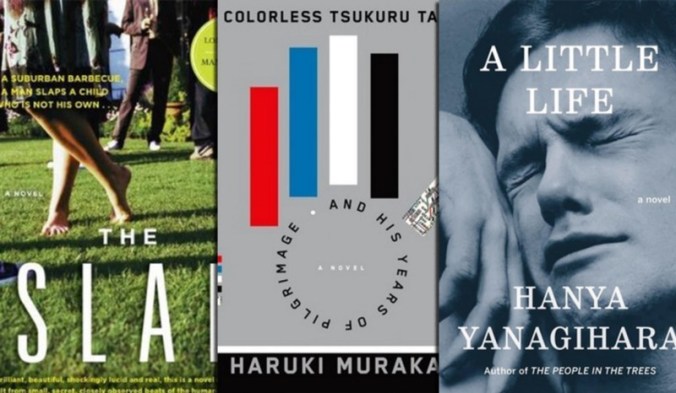
I want to discuss three novels where the loyalty of friendships and families are tested, pulled to very limits, and allowed to snap.
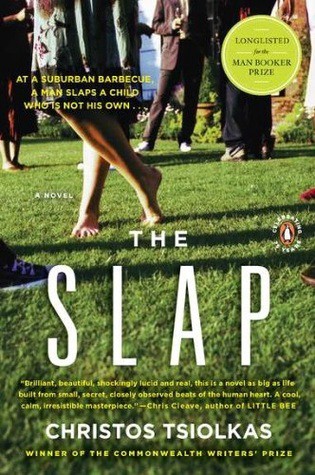
The Slap is one of those stories told through the perspective of multiple characters. Each chapter, the vantage switches and we see through the eyes of someone we thought we couldn’t possibly feel sympathy for. That’s the beauty of a good book, it can make you love and hate many characters individually. One moment you are rooting for them and the next you are cursing them.
At the heart of the story, The Slap asks us to pick sides when an invisible line is crossed. It ask you where you yourself set the lines. Would you cheat on your wife with a younger woman? Would you use a racial slur without malice? Would you hit someone else’s child in order to protect your own? Where is that line for you in this gray world? And should you cross it, how will you live with the consequences? What if it was your friend who crosses it? Will you stand by him?
There are numerous themes coursing through the veins of this book, and when I finished it I happily, but without confidence, claimed to my fiance (now my wife) that this was the best book I have ever read. I said it like this, “I think it’s my favourite book.” This one found me at exactly the right time in my life, as I watch two of my best friends make their way into parenthood.
Whenever I hear that one of my friend is going to have a kid, I put on a smile and congratulate them. It is what they want and I am happy for them. In my childfree life, I’m saddened to know that those wild late nights with those individuals have officially ended. I will see them on key occasions throughout the year — birthday parties, Christmas, etc. — but otherwise, we aren’t going to hang out like we used to. Even if we lived close by, it becomes a long distance relationship. We now see the world differently. But that would have happened otherwise. Different jobs, different neighbourhoods, different gender of the child you bear will lead to different life values.
Time is not the only thing that is gone. What they want to talk about also changed. What they were once proud of has changed. I look at the pictures of their children as they show me, and I smile… once again happy for them. We are friends still, yes, maybe even family in some way, but we aren’t sharing the same qualities that friends share. You see that when friend circles gather together, at say, a BBQ, like the characters of The Slap were when the conflict occur, when the child was slapped.
Parenting, like food or politics, is something that every person has an opinion on whether they have children or not. People with kids are quick to dismiss the thoughts of those without — and those without see parents as fixed in their ways. It’s easy to be fixed in your ways because the consequence is so far away. You don’t know your child will turn bad until later on in life, and even then, can you really say parenting was the fault?
I digress. We, as our own person, just like the eight characters we enter the minds of in the book, we don’t feel what other people are feeling. We can never know what it’s like to be a parent without having kids, we can never know what it’s like to be ethnic if we are not, and we cannot know what two people are like when they are alone, so how can we judge someone for adultery — when in the same situation, in the same life, we would do it as well?
Watching my friends have children made me realize that from this point on, I’ll never see eye to eye with these people. We’ll have different politics. What is good for them will no longer be good for me. What makes them happy, will not be the same thing that makes me happy. Yet, beyond all that can we still be friends? Of course. But what happens if I cross the line? How great is our loyalty then?
There is a way of thinking that says, if your friends can’t propel you forward, they are holding you back. I think that’s true. What’s the point of having friends if they are just going to make you miserable or keep you from reaching your potential? The key is to notice this before it’s too late. Loyalty in friendship is honourable, sure! But it’s not always healthy. Recognizing your friend’s values as they change will save you from crossing the line in the future.
But of course, like the obligation of going to work, we are at times obligated to see our friends. They are family. We enter the social scene and at the end of the night, we leave breathing a sigh if nothing bad has happened. The Jenga pieces that are our friendship wasn’t destroyed, but each time we see each other we are forced to pull a tile from the bottom and move it to the top. That’s progression. But what if it does fall? Is it tragic? What if it wasn’t you that knock down the pieces either? It was someone else, another friend. There you watch as two friends bite at each other… their relationship is sent to the fringe. By staying neutral, you lose both of them… what do you do? That is the case with many of the characters in the novel The Slap. Friends are told to pick sides and in that — loyalty and value are tested.
It’s not about who you share the most precious memories with that holds a friendship together. It’s about who you will keep as friends as one by one each of them crosses that line you drew for nobody but yourself.
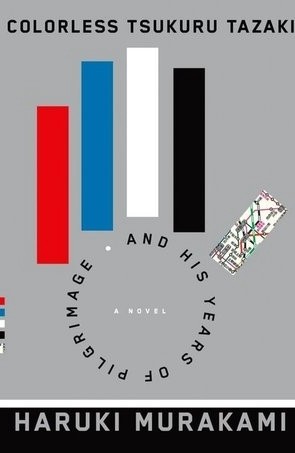
The painful idea of having to pick sides between friends led me to my next tragic novel by Haruki Murakami. Colorless Tsukuru Tazaki and His Years of Pilgrimage (a mouthful), for me, falls into the category of mystery. In The Slap, it’s so obvious what happened. The knife that severed the bond of the friendship was clear. But what if the situation wasn’t? What if suddenly one day, all your friends stopped talking to you?
To me, when I talk about wealth, I’m not always talking about money. Sometimes, wealth can be having a supportive group of people around you. When you are ill, is there someone that will come and take care of you for free? If no, then you are poor. If something great has happened to you and you want to celebrate, is there someone you can immediately call and share the news with and know that there won’t be any jealousy or animosity? If not, then you are poor.
Like money, the friends in our lives are currency. You don’t need money to pay for movers if you have a group of burly friends with freetime and a truck. You don’t need money to pay for dinner if you have a friend that is a culinary fiend and just wants you to taste his latest recipe. You don’t need to rent a hotel if you have a friend who has relatives in New York or San Francisco or London or Tokyo and they are happy to have you for a few days to a week. Not that you bother all those friends all the time — being a good friend, and a smart investor, is knowing when to cash out.
Wealth in any form can be lost. One morning you can wake up and find that it has all disappeared. Like you had been robbed, all the friends you thought you had. The friends, like your savings that you were hoping will be there for you until your old age, will be gone. That is exactly what happened to Tsukuru Tazaki.
Like a poor investment, the same feeling is felt with people. You wonder where the mistake was made. If your core group turns their back on you, do you have more in the reserve to call upon? Will you demand to know what happened? Will you take it as the natural forces of growing up? A painful lesson. If a friend decides to stop showing up to parties, if a friend stops responding to your messages, if a friend disappears from your life completely, will you be okay with it? If you lose a hundred dollars, wouldn’t you want to know where it went?
Every person within a core friend circle needs to fill a role. You might not consciously recognize this, but it’s true. Like a community cannot have too many bakeries or too many tailors, it cannot have too many members with the same characteristics, skillsets, or functions before they start stepping on each others toes.
For example, in a group of five where three are male and two are female, it’s going to be tricky for the third boy if the two other are paired up with the two girls. The boy will ultimately be forced out, this is especially true if he has feelings for one of the girl as well. When you pick your core group of friends, the ones you want to be sustainable for the rest of your life, ask yourself will you betray one of them for your needs — will they betray you? And if they should, will the others join you — or will you be the odd man out?
With friends, we often think in the short term, we walk into a party, we see a group of people and we join in. Slowly we learn the dynamic of each person within the circle, but is this the group where you want to put your chips down? Sure you can invest a little in this group and a little in that group, and create a lot of little bonds and feel that when they are looking around at the stakeholders of the group and wondering who they should buy out, most likely it’ll be the one who only chipped in a little. Like accumulating monetary wealth, generosity is a necessary quality for establishing friendships that is sustainable. It can’t all be fun. If you want someone to take care of you when you are sick, you better be willing to do the same for them. Getting wealthy with friends is not about winning the lottery, it’s about investing, it’s about paying insurance, it’s about putting funds in every day, week, month, year, and knowing that when shits hit for you, they will be there tenfold.
In The Slap, we witness what happens when friends turn against each other. In Colorless Tsukuru Tazaki and His Years of Pilgrimage, we see what happens when friends turn against us. But what happens when we turn against our friends? Like a dog with an incurable itch we scratch at ourselves, and when our friends, our companions, attempt to block our nails from another vicious scratch to the face, the neck, or the wrist, we bite at them.
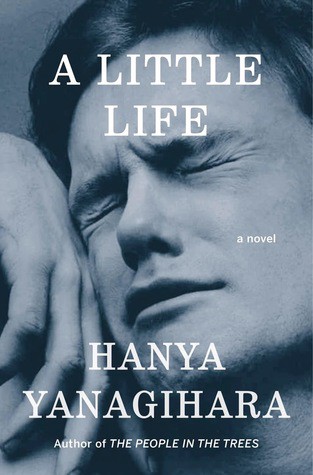
A Little Life is hands down the saddest novel I have ever read — and thus making it a book that I encourage anyone that needs a heavy dose of empathy to checkout. It may cripple the light hearted, but those that are having trouble feeling grateful for the simplicity of life, they need to read this epic novel based around a group of male friends living in New York, growing old together.
We are all troubled. Every one of us. Everyday we wake up and we face our demons. Your demons might be addiction. Your friend’s demons might be a repressed childhood experience. Your other friend’s demons might be a relationship he or she is trapped in. We are all facing our own battles. Sometimes, we lose and our friends have to watch as our defences, our fortress that they so proudly built with us: our confidence, our happiness, and our successes — they watch it all crumble. Nobody will really know what it’s like to be you. Nobody can ever save you from yourself. But a friend is one that hopes — a friend is someone who doesn’t give up on you. They wait across the moat, watching the dust settle and for you to emerge from the ashes ready to lower the bridge, ready to let them back in, and ready to rebuild.
Jude, the protagonist of A Little Life, had built a facade, a shield he hid behind. For the majority of the story, we only learn what he tells his friends, especially his closest friend, Williem. His childhood injury that has caused spinal damages and affected the way he walks was merely addressed as a misfortune. His self-mutilation was hidden because he will never be seen by others without a shirt or with short-sleeves. His inability to be intimate was shrugged off as him not feeling any sexual desire for anyone, male or female.
When we build a fence or a wall, we do two things: we keep people out and we lock ourselves in. What Jude has done is that he has build a wall around his castle in ruins. He is there alone trying and failing to repair himself. His friends want to enter to help, but for much of the novel, he shuns them with one reason or another: he cannot trust that they are not Trojan horses entering as a gift and dismantling his world ever worse. Additionally, for the friends he knew who were loyal and noble, he did not want them spending their short life on Earth, helping him salvage what little life he had. His friends were all successes in their profession: artist, actor, architect. They deserved better than him — he did not want to be a charity case.
I have a problem with empathy. In day-to-day life, I’m failing at that trait — maybe barely passing. I am not the most empathetic person I can be, which at times, I feel can make me a less than perfect friend. When I was in high school, there was a class… actually, it was more of lecture, because it wasn’t so much of a course, as just a social worker coming into talk to us. We watched a movie where the main character went through some trauma and was cutting herself. I uttered out loud that indeed this movie was fiction. At that age, without having ever faced trauma of my own — misfortune yes, but nothing I can call trauma — I couldn’t understand why a character had chosen to hurt herself. The social work failed in empathy that day as well. All she said was, “I hope you never have to understand,” which was a weak attempt at educating, as if a math teacher will say, “I hope you’ll never need to use long division” after I failed a test. Empathy is such an important skillset and I feel like I was handicapped at an early age, because it was not something that came naturally. I had a hard time practicing empathy, so now when I see my friends in trouble, I wish I could do more, but I merely stand at the perimeter, from my tower, looking in their direction, hoping they will figure it out before it’s too late.
A Little Life taught me more than what that high school social worker teacher (or whatever she was) could. It taught me that loyalty goes both ways. A dog defends its master and the master feeds the dog. The thing is… in this scenario, sometimes the master gets sick and there is nothing the dog can do. Sometimes the master dies and there is nothing the dog can do… That is the lesson I got out of A Little Life, we might end up being the dog without a master. We are all hanging to life by a rope or a string or a piece of thread, awaiting to drop into oblivion. If we only have one person to rely on for our needs: food, shelter, love, then we are merely hanging by a thread.
Empathy becomes the knotted tether. Empathy gathers other threads and strings and binds them. If we want loyalty. If we want lasting friendships. If we even just want to be nicer to strangers, it all begins and ends with empathy. If we can’t do that… then we don’t deserve it. To have friendship without empathy is theft: theft of trust and loyalty and will ultimately lead to a sad heartbreak. We can’t always know our friends truly, but when things get bad — and they will, because the world is hard — we must lower our weapons, because our friends are fighting a must tougher enemy, one that you can’t see. We can help them instead.
I recommend these three books to anyone feeling the pull of life dragging them away from the good times. I recommend these three books to those who have lost a friend, be it through betrayal, misunderstanding, or tragedy. I believe sometimes the best way to cry is in the rain, so that nobody can see, but we can’t control the weather, so let it pour from the heart.
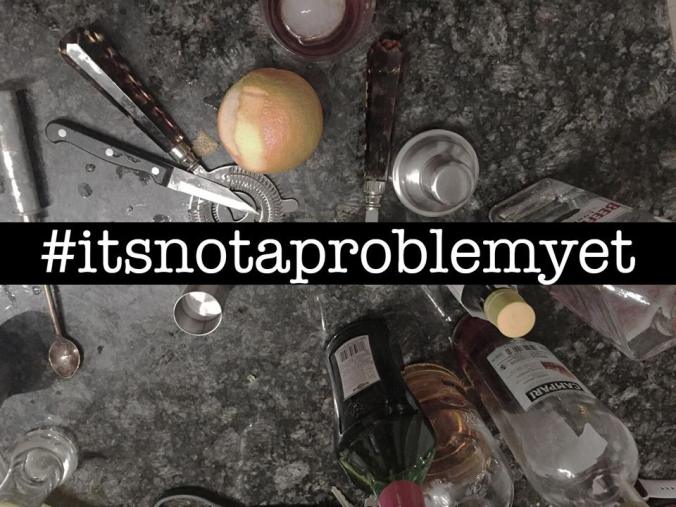
It’s been a busy year (2017). Aside from getting married and doing that whole thing, I also turn the heat up on a passion I developed. Boiling over now, it is my obsession to learn as much as I can about — you guessed it — booze. Before I go any further, I must let you know that the project is called: It’s Not a Problem Yet. While I have registered for the domain name, the YouTube channel is where the majority of the attention is placed at the moment. It’s a mixture of everything I enjoy.
What is It’s Not a Problem Yet? Well, above all else it is a philosophy. Look at this guy, talking about philosophy, who does he think he is? I don’t know, but I know that so much of life is wasted worrying about the consequences. So much so that we end up not pursuing something that you enjoy. I enjoy booze. I’m getting more and more comfortable admitting it. When I told people this, I got a lot of caution. Uh Oh! As if I just announced to them that I had decided to nurture a horrible addiction. Yes, a lot of people are alcoholics. It’s a problem. But then again, a lot of people are ill in many other ways. Substance abuse is one crippling effect of life. Addiction is something we all face as people. There are many addictions, I can list them all, but I won’t. Everybody is doing something they enjoy that they shouldn’t, that they think they can stop, but they can’t. What the philosophy of It’s Not a Problem Yet is about is that you can do what you want… this potentially dangerous thing (like base jumping is pretty dangerous too) and really go down the rabbit hole. I want to walk down this slippery slope, but I’ll do it with full awareness, fully sober. I will do it with confidence that each step I take is deliberate.
I’m fascinated with the ancient craft of brewing, distilling, mixing, and winemaking. I love learning about the geography, the history, the culture built around booze. I love how long it takes and how worthless it becomes… (pee). It doesn’t matter if it’s a $1,000 bottle of scotch or $3 beer, it all ends up the same. Such like life. I think there is some deep shit in all this. It helps grounds me in everything I want to learn and be. It’s a little rebellious like me. I like that. So to the people who are worried about what I’m doing with my free time, all I have to say is “It’s Not a Problem Yet.”
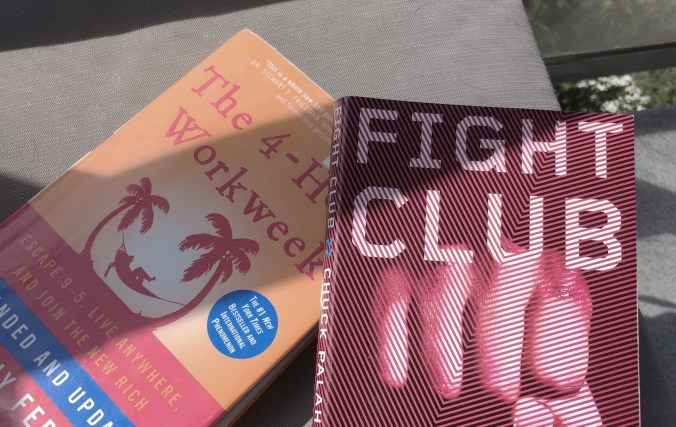
I’ve recently finished reading two books that shared some eerie thematic similarity about society, class, freedom, and identity: Tim Ferriss’ The Four-Hour Workweek and Chuck Palahniuk’s Fight Club.
If you judge books by their cover, they don’t have any visible similarities. One is non-fiction, encouraging want-to-be entrepreneurs to abandon the old route towards wealth by innovating and automating their lives, thus becoming the New Rich. The other book is the source material for the famed Brad Pitt-Edward Norton movie about a man suffering from insomnia, meeting a mysterious individual named Tyler Durden, and starting a terrorist group that spawned from an underground fight club.
What association am I seeing? What am I even trying to say? Well — let me connect the dots for you and you can tell me if you see it too.


 Elliot Chan