There’s always another word. Another sentence. Another book.
The hope is that I get to do this for as long as possible. That’s the real goal. And honestly, it feels endless right now—and that actually gives me a sense of calm. A few years ago, that feeling used to scare me. I was daunted by the idea that this project might never end. I became obsessed with reaching some finish line. But when I think back to why I started this during COVID, I remember I wanted the opposite. I wanted something that would take a long time. Something I could grow alongside.
When you commit to a project that stretches across years, you evolve with it. I haven’t looked at the first draft of the first page of the first book in a long time, but if I did, I doubt I’d recognize it. The beginning wasn’t really the beginning. And it shouldn’t have been.
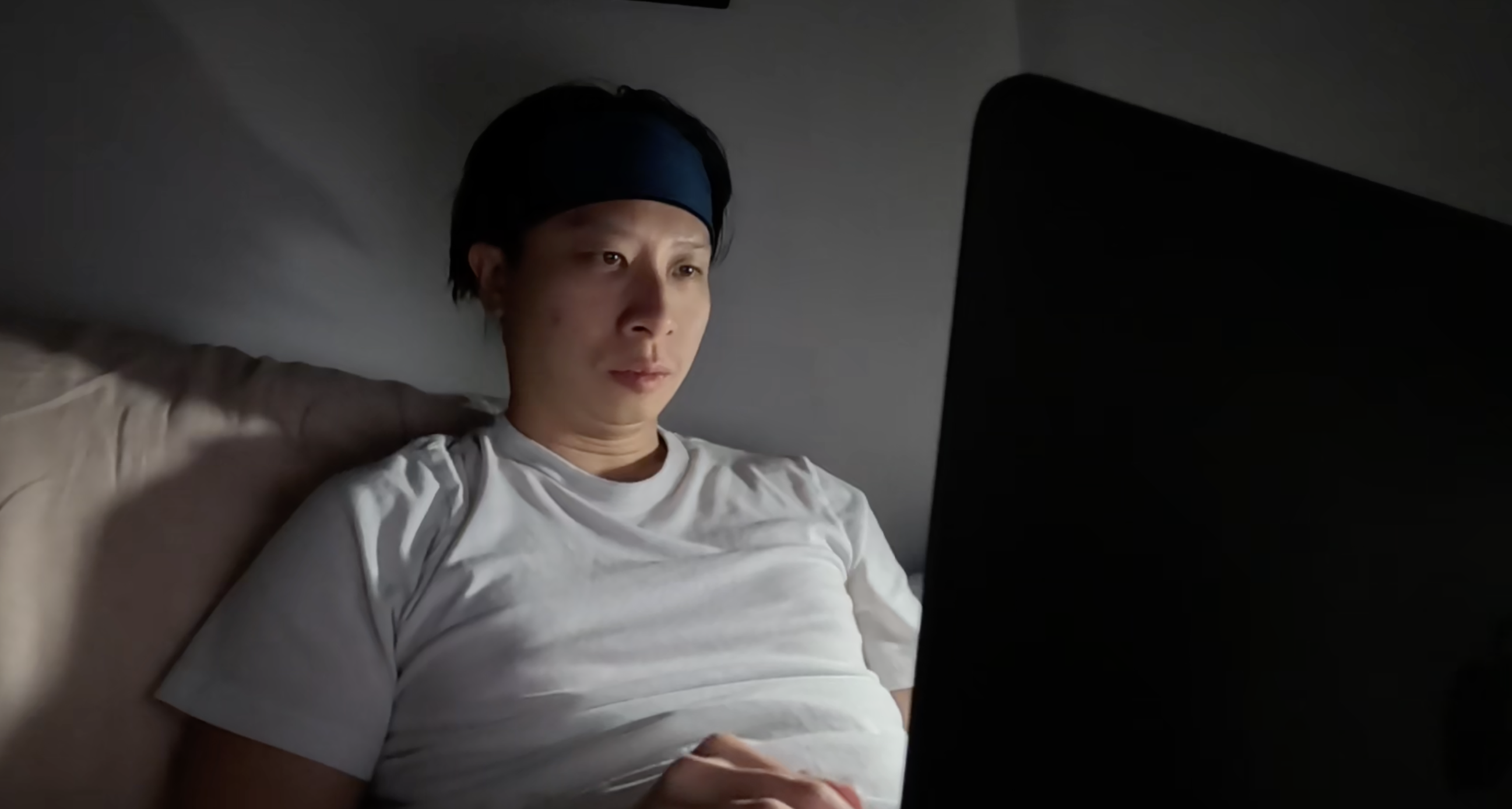
What’s changed isn’t just the writing—it’s how I work. This month, I finally upgraded my setup. For years, this project lived in notebooks and on a single laptop screen. And now—nearly six years in—I added a second monitor. It sounds small, but it matters. I’m deep in the editing phase, and being able to see two documents at once—comments on one side, the manuscript on the other—makes the process feel more deliberate. Two versions of the same thing, existing at the same time.
That upgrade marks a new phase of the project. And this is the phase where the grind really shows up.
I’m right in the middle right now—editing the middle of book two of the trilogy. I can’t think of a harder place to be if you’re trying to stay motivated. Especially because this is a second draft. And second drafts are brutal.
This is where you confront all the things you told yourself you’d “figure out later.” This is where you reread sloppy sections and resent the version of yourself who rushed through them. The momentum I had in the first draft now comes in fits and starts. There’s a lot more reading than writing. The work is slower—at least it feels slower.
This month, I wrote every day for twenty-five minutes. And in that time, I edited chapters nine through eleven. Two chapters in a month. About twelve and a half hours of work.
This book has twenty-six chapters. And then there’s book three.
Yeah… doing that math was a mistake.
Sometimes I think I should speed things up. And now you know why this project is taking so long. Part of me wants to pour everything I have into it. But I also know that I can’t. Not while working full-time, training for a triathlon, making YouTube videos, and still trying to have something that resembles a normal life.
And strangely, I like this balance. When I stop thinking about needing to finish, I feel better. I feel at peace with the project. It becomes a routine. Something I return to. Which I think I talked about in my last video.
It’s hard to explain what writing is to me now. It’s something nobody really cares about. It’s something I barely talk about, because no one wants to hear about a project this vague and this long. Friends and family want something recent to cheer for.
But writing feels more like a birthday. It’s something you come back to every so often and celebrate the fact that you’re still doing it. You’re still here. You haven’t quit. You’re still creating. Still breathing. Another trip around the sun. A little more progress.
And sometimes, as the world turns, you get small upgrades along the way. This time, it was a new monitor—something to make the journey slightly easier. Which is good, because the work itself isn’t getting easier.
It’s about recognizing when things are hard. And accepting that when it’s hard, it’s going to move more slowly. I curse the writer I was two years ago for leaving me with this messy draft. I curse him for not thinking things through. For making it up as he went.
But… isn’t that life? Making it up as we go.
I think this project is in its adult stage now. I understand that it’s a daily grind. No one is going to finish it for me. If I abandon it, it dies. If I keep showing up—even in small ways—it keeps growing.
Like me.
And honestly, I don’t think there’s another upgrade that will suddenly make this easy. I don’t need a third monitor. Sometimes you already have everything you need, and what’s left is just the work. It’s like buying a faster bike but still being afraid to descend. The upgrade only matters when you’ve leveled up.
It’s like that old saying: When the student is ready, the master appears.
For now, it’s about maintaining inertia. Keeping momentum. Filming myself every day helps. And knowing there’s a break at the end helps too. You learn these little tricks as you get older. You learn how you work. And at this stage—when things feel the hardest—this is enough.
For more writing ideas and original stories, please sign up for my mailing list. You won’t receive emails from me often, but when you do, they’ll only include my proudest works.
Join my YouTube community for insights on writing, the creative process, and the endurance needed to tackle big projects. Subscribe Now!
It’s good to be back. After taking a month off from editing my novel trilogy, it feels great to return to it with fresh eyes. The last few months of summer were hectic, and I was running on fumes. As much as I wanted to power through, I knew a break was better than burning out.
Over the last few years, I’ve made a ton of progress — getting drafts of all three books down on paper was a huge milestone. But now I’m deep in the editing phase, making sure each story flows not just on its own, but as part of a bigger arc. Think of it like this: each book has its own beginning, middle, and end — but together, books one, two, and three form one larger story with the same structure.
It’s exciting, but it’s also a grind. I’m chipping away at it day by day while balancing the rest of life. By the end of summer, I was training for my triathlon and working full-time, and something had to give. I believe you can do everything — just not all at once. So, for a while, writing took a backseat.
I’ll admit, I was nervous about stepping away. I worried I’d lose momentum or that this would be the moment my project quietly died — that fear every long-term creator knows: put something down for “just a bit,” and never pick it up again.
But working on this project has been part of my life for five years now — it’s built into my routine, like cleaning the house or tending the garden. When I take a break, it’s not like quitting; it’s more like letting the plants grow wild for a bit. Eventually, I’ll come back to prune and tidy things up.
I didn’t even stop at a neat checkpoint — I was mid-edit, right in the middle of Chapter 3 of Book 2. That actually made it easier to return. There wasn’t a buildup or mental block. I just jumped back in where I left off.
So yeah, it might feel like starting over, but it’s not. It’s more like reconnecting with an old friend. You know that feeling when you haven’t seen someone in ages, and you wonder if it’ll be awkward — but then, as soon as you meet, you pick up right where you left off. That’s what returning to my writing felt like.
And as the saying goes, absence makes the heart grow fonder. I’m more excited about this project than ever. Is it going to be the greatest thing ever written? Probably not — but that’s not the goal. Nobody visits Italy thinking, “I’m going to be the best person to ever visit Italy.” You go because you love the experience. Writing is like that for me. With each revision, I see the story sharpen and come alive. I’m polishing the stone, adding color to the outline, and watching my vision take shape.
So here’s what’s next: to stay accountable, I’m starting a new monthly series documenting my progress — the writing, the challenges, the little breakthroughs.
It won’t be easy, but I’m committed. I feel refreshed, inspired, and ready to keep going. This years-long journey still fills me with an energy I can’t quite put into words.
My name’s Elliot. I make videos about the endurance of creativity and life in this wild, dystopian world.
If you’re working on your own story and want some support and inspiration along the way, follow this series, check out the playlist, and don’t forget to subscribe.
For more writing ideas and original stories, please sign up for my mailing list. You won’t receive emails from me often, but when you do, they’ll only include my proudest works.
Join my YouTube community for insights on writing, the creative process, and the endurance needed to tackle big projects. Subscribe Now!
What happens when writing gets hard? When the excitement, the energy, the motivation you had at the start begin to fade?
Because here’s the truth: it will fade. And when that inspiration well runs dry… what do you do? Do a rain dance? Give up entirely? Or do you go out and start hunting for it again? Searching, gathering, and collecting new fuel.
You can’t keep pulling inspiration from the same place forever. That’s the trap we fall into, especially with big, long-term projects. We tell ourselves we have to remain close to the original spark, to keep circling the same seed that started it all so the story stays “authentic.” But what if the thing that got you here isn’t enough to get you there?
Sometimes the original inspiration is just the beginning — not the whole map.
For me, books alone stopped being enough. I needed more. So I started paying attention to other things — film, music, food, movement, architecture, nature, silence. I stopped searching for the one thing that would spark my writing and started letting it come from everything else.
Because art is about blending. The visual and the emotional. The structured and the chaotic. The outer world and the inner world.
What helped me jumpstart my writing again was realizing that inspiration isn’t a straight line — it’s a mosaic. And the more pieces I add, the richer the story becomes. Staying inspired is still a challenge. But I’ve learned how to refill the well — piece by piece, day by day, source by source.
Books were my starting point.
It started with fantasy — big worlds, bold stakes, magic and myth. That’s what I loved, and that’s what I set out to write. But as I kept drafting, I realized the story needed more dimension.
So I started reading more dystopian books — stories where things feel heavy and tense. They helped me think about what it’s like to live under control, when people don’t have real freedom, and how that kind of pressure affects every little choice a character makes.
Then came sci-fi, which cracked open ideas around memory, time, and identity.
That led me to survival stories — gritty, grounded, visceral — where every decision matters.
And finally, humor. Writers like Terry Pratchett reminded me that even serious stories need light. That levity brings depth. It’s about giving the reader space to breathe. Especially in a long, heavy story, humor makes the darker moments hit even harder.
Each genre added a new tone, a new layer. And the more I read, the more I started to see the overlap — like a Venn diagram where themes echoed across genres. And that’s how my story stayed alive — not by staying in one lane, but by blending them all.
Then I started watching movies differently.
It wasn’t a passive experience anymore. I’d rewatch films I always loved, but with new eyes. Not for the story, but for the spaces between it. The quiet edits. The way light falls. A shot that lingers just long enough.
Movies taught me a lot about pacing—especially those by the Coen Brothers. Fargo showed me how tension can thrive in seemingly quiet moments: a snow-covered highway, a character’s lingering glance, the distant hum of a TV in another room. It revealed how absurdity and violence can exist side by side, and how even the driest humor can be stretched out until you don’t know whether to laugh, cringe, or sit in silence.
Inside Llewyn Davis offered slow, looping melancholy. The story doesn’t build; it drifts. But the mood is so specific, so textured, it stays with you. There’s music, but it’s mournful. There’s struggle, but no resolution. That tone — lost, searching, slightly bitter — helped me lean into the emotional ambiguity in my own work.
And then there’s No Country for Old Men. I’d seen it before, but rewatching it while thinking about my writing, I focused on the silence. No score. Just footsteps down the hall. Then, gunshots in the distance. It made me ask: what happens when I let the quiet moments breathe in my own scenes — when I make my characters sit in the tension and feel every beat of a stressful moment?
Music became my outline.
From film, I turned to music.
It stopped being background noise and started becoming the outline. I didn’t just write to songs — I wrote from them, using them not to establish a scene, but to lead to a feeling.
“The Spiderbite Song” from the album The Soft Bulletin by The Flaming Lips stayed with me because of its deeply personal metaphors — a wound from addiction mistaken for a spiderbite.
The line: “Cause if it destroyed you, it would destroy me” really struck a chord. It changed how I see fantasy: it doesn’t always need dragons or kingdoms. Sometimes the magic lives in the metaphors themselves — in the way grief and love can exist together in a single sentence.
Then there’s “Love Is a Laserquest” from Suck It and See by Arctic Monkeys. I love this song, because of its mix of jadedness, wistfulness, and strange romance — like someone trying to ask a serious question behind a smirk. It made me think about growing up not as gaining wisdom, but as watching your idealism slowly fade. That mood helped me shape characters haunted by who they once were and what they still wish could be true.
Finally, “Under Glass” from Thin Mind by Wolf Parade hit me like a rush of energy. It’s fast, frantic, filled with building dread — like someone running toward something unknown. The lyrics feel trapped, like banging against the edge of an invisible barrier. It reminded me that dystopia isn’t always about strict regimes or harsh rules — sometimes it’s the slow, personal panic of realizing you can’t escape. That feeling became the emotional core for some of my most intense scenes.
I began shaping chapters like tracks on an album — letting rhythm set the pacing, letting lyrics echo through dialogue. Each chapter could stand on its own, like a song, but together they built something larger. An album. A whole. This was especially useful when the plot refused to move in a straight line.
Art gave me images when words wouldn’t.
Sometimes, when words stop flowing, I take a break and turned to art. One image — just one — can shake something loose. I’ll scroll through a gallery or flip through an old art book until something catches. It doesn’t have to make sense. In fact, it’s better when it doesn’t.
Surrealist art is great for that. I went through a Dali phase, and one piece I remember growing fond of was The Hand.
The giant, distorted hand extended over a vast, dream-like landscape, with just a few individuals scattered below. Who is the strange figure that belongs to? Is he a statue of some past ruler, or was the hand reaching out to beg? Who is that strange woman smiling behind like a lover past? Whatever it means, to me, this piece feels like authority, guilt, and longing all rolled into one.
That tension and imbalance seep into my writing: characters who reach for something they can’t quite hold, worlds where power feels both disembodied and dangerously close. These moments of visual stillness create scenes not through plot, but through emotion, space, and question.
Alongside classic surrealism, I also turn to the vivid art of Magic: The Gathering cards. Each card is a microcosm — a warrior mid-battle, a sorceress unmoved by swirling storms, a ruined temple glowing with latent power. A single illustration can spark inspiration for an entire chapter.
Whether it’s Dalí’s hand demanding something unseen, or a fantasy card hinting at ancient magic, these images become a little excursion away from the pages on the screen, which allows me to come back fresh.
Food reminded me to use my senses.
We talk about “show, don’t tell,” but nothing expands a story like taste. The sharp burn of wasabi that hits your nose, the fiery punch of hot sauce lingering on your lips, or the unexpected bitterness of dark chocolate that makes you pucker.
Some flavors comfort, like a warm bowl of miso soup or tangy kimchi, but others sting—like the sour bite of fermented mustard greens or the acrid edge of bitter melon. It’s hard to describe it, but these tastes strangely resemble old painful memories.
Food can also be surprisingly divisive — what’s a comfort to one person might be unbearable to another. A perfectly balanced hot sauce awakens the senses, but overdo it, and it hurts. Bread fresh from the oven is soft and inviting, but stale or burnt, it turns tough and abrasive, changing the whole experience.
I find that transformation inspiring. It reminds me that even the best things can shift with time, care, or neglect — just like characters and stories. How something changes, for better or worse, adds layers of complexity that I try to bring into my writing.
Architecture showed me how space shapes story.
As my search for inspiration deepened, I found myself drawn to architecture from around the world — from the stark brutalist towers of Eastern Europe to the half-sunken temples in Cambodia, to neon-lit apartments in Tokyo.
I began imagining my characters moving through these spaces, experiencing the subtle shifts as they step inside and out. The cool air inside a stone temple after the scorching sun outside. The hollow echo of footsteps in a concrete hallway of a Soviet-era building. The sudden flood of neon light in a cramped Tokyo stairwell.
That feeling of crossing thresholds — walking through a doorway or stepping into a new room — changes everything. The way the air smells, how light bends and shifts, the sounds and textures that greet you. The high ceilings. The tight quarters
Architecture has the power to shape mood, tension, and stories. It can be a sanctuary or a cage. And that’s the kind of atmosphere I try to bring into my writing when creating an environment.
Working on a long project requires both inspiration and motivation. Motivation keeps you showing up, day after day, page after page. But it’s inspiration that gives your motivation direction—it lights the path forward when the road feels long.
This story is mine, and most importantly, I’m enjoying the process again—filling the well as I go. When you return to the page, start with one source of inspiration. But then, let it grow, let it fill your character, your world, your story. If you get stuck, don’t push too hard—go fill your well.
For more writing ideas and original stories, please sign up for my mailing list. You won’t receive emails from me often, but when you do, they’ll only include my proudest works.
Join my YouTube community for insights on writing, the creative process, and the endurance needed to tackle big projects. Subscribe Now!
I want to tell you a story. Not the one I’ve been writing, but the story of bringing it to life.
About five years ago, something sparked. A character showed up, then a scene, then a whole world. I remember thinking, This is it. This is the story I have to tell.
I had this image in my head of how it would go: sleepless nights, fast fingers, drafts piling up like magic. You know the stereotype, the fevered genius at the keyboard.
That didn’t happen.
Instead, writing this story turned into something slower. Quieter. Not a mad sprint, but more like wandering. I felt like a lost hiker, circling the same trees, passing the same landmarks, unsure if I was getting anywhere at all. But there was hope. Every plot breakthrough gave me energy—just long enough to run into the next wall.
In the beginning, everything buzzed. But the spark isn’t supposed to last.
At some point, the dialogue dries up. You lose the thread. You open your draft and just… sit there.
I told myself I was “thinking about the story,” when really, I was avoiding it. Because facing the page meant facing the fear that maybe this story wasn’t good. Or worse, that I wasn’t good.
That’s when I started to understand: inspiration might start the fire, but discipline keeps it going.
So I began showing up. On bad days. On tired days. For ten minutes at a time. I’d rewrite the same paragraph five times and still feel like I hadn’t moved. But that was progress, too.
Writers like George R. R. Martin have talked about the middle—the long slog—as the real heart of the work.
Eventually, I gave up on waiting for ideal conditions. I let go of perfect. Some days I wrote two pages. Other days, I added a single word only to cut it. That had to be enough.
What helped was remembering that no one reads the first version and that revision isn’t punishment—it’s a privilege.
Robert Jordan used to write sprawling, chaotic outlines just to figure out what he might say. Brandon Sanderson rewrote entire books. That gave me permission to take my time too.
Time wasn’t the enemy. It was the process.
There were moments I felt guilty for not writing. For thinking about quitting. For wondering if I should just start a new project with all that fresh, exciting energy again.
But there were also quiet wins: a chapter that finally clicked. A problem I solved after months of spinning. The story shifted. So did I. It stopped being about finishing fast and started being about building something I enjoyed.
Characters evolve not just in my drafts, but in my mind. Themes start to mean more. My voice changed. The world I wrote grows richer, not because I pushed, but because I lived with it.
That’s what chipping away builds. Not perfection. Not speed. But depth.
Every great epic—The Lord of the Rings, The Wheel of Time, A Song of Ice and Fire—wasn’t written overnight. They were sculpted. One patient, faithful, messy page at a time.
These days, I think of persistence as its own kind of art.
It’s not about grinding harder. It’s about staying close to the work. Trusting that something is happening, even when it feels slow. Especially when it feels slow.
So if you’re working on something long—something that keeps asking for your time and care—you’re not behind.
You’re not lost.
You’re an artist in motion.
Maybe you’ll finish the thing. Maybe you’ll shelf it. Maybe you’ll come back in a year with fresh eyes and finally crack it open. Whatever happens, the time wasn’t wasted.
If you’re in the middle of a project that’s taking longer than you expected. Keep chipping away.
And remember: art isn’t finished. It’s only ever abandoned. There is no end.
So maybe today’s the day you write one more sentence. Maybe that’s enough.
For more writing ideas and original stories, please sign up for my mailing list. You won’t receive emails from me often, but when you do, they’ll only include my proudest works.
Join my YouTube community for insights on writing, the creative process, and the endurance needed to tackle big projects. Subscribe Now!
I think a lot about how momentum works. Not just in training—although yeah, I do love a good triathlon—but in creativity too.
When I’m training for a triathlon, I’m not just running every day. I swim. I bike. And I run. Each discipline works different muscles, keeps things fresh, and somehow… they all support each other. Like, I come out of a bike ride with stronger legs for the run.
And that’s kinda how I’m approaching my creative life too.
I don’t just write. I don’t just draw. I don’t just make videos. I move between all of them—and doing that actually helps me stay motivated and inspired. If I’m stuck in one, I switch to another. If I’m tired of reading, I pull out my camera. If I can’t sit down to draw, I cut up footage and express my creativity in a whole new way.
So today, I’m sharing something I call the Creative Triathlon. It’s a predetermined length of focused time on three different creative practices: illustrating, video creation, and writing. One discipline at a time. No pressure. No multitasking. Just a way to find time to do what you enjoy.
First leg: illustration. For the past 4 years, I’ve been working on this massive personal project—drawing every single Pokémon. Yeah. All of them. It’s been slow-going, not because I don’t love it, but because finding the time is hard. Life piles up. Other projects take priority. And as strange as it sounds, drawing Pokemon doesn’t pay the bills.
But when I do this creative triathlon, it forces me to carve out time for it. Even just 25 minutes. And honestly? It’s kind of like swimming. At first, it takes a while to get ready. But once I start? I don’t want to stop. It’s peaceful. It’s focused. And there’s something really satisfying about seeing one more little creature take shape.
This leg always reminds me why I started this project in the first place: because I love it. Because it brings me back to that kid part of myself that used to draw these things on notebooks.
I’m almost at 1000 Pokemon. I really want to finish before they add more. If you are interested in see the rest, check out this video in the cards and the instagram in the link in the description.
Second leg: video creation. Right now, I’ve been making a series of YouTube Shorts where I highlight key takeaways from books I’ve read. It’s honestly become one of my favorite creative outlets.
What I love about it is that it’s a true mashup of all my past-time activities—reading, thinking, writing, editing—it all comes together in these tiny videos. It makes everything I do feel active. Reading no longer feels like a passive intake of ideas. By turning it into a video, I get to spend more time with what I’m reading. I get to sit with the concepts, rephrase them, visualize them. And because of that, the lessons stick. They become part of me. A little snapshot of my life.
Video creation is great that way. It lets you experience your own thoughts in a completely new medium. You go from absorbing to articulating, from quiet reflection to something that moves and speaks. Seeing an idea come to life on screen—it just never gets old.
Final leg: writing. I’m currently editing the fifth draft of the first book in a trilogy I’ve been working on for years. And yeah—it’s a slog. A meaningful one, but a slog nonetheless.
It’s such a big project that most days, I’m just chipping away at it. I don’t always see progress. There’s no big “aha” moment, no flashy breakthrough. It’s slow, repetitive work. And honestly, it feels a lot like running. Not a sprint—a marathon. You get tired. You want to stop. But you don’t, because the work is worth it. The fatigue is part of the point. It’s what builds endurance. It’s what makes the story matter.
Working on something this big, this long—it becomes part of your life. It’s something you carry. And the beautiful thing about creativity is that it’s not like sports… there’s no finish line in the same way. It doesn’t end. But that’s why I love this Creative Triathlon practice—because it does give me small finish lines.
Instead of focusing on finishing the book, I just focus on finishing a session. That’s it. One 25-minute block. And when it’s done, I get this little burst of relief, a sense of accomplishment. Like I’ve closed a loop. It’s such a good feeling—being able to look back at my day and say, “I did something today.” No guilt. No disappointment.
So that’s my Creative Triathlon. Three disciplines, 25 minutes each for me today. It could be more on other days, but today was only 25 minutes. Which is enough to get a good chunk of work done. Know this, though, it’s not about finishing a masterpiece in an hour and a half—it’s about movement. It’s about momentum.
Just like in a real triathlon, each leg has its own rhythm. Some feel strong. Some feel slow. But they all carry me forward.
If you’re someone who loves multiple creative things—or if you’re feeling stuck—try this. Treat your creativity like a triathlon. Mix it up. Work different muscles. Let each practice breathe new life into the others.
Thanks for hanging out with me today. If you decide to try your own Creative Triathlon, let me know how it goes! And if you already have a different combo that works for you—maybe it’s music, painting, and cooking—drop it in the comments. I’d love to hear what you’re working on.
Join my YouTube community for insights on writing, the creative process, and the endurance needed to tackle big projects. Subscribe Now!
For more writing ideas and original stories, please sign up for my mailing list. You won’t receive emails from me often, but when you do, they’ll only include my proudest works.
Having completed “Right Thing, Right Now” by Ryan Holiday (Amazon), I want to highlight a chapter that stood out: “You Just Have to Be Kind”
As Kurt Vonnegut said, “There’s only one rule that I know of: Goddamn it, Joe, you’ve got to be kind.””
Be kind.
To the ones who serve you.
To the ones who frustrate you.
To those who falter, those who fall.
To the ones who follow you and the ones who came before.
To the ones you may never meet.
The history is filled with brilliant and successful people. You’ve probably encountered plenty. But how many truly kind people have you met? When we look back, one thing that never ages well is a lack of kindness.
The cruelty of mobs. The selfishness of leaders. The way whole groups of people were dismissed, diminished, denied their humanity.
It’s true: There is no leader who has not faced frustration. There is no wise person who has not endured foolishness. There is no good person who has not been wronged.
This is the way of the world.
But it is our strength, our wisdom, our decency that obligates us to be kind anyway.
You never know what someone is carrying. You never know how far a small kindness might ripple. But that’s not why we do it.
We do it because as Vonnegut puts it, it’s the only goddamn rule there is.
For more writing ideas and original stories, please sign up for my mailing list. You won’t receive emails from me often, but when you do, they’ll only include my proudest works.
Join my YouTube community for insights on writing, the creative process, and the endurance needed to tackle big projects. Subscribe Now!
Winter nights have a particular kind of silence that makes everything feel slower. This year, that quiet has become my writing time. I’ve had to face the fact that I only have 30 minutes a day to work on my novel. Between a busy job, taking care of Petey—my newly adopted dog—and the general rush of life, there’s no extra time to spare. But I’ve made it work, and consistency has been the secret.
Petey is a sweet soul who’s been through his own rough chapters. Between training sessions, walks, and making sure he’s not chewing on our blankets, my evenings belong to him. By the time he’s snoring at my feet, it’s close to bedtime. That’s when I sit down, put on Game of Thrones in the background, and dive into the fifth draft of my novel.
This draft is all about fixing inconsistencies and aligning the story with the rest of the trilogy I’m building. Every sentence I tweak and every plot hole I patch has to fit into the larger picture. With only 30 minutes a day, progress is slow but steady. Some nights I manage to rewrite an entire scene; other nights, I just have the energy to read a few paragraphs. But it’s not about how much I get done in one session—it’s about showing up every day.
Here’s how I’ve made the most of my limited time:
Plan Ahead: I end each session by anticipating what comes next. That way, when I sit down the next night, I know exactly where to pick up. I give a purpose for each session, am I reading, am I leaving comments, or am I making the edits? When I know what comes next, I can take action.
Set A Timer: I don’t only say that I’m going to write for 30 mins, I actually set a timer to ensure that I do. And at the end of the timer, I can stop or I can push through a little more. Often, I will end up doing a little more than 30 mins, but rarely do I do less.
Find Motivation in the Routine: Writing at the same time every night has turned it into a habit. Even on days when I’m tired, my brain knows it’s time to write. It’s the last thing I do. A final burst of energy, the kind you would do in a HIIT workout.
Tracking Your Streak: I find that marking down the days that I write really helps me stay committed. By marking it down, I can see how many days in a row I have been writing and then that gives me a little boost of motivation.
If you are hard-pressed to find time, often what you need is to feel committed. I know I’m always pushed to start and keep going when I have committed to a project, a program, or even a person.
If you are looking for that little extra push, you should check out Reedsy’s events and memberships. It’s a fantastic source to get your questions answered by publishing professionals, including literary agents and editors at Big 5 publishers. With the membership, you’d receive 12 months of exclusive access to events with bestselling authors and top publishing professionals from the Reedsy Marketplace.
If you are interested, check out the link here to learn more about the events and memberships.
This winter, I’ve learned that consistency is more powerful than long stretches of time. Petey reminds me of this in his own way. For dogs, in order to train them, they need to do the same things every day. Consistency. He’s grown so much since I adopted him, but it’s happened gradually, with patience and daily effort. The same is true of this novel. Each night I sit down, I’m inching closer to the story I’ve been imagining for years.
If you’re struggling to find time to write, my advice is simple: make the most of what you have. Whether it’s 30 minutes a day or even less, commit to showing up. Plan your sessions, set small goals, and trust the process. One day, you’ll look back and realize how far those tiny steps have taken you.
Join my YouTube community for insights on writing, the creative process, and the endurance needed to tackle big projects. Subscribe Now!
For more writing ideas and original stories, please sign up for my mailing list. You won’t receive emails from me often, but when you do, they’ll only include my proudest works.
Bryan Cranston—you know, the guy who gave us Walter White—once shared some advice for actors going into an audition. But this advice felt bigger than just acting. He said: “know what your job is
At first, it sounds simple, almost too simple. But then he elaborates:
“I was going to auditions to try and get a job. That is not what you are supposed to do. An actor is supposed to create a compelling, interesting character that serves the text, you present it in the environment where you audition. And then you walk away. And that’s it. Everything else is outside your control, so don’t even think about it, don’t focus on that. You’re not going there to get a job. You’re going there to present what you do. You act. And there it is. And you walk away and there’s power in that.”
Cranston’s not saying “Don’t care about the outcome.” He’s saying, “Care about what you can control.” For him, it’s about crafting a character that serves the story. For us—whether we’re writers, marketers, or creators—it’s about honing our craft and delivering it with intention.
I remember a time when I was deep in job applications, obsessing over every detail, trying to predict what each company wanted. The constant second-guessing, the tweaking of synonyms and punctuations—it was exhausting. My job wasn’t to convince them I was perfect. My job was to show up and be myself—to present what I do best.
The same rule applies when you’re already on the job. Showing up every day isn’t just about ticking off tasks or meeting deadlines. It’s about knowing what’s at the heart of your work. If you’re a writer, your job isn’t just to write—it’s to tell a story that connects. If you’re a marketer, it’s not just about ad campaigns—it’s about creating something that leads to action.
But here’s the thing—the pressure to get it “right” can mess with your head. You want the recognition, the results, the wins. That’s why Cranston’s advice feels so important. He’s saying: let go of what you can’t control. You can’t control how people respond to your performance, your draft, or your campaign. But you can control the effort and care you put into it.
So, how do you do this in real life? First, focus on the process. Instead of asking, “Will they like it?”
Ask: “Am I proud of this? Does it serve the purpose?”
Second, detach from the outcome. Present it and move on.
And third, redefine success. It’s not just about landing the job or nailing the project—it’s about the growth that comes from the work itself.
Rejections sting. Constructive criticism can break me down. And negative comments are hard to ignore. But when you focus on what’s within your control, you start to find a different kind of power. You’re less tied to the highs and lows, and more grounded in the work you’re doing every day.
So, whether you’re pitching ideas, crafting stories, or designing campaigns, take Cranston’s advice: “Know what your job is.” Show up. Do the work. Let go of the rest. There’s freedom in that.
For more writing ideas and original stories, please sign up for my mailing list. You won’t receive emails from me often, but when you do, they’ll only include my proudest works.
Join my YouTube community for insights on writing, the creative process, and the endurance needed to tackle big projects. Subscribe Now!
Show up. … when you’re tired. … when you don’t have to. … even when you have an excuse. … even if you’re busy. … even if no one will notice. … even if it’s beating you down.
Once you start, you can build on it. Once you act, momentum can grow. Showing up is the key—because when you show up, you can do.
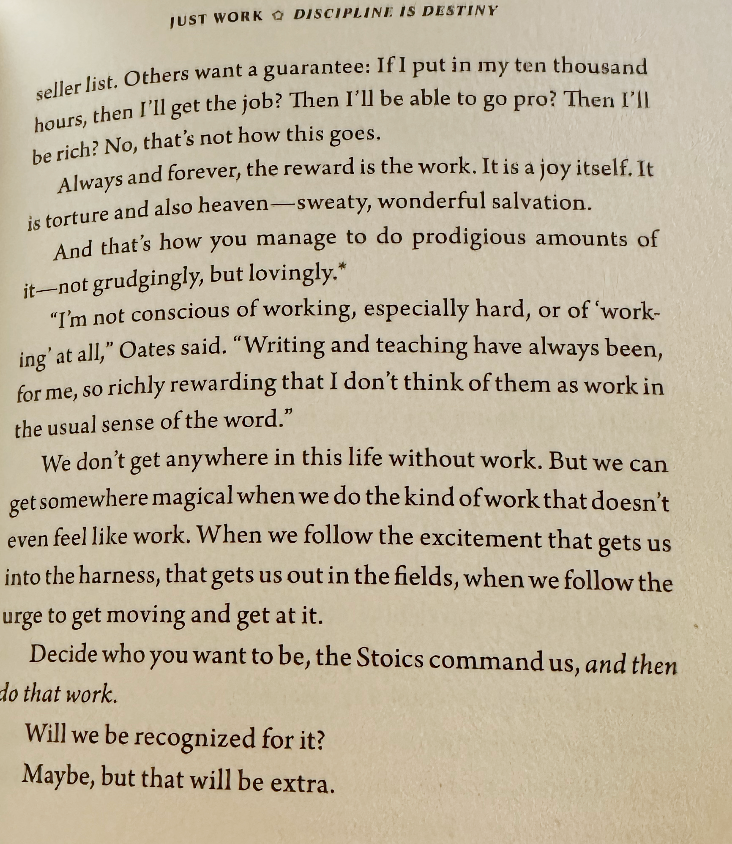
Over a nearly 60-year career, Joyce Carol Oates wrote novels, stories, poetry, plays — millions of words. If she can show up every day, you can get on the treadmill. Pick up the violin. Answer emails. Write a scene. Lift some weights. Cross one thing off your list.
It doesn’t matter what it is—all aspects of life improve when you work on them daily.
The Greeks have a word for this: philoponia—a love of hard work.
So, show up. Do the work. Not for perfection, but for progress. The grind pays off.
Join my YouTube community for insights on writing, the creative process, and the endurance needed to tackle big projects. Subscribe Now!
For more writing ideas and original stories, please sign up for my mailing list. You won’t receive emails from me often, but when you do, they’ll only include my proudest works.
I am a notoriously slow reader—almost to the point of embarrassment. When I read with someone else, I often pretend to be finished, even when I’m not, just to appear as though I’m keeping up with their speed. Of course, I have no idea what their speed is; I just get so self-conscious that I find myself staring blankly at the page or the plaque or whatever it is I’m trying to read.
That’s not to say that I don’t read; I actually read more than the average person—usually around 20 to 30 books a year. However, to achieve that, I need to set aside a lot of time for reading, which I enjoy. But something changed this year.
I got busy!
That’s right; up until September, I had only finished three books—three books! That is unacceptable. Granted, I’m over 60% through one long collection of short stories by Alastair Reynold (Amazon) and 50% through the third book of the Wheel of Time series (Amazon), both massive tomes, but still… I am way below my yearly average for 2024.
So, I decided to change that. With a few months left in the year, I wanted to get back on track and finish as many books as I could. To achieve this, I needed to challenge myself properly. I wasn’t just going to set a random goal of reading ten books by the end of the year. No! I needed something more structured.
You see, if I want to read more books in the time I have left this year, I can either schedule more time to read or read faster—or even better, do both!
However, reading faster will require some practice, and that requires a process. If there’s one thing I’m good at, it’s building a process to help myself stay consistent.
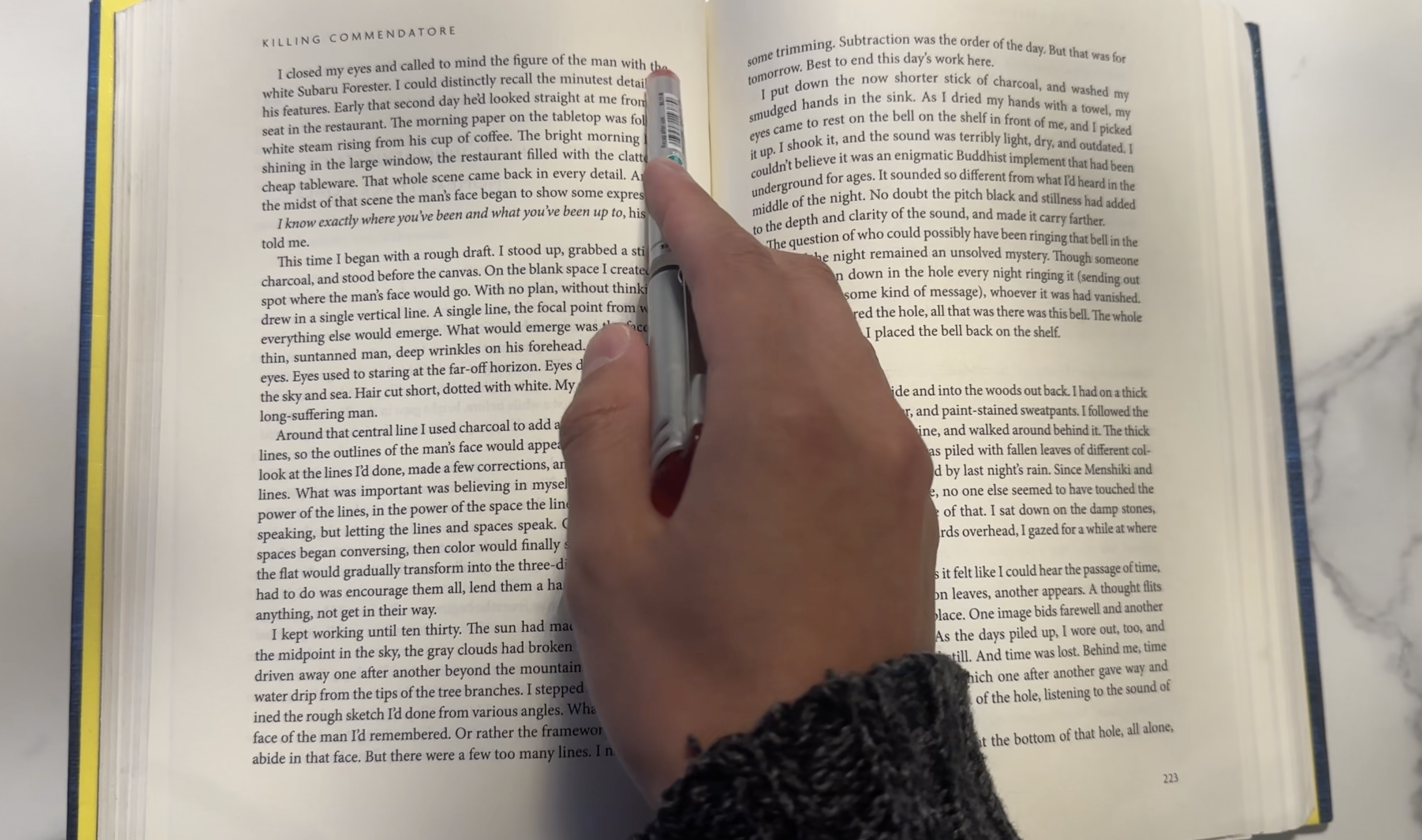
I went to the library and picked a book. It could have been any book, but I ended up choosing one bigger than I intended: Killing Commandatore(Amazon) by Haruki Murakami, which is about 680 pages long. My goal is to finish reading it before it’s due, and I plan to do that by speed reading.
As for the process. First, I need to set a specific amount of time—let’s say 30 minutes per day. Next, I need a technique to practice; for me, that’s speed reading.
After doing some research, I discovered that the easiest technique to start with is using a pen to guide my eyes. This helps me focus on the next word in the line without letting my eyes dart around, which is a natural tendency. This is often why I find myself rereading sentences and paragraphs.
Lastly, I need a way to hold myself accountable. The best way to do this is by keeping a record of my practice, and there’s no easier way than filming myself and posting it as an Instagram story. Yes, it may seem a bit odd to showcase myself reading, but I know that external pressure can be one of the most powerful motivators.
So off I went. The objective was clear: I needed to finish this 680-page book before it’s due. The Vancouver Public Library has a borrowing period of 21 days from the day you check out. Which means I need to read an average of over 32 pages every day.
According to Marc Brysbaert from Ghent University in Belgium, who analyzed 190 studies on reading rates, silent-reading adults average 238 words per minute, while adults reading aloud average 183 words per minute.
With a quick calculation, at 350 words per page, I’ll need to read about 11,333 words each day in 30 minutes, which comes out to approximately 378 words per minute.
Of course, I didn’t expect to reach 378 words per minute right away. I anticipated that it would take some practice to get used to it. However, I hoped that I would eventually get there, increasing my average reading speed in everyday life while still maintaining a level of comprehension—and, of course, enjoyment.
So, off I went!
Day 1: I read 19 pages. I didn’t use the pen today—just my bookmark. This gives me a good starting point for my reading speed. Day 2: I bumped it up to 23 pages! I started using the pen, and I felt the difference right away. My eyes were following the words much easier. Day 3: Another 23 pages. It seems I’ve found a new baseline. Day 4: I managed to read 28 pages! Now that I know the technique works, it’s all about pushing myself a bit faster. I need to average 32 pages, after all, which means I have some ground to make up.
Today I passed the 100-page mark!
Day 5: I read 29 pages today. I’m still pushing myself, but it feels like I’ve hit another plateau. Day 6: Finally broke through with 31 pages! This is my first day hitting the 30+ mark, and it feels great. Using the pen to guide my eyes is becoming second nature. Day 7: I only managed 27 pages today. A little regression is totally normal, though. I was tired, and sometimes you just need to recover after a big push during the week.
Today I past the 200-page mark!
Day 8: I hit 31 pages again! This shows me I can get back over 30 pages in 30 minutes. It really boosts my confidence that I can step it up when I need to. Day 9: I reached 32 pages—new personal best! I’m feeling pretty confident that I can hit my goal if I just keep up this pace. Plus, I still have about two weeks left! Day 10: Sticking with it at 31 pages today. Day 11: 31 pages again! Looks like the low 30s are my new comfort zone. It’s going to take a little extra effort to break through, while I’m trying to keep my comprehension up as well.
Halfway through the book!
Day 12: I read 32 pages! I’m halfway through, and I can really feel the improvement. It feels good! I’m ready to pick it up. Day 13: I pushed it to 34 pages. I started reading a bit later in the evening today, and I think the quiet atmosphere helped me focus. Plus, it felt great to hit a new personal best! Day 14: 37 pages today! This is a big milestone for me. I was really feeling it, so I pushed myself a bit more, moving my pen and guiding my eyes just a bit faster. It’s all about gaining confidence in reading the words together instead of just one by one. Day 15: I managed to replicate yesterday’s effort with 36 pages. It felt good, like reaching a new level in weightlifting. Adding just five more pounds on top of 300 is significant, right? We call that marginal gains. Day 16: 37 pages! I’m super proud of my consistency lately. I’ve really shown progress! With less than a week to go, it’s crunch time.
Today I passed the 500-page mark!
Day 17: I read 33 pages today. Not as good as before, but there was a time when 33 pages would have blown me away! Progress is about looking back and seeing how far you’ve come. Day 18: Another 33 pages today. At this point, consistency is key. The fact that I’ve read every day is what matters—it’s like chipping away at a big project. It doesn’t have to be a home run; sometimes you just need to get on base. Day 19: I hit 38 pages—new record! Some days, everything just clicks, and reading feels easier, whether it’s from having more energy or focus. Day 20: I managed 33 pages again. I can feel the finish line coming, and I know I’m going to hit my goal. It’s all about finishing strong and making the most of this time. Day 21: I only needed to read 21 pages to complete the book, and I did it! I finished on the exact day it was due!
If you are familiar with Haruki Murakami’s writing, you know it’s full of beautiful prose and surreal imagery. And this one is no different. If I was to compare it with another one of his novels, I’ll say it’s kind of like The Wind-Up Bird Chronicle (Amazon). So if you like that, check out Killing Commadatore. There’s no way to show my comprehension of the book in this video and I’m not going to give it a proper review. But I do want to share my favorite passage:
“When you’re locked up alone in a cramped, dark place, the most frightening thing isn’t death. The most terrifying thought is that I might have to live here forever. Once you think that, the terror makes it hard to breathe. The walls close in on you and the delusion grabs you that you’re going to be crushed. In order to survive, a person has to overcome that fear. Which means conquering yourself. And in order to do that, you need to get as close to death as you possibly can.”
This year, like I mentioned, has been a bad year for reading, but the year isn’t over yet. And next year is just around the corner. I’m getting back on the horse. I’m not going to let the excuse of being too busy slow me down from my reading goals anymore. If I can’t create more time in the day, I just need to read faster. And now knowing that I can read at 377 words per minute at a somewhat comfortable pace, means I will be able to finish books at a rate hopefully a quarter of the time faster… if not double the time faster.
But there is a lot more practicing for me. A muscle only stays strong if you keep using it. So…
I’m going to keep borrowing books from the library with the intention of finishing them before the due date arrives.
Yes, often times, I will be able to renew the book, but… if the library thinks I can read a book in 21 days… then hell… I’ll do my best.
Join my YouTube community for insights on writing, the creative process, and the endurance needed to tackle big projects. Subscribe Now!
For more writing ideas and original stories, please sign up for my mailing list. You won’t receive emails from me often, but when you do, they’ll only include my proudest works.
 Elliot Chan