Hi, I’m Elliot, and I’m here to improve my cycling skills. To achieve this, I’m embarking on a project I call FTP Builder, inspired by the Build My FTP workout I’ll be taking on in Rouvy. This series will be told in five parts. This is Part 3, entitled: The Workout
Rouvy’s Build My FTP workout is a structured training plan designed to boost your FTP over 4 weeks. It includes various intervals that target different aspects of your fitness like endurance, strength, and power.
During each workout, I can expect a warm-up to get my muscles ready and my heart rate up. This usually means starting at a moderate pace and gradually increasing the intensity.
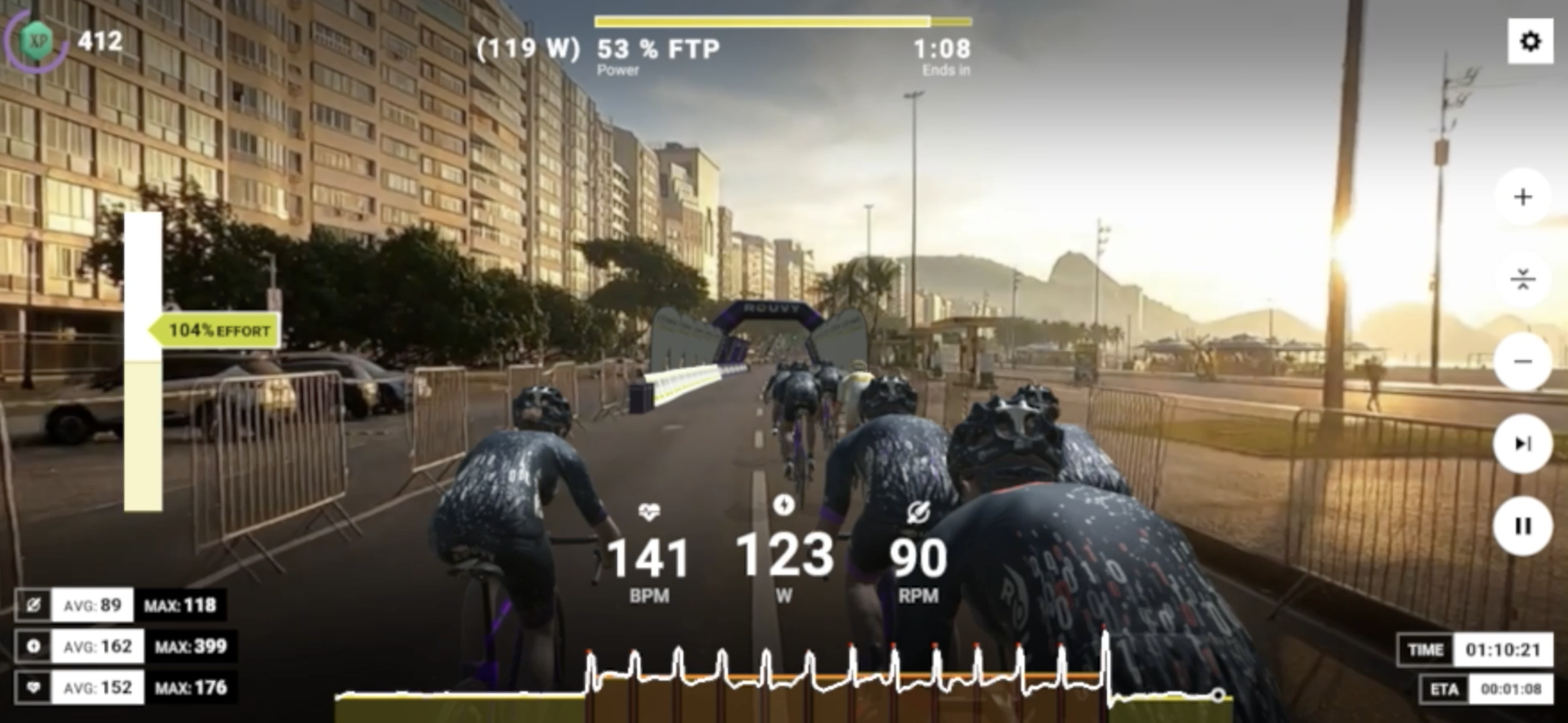
Then there’s the intervals. This is the heart of the workout. I’ll do several high-intensity intervals where I’ll push myself to hold a specific wattage for a set amount of time. These intervals are tough but this is where the gains happen.
Some segments of the workout require me to maintain a consistent power output for longer periods. These are called steady efforts and they simulate the sustained effort I’ll need during a race or a long ride, helping me build the stamina to keep up high wattages over time.
Finally, each session wraps up with a cool-down phase. This helps lower my heart rate and start the recovery process for my muscles.
Now, let’s find out how I did:
Week 1: Getting Used to It
I was excited to get started on this workout, but that feeling didn’t last long. The first one was rather short, but the next two were not.
This week was all about adapting to longer, high-intensity workouts. Anything over 40 minutes felt like a grind. I’m used to more frequent, but shorter rides on the indoor bike. Holding the required power for that duration wasn’t easy. I was pretty tired by the end of the week, especially since I was also doing some high-intensity run training at the same time.
I’m not too sure what I’ve gotten myself into trying to fit this project inside my training for an upcoming sprint distance triathlon. I guess I’ll find out.
Week 2: Squeezing It In
With three long workouts this week, I had to alter my schedule to fit it all in. I had to do them early in the morning, after work, or after another workout. They were tough, and most of the time, I couldn’t even hold the required power. By the end of the week, I was pretty exhausted.
Any excitement I had for this project was gone… these workouts are painful. But I knew that the hard work will pay off when I’m at the start line and I’m confident that I’ll have the strength to climb those hills. So I stayed positive and committed to the process.
Then, something unexpected happened.
Week 3: The Crash
Maybe I was doing too much and the universe decided I needed a break. I started this week by crashing my bike while riding to work.
While going down a hill just outside of my place, I was fidgeting with my jacket with my right hand and I accidentally pulled too hard on the front brakes with my left. My momentum sent me over the handlebars and I literally tackled the pavement at 20 km/hr with my right arm. It happened so fast that I was genuinely confused when I picked myself up from the road.
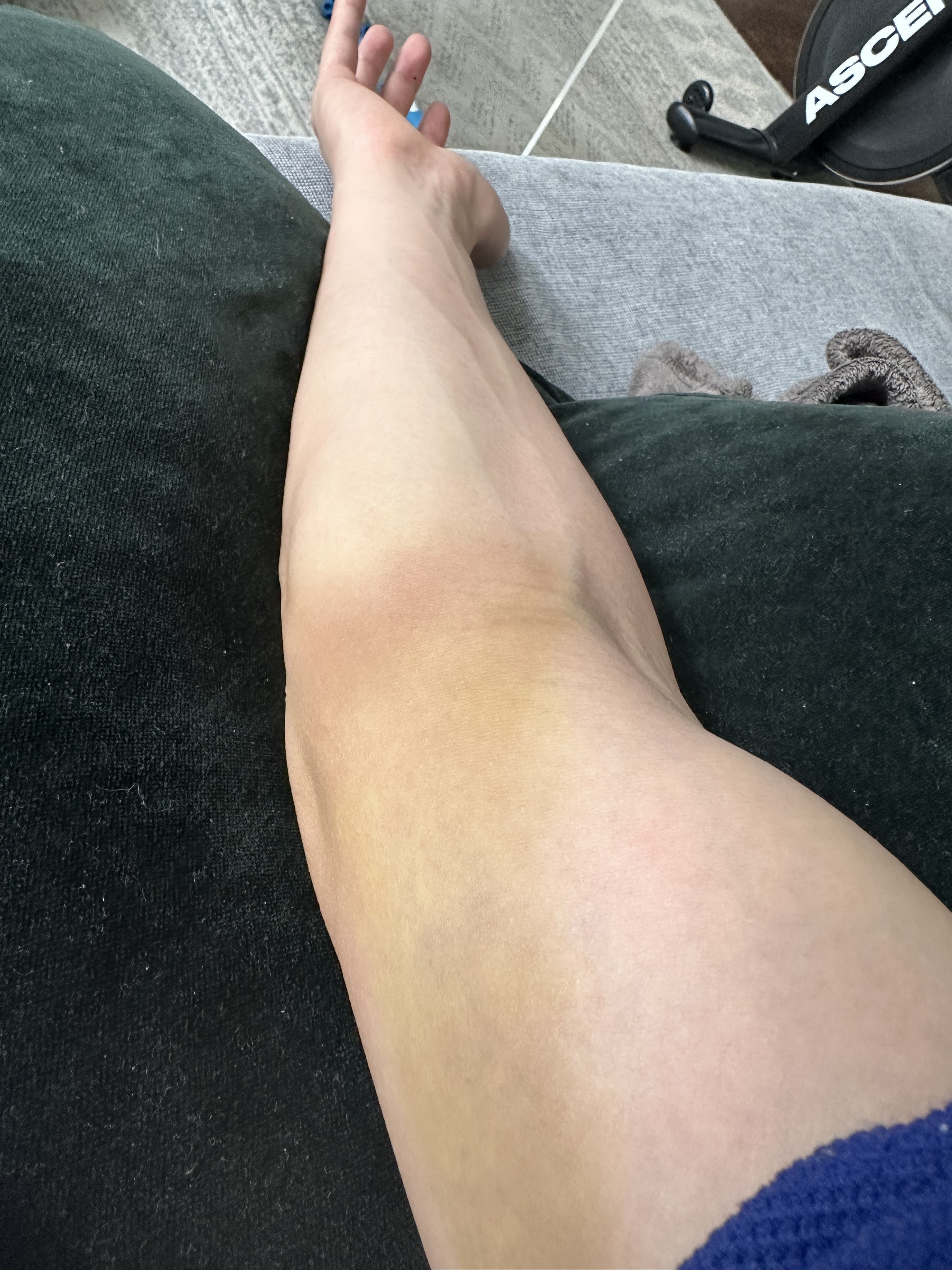
My elbow hurt a lot and was completely swollen. It took a couple of days before the bruise even appeared. I didn’t have much mobility, but at the time, I didn’t think it was that bad and that it would only set me back a few days. I was wrong. This week ended up being a complete write-off.
Week 4: Recovery and Return
After a few days off, I went to the physio for an assessment to see how much I should push myself in preparation for my triathlon race in three weeks. He assured me I’d be fine, but my elbow might take 4-6 weeks to heal completely. The only way I could injure it further was if I fell off my bike again, so all my exercises would be done indoors, which was the plan with the whole Rouvy thing.
Returning to workouts was a bit of a struggle while trying to deal with the lingering pain in my arm. You don’t realize how much you rely on it sometimes. Simple turning motions and loading bearing were the toughest. However, my legs felt fresh, which was a good sign that the project was having some positive results before I got injured.
While the workouts were still long and holding the watts was tough, I surprisingly managed to get through them. Holding myself up with my arm for over an hour was a bit challenging, but it actually helped get the blood flowing, and my arm felt better after the workouts. Though getting injured never feels good, this one came at a good time to help me regroup.
Week 5: Another Setback
Although my right arm was still stiff and achy, I was grateful that the injury wasn’t worse, considering how unpredictable a crash can be, and that I still had the ability to train from home. Yes, the workouts on Rouvy were still tough — maybe even harder now that I was in recovery mode. Holding the watts for long durations was so painful it dulled everything else. But a short burst of power, such as sprinting felt good, and I could tell I was getting stronger, but the week 4 workouts were a doozy. But I was conquering them. I was so close to finishing.
But then… with only two more workouts left to go —just as I was wrapping up the last bit of training in preparation for my triathlon, I crashed again during a practice ride outside.
That’s two crashes in under three weeks. This time, it just felt like a lapse in focus. I was doing laps on a local hill, and on the third lap of a decent that day, I got distracted for a moment, and when I came to, I was heading towards the curb. I don’t know how that happened, but I put a lot of blame on the fact that my arm wasn’t healthy enough to return, at least not strong enough to take the risk that I took. If I was in full strength I think I could have steered myself away, but my right arm just couldn’t respond in time.
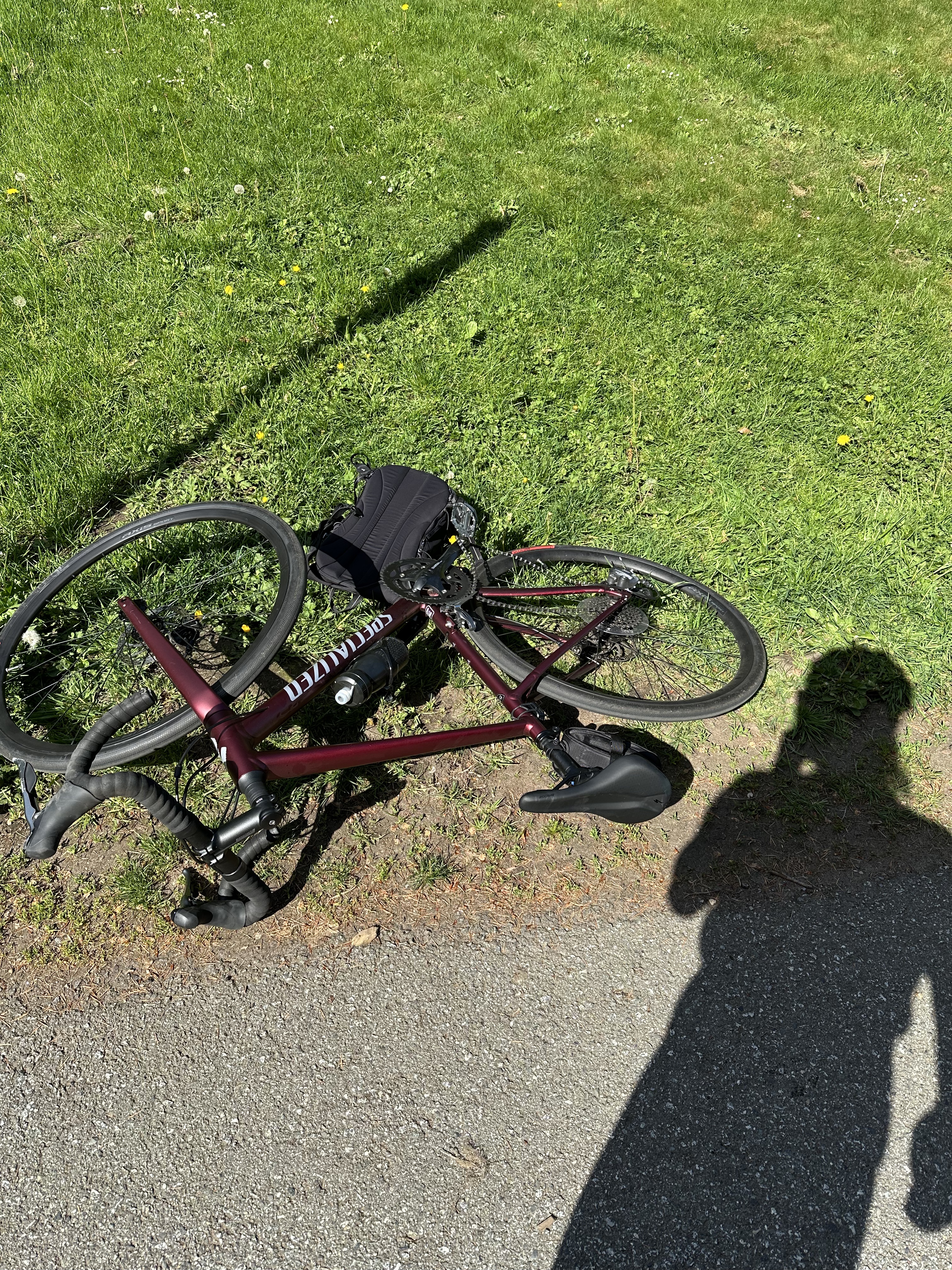
This time I scratched up my road bike and the other side of my body. More critically, this crash really affected my mental state. I started this project wanting to improve my cycling skills and in the end, I feel like I regressed.
If you recall, after visiting the physio for the first time, the only concern was getting into another crash. It goes to show that if you tell me not to do something, you can almost guarantee I’ll do it. If my right arm was 80% recovered, the fall probably took me back to 65%.
Overall, I’m okay, and my bike is okay, but my confidence took a hit. I worked so hard through this training block, wanting to do well in this race, set a new personal best for my time trial, and build up my FTP. I keep replaying my two crashes in my head, even though the memories are all foggy and fragmented. It sucks, because I feel like I’d be in better shape mentally and physically if I hadn’t done this project at all. But, that’s the wrong way to think of it — accidents happen, and it’s a lesson that is probably more valuable than improving my FTP.
Reflecting on everything now.
I don’t want to blame my indoor training for my hubris, but over the last few months, due to various circumstances including weather, I made a lot of progress in my indoor cycling fitness and strength and improved my FTP. However, I haven’t done enough training handling the bike outside. Maybe that’s the cause of my two crashes. My comfort on the bike indoors hasn’t translated to my abilities outdoors. Or maybe I just lost focus at critical moments. My race is next week. I have a couple more workouts left in Rouvy, and then we’ll see what happens.
To be continued…
Join my YouTube community for insights on writing, the creative process, and the endurance needed to tackle big projects. Subscribe Now!
For more writing ideas and original stories, please sign up for my mailing list. You won’t receive emails from me often, but when you do, they’ll only include my proudest works.
As a part of the process of gauging my current cycling level, I decided to do a time trial ride on one of Rouvy’s courses and compare it with the same route in real life. For this experiment, I chose the iconic Stanley Park loop in Vancouver, British Columbia.
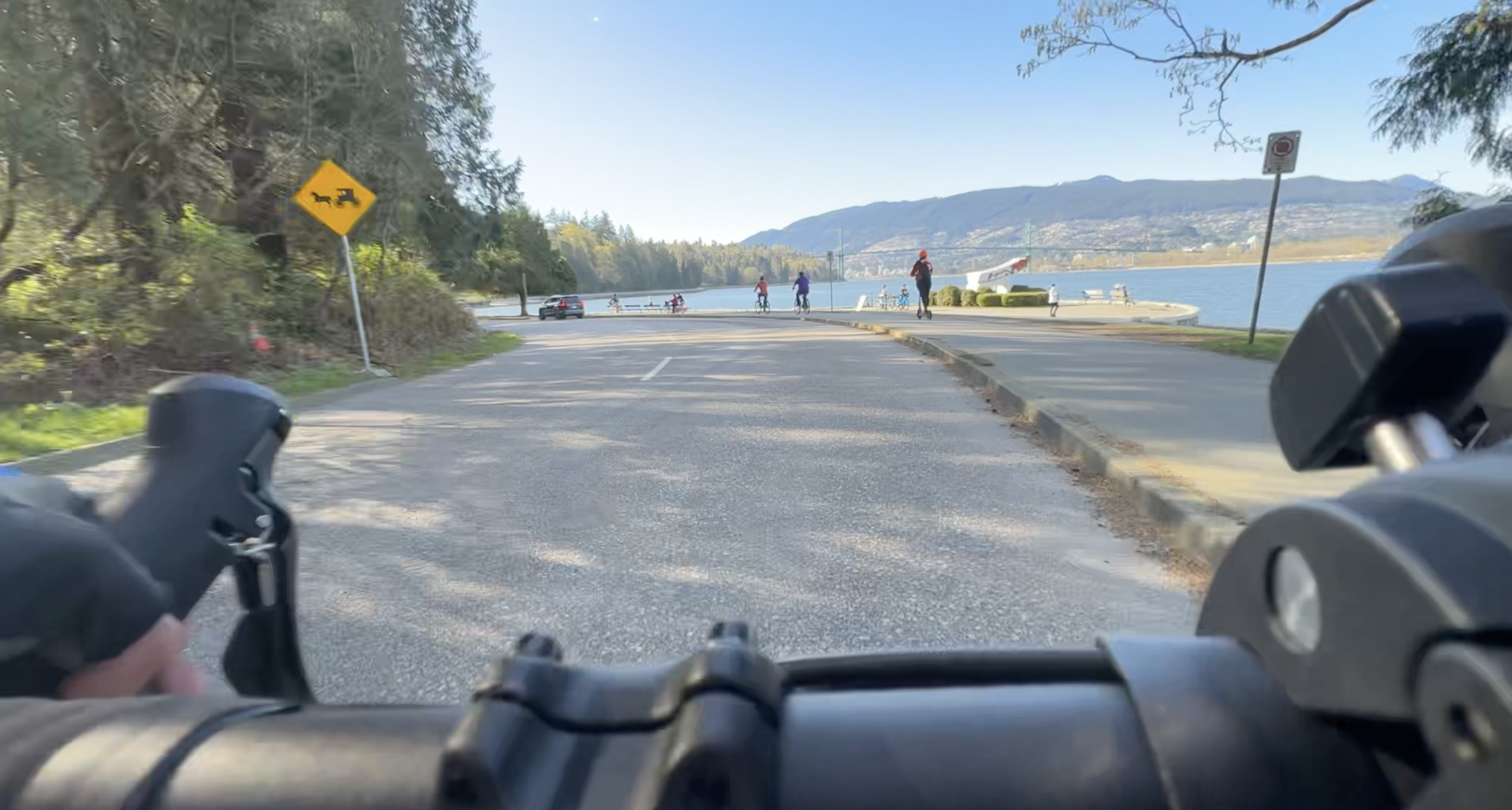
Stanley Park is a beloved destination for cyclists in Vancouver. The loop around the park is about 10 kilometers of scenic beauty, featuring coastal views, a hollow tree, and glimpses of the city skyline and the Lion’s Gate Bridge. It’s one of my favorite outdoor spots in the city and just another reason why it’s so great to live in Vancouver. .
And it’s perfect, because for my Olympic distance triathlon later this year, I will be doing four loops of this course, so this is very appropriate training for me.
So let’s get started.
The Virtual Ride: Stanley Park on Rouvy
I decided to start with the virtual ride on Rouvy.
I’ve taken the Stanley Park loop many times before, but doing it virtually was new. My first impression was a good one, the virtual representation was impressively accurate. As I pedaled, I recognized all the turns along the way leading in, and for the first time, I didn’t have to look over my shoulder while cutting across the road.
One major advantage of riding on Rouvy is that I didn’t have to worry about traffic. There were no cars to navigate around, no tourists stepping into the bike lane, and none of the usual park hazards like potholes, speed bumps, or horse droppings. The virtual course was smooth and uninterrupted, allowing me to focus entirely on my performance.
Additionally, I didn’t have to worry about the big hill’s challenging incline or my handling on the big descent. The effort was consistent and controlled, which made it easier to maintain my target power output at about mid 180s, all the way until I reached the hill, where I began pushing it up to the mid 220s. With all that I ended up completing the course in 16:38.7, which is an average speed of 32.5 km/hour.
Not bad, but there is definitely room for improvement, and I can’t help feeling that I might have held back a little.
I do love all the data I get right in front of me on my virtual rides. You see, I don’t have a power meter on my road bike, and I can’t just magically appear at the start line at Stanley Park, I’ll need to ride about 10km to get there, so all of that will play a factor in my performance in real life.
But hey, no excuses.
The Real-Life Ride: Stanley Park in Person
A few days later, I took my bike to Stanley Park to ride the loop in real life. The experience was, as always, invigorating. It’s so nice to get away from the desk and the screens and be outside. However, going all-out on a time trial came with some challenges.
To start, I had to deal with traffic along the first half of the ride. Navigating around cars that were clearly there to do some sight seeing added an extra layer of complexity. I happened to choose a Friday afternoon for this ride, so really it’s my fault.
Additionally, my front chainring was making an annoying sound, which was a constant distraction as I entered the park and started to accelerate.
As I continued, I encountered other riders who were out for a casual ride but were blowing past me effortlessly. This was somewhat demoralizing, especially when I was trying to push as hard as I could, taking this time trial as seriously as I could.
Yes, I was attempting to do this familiar course as quickly as possible, but riding in the real world means being aware of my surroundings and the potential hazards. Other riders, pedestrians, parked cars, little bumps in the road, I’m not skilled enough to just bury my head and push power.
In the real world, I cannot just step off my bike and lie down in bed. I had to gauge how hard to push myself because I didn’t want to blow up halfway and still needed to get home.
Then came the hill. This is the most challenging part of this course, but it was also the section that made this loop so enjoyable. I both look forward to it and dread it.
Here was where I could really put down some effort and make a difference in time, as I usually take this part as lightly as I could to conserve energy. This time, I caught a couple of causal riders on my way up, which gave me some confidence as I headed towards the decent. Even though this was the fastest I’ve ever done the decent, at the end, another rider just flew past me. It goes to show that I had a long way to go.
Still nothing beats the rollercoaster feeling of soaring down that hill. I love it. It’s such a nice rush and — it’s free, all it cost was the power to get up.
In the end, I finished the Stanley Park loop, exactly where the Rouvy course started at just under 21 minutes. 20:58, if I’m not mistaken.
That’s a difference of 4 minutes 20 seconds between Rouvy vs the real world, which to be honest, is pretty good!
I thought with all the factors of the real world, that my time would be much slower.
I’m pretty glad that Rouvy has a virtual course that is local to me as well. Since I will have to do this Stanley Park loop 4 times for my Olympic distance race at the end of the summer, I’m happy that I will have it accessible to practice, and that I can use the real world vs indoor experience to gauge where I am in my training.
If you live close to a Rouvy course, I really recommend you giving this benchmark test a try.
Both Rouvy and real-life rides have their unique advantages. Rouvy is great for its convenience, detailed data analysis, and consistent training conditions, making it perfect for structured workouts and tracking fitness.
On the other hand, riding outside provides a richer experience and there is something to be said about physically moving through space and seeing the world pass by. And it’s important to experience the thrill of travelling over 30 km/hr in real life.
Now that I have my benchmarks, I’m ready to move to the next phase of this project, which is actually going through the workouts. Like I mentioned before, I will be doing the Rouvy FTP Builder workout, which will last 4 weeks. At a glance, it seems pretty hard, but I look forward to it and hopefully, it’ll all be worth it and in the end, I’ll be fitter and more capable on the bike.
Stay tuned! Thanks for joining me on this ride—if you want to follow along on this journey, hit subscribe and check out this playlist right here.
For more writing ideas and original stories, please sign up for my mailing list. You won’t receive emails from me often, but when you do, they’ll only include my proudest works.
Join my YouTube community for insights on writing, the creative process, and the endurance needed to tackle big projects. Subscribe Now!
Hi, I’m Elliot, a writer and age-group triathlete training for a sprint distance triathlon in 5 weeks and an Olympic distance triathlon at the end of summer. But more specifically, I’m here to improve my cycling skills. To achieve this, I’m embarking on a project I call FTP Builder, named after the workout I’ll be taking on in Rouvy, the indoor cycling app. This series will be told in five parts. This is Part 1, entitled: Benchmark.
In order to determine my current level, I decided that I’ll run a few different baseline tests. First will be a test to determine my FTP. I’m sure you already know what an FTP test is, but here’s a quick refresher.
FTP—Functional Threshold Power—is a measure of the highest power output you can sustain for one hour, normalized to your weight. It’s a key metric for cyclists because it helps gauge fitness levels, set training zones, and track progress. For me, understanding my FTP will be crucial because Rouvy will use this data to properly design my FTP Builder training plan.
I’m a pretty light guy, and given my weight of 66 kg, it was recommended I use Rouvy’s Ramp Test Lite, which is designed to provide a solid estimate of my FTP. This will serve as my primary benchmark.
I’m not good with tests, but I did my best to take this one seriously. I got as much rest as I could and picked a weekend with low stress to attempt it. The competitor in me wanted to have a high mark, but I also knew that if I take it to my limit, I’ll just have a higher bar to deal with going forward. Nevertheless, I set off with an attitude to do my best.
As anticipated, the first half was smooth sailing. My heart rate remained steady and manageable as I increased the power output incrementally. Up until the 200-watt mark, I felt strong and in control.
But at 220 watts, things started to get shaky. My heart rate climbed, and the effort required began to take its toll. By the time I hit 230 watts, my legs were starting to feel the strain. Holding that wattage for the full minute became a real struggle.
The default course for this Ramp Test was in Norway. I’m not even going to try to pronounce the name of the region I was riding through. I went up a winding road and saw some nice houses built on the side of cliffs, but really, I wasn’t paying too much attention to my environment. While I like the realism of Rouvy, sometimes the roads in the real world just aren’t that interesting to look at. For most stretches, Norway looks pretty similar to the mountain roads we have in British Columbia. Sometimes scenic, sometimes just a wall of trees.
The test continued, and as I approached the 250-watt mark, I found myself struggling to maintain that power for more than a few seconds at a time. I made occasional bursts of effort, pushing myself to reach higher numbers, but it was clear that I’m at my limit. My heart rate soared past 180 beats per minute, and my primary goal shifted to holding enough power to simply finish the test.
That bit of motivation helped me squeeze out every last bit of energy, allowing me to reach a maximum wattage of 306.
Finally, the test was over, and according to Rouvy, my FTP was calculated to be 225 watts. To be honest, that number feels quite high to me. If FTP is a measure of what I can sustain for an hour, there’s no way I could maintain 225 watts for that duration. However, I’ll take this result as a starting point and see where I can go from here.
So there you have it, my initial benchmark: 225!
In the upcoming episodes of Project: FTP Builder, I’ll be taking on my next benchmark test, which will be comparing the indoor ride on Rouvy with the exact course in the real world. I will be doing a time trial of the Vancouver Stanley Park loop to see how I perform indoor vs. outdoor. This will hopefully help me determine whether my indoor training can be translated to the real world.
Join my YouTube community for insights on writing, the creative process, and the endurance needed to tackle big projects. Subscribe Now!
For more writing ideas and original stories, please sign up for my mailing list. You won’t receive emails from me often, but when you do, they’ll only include my proudest works.
I joined Zwift in January 2024 to prep for 3 triathlons I have coming up this year, and I’ve really come to enjoy the racing aspect of the platform. I use them mainly to toughen up mentally and stay cool when the going gets tough. Plus, with competition, it really becomes a solid kill-yourself type of workout. Which is just what I need to punish myself with after a long week.
Zwift splits racers into different categories, E, D, C, B and A. After a week of riding Zwift, I got placed in D to start. But you know what? If I can take on stronger competition, why not? How hard could it really be? What happens when I tackle races in all four categories available to me? Can I win? How badly will I lose? Time to find out. I call this Project: Get Humbled
In this post, I’ll share my experiences in my first 4 races, increasing the category level each time. With one week to recover, I believe this will be a good baseline test that I can use to reference maybe a year, or two years from now. Well, that’s the idea, simple enough, let’s get sweating and kick off with my first race. My maiden voyage, if you will.
This was Race 1:
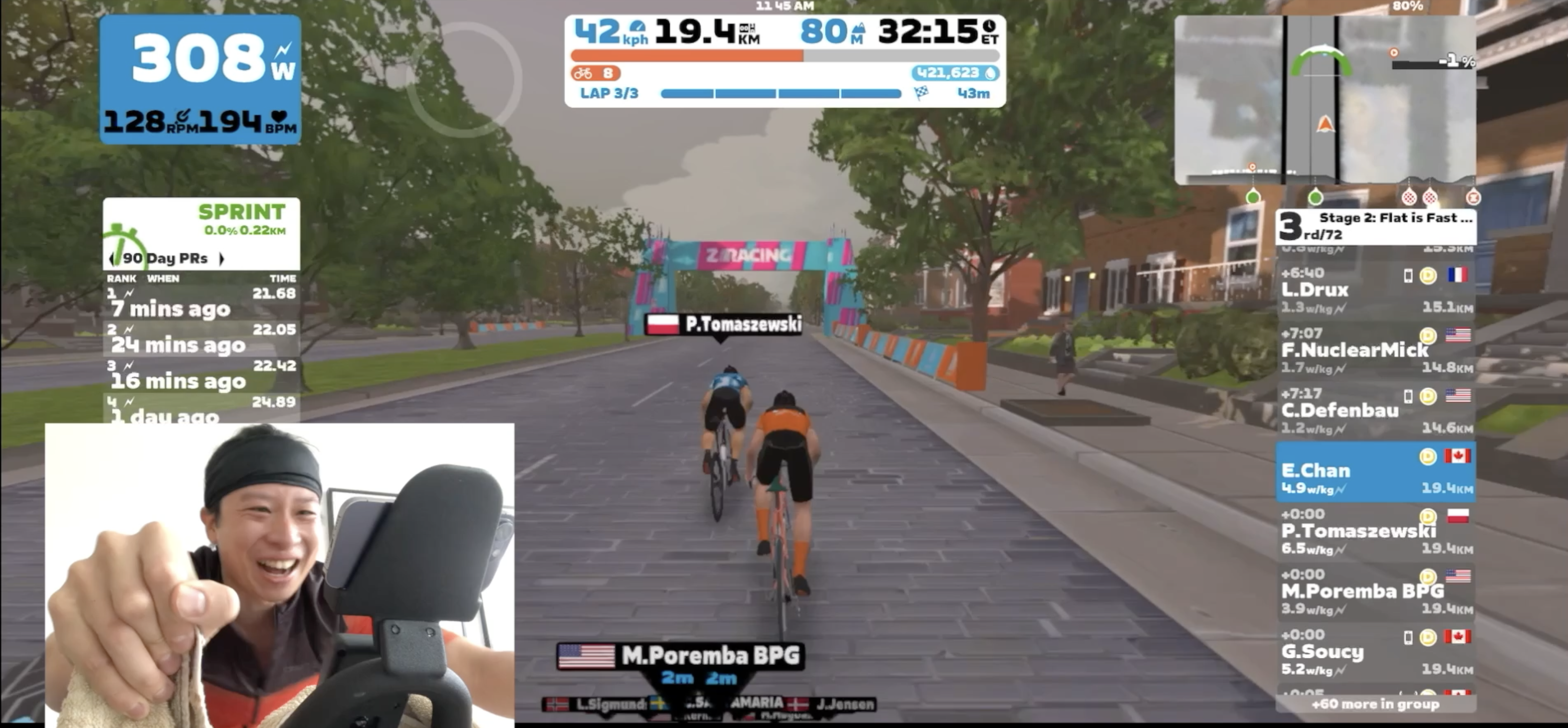
Group D. Stage 2 of The Flat is Fast: Series: The Fan Flat in Richmond
I call this chapter: The Naive
As the first race counted down, I felt a surge of excitement. Having done a test ride of the course the day before, I was eager to see how I’d stack up against competitors worldwide. Yet, unexpectedly, nerves crept in. My goal was simple: finish the race and establish a baseline performance. I hoped nothing beyond my control would knock me out, given the unpredictability of technology. If I was going down, I wanted it to be under my power. This was all so new to me… just watch me navigate the interface, adjusting my camera angles, not even understanding what’s going on.
When the race started, I repeated my plan in my head. All the research I’d done emphasized the importance of giving it your all early on to keep up with the pack, and that’s precisely what I aimed to do. My sole focus was to hang on tight and maintain a position as close to the front as possible—— even accidentally launching myself to the lead a few times.
Keeping with the pack felt good here. I was pushing myself, yet it didn’t feel like I was exhausting all my energy reserves. In the early stages, I felt confident. I could truly hold my ground here. As long as I stuck with this group, anything seemed achievable. And that’s exactly what I did.
I kept pace with them until the third lap, then I began to assess my condition. It was likely a mistake, as I found myself at the forefront of the pack. I was putting a lot of watts in. And for my size, this was strategically a bad idea. I was really pushing the limits in terms of my watts per kilogram, and I was about to push even harder.
At the 24th-minute mark, a break occurred, and five cyclists surged ahead. The chase was on. I could see them rapidly distancing themselves, potentially becoming unreachable. Faced with a decision, I had to choose between playing it safe and sticking with the chase group or ramping up my watts even further to pursue them. I opted for the latter, pushing myself to maintain up to 4 watts per kilogram in pursuit.
Guess what? I managed to catch up with the three cyclists breaking away. The podium was within reach, and I understood that this might be a once-in-a-lifetime opportunity, even though it was my first race. I realized I had to shake off any doubts right away. I was going all in. The top four of us powered through the last three-quarters of the lap together—sprinting hard, pushing each other to the limits. I went all out. I gave it everything I had to secure the win.
The number of km left slowly went down. I found myself in the lead. It was time to lower my heart rate and prepare for the final sprint in the last kilometer or so. I needed to bide my time. I could see the two cyclists behind me, but I wasn’t sure if others had caught up. I waited, perhaps too long, allowing them to make the first move. I should have been the one to push harder initially; gaining momentum would have made all the difference.
Now, I was the one chasing, with less than a kilometer to go. We surged forward, and I was overtaken. Then it happened again. I settled into third place. Fine. Hold onto it, I urged myself. Hold it. With just under 200 meters to go, I closed in. But it was not meant to be, my Cinderella story was dashed, with only 50 meters left, another cyclist blew past me right at the finish line. Fourth place! Unbelievable. Gut-wrenching!
But wait… on the official Zwift Power website. I came in third! Huge! Due to that performance, I was bumped up into the C category. My first race. I overdid it. It would have been nice to do another race in D, but… I guess if Zwift wants to challenge me… challenge accepted.
This was not easy. I put everything I had into this race. I got my HR up to 190 for god sake. I really thought I could win. That was how naive I was. Well… now I can never race in Cat D again. On to the future. I’m ready.
Now let’s get into the second race.
Which was…
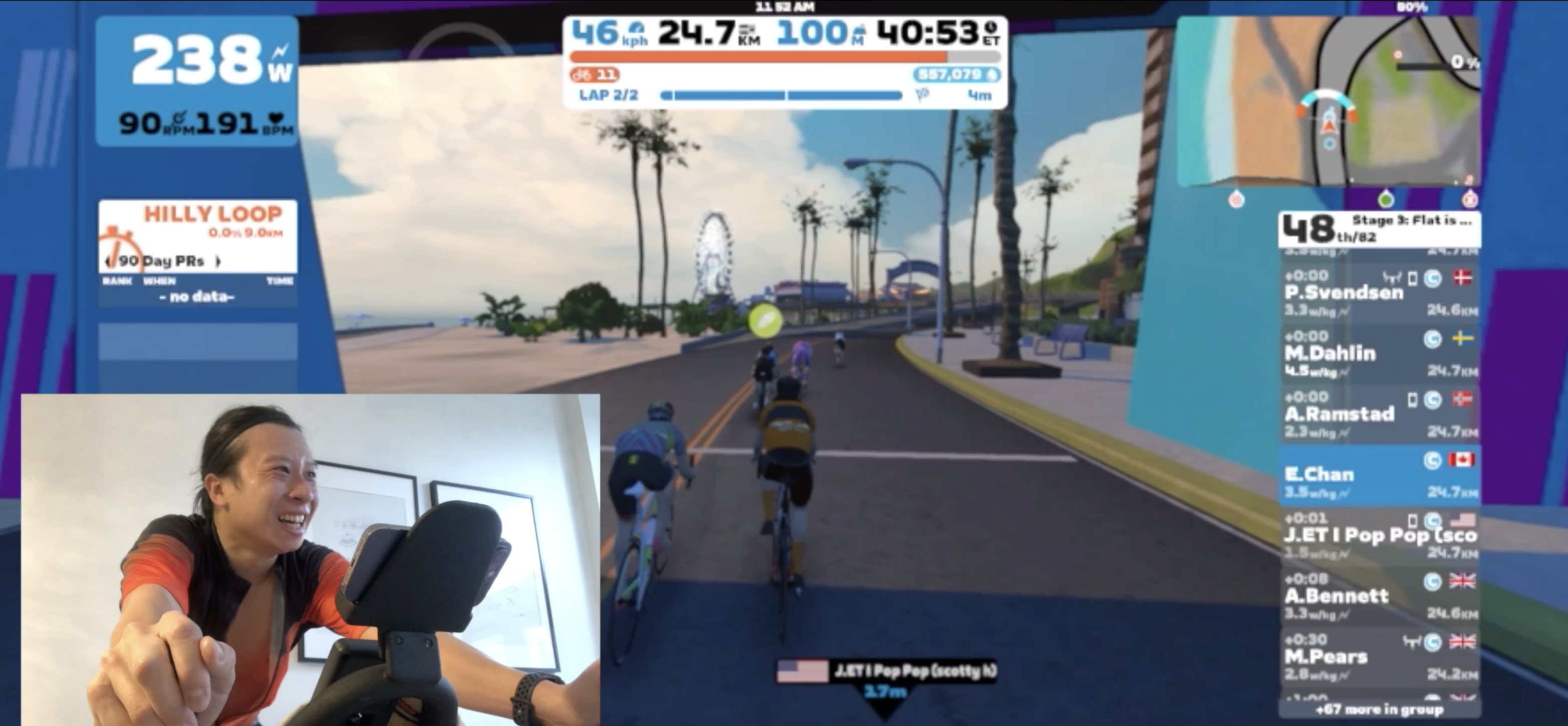
Stage 3 of the Flat is Fast Series in Group C: The Volcano Flat in Watopia
The title of this race is Stay Calm
Heading into the second race, I felt much better than I did during the first one. I was warmed up and had a solid game plan in mind. But, as they say, everyone has a plan until they get punched in the face—and let me tell you, I definitely got punched in the face.
The race opened at a fast pace, but I managed to hang on, and I was genuinely proud of my effort. I dug in, stayed focused, and didn’t hesitate to push my watts into the 300s. Deep down, I knew I couldn’t sustain that level of intensity, but I hoped and prayed that the pace would ease up, allowing me to maintain a steady rhythm.
If by some miracle, I could stick with the lead group, that would be fantastic. My primary goal was simply not to get dropped, a real concern less than a minute into the race. Then, unexpectedly, I found myself at the front. There was a glimmer of hope. Regardless, I experienced some back-and-forth movement for a while, but overall, I felt good about my performance.
Then disaster struck. Well, disaster is not the right word, but something did go wrong.I began to notice a clicking sound coming from my spin bike. Initially, it was sporadic, but soon it occurred with every rotation. It was unsettling, and I kept checking, hoping to find a loose screw or some visible issue that I could fix. However, everything appeared to be fine. The persistent clicking made me nervous because I didn’t want to damage my bike during the race. It really messed with my head, and I could feel my mental focus slipping.
I was getting dropped, and the clicking sound from my bike became increasingly difficult to ignore. About a quarter of the way into the race, after over 10 minutes had passed, I realized I couldn’t ignore the issue any longer. I had to address it. At 11:18, I made a quick decision to step off the bike, seizing an opportunity during a downhill stretch. Unsure of what to do, I attempted to tighten up the pedal.
Fortunately, by sticking with the lead group from the beginning, I created some space to address the issue. I could see that I had a gap before the chase group caught up, allowing me some breathing room. I resumed pedaling and got back on the bike at 12:02, spending nearly 40 seconds without pedaling. By the time I got back on, the chase group had caught up.
Now, the game plan has completely changed. My objective now was to stick with this chase group and hopefully make it to the end in one piece, both myself and my bike.
The clicking sound persisted throughout the remainder of the first lap, and I was coordinating with my wife, who was watching, to troubleshoot the issue. At that moment, I contemplated whether to dismount completely and abandon the race to address the bike problem. However, I’m pleased with how I managed to stay calm, collected myself, and pressed on.
Here’s the thing about technology and mechanical issues: sometimes they just fix themselves. Not always—sometimes they completely fall apart. But today, to my relief, the clicking sound stopped for the second lap.
Now, I was just trying to stay with this chase pack and hopefully finish in the top 50. So we stuck together for the majority of the last lap.
The second lap was brutal. It took everything for me to keep up. Just look at me. I’m dying. But I hung in there. With a km left, I was hanging on for dear life and anytime I had to push over 200 wats, I felt it. I didn’t have many matches left to burn. I was in pain, drenched in sweat, giving it my all. I wasn’t sure how much longer I could hold on. But you know me—I’m always up for one final push and a sprint to the finish. It was an emotional race, and I was determined to give it everything I had to finish in the top fifty.
49… 49… 48.. At the very last moment. I got it!
Even better, the official results had me in 24.
Given everything that went wrong, including the need to dismount the bike, I would consider the outcome a success. Needless to say, Group C was significantly more challenging than D. There appears to be a noticeable divide between the top and bottom of C. I believe there should be another category in between, as our group finished well over 2-3 minutes behind the lead group.
This result has left me eager to race in Group C again because I feel I now have a better understanding of what to expect. What if my bike hadn’t started making that clicking sound? Would I still have been dropped? Most likely. However, I’m curious about how long I could have kept up with the lead group and what impact it would have had on my overall time.
Sadly, before I could answer that question about group C, I now had to get ready for my race in group B.
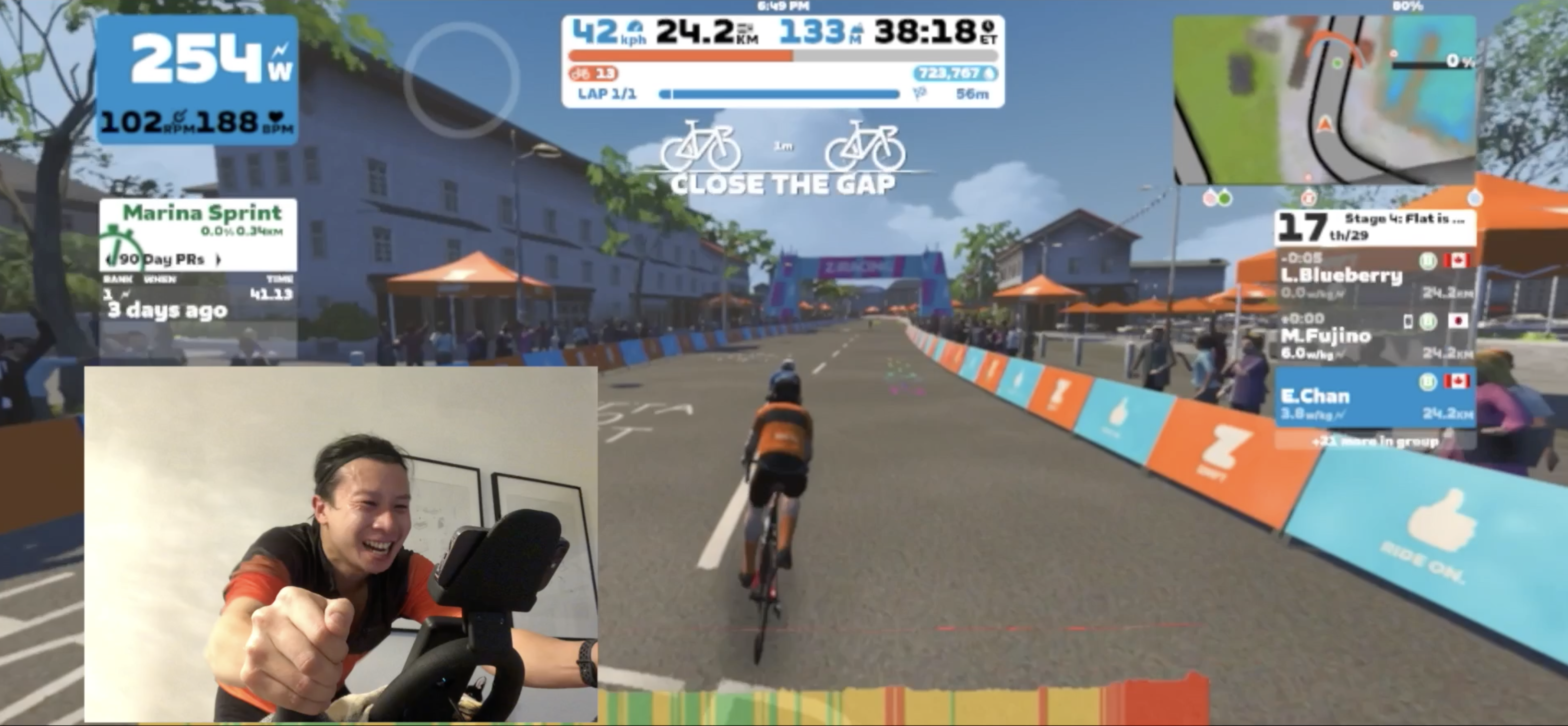
Stage 4 of the Flat is Fast Series in Group B: Douce France in France
It’s my 3rd Race, and I call this one: Still Breathing
In my last two races, I competed on Sunday mornings Pacific time. However, this week, I had to reschedule my Zwift race to Friday evening because I’ll be running a half marathon on Sunday.
Friday evenings typically see less activity on Zwift, and there weren’t as many participants in this particular race. I’m also aware that as I advance through the categories, the number of competitors in the race will likely decrease as well. Initially, this gave me hope. Perhaps I could perform well in a smaller group.
But there is no reason to believe I would because having a smaller group means there are fewer people to keep up with if a break occurs early. And what do you know, less than 2 minutes in, a break happened. I pushed as hard as I could, maintaining around the mid-200 watts, but the lead pack was gone.
My bike started making the clicking sound again, but it stopped a few minutes later. So I’m going to leave it as a mystery. Regarding the race, my hope of even being a contender was dashed right away. The dream was dead.
However, I wasn’t stranded. I managed to stay with a small group of 4 riders. In this group, we pushed each other, just because we were at the tail didn’t mean we were going easy. Whatever was happening in the lead pack didn’t matter anymore. Four minutes in, my focus shifted to maintaining my position within this group. I cannot get dropped by them.
That was hard! At some points, I went as high as 300 watts, not sustainable. I knew that to even stay in this chase pack, I would need to give everything I got. And this thought was happening early on, at about 5 minutes.
Big shoutout to the 4 riders I was cycling with during this stretch—they really pushed my limits. As I crossed over the aqueduct around the 18-minute mark, I was fading. But something else was happening. Other racers were either getting caught or dropping out altogether. A glimmer of hope. If I couldn’t out ride them, I’d try to outlast them. I was determined to stay in the race until the very end.
Around the 17 km mark of the race, nearly 30 minutes in, the group began to spread out. My watts were decreasing, and I knew it was something I had to accept. While some riders had dropped out by this point, those ahead of me were starting to create insurmountable separation. Suddenly, I found myself with just one other rider: Fujino from Japan.
Now, Fujino was my sole focus. My last goal in this race was to avoid being completely left behind. This was me hanging on by my fingertips.
Everyone was gone. My effort was at max. My watts were however going down. I couldn’t hold it anymore. Reality was sinking in. With all the drop outs… I was now officially the last racer still in the race. There wasn’t much I could do about it, except give everything I could in the final sprint to get past Fujino. But he was not making it easy for me.
Then came the final kilometer. I needed to choose the right moment to make my move. That came with 700 meters to go. I unloaded, but I couldn’t gain any ground. Fujino activated his Aero power-up, and if anything, he pulled further ahead. It seemed hopeless… but not quite. I dug deep with 100 meters left, but the race was over.
I finished 17th out of 29, but the official time on Zwift Power says it all: 14th out of 14. Last place, just as I had anticipated. It was an incredibly humbling experience. But I’m proud of my performance. I persevered. I didn’t give up. And I was only 4 minutes and 30 seconds behind the winner. That seems achievable someday.
To be honest, attempting to win Group C feels as challenging as trying to win Group B at this stage. The gap is so significant either way. Racing in Group B almost takes the pressure off in that sense and you can just do your best. Even if I don’t level up, I see myself participating in a Group B race again, hopefully in one with more competitors.
Speaking of competitors.
Stage 5 of the Flat is Fast Series in Category A: Greater London Flat in London
Final chapter: A Lonely Road
This big race took place after a busy, exhausting week, but I won’t make any excuses. Nevertheless, it’s important to note that just seven days ago, I ran a half marathon… so needless to say, I didn’t come into this event feeling fresh.
No, as I lined up, it was the first time I felt fear. I dreaded the pain that was about to come. Having pushed myself to the limit in previous races, I knew that today would be no different.
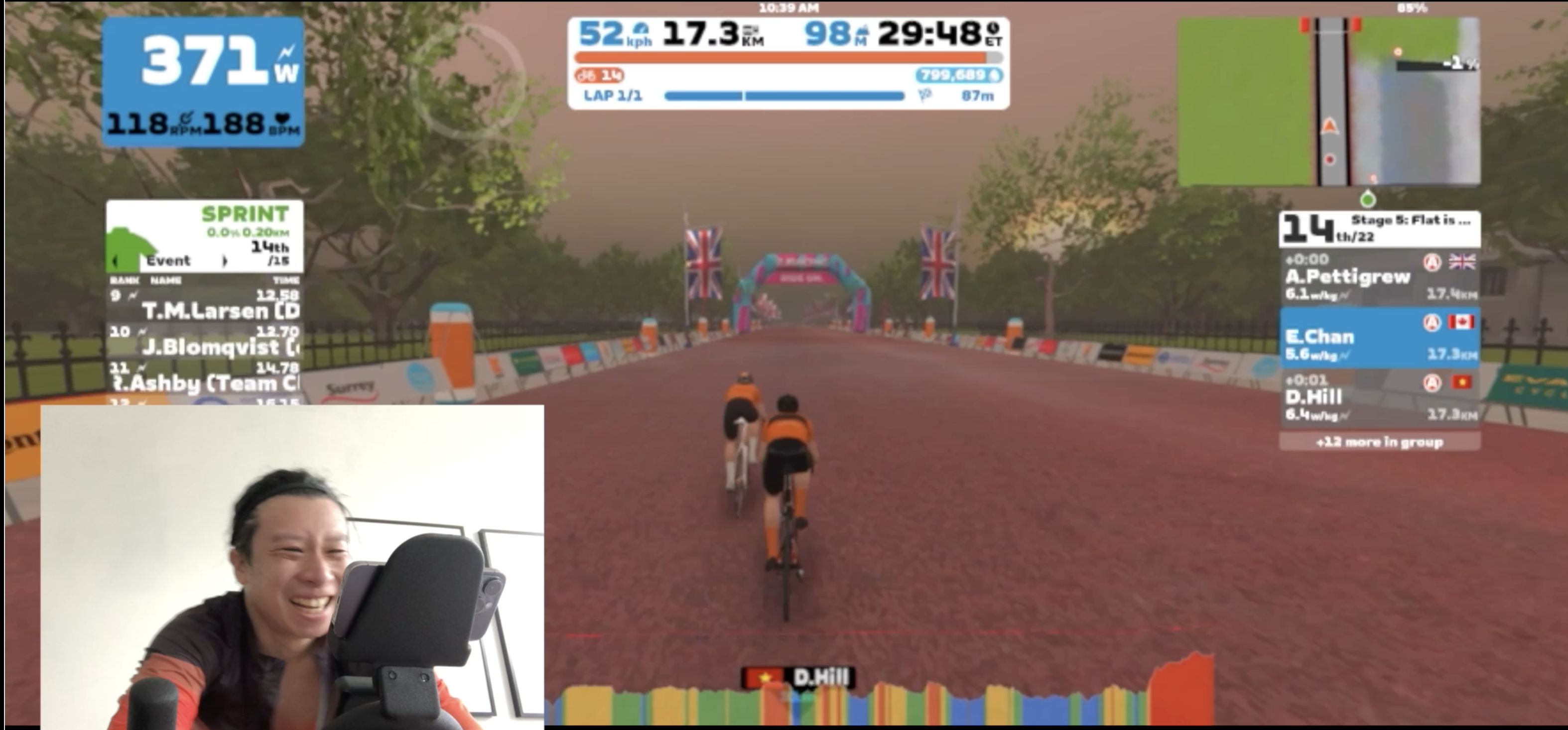
Before I could even calm my heart rate down, the gun fired, and off we went… well, everyone else did. In less than a minute, I was dropped. I found myself completely alone, in no man’s land. With nearly a 5 km lead-in, this race was going to be long and mentally taxing.
The reason I participate in these races is to train both my mental and physical endurance. I must constantly adapt my strategy based on how I feel and what unfolds during the race. Now that I was all alone, I had to create challenges to stay motivated, as there was no one in sight. So, I focused on the numbers. My new objective was to stay ahead of those behind me, and surprisingly, there were people behind me — Pettigrew and Hill.
Struggling to maintain even 200 watts, I knew it wasn’t going to be easy. The race seemed endless. That’s the feeling when you’re alone, and the only carrot you have is the projected distance between you and the competitors chasing you. It’s tough because part of you wants them to catch up so you’ll have company, but you know that if they do catch you, it’s game over.
I was grappling with my inner demons, pushing my power as high as I could, when the rain started to pour down on the course at the 11 km mark, with a third of the race still ahead.
This was where I knew the inevitable was going to happen. Gradually, Pettigrew and Hill began to reel me in. What was once a gap of well over 20 seconds had now dwindled to 10 seconds and was decreasing. Then, at the 13.5 km mark, they caught up with me. In a way, I felt relieved that the solo struggle was over. I could now hang with them and play this cat and mouse game, chasing and dropping back so I can get some draft. I recalibrated. New goal. I couldn’t let them get away.
So the three of us rode together, swapping positions, taking turns in the lead. As we reached the point where there was only 1 km left, I knew I needed to make my move soon. But I was tired… so I waited… I hesitated… with 800 m left, I held back until Hill came up right behind me, pressuring.
Then, with 500 m left, I made my move. It was me and Pettigrew all the way. I pushed and pushed. But I just couldn’t take it to the next level. My heart rate spiked to 191. But I simply didn’t have the power to compete, and Pettigrew beat me by a wheel’s length. Once again, another sprint finish lost.
Unofficially, I finished 14th out of 22, but once again, I found myself last on Zwift Power. I have to give credit to Pettigrew and Hill, even though they didn’t rank officially, they meant everything to me in this race. As much as it sucked that they caught me, they made the finish interesting, and, I can’t help but feel humbled. So shout out to them… and I guess, everyone else ahead of us.
Conclusion
There you have it. Those were my first four races in Zwift, covering all four categories available for me to compete in. Here’s another look at the results, which are pretty consistent in terms of the stats and serve as a good indicator of my current power level.
I called this Project: Get Humbled and I think I did just that. It’s incredible how strong some people are on the bike. When you push yourself beyond your limits to compete with them, and still lose so badly, it’s just impressive.
On the flip side of the coin, this project was very inspiring. I feel positive about the progress I’ve made on the bike so far. I’ve already increased my power by nearly 60 watts since I started including the stationary bike in my training about two months ago, so the sky’s the limit.
With that being said, I’m also glad that it’s over now, and I can spend some time resting my legs and preparing for more achievable challenges. So stay tuned for more Zwift and endurance adventures and be sure to subscribe to my channel so you don’t miss them.
Join my YouTube community for insights on writing, the creative process, and the endurance needed to tackle big projects. Subscribe Now!
For more writing ideas and original stories, please sign up for my mailing list. You won’t receive emails from me often, but when you do, they’ll only include my proudest works.
In September 2023, I participated in my first sprint-distance triathlon in Vancouver’s Stanley Park. The race comprised a 750m swim starting from Second Beach, followed by a 20k bike ride—two laps around Stanley Park—and concluding with a 5 km run to Burrard Bridge and back to Second Beach.
Before training for this race, I had close to zero experience with all three disciplines. I had swimming lessons when I was a kid, but I was only good enough to save myself from drowning… temporarily. That’s about it. Like many, I came into the sport most nervous about the first leg of the race: the swim.
However, my cycling history wasn’t much better. I didn’t grow up with a bike; I learned to ride one at the age of 13 while hanging out with schoolmates. My most vivid cycling memories involve biting off more than I can chew—whether it’s renting a bike on vacation and venturing too far up a volcano or commuting too far in the city and finding myself needing to navigate a sketchy, heavy-traffic route home. Naturally, I associate cycling with near-death experiences. But I was really more concerned about the mechanical aspect of the sport.
Finally, there is the run. I’m not particularly fond of running; I used to jest that the only way to get me to run was by giving me a bus to chase. Running for anything more than a quick sprint didn’t appeal to me, and I certainly didn’t take it seriously. Before registering for the triathlon, I had only participated in one 10k race—that’s the extent of my running experience.
So, that was my background before the triathlon. Not only was I a novice in the sport, but I was essentially a beginner in all three disciplines. I found a certain charm in that. I didn’t have to pick favorites; there was a wealth of learning in each of them, and learn I did. In my rebellious manner, I learned through making mistakes. While, yes, there were errors, there were also some small wins along the way.
Today, I’m going to share three things that went right during my training and race, and three things that went wrong.
The first thing to go right is that…
I gave myself a lot of time in training
As mentioned, the race took place over Labor Day weekend in September, and I registered for it in March, providing me with a little over 180 days to prepare. It took about a week or two to find my comfort zone on the bike and a couple of months to control my breathing technique in the swim. Not only that, it gave me time to recover from pushing my body like I have never before. The sudden training led to shin splints, sidelining me from hard running for a week in March.
Having enough time on my hands also let me join a few smaller races in between. I did a 10k in April, a 5k in June, and another 10k in August. These races were great for getting used to the mindset of competing with others, which is tough to simulate in regular training. It helped me figure out how I’d respond when someone faster passes me—would I speed up? I wanted to practice the mental side of things too, and that required real-life experience.
I’d say, if you are starting out. Give yourself as much time as possible. Commit to it early on and just make a year out of it.
Now let’s talk about something that didn’t go well:
Going too fast on the swim during choppy water
Everyone told me to go easy on the swim. I heard that advice, and I was planning to follow it. The only issue was, I wasn’t exactly sure how slow I should go, and I didn’t know what might happen if I didn’t follow the advice correctly. Sometimes there’s only one way to find out.
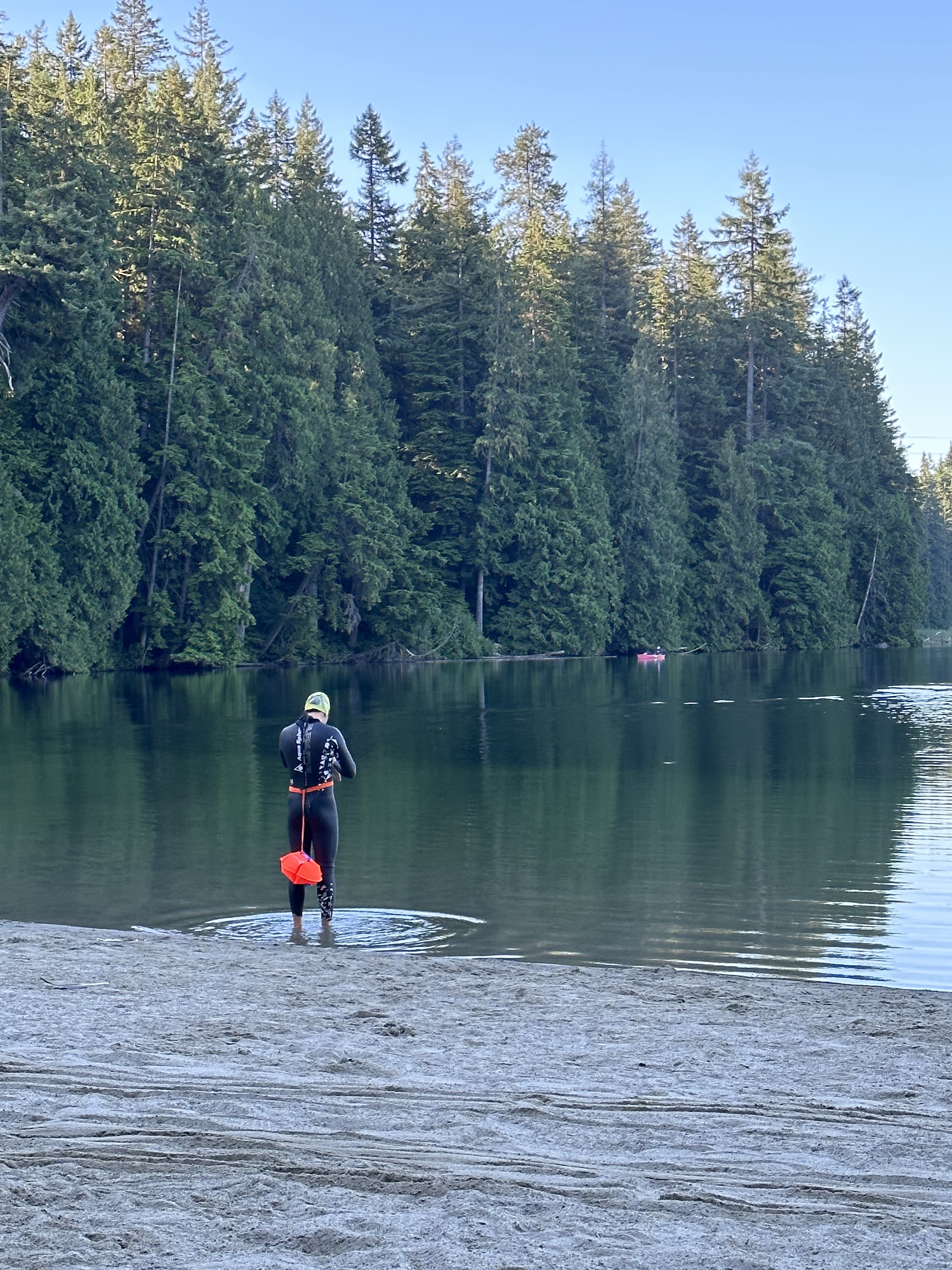
On race day, the water was unusually choppy. I had practiced swimming the race course three times before the event, and each time, I felt quite comfortable. However, on that particular day, the conditions were wild.
Still, I wasn’t discouraged. When the race began, I joined the group at the starting line and just went for it. The first 200m went well, and I felt great keeping up with everyone. But things changed at the first turn; there was a bottleneck, and a wave hit me, making me swallow a lot of salt water. Despite people swimming around me, I had to keep moving, but getting around the corner was tough with the waves beating on me. I got exhausted and struggled to breathe. This was the result of starting too fast; I didn’t have the energy to recover.
After making the turn, I was now swimming with the waves hitting me from the side I usually breathe on, my left side. It was a critical moment in the race, and I thought about stopping many times. But I remembered all the hard work to get to this point. Quitting after just a 300m swim wasn’t okay. I had to keep going. It was a struggle, but eventually, I turned back toward the beach, and the waves helped propel me forward. The worst was over, and I made it through.
Now for something that went right… and this is a big one:
I finished the race
That was the only goal I had going in. Finishing the race. Getting that benchmark time and having a better sense of what needed improving.
Many things could have gone wrong and stopped me from finishing. The tough swim was one worry, and my bike falling apart was another. I also had the fear of getting disqualified in my mind.
During the race, there were times when things could go wrong. I saw someone crash on the bike course, which affected me mentally, and the first kilometer of the run was painful, and I had to adjust a lot. The interesting part was figuring out how to balance everything rather than just pushing hard all the way to the finish.
Something that went wrong that I didn’t anticipate or practice was:
Racking my bike…
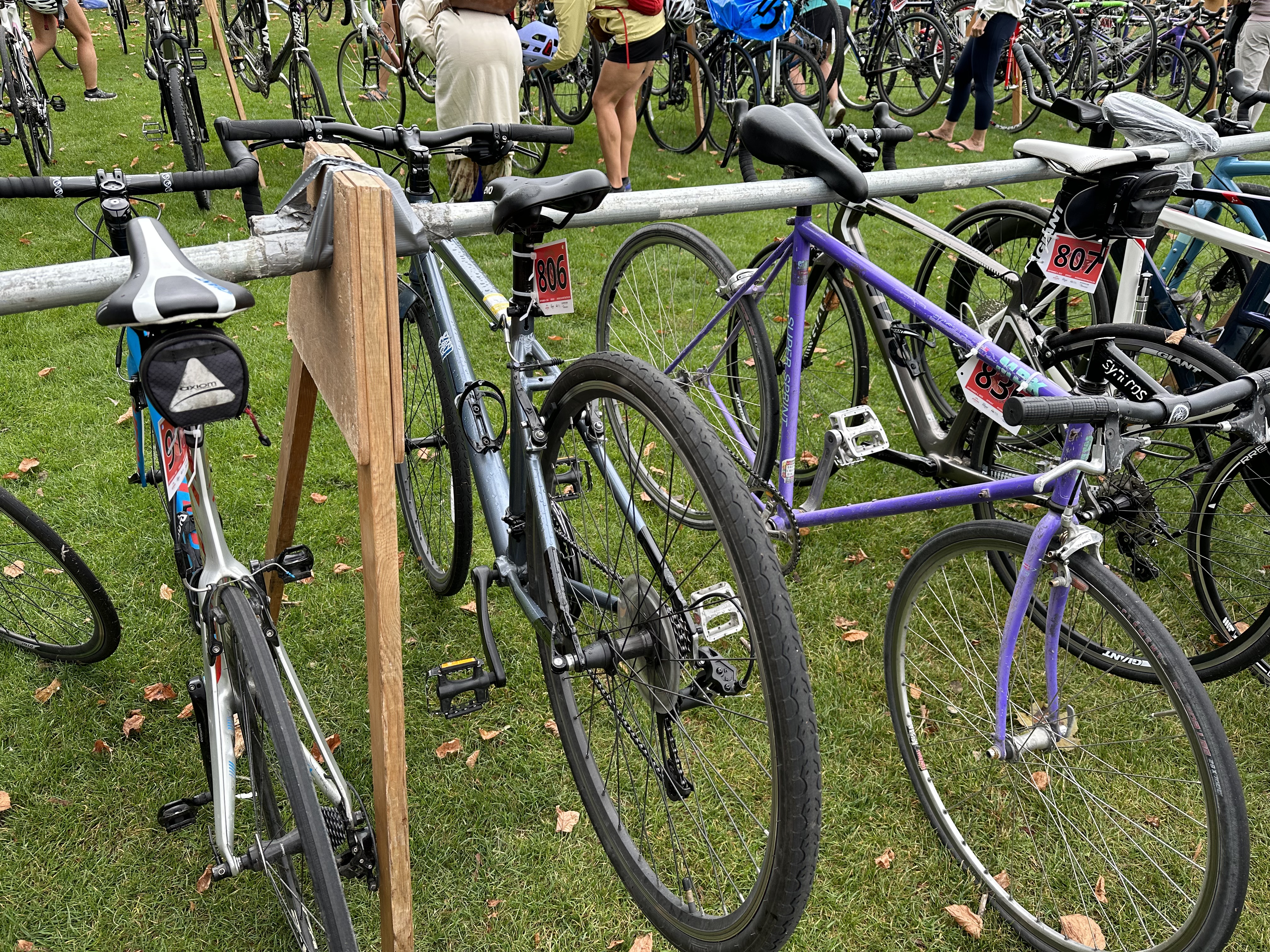
Returning to transition after the cycling portion of the race, I had to put my bike back onto the rack. I had so much trouble getting it on. First off, not that this was a problem, but I noticed that my bike saddle was crocked when I got to the race. I’m not sure how it got damaged. It might have been because of a crash a few weeks before (I’ll get more into that later).
Anyway, I recall standing there, grappling with my bike, rolling it over my wetsuit and attempting to get it back onto the rack. Not only did I waste 10-20 seconds doing that, but I also expended a considerable amount of energy. To add to the chaos, I entered through the wrong side of the rack. Once I finally managed to rack my bike, scratching up my new shifter in the process, I had to run around to put on my running shoes. My transition 2 was not impressive.
Sticking with another thing that went wrong:
My bike itself…
Look, I still think I made a good decision getting the bike I did because I was close to getting an even worse bike.
I didn’t want to invest in a pricey bike only to discover that I wasn’t fully committed to the sport.
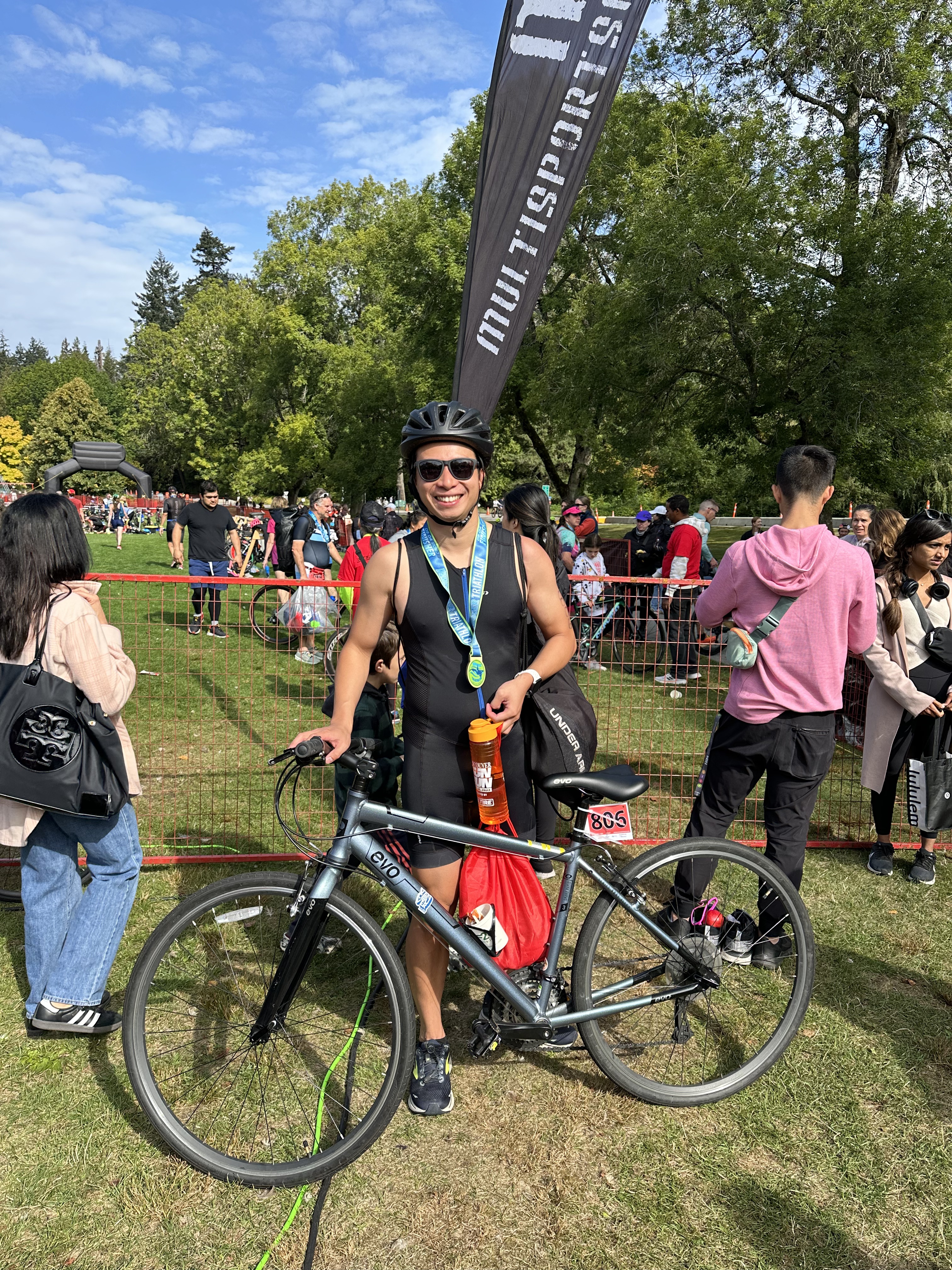
This is a $500 hybrid bike, also the nicest bike I’ve owned so far. I pushed this bike to its limits during training, and a few components began to show wear, with the shifter being the most notable. Approximately a month before the race, every time I hit a bump, the left shifter would unexpectedly drop gears, which became super annoying.
My initial plan was to complete my first two races with this bike and then upgrade to a road bike. I’m honestly relieved that it managed to hold up and get me through the race. Because a week after, I noticed a clunking sound every time I pedaled. It turned out that the freewheel had broken.
I must have pushed it too far during the race itself.
This little bike had a lot of action in a short amount of time and I’ve paid a lot since to maintain it. But after my first race, I decided to retire it from racing and purchase an entry-level road bike to take over. As for my old one, I use it as a commuter bike and it’s great for that. Despite not everything going perfectly, and a few stressful days, I wouldn’t change a thing.
Something that went right from beginning to end was my pleasure for
Tracking progress
I got into this sport because it’s not just about fitness and gear; it’s also analytical. I enjoy tracking each workout, noting improvements or areas to work on. Using this data helps me adjust my effort and tweak my plan. Seeing myself get better gradually—swimming, cycling, and running longer and faster over time on a spreadsheet—brings me an abnormal amount of joy.
Second only to enjoying a beautiful summer day outdoors, observing my progress is my favorite aspect. It’s incredibly motivating to reflect on the beginning and recall how challenging it was to swim 200 meters. I vividly remember that version of myself, and it’s astonishing that in less than a year, I’ve gained so much more confidence in the sport.
Without a doubt, if I hadn’t tracked my progress in some way, it would have been harder to remember where I came from and my commitment would have waned, and I likely would have given up, or at the very least, not signing up for another race.
That’s correct—I’m currently fully invested in triathlon as my recreational pastime. It’s been a welcome counterbalance to the extensive time I spend at a computer. I recommend it to most people with a sedentary job.
If you’re thinking about signing up for a triathlon and haven’t before, just know it’s a commitment. Starting with nothing, I spent at least $2000 getting ready for my first race, but the time I put into training made it worthwhile. It’s become a stress reliever I look forward to, and it broke up my day nicely.
It can become quite an obsession, but when you’re working on a novel like I am, it’s more pleasant to share that you’re doing a triathlon rather than writing a novel. Both are braggy lines you can boast about, but at least with the triathlon, you don’t have to bore people with the details of your dystopian fantasy.
Well, those are three things that I believe I did well and three things that didn’t go as expected when I signed up for a triathlon. If you’re feeling inactive, going through an existential crisis, or just frustrated with the world, consider giving triathlon a try. Above all, it has been therapeutic, and I think that’s a good thing.
For more writing ideas and original stories, please sign up for my mailing list. You won’t receive emails from me often, but when you do, they’ll only include my proudest works.
Join my YouTube community for insights on writing, the creative process, and the endurance needed to tackle big projects. Subscribe Now!
DNF. It stands for Did Not Finish. In a race, those three letters haunt all athletes. In the creative world, not finishing carries the same weight of shame.
For many of us, creativity is something we often have to pursue in our personal time. We may steal moments early in the morning or stay up late into the night to work on our creative projects. The specific goals of these endeavors aren’t as important as the fact that we consistently dedicate time to them, with a focus on long-term progress.
However, life can unexpectedly consume our days and nights. Work, personal commitments, and unforeseen opportunities may arise, and we need to seize them. When this happens, time can slip away, and even when we do find time, we may lack the energy.
When the pandemic began, my schedule opened up in a way I hadn’t experienced since my school days. I felt like I had ample time to dedicate to my projects, and I made the most of it. I made significant progress on my novel, invested more hours in my video creations, practiced illustrating and animating, and honed my audio recording skills. I pressed down on the accelerator for three years.
But at the end of 2022, I fell into a bit of a depression. Personal struggles and painful childhood memories resurfaced, and I realized that during my free time, I was mostly sitting in front of a computer. I was rather working or laboring on my creative projects. My mind wandered into dark places, and I began to lose touch with myself. While I was writing my stories, I was also rewriting my own history, and it wasn’t a happy one.
During my darkest moments, I believed the only way to escape the pain was to complete my creative work. But there’s no such thing as truly finishing your work. The goal is consistency, doing a bit each day. There’s no destination; the journey continues. My healthy creative habit had become distorted, and I expected something grand to emerge at the end.
There was a moment when I recognized I needed to step away from the computer. It wasn’t that I wanted to stop working on my projects, but I had to balance that intense effort with other aspects of my life, including confronting my troubled memories.
Around this time, I had also become quite inactive. I’d stopped playing hockey since the beginning of the pandemic, and I wasn’t sure where to go next. I love hockey, but it was a time-consuming sport with a rigid schedule. Additionally, as a goalie, it was one of the most stressful positions.
I needed something I could control, something I could pick up on my own terms. My wife is a marathon runner. And endurance sports intrigued me. Surely it was a better alternative than self-harm. But I’d convinced myself that I wasn’t an endurance athlete. I labeled myself a quitter, and that is the theme of this narrative.
There were many mornings when I woke up and my wife was already out for her run. She would be gone for hours on end. I wasn’t sure if I could do that. But still, I needed something to replace hockey. So I kept thinking. I might not want to run every day, but what about adding cycling and swimming to break the monotony? For a few weeks, I contemplated attempting a triathlon, even though I had minimal, negative experiences with running, cycling, and swimming in the past.
As I considered these new challenges, my old, self-limiting stories were retold over and over in my head. I told myself, “Look at all those bad experiences; you don’t want to do that. Plus, with your history of quitting, you’ll just give up anyway, so why start?”
The more I repeated those stories to myself, the more I realized before I could finish my projects, I needed to rewrite my life. What would the next ten years hold for me? Would I become a bitter writer, endlessly struggling at my desk and resenting my creative work? Or would I seek new experiences?
“Some writers who in their youth wrote wonderful, beautiful, powerful works find that when they reach a certain age exhaustion suddenly takes over. The term literary burnout is quite apt here. Their later works may still be beautiful, and their exhaustion might impart its own special meaning, but it’s obvious these writers’ creative energy is in a decline.
This results, I believe, from their physical energy not being able to overcome the toxin they’re dealing with. The physical vitality that up till now was naturally able to overcome the toxin has passed its peak, and its effectiveness in their immune systems is gradually wearing off. When this happens it’s difficult for a writer to remain intuitively creative.
The balance between imaginative power and the physical abilities that sustain it has crumbled. The writer is left employing the techniques and methods he has cultivated, using a kind of residual heat to mold something into what looks like a literary work—a restrained method that can’t be a very pleasant journey. Some writers take their own lives at this point, while others just give up writing and choose another.
If possible, I’d like to avoid that kind of literary burnout. My idea of literature is something more spontaneous, more cohesive, something with a kind of natural, positive vitality. For me, writing a novel is like climbing a steep mountain, struggling up the face of the cliff, reaching the summit after a long and arduous ordeal. You overcome your limitations, or you don’t, one or the other. I always keep that inner image with me as I write.”
Inspired, I bought a bike, got a community pool pass, and signed up for my first sprint triathlon.
I eased up on my creative projects and made room for training, which turned out to be a rejuvenating addition to my day. Knowing I had a run, bike ride, or swim to look forward to made sitting at my desk more bearable.
Creative writing, too, is like a triathlon – it involves writing, editing, and publishing— three different disciplines. I saw threes in everything. A story is structured with a beginning, middle, and end. I find all the metaphors in this sport reassuring. As if this was meant to be. By temporarily pausing my projects, I can reflect on my life, much like a swimmer surfaces from the water to sight where he is going and where he has come from.
Creativity is so subjective. There are no clear winners or losers. There are no rankings you can compare with others. And I think that is a blessing.
While I do need to be evaluated and ranked to feel some sense of accomplishment, I don’t have to put that burden on my creative work. I can put that on something a little more objective — like athletics. My competitive energy, I can direct towards my sports. My creative energy, I can protect and keep for my art. While this spreads my energy across a wider surface of my time, I’m also happier this way. This is the new story of my life. I don’t have to be a writer locked up in a room, hammering away at a manuscript that maybe nobody will read and feel angry about it. I can write freely. And then go run freely.
I do feel guilty for not dedicating as much time to my projects as I did last year, similar to the guilt I feel for not spending more time with friends, or the guilt I feel for not having travelled to Japan yet. However, I remind myself that this guilt is just a story as well.
We are on a journey of healing, much like climbing a mountain or training for a race. Every day, we confront our limitations, whether we’re writing or standing at the starting line. Guilt is a toxin that can deplete our energy, so we must incorporate various disciplines in our lives to keep it at bay, enabling us to focus on what matters.
I might not be great at everything I do, but with this mindset, I’m able to do more and keep at it. I’m not going to be a professional athlete and I might not be the next best seller. But nobody can stop me from trying. I pursue it all now little by little. My athletic triathlon and my creative triathlon. Each time I sit down to write, I’m excited. Each time I go out to swim, bike or run, I’m energized.
The dread of the DNF is gone. Because finishing is no longer the goal.
Join my YouTube community for insights on writing, the creative process, and the endurance needed to tackle big projects. Subscribe Now!
For more writing ideas and original stories, please sign up for my mailing list. You won’t receive emails from me often, but when you do, they’ll only include my proudest works.
By Elliot Chan, Opinions Editor
Formerly published in the Other Press. October 6, 2015
Here’s to another year of hockey, and, like the start of every school year, we have to wonder who will excel, what surprises will occur, and how all the changes will affect the grand scheme of things. Overtime storylines will play out on the ice, and we’ll learn the answers. Until then, these are the top question entering the 2015–16 NHL season:
Will Connor McDavid lead the Oilers to a playoff berth (and beyond)?
McDavid is marketed as the next Sidney Crosby, but will Edmonton—with its poor development system and defensive support—drain the talents of another first overall draft pick? Will McDavid be able to do what Nail Yakupov, Ryan Nugent-Hopkins, and Taylor Hall couldn’t? It took Crosby three full seasons before captaining the Penguins to a championship. How long will it take McDavid? No rush. The bar is low. For now, synergistically, Edmonton as a whole can aim for the next level and make it into the playoffs. Easy.
How will three-on-three overtime affect the overall standings?
The shootout has not been eliminated, but with three-on-three overtime, it might as well have been. I love this new tie-breaking format, however, I’m disappointed to see the end of four-on-four—if only there was some way to integrate that. Needless to say, with opening the ice for key players and reducing the flip-of-the-coin factor of shootouts we can see more skilled teams earning points. For example last season the Los Angeles Kings won 2 of 10 overtime shootouts. Those lost points could have ultimately gotten the former Stanley Cup champions into the playoffs, where they would have surely dominated.
Can coaching changes turn the tides for underachieving teams?
Mike Babcock to Toronto, Peter DeBoer to San Jose, Dan Bylsma to Buffalo, and Todd McLellan to Edmonton—these are a few of the high profile coaches standing behind new benches this season. The only reason coaches are moved is because their old teams are failing to achieve certain goals and their new teams have limited options. I don’t believe any coach can singlehandedly turn a franchise around, and as great as their track records are—especially for Babcock and Bylsma—I believe it’ll be a few years before they can make their mark. The thing is, will their new teams be so patient?
Will the Western Conference dominate the East again in the finals?
For five of the past six years, the winner of the Stanley Cup playoffs has been from the Western Conference. On top of that, those five victories were from two teams, the Los Angeles Kings and the Chicago Blackhawks. These two “dynasty” teams will be hard-pressed to continue this pattern as many of the Eastern contenders have seen improvements. This might be the year the New York Rangers, Pittsburgh Penguins, or Tampa Bay Lightning learn from their tribulations and win four series in a row. There are also a few dark horse contenders with generational players—Alexander Ovechkin and Jonathan Tavares both have optimistic teams ready to face-off—ready to take their legacy to supremacy. This year, I believe the two teams matched in the finals will be turning the page on the Kings’ and Blackhawks’ dominance.
By Elliot Chan, Opinions Editor
Formerly published in the Other Press. Oct. 1, 2015
The National Hockey League has kept their cards close to their chest in terms of when and where the next expansion franchise—if there is one—will be. As far as competition goes, Las Vegas and Quebec City are the two frontrunners, being the only two cities to submit their $10 million application fee. While eyes are on the prize, both of those cities have things working against them when it comes to adopting a NHL franchise.
Las Vegas, known for its sultry heat and abundant amount of entertainment, may seem like a bizarre place to watch hockey. In addition, having never been home to a major sports team, Las Vegas doesn’t inspire a lot of confidence. Bets are on for whether such a venture would be successful or not. We would hate to see it become another inescapable desert disappointment, (cough cough) Phoenix, I mean, Arizona.
All I can say is that the heat will not be what harms their chances; it will be the fan base. At the moment, Hockey Vision Las Vegas, an organization seeking committed hockey fans to buy tickets, is aiming to convince the league that there is a strong desire for hockey. I believe there is a fan base in Vegas, but not necessarily from the locals.
Las Vegas is a vacation hotspot with 40 million people visiting in 2014—many of whom came during the winter season, i.e., hockey season. This is a perfect opportunity to lure in spectators who would not have an opportunity to see hockey otherwise.
I know that Vancouver fans will happily drop $500 for flights and an all-inclusive trip to Vegas to see a Canucks away game against the Las Vegas team. But would those living in the Sin City bother seeing their own team? The fact is that any Canadian hockey fans would be excited to see their team in Vegas, but if that’s the case, why not have the expansion take place closer to home?
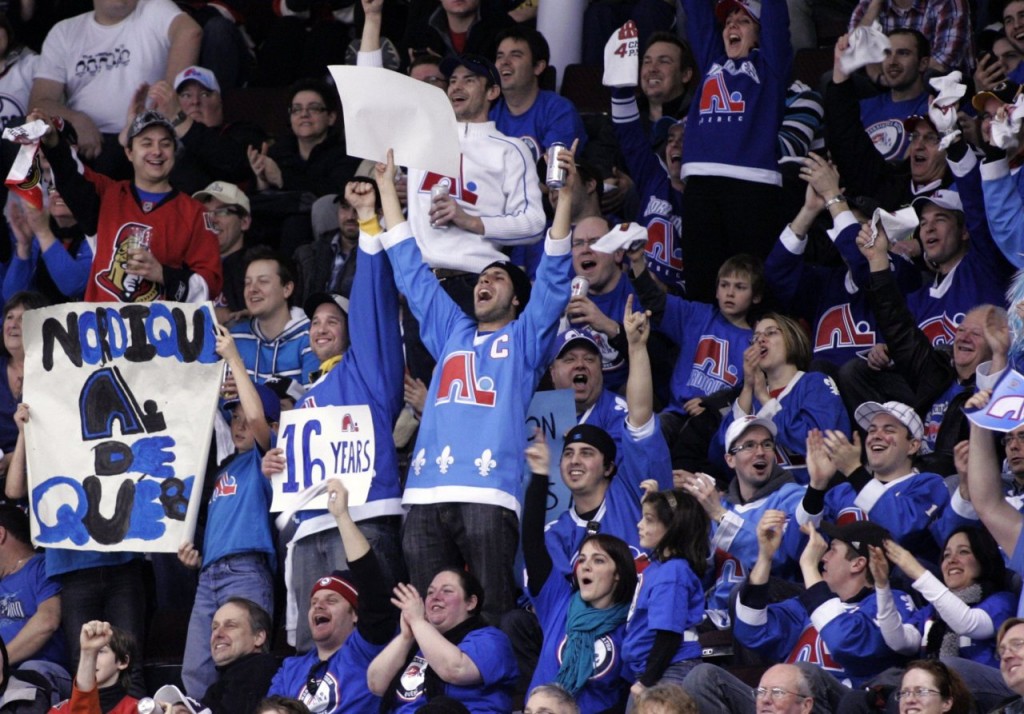
Seeing Winnipeg get a team back in 2011 must have given Quebec City a lot of hope. The reason they lost the Nordiques in 1995 to Colorado was because their facilities could not match the new NHL standards. That’s all changed now; the Videotron Centre gives the city some legs to stand on when trying to earn the NHL’s attention. It’s designed with hockey as its sole purpose. With that being the case, it’s just a matter of time before hockey returns to French Canada.
However, Quebec could get a franchise again via a different route: the Carolina Hurricanes have been rumoured to be on the move. This means the former Hartford Whalers franchise could possibly move north of the border… wouldn’t that be nice?
Las Vegas and Quebec City are as different as cities come, but for hockey, I believe these two places are apt choices. Nevertheless, I hate seeing so many NHL franchises concentrated on the East Coast. We are due for a couple of purely western teams. For selfish reasons, I would rather see an expansion team in Seattle or Portland before a team in Quebec City. One thing lacking for Vancouver fans is an opportunity to go on road trips to see our regional rivals. If Seattle can make a push when the next expansion round comes around, that would be exciting news. But for now we’ll take what we can get, and be happy we don’t live in Atlanta.
By Elliot Chan, Opinions Editor
Formerly published in the Other Press. June 2, 2015
How can you tell whether or not the world cares for you? You know when people are willing to band together and offer a critical part of themselves to keep you alive.
When the owner of the Ottawa Senators, Eugene Melnyk, was diagnosed with liver complications and needed a new one to survive, he and his supporters reached out to the public. Crowd sourcing for an internal organ is in many ways taboo—shameless even—but realistically there is no shame in wanting to stay alive. With one in three people dying during the donor-waiting process, time was a luxury he didn’t have.
The criticism was that Melnyk used his celebrity status to leapfrog other candidates awaiting transplants. Such behaviour was unethical. But how can you blame a dying man for using what he had created his whole life—his status—to stay alive. Placed in the same life-or-death situation, you would do the same. You should do the same.
The matter was that Melnyk was never a part of the general waiting list. He created his own list from people who would have otherwise not have become donors. Five hundred people came out of the woodwork to save this man. Only one volunteer was needed, but more than 20 said they would continue the process, donating their organs to someone else in need. It was not Melnyk’s intention, but for a small moment he was able to place the spotlight on an often-forgettable circumstance.
I don’t believe any person is more deserving of life than anyone else. But if I were diagnosed with any organ complication and needed a donor, I would like to think that I would do more than wait patiently. I would pull out your liver and use it as my own if I could. I would pull out your liver and give it to someone I love if I could. We are designed to care about those who are most close to us and those who have influenced us positively. It’s not that we idolize or worship these people, it’s because they matter to us. Let it be our way of thanking them for enriching our lives.
Thinking of asking for such an important aspect of someone’s life—an organ—to stay alive really makes me rethink the way I treat those I love around me. Should I become ill, will I receive such an outpouring of love? Will 500 volunteers come forward to save me? Will they for you? Then pause, really ponder, and ask yourself: why wouldn’t they?
Russians walk off the ice, Canadians should shake it off
By Elliot Chan, Opinions Editor
Formerly published in The Other Press. June 2, 2015
We won. They acted like poor sports—or as they put it, they made a “mistake.” After the annual World Hockey Championship, with the Canadians beating the Russians 6-1, the majority of the losing team skated off the ice as “O Canada” began to play. Whether it was an act of disappointment, bad sportsmanship, or political displeasure, it didn’t look good for the organization and the individual players. Still, there is nothing more awful than being forced to watch someone else celebrate, especially after getting plastered.
I have played hockey games—not at the international level, but still competitively—and I know how it feels to want something and then have someone beat you for it. Fuck them, right? I’ve shaken their hands, I’ve congratulated them, and now you want me to stand patiently while they sing their silly national song? We lost. Let me leave. What more do you want?
I get it. There is a patriotic aspect to international sports; that is why the Olympics and World Cups are so popular. But we don’t need the opposition to look sad while our song plays. Generally speaking, I’m not a big fan of national anthems at sporting events altogether. I’ve heard “O Canada” and “The Star-Spangled Banner” so many times they’ve lost all meaning.
The act made the team look like they had “no class” as Don Cherry would say. We all know what type of player Ilya Kovalchuk is, and the fact that he led the way was no surprise. But let’s not forget about the players that stayed on the ice, including superstars Alexander Ovechkin and Evgeni Malkin. Hockey is a team sport, but sportsmanship is an individual game. If you are going to punish anyone, punish the players individually, not the whole organization.
Then again, what punishment would fit, especially during this heated tumultuous time between North America and Russia? Hockey may be the glue that keeps people together, but it is not a Band-Aid for international problems. Punish players, but don’t punish the game of hockey. It’d be a shame to see Russia banned from the tournament next year. It would be a shame if we couldn’t beat them again next year.
For now, I’m happy giving the Russians the benefit of a doubt. In the heat of the moment, people do things that are in poor taste, but in the long run, nobody was hurt. So whatever, our national anthem wasn’t for them anyways.