Love, actually?

maxresdefault

Is age difference a problem in romance?

By Elliot Chan, Opinions Editor
Formerly published in The Other Press. November 25, 2015

It’s not surprising to see an older, wealthier man fall for a younger woman, yet such an occurrence often still reflects a sleaziness that causes our society cringe. The situation is cruder when the man divorces his wife of 26 years to be with this much younger woman. There are many cases to draw examples from, but I’ll point at the most recent one involving my childhood hero and actor, Rowan Atkinson.

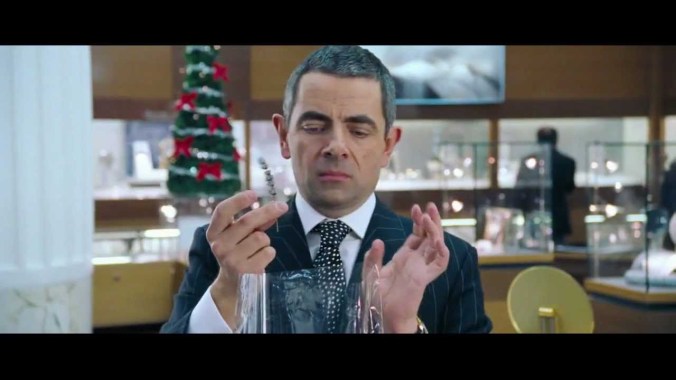
Atkinson, famous for Mr. Bean, Blackadder, and his scene-stealer in Christmas classic Love, Actually, was involved in a swift 65-second divorce proceeding, separating on the grounds of “unreasonable behaviour.” I always wonder about the complexity of marriage: the leash wives have on their husbands and the secret lives husbands have away from home. It makes me wonder what “unreasonable behaviour” within a marriage even means. Because how can we truly know how two people behave when they are alone? This type of classification makes me look down on people who can’t keep a marriage together. It makes me judge them poorly. How can I trust someone who breaks promises and behaves unreasonably? How can I trust someone who is so easily tempted by what we can only define as lust?

It’s so easy for people at the perimeter to point their fingers at someone like Atkinson, even in 2015, saying that he is just swapping old for new. Who doesn’t want something new? However, when it comes to being in a committed relationship, that type of behaviour is most certainly unreasonable. Then again, what if we look at it from the view of happiness. Over half of all marriages end in divorces today… how unreasonable is that? Should we really be criticizing anyone for the complicated choices they make regarding love? I say no.

It is both an act of courage and cowardice to pursue a romantic endeavour and to leave a committed relationship. It digs deeper into the person. You are not a student, you are not a doctor, you are not a writer, or whatever occupation you have—deep down, you are those you love. I do agree that people make mistakes in the realm of marriages, but I don’t believe people should be judged poorly for them. They took a chance at love and that should be admired.

My problem is the pedestal people put the status of marriage on, as if it’s some kind of achievement. I think it’s that type of perspective that makes it hard for so many people to “love.” Love shouldn’t be like tightrope walking across a skyscraper. Any slip up will be met with death. It should be a journey with many encounters. It should be a journey made with a partner. And should the partnership change, it’s just the way it is. It’s a part of it.

So should age ever be a problem in romance? I don’t think so. When it comes to consenting adults, they should just enjoy each other while they have time. While age is just a number, our time on this world is running out. So share it with the people who matter and leave the ones that don’t. You, just like Mr. Bean, will have to make that decision yourself, no matter how ridiculous and unreasonable it may seem.

Double negative

Image via Thinkstock

Why you might be concerned about the wrong things

By Elliot Chan, Opinions Editor
Formerly published in the Other Press. November 18, 2015

What concerns us in day-to-day life differs from person to person; some worry about immediate problems such as deadlines and commitments, while others worried about situations that have no direct influence on them. I’m all for the former and not so much about the latter. We waste too much time concerned with aspects of the world that we cannot control, and when we do think that we are making a positive impact, we are often neglecting an issue closer to home.

The environment: it is the foundation of life upon Earth. Many of us make every effort to take care of it, but then again, we often forget to take care of ourselves—to protect ourselves. How often do I see commuters on bicycles swerving this way and that on the road without a helmet? I see it almost all the time, especially in urban areas. Riding a bike is better for the environment, but neglecting your safety is far from smart. Your wellbeing is a far bigger concern than the carbon you would emit into the air if you were driving.

The world at large is full of disruption and corruption. I remember this cliché line growing up: there are poor children in Africa that want what you have. Hell, there are poor children in Canada that want what I have. We often look at developing countries or countries in crisis, such as Syria, and offer our deepest sympathy. However, when we look at an unfortunate individual closer to home, what do we do? We call them lazy, we call them bums, and we call them stupid, and so on and so on. If you want to help people, start with those in your backyard.

Worrying is a type of escape, don’t deny it. Sometimes we get emotionally invested in things just so we can avoid the immediate problems with our lives. Look at sports for example. We put so much emotional weight on the performance of a group of people we don’t even know. The outcome has minimal effect on our lives. If we own a sports bar, we might benefit from the Canucks winning, but otherwise, it’s pretty much a way to misdirect attention from our own work ethics. We worry so much about how the Canucks, Whitecaps, and Lions are doing, but how often do we turn to our friends and family and show interest in their pursuits? Rarely. Working at an office or a restaurant is not as interesting as scoring a goal. Finishing an assignment is not as exciting as making the playoffs. But if you are worried about the successes and failures of complete strangers, why aren’t you worried about those who matter so much to you?

It’s okay to be farsighted now and then and be concerned about the world, but more often than not, we should look at what’s around us—there are problems everywhere that need to be solved. Let’s start with those.

The art of ghosting

facb4e1ca83e03b78651b5ec2b896398

How to disappear from a long night of partying

By Elliot Chan, Opinions Editor
Formerly published in the Other Press. November 11, 2015

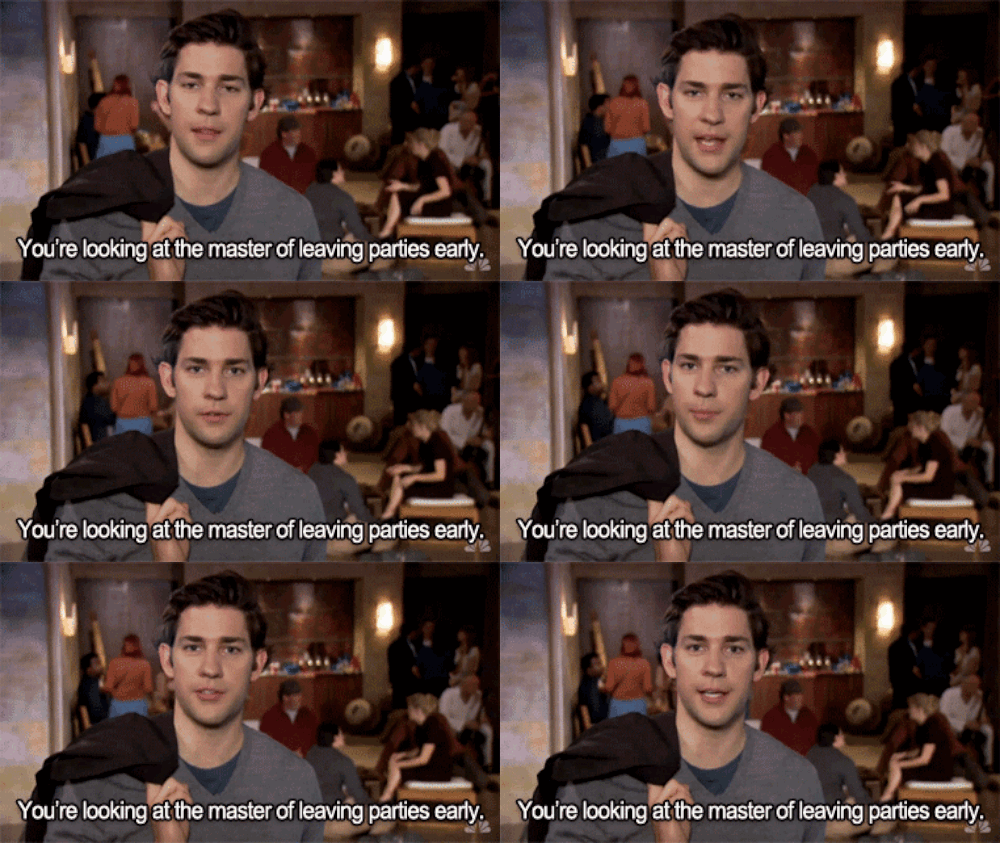
Sometimes known as the Irish goodbye or the French exit, ghosting is the act of leaving a party without announcing it or saying farewell to the host or the rest of the guests. It can be humourous for some and insulting to others. Some will be happy that you’ve been able to make it there at all, while others would demand some sort of appreciation for their efforts. As we approach the festive season, where our free time begins to fill up with parties and get-togethers, I figure it’s a good idea to touch on the idea of ghosting.

Before we go any further, I want to say that I am a proud supporter of ghosting. After a long night of drinking or whatever the party entails, you are tired. Just get yourself home and rest. Friends don’t need friends to go through all the bullshit formalities required to leave. Simply leave and forget about it.

We are so connected these days through our phones and social media that if a goodbye was not exchanged, a simple text can fix everything. There is no shame to ghosting and there shouldn’t be any guilt either.

Making it out to a party is hard enough without having to feel rather shitty for leaving early. You might have been having fun; you might not have. Either way, it is not work. You are not being paid to be there. Therefore, you don’t need to punch in and out—in addition to punishing yourself.

You don’t need to ghost completely. Say goodbye to those in your vicinity when you leave. Let them relay any parting messages you may have for other people in the venue that you have missed. Note: they probably won’t relay any messages for you, but they will act as witnesses to your departure. On your way out, you’ll likely say goodbye to a handful of people smoking.

There are many social gatherings that hold attendees to a higher standard than other engagements. Weddings, for example, are a big pain in the ass if you want to leave early. Sometimes people even expect you to help clean up—say what? A dinner party, one where there is a place reserved for you specifically, is different from a night of binge drinking with friends. However, you don’t need to make your exit a big scene. Say goodbye to the host, if nobody else. Thank them quickly. Excuses aren’t really necessary, unless they force it out of you. Pay for your portion (if that is expected), and just leave. It’s ghosting, but that doesn’t make you a monster.

When networking isn’t working

Getting-the-Most-out-of-Your-Networking-Event-SB

Why your networking opportunities are a waste of time

By Elliot Chan, Opinions Editor
Formerly published in the Other Press. November 11, 2015

Remember the last school day in high school when you, your classmates, and everybody else gathered in the foyer to sign yearbooks? Remember how you tried to accumulate as many signatures and H.A.G.S. (have a great summer) as possible? Remember how empty that feeling was after? That is how I often feel when I go to networking events.

Ask any working professional and they will tell you that networking, at some point, contributed to their success. But where and how they network? That they seldom share. I’m far from a successful professional, but I think I know when my time is being wasted. My time is being wasted when I’m not making any genuine connections. Like those speed-dating events that people do to find romance, I feel that same way with attending networking events in search for employment. If there is no connection in five minutes, I slowly start sneaking away.

If you approach a networking event for your sole benefit, i.e. employment opportunities, you’ll ultimately fail. Rarely are employers hiring at these events, and if they are, you entering their lives spontaneously and then disappearing a few minutes later will not go far in influencing them to hire you. Instead, approach a networking event with an additional purpose. Ask yourself: What would I like to learn at this event? Product development? Marketing strategies? Sales tactics? Whatever. Rather than showing off your smarts and woefully impressing people who don’t care, gain knowledge by communicating with those who have more experience than you.

One thing I found really useful at a networking event was to have a project going in. If I had to report on the event, what where the topic be? What can I wrap my story around? Let’s say I was at a tech-startup event (I’ve been to a lot of those), I could write about the hardest aspect of building or working at a startup company. Then I probe, I interview, I meet people who work at those companies, and I asked them the question: “What’s the hardest thing about working at a startup company?” I’m gaining knowledge. I’m getting results. At the end of it all, I have a collection of interviews and maybe even an article with knowledgeable insights. What I decide to do with that post is up to me. I can share it via my own network and up my Klout score, I can keep it for myself, or heck, I can send it to those who I have interviewed and see if they would be interested in the content. I have done more than network; I have made a connection. I’ve gone the extra distance and shown my spunk.

Networking events are a waste of time if you are collecting business cards. Business cards are worth less than Pokémon cards if you don’t reengage with the person. They’ll forget about you as quickly as you’ll forget about them.

Policing the police

Photo by Patrick Sison

Can we stand up against brutality without looking in the rearview mirror?

By Elliot Chan, Opinions Editor
Formerly published in the Other Press. November 18, 2015

On October 24, acclaimed director and writer Quentin Tarantino stood up at an anti-cop brutality rally, supported the #BlackLivesMatter campaign, and expressed his views on the damaging results of trigger-happy authorities.

When unarmed citizens are being shot down, it’s worth speaking up. It’s not a matter to be brushed away as collateral damage. The fear that many experience when being approached by a police officer is genuine. They have guns! Tarantino goes on in his speech, labeling officers who have killed unarmed civilians “murderers.” And perhaps that was what made the Fraternal Order of Police union put Tarantino in their crosshairs.

Jim Pasco, the executive director of the Fraternal Order of Police, in mafia fashion, issued this statement in response to Tarantino’s rallying speech: “Something is in the works, but the element of surprise is the most important element. Something could happen anytime between now and [theHateful Eight premiere]. And a lot of it is going to be driven by Tarantino, who is nothing if not predictable. The right time and place will come up and we’ll try to hurt him in the only way that seems to matter to him, and that’s economically.” It’s a little freaky. It’s almost as if Pasco is an evil character in a Tarantino movie.

When a police official makes a threat to a public figure, it cannot be ignored. When I think of those people protecting and defending me, I don’t appreciate the fact that they use intimidation as one of their tactics. In addition, to say the police are going to “hurt” him economically is a petty attack. Apparently we are living in a world where we have the freedom to talk about whatever we want, except we aren’t allowed to criticize police. Apparently we live in a world where the police can act above the law and face little to no repercussion, and when civilians take arms and speak out—especially those in the public eye—they get accused for being slanderous. Then they get outright bullied.

The facts are there. There is no denying that unarmed citizens were killed. Instead of opening up and saying that the policing efforts will work to prevent these incidents from ever reoccurring, the police union—or rather the police mafia—in all boldness goes and threatens the work of an artist. In another example of this, Patrick Lynch, president of the Patrolmen’s Benevolent Association, announced that “it’s time for a boycott of Quentin Tarantino’s films.” Guess what? Boycotting a film is not going to stop cops from overreacting. It’s such a childish knee-jerk reaction to target the person who speaks up against the corrupted powers working to “protect” us. That is always the response police give when anyone questions policing methods. Civilians don’t understand how dangerous the job is for cops. But guess what? When you start turning against us for asking questions and demanding a response, we might start believing that you did all those awful things on purpose. So you tell me: whom am I supposed to believe?

A whiny Christmas to all!

Image via Thinkstock

The spirit of complaining about nothing

By Elliot Chan, Opinions Editor
Formerly published in the Other Press. November 18, 2015

It’s that special time of year between Halloween and New Year’s where people start making a fuss about decorations and salutations. This year it’s no different. We are still over a month away from Christmas and already we have two notable controversies to discuss. And the funny thing is, science and religions are not even involved.

The one that received the most attention is the Starbucks “red cup” controversy. When it was first brought to my attention that Starbucks had released their annual festively decorated trash—I mean, disposable cups—I, like most people, didn’t care. Each year, the coffee retailer goes out of their way to design holiday themed cups, but this year all that was present was a simple coat of red. It was minimalistic, and highly offensive to some, apparently.

Starbucks, with an effort to stay politically correct and secular, decided that a simple red would be a modest choice for the brand. I agree. It is nice to drink from a cup that isn’t cluttered with clichéd designs. Honestly, I barely ever look at the cup anyways. Why would I? It would just remind me that once again they thought my name was “Alex.”

I hope that next year Starbucks uses the same stupid red cup. Or better yet, they should just stick with the white cups that they use the rest of the year. After all, white is a Christmas hue.

The second controversy is even more absurd. It involves one of the largest payment processors in the world, PayPal. PayPal is known to frustrate a lot of people, but not usually in such a ridiculous fashion as their new commercial did. In the UK PayPal ad, a couple of children are left saddened, anxious, and concerned when their parents aren’t bringing any gifts home as the holiday approaches. Snotty little kids worried about their gifts, how touching right? The twist in the commercial is that the parents weren’t carrying any gifts home, because they made online purchases and they were delivered without the children knowing—much like some Father Christmas guy.

Well, apparently PayPal broke the illusion for some British children. There is no Santa Claus! What I find interesting is that children are watching a PayPal commercial at all. Moreover, if your children are able to conceptualize the idea of digital payments, they are probably too old to believe in Santa. Although, the idea of invisible money does sound as fictional as a man who lives in the North Pole with a bunch of elves and reindeers.

What corporations need to understand is that they can’t please everyone this time of year. If you put up too many decorations and play too much Michael Bublé, people are going to be angry. Then again, if you don’t make an effort, you get chewed out all the same. I didn’t grow up with Christmas being a big deal, it just happened around me. I’m not religious, and as an only child I never really had a problem with presents. Christmas to me is a chance to get some rest and enjoy myself. The only thing I have to complain about during Christmas is that most stores and restaurants are closed. That’s the real bullshit!

Vancouver’s viaduct variables

11418461

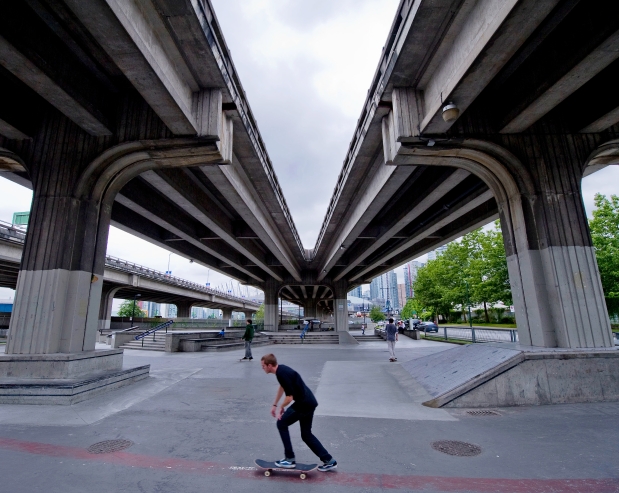
What shall we do with the Georgia and Dunsmuir Viaduct?

By Elliot Chan, Opinions Editor
Formerly published in The Other Press. November 11, 2015

Now that the filming of Ryan Reynolds’ Deadpool has ended, I guess we can start talking about how awful the Vancouver viaducts are. If you are unfamiliar with these viaducts, they are the two roads that connect Prior Street, Strathcona to Expo Boulevard, Stadium/Downtown. It’s the big concrete bridge that runs alongside the SkyTrain from Chinatown to Rogers Arena.

Built in the 1970s, the viaducts were designed to be an entry point into the urban core of Vancouver. I’ve taken it to and from the city as long as I can remember, and it has never—ever—been a pleasant experience. Now, with the inception of the bike lanes, the viaducts are hazards left, right, and centre. And let’s not forget about it also being a seismic calamity waiting to happen. So when the city council voted to replace the ultra thin, unsettling Hot Wheel tracks with a six-lane, ground-level road that offers neighbouring areas more space for parks, residential, and commerce, I was all in.

But once the viaducts are torn down, what will ultimately take their place will be high rises. Let’s not lie to ourselves, we are running out of room in Vancouver, and building upward seems to be the only feasible solution. While some people have a problem with that initiative, I don’t. Done correctly, buildings can be as beautiful as the waterfront. Buildings can become the ripples of the city, where the waves are the ripples of the ocean; both can be majestic and encapsulating to look upon.

The problem with so many big cities is that their infrastructures end up fencing people from one corner away from people in another corner. Basically, crossing the road becomes a great hassle, so people don’t do it. This creates a divide, which eliminates cross-community engagements. The viaduct truly makes it difficult to traverse. Nevertheless, we should not make the same mistake. The great big cities of the world—London, Paris, and New York—have channels that connect pedestrians, not just vehicles. In Hong Kong, people never have to touch the solid ground; there are walkways connecting to every part of the city, some call it a “pop-up city.” I digress; we shan’t be one of those, albeit it does sound cool to live in such a futuristic metropolis.

Those designing the new roadway systems are assuring us that it is going to be better. I believe them, because honestly, I don’t see how it could be worse. I fear that one day we are going to be like Los Angeles with layers upon layers of highways. With the demolition of the viaducts, I can feel relieved that at least for the moment we are taking a step away from that.

What is war (and I) good for? Absolutely nothing!

U.S. marines fire on a group of insurgents shortly after they launched a rocket propelled grenade at their 7-ton truck while on a 'movement-to-contact mission in order to flush out insurgents operating in the Fallujah area  south of Fallujah on Thursday, April 15, 2004 in Iraq.  The marines are part of the 3rd Battalion, 4th marine regiment, which saw heavy combat at the beginning of the war last year, and is now back in Iraq embroiled in intense fighting with the resistance.  Today, the men of the 3rd Battalion were ambushed half a dozen times while they patrolled the palm groves and wheat fields around fallujah, and the marines killed at least 10 insurgents, and suffered only minor injuries. (Credit: Lynsey Addario/ Corbis, for The New York Times)

Would I become a soldier if there was a war to fight?

By Elliot Chan, Opinions Editor
Formerly published in The Other Press. November 11, 2015

There was a time when refusing to fight in a war was an act of cowardice. Conscientious objectors were often shunned for being “unpatriotic” and “disgraceful.” Many of them in the past were even considered criminals. Thank god we don’t live in those times anymore. As Remembrance Day approaches, I’m often left with a bitter, remorseful feeling, because I know, I’ll never make such a sacrifice—I won’t!

Those who serve on the front line today demand respect. However, that does not necessary make them “heroes.” The way I see it, it makes them victims. I respect them not because of their training, but how their training and their experiences have corrupted them. Hate begets hate. War does not elevate kindness, tolerance, and benevolence in people; it pulverizes it with fear and righteousness. Post-traumatic stress disorder is chalked up as a workplace hazard for soldiers like carpal tunnel is for office workers.

We are currently living in the most peaceful time in the history of humanity. Yes, there are countless wars taking place on this planet, but most of them are civil wars or wars between countries separated by a thin border, far from where I am. These wars are feuds between neighbours that have lasted generations upon generations. If I were to pick a battle to fight, it would be an intrusion. Me sticking my nose in something I truly don’t understand.

One nearsighted saying I hear from those who are willing to join the army is this: I fight so my children won’t have to. First off, your children will do whatever the hell they want to; they’re their lives. Secondly, if you truly care about your children, you should teach them acceptance, rather than aggression. Teach them that there is more to a war than simply good guys fighting bad guys. Thirdly, if you think there is anything to gain from becoming a pawn, you are right, there is. There is a lot of profit, but don’t be surprised if it all goes to corporations—not to you or your children.

It might sound selfish of me to say that I wouldn’t defend my country. But what does it mean to defend my country? Does it mean entering someone else’s home and killing innocent people there until I find the few that are doing wrong to the true north strong and free? I hope not. In Canada, wherever we send our troops, we say we they are there for “peacekeeping” reasons. I don’t know how peaceful I can be waltzing into a battle zone.

We need to appear strong in the face of adversity. We need to have muscle so that the world at large won’t push us around. But the thing I never understood about our military, and those of our allies, is this: How will our guns stop their guns? How will our blood wash away their blood?

I’ll support our troops by taking off my hat during ceremonies, but man, there has got to be a better way.

Book Review – This One Summer

Formerly published in Ricepaper Magazine

51pPqSnhtBL._SY344_BO1,204,203,200_THIS ONE SUMMER
By Mariko Tamaki and Jillian Tamaki

Groundwood Books (May 6, 2014)
320 Pages, $17.99 (Paperback Graphic Novel)


REVIEWED BY ELLIOT CHAN


Awago Beach has been a summer sanctuary for Rose and her parents for as long as she can remember. Fresh air, a private lakeside cabin, and Rose’s friend, Windy, make up for the monotonous humdrum of childhood vacations. But, this one summer, Rose dares to overstep her boundaries. Fueled by fascination, naive yearning, and repressed angst, Rose becomes entrenched with the complicated lives of the local teenagers and her parents themselves—in addition to bingeing on candy and horror movies.

This One Summer flows like a dreamy, lazy July afternoon, the kind that doesn’t last forever, unless in our memories. The humorous yet meditative storytelling plays on the reader’s nostalgia, while the illustrations offer a vantage of yesteryears that many of us are beginning to misremember. The coming-of-age graphic novel is sincere, captivating, and poignant, but most of all it is a faithful rendering of both ephemeral and intense moments that makes up a season in a life.

Mariko and Jillian Tamaki skillfully capture the subtleties of adolescence, teenage-hood, and even adulthood. With a few simple frames and some indispensible words, the hesitation of youth, the dynamic of a modern family, and the consequences of reckless decisions are fully presented with a heartfelt attitude that is pure and powerful.

This One Summer is the Tamaki cousins’ second full-length collaboration. In 2008 their graphic novel, Skim, a story about the culture and conflicts at an all-girl Catholic school, received wide acclaim for its equally passionate presentation of the younger generation. There is no doubt that there is a harmonized understanding between the two artists. The ability to place the microscope on such a tender corner of existence is an element that is often absent in most of life’s maturing ventures.

Mariko and Jillian remind us in This One Summer that new experiences have no age restrictions, and that coming of age is actually a lifelong endeavour. Although the focal point of the story is on Rose, she is in fact the supporting character to the real drama of those around her. We have all stood where she stood, at the perimeter of other’s lives, helpless to assist, and powerless to disengage. We ride the turbulent waves, while witnessing the ebb and flow of those around us. This stunningly candid graphic novel, in the end, encourages us all to stand by those we love and overcome the adversity of another fleeting summer.

To be reviewed

Screenshot from 'South Park'

Are crowd-source reviews still effective?

By Elliot Chan, Opinions Editor
Formerly published in The Other Press. November 4, 2015

The recent South Park episode “You’re Not Yelping” shone a light on the power of public opinion. Review sites such as Yelp, Zomato, and Rotten Tomatoes have given regular everyday folks like you and me the power to vote up or down virtually anything. This type of social governance seems to be democracy at its finest, since everyone who has a voice is encouraged to use it. But are we really getting honest reviews or are we—as pseudo-experts—trying to sway people away from their own authentic experience with our biased perceptions?

Ultimately, all reviews are biased. It doesn’t matter if you are getting them from Roger Ebert or your mother; regardless, the review is a product of the person’s life, thoughts, and opinions. This is great, because freedom of speech is wonderful. But not everyone is posting reviews. In fact, only an incredibly small percentage of people actually create content on review sites. Journalist Susan Kuchinskas informed us of an interesting statistic, known as the “1/9/90 Rule.” The rule states that only one per cent of people write reviews. Nine per cent of people will drop in on those reviews and rate them. The 90 per cent are solely readers, swayed by those reviews by the one per cent.

I’m opinionated, but I’m not a reviewer. I have never written a review on Yelp, or any other site that encourages me to. Why should I? I don’t believe people should do or not do anything based on my opinion and experience. Don’t listen to what I say, because what I’ll say is go watch Jack and Jill starring Adam Sandler and come to your own opinion on whether it’s good or not. Don’t simply look at the ratings on IMDB.com and automatically write it off. Make your own discovery, not just an easy conclusion via crowd-sourced reviews.

They say professional reviewers are dying out, and I believe that makes sense—not because reviews don’t have some substance though. Quality ones are introspective commentary on pieces of art or experiences. It’s—in its own way—literary. However, consumers don’t want introspection. Consumers want yay or nay: should I go here, or should I keep searching?

The Internet influences so many of our spending decisions. I say we should turn that off for a bit and come to our own conclusions. Let’s not listen to that one per cent for a little while and see what we can discover on our own. It’s a risk, sure, but I know we have clear judgement, capable of distinguishing between good and bad. I encourage you, the next time you are scrolling on your smartphone looking for a place to eat, ignore the star ratings and reviews, and just give a restaurant a chance. How can you know what is good when you are constantly avoiding bad?

This returns us to the ultimate question: are crowd-sourced reviews still effective? I don’t know, but they’re probably as effective as this article.