The art of ghosting

facb4e1ca83e03b78651b5ec2b896398

How to disappear from a long night of partying

By Elliot Chan, Opinions Editor
Formerly published in the Other Press. November 11, 2015

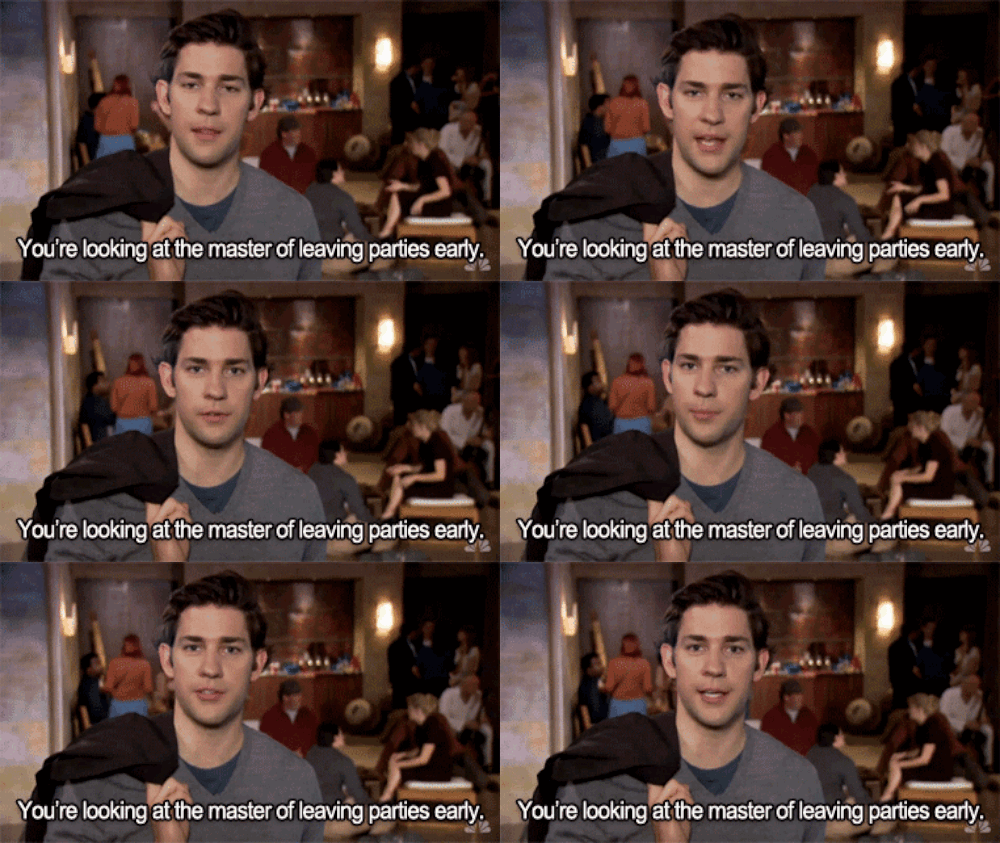
Sometimes known as the Irish goodbye or the French exit, ghosting is the act of leaving a party without announcing it or saying farewell to the host or the rest of the guests. It can be humourous for some and insulting to others. Some will be happy that you’ve been able to make it there at all, while others would demand some sort of appreciation for their efforts. As we approach the festive season, where our free time begins to fill up with parties and get-togethers, I figure it’s a good idea to touch on the idea of ghosting.

Before we go any further, I want to say that I am a proud supporter of ghosting. After a long night of drinking or whatever the party entails, you are tired. Just get yourself home and rest. Friends don’t need friends to go through all the bullshit formalities required to leave. Simply leave and forget about it.

We are so connected these days through our phones and social media that if a goodbye was not exchanged, a simple text can fix everything. There is no shame to ghosting and there shouldn’t be any guilt either.

Making it out to a party is hard enough without having to feel rather shitty for leaving early. You might have been having fun; you might not have. Either way, it is not work. You are not being paid to be there. Therefore, you don’t need to punch in and out—in addition to punishing yourself.

You don’t need to ghost completely. Say goodbye to those in your vicinity when you leave. Let them relay any parting messages you may have for other people in the venue that you have missed. Note: they probably won’t relay any messages for you, but they will act as witnesses to your departure. On your way out, you’ll likely say goodbye to a handful of people smoking.

There are many social gatherings that hold attendees to a higher standard than other engagements. Weddings, for example, are a big pain in the ass if you want to leave early. Sometimes people even expect you to help clean up—say what? A dinner party, one where there is a place reserved for you specifically, is different from a night of binge drinking with friends. However, you don’t need to make your exit a big scene. Say goodbye to the host, if nobody else. Thank them quickly. Excuses aren’t really necessary, unless they force it out of you. Pay for your portion (if that is expected), and just leave. It’s ghosting, but that doesn’t make you a monster.

When networking isn’t working

Getting-the-Most-out-of-Your-Networking-Event-SB

Why your networking opportunities are a waste of time

By Elliot Chan, Opinions Editor
Formerly published in the Other Press. November 11, 2015

Remember the last school day in high school when you, your classmates, and everybody else gathered in the foyer to sign yearbooks? Remember how you tried to accumulate as many signatures and H.A.G.S. (have a great summer) as possible? Remember how empty that feeling was after? That is how I often feel when I go to networking events.

Ask any working professional and they will tell you that networking, at some point, contributed to their success. But where and how they network? That they seldom share. I’m far from a successful professional, but I think I know when my time is being wasted. My time is being wasted when I’m not making any genuine connections. Like those speed-dating events that people do to find romance, I feel that same way with attending networking events in search for employment. If there is no connection in five minutes, I slowly start sneaking away.

If you approach a networking event for your sole benefit, i.e. employment opportunities, you’ll ultimately fail. Rarely are employers hiring at these events, and if they are, you entering their lives spontaneously and then disappearing a few minutes later will not go far in influencing them to hire you. Instead, approach a networking event with an additional purpose. Ask yourself: What would I like to learn at this event? Product development? Marketing strategies? Sales tactics? Whatever. Rather than showing off your smarts and woefully impressing people who don’t care, gain knowledge by communicating with those who have more experience than you.

One thing I found really useful at a networking event was to have a project going in. If I had to report on the event, what where the topic be? What can I wrap my story around? Let’s say I was at a tech-startup event (I’ve been to a lot of those), I could write about the hardest aspect of building or working at a startup company. Then I probe, I interview, I meet people who work at those companies, and I asked them the question: “What’s the hardest thing about working at a startup company?” I’m gaining knowledge. I’m getting results. At the end of it all, I have a collection of interviews and maybe even an article with knowledgeable insights. What I decide to do with that post is up to me. I can share it via my own network and up my Klout score, I can keep it for myself, or heck, I can send it to those who I have interviewed and see if they would be interested in the content. I have done more than network; I have made a connection. I’ve gone the extra distance and shown my spunk.

Networking events are a waste of time if you are collecting business cards. Business cards are worth less than Pokémon cards if you don’t reengage with the person. They’ll forget about you as quickly as you’ll forget about them.

Policing the police

Photo by Patrick Sison

Can we stand up against brutality without looking in the rearview mirror?

By Elliot Chan, Opinions Editor
Formerly published in the Other Press. November 18, 2015

On October 24, acclaimed director and writer Quentin Tarantino stood up at an anti-cop brutality rally, supported the #BlackLivesMatter campaign, and expressed his views on the damaging results of trigger-happy authorities.

When unarmed citizens are being shot down, it’s worth speaking up. It’s not a matter to be brushed away as collateral damage. The fear that many experience when being approached by a police officer is genuine. They have guns! Tarantino goes on in his speech, labeling officers who have killed unarmed civilians “murderers.” And perhaps that was what made the Fraternal Order of Police union put Tarantino in their crosshairs.

Jim Pasco, the executive director of the Fraternal Order of Police, in mafia fashion, issued this statement in response to Tarantino’s rallying speech: “Something is in the works, but the element of surprise is the most important element. Something could happen anytime between now and [theHateful Eight premiere]. And a lot of it is going to be driven by Tarantino, who is nothing if not predictable. The right time and place will come up and we’ll try to hurt him in the only way that seems to matter to him, and that’s economically.” It’s a little freaky. It’s almost as if Pasco is an evil character in a Tarantino movie.

When a police official makes a threat to a public figure, it cannot be ignored. When I think of those people protecting and defending me, I don’t appreciate the fact that they use intimidation as one of their tactics. In addition, to say the police are going to “hurt” him economically is a petty attack. Apparently we are living in a world where we have the freedom to talk about whatever we want, except we aren’t allowed to criticize police. Apparently we live in a world where the police can act above the law and face little to no repercussion, and when civilians take arms and speak out—especially those in the public eye—they get accused for being slanderous. Then they get outright bullied.

The facts are there. There is no denying that unarmed citizens were killed. Instead of opening up and saying that the policing efforts will work to prevent these incidents from ever reoccurring, the police union—or rather the police mafia—in all boldness goes and threatens the work of an artist. In another example of this, Patrick Lynch, president of the Patrolmen’s Benevolent Association, announced that “it’s time for a boycott of Quentin Tarantino’s films.” Guess what? Boycotting a film is not going to stop cops from overreacting. It’s such a childish knee-jerk reaction to target the person who speaks up against the corrupted powers working to “protect” us. That is always the response police give when anyone questions policing methods. Civilians don’t understand how dangerous the job is for cops. But guess what? When you start turning against us for asking questions and demanding a response, we might start believing that you did all those awful things on purpose. So you tell me: whom am I supposed to believe?

A whiny Christmas to all!

Image via Thinkstock

The spirit of complaining about nothing

By Elliot Chan, Opinions Editor
Formerly published in the Other Press. November 18, 2015

It’s that special time of year between Halloween and New Year’s where people start making a fuss about decorations and salutations. This year it’s no different. We are still over a month away from Christmas and already we have two notable controversies to discuss. And the funny thing is, science and religions are not even involved.

The one that received the most attention is the Starbucks “red cup” controversy. When it was first brought to my attention that Starbucks had released their annual festively decorated trash—I mean, disposable cups—I, like most people, didn’t care. Each year, the coffee retailer goes out of their way to design holiday themed cups, but this year all that was present was a simple coat of red. It was minimalistic, and highly offensive to some, apparently.

Starbucks, with an effort to stay politically correct and secular, decided that a simple red would be a modest choice for the brand. I agree. It is nice to drink from a cup that isn’t cluttered with clichéd designs. Honestly, I barely ever look at the cup anyways. Why would I? It would just remind me that once again they thought my name was “Alex.”

I hope that next year Starbucks uses the same stupid red cup. Or better yet, they should just stick with the white cups that they use the rest of the year. After all, white is a Christmas hue.

The second controversy is even more absurd. It involves one of the largest payment processors in the world, PayPal. PayPal is known to frustrate a lot of people, but not usually in such a ridiculous fashion as their new commercial did. In the UK PayPal ad, a couple of children are left saddened, anxious, and concerned when their parents aren’t bringing any gifts home as the holiday approaches. Snotty little kids worried about their gifts, how touching right? The twist in the commercial is that the parents weren’t carrying any gifts home, because they made online purchases and they were delivered without the children knowing—much like some Father Christmas guy.

Well, apparently PayPal broke the illusion for some British children. There is no Santa Claus! What I find interesting is that children are watching a PayPal commercial at all. Moreover, if your children are able to conceptualize the idea of digital payments, they are probably too old to believe in Santa. Although, the idea of invisible money does sound as fictional as a man who lives in the North Pole with a bunch of elves and reindeers.

What corporations need to understand is that they can’t please everyone this time of year. If you put up too many decorations and play too much Michael Bublé, people are going to be angry. Then again, if you don’t make an effort, you get chewed out all the same. I didn’t grow up with Christmas being a big deal, it just happened around me. I’m not religious, and as an only child I never really had a problem with presents. Christmas to me is a chance to get some rest and enjoy myself. The only thing I have to complain about during Christmas is that most stores and restaurants are closed. That’s the real bullshit!

What is war (and I) good for? Absolutely nothing!

U.S. marines fire on a group of insurgents shortly after they launched a rocket propelled grenade at their 7-ton truck while on a 'movement-to-contact mission in order to flush out insurgents operating in the Fallujah area  south of Fallujah on Thursday, April 15, 2004 in Iraq.  The marines are part of the 3rd Battalion, 4th marine regiment, which saw heavy combat at the beginning of the war last year, and is now back in Iraq embroiled in intense fighting with the resistance.  Today, the men of the 3rd Battalion were ambushed half a dozen times while they patrolled the palm groves and wheat fields around fallujah, and the marines killed at least 10 insurgents, and suffered only minor injuries. (Credit: Lynsey Addario/ Corbis, for The New York Times)

Would I become a soldier if there was a war to fight?

By Elliot Chan, Opinions Editor
Formerly published in The Other Press. November 11, 2015

There was a time when refusing to fight in a war was an act of cowardice. Conscientious objectors were often shunned for being “unpatriotic” and “disgraceful.” Many of them in the past were even considered criminals. Thank god we don’t live in those times anymore. As Remembrance Day approaches, I’m often left with a bitter, remorseful feeling, because I know, I’ll never make such a sacrifice—I won’t!

Those who serve on the front line today demand respect. However, that does not necessary make them “heroes.” The way I see it, it makes them victims. I respect them not because of their training, but how their training and their experiences have corrupted them. Hate begets hate. War does not elevate kindness, tolerance, and benevolence in people; it pulverizes it with fear and righteousness. Post-traumatic stress disorder is chalked up as a workplace hazard for soldiers like carpal tunnel is for office workers.

We are currently living in the most peaceful time in the history of humanity. Yes, there are countless wars taking place on this planet, but most of them are civil wars or wars between countries separated by a thin border, far from where I am. These wars are feuds between neighbours that have lasted generations upon generations. If I were to pick a battle to fight, it would be an intrusion. Me sticking my nose in something I truly don’t understand.

One nearsighted saying I hear from those who are willing to join the army is this: I fight so my children won’t have to. First off, your children will do whatever the hell they want to; they’re their lives. Secondly, if you truly care about your children, you should teach them acceptance, rather than aggression. Teach them that there is more to a war than simply good guys fighting bad guys. Thirdly, if you think there is anything to gain from becoming a pawn, you are right, there is. There is a lot of profit, but don’t be surprised if it all goes to corporations—not to you or your children.

It might sound selfish of me to say that I wouldn’t defend my country. But what does it mean to defend my country? Does it mean entering someone else’s home and killing innocent people there until I find the few that are doing wrong to the true north strong and free? I hope not. In Canada, wherever we send our troops, we say we they are there for “peacekeeping” reasons. I don’t know how peaceful I can be waltzing into a battle zone.

We need to appear strong in the face of adversity. We need to have muscle so that the world at large won’t push us around. But the thing I never understood about our military, and those of our allies, is this: How will our guns stop their guns? How will our blood wash away their blood?

I’ll support our troops by taking off my hat during ceremonies, but man, there has got to be a better way.

To be reviewed

Screenshot from 'South Park'

Are crowd-source reviews still effective?

By Elliot Chan, Opinions Editor
Formerly published in The Other Press. November 4, 2015

The recent South Park episode “You’re Not Yelping” shone a light on the power of public opinion. Review sites such as Yelp, Zomato, and Rotten Tomatoes have given regular everyday folks like you and me the power to vote up or down virtually anything. This type of social governance seems to be democracy at its finest, since everyone who has a voice is encouraged to use it. But are we really getting honest reviews or are we—as pseudo-experts—trying to sway people away from their own authentic experience with our biased perceptions?

Ultimately, all reviews are biased. It doesn’t matter if you are getting them from Roger Ebert or your mother; regardless, the review is a product of the person’s life, thoughts, and opinions. This is great, because freedom of speech is wonderful. But not everyone is posting reviews. In fact, only an incredibly small percentage of people actually create content on review sites. Journalist Susan Kuchinskas informed us of an interesting statistic, known as the “1/9/90 Rule.” The rule states that only one per cent of people write reviews. Nine per cent of people will drop in on those reviews and rate them. The 90 per cent are solely readers, swayed by those reviews by the one per cent.

I’m opinionated, but I’m not a reviewer. I have never written a review on Yelp, or any other site that encourages me to. Why should I? I don’t believe people should do or not do anything based on my opinion and experience. Don’t listen to what I say, because what I’ll say is go watch Jack and Jill starring Adam Sandler and come to your own opinion on whether it’s good or not. Don’t simply look at the ratings on IMDB.com and automatically write it off. Make your own discovery, not just an easy conclusion via crowd-sourced reviews.

They say professional reviewers are dying out, and I believe that makes sense—not because reviews don’t have some substance though. Quality ones are introspective commentary on pieces of art or experiences. It’s—in its own way—literary. However, consumers don’t want introspection. Consumers want yay or nay: should I go here, or should I keep searching?

The Internet influences so many of our spending decisions. I say we should turn that off for a bit and come to our own conclusions. Let’s not listen to that one per cent for a little while and see what we can discover on our own. It’s a risk, sure, but I know we have clear judgement, capable of distinguishing between good and bad. I encourage you, the next time you are scrolling on your smartphone looking for a place to eat, ignore the star ratings and reviews, and just give a restaurant a chance. How can you know what is good when you are constantly avoiding bad?

This returns us to the ultimate question: are crowd-sourced reviews still effective? I don’t know, but they’re probably as effective as this article.

Give me give me

Illustration by Ed Appleby

What to do when you reek of desperation

By Elliot Chan, Opinions Editor
Formerly published in The Other Press. November 4, 2015

We all want something. We all have objectives and goals. That’s good. That’s the fuel that propels us forward in life. However, there are times when we’ve been sitting idle or maybe even fallen behind. We end up thinking that good things will never happen, and that we’ll never get back to where we were or achieve what we want. It could be money, romance, competition, or personal pursuit—when we put all our chips down on the table, we can’t help feeling desperation creep up.

Our desperation is a response to our stress. It’s useful in a life-or-death situation. When we are desperate for food, for example, we would go to incredible length to feast. There’s nothing stronger than the will to live. But when it comes to being desperate in a social interaction, such as a job interview or a first date, our undeniable hunger may be incredibly off-putting.

Nobody likes being around people who are desperate. Nobody wants to work with someone who is on edge about every task, or go out to dinner with someone who has an agenda. Most of us want to relax and not feel our heart beating out of our chest. Now, I understand that simply saying “Don’t be desperate” is not the solution. It’s not a switch you can turn off and on. It goes deeper than that.

Desperation is rooted in fear. You fear that you’ll be in debt forever. You fear that you’ll be alone forever. You fear that all your hard work will be for nothing. To lose the smell of desperation on you, you need to wash the fear off yourself, and be reminded that what progress you are going to make will be gradual. Do people win lotteries? Sure. But you cannot bank on that. What you need to do is accept that you’ll have to take baby steps towards your goals. You’ll feel less desperate if your tasks seem achievable to begin with.

Alternatively, you can just forget about it. So you are single, and worried that you’ll be alone forever. You’ve gone on dates, but there’s no magic and it just didn’t click. Stop dating for a bit. Take a class. Go on a trip. Meet new people. Pivot away from the problem and work on something else for a bit. Build your confidence back up in something else and then dive back into dating after.

Nowadays, we are not faced with deadly situations. Our own fears are constructed inside our own brain, and that’s where they fester. When you wonder why you are striking out, it could be because the people around you can smell your desperation. Get clean, relax, and know that you’ll get many chances. But before you take another one, maybe take a break first.

Lesson learned

teacher-pornographic-instagramUS2

What we should do with our social media accounts in the face of professionalism

By Elliot Chan, Opinions Editor
Formerly published in The Other Press. November 4, 2015

When bodybuilder and middle school teacher Mindi Jensen received an ultimatum from her academic employers to either delete her workout/bikini pictures from her Instagram account or lose her job, it seemed like the whole world collectively rolled their eyes. Here we go again.

There was a time when I thought my teachers lived in the school after the bell rung and plotted our next quiz and homework assignments. While they might have been preparing the following day’s lecture, teaching was far from the only thing on their mind. Turns out, they do have a life outside of school and they barely thought of me after work—just like all people who make money during the day and go home to pursue their personal hobbies and projects in the evening.

Parents of all people should know that. So the fact that some parents approached North Sanpete Middle School’s administrators, the people in charge of Jensen’s career, and complained about the pictures on her personal account is a little appalling. The parents go on to claim that the images of Jensen were “inappropriate” and “pornographic.” Do those parents even know what porn is? Because I scroll through Instagram once a day and I never find “porn,” no matter how hard I scroll.

While it’s true that a professional working closely with children should remain decent on all platforms, it’s unclear where the line is drawn. Here’s how I see it: let’s say the teacher was a man and he had pictures of himself working out and in swim trunks—no!—Speedos. Would he get in trouble? Would the school board threaten to fire him if he didn’t take down those pictures? If that does happen, it doesn’t make the news. What is happening is oppression. What the parents are actually saying is: “You can’t show those pictures, because you are too pretty and you are arousing our kids. I don’t know how to discuss sexuality with them or explain that teachers are people too, with personal lives and aspirations, so I’ll just blame it on you, fit lady.”

At the end of the day, the school came to their senses, realized the legless claim the parents were standing on, and apologized to Jensen. But the question remains: how can we know if something is appropriate for the Internet or not? With nude and embarrassing pictures soaring this way and that through the air, we can’t be certain who would take offence. Therefore, we must go back to the rule of thumb: would we be okay if our mothers saw that picture of us? If the answer is yes, then share it. If no, then maybe it’s best to keep it in our private archives.

When it’s all said and done, Jensen will have a great lesson to teach to her students, one that stems from confidence and defending personal convictions. I think that’s a good lesson to learn in the social media age.

In-app purchase games are out of line

Photo via Thinkstock

What’s to blame: tech-company trickery or poor parenting?

By Elliot Chan, Opinions Editor
Formerly published in The Other Press. October 21, 2015

On October 9, Kanye West took to Twitter to give mobile game developers a little piece of his mind: “That makes no sense!!! We give the iPad to our child and every five minutes there’s a new purchase!!!” He added: “If a game is made for a two-year-old, just allow them to have fun and give the parents a break for Christ sake.” Empathic and on point as West was, he also neglected to mention that the mother of his child has one of the most lucrative mobile games on the market. I’m speaking of Kim Kardashian: Hollywood, a game where you get to prepare the reality TV star for the red carpet.

It’s hard to sympathize with West, because… well, who gives a shit what he does financially. However, many parents out there are facing the same problem as the multi-millionaire rapper. They give their kids an iPad, as a replacement for a doll, a toy car, or a deck of Yu-gi-oh! cards, and expect them to have fun and be responsible. Now, I don’t know too many two-year-olds that are able to conceptualize virtual money, because many adults still aren’t able to. Check around to see how many of your grown-up friends have credit card debt. It’s unfair to put the onus on children to be responsible while playing, so who should take the blame?

We blame cigarette companies for giving us cancer, we blame fast food companies for making us fat, and of course we should blame mobile game companies for leaking money out of our virtual wallets. Some consider the freemium-style of business brilliant, while others consider it trickery. In terms of games, it begins as a sample, usually free, to get the user hooked, and then they up the price once the player is addicted. While I believe the game companies have done a brilliant job in harnessing this, I don’t believe their intentions were malicious. And, as a businessman, West should know that it’s just supply and demand. If the player wants to skip a level, earn more stock, or gain leverage over an opponent—but they don’t want to put in the time—they can upgrade with a monetary solution.

Surprise, your kids are going to cost you money! Freemium games aren’t the culprit, they are just another avenue for your money to be lost. The same way you don’t give your children your credit card and PIN at the toy store, you shouldn’t give them an iPad with full access until they understand that the reality of their purchases. Educate your children about frivolousness and how each $0.99 click adds up.

You cannot stop businesses from creating products for profit, even if they do target children. Don’t believe me? Look at McDonald’s. You can’t win that way. What you can do is pull the iPad away from your child if he or she abuses it. Be a good parent and teach your children from an early age the value of money, and how it relates to the technology they are using. Organizations aren’t going to educate your children for you… or maybe there is an app for that.

Rest easy

Photo via Thinkstock

Why we shouldn’t be ashamed for getting more than enough sleep

By Elliot Chan, Opinions Editor
Formerly published in The Other Press. October 21, 2015

We all know the importance of sleep. The benefits are countless, yet still we often place shame upon ourselves for getting enough or more than enough sleep. We should feel blessed and prosperous for having an ample amount of rest each and every day. No person should feel ashamed for having too much, just like how nobody should feel ashamed for having wealth.

Now, as you can tell, I enjoy sleeping. I don’t believe there is anything better than a good night’s rest. I even dare to say that we are born to sleep, although it is challenging for some. I’m proud of my ability to sleep easily, because I know of those who are insomniacs. But just because I sleep well, many chalk it up to me being lazy. Although I can be lazy often, I believe sleep has been the secret sauce to my survival as a well-adapted human being.

All my life I have lived by the philosophy that no matter what I have to do tomorrow morning, such as an exam, long drive, or championship game, I’ll perform best after a good sleep. A UCLA research study showed that staying up all night and cramming is a waste of time and energy compared to habitual studying. While you may trick yourself into believing otherwise, staying up all night reading textbooks is undoubtedly detrimental. Sacrificing sleep means you aren’t letting your body and mind rest and heal. This can cause illnesses, forgetfulness, depression, and many, many more not-so-surprising effects. There is no pride in staying up all night, just like there shouldn’t be pride for drinking recklessly or driving quickly.

On weekends, some people like to go on long road trips or whatever. Me, I prefer to sleep in, and if I can’t do that, I’d like to take a nap. This is often frowned upon, because we live in a seize-the-day society. Any moment not spent being productive is wasted time, time that you’ll never get back. That, to me, is bullshit, and such an awful way of living. The thing about resting is that, when I am awake, I am twice as effective as I would be if I were burning oil all day, into midnight and beyond.

The ability to get sleep and sleep well should be admired and cherished. Many of us are so stressed all the time with commitments and deadlines, and the first thing we chop from our schedule is sleep. If you want to go out after work, you’ll have to lose some sleep. If you want to finish your project, have a drink with friends, and beat the next level in your video game, you’ll have to sacrifice some sleep. But what’s the point of all of that if you feel shitty all the time?

One of the seven deadly sins is sloth, the crime of indolence, apathy, and refusal to work. Somehow we’ve paired it up with the idea of having ample rest, as if rest itself is a sin. It’s not. It’s a right. It doesn’t matter if you are a single mother of three or a medical student who also works part time, you can sleep. You should.