Textbooks: the other tuition

The relationship between students and their textbooks

By Elliot Chan, Staff Reporter

Formerly published in the Other Press. Aug. 13, 2013

NEWS_texbooks_final

As Douglas College classrooms fill up for a new academic year, students are emptying out their wallets for the exact same reason. Regardless of how much students organize their educational finances, the textbook monopoly will take a big chunk out of their limited funds. It’s the way the game is played—but are textbooks a good investment, or are they simply a luxury tax? A 900-page burden, or an instructional baton waiting to be passed on to the next wary student seeking discounts?

Postings for used textbooks cover the bulletin board on the first floor at the New Westminster campus. It’s obvious that most students have little intention of keeping their expensive textbooks for future reference. Students are simply doing what students do best—being obedient.

“I want to spend as little as possible,” said third-year business student Haleen Mullhi. “But I’ll end up spending between $300 and $400, which adds up to $2,000 each semester.”

Music and accounting have consistently produced some of the priciest textbooks in the store. But the bookstore itself only receives a 25 per cent margin, which Ryan Hill, bookstore supervisor, considers low.

“We are retail, but we are also a service department in the college,” said Hill. “After covering shipping and overhead, the bookstore makes a low profit.”

It’s not always easy to see the gain in textbooks when all you hear about are students trying to offload them and the bookstores accepting refunds.

When asked whether or not she will sell her textbook at the end of semester, Mullhi confidently said, “Yes, I’ll post it out on the board and see if anyone wants them.”

Students don’t have many options when the course is done. The textbooks age and become irrelevant, so even though they might not be studying marketing, they still have to be salespeople and attempt to make some money back while clearing off their bookshelves. Many consider open postings on the bulletin board, but be forewarned: although that option might feel like a free-for-all, it can also be a stressful bidding war. Buybacks are the alternative, but students often find the compromise of 10 per cent or less insulting—that’s if the bookstore even decides to take it back.

“We don’t run any stats, so it is tough to say which program has the most textbooks returned,” said Hill. “It is all pretty balanced, because I believe most students have the same mentality—rather they have found another source or they dropped a class.”

The current refund policy only allows for students to return their books in the first month of the semester, within 14 days of their purchase. They must have the sales receipt and may need picture ID.

It’s difficult to tell which program yields the most returns, but Hill noticed that ESL textbooks often come back because of the language barrier and classes are commonly mistaken.

Although price is a deterrent, most students really don’t mind investing in a textbook if they know the course will put it to good use.

“If teachers actually read the textbook and assign homework from them,” said Joyce DesLauris, a first-year nursing student, “and give them credit—it would be worth having.”

Repeat in Russia

Will Canada strike gold in Sochi 2014?

By Elliot Chan, Staff Writer

Sports_Sochi-hockey

Formerly published in the Other Press. Aug. 6, 2013

Remember that day in February 2010? Remember the city—the country bursting with jubilation? Wouldn’t it be great to relive it?

Sure, the Olympics in Sochi is months away, but it’s never too early to talk about international hockey—especially since the NHL has now confirmed that its players will be able to compete in the prestigious tournament.

The most notable change in Sochi in comparison with Vancouver is the rink size. The two Canadian ice hockey gold medals in 2002 and 2010 were won on NHL-sized ice (61m by 26m). In Russia, the Canadians will be competing on international-sized ice, which is (61m by 30.5m). Rink sizes have posed challenges before, especially against speedy teams like Russia who can take advantage of the open ice.

The home team is the favourite going into the tournament, but Canada, Sweden, and the United States shouldn’t be intimidated by the jeers they’re expecting when they step onto the ice against superstars such as Pavel Datsyuk, Alexander Ovechkin, and former NHLer turned KHLer Ilya Kovalchuk.

Since the days of the Soviet Union and the Unified Team in 1992, Russia itself has never won a gold medal. But there was a period in history when the red army dominated international ice. But like the Cold War, those days are long gone and though Russia has a barrage of talent, they haven’t been able to make the podium since 2002.

The question that hangs on everyone’s lips is will Canada be able to repeat? I hope I eat my own words, but I don’t believe they will. There hasn’t been an Olympic ice hockey repeat since the Soviets did it in the late ‘80s. Canada might be good, but we have never been dominant. The fact that we won in 2010 was not a miracle, but it was definitely a hard fought game that came down to one key moment. We could easily be talking about USA’s chance of repeating right now if it wasn’t for Sidney Crosby’s heroics.

In 2006, Canada followed up their gold medal victory in Salt Lake City with a demoralizing seventh place finish in Turin. By relying on players that had experience, but were way past their prime like Kris Draper, Adam Foote, and Todd Bertuzzi, the team was doomed from the start. Selecting the perfect team is difficult, since it’s about assigning roles to elite players. With Mike Babcock, head coach of Detroit Red Wings returning to serve another term as team Canada’s bench boss, the players and fans will know they are in good hands. Sidney Crosby, Jonathan Toews, and Shea Weber can all be expected on the roster come February 12, 2014, but the number one goaltender is still unknown.

Martin Brodeur will also be stepping down this year from the international limelight. Roberto Luongo will likely get a few games just because of his reputation, while Carey Price, Cam Ward, and Marc-Andre Fleury will fight for the last two spots.

As excited as I am for the beginning of the NHL season, there is something about Olympic hockey that can make a grown man giddy. The NHL season will pause their schedule from February 9 to February 25 for what should be some epic games in the Motherland.

All eyes on new realignment

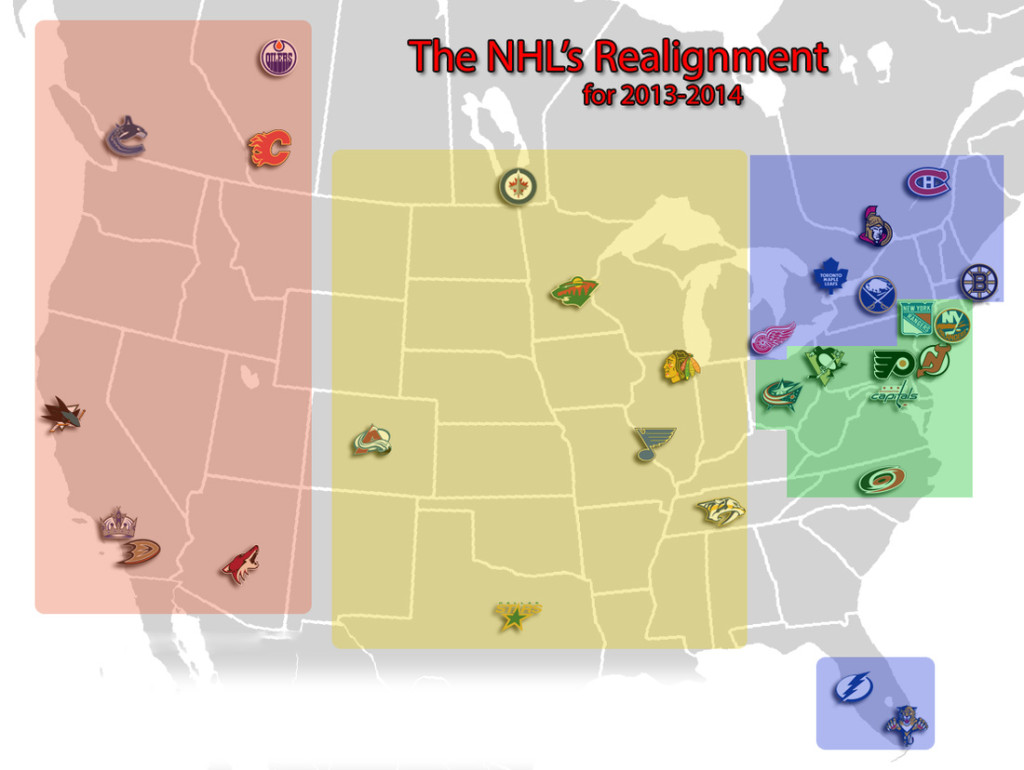
Sports_NHLs-new-regions-1024x770NHL’s new division format intensifies geographical rivalries

By Elliot Chan, Staff Writer.

Formerly published in the Other Press. Aug. 6, 2013

The Vancouver Canucks and the rest of the Western Conference are saying goodbye to Detroit and Columbus, and hello to the Winnipeg Jets.

This time last year, we were all anticipating a NHL lockout; the scenario this season is much more hopeful. As summer ends and the hockey season commences, all eyes are on the year-long experiment—the realignment. The NHL board of governors approved the new divisions and playoff format in July when the 2013/2014 schedule was released.

The Western Conference will now have 14 teams split geographically into the Pacific and Central divisions. The Eastern Conference will have 16 teams split into Atlantic and Metropolitan. The most significant change is Detroit joining the Atlantic division facing-off with three other original six teams, Montreal, Toronto, and Boston. Columbus and Winnipeg swapped conferences, with the Blue Jackets now playing in the Metropolitan division against Sidney Crosby and the Pittsburgh Penguins and Alexander Ovechkin and the Washington Capitals. The West Coast will get a few more chances to see the young Jets team and BC born players Evander Kane and Andrew Ladd.

The two main objectives for the realignment is to shorten travel times and build rivalries. It’s hard to see a downside to this change, since it was inevitable.

“It’s much better for us,” said Dallas Stars defenseman, Stephane Robidas. “It’s less travel, fewer trips out west—the time zones, the amount of time you spend on the plane after games. You don’t have to wait in [Los Angeles], you can come back after games. It’s all little things in the long run I think will help our team.”

The only two teams separated from their division in terms of geography are the two Florida teams. The Lightning and the Panthers are in the Atlantic division, but they have the whole Metropolitan division separating them from the rest of their division rivals.

“From a business standpoint, I think this is probably really good for both Florida teams,” said Commissioner Gary Bettman. “Competitively they may have their own issues, travel-wise they may have issues, but based on where Florida is from a geographic standpoint, whatever we did wasn’t going to be perfect.”

For the Canucks, it’ll be interesting seeing them battle for a post-season spot against consistent playoff contending teams such as the LA Kings, San Jose Sharks, and the Anaheim Ducks.

The Stanley Cup Playoff’s intensity may stay the same, but the route getting there is going to be slightly different. Eight teams in each division will make it to the post-season. The top three teams in each one will take the first 12 spots and the other four will try to land the wildcard position regardless of their divisions.

Though the stage for this season is set, many still see problems in the geographical layout of the league. The main problem lies in the Western Conference, where all the teams are scattered. I foresee (and hope) for a two-team expansion. Perhaps we will see another change next year with, dare I say it, a team in Seattle and Portland?

Smart phones for dummies

Are smart phones a necessity or an addiction in school?

By Elliot Chan, Staff Writer

recultured

Formerly published in The Other PressAug. 6, 2013

Smart phone ownership has grown significantly in the past few years. In a survey conducted by Google, 56 per cent of adults are now using smart phones—a 33 per cent increase from last year.

This comes as a result of the way we live now. We wake up, roll out of bed, and instantly have our phone in our hands before a toothbrush or a cup of coffee. It might sound alarming to be so reliant on a device that commonly runs out of battery halfway through the day, but is it an addiction or is it a tool? Where does a smart phone rank with the other important things in our lives, especially for students?

Let’s admit it; most of us aren’t business executives conducting big money deals. Most students just use smart phone for casual communication and research.

“Smart phones are not really necessary for school,” said Jordan McChesney, an Asian Studies student. “All we really need is an Internet connection.” He added, “I intentionally leave my phone at home sometimes so I can’t be contacted. I can use Facebook messenger.”

Although some can detach themselves from a smart phone, others find the technology to be a multipurpose solution to everyday monotony. A smart phone is not a textbook. It is something we enjoy looking at, it is a relief for students during the trails of a school day.

“I cannot go on transit without my music,” said Chris Pereira, hospitality management student. “I’ve run home before and missed the bus.”

“It is an addiction for me,” admitted Solange Valverde, university-transfer student. “I use my phone a lot.”

Smart phones can be considered an addiction, but for now they are merely a lifestyle choice. Eight out of 10 smart phone users admit that they will not leave their house without their phone. The average smart phone user has approximately 30 apps installed and uses about 12 consistently in a month.

“It helps with involvement for sure,” said McChesney. “It helps with involvements in clubs and allows you to be more social. You can also use it to prove the teachers wrong.”

Although it may seem rude to be texting or scrolling through Facebook while in a real life conversation with someone else, nobody will condemn you for it—not yet, at least. We have already banned handheld devices while driving, in theatres, and in certain classrooms and workplaces, but when will we start treating it like a real addiction? No texting three metres in front of doorways, no tweeting at the dinner table, and no Instagramming during working hours— can there be any mitigation for smart phones’ eventual take over?

Technology is constantly evolving, and with the new Google Glass gadgets gradually making their way into consumers’ homes we should all address the consequences of the tech-dependent lifestyle to which we are adopting.

“A smart phone is not food or air,” said McChesney. “It can make you more socially-active and give you more options to contact people, but it is like a cup of coffee. We don’t really need it.”

Wagepoint Launches Pay, a New Online Payroll App

There are no jobs more important than making sure every worker gets correct payment for their time and efforts. HR managers and business owners across the country will agree that managing salary and hourly pay, while subtracting benefits and such without proper tools is a complicated task.

Luckily, Toronto-based payroll software company Wagepoint has launched a new online application that will make the painstaking process a more bearable and—dare I say— even enjoyable endevour. The fully automated, cloud-based payroll software can be set up with just a few clicks.

There are two plans that users can choose from. The Free plan offers the fully featured app as an alternative to the CRA calculator. But for a $20 base fee and $2 per employee per payroll, users with the Pro plan are allowed to use the direct deposit feature, enabling administration to deposit funds straight to the employees or contractors’ bank accounts. Also the Pro plan takes care of the government remittances and issues T4s at the end of the year.

Wagepoint’s Pay offers many more features that separates it from the common spreadsheets and data entry software administration uses to manage wages. These features include employee self-service, which reduces paper trails and waste, while allowing employees to access their electronic paystubs anytime.

Another one of Pay’s features is helping to manage the different type of workers that needs to receive compensation: hourly versus salaried and employees versus independent contractors. With Pay all the data will be centralized so all workers will receive the appropriate amount with less errors and confusion.

After the first payroll with Pay, businesses can choose to use the Auto-Run Payroll feature to manage their payments if there is nothing new to report. This feature can be turned off at anytime, but if left on it will automatically send payments to employees and the government at the appointed time.

Wagepoint makes the payroll task light and easy, but they also understand the critical importance of security. Pay’s data is encrypted using 128-bit secure socket layer (SSL) encryption. Wagepoint utilizes state of the art firewall and backup technology and the data is kept in a high-security, access-controlled Tier 3 facilities.

Tapped Mobile Launches in Canada with Top Tech Partners and Brands

Last week, Tapped Mobile announced its official launch in Canada, offering brands a new approach to marketing.

The Canadian mobile advertising market will grow by over $135 million this year, and Tapped Mobile is partnering up with leading mobile ad tech companies to bring the highest quality products and services to Canadians.

Some features that Tapped Mobile’s partnerships will deliver are store-level mobile location data, first video ad units with social sharing, several in-stream video ad units, location-based retargeting, mobile research and many more.

Tapped Mobile was founded by Jed Schneiderman, Eric Shedletsky and Mark Shedletsky in 2012 with its headquarter in Toronto. The executive team combines for over 25 years of marketing, ad sales and mobile start-up experience.

“We scour the world for the best mobile ad technologies,” said Tapped Mobile President Jed Schneiderman. “We screen them vigorously and bring the best ones to Canada so that you can be ahead of the curve, delivering huge value to your brand and reaching your consumers in the most trusted and proven ways possible.”

Schneiderman was a senior management at Microsoft and CTV before he founded Tapped Mobile. He also took on a strategic marketing role at MTV, AOL, and Procter & Gamble.

Several Canada’s top brands have already signed on with Tapped Mobile. After six months of operation Tapped Mobile have been advertising across different sectors including wireless, cable, auto, consumer packaged goods, QSR, travel and more.

“We ensure each and every campaign is optimized in three ways” said Co-Founder of Tapped Mobile, Eric Shedletsky. “First, we help our clients leverage the best mobile technologies; then, we pinpoint the exact right audience across a huge list of top tier publishers and utilize the best performing ad units to deliver strong ROI.”

Brands and companies are paramount to technological innovations and Tapped Mobile, with its respected reputation will be expected to deliver top-notch ad tech for companies across the country. With Canada’s mobile marketing industry in high demand, there is no better place to start than here.

My Filipino Post-Drinking Meal: Balut Eggs

Formerly published in TofuMag.com August 3 2013
By Elliot Chan

The tricycle engine roared loudly down the silent Bayombong streets. I had my fair share of gin and I was drunk enough to do anything, but I had no idea where I was. Gripping onto the sidecar of the tricycle, all I knew was I was following my friend’s family through the small residential back alleys in the Philippines, or were they the main roads, it is hard to tell here.

We finally came to a stop and we all squeezed out, all six of us on a motorbike and a sidecar. There was a hawker’s stand on the corner of the street. Several lights hung above casting a haunting glare. A lady stood in the shadows; she had a bowl in front of her. I approached—undaunted, uncertain. A pile of eggs sat in the little porcelain nest. Someone gestured to one of them and I helped myself. But before I could grab one, the lady selected one on my behalf. She struck it with a spoon, ripped off the shattered shards and handed it to me.

Perhaps I should have had the classic Western reaction to an egg embryo, but I’m Chinese. I had duck embryo before. Still the idea of serving eggs on the side of a street in the middle of the night was still far enough from the norm for me to enjoy the novelty.

balut egg diagram

I was too drunk to pick at the bits and pieces of the little baby bird, so I just shoved the whole thing into my mouth. I felt the feather, an uncommonfeeling against my tongue. But that sensation was dwarfed by the sudden crunch of the bone. I bit down and a tangy, yet savory flavour. It was a surprising taste, that wasn’t horrible. The texture confused my tongue as it wrapped around the orb of yoke beneath the skeleton. It was still solid so I needed another bite. The hemisphere separated into two crumbling bits. There was no room in my mouth to do anything else—I must swallow.

My memories are unclear, whether the digesting process took a long time, or if I had inserted another embryo into my mouth before I finished the first, I wasn’t sure. I was enjoying myself, but my companions were grimacing. I felt a little pride, though I know there really wasn’t anything to be proud of. I expected a complement from the locals, but there was nothing to complement. All I really did was eat an egg. But when you come from the West where stores don’t even open pass midnight, finding an egg embryo stand in the dead of nightwas something worth celebrating.balut eggs

Internet intimacy

Opinions_Online-Dating

The social stigma against a safe means of finding ‘The One’

Formerly published in The Other Press. July 3 2013

By Elliot Chan, Staff Writer

Romance: a perpetual cloud hanging over our heads—or not.

Sometimes it’s violent like a thunderstorm, other times it’s a wisp in the sky-refracting sunlight upon us. Either way, we yearn for it. But it’s not easy in this modern world: a relationship is as hard to get and keep as a full-time job. So with the advantages of Internet dating, why are we still reproachful of it? Why do so many consider online dating sites to be for the desperate, the lonely, and the horrifyingly unkempt? Is it ever going to change?

Dating sites exist across the globe and they’re gaining popularity. What began as a trend in the early ‘90s is now a million-dollar industry. So why is it not like Facebook? Why are so many individuals not on Plenty of Fish (POF) or Match.com?

It’s because finding a meaningful relationship isn’t as simple as picking apples out in the produce section. We choose to go to certain bars and nightclubs instead of others because we enjoy the scene, the music, and most importantly, the people there. It’s easier to interact with someone if they have similar tastes and interests, and dating websites understand that—that’s why in recent years the Internet has exploded with different sites appealing to every kind of person, from exotic travelers looking for companionship to married individuals seeking affairs. Yep, once we get over the stigma of online dating, odds are we will never be alone again.

Ultimately, the fear of loss, rejection, and humiliation are what keep online dating at arm’s-length. Then again, heartbreak happens in physical relationships too. How often do you see two friends dating each other within a friend circle, and when the inevitable breakup happens, one of them is cast away from the group? Some people, myself included, consider this form of intimacy to be even riskier.

Online dating is changing rapidly. Sites like POF are converting to mobile devices, allowing users to correspond without having to be tied down to their computers. “All online dating is going to be mobile in the next year or so—that’s the huge thing,” POF founder and CEO Markus Frind told The Globe and Mail before Valentine’s Day this year. “We also launched top prospects a few weeks ago, which basically shows all the people you have communicated with and then we predict which one of those you’re most likely to enter into a relationship with—and also stay in it.”

We do a lot of shameful things in the name of love, so why are we still condemning Internet dating? Drunk girls and drunk boys, pull yourselves together and reevaluate what you really want. You can choose follow your heart, but there are many paths leading to your happy ending, and Internet dating should no longer be the road less traveled.

Chapter 3 of “Toasted”

Humour_sexy-quiznos-1024x768

An erotic fiction, sponsored by Quiznos

Formerly published in The Other Press. July 3 2013

By Elliot Chan, Passionate Lover and Sellout

When he suggested that you both meet at the local Quiznos for dinner, you were surprised. After all, it’s one of the finest establishments you know. Sure, you often find yourself being frugal and going to Subway instead, but you get what you pay for. Mesquite, Honey Bacon Club, Prime Rib Peppercorn: the selection is endless, or perhaps you’re just indecisive—like your selection of men. Negative thoughts, go away, and think only of Quiznos today.

You arrive a bit early, a force of habit. The cute mustached high school student behind the counter smiles at you. You smile back. Don’t play these games, you tell yourself; he’s not the one you’re waiting for.

Sitting near the glass window by the door makes you feel like an animal in a zoo, people walking by glance at you. What are they thinking? Did they see how pretty you look? Did they see how desperate you are? What will he think of you when he enters? Tension is building, you want to flee, but it’s too late.

Your eyes and his connect like a laptop to Quiznos’ free Wi-Fi connection. “Come here often?” he asks as he embraces you with his strong, masculine arms, engulfing you with the scent of Tag body spray.

“Not often enough,” you reply with a coy smile. “But I always enjoy myself when I do.”

So this is how the courtship begins. As your sandwich is being made, you imagine the two of you lying on the flat bread and layering lettuce, tomato, cheese, and honey mustard all over your bodies. You lick your lips and look up to him. His eyes glow seductively; he might have just been reading your mind.

“Toasted?” the lost Mario brother employee asks.

“Always,” you answer with a wink. In your mind, they fought for your honourable hand using sandwich meat as weapons.

You take your sandwich, find a seat, and wait. He arrives moments later with a tender smile, just like the savory Black Angus Steak in his sandwich. “Hungry?” he asks, unraveling his meal with the meticulous dexterity of a certified sandwich artist.

“Starved,” you say while peeling back the wrapper clumsily. You take a bite, the crust crumbles, the meaty inners tear apart and the sauce dribbles down your chin. You wonder as you look up at him: can a man compare with a sandwich in bed? You’re compelled to ask, but you’ll find out soon enough. Toasted? Always.

Equity Crowdfunding Will Come with Major Learning Curve, Canadian Report Suggests

Equity crowdfunding had always posed as a risky means for struggling startup businesses or a financial threat.

As US policymakers determine the potential outcome of equity crowdfunding, the Rotman School of Management in Toronto produced a research paper aimed at helping them approach the most positive conclusion. The paper will be included as a chapter in the up-coming volume of Boston’s National Bureau of Economic Research.

“There’s no question that there will be fraud and that some investors will lose money, but that’s true in every market,” said Ajay Agrawal, an associate professor of strategic management at the University of Toronto’s Rotman School of Management, who wrote the paper on the topic alongside Christian Catalini, a Rotman PhD student, and Avi Goldfarb, a professor of marketing. “This is a new market and we suspect there will be a steep learning curve for all participants: entrepreneurs, investors, crowdfunding platforms and regulators.”

From disaster relief to artist works, many are using non-equity crowdfunding to help grow their projects. There are currently more than 200 non-equity crowdfunding platforms. Often they allow people to utilize the Internet to garner small contributions in the form of donations or in return for a reward.

“Our objective was to put some structure around this innovation in financial markets,” said Agrawal. “It’s not often that we get a chance to speculate on the advent of a new market. It’s exciting.”

Currently only accredited investors are allowed to raise business capital using the platform. US regulators are working carefully in an effort to open the market to anyone. In 2012, the Obama administration introduced Jumpstart Our Business Startup Act, but regulations from the Securities and Exchange Commission is still pending.

In order to reduce potential risk, the paper says that entrepreneurs using equity crowdfunding will have to address costs for fraud, incompetence and creating unrealistic goals.

“It feels like we are being far more protective of people making mistakes buying small amounts of equity through crowdfunding than we are of people making mistakes buying other goods and services on the Internet that are sometimes fraudulent, of lower-quality, or overpriced,” said Agrawal.