Totally Real Food Review: Happy Lucky Dragon Smiling Restaurant

chinesefoodbowl

Chinese food that you eat with your mouth

By Elliot Chan, Opinions Editor
A satirical article, originally published in The Other Press.

The 7-Eleven of Chinese restaurants, Happy Lucky Dragon Smiling Restaurant never closes—not even for New Year’s Day or Christmas—making it a perfect last option for desperado foodies.

Located in the same complex as Money Mart, Lust Factory Adult Store, and Subway, Happy Lucky Dragon Smiling Restaurant’s parking lot is usually empty due to the swiftness of its neighbours’ clientele. This means you can stay as long as you want at Happy Lucky Dragon Smiling Restaurant without worrying about your car being towed. However, crime rate is up 12 per cent in the area, so be cautious—nevertheless, most of the crimes are just hate crimes and crimes of passion.

Inside Happy Lucky Dragon Smiling Restaurant, you’ll find chairs to sit on and tables to eat food on. The chairs have four legs and some have rips in them. This gives you an exclusive look at the browning inners of the cushion. The wallpaper is different from my home, because I decided at the last minute not to decorate it with water-stained flower patterns. But I think it’s pretty cool seeing the deterioration of the wallpaper; it reminds me that even though life is short, you can live long enough to see wallpaper get ugly. I think that’s beautiful. It’s like watching your grandmother do stuff, and you’re just like: “Oh grandma, just get out of the way. I’ll do it for you.”

Once I was done admiring the décor, I chose to sit by the window, offering a perfect view of the parking lot, which with my imagination kind of looked like a tennis court, but instead of tennis players there was just a lunatic.

The service was nice. The server was also the cook, which I believe should be how every restaurant should work. Imagine how nice it would be just to tell the cook what you want to eat and then he or she would just run back into the kitchen, which is pretty much right beside the table, and cook it for you. It’s like eating at your mom’s house, but without the resentment or guilt for not cooking the food yourself.

When the food arrived, I ate it with my mouth. It tasted hot. After a while it tasted cold, but some say there is no such thing as cold, and that cold is really just an absence of heat, so I guess it just tasted normal after awhile, which was okay.

Overall, Happy Lucky Dragon Smiling Restaurant is not the worst. If you end up there after an argument with your spouse about where the two of you should go for dinner on your anniversary, you should be happy that you are still alive. Happy Lucky Dragon Smiling Restaurant lives up to its name and reminds us of what it’s like to be a happy, lucky, dragon smiling at a restaurant. Few other restaurants are that honest. Maybe White Spot.

Let’s be smart

muppet-critics

Do we still need professional critics?

By Elliot Chan, Opinions Editor
Formerly published by The Other Press. January 6, 2015

What makes one person’s opinions more valuable than another? Why should some people get paid for their thoughts on entertainment, economics, and world news when other people can barely get an audience? In a world where everybody is shouting aimlessly, professional critics or critics with  credible reputations should be appreciated more than ever, right?

The thing is, the idea of an expert doesn’t materialize overnight. Although anyone can claim to be an expert and a critic, it takes a gifted person to add insight and not just spew jargon. Anybody can flip through a dictionary and find sophisticated words to describe the refined, yet robust taste of a bottle of wine. But that is just a façade. Anyone can hide behind a keyboard and type up their thoughts on any given subject and some points will undoubtedly hit a mark; anyone can do what I’m doing right now. Being an expert and a critic is no longer about judging, it’s about communicating. Experts who can express their ideas in a clear and intelligent fashion will be quoted, and the quotes are what make professional critics necessary.

A good critic does more than just critique a project or a topic; their work itself is an art form. Just take a look at the late-great Roger Ebert; he could present painful truths in an entertaining, witty manner. Ebert wrote in a review of 2009 failed comedy Old Dogs starring Robin Williams and John Travolta: “Old Dogs seems to have lingered in post-production while editors struggled desperately to inject laugh cues. It obviously knows no one will find it funny without being ordered to. How else to explain reaction shots of a dog responding to laugh lines?” Such an observation is commonly lost by amateurs or delivered in bad taste.

Few dream of becoming critics or experts as children. It’s hard to imagine a life judging stuff professionally or being called upon to comment on a specific area of interest. But if we live in a world where a social worker is a legitimate job title, then yes, professional critics should be as well. Because what they do is more than just researching, wasting time on a subject, or simply watching movies, they are summarizing sometimes complicated, sometimes idiotic ideas to us. And those deemed worthy of the job should be revered but also challenged. After all, experts are not always right.

We should all aim to be professional critics and experts. Although some have the fortune to be paid to spew their thoughts, we must remember that the reason why they are compensated for their words is because people are ready to listen. What makes people listen to you? What do people ask you about? Perhaps you can monetize that as well.

‘The Interview’ aftermath

Opinions_the interview

What Sony, North Korea, and hackers taught us about movies

By Elliot Chan, Opinions Editor
Formerly published in The Other Press. January 6, 2015

Terrorist threats, computer hackers, and harsh critics have all failed in killing The Interview this holiday season.

While the North Korean government is still bitter over the Christmas release, viewers rejoice knowing that we can all move on to award season without further controversy from the lacklustre film. Our freedom is still intact. We watched a movie without being executed. We won—sort of.

After all the buzz and scare, it’s safe to say that the movie will become a forgettable political satire. The Interview was pretty much Pineapple Express with a sympathetic villain, Kim Jong-Un. I’m not sure what the terrorists and hackers expected, perhaps a defamatory representation of their “god,” but the fact that they made us worried—even for a little bit—is a violation of our rights. For a moment there, we were intimidated. And we should never be intimidated in such a coercive manner.

Obviously President Obama’s statements after Sony pulled The Interview from theatres will not be the most memorable moment of his term, but it’s good to see that they wasn’t bypassed either. Censorship is a dangerous power, especially in a society that harbours freedom of speech. Enabling some foreign government to control our right to document, report, and create art to establish discourse is something every media company should be wary of, but shouldn’t give in to.

The whole scenario is a laughable one now, perhaps even funnier than the movie itself. I hope that Sony is no longer afraid of North Korea, and I hope other private media companies have learned from the incident and fortified their networks as well.

The fact that a movie can be considered a threat says a lot about that nation and the fact that we wavered when threats were uttered says a lot about us too. However, we’ve rebounded with grace and innovation, even teaching some of us to purchase and rent movies via online streams; meanwhile North Korea is shooting insults at the American president, using racial slurs and poor turns of phrase.

Although it was a bit annoying, it was also reassuring to see all the support on social media after The Interview was pulled from major theatre chains. It’s good to know that so many people out there understood the circumstances. It’s good to know that we are not easily swayed by terrorist threats. Sure safety is paramount, but doing something just because someone has a gun to our head is cowardly.

But then again, perhaps Sony already knew about all this. Perhaps, it was all a big publicity stunted written by a supreme leader and orchestrated by a corporate behemoth. The Interview will forever live in infamy. There will be college courses teaching the events of this film in years to come. Maybe Sony knew this. After all, the movie made over $15-million during the holiday weekend and ranks number one in online Sony films.

The Interview was not a threat; it’s a cinema-distributing pioneer. Because of it, YouTube and Google Play are now big players in the feature motion picture game. If there is going to be a censorship war, it’s going to take place in cyberspace, not in the movie theatre.

New year, old news

Opinions_new year predictions

A pessimistic look towards 2015

By Elliot Chan, Opinions Editor
Formerly published by The Other Press. January 6, 2015

Here’s to another new year—but let’s be honest, as much as things change, the next 365 days will probably contain some scenarios that will feels as though history is repeating itself. This is because numerous unresolved incidents, like lawsuits and wars, can just drag on and on. Other occurrences may seem spontaneous and random, but after the smoke clears, we’ll see that it’s much of the same.

I have high hopes for 2015, I think it’ll be a great one, but don’t be surprised if some of these scenarios occur without warning to derail our plans.

Death of a star: Each year we seem flabbergasted when we hear about tragic deaths of celebrities. It’s nothing new. Death is inevitable and stars burn out. Some might be aging legends, others are troubled individuals, and a few are just ill-fated tragedies.

At the start of 2014, none could have guessed that we’d lose Robin Williams, Philip Seymour Hoffman, and Joan Rivers. Shirley Temple, Lauren Bacall, and Richard Attenborough were not that surprising, although the pain lingers still. By the end of 2015, we’ll be recuperating from another year of mourning.

Health crisis: In 2014 Ebola scared medical workers, border guards, and pretty much everybody else in the world. Every few years we get an epidemic scare. Here’s a brief list of diseases we’ve survived so far: H1N1 (swine flu), E. coli, H5N1 (avian influenza), Listeriosis, mad-cow disease, SARS, etc. With that in mind, let’s be ready for the next one. It’s bound to happen with so much filth in the world. Let’s trust in the warning systems and the institutions that protect us. Let’s make good health practices and laugh in the face of death one more time.

Aircraft tragedy: Since 9/11 and the disappearance of Malaysia Airline’s aircrafts, getting on an airplane is a risky and stressful experience. While flying still remains the safest method of travel over great distances, aircraft tragedies have become an international crisis whenever they occur. Tenerife, Lokomotiv Yaroslavl, and Captain Sullenberger are all memorable stories that have made a significant mark in our lives and in the year when they occurred. Don’t be too shocked when another aircraft crash lands into our headlines and leaves us wondering what if.

Cyber controversy: The world of technology is an exploration people have just embarked on and we are all discovering the wonders and the horrors of the Internet and the devices we use. From newly implemented laws such as distracted driving to chilling crises like security breaches and hacks, 2014 was full of stories involving technology, proving that although we can send files across the globe we have yet to master this new tool. The celebrity nude images scandal and the Sony/North Korea hack were proof that the cloud and the ether are no safer than a dark alleyway. As we venture deeper, more awfulness will be discovered and hopefully vanquished.

Natural disaster: Finally, we come to natural disasters. Unlike 2012, 2015 does not have any prophesized apocalypse, and I hope Mother Nature knows that. Any act of God this year will undoubtedly be a shock whether it be an earthquake along the Pacific Ring of Fire, a volcano on an island nation, blizzards on the east coast of North America, or maybe even a wildfire close to home.

Bad things happen. They’re bound to happen and they’re probably happening already, but don’t let that ruin our year. We can rise above it; we have before. Here’s to a great year!

Strongbody Apparel Uses Nanotechnology from Ocean to Make Next Generation of Activewear

Posted by Elliot Chan on Nov 20, 2014

Originally published in Techvibes Media.


15805788566_cd1794353c_o
From high-intensity training to grocery shopping, Strongbody Apparel is ready to face any challenge.

The Vancouver-based athletic wear manufacturer is changing the way people think and wear their gym clothes. Gone are the days of jogging in a worn out hoodie á la Rocky Balboa: casual and professional athletes alike are seeking the next garment innovation that can endure the strain and sweat of training, as well as the functionality needed in order to reach their athletic pursuits.

“We never found anything that resonated with us,” explains Meghan Conyers, CEO and cofounder of Strongbody Apparel. “It was either not stylish or not functional. A lot of brands tout inspirational messages but don’t really live up to them. That is what we want to change.”

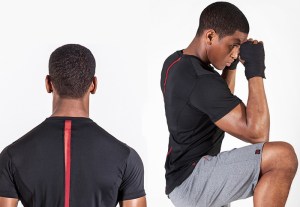
Strongbody Apparel spent almost three years researching and developing fabrics that can satisfy the fitness-driven public of tomorrow. The result is a product that combines enhanced functionality of active wear with sophistication of high-end fashion. Their unmatched innovative fabrics is suited with antibacterial nanotechnology—Chitosan, harnessed from crab and shrimp shells—that enables the garment to stay fresh over time, workout after workout, wash after wash, gym bag after gym bag.

“In Vancouver we wear our gear everywhere,” said Conyers. “We are always walking our dog. We are in coffee shops. We want it to be able to transition easily and be comfy wherever we are.”

There was a time when athletic wear in public was looked upon with the same distaste as those walking down the street in their pajamas. Now with a more active attitude towards fashion, wearing sporty apparel to run errands is the comfortable norm. Strongbody Apparel is reaching out to the market that grew up with athletic clothing and delivering a sense of practicality.

15209444254_b5db4fa0d9_b

“It’s like jeans,” says Conyers. “There used to be just Levi’s and now there are tons of higher end, smaller brands that are catering to a more educated consumer.”

Strongbody Apparel wants to be seen in a different light from those over-branded, neon coloured activewear seen on the racks of department stores. It doesn’t want to be another “knock-off” product. While big name brands have worked to build a slogan-spewing culture, Strongbody Apparel focused on innovation: breathable and moisture wicking, wrinkle and pill free fabrics, and zoned ventilation construction to name a few, earning the people’s trust in activewear back.

“We are the crossover of active wear into streetwear,” said Quincy Samycia, co-founder of Strongbody. “It’s one of those things that is happening that people don’t even realize it’s happening. We are on the front end of that and we are driving it home to people.”

Strongbody Apparel’s Kickstarter ends on December 4 and it has earned approximately $20,000, after achieving its goal with 24 days left.

Tired of the Bar Scene? Go to a 24-Hour Bookstore

I’ve never been much of a late night barhopping kind of guy; give me a nice book any day of the week—even weekends. And in Taipei, Taiwan, that is exactly how many people feel as well.

The Eslite Xinyi Store, a 24-hour five-story bookstore, is a haven for bookworms and night owls. People of all demographics are welcomed to sit around reading tables and simply enjoy their books in peace. No loud conversations, no heavy bass “unch-unch-unch” music, just the tranquil ambient sound of turning pages and soft classical background music.

Eslite Store. Taipei, Taiwan

In North America, books retailers such as Indigo and Barnes & Noble are still limping as they struggle to find relevancy in brick and mortar establishments. Starbucks, home décor, and other fashionable and eccentric items can now be found in bookstores as a means to sustain themselves financially.

But perhaps North American retailers can learn a lesson from their Asian counterparts. Eslite has turned their store into more than just a place for business; like a café, it’s a stylish place to hang out and chill. The all-day bookstore reported an approximate $425 million revenue in 2013, with 40% coming from book sales. In 2014, revenue is projected to increase by an estimated 8%.

Eslite has created a community where cool and intellectual people can gather, read, share ideas, and even flirt. Those in Taipei proudly compared the bookstore to New York’s SoHo.

While critics say that Eslite is in fact harming the publication industry by allowing hundreds of hours of free readings, a spokesperson for the store, Timothy Wang, claims it is the hospitable attitude of the company that enables success.

So what do you think? Would you like a bookstore open 24-hours around your neighbourhood? Will you be there at 3 a.m. reading the latest issue of Ricepaper Magazine?

So this is Christmas and what have you done?

Opinions_experiance not trash

Give a reason to remember this holiday season

By Elliot Chan, Opinions Editor
Formerly published in The Other Press. December 2, 2014

It’s been said over and over again, yet every year I still see aisle upon aisle of useless garbage in department stores and super markets. The annual exchange of knick-knacks and thingamajigs is the primary reason I get rather turned off by people’s behaviour this holiday season. I see them stressing out, spending money, and swapping items that serve no real function or trigger little lasting memory. It’s been said over and over again, but let’s try it again this year: give an experience, not trash.

The orgasmic thrill of unwrapping presents is a trait so human it might as well be related to the joys of eating; however, gifts do not need to be wrapped. We love unwrapping stuff, but more often than not, after you have left, the recipient of your gift will just have to “deal with it.” Room is limited, and presents quickly become garbage. Unless you are feeding your friends and families’ sick hoarding problems, you are giving them something they don’t need. And if they do need it, they’ll probably buy it themselves.

When I say, “give an experience” or “make a memory,” I don’t necessarily mean buying your friends, families, co-workers, or next-door neighbour a plane ticket to a tropical island; I mean you can take your friend out to lunch, take your parents to the movies, make dinner for your neighbours, or buy a case of beer and share it with your peeps.

It’s not about being frugal—it’s about being smart. I hate spending money knowing that it’s ultimately going to end up in the dump. I know when I’m giving a thoughtless gift just to keep face during the holiday season, and I know that other people do it too. I have nothing against those who claim that buying body lotions, coffee mugs, decorative soaps, holiday gift packs, satirical sweaters, or seasonal plush toys is an act of generosity, but please transfer those generous acts into something memorable or at least purposeful.

We always pretend as though Christmas is a one-day event, but it’s in fact a whole season. Few of us wake up on December 25 and unwrap gifts as if it’s a big spectacle. We have many days to celebrate, we have many days to share some experiences. All we need to do is trade in those hours we allot each year for shopping into hours we can share with the people we care about.

Make some food, plan a trip, take the time, and don’t give something that is forgotten by March.

Netra Wants to Save the World from Drowning in Imagery

“The world is drowning in imagery,” says Shashi Kant.

“We’ve generated more information in the last 48 hours than we had in all of human history leading up to 2004,” continues the founder of Netra Systems. “We are generating so much information, and the fact is 90% of that is imagery and most of it lies unexploited and inaccessible. That is a fundamental problem.”

Netra Systems is a visual search and tracking company designed to clean up the way we access our overwhelmingly large quantity of video and image-based content. Not just in our Instagram, Flickr and Facebook, but Netra Systems is hoping to alleviate the strain in numerous other sectors including retail, healthcare and security.

“When you think about it, Google just exploits text,” said Kant, “but imagine if we mine imagery in the same way and make it accessible and searchable.”

Netra Systems apply both machine-vision technology and a search engine style indexing. The algorithm breaks down a video by frames and tracks the blobs, which are the distinct objects within the frames. From there, Netra Systems identify the visual attributes of the blobs—should it be a vehicle, a cat, a human, etc.—it’ll note the colour, contour, texture, shape, etc.

Once the program recognizes the appearance characteristics of each object, it’ll give it a label in accordance to the most similar appearance. The “deep learning” will, for example, identify that within the image there is a blob that appears to be a cat, thus marking it as such. Then like Google, should a user search “cat” in the database, a list of plausible images will be presented in a search engine style result.

The capability of identifying imagery through an artificial neural network has a lot of potential for organization that focuses on little details. In recent scenarios as examples, Kant brought us back to the tragic events of the 2014 shooting at Parliament Hill, as well as the horrific incident involving the aftermath of the Boston Marathon bombing.

“One of our technology is what we call a multi-camera or cross-camera search,” said Kant. “In a retail store or in a surveillance camera, you typically only capture a small portion with a single view and there is no single camera that can cover the entire building. You need multiple cameras to follow the person and track from camera to camera. And that is the part where we really shine. And that is actually how we go and find the person.”

Organizations of all sizes invest a lot in cameras and machine vision, not only for security but also for visual data such as understanding high traffic areas within a store. By having a keen eye on a promotional item, retailers and suppliers can analyze customer’s engagement and propensity. The knowledge acquired will help merchants, managers and executives work together to make the best out of their retail space and the merchandise within.

When the topic of privacy implications arose, Kant responded with a question of his own: “Do you carry a cellphone? Between your cellphone and your credit card, if someone were to analyze that information they will know far more about you than looking at a camera and analyzing it.”

No doubt the visceral reaction to visual data is unlikely to change soon, however, we can clearly say that new technology and governance are being applied to keep us blobs safe when we are on the screen. Netra Systems offer a unique privacy protection that obfuscates images identified as humans in real-time. The original video will be recorded, saved, and retrieved only by those authorized, i.e. law officials.

Seeing the potential, investor, Mark Cuban signed on with Netra Systems in late 2013 after only 48 hours of email negotiation—no phone calls, no in-person meeting. “Machine vision is an area I have a lot of interest in,” Cuban wrote. “Its a big part of Motionloft.com and what we are doing there.”

When inquired about what excited him the most about Netra Systems, Cuban stated: “The ability to identify images with in a video from a connected database and their ability to apply artificial intelligence to video.”

“Plus the fact they are just damn smart,” he added.

Netra Systems is currently piloted and used by a number of major retailers and media and advertising agencies.

Scent of a woman

Sweet Peach Probiotics

Startup ‘Sweet Peach’ offers supplements to eliminate stinky vagina

By Elliot Chan, Opinions Editor
Formerly published in The Other Press. December 2, 2014

Up-and-coming startup, Sweet Peach Probiotics recently went under scrutiny for creating a product aimed to “freshen up” women’s smelly vaginas.

Before we go and slam Sweet Peach Probiotics as some sort of sexist organization telling women that they—mostly their vaginas—stink, let’s try to understand the biological elements of smell. Things that smell bad to us humans are repulsive because they also do us harm: rotting food, faeces, and even body odour. We are taught to throw away food before it spoils, we are taught to flush the toilet after we use it, and we are taught to take daily showers and brush our teeth.

True, it’s always a sensitive matter when confronting people about their stench. Most likely, they won’t even know that they smell bad. Inherently, we learn to appreciate our own aroma, the same way we appreciate our own uniqueness. We are constructed of a billion tiny bacterial organisms that generate our distinct odour. Bacteria, as you know, is not exactly Chanel No. 5.

As a man, I would never dare order a woman to take supplements to eliminate her natural body odour—not because I’m oblivious, but because I want to continue living. Natural fragrance is a sensitive matter, and although people should be proud of how they smell, it is also important to know when “things” don’t smell right.

A vagina (like a penis and anus) resides in a region of the human body that bacteria loves. The warm, dark, and sometimes wet area, if neglected, can become a marinating pool of microorganisms that can cause infection and discomfort.

I don’t believe Sweet Peach Probiotics is a glamourous product or a female-shaming initiative. Twenty-year-old student and CEO of Sweet Peach, Audrey Hutchinson tells us that it is a product aimed to solve a complicated health issue. It’s not about rejuvenated fragrance—or making vaginas smell like peaches—it’s about restoring a woman’s body into a healthy condition. “A vagina should smell like a vagina,” Hutchinson proudly declares in an interview with Huffington Post, “and anyone who doesn’t think that doesn’t deserve to be near one.”

Men and women alike have distinctive medical problems that can be embarrassing within our society. Instead of opening up and receiving assistance, we often choose to internalize it and hope it fixes itself, while avoiding the risk of being treated like a pariah.

Drugs and supplements may be a solution, but mitigating the risk is equally as effective. We already know the solution to stinky vaginas and other stinky parts of the human body: keep the area clean, and keep anything entering the area clean.