The millennial priority shopping lists

Photo illistration by Joel McCarthy

Five things you should purchase if you actually have money

By Elliot Chan, Opinions Editor
Formerly published by The Other Press. January 27, 2015

Youth is wasted on the young, but money shouldn’t be. I know we might be a little strapped for cash here at the moment, but that is not going to be the case forever. We have our five-year plan and all our investments are in order. No time to worry about the future. That’s why we should take advantage of our current disposable income. The question is, what should we actually spend it on? Booze? Rent? Food? Those are all legitimate options, but here are my top five purchases to make if you are lucky enough to get a sudden influx of cash.

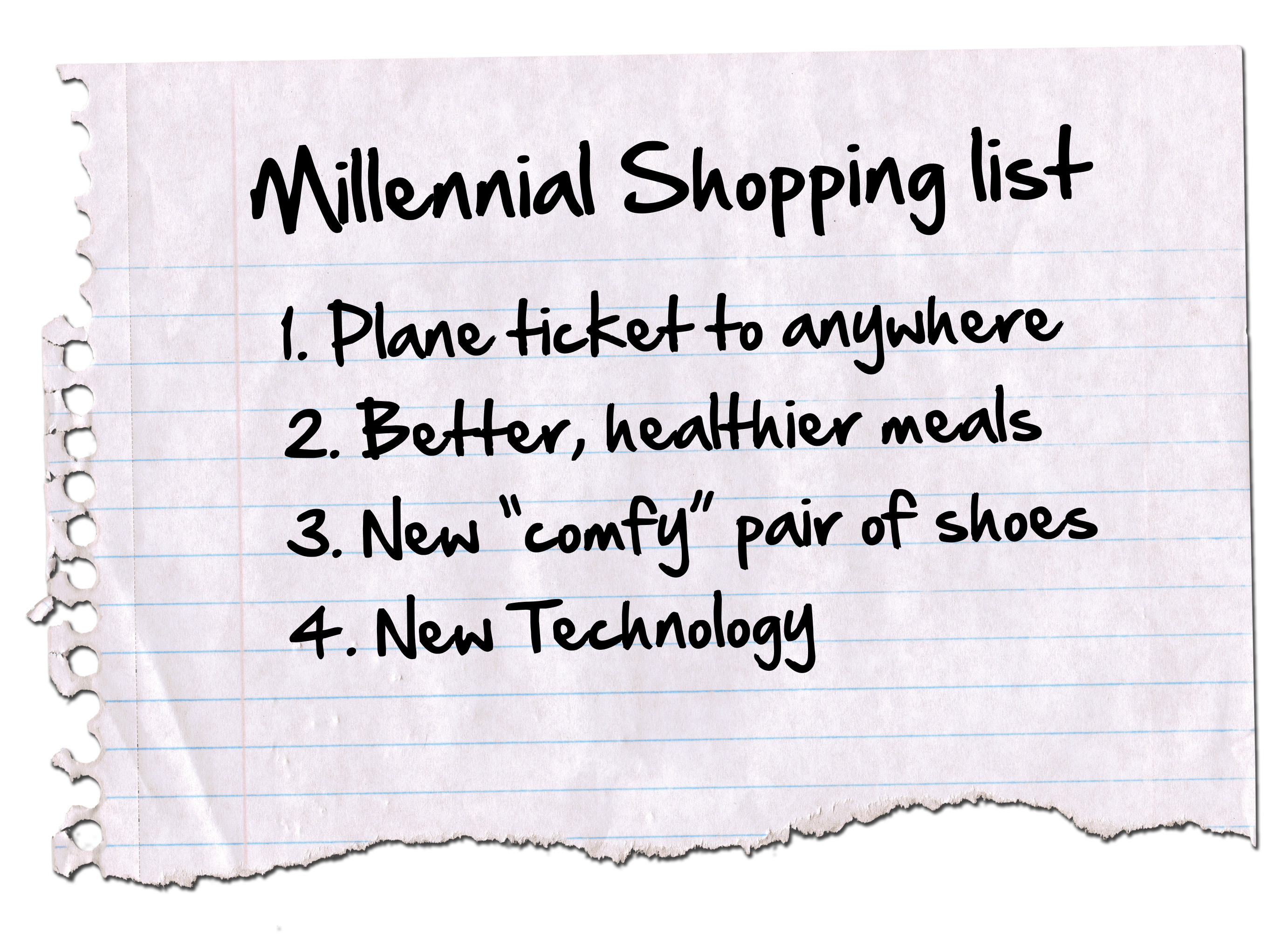
Plane ticket to anywhere: Any extra money I have I deposit into a saving fund dedicated to plane tickets and other traveling expenses. I’m passionate about traveling and I can’t imagine my life without the anticipation of another trip. Instead of spending money on more things around the house, I choose to go somewhere, see something new, and create worthwhile memories and experiences. There will come a day when I won’t get the opportunity to travel, but before then I want to see as many different places and experience as many different cultures as possible.

Better, healthier meals: It’s easy to get into the habit of eating poorly. Fast and unhealthy food is convenient and cheap and that is why we gravitate to it. When we receive some extra cash, why are we still making excuses not to eat healthier or fancier? Buy some vegetables or go to a restaurant that requires reservations. I enjoy fine dining as much as I enjoy McDonald’s. I have to tip more at one, and that is why I’m not a regular at Tojo’s, but I like treating myself and my friends and family to an evening of extravagance when I can.

New furniture (especially bed): Nothing symbolizes growing up like purchasing your own furniture. The day you decide to throw away your parents’ hand-me-downs and go shopping with the mission to create your own space is a monumental milestone that many people fail to commemorate. Obviously you can get by with what you have. You know, the couch from Craigslist, the table from your aunt’s garage, and the cheap, squeaky IKEA chair that pretty much grew up with you. I don’t care how sentimental you are, things get old, and you deserve new furniture that represents your taste.

New “comfy” pair of shoes: Few things in the world can guarantee to ruin your day: missed opportunities, regrettable comments or actions, and painful shoes. You might have one pair of shoes, you might have a thousand pairs, but what is important is that you have at least one comfortable pair of shoes. If you have one, then buy another one. Buy one in every style that you need. If it’s not comfortable, throw it away! Live a life where every step is enjoyable.

New technology: If you are the kind of person that says, “Yep, the Motorola flip phone from 2006 is still good for me, I don’t need smartphones,” then there may be no saving you. Technology is here to make our lives better. For it to improve we must continue using it, even as consumers. We must continue learning from it. We might not be the innovators, but we should be able to identify with the latest software and certain standards of technology usage. So buy a new desktop, buy a new tablet, and subscribe to digital media. There is a whole world out there waiting to be explored.

The cause of mass retailer extinction

Photo illistration by Joel McCarthy

Why Target, Sony, and other retailers may be missing the market

By Elliot Chan, Opinions Editor
Formerly published by The Other Press. January 27, 2015

Remember Zellers? I do, and that is why Target failed. The same everyday brands presented in the same everyday fashion with prices as high as any other major retailer. Target’s failure is no surprise to me.

I wanted to shop there, I tried to shop there, and on occasion, I have spent some hard-earned money there; nevertheless, I often found myself at Wal-Mart, Superstore, and Costco instead. There is absolutely no reason to choose Target over their competitors, except perhaps that it was closer to home. In my case, it was not.

Although Target’s demise is clear, the retail closure trend is a little scary. I hate to see Sony stores go, but I can’t remember the last time I went into one. Heck, I’ve been into more Disney stores than Sony. Another retailer that has disappointed me is the flagship Chapters on Robson. I’m going to miss walking through the four-storey space, killing time before an appointment, and never actually buying anything. I’ll miss that very much.

It’s obvious why those stores are failing, and if your behaviour is anything like mine, you would not be surprised either. The thing is, people still want to shop and browse, they just might not commit to a purchase or wait in line at the checkout anymore. Unless you have a unique product or a loyal customer base, you are going to have trouble surviving in our tough economy. New and old retailers need to understand the game: if you are going to take up space, you’d better have value.

Ask yourself this, what makes you go out to stores? Why are you choosing to buy something in person, instead of ordering it online? Why are you choosing that store instead of the others? The stores that are dying out are a part of natural selection. The power goes to the consumers. We’re at a crossroad and we get to determine which companies succeed and which fail.

As for brands, they can no longer act so big and arrogant. Any giant can crumble now. In a matter of weeks, a retail giant like Target collapsed. Whatever company that is taking over that retail space had better have a plan.

Canadian economics is a whole other ballpark and companies entering from the States must recognize the different culture. The next big brand to set foot in Vancouver is Nordstrom. I can’t wait to wander around their aisles, touch their fabric, acknowledge some of their employees, and then leave quietly out a random exit. Yes, I wish them luck—they’ll need it.

National egotism and propaganda

Photo by Keith Bernstein - © 2014 - Warner Bros. Entertainment

‘American Sniper’is an encapsulating project rooted in pride

By Elliot Chan, Opinions Editor
Formerly published in The Other Press. January 27, 2015

When Seth Rogen and Michael Moore voiced their opinion on American Sniper—the number one movie in January with over $100-million in box office over the long weekend—it was targeted at the machine that was America.

Rogen, accustomed to controversies, compared the highly acclaimed film to the third act of Quentin Tarantino’s Inglourious Basterds. One may remember the scene in which Hitler and his posse sat in a theatre, watching a movie with a sniper on higher ground taking out Allied soldiers. He said it without saying it; Rogen was pretty much comparing Clint Eastwood to Leni Riefenstahl and the American public to animals akin to Nazis.

Moore, the director of Oscar-winning documentary Bowling for Columbine, added in a tweet: “Only a coward will shoot someone who can’t shoot back.” A Japanese sniper killed Moore’s uncle almost 70 years ago.

The story of US Navy SEAL Chris Kyle, portrayed by Bradley Cooper, was a haunting one. Were we watching a film about a national hero or an international murderer? Either way, I believe it’s an honest war movie.

Of course, movies with a patriotic undertone have been a popular genre in cinematic catalogues since the existence of filmmaking. The original purpose of motion pictures was not just to entertain but also to persuade. How is American Sniper any different from the rallying war and disaster movies that made regular civilians feel empowered?

The criticisms aren’t directed at the performance or the movie itself, but the encompassing scenarios. Why is America hell-bent on murder, enough so to transform a normal man into such a weapon? What does it say about the current system of politics and recovery? How are we helping those transitioning from normal life to a life of war and then back again?

Although I agree with Rogen that the movie comes across as enemy-murder porn, and I understand where Moore is coming from, saying that heroes don’t gun down people from a hiding spot, I don’t believe that the movie is anything more than a reflection on the way we ourselves react to war.

Honestly, I enjoy movies that focus not just on the event, but also on the repercussions. I want to see the brutality of it. I want to see the broken relationships and the torturous anguish. I don’t want to see it glamourized like in many action movies. I want to watch a war movie and feel fortunate that there are those participating in such duties. And then I want to feel disappointed that I live in a world where we require people to participate, to enrol, to risk their lives, and to end the lives of others.

American Sniper, like many other Hollywood-produced war movies, has a clear identification of the enemy, but know this: not everything in movies is real. In fact, none of it is—they’re movies.

When I was young vs. Kids these days: Boy bands

boy-bands

By Elliot Chan, Opinions Editor
Formerly published in the Other Press. January 20, 2015

When I talk about boy bands, I’m talking specifically about the bubblegum pop genre. We are looking at the frosted tips, the heartfelt ballads, the cringe-worthy lyrics, the addictive tunes, and the incredible marketing mechanism that is boy bands.

When I was young

Around the time I was old enough to like girls, I was influenced by those that girls gushed over. Professional athletes, Nickelodeon teen sensations, and of course, “musicians.” How can I be more like Justin Timberlake and Kevin from the Backstreet Boys? That was the question that kept me up at night. Naturally, I reached high school before I found the answer and the ultimate quest was lost forever.

Boy bands shaped my life (significant is the wrong word) in significant ways. The fact that I once idolized them on television and purchased their cassette tapes says a lot about the power of mass media. Like Pokémon cards and Pogs, I fell for it; I had to keep up with the stupid Joneses. I was tricked.

Rounding out the end of my teen years, whenever a classic ‘90s boy band song came on someone else’s iPod, I’d cross my arms and protest, “Nope, this isn’t me anymore, this is not what I like now.” I was ashamed. The stigma of appreciating pop music for what it was made me self-conscious. But it remained a guilty pleasure.

Then I got a bit older. And set my iTunes on shuffle. Randomly, old favourites started to play. It was the same garbage but I had a different frame of mind. Like looking at old photographs and being embarrassed, but also seeing the importance of them. This was my history. I once found pleasure in this, and nobody should take it away from me.

Kids these days

Sometimes I find myself mocking the younger generation for new boy bands like One Direction. It sometimes hurts me viscerally just to think of them. I guess the problem with getting older is that I witness the mistakes I have made before repeated by someone else. I see the same delusion of grandeur in the eyes of young boys and girls watching the latest music video I had when watching “Bye Bye Bye” for the umpteenth time.

Still, times have changed significantly; the ‘90s boy band craze has diminished significantly. The bubblegum pop bubble has burst. Boy bands today are predominantly from the UK and other international markets. The selling value of boy bands has become a harder enterprise. After decades of satire and parody, boy bands have lost their trendiness. What replaced it? Solo artists.

Justin Bieber, Nick Jonas, and—why not—Bruno Mars show that it is now easier to promote a solo act than a group. Unless every member is playing an instrument, boy bands have no reason to be. To say that kids these days are dumb is untrue. Even they know that backup dancers and singers should not get the prestige of stardom. There is a lot of music today. It’s not easy being a Lance Bass or a—you know, Kevin from Backstreet Boys any more.

When I was young, boy bands started a movement, but the capitalist machine saturated the market. Kids these days are still being fed the same jumbled-up tunes, just with slightly different packaging.

You don’t know how I feel

You+are+not+alone+_088679e528878caeb5f6d572c333a081

Don’t trivialize others’ sadness and depression with rhetorical comparisons

By Elliot Chan, Opinions Editor
Formerly published in The Other Press. January 20, 2015

Whether I’m feeling good or bad, you won’t understand my emotions. You won’t understand the reason for my elation or the cause of my sadness. You won’t understand how frustrated I am or how much pain I’m going through. Obviously you’ve felt these feelings before, but you do not know how I feel. Even though you think comparing your trials and tribulations, adversities and injustices, and triumphs and errors will cheer me up or make me hopeful, it won’t. It just trivializes my pain, making it virtually irrelevant in your mind, thus not really a problem at all.

A common human response to someone else’s tragedy is to relate it to our own. Sometimes it evokes empathy, like when we watch a movie and we cry. However, sometimes that response can come across as ignorant, self-indulgent, and dismissive.

“I’m sorry your parents passed away. I know how that feels; my dog died when I was 12. It was very hard for me.”

Such a comment, for example, may be designed to offer condolences and a parallel experience of sorrow, but it never comes across as such, especially to the person in grief receiving it. Even though we’re constructed to wince when someone else is in pain, we can never feel the exact pain. The suffering is always channeled through our own body. We can never be someone else; therefore, we will never know how others feel.

Now that we have established that the saying, “I know how you feel…” is a poor response to an open-hearted discussion, what is the proper reply?

Every situation is unique and should be treated as such. Above all else, don’t be an emotionless robot with rehearsed dialogue for emotional situations. I tell you this because I struggle with it. I grew up as an only child, and calming people down or cheering them up have never been inherently strong traits of mine. But see, most people don’t want to be calmed down or cheered up, not in a blatant way at least. They just want someone to listen.

Be attentive and understanding. Understanding means that you don’t know how someone feels, but you get it. You hear their pain, you recognize their anxiety, and you understand their stress. Allow them time to vent. Don’t interrupt with a funny anecdote. It doesn’t matter. Make every question a supportive one that allows them to unload their burden. Don’t give space. Giving space, in the griever’s eyes, appears to be avoidance and may be more hurtful in the long run. Stay. Listen. And respond positively and lovely. It’s not going to be pretty, and it’s not going to be solved in a moment or two, but if the person chose you out of all the people in their lives to express their emotions, you should feel honoured, not encumbered.

Friends and family stand by each other during hard times. They should not trivialize grave matters. They should acknowledge them. Embrace them. Shine the spotlight on them. And then allow the grieving process to move to the last stage of grief. Acceptance.

Stars without a purpose

 Rádio-Expres-Hlasujme-spolu-za-Jara-Haláka-do-NHL-All-Star-game-2015-1024x632

Give the NHL All-Stars something to play for

By Elliot Chan, Opinions Editor
Formerly published in The Other Press. January 20, 2015

The format for selecting the top players to be involved in the annual NHL All-Star Game and Super Skills has been an experiment for many years. Fan voting, player drafts, and the executive choices from the NHL have all been tried. Not that the games themselves have any merit except a little bit of bragging rights for the players and some excitement for the fans. The selection process is often more surprising than the actual event itself. With all that being said, how can we give a little more life to a game that doesn’t matter?

From the old-fashioned World versus North America to the current Eastern versus Western Conference battles, we always see some key players left off the roster. With the fans in charge of selecting the top six players in each respective position this year, we can see a huge flaw within the voting system. Five out of the six players voted are from the Chicago Blackhawks and one player from the Buffalo Sabres. The NHL then went on to select the remaining 36 participants.

This fan voting system, however, leads itself to some less-than-serious picks. Nothing against Zemgus Girgensons of the Sabres (who?), but with over 1,500,000 votes, beating out players with double his point total, I must say he is occupying a spot that doesn’t belong to him. Thanks, fans! This reminds me of the year where the Canucks’ Rory Fitzpatrick nearly earned himself a spot on the All-Star roster with the help of fan voting and a Twitter campaign. Fitzpatrick was well-liked, but far from All-Star material. The conspiracy is that the NHL stepped in and voted Fitzpatrick out near the tail-end of the voting process.

Another problem just happens to be a publicity ploy. A fantasy draft format will take place on January 23 to decide the two teams. Nick Foligno of the host city, Columbus, will be the captain of one team and Jonathan Toews of Chicago, the captain of the other, will vie for the best suited players, or their own teammates and friends. As proven from the past years, this is a popularity contest and less of a serious team construction.

All-star games, currently jokes masqueraded as sporting events, could have some value. The MLB puts pressure on the game by giving playoff home-field advantage to the team that wins. The NHL could use this. Here’s a hypothetical example: if the Eastern Conference wins in the All-Star Game last year (if there was one), then in the Stanley Cup Finals, the New York Rangers would have the home-ice advantage instead of the LA Kings because of the All-Star Game victory, even though they were both seeded forth in their conference.

The All-Star Game is often a lacklustre event, full of showboating and antics. It’s barely a hockey game. Sure, the MVP gets a new car or something and the winning team gets a celebratory pat on the back, but what’s the point? Make them play for something.

The games should be about building an elite team to compete for an advantage that will come into play when it really matters. I agree that it would be a shame if a player were injured, but hell, I want to watch hockey, not figure skating!

Don’t let the sound of your own wheels drive you crazy

Opinions_dont burn out

Take it easy and don’t burn out too early in the year

By Elliot Chan, Opinions Editor
Formerly published by The Other Press. January 13, 2015

Pace yourself. For those who are working and going to school, taking a break periodically at the start of the year can do wonders. Let’s be honest, the holiday season is not as relaxing as you would have wanted it to be. In fact, some might say that running around, buying gifts, attending parties, and mingling with old friends and familiar relatives is as stressful as a communications project. Now that you are back into the groove, take a moment, breathe, and relish in the start without anticipating the finish.

If you have chronic stress or if you don’t want to develop it, there are few things you need to do: avoid exhaustion, stay motivated, dismiss cynicism, and get cognitive rest and take care of yourself.

We often overload our schedule early in the year or try to harness the momentum that dwindled a bit after the festivities. There is a bit of holiday hangover though, so although we are optimistic, we must also be realistic. While some people are busy making New Year’s resolutions, you may consider taking a break. Ease up, allow yourself time to soak in the new environment, new classrooms, new responsibilities, and new opportunities.

Why do we burn out in April when it’s exam season? Why do we feel overwhelmed and stressed? It’s because we weren’t taking care of ourselves earlier on. We weren’t preparing ourselves properly. Once activities and assignments pile up, there is no time to rest, but there is plenty to stress.

Instead of doing frivolous work or starting anything new, consider how far you’ve come since the previous year and maybe reassess your goals. Mark milestones you would like to hit throughout the year and plan. Planning an event in May will give you energy in March, so even if you start burning out in the latter half of the season, know that you’ll be rewarded by someone who cares: you.

Relaxing is serious business. While the grind up ahead seems daunting and preparation is a must, relaxation is the act of staying attuned with your body and mind. A body builder doesn’t go to the gym every day and doesn’t work the same muscles every day. Neither should you.

Trust in yourself that you will survive this year with grace. Exemplify vitality. Don’t beat yourself up for having a day where you get to sleep. Not every day needs to be productive, especially early on in the year. You’re about to climb a mountain, a mountain you have climbed many times before, a mountain that lasts 365 days. Look up, visualize all that you want to accomplish, and then take one step at a time. Most importantly, don’t forget to enjoy the view.

Lighthouse Labs Bridges Digital Literacy Gap with HTML500

Coding is a universal language; however, many find it daunting, confusing, or overwhelming. Like learning all new languages, the best way to become skilled is to engage with it socially. That is the environment The HTML500, a free one-day coding event hosted by Lighthouse Labs, has established.

“When you are learning in a room with 499 other people who don’t know how to code and being helped by 100+ mentors,” said Jeremy Shaki, co-founder of Lighthouse Labs, “the energy is fantastic and the room is engulfed by this buzz of people who want to learn and are seeing the instant results of their learning.”

The HTML500 will kick off 2015 in four Canadian cities: Vancouver (January 24), Calgary (January 31), London (February 7) and Toronto (February 22).

The value of coding stems further than getting a well-paying job (Canadian programmers can make over $50,000 annually), it can also give people the confidence to create projects that change the way we live.

Although coding is often recognized as a young person’s game, the best coders are those who are curious about technology and strive for logical solution-oriented thinking. The 2014 The HTML500 welcomed attendees ranging from 13 to 65 years old.

“Fluency in code for a non-developer can empower them to make their own lives and work more efficient,” said Khurram Virani, co-founder of Lighthouse Labs. “Personal and professional websites, macros in Excel, desktop and mobile apps are some common examples. At work, it will help them communicate better with their developers. And lastly, learning to code and coding can also serve as a great creative outlet.”

For many years, those who were interested in coding had to seek educational workshops and tutorials independently through online sources such as YouTube or apply to post secondary programs and private institutions. Few classes in elementary, middle and high school deal with the in-demand skill set in depth. Students will rather stumble into it or take initiative if they want to pursue programming and tech.

“A great, but telling, story from my partner Khurram is that when he was in Grade 10 he ended up essentially teaching his Computer Science class because the teacher was trying to teach something they didn’t understand,” said Shaki. “That’s still a reality in a lot of schools, and the only way to combat that is to bring awareness to the opportunities coding presents both the individual and the classroom and the ease of which it can be taught at basic levels.”

“The tech industry as a whole is rapidly growing,” said Virani, “resulting in higher demand for coders and there aren’t enough of them out there because as a country, we still haven’t placed a priority on digital literacy. If we are to support the growth of our tech industry here in Canada, we need to start teaching code in schools as a basic part of literacy.”

With numerous job opportunities in mind, The HTML500 encourages attendees to bring along their résumés. After the event in 2014, the organizers discovered that many companies were interested in hiring people for non-technical roles. This year, The HTML500 has partnered with Vancouver Economic Commission to host a career fair at all four events.

“If you think about what many tech companies are looking for when hiring for non-technical roles,” said Shaki, “they are seeking self-motivated people who strive to grow and learn, and who show an interest in tech. With all these participants giving up a Saturday to come and learn something on their own, they are checking off some key checkboxes as marketers, operations people, HR staff, etc.”

Companies participating range from startups to corporate companies, including some establish brands such as Techvibes Job Board regulars Hootsuite and Unbounce.

A one-day event is obviously not enough to tech everything about coding, but The HTML500 is hoping to give the attendees some comfort and confidence, in addition to creating a community for developers of all level.

“We strongly feel that everyone should know the fundamentals of software and how computers work, regardless of their profession,” said Virani. “The current education system has yet to consistently and sufficiently teach coding in schools so we decided to create The HTML500 as a great way to have companies and the developer community come together to bridge the digital divide.”

Honouring ‘Charlie Hebdo’ and freedom of speech

Firefighters carry a victim on a stretcher at the scene after a shooting at the Paris offices of Charlie Hebdo, a satirical newspaper,

Where the line is drawn and where it is crossed

By Elliot Chan, Opinions Editor
Formerly published in The Other Press. January 13, 2015

The hostile take over of Charlie Hebdo, the French satirical left-wing magazine, and the massacre of nine employees and two National Police officers reminds us of the thin barrier protecting our freedom of speech and the fine line between poking fun and instigating attack.

The senselessness that occurred on January 7 gave strength to what many agree to be a dying medium. Publications across the globe banded together to acknowledge the bravery of those cartoonists who died so that we may continue to speak our mind and express our opinions.

Newspapers, magazines, and various other publications that hold the mirror upon society, showing all the blemishes, scars, and corruption, are the vehicles for democracy. Without them, without freedom of speech, without public and private institutions to speak up, we are doomed. And for that reason alone, I honour those who have lost their lives over the years—CharlieHebdo included—for our right to express ourselves.

Yet, such ruthlessness cannot be ignored. Forthright as I am, I am not eager to die for my craft. So I must ask, where is the line I must draw for myself? How will I know when I have crossed it? When should I cross it?

Those who know me know that I only view activism from the perimeter. I have yet to determine my stance. Should I fight against corporate giants like Kinder Morgan? Should I challenge government discourse, like those in Hong Kong did last year? Should I rally for legalization of marijuana? I know at some point I’ll have to pick a battle, because those who stand idly by give power to the enemy, whoever it is.

So I ask us all: What are we willing to die for? What change in the world do we wish to see for the next generation? What have we inherited from the sacrifice of those before us? Take a moment to learn about our history, whatever realm you are interested in—art, politics, civil rights, etc. You will find that what we have did not materialize overnight; what we have came from battles hard-fought. Unlike a war, but still a battle with casualties.

We should arm ourselves with open-mindedness and good intentions. We should not talk or write with the goal of being accurate, but with a whim of curiosity. Societal issues lie in a grey area.  What is right in our minds may be wrong somewhere else. We as artists, journalists, comedians, filmmakers, and other influencers must set the example. We too must not be close-minded. We too must see from our opposition’s point of view, understand where they are coming from, and why they are willing to risk their lives to defeat us.

Let’s harbour discussion to create a better world—one without intentions to provoke, one without intention to kill.

Paul is dead

51st Annual GRAMMY Awards - Backstage and Audience

Relax, Kanye West fans will find out who Paul McCartney is sooner or later

By Elliot Chan, Opinions Editor
Formerly published by The Other Press. January 13, 2015

On New Year’s Day Kanye West and Sir Paul McCartney released a new song, “Only One,” in anticipation of West’s seventh album. Although this should have been an occasion of excitement, it turned into an Internet uproar of ignorance. West fans—perhaps in jest—asked, “Who is Paul McCartney?” and other questions suggesting that West is “shining a light on unknown artists.”

At my age, the notion of anybody not knowing who McCartney is or about the Beatles is insulting, perhaps more insulting than the cheap auto-tune song itself. If the statements are meant to be sarcastic then I’ll laugh along (because I get jokes), but a part of me is withering inside.

Those who are clueless to the Beatles are like people who have never seen an episode of The Simpsons. How?

For me, I went through the Beatles phase around high school. Before that, I thought it was music for old people. And if that was the case in the early 2000s, then “Let It Bet” must seem really ancient now. But there is a timelessness to the Beatles’ music, and that is why I feel it’s in a genre of its own. Like punk, blues, or electronic music, the indulgence in that art represents a phase in our lives we can revisit; the same goes with the Beatles.

I remember the first time I heard “Yesterday”—albeit it was during the Mr. Bean movie. I remember how I felt when I heard “Here Comes the Sun” and tried to replicate it on every instrument I had. Then I remember hearing “Revolution 9” and thought, now this is getting weird (drugs?). Unlike a lot of other artists, the Beatles were the soundtrack to early mornings, long nights, road trips, homework sessions, and many other scenarios. Then I grew up and I watched as the next generation discovered it; I realized that I was a part of a chain.

Not everybody listens to the music I like these days, and oftentimes I have to defend my taste. But people are drawn to the Beatles; everybody knows how their tunes go—even if they hate them. Whether it’s your cup of tea (British slang) or not, the Beatles are like Stephen King. They have influenced everybody in one way or another, but nobody should say, “Stephen King is my favourite author.” That’ll just make you look uncultured.

Like learning about history, the Beatles may be shoved down some young people’s throat. That will cause resistance for sure. But if they allow it to digest and savour what it really is, perhaps there is hope that the future will continue listening to the Beatles and McCartney without the help of a modern day artist or being sampled in a rap song.