The right to bear religious symbols

Opinions_Religous-attire

Attire, accessory, and attitude don’t change your religion

By Elliot Chan, Opinions Editor

Formerly published in The Other Press. Oct. 2013

How does one practice their religion? Do they practice in their house, church, temple, or cathedral—or could they do it while commuting to work? Surely they don’t practice at work, right? Of course I’m talking about Quebec’s charter of values and how, if it passes, civil servants will no longer be allowed to wear religious articles of clothing including turbans, kippas, and overt crucifixes.

Religion has played a large role in my life, and it’s not my intention to argue against it. I’m not against religion. In fact, I wish I had faith. Sadly, although I was brought up as a Buddhist, I cannot honestly call myself one.

What I do want to express is a social commonality. That doesn’t mean tolerance or intolerance, or being anti- or pro- anything; it simply means a culture we can all agree upon.

For example, my father is a smoker. When the regulation passed to have smoking banned in public areas, he became a monster and he’s not—he’s just a dude trying to relax. People who wear religious articles aren’t monsters either, they’re simply expressing their faith and practicing a tradition that they’ve known since they were young. It upsets some, but so does a bit of cigarette smoke.

“Suck it up,” some smokers said initially—the same thing those advocating religious symbols in public sectors are saying now. “It’s not harming anybody.”

Harm is not the point. Commonality is the point; a mutual understanding is the point. If you entered an Asian person’s home, you would graciously take off your shoes. That’s a custom and an understanding. Your shoes are clean and it doesn’t hurt anyone for you to keep them on, yet you do it out of respect.

Canada has an ambiguous culture. It’s more of a mosaic than a mixing pot, and different communities have different conventions. That’s great, that should be cherished, and people should be delighted that we have such diverse communities.

But we need commonality as well to help establish a general culture as our cities, provinces, and country continues to grow. The mindset of Quebec isn’t to alienate. Instead, they’re trying to develop a central place to bring everyone together, where everyone feels welcome, and where no animosity is displayed. This is a good thing. And this is the first step towards having a province that really understands itself. It might feel ruthless, but in generations to come, you’ll see that it’ll bring them closer together.

I worked at Starbucks for over a year and I had to wear a green apron. I wasn’t thrilled, because green isn’t my colour. But I was under Starbucks’ roof, I was being paid Starbucks’ money, and the Starbucks customers recognized the standards—that was how they knew I worked there. It didn’t make me who I was, it didn’t change my beliefs that capitalism is just another form of slavery, but I accepted it because that was the corporate culture.

We might think that commonality is harmful; that it will cause us to lose our heritage and roots, but I believe it’ll help us to understand our history better. Why do we do certain things “just because”? Commonality allows us to question our traditions, habits, ethics, and values and ask the ultimate question: are we doing the right thing? Am I actually less of a person—less myself—if I go without certain things? Does it benefit the hive and not just the honeybee?

All through life, I have mistaken my wants with my needs. I get my priorities mixed up, and I feel many others have as well in regards to this religious symbols debate. Your ideals don’t have to change, your personality doesn’t have to change, and if it helps the general population approach civil servants with ease, I don’t see why they shouldn’t appeal to them. After all, have a little faith.

Art attack

 Bad-Artist

Judge the art, not the artist

By Elliot Chan, Opinions Editor

Formerly published in the Other Press. Oct. 2013

I always wonder what Hitler would have created if he had made it into that art school.

All throughout history, bad people have created brilliant artwork. There doesn’t seem to be a correlation between artistic ability and common courtesy. Musicians, painters, filmmakers, and all other artists are just average people, and people are complicated creatures. Sure, we might condemn a person for an unforgivable act, but is it right to boycott or banish the art they produced? Are we horrible people for enjoying the work of monsters? Shouldn’t the work of art have a life of its own?

In modern times, there are several despicable individuals who have created such a substantial body of work that we cannot help but admire. The first that comes to mind is Kanye West. Although I don’t know the man, I do know his work and his reputation. His arrogant persona often makes entertainment headlines and causes a stir. I for one don’t care how he behaves or what he does, as long as he continues creating evocative and enjoyable music. His 2010 album, My Beautiful Dark Twisted Fantasy, is one of my favourite albums, and I couldn’t imagine it without the hit single “Runaway, where Kanye acknowledges the fact that he is a douche-bag.

In 1977, Roman Polanski, director of classic films including Chinatown andRosemary’s Baby, was arrested for raping a 13-year-old girl. Fleeing from America to France to avoid imprisonment, Polanski went on to direct some of the most thought-provoking films of the past three decades. The Pianist, which received theatrical release in 2002, still remains one of my favourite World War II movies. Polanski was detained when he tried to attend the Zurich Film Festival in 2009, where he was to receive a lifetime achievement award for his work.

Anti-Semitism and racism have been the muses of many artists throughout history. From the works of Joseph Goebbels to TS Eliot to DW Griffith, all have had an impact on history—despite their bruised reputations.

Goebbels developed some of World War II’s most appalling and brilliant pieces of cinema, all of which were used in some form or another as wartime propaganda. He was therefore known as one of the most influential people during the Third Reich.

Many consider TS Eliot to be one of the greatest poets of all time, but that doesn’t mean he didn’t find inspiration from his prejudice. In a piece entitled “Burbank with a Baedeker: Bleistein with a Cigar,” Eliot uses a classic stereotype to compare the Jewish people with vermin: “The rats are underneath the piles. The Jew is underneath the lot. Money in furs.”

My last example is DW Griffith, who was best known for directing American masterpieces The Birth of a Nation and Intolerance: Love’s Struggle Throughout the Ages. The silent films made in 1915 and 1916 told the stories of the American Civil War, but through the eyes of Griffith’s racist ideals. Although the Old South bias stained the cinematic experience, the movie led the way in filmmaking and storytelling innovation and changed cinema for the better.

It seems as though art is a lawless occupation, where quality entertainment offers immunity. In a world where any other professional would lose their job, an artist can survive, because creating art is akin to creating life—the art lives on honestly, while the hateful person dies shamefully.

The shame game

Opinions_Drinking-games

I’m just here to drink

By Elliot Chan, Opinions Editor

Games aren’t my thing, but I do enjoy company and a beverage now and then. I’m what you call a passive social drinker: I don’t care what you do, but let me do what I want to do. Hopefully I won’t ruin your good time and you won’t ruin mine.

I’ve never understood the purpose of drinking games, because I came to drink, not to prevent myself from drinking. The argument is that people who play drinking games tend to get drunker. I don’t necessarily disagree, since it’s house rules, so BYOB. But it’s not my intention to simply get drunk.

When a game of King’s Cup or I Never breaks out, I sit to the side while other partygoers try to wrangle me into the group. Eventually, I’ll notice that everyone has gathered around a table or in a circle on the floor, scattering a deck of cards around. I give an exasperated sigh and express my lack of interest. I continue to receive indignation and encouragement from the group, but I can feel their loathing.

I have two options now: to be alienated from the party, or indulge my friends in a game I want no part of. Feeling like a sourpuss, I always choose the latter.

I don’t really care for games. They stress me out and cause me to think, which is the last thing I want to do when I’m relaxing with company, enjoying a conversation, and consuming alcohol responsibly. Now, I’m not saying I’m against drinking games; I don’t care what others do. Just because I don’t want to participate doesn’t mean I should be shunned for being a spectator. I conform to many things, but why should I spend my precious free time doing something I don’t want to do? I appreciate the invite, but I respectfully decline. Competition is fine, just not while I want to relax.

To me, sitting idly by is more enjoyable than trying to think of something I’ve never done, or remembering what rule correlates to the six of diamonds. The worst part about being a passive social drinker in a drinking game is that I will always end up being the loser, because I don’t pay attention. I forgot to put my thumb on the table or I miss a rhythm—whatever.

But drunks are hard to convince.

A simple solution: if you want people at your parties, don’t force activities onto them. This extends further than drinking games: if you want lasting friendships, you shouldn’t shame others into doing what you want.

I’m aware that I’m not the most valuable person at a party. I bring a six-pack and a bag of chips and mingle—that is my ideal party. It’s what I want to do after a long week of work. Let me have that without stressing over Truth or Dare. Please, let there be a mutual understanding. Because, hey, I don’t force you to come to karaoke night, do I?

Facebook down

Opinions_Facebook-blackout

The effects of a social media blackout

By Elliot Chan, Opinions Editor

Formerly published in The Other Press. Oct. 2013

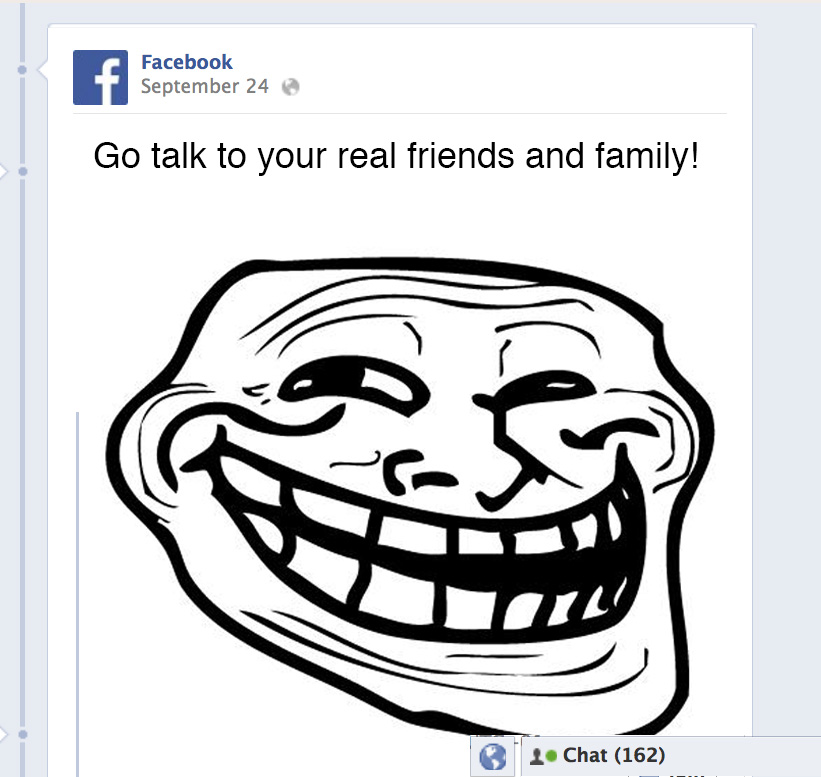
On October 21, Facebook users experienced a brief outage caused by network maintenance. Although recovery was swift and the team at Facebook was quick to apologize, I couldn’t ignore the uproar of such an occurrence. Am I crazy to be concerned about such a minuscule problem?

I need to step back for a moment and remember my life before social media: before Twitter, LinkedIn, Myspace, and even Nexopia. I was a 14-year-old high school student waiting patiently for a phone call on a Saturday afternoon. I was in grade eight, procrastinating over homework by watching television and taking naps. But how would I behave now, a decade later? Would my life be any different?

Facebook is more than just a tool to communicate with friends and plan events: businesses use it to market, and people use it as a news source. There is a lot of other noise buzzing about on social media, like adorable cat pictures, inspirational quotes, and public displays of affection, and these would be the greatest loss; Facebook allows us to share little slices of life any time we want.

Social media is a casual means of communication. Phone calls have become too intrusive, emails feel too professional, and meeting in person is too time-consuming. For me, the first real consequence of social media’s demise would be a sudden increase in text messaging.

As time passed and Facebook remained broken, I’d begin to lose contact with certain people. Those “friends” and “followers” who aren’t affecting my real life would fade away. That random girl at the bar, my science fair partner in high school, and the manager at the restaurant where I worked for a few months one summer would all be gone. You might be a “friend” on Facebook, but if you don’t have my number, we’re not really friends in my book. Sorry.

Because of social media, the act of verbally catching up is virtually obsolete: job promotions, new relationships, and exotic vacations are all displayed online for everyone to see. Without this, people at parties would spend more time indulging others with “what’s new,” and less time simply saying, “Oh, you know.” No, I don’t know—how would I know?

There is no doubt that my Facebook persona is much cooler than the real me. That’s because I only publicize good things. I have full control, where I don’t have full control of real life. The Internet is a marketplace and I’m the brand. I have to make my Facebook page cool. I go on trips and take photographs, I share interesting content and creations, and I interact with my “friends” even though I barely ever get to see them. I make all those things happen.

I’d like to believe that without Facebook, I’d still act the same. To me, the platform is nothing more than a scrapbook. Sure, it’s nice to look back and see what other people have been up to, but I’d rather look ahead. Because in the future, there might be a solar flare that would erase all the material online—then what will we “like?”

Revo Mortgage Collaboration System Helps Brokers Close More Deals

Formerly published in Techvibes. 

The old survival tactics of mortgage brokers used to be an independent way of living: brokers venture out of their office, find clients, secure a deal, fill out the paper work and follow up—essentially the broker will be in charge of everything start to finish. The new way of living is different.

Today the mortgage broker industry is a team environment. And Calgary-based Revo Mortgage Collaboration System is a new dashboard platform assisting all team members in communicating effectively and staying organized.

“Mortgage brokers are hunter and gatherers,” explains Philip Slen, president of Revodoc Inc., in an interview with Techvibes. “They bring in the business and in house assistance, underwriters or administration will take care of the rest. That frees up the mortgage associate’s time to have more customer face-time, more sales activities to generate more business and to do what they do best, which is selling mortgages and advising customers—instead of being tied down with paperwork.”

“Our system came about because there are no tools to help them collaborate on deals,” he added.

Deals get passed around from one member of the team to another, then back to the clients and then handed off to another member. Often times with no successful way of organization, certain works get lost or misremembered. Revo is designed to keep every member associated with the deal in the loop. So when the customer calls in, the brokerage team will have the information at the fingertips, instead of having to deal with the heinous chore of ruffling through file folders.

Security is a prime concern for most mortgage brokers and emailing documents is not always the wisest choice in communication. The Revo platform enables brokers to send customers secure-links, which will allow the customer to access information, not as a downloaded source, but from the actual deal.

Each deal, condition and customer is different, so that makes communication key. Important notes are taken all through the process and brokers will now be able to use Revo to underwrite these key information where applicable so that in-house underwriters and assistance will already have that information captured.

“There has been origination systems for a long time, but those are just systems where you route your application to a lender,” says Slen. It doesn’t allow you to do anything more; there is no workflow, no progress tracking, etc. It makes it very difficult for the brokerage team to collaborate when they are working on deals.”

Revo jumped upon the demand and created a standard for mortgage brokers. Before this platform has been created, Slen had noticed that many brokers were simply using different systems to address different situations, such as using Outlook calendar to send reminders or Excel spreadsheets to do tracking.

“Whatever database they have,” notes Slen, “they create it on their own. The tools are really only for proprietary use. It’s not an enterprise system that is cloud-based where everyone can have access. Our system allows them to grow and scale without having any influence with IT.”

Many consider mortgage to be a complicated undertaking and there is often gratitude for those who can simplify the task—Revo Mortgage Collaboration System may create many grateful brokers in the future with their workflow and organization system. After a brief tour through the dashboard I noted the many different conditions and categories to handling a mortgage deal, as well as the importance of clear, concise communication.

Got too much on your plate?

 Opinions_too-much-on-plate-1

Save some room for dessert

By Elliot Chan, Opinions Editor

Formerly published in the Other Press. Oct. 2013

So now you’re popular; or at least, people are starting to expect more from you. Responsibilities, commitments, deadlines, schoolwork, part-time jobs, and relationships. When you do have free time these days, it fills up pretty quickly. Nobody has to point it out to you—after all, you feel it from the strain of carrying the world on your back—but they do anyways: you look tired and it can’t be ignored. How did this happen? How did you get so much on your plate?

It’s not a question of how, but rather a question of why. Those with too much going on have made a conscious choice to say “Yes” more, and by doing so, they’re receiving more opportunities. The result is far from the worst-case scenario. Sure, you’re thrashing about in the deep end, but what better way is there to learn to swim? Don’t be distracted by the competition; you set your own bars in life.

You are being productive and there is a clear path of progress, but the weight of it all can be damaging. You want to do more, but you’re afraid the standard of your work and the quality of your relationships will diminish, while the amount of rest you get will start depleting. Don’t panic yet: the crisis is all in your head.

Pick your battles. You’ll want to do everything, and that’s respectable, but sometimes it’s impossible. Prioritize your work, and ask yourself what’s most important to you. Sure, money and reputation are important, but it’s still your life and you get to determine how it plays out. Do you want a promotion at work or do you want to ace an exam? Do you want to spend more time with the family or do you want to earn a little bit more for a vacation? Understand what you are working for: by having a clear goal, you can then choose the most pertinent task and accomplish it. Focus on one thing at a time, and if work falls to the back burner, acknowledge it, communicate it, but don’t ignore the loss; someone is always willing to help you or forgive you, as long as you vocalize your issues. Your passion will decide what is most important—not your friends, family, instructors, or employers.

Covering your ass is not a bad habit. A little safety net while you work can help reduce stress. Always communicate with clients, employers, and everyone else in your life. Update them on the progress of work—honesty is the best policy. If they don’t appreciate you then, in my opinion, they aren’t worth working for or hanging around with. Keep the onus on you, and don’t be pushed around by others. Work hard, but do it because you want to do it, not because someone else demands it.

Treat yourself, because after a long day of toiling, you’ll need to recharge. Take a breather or a day off. Work and school are important, but you need to find time for friends and family. Watch a movie, go on a trip, and make plans that will break you from the norm. Schedule them in and treat those enjoyable obligations like they’re a paying job, because when it’s all said and done, that is what you’re really working for: the sweet reaping of fun.

Facebook Not Forever: The Social Media Giant is Over the Hill

Formerly published in Techvibes. 

I was late to start: I opened my Facebook account around 2007, when all my other high school friends were advocating it and praising about the innovative capability to make events, share pictures, and occasionally poke each other.

I remember feeling hesitant when signing up for the account—I knew I was opening a Pandora’s box. I would never be the same.

Over six years later I have shared a lot of good times on Facebook. But my attitude towards it has changed multiple times over the course of my active account. I began by simply using it as a social hangout. Then I used it as a professional networking platform to seek work and experiences. Today, it’s just a place for me to keep tidbits of my life and to check in with old friends that I don’t get to see in person.

So when news about the gradual decline of youth engagement in Facebook surfaced, I was far from surprised.

What does the word “decline” even mean in the Facebook world? After all, the social media platform has approximately 1.2 billion active users. It seems everybody we know have Facebook—and that is part of the problem. The younger generation will never feel the liberty of social networking if Mom and Dad are creeping about, commenting on pictures and liking posts.

It’s true; we, the mass, are in fact making Facebook lame. This proves that the life expectancy of social media only has the longevity of the generation that pioneered it.

Success is the best poison any company can hope for and Facebook is coping with the repercussions now. Competitors that were once dominated have changed their strategy from facing the giant head on to luring the aging youth away like the Pied Piper. In a survey measuring the most important social media platform for teens done by Piper Jaffray & Co., 26% said Twitter is the most important as of Fall 2013 and 23% said Instagram is most important, matching Facebook (also 23%), which dropped from 42% a year ago.

Twitter and Instagram can obviously celebrate their accomplishment, but they aren’t Facebook’s only competition today. Messaging apps, although are smaller, are as intimidating as any other competitors on the communication market. This case was proven when Facebook offered a generous $3-billion to buy the ephemeral picture and text messaging app Snapchat.

The startup founded in 2011 by a couple of Standford students turned down the offer. Many thought they were insane—but I don’t.

I believe mobile is the future and that is where Facebook will lose the youth. Sure, they have their own messaging app, but with so many different ways to chat, not even SMS is safe, let alone Facebook’s mediocre application. The rise of Whatsapp, the resurgence of BBM, and the novelty of Snapchat will all act as alternatives for a text-heavy world that can often get very boring, especially for generations with shorter attention spans.

In 2007, I imagined my relationship with Facebook in the future. I saw myself as this distracted creature with a habitual tendency to check up on my network of friends for no reason. I am now that being—and if the younger generation saw me, they would think I’m so not cool.

But while the coolness and popularity of Facebook has declined significantly since the early 2000s, that doesn’t mean it’s going anywhere. Like phone numbers, emails and postal codes, Facebook accounts will just be another thing modern people use in their daily lives without acknowledgement.

It might not be hip or trendy, but it’s still necessary. And some might say that is the best accomplishment. And for the moment the Zuckerberg camp can breathe a sigh of relief: they’re not Myspace. Yet.


Fight for your right

Opinions_Protest

The pros and cons of peaceful protest

By Elliot Chan, Opinions Editor

Formerly published in The Other Press. Oct. 2013

What began as a peaceful protest near Rexton, New Brunswick on October 17 turned violent as armed RCMP clashed with those opposing shale gas exploration and fracking. Led by the Mi’kmaq First Nations people, the protesters created a blockade and asserted they were “willing to die” for their position. Molotov cocktails and firearms don’t necessarily demonstrate peace or a willingness to negotiate, so when the smoke cleared, guns were holstered, and the roads were emptied, 40 protesters were arrested and five RCMP vehicles were torched.

This was a fine example of a peaceful protest gone wrong, but has a peaceful protest ever gone right? Has dissatisfaction ever been effectively communicated through defiance? Do rebels ever sway public opinion? Personally, I am a supporter of protest: when injustice is clearly displayed, it’s our duty as citizens to stand up and stand together. The history books are full of great examples of effective peaceful protests. Of course the results weren’t immediate, but those who banded together sparked changes and got the rolling wheel of revolution heading in the right direction.

What some consider mischief, others see as heroic. Hell, when put in a high pressure situation, I hope I have the guts to march out in front of a moving tank like the students did in Tiananmen Square during the June Fourth Incident in 1989. I like to think that I have the courage to stand up for my fellow man when the situation calls for it. We all like to believe we can take down Goliath, and we like to cheer for the underdogs, but often we simply bark—what happens when we bite?

More often than not, we consider protest to be a waste of taxpayers’ dollars. Just take a glance at the accomplishments—oops, I mean the consequences—of Occupy Wall Street in 2011. When done right, a protest will trigger debates, dialogue, and meaningful conversations. When done wrong, it becomes a spectacle and a shame on the city, country, and even mankind.

There is a lesson we need to learn from all of this: lessons from Mahatma Gandhi’s hunger strike, Martin Luther King Jr.’s March on Washington, and John Lennon and Yoko Ono’s Bed-Ins for Peace. The strikes, boycotts, and protests garner attention, but all lead to tragic results. They effectively call attention to a problem, thus paving way for a solution, but we must recognize that there might not be such thing as a peaceful protest: all protest hurts in one way or another.

As disruptive as it is, protesting is our human right—or it should be. North Americans are accustomed to their safe little abodes and often only see the devastation of violent protests in other countries. Those people in Egypt and Turkey aren’t uneducated ruffians causing trouble for the establishment. They’re just like us, trying to find comfort and trying to defend something they truly believe in. Those people are “willing to die” for their cause, and to me that is something humanity needs. Protest is an amiable choice and a potentially horrible one—but when push comes to shove, only the cowards are passive.

Sphero 2.0 Revolutionizes Mobile Gaming Platform with Introduction of Augmented Reality

Formerly published in Techvibes Media. 

Introducing Sphero 2.0 by Orbotix: if you haven’t heard of this unique gaming platform yet, you are in for a treat. On the surface, there is nothing particular about the ball, it’s round, white with a little cute blue logo, but inside there is definitely something going on—an engine.

I place it on the charging dock and plug it to the wall. A light inside flashes and glows, changing colour several times. I download one of many apps and connect it to Bluetooth. I still don’t know what to expect.

Sphero 2.0 is more than your average RC toy and I learn that right away. First off, how many RC toys can I control with my iPhone? How many RC toys will allow me to upgrade, thus increasing the speed, adjusting the handling and changing the colour spectrum of the LED light inside? How many RC toys have over 25 free apps associated with it? These apps transform it from a simple controllable rolling hamster-ball to multiplayer games and augmented reality controller.

At the moment there isn’t much like it.

“We have set the standard for devices that connect to your smartphone that you play with, but it has more than one use,” says Chuck Lepley, marketing manager at Orbotix. “We are ahead of the curve and that is what we want our company to be—we want to create robots and that is what Sphero is—it’s a robot that can do these different things. We want people to expect more from their toys and their gadgets.”


Colorado-based Orbotix is not aiming to push the Sphero in any one direction. From the onset, there is a lot of appeal from different demographics. Children love the interactive game play, hackers love the programmable aspect of the device, parents enjoy the educational factor and pet dogs—well maybe they don’t appreciate Sphero as much. But there is no current intention of targeting one audience and turning the gaming platform into a robot vacuum cleaner. Yet the new technology is definitely opening a lot of doors.

Sphero 2.0 is a different device to different people; the same way a smartphone has different usage to different people. We are considering more today when we are making a purchase for a mobile device. Game play is becoming the next desirable feature for smartphone and tablet owners.

“If you look at where we are now,” Lepley tells Techvibes, “we didn’t expect our phones to be our CD and MP3 players. Even with tablets, [users are] watching movies and tv shows. We didn’t expect our phone to be our camera.”

I parade the Sphero 2.0 around for a bit, navigating it into crevasses of my house that I never knew a little glowing orb could go. Although the game play is innovative the controlling is not easy in tight parameters. The game requires the users to over come a slight learning curve.

In addition, Orbotix included a couple of ramps. But getting it to launch and catch any real airtime is difficult. The most surprising element of Sphero is that it’s waterproof. There isn’t any spectacular practical reason for Sphero to be afloat, but there is something mesmerizing about an illusive glowing ball playing Marco Polo with you in a swimming pool. Just be careful with your iPhone.

As technology develops and more companies catch on to Orbotix’s creations, they will begin to see that they’re doing more than passing the time with zombie attacks (Rolling Dead) and space invasions (Exile). Augmented reality has been around for a while, but never used in any significant way. Even though Sphero 2.0 can be as simple as a hot-potato game between friends and families, it might also be the stepping-stone to many more advanced gaming.

As well as sparking user’s imagination, the platform had attracted the attention of many other tech-savvy programmers looking to explore new innovative avenues.

“We do something called Hack-Fridays at our office,” says Lepley. “Every afternoon on Friday developers and engineers can work on whatever they want. One of our developers made this basic thing where he used the Sphero to control a teapot on the screen by tilting the ball. We thought it was really cool so we decided to make an app for it and it ended up being Exile. We then made several other apps like it. But there are third-party developers who make tilt-based games, they’ve included the option to use Sphero as a controller into their games.”

Since Orbotix introduced Sphero to the public in December 2011, there have been many more advances. The company is intending to increase their product line, adding to the family of robotic toys, as well as heightening the experience of the current Sphero 2.0.

Whether you intend to drive it around furniture or showcase it at parties or develop inventive programming with the MacroLab app, Sphero is a new breed of gaming. And it is now available in retail stores across Canada.


We don’t need no education

pink3

Homework and exams can only do so much

By Elliot Chan, Opinions Editor

Formerly published in The Other Press. Oct. 2013

Mark Twain once said, “Don’t let schooling interfere with your education.”

As I round into the latter-half of my two-year program, this quote resonates more than ever. Sometimes I get so focussed on grades and assignments that I forget the whole reason I signed up for college in the first place. After all, I’m attending post-secondary for the same reason everybody else is: to achieve my full potential in a career of my choice. But when an opportunity knocks, what choice do I really have?

The education system can only teach me so much before I become disinterested and start to reject the content. Nay, it’s just my inability to retain it. I sit through lectures, I jot down notes, and go through the classroom motions until I’m released once again with a list of readings, several assignments, a scheduled exam, and project deadlines. Unsure of what I’m getting out of it, I feel overwhelmed and anxious.

People tell me to pay my dues, but trudging along learning something that will be forgotten or never applied feels like a complete waste. Public schools and general studies are just that—general. Catering to the masses and focussing on a few, schooling may often feel like the instructor is teaching to another student while you sit idly by waiting for some relevant content to spark your interest. Sure, with a little luck, we’ll end up with that piece of paper honouring our completion—but is it worth the price?

I say build your own curriculum and don’t just follow schooling. Classrooms and lecture halls can only do so much. In preparing for the real world, it’s important, nay, critical to experience the real world. Don’t just get a part-time job at a local restaurant if you’re studying law. Strive for something in your field and don’t fall for the trap of convenient work. I understand that those opportunities are hard to come by and jobs are incredibly competitive, but take the chance. You’ll learn more interning at a firm than you would serving drinks, or even cramming for an exam.

Volunteering may seem like offering free labour, but if you think that then what do you think homework is? Being an unpaid helper shows the public that you care about your craft, that you’re willing to take time out of your busy schedule to learn, and that money isn’t the priority. Volunteering is a terrific way to network and meet future employers, regardless of the volunteering circumstances. By surrounding yourself with people of the same professional interests, you can gain knowledge and inspirational fuel.

Travelling is the best and only way to see the world. You’ll learn more about yourself sitting at a bus terminal halfway around the world than you would sitting in a two-hour lecture about global economics. Didn’t get the course you wanted? Instead of spending your money on meeting your post-secondary credit quota, book a trip. Tuition comes in many forms and that means education does as well.

Just because you are in school, that doesn’t mean you can’t learn outside of it. Workplace preparation is more than exams and homework. It never hurts to be an all-around interesting person.