What is war (and I) good for? Absolutely nothing!

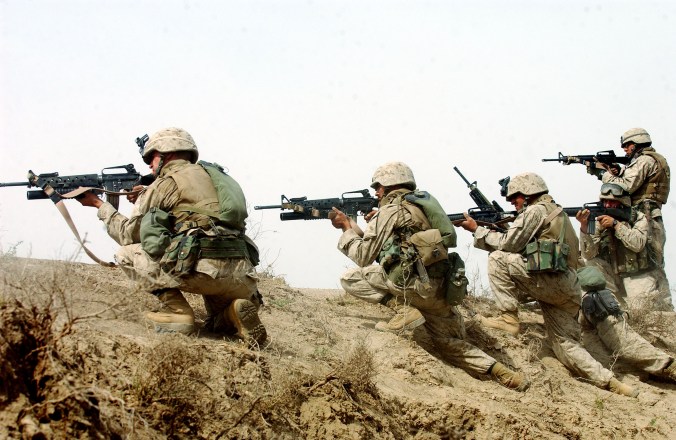
U.S. marines fire on a group of insurgents shortly after they launched a rocket propelled grenade at their 7-ton truck while on a 'movement-to-contact mission in order to flush out insurgents operating in the Fallujah area  south of Fallujah on Thursday, April 15, 2004 in Iraq.  The marines are part of the 3rd Battalion, 4th marine regiment, which saw heavy combat at the beginning of the war last year, and is now back in Iraq embroiled in intense fighting with the resistance.  Today, the men of the 3rd Battalion were ambushed half a dozen times while they patrolled the palm groves and wheat fields around fallujah, and the marines killed at least 10 insurgents, and suffered only minor injuries. (Credit: Lynsey Addario/ Corbis, for The New York Times)

Would I become a soldier if there was a war to fight?

By Elliot Chan, Opinions Editor
Formerly published in The Other Press. November 11, 2015

There was a time when refusing to fight in a war was an act of cowardice. Conscientious objectors were often shunned for being “unpatriotic” and “disgraceful.” Many of them in the past were even considered criminals. Thank god we don’t live in those times anymore. As Remembrance Day approaches, I’m often left with a bitter, remorseful feeling, because I know, I’ll never make such a sacrifice—I won’t!

Those who serve on the front line today demand respect. However, that does not necessary make them “heroes.” The way I see it, it makes them victims. I respect them not because of their training, but how their training and their experiences have corrupted them. Hate begets hate. War does not elevate kindness, tolerance, and benevolence in people; it pulverizes it with fear and righteousness. Post-traumatic stress disorder is chalked up as a workplace hazard for soldiers like carpal tunnel is for office workers.

We are currently living in the most peaceful time in the history of humanity. Yes, there are countless wars taking place on this planet, but most of them are civil wars or wars between countries separated by a thin border, far from where I am. These wars are feuds between neighbours that have lasted generations upon generations. If I were to pick a battle to fight, it would be an intrusion. Me sticking my nose in something I truly don’t understand.

One nearsighted saying I hear from those who are willing to join the army is this: I fight so my children won’t have to. First off, your children will do whatever the hell they want to; they’re their lives. Secondly, if you truly care about your children, you should teach them acceptance, rather than aggression. Teach them that there is more to a war than simply good guys fighting bad guys. Thirdly, if you think there is anything to gain from becoming a pawn, you are right, there is. There is a lot of profit, but don’t be surprised if it all goes to corporations—not to you or your children.

It might sound selfish of me to say that I wouldn’t defend my country. But what does it mean to defend my country? Does it mean entering someone else’s home and killing innocent people there until I find the few that are doing wrong to the true north strong and free? I hope not. In Canada, wherever we send our troops, we say we they are there for “peacekeeping” reasons. I don’t know how peaceful I can be waltzing into a battle zone.

We need to appear strong in the face of adversity. We need to have muscle so that the world at large won’t push us around. But the thing I never understood about our military, and those of our allies, is this: How will our guns stop their guns? How will our blood wash away their blood?

I’ll support our troops by taking off my hat during ceremonies, but man, there has got to be a better way.
The good will always win

4n4ce

At least that is what the winners will tell us

By Elliot Chan, Opinions Editor
Formerly published in The Other Press. March 17, 2014

To paraphrase Winston Churchill, or whomever he originally heard it from, “History is written by the victors.” Regardless of who said it first, the idea is probably as old as history itself—and still the statement is ever so true. We just need to look at contemporary situations to understand that we are in a constant flux for power, and there is no simple, peaceful solution in sight; examples could be found on every continent (omitting Antarctica, of course). But should we, as outside observers, acknowledge that whether the result may be good or bad for us, the winners are still winners and should therefore be respected?

We all want to change history for the better, but what might be better for us may be worse for someone else. Let’s look back to the birth of our nation—the genocide of aboriginals. We are of course now living in a society that is the consequence of that act. For us, it no longer feels like that big of a deal, because we weren’t there suffering or struggling through the backlash of the incident.

The same goes with the Chinese head tax, which was a fee introduced in 1885 to discourage Chinese immigration. Although, I’m of Chinese descent and feel the redress offered in 2006 was a small step in the right direction, it was far from resolution. But I also feel slight passivity to fight for that cause, knowing the struggle it takes to get any recognition from the government, let alone an apology.

The people in power today are ploughing forward without taking a look back at the mess they’ve made. We are not learning from our history, but not only are we not learning from it, we are using the history itself to intimidate. The winners of the past have become bullies of the present and that is evident in the Crimean crisis in Eastern Europe.

With so many diverse groups living together and such rich history on all sides, no one is willing to back down. Will there ever be harmony in that small patch of the world? Perhaps. But if we just glance slightly to the south and a smidgen to the east and see the endless dispute in the Middle East, we can say that resolution may never happen, because a victor is never crowned. Peaceful solution simply doesn’t exist, it cannot exist. I’m not just saying this because I’m pessimistic about the human race, but because history is not built upon handshakes and compromises—it’s built upon winners and losers.

The downfalls of Pol Pot, Adolf Hitler, Fulgencio Batista, and Saddam Hussein, to name a few, are all examples of how the losers have paved the way for the winners. There were no handshakes—there were only executions and suicides. Ask yourself, is it likely that Kim Jong-Un and the North Korean dictatorship will simply wake up one morning and submit to Western democracy? That’s unlikely. If we want people to behave a certain way, we can rather ask or we can force. One is of course more effective than the other.

We North Americans are lucky to be living in the aftermath, as we clean up our own country and observe the destruction of others. The destruction, as our history has shown, is inevitable. We must also remember that the problems of others are not our fight. We have fought our battle and now they must fight theirs. They must, in a sense, establish their own winners and losers—and it won’t be pretty.