I joined Zwift in January 2024 to prep for 3 triathlons I have coming up this year, and I’ve really come to enjoy the racing aspect of the platform. I use them mainly to toughen up mentally and stay cool when the going gets tough. Plus, with competition, it really becomes a solid kill-yourself type of workout. Which is just what I need to punish myself with after a long week.
Zwift splits racers into different categories, E, D, C, B and A. After a week of riding Zwift, I got placed in D to start. But you know what? If I can take on stronger competition, why not? How hard could it really be? What happens when I tackle races in all four categories available to me? Can I win? How badly will I lose? Time to find out. I call this Project: Get Humbled
In this post, I’ll share my experiences in my first 4 races, increasing the category level each time. With one week to recover, I believe this will be a good baseline test that I can use to reference maybe a year, or two years from now. Well, that’s the idea, simple enough, let’s get sweating and kick off with my first race. My maiden voyage, if you will.
This was Race 1:
Group D. Stage 2 of The Flat is Fast: Series: The Fan Flat in Richmond
I call this chapter: The Naive
As the first race counted down, I felt a surge of excitement. Having done a test ride of the course the day before, I was eager to see how I’d stack up against competitors worldwide. Yet, unexpectedly, nerves crept in. My goal was simple: finish the race and establish a baseline performance. I hoped nothing beyond my control would knock me out, given the unpredictability of technology. If I was going down, I wanted it to be under my power. This was all so new to me… just watch me navigate the interface, adjusting my camera angles, not even understanding what’s going on.
When the race started, I repeated my plan in my head. All the research I’d done emphasized the importance of giving it your all early on to keep up with the pack, and that’s precisely what I aimed to do. My sole focus was to hang on tight and maintain a position as close to the front as possible—— even accidentally launching myself to the lead a few times.
Keeping with the pack felt good here. I was pushing myself, yet it didn’t feel like I was exhausting all my energy reserves. In the early stages, I felt confident. I could truly hold my ground here. As long as I stuck with this group, anything seemed achievable. And that’s exactly what I did.
I kept pace with them until the third lap, then I began to assess my condition. It was likely a mistake, as I found myself at the forefront of the pack. I was putting a lot of watts in. And for my size, this was strategically a bad idea. I was really pushing the limits in terms of my watts per kilogram, and I was about to push even harder.
At the 24th-minute mark, a break occurred, and five cyclists surged ahead. The chase was on. I could see them rapidly distancing themselves, potentially becoming unreachable. Faced with a decision, I had to choose between playing it safe and sticking with the chase group or ramping up my watts even further to pursue them. I opted for the latter, pushing myself to maintain up to 4 watts per kilogram in pursuit.
Guess what? I managed to catch up with the three cyclists breaking away. The podium was within reach, and I understood that this might be a once-in-a-lifetime opportunity, even though it was my first race. I realized I had to shake off any doubts right away. I was going all in. The top four of us powered through the last three-quarters of the lap together—sprinting hard, pushing each other to the limits. I went all out. I gave it everything I had to secure the win.
The number of km left slowly went down. I found myself in the lead. It was time to lower my heart rate and prepare for the final sprint in the last kilometer or so. I needed to bide my time. I could see the two cyclists behind me, but I wasn’t sure if others had caught up. I waited, perhaps too long, allowing them to make the first move. I should have been the one to push harder initially; gaining momentum would have made all the difference.
Now, I was the one chasing, with less than a kilometer to go. We surged forward, and I was overtaken. Then it happened again. I settled into third place. Fine. Hold onto it, I urged myself. Hold it. With just under 200 meters to go, I closed in. But it was not meant to be, my Cinderella story was dashed, with only 50 meters left, another cyclist blew past me right at the finish line. Fourth place! Unbelievable. Gut-wrenching!
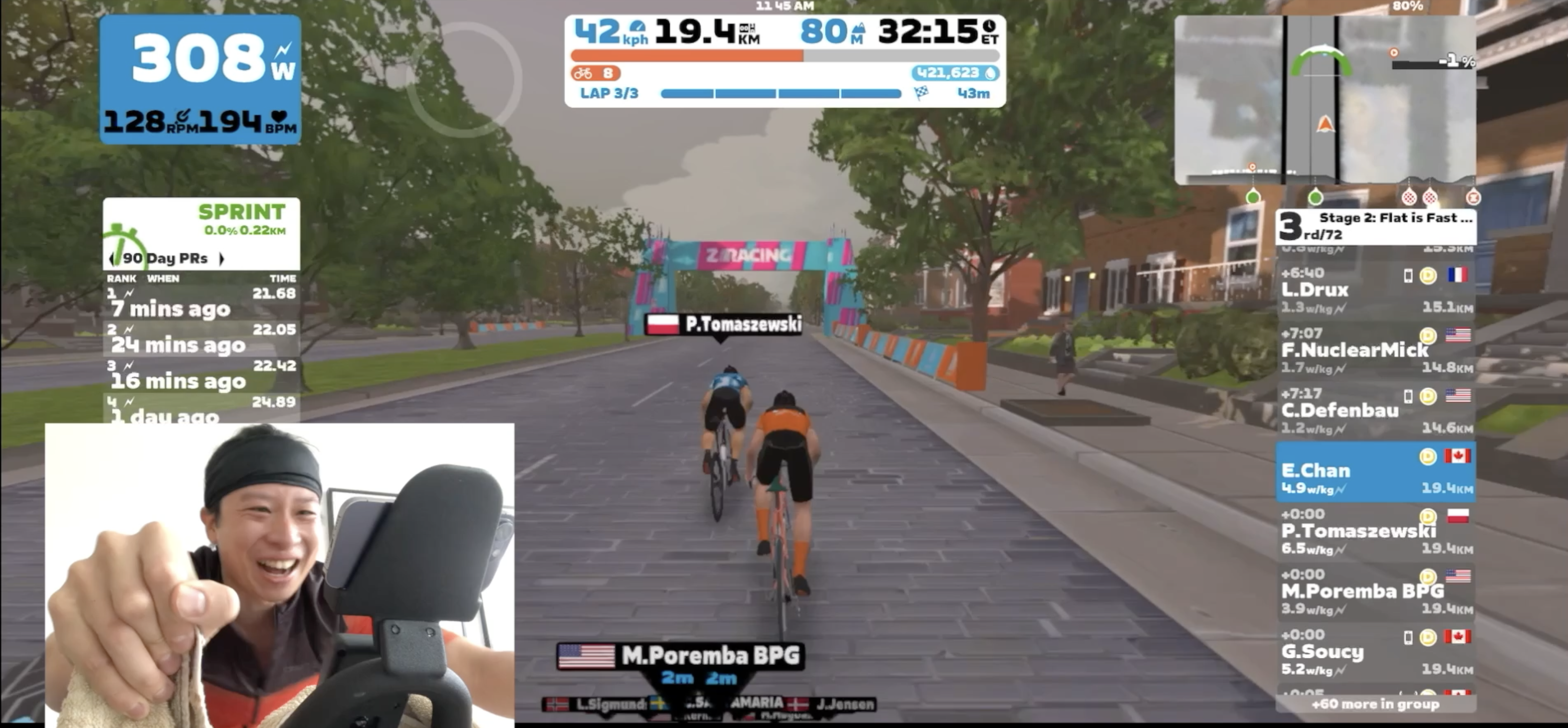
But wait… on the official Zwift Power website. I came in third! Huge! Due to that performance, I was bumped up into the C category. My first race. I overdid it. It would have been nice to do another race in D, but… I guess if Zwift wants to challenge me… challenge accepted.
This was not easy. I put everything I had into this race. I got my HR up to 190 for god sake. I really thought I could win. That was how naive I was. Well… now I can never race in Cat D again. On to the future. I’m ready.
Now let’s get into the second race.
Which was…
Stage 3 of the Flat is Fast Series in Group C: The Volcano Flat in Watopia
The title of this race is Stay Calm
Heading into the second race, I felt much better than I did during the first one. I was warmed up and had a solid game plan in mind. But, as they say, everyone has a plan until they get punched in the face—and let me tell you, I definitely got punched in the face.
The race opened at a fast pace, but I managed to hang on, and I was genuinely proud of my effort. I dug in, stayed focused, and didn’t hesitate to push my watts into the 300s. Deep down, I knew I couldn’t sustain that level of intensity, but I hoped and prayed that the pace would ease up, allowing me to maintain a steady rhythm.
If by some miracle, I could stick with the lead group, that would be fantastic. My primary goal was simply not to get dropped, a real concern less than a minute into the race. Then, unexpectedly, I found myself at the front. There was a glimmer of hope. Regardless, I experienced some back-and-forth movement for a while, but overall, I felt good about my performance.
Then disaster struck. Well, disaster is not the right word, but something did go wrong.I began to notice a clicking sound coming from my spin bike. Initially, it was sporadic, but soon it occurred with every rotation. It was unsettling, and I kept checking, hoping to find a loose screw or some visible issue that I could fix. However, everything appeared to be fine. The persistent clicking made me nervous because I didn’t want to damage my bike during the race. It really messed with my head, and I could feel my mental focus slipping.
I was getting dropped, and the clicking sound from my bike became increasingly difficult to ignore. About a quarter of the way into the race, after over 10 minutes had passed, I realized I couldn’t ignore the issue any longer. I had to address it. At 11:18, I made a quick decision to step off the bike, seizing an opportunity during a downhill stretch. Unsure of what to do, I attempted to tighten up the pedal.
Fortunately, by sticking with the lead group from the beginning, I created some space to address the issue. I could see that I had a gap before the chase group caught up, allowing me some breathing room. I resumed pedaling and got back on the bike at 12:02, spending nearly 40 seconds without pedaling. By the time I got back on, the chase group had caught up.
Now, the game plan has completely changed. My objective now was to stick with this chase group and hopefully make it to the end in one piece, both myself and my bike.
The clicking sound persisted throughout the remainder of the first lap, and I was coordinating with my wife, who was watching, to troubleshoot the issue. At that moment, I contemplated whether to dismount completely and abandon the race to address the bike problem. However, I’m pleased with how I managed to stay calm, collected myself, and pressed on.
Here’s the thing about technology and mechanical issues: sometimes they just fix themselves. Not always—sometimes they completely fall apart. But today, to my relief, the clicking sound stopped for the second lap.
Now, I was just trying to stay with this chase pack and hopefully finish in the top 50. So we stuck together for the majority of the last lap.
The second lap was brutal. It took everything for me to keep up. Just look at me. I’m dying. But I hung in there. With a km left, I was hanging on for dear life and anytime I had to push over 200 wats, I felt it. I didn’t have many matches left to burn. I was in pain, drenched in sweat, giving it my all. I wasn’t sure how much longer I could hold on. But you know me—I’m always up for one final push and a sprint to the finish. It was an emotional race, and I was determined to give it everything I had to finish in the top fifty.
49… 49… 48.. At the very last moment. I got it!
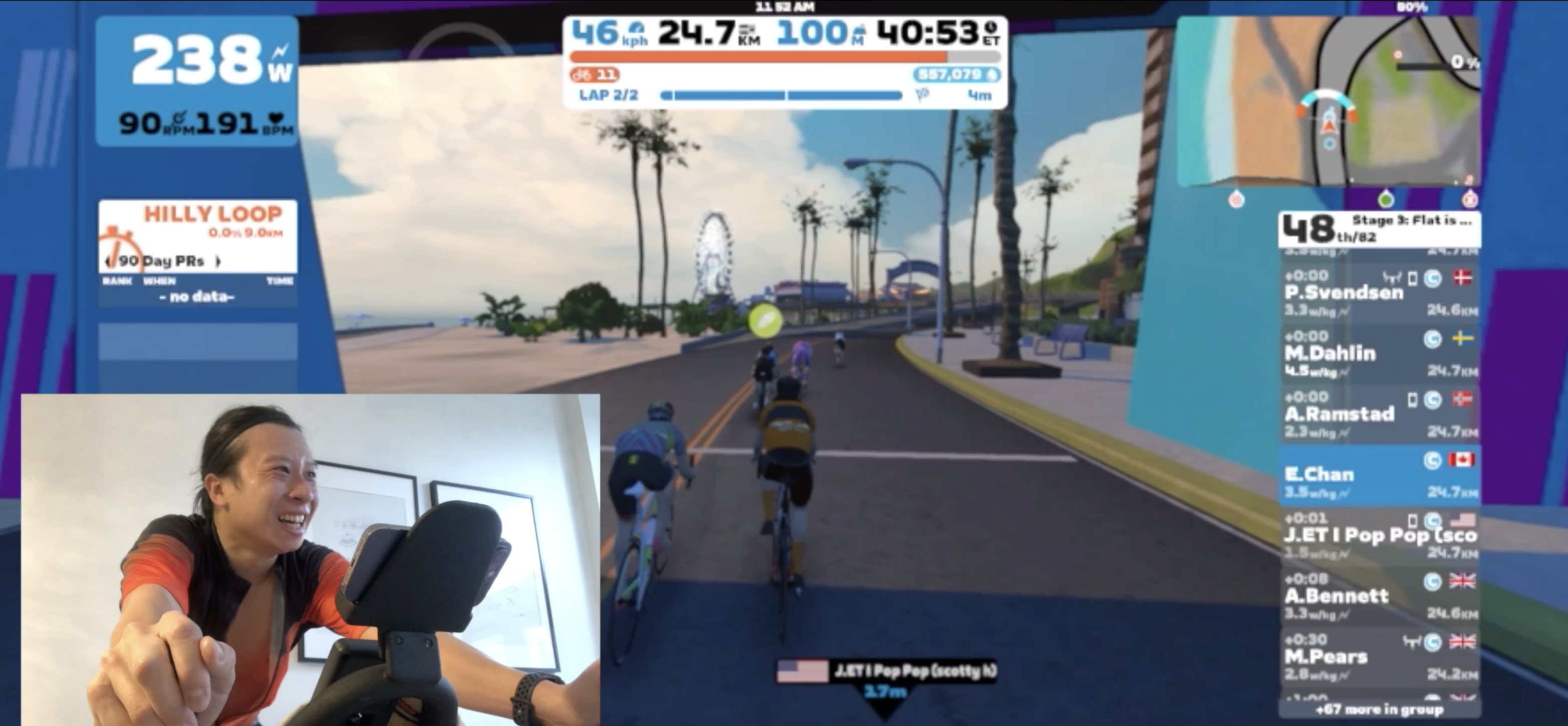
Even better, the official results had me in 24.
Given everything that went wrong, including the need to dismount the bike, I would consider the outcome a success. Needless to say, Group C was significantly more challenging than D. There appears to be a noticeable divide between the top and bottom of C. I believe there should be another category in between, as our group finished well over 2-3 minutes behind the lead group.
This result has left me eager to race in Group C again because I feel I now have a better understanding of what to expect. What if my bike hadn’t started making that clicking sound? Would I still have been dropped? Most likely. However, I’m curious about how long I could have kept up with the lead group and what impact it would have had on my overall time.
Sadly, before I could answer that question about group C, I now had to get ready for my race in group B.
Stage 4 of the Flat is Fast Series in Group B: Douce France in France
It’s my 3rd Race, and I call this one: Still Breathing
In my last two races, I competed on Sunday mornings Pacific time. However, this week, I had to reschedule my Zwift race to Friday evening because I’ll be running a half marathon on Sunday.
Friday evenings typically see less activity on Zwift, and there weren’t as many participants in this particular race. I’m also aware that as I advance through the categories, the number of competitors in the race will likely decrease as well. Initially, this gave me hope. Perhaps I could perform well in a smaller group.
But there is no reason to believe I would because having a smaller group means there are fewer people to keep up with if a break occurs early. And what do you know, less than 2 minutes in, a break happened. I pushed as hard as I could, maintaining around the mid-200 watts, but the lead pack was gone.
My bike started making the clicking sound again, but it stopped a few minutes later. So I’m going to leave it as a mystery. Regarding the race, my hope of even being a contender was dashed right away. The dream was dead.
However, I wasn’t stranded. I managed to stay with a small group of 4 riders. In this group, we pushed each other, just because we were at the tail didn’t mean we were going easy. Whatever was happening in the lead pack didn’t matter anymore. Four minutes in, my focus shifted to maintaining my position within this group. I cannot get dropped by them.
That was hard! At some points, I went as high as 300 watts, not sustainable. I knew that to even stay in this chase pack, I would need to give everything I got. And this thought was happening early on, at about 5 minutes.
Big shoutout to the 4 riders I was cycling with during this stretch—they really pushed my limits. As I crossed over the aqueduct around the 18-minute mark, I was fading. But something else was happening. Other racers were either getting caught or dropping out altogether. A glimmer of hope. If I couldn’t out ride them, I’d try to outlast them. I was determined to stay in the race until the very end.
Around the 17 km mark of the race, nearly 30 minutes in, the group began to spread out. My watts were decreasing, and I knew it was something I had to accept. While some riders had dropped out by this point, those ahead of me were starting to create insurmountable separation. Suddenly, I found myself with just one other rider: Fujino from Japan.
Now, Fujino was my sole focus. My last goal in this race was to avoid being completely left behind. This was me hanging on by my fingertips.
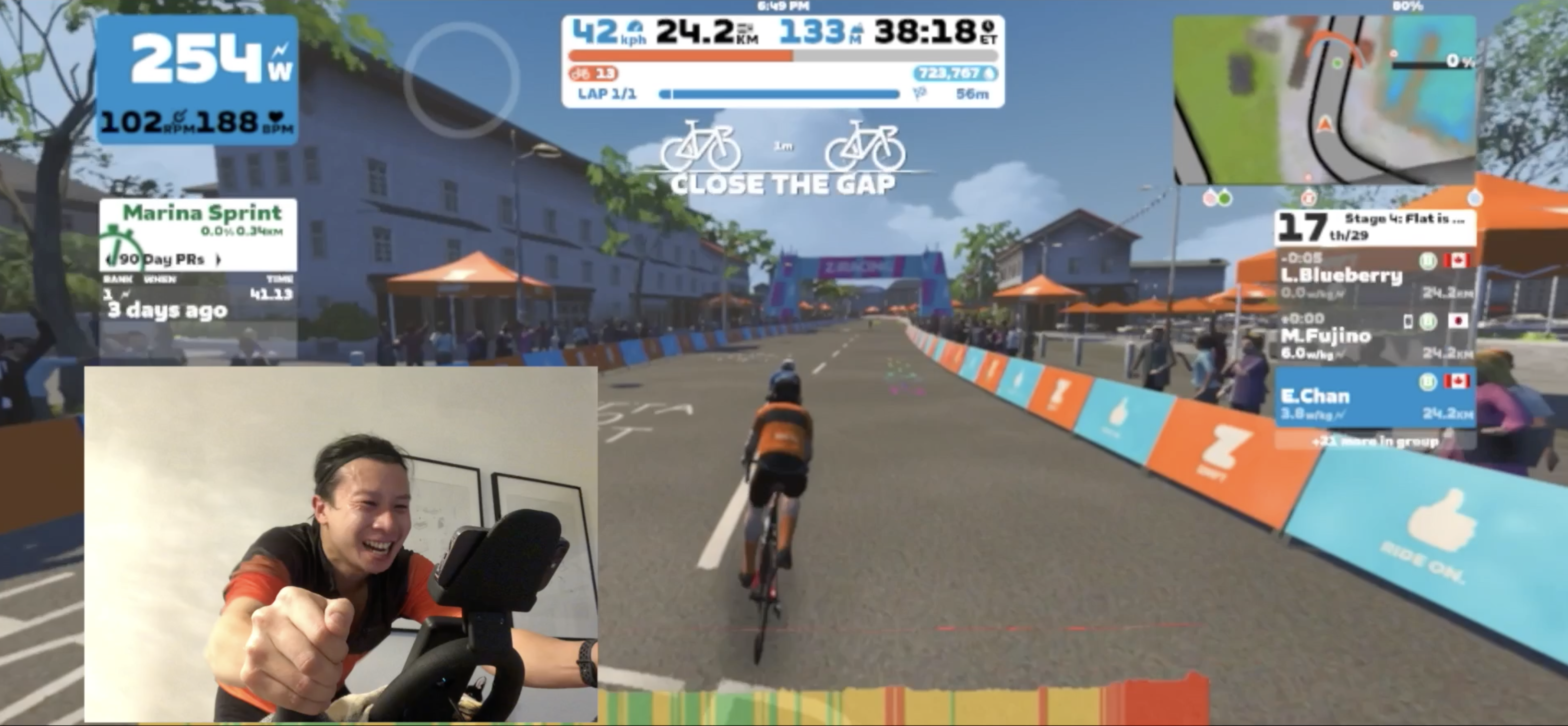
Everyone was gone. My effort was at max. My watts were however going down. I couldn’t hold it anymore. Reality was sinking in. With all the drop outs… I was now officially the last racer still in the race. There wasn’t much I could do about it, except give everything I could in the final sprint to get past Fujino. But he was not making it easy for me.
Then came the final kilometer. I needed to choose the right moment to make my move. That came with 700 meters to go. I unloaded, but I couldn’t gain any ground. Fujino activated his Aero power-up, and if anything, he pulled further ahead. It seemed hopeless… but not quite. I dug deep with 100 meters left, but the race was over.
I finished 17th out of 29, but the official time on Zwift Power says it all: 14th out of 14. Last place, just as I had anticipated. It was an incredibly humbling experience. But I’m proud of my performance. I persevered. I didn’t give up. And I was only 4 minutes and 30 seconds behind the winner. That seems achievable someday.
To be honest, attempting to win Group C feels as challenging as trying to win Group B at this stage. The gap is so significant either way. Racing in Group B almost takes the pressure off in that sense and you can just do your best. Even if I don’t level up, I see myself participating in a Group B race again, hopefully in one with more competitors.
Speaking of competitors.
Stage 5 of the Flat is Fast Series in Category A: Greater London Flat in London
Final chapter: A Lonely Road
This big race took place after a busy, exhausting week, but I won’t make any excuses. Nevertheless, it’s important to note that just seven days ago, I ran a half marathon… so needless to say, I didn’t come into this event feeling fresh.
No, as I lined up, it was the first time I felt fear. I dreaded the pain that was about to come. Having pushed myself to the limit in previous races, I knew that today would be no different.
Before I could even calm my heart rate down, the gun fired, and off we went… well, everyone else did. In less than a minute, I was dropped. I found myself completely alone, in no man’s land. With nearly a 5 km lead-in, this race was going to be long and mentally taxing.
The reason I participate in these races is to train both my mental and physical endurance. I must constantly adapt my strategy based on how I feel and what unfolds during the race. Now that I was all alone, I had to create challenges to stay motivated, as there was no one in sight. So, I focused on the numbers. My new objective was to stay ahead of those behind me, and surprisingly, there were people behind me — Pettigrew and Hill.
Struggling to maintain even 200 watts, I knew it wasn’t going to be easy. The race seemed endless. That’s the feeling when you’re alone, and the only carrot you have is the projected distance between you and the competitors chasing you. It’s tough because part of you wants them to catch up so you’ll have company, but you know that if they do catch you, it’s game over.
I was grappling with my inner demons, pushing my power as high as I could, when the rain started to pour down on the course at the 11 km mark, with a third of the race still ahead.
This was where I knew the inevitable was going to happen. Gradually, Pettigrew and Hill began to reel me in. What was once a gap of well over 20 seconds had now dwindled to 10 seconds and was decreasing. Then, at the 13.5 km mark, they caught up with me. In a way, I felt relieved that the solo struggle was over. I could now hang with them and play this cat and mouse game, chasing and dropping back so I can get some draft. I recalibrated. New goal. I couldn’t let them get away.
So the three of us rode together, swapping positions, taking turns in the lead. As we reached the point where there was only 1 km left, I knew I needed to make my move soon. But I was tired… so I waited… I hesitated… with 800 m left, I held back until Hill came up right behind me, pressuring.
Then, with 500 m left, I made my move. It was me and Pettigrew all the way. I pushed and pushed. But I just couldn’t take it to the next level. My heart rate spiked to 191. But I simply didn’t have the power to compete, and Pettigrew beat me by a wheel’s length. Once again, another sprint finish lost.
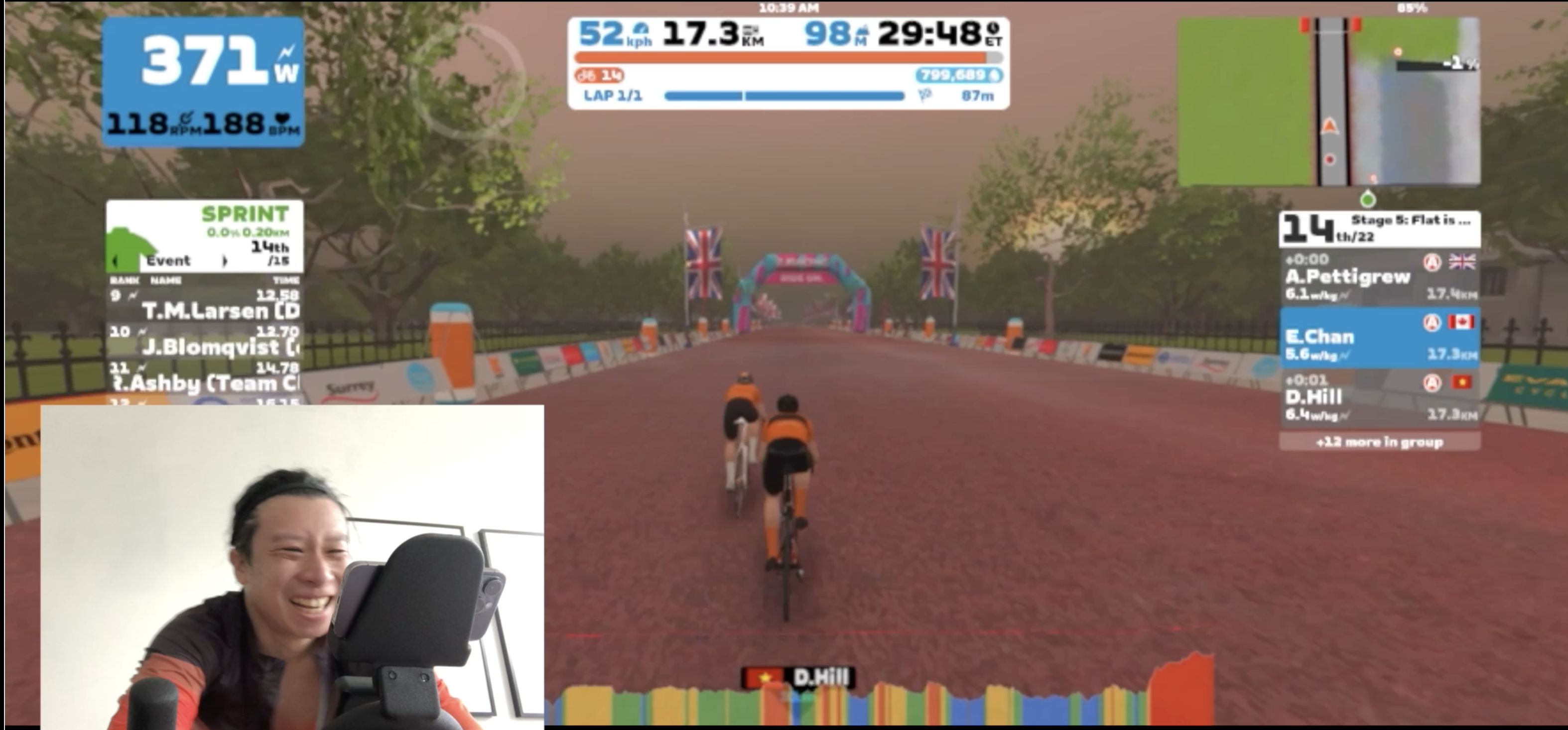
Unofficially, I finished 14th out of 22, but once again, I found myself last on Zwift Power. I have to give credit to Pettigrew and Hill, even though they didn’t rank officially, they meant everything to me in this race. As much as it sucked that they caught me, they made the finish interesting, and, I can’t help but feel humbled. So shout out to them… and I guess, everyone else ahead of us.
Conclusion
There you have it. Those were my first four races in Zwift, covering all four categories available for me to compete in. Here’s another look at the results, which are pretty consistent in terms of the stats and serve as a good indicator of my current power level.
I called this Project: Get Humbled and I think I did just that. It’s incredible how strong some people are on the bike. When you push yourself beyond your limits to compete with them, and still lose so badly, it’s just impressive.
On the flip side of the coin, this project was very inspiring. I feel positive about the progress I’ve made on the bike so far. I’ve already increased my power by nearly 60 watts since I started including the stationary bike in my training about two months ago, so the sky’s the limit.
With that being said, I’m also glad that it’s over now, and I can spend some time resting my legs and preparing for more achievable challenges. So stay tuned for more Zwift and endurance adventures and be sure to subscribe to my channel so you don’t miss them.
Join my YouTube community for insights on writing, the creative process, and the endurance needed to tackle big projects. Subscribe Now!
For more writing ideas and original stories, please sign up for my mailing list. You won’t receive emails from me often, but when you do, they’ll only include my proudest works.

 Elliot Chan