BC Ferries strong arm commuters with sea-leg proposals

Illustration by Ed Appleby

Why empty threats will not save money

By Elliot Chan, Opinions Editor
Formerly published in The Other Press. November 17, 2014

The problem BC Ferries faces is a common one: many transportation enterprises have been known to lose money. But the way they are handling it is classless, knowing that they have a monopoly. Commuters traveling to and from the island do not have another alternative, and to act as though keeping the Horseshoe Bay to Nanaimo route, one of the most popular routes for BC Ferries, is doing the public a great favour, well that is as if BC Hydro decided to turn off the power in the middle of the night to save money, since well, nobody needs electricity while they sleep, right?

BC Ferries’ clever tactic was to present a whole bunch of despicable proposals. Then, when everybody got pissed enough, they gave us an indisputable alternative: fare increase. Wow, didn’t see that coming. Thanks.

In a viral open letter to BC Ferries posted on Facebook, Campbell River resident Sean Smith explains his frustration claiming that he doesn’t understand why BC Ferries is presenting itself as some sort of luxury cruise ship, embarking on an exotic destination. BC Ferries at its best is a vessel for a weekend getaway, and for most people who use it, it’s an overpriced Sea Bus. Smith goes on to say that the vessel does not need a fancy restaurant, it does not need a marketing department, and it does not need bold advertisements in Rogers Arena. We don’t see ads in public areas telling us to ride the bus do we? What BC Ferries needs to do is get off its high horse and act accordingly.

The government doesn’t want to pay for the ferries anymore and for many who live on the island that is just ridiculous since many of the island taxpayers support infrastructure in the Lower Mainland, and the demand to cross the strait is as high as ever. Someone at some point in the office of BC’s Transportation and Infrastructure Ministry messed up. But it doesn’t seem as though the government is trying to fix the problem; rather, they are subtly adjusting it, turning our attention in another direction. Maybe this whole business is just to distract us while Enbridge takes over. Conspiracy alert!

What we need now is a private organization to stand up and see the opportunity. There is a lot of growth on Vancouver Island, a region in our province larger than many island nations in the world, and connecting it with the rest of the country can only be seen as a benefit. After all, there is a bridge linking Prince Edward Island, a landmass less than half the size of Vancouver Island with approximately six times fewer people, to the mainland.

The solution is right in front of our eyes but for many who make the choices, it’s too big of a commitment. By having the BC Ferries as a scapegoat, the public will have something consistent to complain about. There will always be problems for the government; why not centralize it? Why not foreshadow the worst and act as though they have saved the day by doing nothing except raising the price? Nice trick. Now do your job.

Raw food and nudity

Opinions_NAKED_SUSHI

Naked sushi and other gimmicky dining might not only be for acquired taste

By Elliot Chan, Opinions Editor
Formerly published in The Other Press. Sept. 23, 2014

Toronto-based restaurant, Naked Sushi has brought—the somewhat traditional and somewhat taboo dining experience—nyotaimori to Vancouver. Critics in the feminist camp were quick to address it as “sexist,” “discriminatory,” and “gross.”

Although sushi is an acquired taste for Westerners, eating it off of a naked human (usually female) body seems to go against every human custom in the world. But after hearing about the platters’ discipline—how they splash cold water on themselves to lower their body temperatures and how they stay completely still during the two-hour long experience—I’m able to see the artistic value of Naked Sushi.

I don’t imagine many little girls dream of being serving dishes when they grow up, the same way girls don’t aspire to be strippers. However, those who do choose to pole dance would tell you that in order to perform skillfully, the dancer not only needs to be attractive, but also well-practiced, athletic, and artistic.

But the question remains: would I eat sushi off of a naked human body? Yes, I would and I wouldn’t even consider the five-second rule. It’s true that I might be nurturing a culture that objectifies women—after all, I would be much less inclined to eat off of a man’s torso, double-standard acknowledged—but there is nothing wrong with using natural resources. If the opportunity arises where I am invited to partake in such a unique experience, I won’t decline.

Keep in mind that the models are not being mistreated, and they are willingly offering their bodies to be decorated with food. The caterers have strictly prohibited lewd acts, both physical and verbal, and sanitation is always the overriding factor. When it comes to restaurants, sultry servers have always been a key attraction for patrons. Do I know that the waitresses at Earls or Hooters get more harassing comments during their eight-hour shifts? Of course not. But would I be surprised if they do? No.

Food brings people together and pulls others apart. That’s the beauty of dining: everyone has a different taste. I enjoy gimmicky restaurants, at least the idea of them. I personally get tired of the same old meal every day, so I’ll take anything that allows me to refresh my senses—whether it’s just turning off the lights in Kitsilano’s Dark Table or allowing me to create art while I eat at Yaletown’s Raw Canvas. New experiences are what life is all about, and with three meals a day, there isn’t much to lose.

I don’t believe Naked Sushi is sexist or discriminatory or even gross, but I do believe that it’s not for everyone. After all, not everyone likes sushi. Not everyone likes nude models. Not everyone likes to break out of their comfort zone. But hey, everyone has different tastes, and that shouldn’t be condemned.

Speaking of the horny devil

Opinions_Dick devilWhy provocative art is healthy for the city

By Elliot Chan, Opinions Editor
Formerly published in The Other Press. Sept. 16, 2014

On September 10, Vancouver commuters travelling past Main and VCC Clark got a chance to admire the newly erected statue of the Prince of Darkness—briefly. While some found good humour in the statue, others clearly had penis envy after seeing the nonchalant exposure of the red devil. With one hand up giving some weird Spiderman web-slinging symbol and the other one placed suggestively close to the large member, it’s not surprising that many people were upset and the statue was removed. However, a petition to “Save the Devil!” is now surfacing online and the number of supporters has passed 666 in less that 24 hours.

Phallic and nude monuments and statues have been around since the dawn of man. From the statue of David to the world-famous Haesindang Park in South Korea, the highly touted male appendage had been an inspiration for artists for generations. Nevertheless, Vancouver has once again shown itself to be a prudish, stuffy group with a snobby belief that in order to be a “world-class city,” the only monuments worth presenting are those of animals and of Douglas Coupland’s head with gum all over it. If Gum Head is art, then surely Horny Devil—the name I’m giving it in this article—is art too. What’s the difference?

Let’s be honest, there are much more pertinent things to worry about than those blasted devil-worshippers corrupting our children. If a devil statue with a large penis is going to upset you on your way to and from work, maybe it’s time to ask yourself why. Art is supposed to “comfort the disturbed and disturb the comfortable,” but most artwork around the city is so forgettable that it might as well be fire hydrants, garbage cans, or those mystery grey boxes painted with foliage.

When seeing something like the Horny Devil, I get excited—no, not in that way. I feel as though some cultural progression is happening. We get so focussed on what we have to do on a daily basis that we forget what we are: horny, sinful animals. The devil statue reminds us that we are all the same on the inside.

I, for one, would much rather look at the devil than at an empty podium. What the hell is that podium used for anyway? What is that little public square used for? I don’t know, but I guess freedom of expression is not one of them.

I applaud the person or group that constructed the Horny Devil. After all, the city is full of CEOs and thought leaders, but we need more artistic rebels. We need people to break us from our status quo, refresh our memory, and allow us—as a collective—to grow. The Horny Devil does not have to be a display of immaturity, but the general reaction is a perfect example that we, as a city, are not mature enough to handle it for what it is. The Horny Devil is a reflection of ourselves and we are not ready to embrace it yet.

Warning signs ignored


Lacklustre earthquake should alert us, not relieve us

Opin_Vancouver-earthquake


By Elliot Chan, Opinions Editor
Formerly published in The Other Press. July 3, 2014

I didn’t crawl under my table during the 6.7-magnitude earthquake near Vancouver Island on April 24. In fact, I didn’t even notice until my social media erupted with comments concerning the swaying of homes and buildings.

I walked away from the situation slightly relieved that the worst that had happened was the reminder that I was spending too much time on the Internet and that I was so unprepared for natural disasters.

But give me a break, it’s hard to think about the collapse of my city when I’ve got so many other immediate things to worry about—that’s right, I’m saying that I’m not the only one who didn’t go under a table or quickly locate the emergency kit. If you did feel the shake, you were probably too busy enjoying the novelty to notice what it was. Preparing for an earthquake is just not a human instinct.

Still I don’t remember a time in my life where I wasn’t anticipating “the Big One,” the name of the megathrust earthquake that was prophesied to hit the Pacific Coast of Canada and the United States in the (very) near future. Images of Japan, Indonesia, and Chile remind me that earthquakes are nothing to joke about. Should it hit with the force predicted, my life would shift, like if I was diagnosed with a terminal illness. At this current state of preparedness, I just hope to survive if the Big One hits.

The earthquake earlier this year was a reminder that our government, our emergency teams, and we citizens are never going to be ready for an earthquake. There is just no such thing as “ready.” There is no saying when it would hit and where you would be. Sure, there are protocols to follow after the incident and there are measures to be taken to mitigate damage, but aside from that it’s a crapshoot. I believe natural disasters occur with the consistency of lottery tickets—you might be lucky enough to survive or you might be less lucky.

Individually, we cannot do much after an earthquake, but together we can pump money into funding that will help us survive in the aftermath. Emergency Management BC currently supplies $6.2 million of funding to “emergency services.” There is no plan to increase the figure since no one can really assess the damage before it occurs. Money is one thing, but having experienced teams prepared is another.

Civilians need to know what to do after the earthquake. What would people downtown do? What would people on the coast of Vancouver Island do? What would people sleeping at home do? What about the people commuting on a highway? The government should go into some length explaining the proper procedures following the quake and the aftershocks.

We need a plan we can all follow, because cluelessness will surely lead to chaos. I am often clueless without my social media—and lord knows I won’t have that after the Big One knocks out my Wi-Fi.

Hiding under the table is one thing, but we need to know what to do once we emerge.

Adopt-A-Pylon

Pylon and traffic cone overpopulation yields new campaign

By Elliot Chan, Opinions Editor

A satirical article, formerly published in The Other Press. June 3, 2014

Since the 2010 Winter Olympics, Vancouver’s pylon and traffic cone population has quadrupled. This sudden boom has caused concerns for many, as these “safety” markers have literally overcrowded our urban streets, highways, and pedestrian walkways.

Such escalation in pylon population has urged many to act. The crisis paved the way specifically for Adopt-A-Pylon, a company with the philosophy that pylons deserve a home, they deserve care, and, most importantly, they deserve to be treated like giant megaphones for children and drunken passersby—that is what they are really meant for. Fun!

Homeless pylons and traffic cones have caught the attention of Devon Détourer, founder of Adopt-A-Pylon. “Seeing all those innocent cones treated in such a way is disgusting,” he said in an exclusive interview with the Other Press. “We should feel ashamed. We drive by and we look at them with distain and pretend like there aren’t a thousand of them just living in the streets, cold and wet… and most of all forgotten. Pylons are a reflection of our society. And Russia is laughing at us right now.”

Détourer is urging British Columbians to band together and open their homes and wallets to traffic cones. “Each night—on your drive home—just grab a pylon from the street and take it back. Give it some love; after all, we all deserve love. If each person does this, there won’t be anything stopping us from getting to where we want to go, and we all want to go towards a happy future.”

Recent Adopt-A-Pylon supporter, Beatrice Oliver said, “We ignore it, plain and simple. We think that pylons and traffic cones are there to make our lives terrible, like garbage cans or fire hydrants. We get angry because the government spends taxpayer dollars buying more and replacing the old ones. Is that how we treat stuff? As soon as they break we buy a new one? Ask your grandma how she feels about that logic, ask your pet goldfish, or ask your stepson. Adopt-A-Pylon’s initiative is easy to grasp, just like pylons. You take one home, you change its life forever, you give it a reason to be. Pylons are not obstructions, they are life changers.”

The trend has made its way through Commercial Drive and all the way to Kitsilano, but has yet to gain traction in less pylon-liberal areas such as Burnaby and the Tri-Cities, where heavy highway construction and urban growth has bred more pylons.

Port Moody resident Fitso Chung spends many hours working as a labourer alongside pylons, traffic cones, and even some wet floor signs. He understands that there is a problem.

“They’re the hardest workers on the team and the lowest paid,” said Chung. “While I’m on break, they’re there. While I’m in the porta-potty, they’re there. I don’t know if Adopt-A-Pylon will change the social stigma. I think what they need is a union. Pylons are not second-class citizens. I believe adopting them is a step forward, but the road is long and we have a long way to go.”

The pylon population is projected to increase by another 28 per cent by the end of 2016, but the support for Vancouver’s forth-largest majority (behind hipsters, yuppies, deadbeats, and tech entrepreneurs) will undoubtedly increase as well. Which offers hope to people like Détourer and those participating in Adopt-A-Pylon.

“We’ll find a way,” said Détourier, “and pylons will help us. I understand that not everyone is a born pylon-lover, but give it a chance. Sign up today or do it anonymously and see where it takes you—maybe to Maple Ridge, maybe to North Delta.”

25 Innovative Technology Companies Showcase Talent and Celebrate Community At NextBC

On May 15, the top 25 tech companies in BC gathered together on the second-floor concourse of The Telus World of Science to showcase their latest innovative breakthrough and to celebrate the influencers and visionaries of the future.

NextBC, presented by DigiBC, the Digital Media and Wireless Association of BC, invited out a diverse collection of game/life-changing companies, from experienced money managing tools [Payfirma] to digital health advances [Conquer Mobile] to HD cameras in the exosphere, shooting perfect images of the Earth [Urthecast].

“At DigiBC we recognize that technology is changing our lives in so many ways,” said Howard Donaldson, President of DigiBC. “Our objective is to promote innovation and that is really what inspired this event.”

NextBC was designed not only as a conference with keynote speakers and panelists, but also as an award show, highlighting the company that has excelled and continues to show great potential.

The top 25 companies, at the end of the night, were chiseled down to five. From there a panel of judges were selected to ask important questions that focuses on four factors that include; breakthrough or rapidly advancing technology, the potential for broad impact, the potential for significant economical impact, and disruptive impact that transform how people work and live. The five companies chosen were: General Fusion, D-Wave Systems, Avigilon, Urthecast and CapTherm Systems.


How many years from commercialization do you think you are?

“Eight years,” responded General Fusion’s representative. “We want to build a power plant; that is not something you can whisk up in an afternoon.”

“Hopefully in the next few years we’ll demonstrate the physics that the power plant is based on, which when we compress this very hot gas, we can make fusion energy,” he continued. “Demonstrating that will take around two years, but this will not be a power plant, this will be a test that can show that it can be done. After that we need to build a piece of hardware, which will take some years and a lot of money, and just raising the money will be difficult to build a power plant like that.”


What is disruptive about your business model?

“We have the ability to stream data from space in utterly new and innovative ways, disrupting how it was done for everyone else,” said Urthecast’s representative. “We can democratize the view of Earth for free for anyone with Internet connection. That free platform that we put out to everyone in the world allows us to generate huge numbers of eyeballs. And those eyeballs can in turn be monetized much like the classic model of Internet companies.”

“I’m happy to say that we are very profitable,” said Avigilon’s representative, “and we are the fastest growing software company in North America. We go to market through certified Avigilon dealers. We directly sell to them and they sell to stadiums, transportations, etc. That’s pretty disruptive because a lot of our competitors mass produce to market distributors, and they dilute their product and their pricing model.”


Why are you here in Vancouver?

“From a national level, the support for research and development in Canada is second to none,” said CapTherm’s representative. “We feel really fortunate for the support we received from national research councils and scientific research and experimental development. We do utilize the ETC tax credits, we got a substantial portion off the pie last year and overall I couldn’t find a better place to run the company out of.”

“As you might imagine quantum mechanics take some pretty smart people to do what we are doing,” said D-Wave System’s representative. “So when we started the company here, we were able to attract some of the world’s best physicists to work on the dream that we had. People have come from all around the world: a lot of European countries, all over the States and across Canada. They always had this dream and that’s why they are here.”

When it was all said and done, the tension had built and the drum roll had fizzled out, General Fusion was awarded the Gold honours, D-Wave System with the Silver and Avigilon with the Bronze—and Fusion Pipe Software Solutions took the People’s Choice Award.

Bad Data, a Usability Gap, and the State of the Wearable Economy

Consumers demand the most out of their wearables. From the days of simple prescription-reading glasses to the Google Glass of the present—if it’s going to exist, it needs to work seamlessly with our lifestyle. But at this early stage, consumers may be expecting a sophisticated Xbox One when their wearables are at an adolescent-Atari stage.

During Wearable Wednesday Vancouver on April 23, moderator, Redg Snodgrass CEO of Wearable World, a couple groups of panelists and a large crowd of innovators, entrepreneurs, designers and investors gathered together to discuss the state of the wearable economy.

While some big companies, such as Nike are bowing out of the wearable-tech arms race, the doors are open for smaller companies to make the next innovative leap.

“The fact that Nike is leaving this market is a compliment to the market,” said Nikola Obrknezev, Technology and Partnership Lead at Fatigue Science. “Consumers are telling the manufacturers what they want and what they don’t want. It is our belief that wearable devices are going onto a platform, be it the iWatch, Android or Samsung. So they are going to build within an ecosystem. I mean [Apple’s CEO] Tim Cook wears a Nike Fuelband; he sits on the board—the fact that [Nike is] getting rid of the hardware team—they didn’t say anything about the software team. Who knows what they are building behind the scenes.”

While wearable developers are transitioning from constructing hardware to creating platforms, the ecosystem shifts into the next phase as data accumulates. But the challenges and the model of development remains the same: prototype, measure and learn.

“Putting something on a person’s wrist—making something that they are actually going to wear—is incredibly complex,” Liz Dixon, CEO of MIO added. “I think people get hammered all the time for making technology that is far too complex to use. Nobody likes to read instructions.”

There is a general public demand for wearables, we can all use another innovative way to communicate, etc. But there is also a demand for wearables in a niche market that includes security and medical. Mike Morrow, CEO of CommandWear, is seeing a lot of potential for technological growth between different sectors.

“Once we know that police and security buy into it and start using it—guess who they work with: Fire, EMS, medical, industries, utilities and on and on, and it grows,” said Morrow. “Of course, as we grow we capture the attention of the big boys. We are already working with Motorola for example. They are more focused on the backend systems, they’re in with police, and they are interested in the big data and analytics side of this business. They are hungry for data feeds from the field.”

Still the gap between innovative technologies, integration between platforms and devices and the usability is one that will take time to close. And it cannot be done when marketable and actionable dishonestly occurs, a mistake that many pioneering manufacturers made.

“Right now we have a lot of devices out there that are being marketed as doing A, B, C, D and—people look at it and say ‘Wow, I really want that,'” said Bayan Vandrico, Lead Researcher and Hardware Engineer at Vandrico. “But they buy it and realize it wasn’t really what they thought it was. That’s because those products aren’t really actionable.”

Collecting data is one thing, turning that data into something useful is another. If a wearable device wants to stay on our wrist or on our face it must serve a greater purpose than telling us how many steps we take or how much we sleep. If our habits don’t change, then the wearables have to.

But with so much data entering the ecosystem, distorted information is blended in with the accurate ones. Tracking location is an example of something that sounds so simple in a technological sense, but is incredibly complicated in a data-heavy ecosystem. It has evolved significantly since GPS tracking to cell tower triangulations to WiFi RSSI and advancements still continues.

“To me the trajectory is figuring out the broad solution,” said Shane Luke, Chief Product Officer at Recon Instruments, “and having someone that really focuses on that problem. It’s okay for it to take awhile; you can still do a lot, even with data that is not quite right.”

Luke added, “It’s an important principal, if you are in this space and you are building stuff, to look around at what others are doing and what they spend all their time on. They are going to do it better than you if you only spend 25% of your time on it, guaranteed.”

Wearable tech currently stands on the threshold of something very exciting. With so much new data, ideas, devices and platforms appearing in the local, national and global economy, partnerships are bound to take the state of wearables to the next level—a stage where wearables will be of the time and not a relic of technological trial and error.

Road-tripping with My Mother the Carjacker

Where do Vancouver musicians go?

By Elliot Chan, Opinions Editor
Formerly published in The Other Press. March 11, 2014

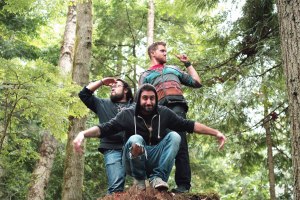
Beside the industrial waves of the mighty Fraser and alongside the barbwire fences and railway tracks is a building long past its prime. Weather-beaten but still venerable, the musical dormitory is both a rehearsal space and a hangout spot for My Mother the Carjacker (MMC).

I joined them as they took shelter from a rainy night in the late winter of 2013. The trio set up their equipment for a session in their humble abode—the sprinkler room. Dan Whittal, Liam Worthington, Allan Heppner, and a 12-pack of beer got down to work; nitty-gritty work, hold-all-my-calls-I’ll-be-here-awhile work.

“We take it really seriously,” said lead singer and guitarist, Whittal. “But we don’t act serious, and that makes all the difference.”

Every band has a different dynamic and MMC’s characteristic is very distinct, since they have one central understanding: “At the beginning we agreed, ‘Don’t tell anyone they can’t do something,’” said bassist, Worthington. “If they write the part, let them write the part. If it doesn’t work with the song, obviously the guy would know anyways.”

Logo and Van

The Road

Vancouver’s live entertainment scene is not always welcoming to newcomers, so MMC embraces the bumpy ride. It’s all up and down, resembling their fast-paced tempo and off-topic banter during their live performances. Still, it’s difficult for a unique band to stand out in a big crowd—like a car with a funky paint job honking in rush hour traffic, there just isn’t enough room.

“The thing about Vancouver is that it is really tough to get people out, we are kind of spoiled for music,” said drummer, Heppner. “There is also a lot of it, because it is a big city. So people see a lot of shit bands, while there are good bands playing all the time. If they don’t like one, they could go to another, because there are 50,000 clubs and bars.”

Like so many other local musicians, they are choosing to take their talents out of town. MMC is not ignoring Vancouver or trying to escape it; they simply know that they must meet their fan base halfway.

“The thing is with booking out of town, you will need to give yourself a three-month window,” said Worthington. “So yeah, we are definitely actively looking towards a fall tour. We are always trying to play out-of-town shows. We are looking at Whistler, Kamloops, Kelowna, Nanaimo, and Victoria. We want to do an extensive BC tour. Prince George, we’ve been asked to go there so many times. And then there is Nelson and Revelstoke. You can have a full-month tour of just BC.”

In early February, MMC returned from Kamloops after a short three-day trip to enjoy some good ol’ Vancouver sushi with me. They all nodded in agreement that the trip, albeit short notice, was both profitable and invigorating.

“We were cruising down the highway when a guy beside us was like, ‘Pull over! Your tires are fucked!’” Worthington, the designated driver in the band, retold the experience. “Oh God! We pulled over and checked it out and it was gone.”

“We didn’t notice at all,” said Whittal, “but it had been dragging for a while.”

“The truck belongs to Hey Ocean!,” Worthington said. “We borrowed it for four hours and fucked it up. They knew it was coming soon so they gave it to us. Whatever, it happened and we dealt with it thanks to the most brilliant man alive, Brian from FortisBC.”

The band laughed off the experience of standing on the middle of a highway during one of the coldest weeks of winter, lifting up their three-wheeled truck in order to fit a jack underneath. In retrospect, the situation could have been disastrous: they could have missed their show, or worse. Adversity comes with the territory when you’re touring as independent musicians. Safety is first, fun is second, but money is always a close third.

The Campaign

The sacred title of musician is respected by MMC: none of them would openly announce that that is what they are. Like judges, doctors, and politicians, Whittal, Worthington, and Heppner don’t feel they have legitimately earned the honours yet—not as a professional title, at least. The definition is still debatable between the three as they contemplate their own identity in the grand scheme.

“When someone asks you, ‘What is your job?’ you cannot say that,” said Worthington. “It’s what I aspire to be… and it’s getting closer and closer every year, but we’re not there yet.”

They speak enthusiastically of other bands, bands they look up to, while drawing a line for themselves. This mark keeps them grounded as they continue to strive for that ultimate goal.

In the summer of 2013, they took on a new initiative: their second album. But before they could return to the studio they decided that they wouldn’t half-ass the job. This time they were serious. Even if they couldn’t call themselves professionals, they would behave like professionals.

“You have an album coming out?” said Heppner, impersonating the public when he told them about their first album.

“Do you even play an instrument?” Worthington mocked.

“Your name is Liam?” Whittal added as the band laughed off their anonymity.

Campaigning for their Kickstarter was a brand new challenge for the group. On stage they were exuberant, but individually they were reserved and far from forthcoming when it came to asking for money. Getting someone to come to a show was one thing, getting them to download music was another, but getting them to chip in to a creative piece of work that has yet to be created is a whole other beast. Sucking up their pride and doing what they needed to, MMC, with the help of many, met their $6,000 goal.

“It gets easier over time,” said Worthington. “When people actually start following you, it does get easier for sure. Especially on social media when we can get the word out about the Kickstarter. Now people know that the album is coming out and we put out little teasers of the album and the recording process. We are just slowly building hype.”

 

Broken tire

The Studio

The day after they returned from their harrowing road trip to Kamloops, the three members of MMC were putting in the hours at the studio, recording layered tracks for their new album. I placed myself on a couch and watched as they worked.

Occasionally an error would arise, one would notify the other, and instead of countering with defensiveness, the response would be in jest and with appreciation. Jokes played in the background just as the music played in the foreground. Even though every moment spent in the studio was precious, there was no indication of anything being rushed. There were no shortcuts.

When it comes to the importance of studio time versus show time, MMC recognizes the value of both and doesn’t take either for granted. That being said, it’s not every day they get to work on recording their new album.

“You’re not going to be recording as much as you are playing,” said Heppner. “If you have nothing to record, then you need to be playing because that’s how you exist as a band.”

“But the way you keep on existing as a band is by having something to record,” Whittal added. “And that is a hard one to—”

“It needs to be a really good exposure show!” Worthington interrupted. “Or we are recording an album. The show needs to be absolutely worth it. In my opinion, studio time is so much more expensive than a show is, so it needs to be a really well-promoted show with great exposure. It would be the show for sure! ”

“Especially for us,” said Whittal, “shows are kind of our thing.”

Genres are harder to define than ever. Avant-grunge, funk rock, and danger polka punk are just a few attempts at characterizing MMC’s sound with words. But they don’t care about creating a theme or focussing on a certain category. What they want is to generate music with unpredictability—the I’m-up-on-my-feet-and-moving-without-knowing-it kind of music.

…Or of Something Else, their second album, will be available in the spring of 2014, and although they are always looking for new roads to explore and new places to play, you can catch them around town at local venues playing their balls-on-the-walls-all-hands-on-deck-feels-so-good-it-can’t-be-butter kind of music.
smallE17-mmcj

For more information about My Mother the Carjacker, their music, and where they’re performing, visit their Facebook page (www.facebook.com/mymotherthecarjacker) or follow them on Twitter (@MyMotherCarjack).

Girls Raising Establishes New Platform For Female Entrepreneurs and Investors in Canada

Girls Raising, a community based around assisting and fostering the growth of women founded startups, in addition to all like-minded entrepreneurs and investors, originated from New York and has since expanded to San Francisco, Toronto and Vancouver.

The empowering organization is dedicated to opening doors, creating an audience for established and up-and-coming female innovators and influencers and bridging the tech-sector’s gender gap.

For many years, the skewed ratio between men and female workers has formed a barrier for emerging female talents. There simply wasn’t enough resources, platforms and opportunities committed to helping women achieve their goals.

Men conduct business in certain way and women conduct business in another way; it’s not about which is better—it’s about how to nurture both forms of communication effectively so that entrepreneurs and investors of either gender can develop the best work possible.

“There is this whole concept of ‘you can’t see what you can’t see’,” says Vanessa Dawson, cofounder of Girls Raising, “so we need more visibility for women leaders and entrepreneurs who are entering startup companies, because then it’ll inspire other women. We are getting there now and there is more.”

The initiative starts with getting promising founders and entrepreneurs out and interacting, sharing resources and developing new ideas. On March 27, Girls Raising will be hosting another event from their Presentation Series in Vancouver. The private event will showcase presentations and panelists, featuring women entrepreneurs and investors that have overcome the gender gap and found success as leaders in the industry. The events are just another actionable step towards supporting, educating and encouraging females to choose tech for a career option.

“The Presentation Series started out as an event series, but it is so much more than that,” says Dawson. “It’s helping more women raise capital for their ventures and get some really good feedback and advice for which direction to take it, and we are building a community around that.”

The event in terms of presentation will cover two specific areas: the finance of a business and the founding of a business. Two women specialist in each of those fields will present, offering tips to raise a company into the green. The event will also see a preselected group of entrepreneurs pitch their ideas to an established panel and receive feedback and potential investment opportunities.

“The quality [of startups] that we bring to the table has been pretty high at all of our events,” says Dawson. “That often leads to acceptance of an accelerator or a follow up investment or some leads that are good for the business. And we share it all with an audience of attendees who are founders, investors, new entrepreneurs and community members.”

Girl Raising caps their active events at 100 people in order to keep the quality of interaction high and insure that everyone gets something out of it, whether they are there as an attendee, panelist or a presenter.

The tech-ecosystem can often be too vast and intimidating for many, but Girl Raising supports the adventurous attitudes of entrepreneurs and understands that there is going to be challenges and adversity, regardless of your gender.

“Be as exploratory as you can,” offers Dawson. “Don’t be afraid to try something, rather than just thinking about it. Women tend to put a lot time into thinking whether they should do this or thinking whether they should do that, and they don’t act. You learn the best lessons and you learn what you want to do and what is the best fit from actually trying something.”

Test driving the car ban

Opinoins-nocarsinparis_final

Paris’ car ban solution to pollution problem is something we should all try

By Elliot Chan, Opinions Editor
Formerly published in The Other Press. March 24, 2014

Many metropolitan cities in the world are suffering from the smog of pollution. It’s just something that happens when millions of people start living together. While some places continue to digest the pollutant, others are working hard on the solution. On March 17, Paris implemented the car ban, where only vehicles with a licence plate ending in an odd number were allowed to drive on the roads—the alternative was a fine.

Roughly 4,000 drivers were fined on the first day of the ban, but many drivers played along with the one-day ban—the government chose not to continue with the second day of the ban. French researchers found significant improvement in the air quality. Although I understand the inconvenience it must have caused for the commuting public, I’m also a bit disappointed that it only lasted a day.

We have recognized the harm of pollution for many years now. Greenhouse effect, global warming, and melting ice caps are all warnings harkened by Al Gore and his environmentalist buddies. The evidence is clearly visible, but still we choose to anticipate the consequence before we engage in a solution.

Why should we wait until there is a smog problem before we execute a car ban? Can we not change this human zeitgeist?

Let’s look closer to home. Beautiful British Columbia. We wouldn’t dare compare ourselves to larger cities like Los Angeles, Mexico City, Beijing, and Paris, right? But aren’t we cruising in the same direction? Didn’t we just expand our highways in anticipation of the growth both in population and in drivers? I’m sorry, but if you think our emerald forest, ivory mountains, and sapphire ocean are going to protect us from pollution, you’re wrong. Those are the things we’ll lose should smog happen here, in beautiful British Columbia.

Bike lanes do a little, a new transit line does a little, but what we need is something like the car ban in Paris: something that keeps us from becoming complacent. As we grow as a city, we must also adjust our lifestyle to accommodate traffic congestions—just because populations double, doesn’t mean traffic needs to double as well.

This new way of living may require us to schedule car pools and strategize our way to and from work. It may sound like a hassle to remember when you can and cannot drive. Moreover, this type of initiative will require that law enforcement ensures people are following the new rule. I understand that may lead to a lot of negative reaction, after all, the road already leaves us so vulnerable and traffic police already have so much to look out for. But one day, shit might just hit the fan, and we’ll be asking ourselves what we could have done—well, this is what we could have done: stop being little whiners.

The car ban may seem like a gimmick to many, but it should be something we all consider, not just for metropolitan cities, but also for soon-to-be metropolitan cities, like our own.