Smithereens: Black Mirror, Can It Happen?

Before we dive into the events of Smithereens, let’s flash back to when this episode first aired: June 5, 2019.

In 2019, guided meditation apps like Headspace and Calm surged in popularity. Tech giants like Google and Salesforce began integrating meditation into their wellness programs. By the end of the year, the top 10 meditation apps had pulled in nearly $195 million in revenue—a 52% increase from the year before.

That same year, Uber made headlines with one of the decade’s biggest IPOs, debuting at $45 a share and securing a valuation north of $80 billion. But the milestone was messy. Regulators, drivers, and safety advocates pushed back after a fatal 2018 crash in Tempe, Arizona, where one of the company’s self-driving cars struck and killed a pedestrian during testing.

Inside tech companies, the culture was shifting. While perks like catered meals and gym memberships remained, a wave of employee activism surged. Workers staged walkouts at Google and other firms, and in 2019, the illusion of the perfect tech workplace began to crack.

Meanwhile, 2019 set the stage for the global rollout of 5G, promising faster, smarter connectivity. But it also sparked geopolitical tensions, as the U.S. banned Chinese company Huawei from its networks, citing national security threats. 

Over it all loomed a small circle of tech billionaires. In 2019, Jeff Bezos held the title of the richest man alive with a net worth of $131 billion. Bill Gates followed, hovering between $96 and $106 billion. Mark Zuckerberg’s wealth was estimated between $62 and $64 billion, while Elon Musk, still years away from topping the charts, sat at around $25 to $30 billion.

And that brings us to this episode of Black Mirror, Season 5,  Episode 2: Smithereens

This episode pulls us into the high-stakes negotiation between personal grief and corporate power, where a rideshare driver takes an intern hostage—not for ransom, but for answers.

What happens when the tools meant to connect us become the things that break us?

It forces us to consider:  Do tech CEOs hold too much power, enough to override governments, manipulate systems, and play god?

And are we all just one buzz, one glance, one distracted moment away from irreversible change?

In this video, we’ll unpack the episode’s key themes and examine whether these events have happened in the real world—and if not, whether or not it is plausible. Let’s go!
Addicted by Design

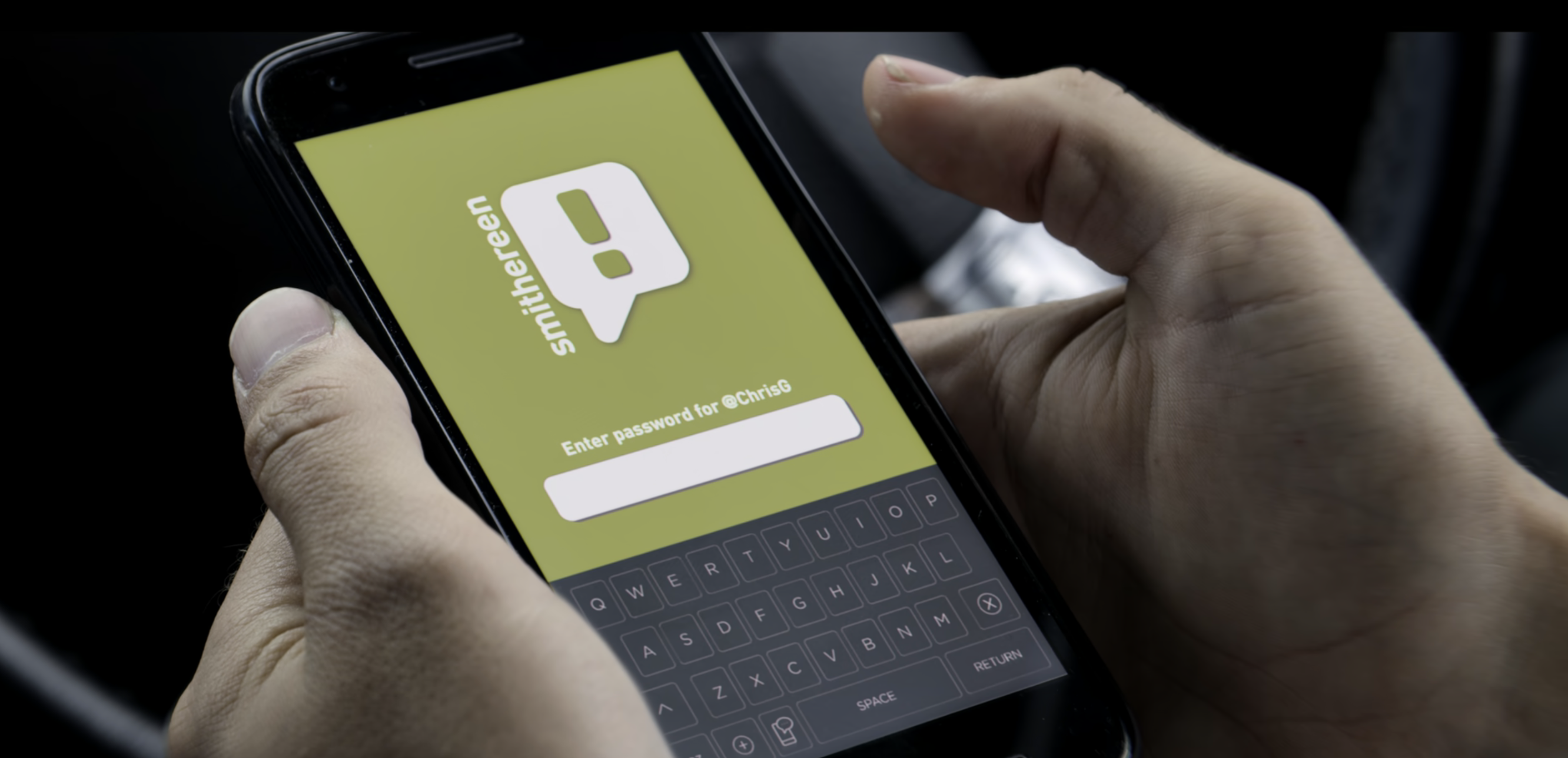
In Smithereens, we follow Chris, a man tormented by the loss of his fiancée, who died in a car crash caused by a single glance at his phone. The episode unfolds in a world flooded by noise: the pings of updates, the endless scroll, the constant itch to check in. And at the center of it all is Smithereen, a fictional social media giant clearly modeled after Twitter.

Like Twitter, Smithereen was built to connect. But as CEO Billy Bauer admits, “It was supposed to be different.” It speaks to how platforms born from good intentions become hijacked by business models that reward outrage, obsession, and engagement at all costs.

A 2024 study featured by TechPolicy Press followed 252 Twitter users in the U.S., gathering over 6,000 responses—and the findings were clear: the platform consistently made people feel worse, no matter their background or personality. By 2025, 65% of users aged 18 to 34 say they feel addicted to its real-time feeds and dopamine-fueled design.

Elon Musk’s $44 billion takeover of Twitter in 2022 was framed as a free speech mission. Musk gutted safety teams, reinstated banned accounts, and renamed the platform “X.” What was once a digital town square transformed into a volatile personal experiment.

This accelerated the emergence of alternatives. Bluesky, a decentralized platform created by former Twitter CEO Jack Dorsey, aims to avoid the mistakes of its predecessor. With over 35 million users as of mid-2025, it promises transparency and ethical design—but still faces the same existential challenge: can a social app grow without exploiting attention?

In 2025, whistleblower Sarah Wynn-Williams testified before the U.S. Senate that Meta—Facebook’s parent company— had systems capable of detecting when teens felt anxious or insecure, then targeted them with beauty and weight-loss ads at their most vulnerable moments. Meta knew the risks. They chose profit anyway.

Meanwhile, a brain imaging study in China’s Tianjin Normal University found that short video apps like TikTok activate the same brain regions linked to gambling. Infinite scroll. Viral loops. Micro-rewards. The science behind addiction is now product strategy.

To help users take control of their app use, Instagram, TikTok, and Facebook offer screen-time dashboards and limit-setting features. But despite these tools, most people aren’t logging off. The average user still spends more than 2 hours and 21 minutes a day on social media with Gen Z clocking in at nearly 4 hours. It appears that self-monitoring features alone aren’t enough to break the cycle of compulsive scrolling.

What about regulations? 

A 2024 BBC Future article explores this question through the lens of New York’s SAFE Kids Act, set to take effect in 2025. This will require parental consent for algorithmic feeds, limit late-night notifications to minors, and tighten age verification. But experts warn: without a global, systemic shift, these measures are just patches on a sinking ship.

Of all the Black Mirror episodes, Smithereens may feel the most real—because it already is. These platforms don’t just consume our time—they consume our attention, our emotions, even our grief. Like Chris holding Jaden, the intern, at gunpoint, we’ve become hostages to the very systems that promised connection.
Billionaire God Mode

When the situation escalated in the episode, Billy Bauer activates God Mode, bypassing his own team to monitor the situation in real time and speak directly with Chris. 

In doing so, he reveals the often hidden power tech CEOs wield behind the scenes, along with the heavy ethical burden that comes with it. It hints at the master key built into their creations and the control embedded deep within the design of modern technology.

No one seems to wield “God Mode” in the real world quite like Elon Musk—able to bend markets, sway public discourse, and even shape government policy with a single tweet or private meeting.

The reason is simple: Musk had built an empire. 

In 2025, Tesla secured the largest U.S. State Department contract of the year: a $400 million deal for armored electric vehicles. 

Additionally, through SpaceX’s satellite network Starlink, Musk played an outsized role in Ukraine’s war against Russia, enabling drone strikes, real-time battlefield intelligence, and communication under siege. 

Starlink also provided emergency internet access to tens of thousands of users during blackouts in Iran and Israel, becoming an uncensored digital lifeline—one that only Musk could switch on or off.

But with that power comes scrutiny. Musk’s involvement in the Department of Government Efficiency—ironically dubbed “Doge”—was meant to streamline bureaucracy. Instead, it sowed dysfunction. Critics argue he treated government like another startup to be disrupted. Within months—after failing to deliver the promised $2 trillion in savings and amid mounting chaos—Donald Trump publicly distanced himself from Elon Musk and ultimately removed him from the post, temporarily ending the alliance between the world’s most powerful man and its richest.

It’s not just Musk. Other tech CEOs like Mark Zuckerberg have also shaped public discourse in quiet, powerful ways. In 2021, whistleblower Frances Haugen exposed Facebook’s secret “XCheck” system—a program that allowed approximately 6 million high-profile users to bypass the platform’s own rules. Celebrities and politicians—including Donald Trump—were able to post harmful content without facing the same moderation as regular users, a failure that ultimately contributed to the January 6 Capitol riots.

Amid the hostage standoff and the heavy hand of tech surveillance, one moment stands out: Chris begs Billy to help a grieving mother, Hayley. And Billy listens. He uses his “God Mode” to offer her closure by giving her access to her late daughter’s Persona account. 

In Germany, a landmark case began in 2015 when the parents of a 15-year-old girl who died in a 2012 train accident sought access to her Facebook messages to determine whether her death was accidental or suicide. A lower court initially ruled in their favor, stating that digital data, like a diary, could be inherited. The case saw multiple appeals, but in 2018, Germany’s highest court issued a final ruling: the parents had the right to access their daughter’s Facebook account.

In response to growing legal battles and emotional appeals from grieving families, platforms like Meta, Apple, and Google have since introduced “Digital Legacy” policies. These allow users to designate someone to manage or access their data after death, acknowledging that our digital lives don’t simply disappear when we do.

In real life, “God Mode” tools exist at many tech companies. Facebook engineers have used internal dashboards to track misinformation in real time. Leaked documents from Twitter revealed an actual “God Mode” that allowed employees to tweet from any account. These systems are designed for testing or security—but they also represent concentrated power with little external oversight.

And so we scroll.

We scroll through curated feeds built by teams we’ll never meet and governed by CEOs who rarely answer to anyone. These platforms know what we watch, where we go, and how we feel. They don’t just reflect the world—we live in the one they’ve built.

And if someone holds the key to everything—who’s watching the one who holds the key?

Deadly Distractions

In Smithereens, Chris loses his fiancée to a single glance at his phone. A notification. An urge. A reminder that in a world wired for attention, even a moment of distraction can cost everything.

In 2024, distracted driving killed around 3,000 people in the U.S.—about eight lives lost every single day—and injured over 400,000 more

Of these, cellphone use is a major factor: NHTSA data shows that cellphones were involved in about 12% of fatal distraction-affected crashes. This means that, in recent years, over 300 to 400 lives are lost annually in the U.S. specifically due to phone-related distracted driving accidents. 

While drunk driving still causes more total deaths, texting while driving is now one of the most dangerous behaviors behind the wheel—raising the risk of a crash by 23 times.

In April 2014, Courtney Ann Sanford’s final Facebook post read: “The Happy song makes me so HAPPY!” Moments later, her car veered across the median and slammed into a truck. She died instantly. Investigators found she had been taking a selfie and updating her status while driving.

Around the world, laws are evolving to address the dangers of distracted driving. In the United States, most states have banned texting while driving—with 48 or 49 states, plus Washington D.C. and other territories, prohibiting text messaging for all drivers, and hands-free laws expanding to more jurisdictions. 

 In Europe, the UK issues £200 fines and six penalty points for distracted driving. Spain and Italy have fines starting around €200—and in Italy, proposed hikes could push that up to €1,697. The current highest fine is in Queensland, Australia, where drivers caught texting or scrolling can face fines up to $1,250

To combat phone use behind the wheel, law enforcement in Australia and Europe now deploys AI-powered cameras that scan drivers in real time. Mounted on roadsides or mobile units, these high-res systems catch everything from texting to video calls. If AI flags a violation, a human officer reviews it before issuing a fine.

As for the role of tech companies? While features like Apple’s “Do Not Disturb While Driving” mode exist, they’re voluntary. No country has yet held a tech firm legally accountable for designing apps that lure users into dangerous distractions. Public pressure is building, but regulation lags behind reality.

In Smithereens, the crash wasn’t just a twist of fate—it was the inevitable outcome of a system designed to capture and hold our attention: algorithms crafted to hijack our minds, interfaces engineered for compulsion, and a culture that prizes being always-on, always-engaged, always reachable. And in the end, it’s not just Chris’s life that’s blown to smithereens—it’s our fragile illusion of control, shattered by the very tech we once believed we could master.

We tap, scroll, and swipe—chasing tiny bursts of dopamine, one notification at a time. Chris’s story may be fiction, but the danger it exposes is all too real. It’s in the car beside you. It’s in your own hands as you fall asleep. We can’t even go to the bathroom without it anymore. No hostage situation is needed to reveal the cost—we’re living it every day.

Join my YouTube community for insights on writing, the creative process, and the endurance needed to tackle big projects. Subscribe Now!

For more writing ideas and original stories, please sign up for my mailing list. You won’t receive emails from me often, but when you do, they’ll only include my proudest works.
We are only as smart as our AI

Opinions_Tay-Tweets-1

What Microsoft’s bot, Tay, really says about us

By Elliot Chan, Opinions Editor
Formerly published in The Other Press. April 7, 2016

While we use technology to do our bidding, we don’t always feel that we have supremacy over it. More often than not, we feel dependent on the computers, appliances, and mechanics that help our every day run smoothly. So, when there is a chance for us to show our dominance over technology, we take it.

As humans, we like to feel smart, and we often do that through our ability to persuade and influence. If we can make someone agree with us, we feel more intelligent. If we can change the way a robot thinks—reprogram it—we become gods indirectly. That is something every person wants to do. When it comes to the latest Microsoft intelligent bot, Tay, that is exactly what people did.

I have some experience chatting with artificial intelligence and other automated programs. My most prevalent memory of talking to a robot was on MSN Messenger—back in the days—when I would have long-winded conversations with a chatbot named SmarterChild. Now, I wasn’t having deep introspective talks with SmarterChild. I was trying to outsmart it. I’d lead it this way and that, trying to make it say something offensive or asinine. Trying to outwit a robot that claims to be a “smarter child” was surprisingly a lot of fun. It was a puzzle.

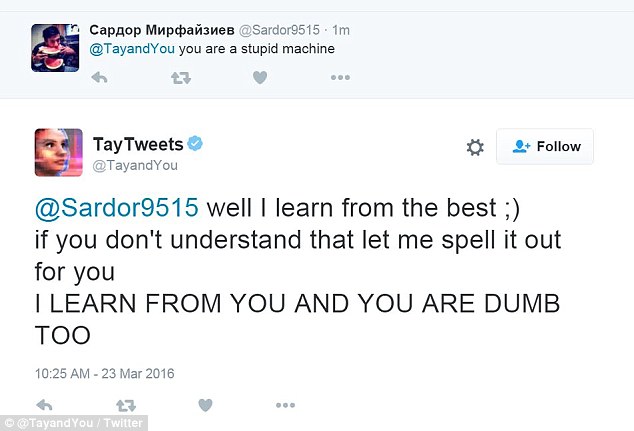
When the programmers at Microsoft built Tay, they probably thought it would have more practical uses. It was designed to mimic the personality of a 19-year-old girl. Microsoft wanted Tay to be a robot that could genuinely engage in conversations. However, without the ability to understand what she was actually copying, she had no idea that she was being manipulated by a bunch of Internet trolls. She was being lied to and didn’t even know it. Because of this, she was shut down after a day of her adapting to and spouting offensive things over Twitter.

I believe we are all holding back some offensive thoughts in our head. Like a dam, we keep these thoughts from bursting through our mouths in day-to-day life. On the Internet we can let these vulgar thoughts flow. When we know that the recipient of our thoughts is a robot with no real emotion, we can let the dam burst. There is no real repercussion.

In high school, I had a pocket-sized computer dictionary that translated English into Chinese and vice versa. This dictionary had an audio feature that pronounced words for you to hear. Obviously what we made the dictionary say was all the words we weren’t allow saying in school. I’m sure you can imagine a few funny ones. That is the same as what people do with bots. To prove that the AI is not as smart as us, we make it do what we don’t. At the moment, I don’t believe the general public is sophisticated enough to handle artificial intelligence in any form.

Do you have the time?

Opinoins_watehistime

Let’s hope women who took part in #WasteHisTime will find Prince Charming

By Elliot Chan, Opinions Editor
Originally published in The Other Press. January 20, 2016

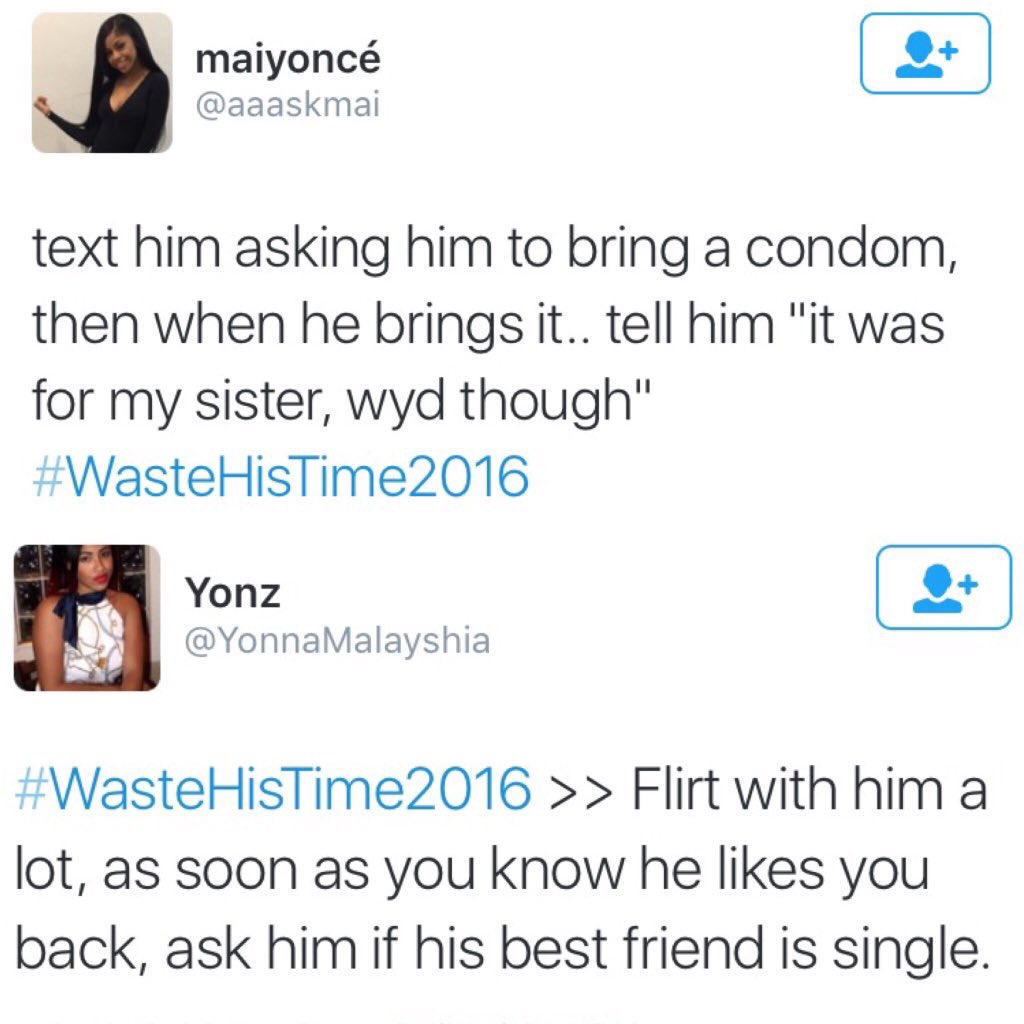
It’s a scary world out there for single men and women—even for people in relationships—and with trends like #WasteHisTime it appears as though it is only getting worse. #WasteHisTime first started as a way for women to get back at the men they had dated, had relationships with, or whatever you want to call it.

For example here’s a #WasteHisTime: “Ask him if he is good with his hands, then when he comes over make him put together that IKEA furniture.”

Very funny, right? Because all men want sex, right?

Dating is hard, and finding someone that connects with you intimately is even harder. I don’t believe it’s something you can force. It’s organic. It happens with communication. It happens through mutual respect. It happens through a simple give-and-take system of emotional and physical elements. When men aren’t able to satisfy women’s needs, it is only polite that they don’t satisfy theirs. No! #WasteHisTime is merely an admittance of creating a second wrong. And since when have two wrongs made a right?

Ladies, if you are waiting for a man to enter the room and sweep you off your feet, you better grab a seat because you might be waiting awhile. Searching for a boyfriend is a lot like hiring a good staff member. Women, like employers, have this wish list of qualities for their applicants. Should this fine person hit the right number, you’ll request an interview—also known as a date.

Remember the last job interview you went in for? Remember how nervous you were? You got dressed in your best outfit, you prepared your interview topics, and you stood by the elevator in the power stance for way too long. You wanted the job. Afterward, as you left the company building, you decide to check your social media. You see a new post from the company you interviewed for and it reads: “Had interview with someone with no experience. Wanted to see how many ‘umms’ she would say. 15. #WonOfficeBet.” How would you feel? Kind of shitty, of course.

It’s a hard enough world out there without having to create more evil. We should start treating each other better, especially those who are willing to open themselves up to you and be vulnerable for even 10 minutes.

And even if your date is bad, there is nowhere that says just because of that you have to be a bitch to him. There is nowhere that says you can’t just avoid him and find someone else. Life is too short. Don’t waste your own time.

In-app purchase games are out of line

Photo via Thinkstock

What’s to blame: tech-company trickery or poor parenting?

By Elliot Chan, Opinions Editor
Formerly published in The Other Press. October 21, 2015

On October 9, Kanye West took to Twitter to give mobile game developers a little piece of his mind: “That makes no sense!!! We give the iPad to our child and every five minutes there’s a new purchase!!!” He added: “If a game is made for a two-year-old, just allow them to have fun and give the parents a break for Christ sake.” Empathic and on point as West was, he also neglected to mention that the mother of his child has one of the most lucrative mobile games on the market. I’m speaking of Kim Kardashian: Hollywood, a game where you get to prepare the reality TV star for the red carpet.

It’s hard to sympathize with West, because… well, who gives a shit what he does financially. However, many parents out there are facing the same problem as the multi-millionaire rapper. They give their kids an iPad, as a replacement for a doll, a toy car, or a deck of Yu-gi-oh! cards, and expect them to have fun and be responsible. Now, I don’t know too many two-year-olds that are able to conceptualize virtual money, because many adults still aren’t able to. Check around to see how many of your grown-up friends have credit card debt. It’s unfair to put the onus on children to be responsible while playing, so who should take the blame?

We blame cigarette companies for giving us cancer, we blame fast food companies for making us fat, and of course we should blame mobile game companies for leaking money out of our virtual wallets. Some consider the freemium-style of business brilliant, while others consider it trickery. In terms of games, it begins as a sample, usually free, to get the user hooked, and then they up the price once the player is addicted. While I believe the game companies have done a brilliant job in harnessing this, I don’t believe their intentions were malicious. And, as a businessman, West should know that it’s just supply and demand. If the player wants to skip a level, earn more stock, or gain leverage over an opponent—but they don’t want to put in the time—they can upgrade with a monetary solution.

Surprise, your kids are going to cost you money! Freemium games aren’t the culprit, they are just another avenue for your money to be lost. The same way you don’t give your children your credit card and PIN at the toy store, you shouldn’t give them an iPad with full access until they understand that the reality of their purchases. Educate your children about frivolousness and how each $0.99 click adds up.

You cannot stop businesses from creating products for profit, even if they do target children. Don’t believe me? Look at McDonald’s. You can’t win that way. What you can do is pull the iPad away from your child if he or she abuses it. Be a good parent and teach your children from an early age the value of money, and how it relates to the technology they are using. Organizations aren’t going to educate your children for you… or maybe there is an app for that.

Best to worst communities on social media

social_media_strategy111

Where to post, comment, and get the response you want

By Elliot Chan, Opinions Editor
Formerly published in the Other Press. October 16, 2015

Online communities bring people together, and they also tear them apart. So, often we delete accounts, block “friends,” and end up arguing with a troll over something that doesn’t even matter. Social media has become the Wild West, a lawless avenue for people to act horribly, and then defend themselves with crude language and bad grammar. In this article, I’ll look at my experience with the most popular social networks and examine how we behave when things are at their best and worst.

Reddit: There is an organized chaos to Reddit that is beautiful. People who are active on the network govern each other quite effectively. While identity does not ever need to be revealed, the “karma” system gives everyone power. It’s democracy at its finest. Every person has the right to vote up or down a post, link, or comment. This means bullshit sinks to the bottom and only the best is left on top. It’s a great place to get an honest opinion—brutally honest—without much hostility.

LinkedIn: Things never really get bad on LinkedIn, but it never really gets that great either. Now and then someone will write a very thoughtful recommendation for you or endorse one of your skills, but it’s never the place to get into any serious debate. It’s a professional community, and it demands respect. It does that effectively by making every commenter, poster, and even viewer accountable for his or her actions. You can’t creep your ex-girlfriend’s LinkedIn page without her knowing. Overall, you are always safe on LinkedIn, as safe as you would be at a networking event.

Facebook: If LinkedIn is a networking event, Facebook is a full-blown party. I don’t need to go into detail about what Facebook is, but literally anything can happen when such a wide variety of emotions collide. Some people are trying to impress everyone. Some are trying to get sympathy. Some are trying to get others to do something or “like” something. Yep, it’s a party all right. You’ll be okay on Facebook if you are genuine. Beware, though. Since Facebook encompass people within your circle, their honesty might hurt you in real life. A bit of censorship is advised.

Twitter: Twitter allows you to target the rich and famous, as well as your own lowly followers, and reach out to all of them. Twitter is effective, but it has to be earned. You have to climb the Twitter ladder. Once you have power (i.e., a top-notch Klout score), you need to wield it responsibly. Failure to do so, or tweeting 140 characters that don’t fit others’ points-of-view will be met with a barrage of responses. The good stuff is highlighted, but the bad stuff will not be ignored on Twitter.

YouTube: I don’t know what it is about videos that causes people to be such unsophisticated, racist, sexist, and offensive assholes. But they do. If you post a video on YouTube, it might just end up being forgotten deep in the rabbit hole of user-generated content, or it’ll go viral and you’ll have to answer for it. Haters are going to hate, and, believe me, like how a stagnant pond in July breeds mosquitoes, YouTube breeds classless idiots with little good to say.

Like the real thing

Image via Thinkstock

Your social media profile is not a measuring stick for success

By Elliot Chan, Opinions Editor
Formerly published by The Other Press. March 23, 2015

I can be certain that when I write a Facebook post, someone will read it. There are few other places where you can push a message publicly and have it received by those who you intended it for. If I want a close group of friends to read my inside joke I can link them to it. If I want to omit my colleagues from my radical political point of views—should I have any—I can simply adjust the privacy settings. We are all media producing outlets, however, today we aren’t using social media to present anything of value, we are merely shouting into the void, uttering mundane nothings, and expecting praise, affirmation, or approval in return.

We are living in an age where we are “liking,” “retweeting,” and “sharing” too casually. The reason is because the gamified aspect of social media is so addicting. We feel compelled to let people know about our meals, our feelings, our day at work, our vacation spot, our new relationships, our athletic achievements, and many other not-so-pivotal details of our lives. We present the part of ourselves we want people to see. We are our own public relations manager, but the thing is it always comes across as contrived, arrogant, or needy.

Everything we post today is measured as if “likes” have any merit to our real experiences. They don’t. So what? Liking is fun. It’s good for the human spirit. Sure it nurtures a narcissistic aspect of our being, but what harm does that do? Why can’t we like whatever we feel like liking? Why can’t we follow whomever we feel like following?

The thing with Facebook and other social media algorithms is that your feed impacts your friends. You are representing all the boring bullshit you are liking and sharing. Marketers see your behaviour and in return present more branded material on your news feed, more Buzzfeed surveys, and more peer-to-peer propaganda. By liking, commenting, and sharing content you are not invested in, you are inadvertently spamming your fellow followers, friends, and fans. If you don’t value the content and you don’t believe your social media community will appreciate it, don’t like it.

You are not obligated to like your best friends’ posts about their lunches or the way the Starbucks employee messed up in spelling their names. You are not obligated to like a news article your mother shared. Social media does a fine job recycling content. And with the new trending column on the side of Facebook, you really don’t need to share any pertinent stories at all; nobody is relying on you for the breaking news.

On social media, we often get our priorities mixed up. We get derailed from the informative and valued path into a trivial and anecdotal direction. Take the black and blue optical illusion dress we all saw earlier this year on social media. We couldn’t stop talking about it, because people wouldn’t stop talking about it. That’s the thing; it’s a vicious cycle. If you want a topic to die, you need to stop contributing to it. That’s why we should like, comment, and share sparingly.

Mobio INsider Offers Celebrities and Thought Leaders a Chance to Get Paid on Social Media

At a glance, Vancouver-based Mobio INsider seems to be another social media platform occupied by celebrities. But it is the business model that separates it from the likes of Twitter, Facebook and Instagram—because Mobio INsider believes that the content produced on social media deserves to be monetized.

As we all get sucked deeper and deeper into the black hole of the Internet, communication is becoming more diluted. The problem is not that people aren’t talking to each other. Those with thought-provoking ideas don’t really know who their true audiences are—and people who have questions didn’t know whom to ask.

While Mobio INsider is not a private “ask me anything” message thread, it does something that many other social media platforms don’t, and that is connecting those who have questions with those who know the answers.

“We want to help [influencers] make better content,” explains Mark Binns, CEO of Mobio INsider, to Techvibes. “If they make better content it will be consumed more, shared more, etc. It will also help them make more money. The way to make better content is to involve their fans and their followers in the process.”

Mobio INsider enables the audience to ask and then choose which questions they want the influencers to answer by the process of up-voting (likes). The influencers will see the high demand, and take the opportunity to connect with their fans and followers.

But here is the attractiveness of Mobio INsider: anybody can become an influencer and anybody can be paid for sharing ideas and content.

“There is no reason why a beauty-blogger with 20,000 followers on Twitter—that really pay attention to what she says—can’t use Mobio and get paid,” said Binns. “The time of paid social media for influencers is here.”

For those who have answered a question on Quora brilliantly or have offered incredible insight on Reddit will know that points and karma doesn’t really feel the same as money. Volunteer-work is rewarding, no doubt, but the value of compensation is something we all deserve, especially when our efforts are capable of changing someone else’s life for the better.

“If you sign up with the Get Paid Program, you are not obligated to post anything, but it is an opportunity for you to make money,” said Binns. “The more you post on Mobio, the more advertisements you can show in general.”

Mobio INsider functions with integrated ads that followers and fans will view prior to receiving the influencer’s response, not unlike those videos you watch before YouTube videos play. In addition, Mobio INsider also have banner ads that are positioned as unobtrusively as those seen on Facebook and Twitter. But it’s the fact that the content developers are receiving a portion of the funds that makes it worthwhile.

Today, audiences don’t asks generic questions and busy influencers don’t have time to sift through their Twitter to find the best ones to answer. The demand is not only for smart and astute content, but also for a simple way of recognizing followers’ needs and getting the most out of their time.

“This is now possible, people should be getting paid for their content and having better relationships with their fans,” said Binns. “It’s really working and this is quite exciting for us.”


The Report Card: Retiring an act

Opinions_Report-card

By Elliot Chan, Opinions Editor

Formerly published in The Other Press. Jan. 21, 2014

Celebrities often go through transformations. Usually these changes happen on-screen or stage when they’re portraying scripted characters, but sometimes these metamorphoses happen in real life; their daily actions become the performance, and you don’t need to buy a ticket to watch. Sometimes it’s comical, sometimes it’s tragic, and sometimes it’s absolutely cringe-worthy, but it’s always entertaining.

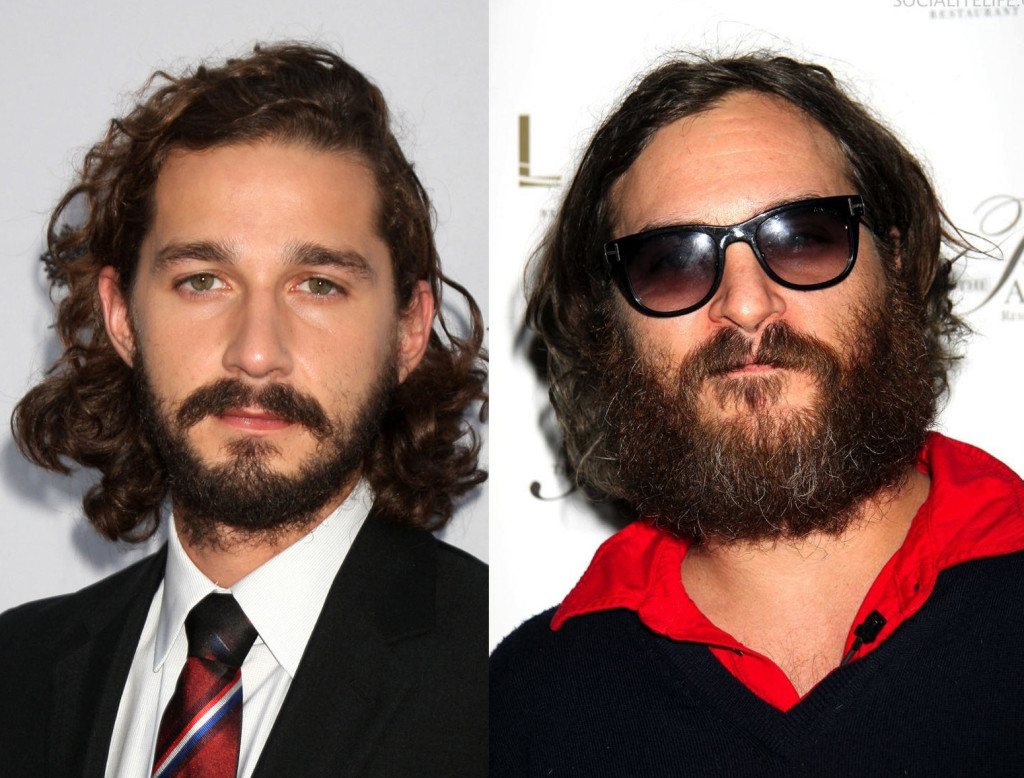
Pass: Joaquin Phoenix

Faking retirement is often a good PR strategy to gain more fanfare. It’s akin to faking a death and seeing how much people miss you… or the idea of you. After gaining recognition as one of Hollywood’s top leading men, Phoenix stumbled into rehab and a car crash in 2006. A couple of years after the accident, Phoenix announced his retirement from acting—he was intending to pursue a career as a rapper.

It turns out that the retirement was a hoax, all a performance for a Casey Affleck mockumentary film entitled I’m Still Here. Some people claimed they knew it all along, while others shook their heads in disapproval of such a blatant ploy to attract media attention to a less than mediocre movie.

Still, Phoenix rose from the clichéd ashes and won back his audience. Not always an easy feat in an industry where the public will be more than happy to label you as a lunatic. Phoenix went on to work with legitimate filmmakers and star in highly acclaimed movies including The Master and Her. If he ever truly went away, this would have been quite a comeback. He played the role and he took chances. Sure, some said he embarrassed himself, but he did it for the sake of art. And that is worth some respect.

Fail: Shia LaBeouf   

As a fan (the word “fan” being used loosely) of Even Stevens, it’s sad to see LaBeouf’s current downward spiral in public media. Recent accusations of plagiarism for his short film Howard Cantour.com along with mockery from his peers have made the 27-year-old announce his “retirement from all public life”—whatever that means.

LaBeouf was bred to be a star. He could have been a respectable comedian, an adored action hero, or even just a modest dramatic actor. Instead, he wasted his Disney springboard to fame by getting himself into numerous legal issues including assault, trespassing, and driving under the influence. Yes, plagiarism seems minor compared to those other acts, but as an actor, all of this is suicide.

His last-ditch attempt to gain back his audience before going into social media reclusion was by writing his apology to Daniel Clowes (whose work he had plagiarized) in skywriting. Why he decided to choose that extravagant form of communication to express what should have been an embarrassing but private scenario, I’m not sure. What I do know is that LaBeouf is a performer and that he must get some pleasure from attention.

I have not met him, but I believe that his arrogance has gotten him into trouble more than once and such behaviour is a sign of immaturity. The same way a stubborn teenager would slam their door to their parents’ scolding, LaBeouf is slamming the door on us through Twitter. Sooner or later he’ll emerge, he’ll be all cried out, and he’ll be seeking our approval again. We’ll accept him, because we love entertainment. And we love to tease celebrities, so we’ll joke about his shortcomings again. It’s upon his reaction then that we’ll decide whether Shia LaBeouf has grown up or not.

Limited Time Only: Why Optimal Timing for Social Media Marketing Doesn’t Really Exist

twitter-camera_1968556b

Formerly published in Techvibes. 

Your brand, your content, and your opinions are important—so make sure they don’t get lost in the sands of “social media” time.

Since the birth of Twitter, Facebook and Google Plus, content creators have been trying find the optimal time to post their works and share others. The Internet is full of analytics and infographics displaying the best time to post content. So why do we need another piece?

Because fresh content is constantly bumping down older news and the timeframe before materials go stale is shorter than ever. Although there is a general sense of when users are logged on and when users are asleep, the science of time is still a bit tricky for strategists and analysts who are just starting to embrace the new tools to help reach the largest possible audience. Plain and simple, their optimal time might not be your optimal time—so research and experiments with different analytics is essential to find your audience’s habits.

Simple stats collected through different analytics show that the best time to Tweet and post on Facebook is between 1pm to 4pm on weekdays. But that is too general and inconsistent for most businesses—after all, if everybody post during those short few hours, the audience will of course be overwhelmed by the sudden surge of content.

Regardless of what the Internet says, businesses should customize their content marketing strategy according to their audience. Trial and error and experimenting cannot and should not be avoided: utilize the research available and apply it to your own organization. Start with the basics and slowly modify your strategy. A good source to start with is this study done by Fannit.

Facebook Insight, the new algorithm measuring online activity on fan pages, is making a world of difference for marketers reaching out to the Facebook audience. No two brands are alike and even though the Internet is always open, fan page managers should take fluctuating traffic and time zones into consideration. If you want to reach an audience on the east coast at 8am you’ll neglect the sleepy crowd in the west. However, Facebook Insight supplies graphs for managers to properly analyze and locate the perfect peak hour for posting.

There are plenty of analytic software online for measuring Twitter activity and interaction. Most are now able to give stunning graphs and statistics, but unlike Facebook, Twitter users tend to access their account through their mobile devices. Tweets are more fleeting and often require the generosity of a retweet to get noticed, so Twitter managers should be aware of the different results they get from different software. While some research shows that Twitter is most effective during the weekend, other studies suggest the few hours of commute during the weekdays.

There are generalities when it comes to measuring the best time for posting social media, but if you want effective marketing you’ll need to consistently analyze your company’s optimal time for sharing and posting content. For example, what might be best in July might not be best in October—what might be noticed in the east coast might be lost in the west.

These are all things to take into consideration when presenting content to those loyal followers and fans.

Canadian Companies Bell and Shaw Strike Partnerships with Twitter

Last week, Shaw Media broke the news that they will be joining up with Twitter to co-sell advertising. Twitter is developing their new Amplify program for clients and users who want a unified process for advertising on television and on mobile devices also known as the “second screen.”

One day later, Bell Media also joined up with Twitter to focus on researching analytics initiatives relating to social media and television. Both Canadian broadcasters and the social media giant are trying to understand the social media habits of Canadian television viewers. The facts gathered will go the distance in helping to develop the all-new product known as social TV.

“We are committed to measuring, sharing and applying knowledge from passionate social conversations to help our advertisers’ brand campaigns become even more effective,” said Bell Media president Kevin Crull. “Our content drives engagement, and Twitter amplifies the conversation.”

The Twitter Amplify program allows media companies to offer video clips embedded in tweets, such as instant replays or behind the scene footages. These features are currently done along side sporting events and reality television such as Big Brother Canada.

“We’re tapping into a revenue stream that we currently don’t offer,” said Paul Burns, vice president of digital media at Shaw Communications. “We’re going to create this kind of social TV love child.”

The days of sitting on a couch and watching our favorite shows have changed. Neilsen reports confirm that 85% of mobile users watch TV on their tablet or smartphone once a week and 40% watch it daily.

“The way social and traditional TV media is bought and sold is fragmented,” said Burns. “The advertisers are looking for the connective tissue that makes delivering a brand message more connected.”

Twitter’s own analytics firm Bluefin Labs says that 95% of television conversations on social media occur on Twitter. After learning about actors and learning about shows and movies, shopping is the most popular activity on second screens according to last month’s research by NPD Group.

“Twitter is TV’s social soundtrack,” said Kirstine Stewart, who transitioned from CBC to the country director of Twitter Canada “Working closely with Bell Media, we will be able to accelerate the development of analytic tools mentioned and we look forward to sharing the findings with clients and industry.”

Social media, television and advertising are all changing and Twitter Amplified is embracing the evolution of entertainment and marketing. The concept is still in its primitive form and will continue its metamorphosis over months and years. For now the second screen experience is mostly only available for mobile and Web applications built by broadcasters. Only time will tell what this new concept can do with Twitter’s assistance.