How I’m Preparing for Triathlon Training

Today, I’m off to get inspired! The T100 Vancouver race is happening at the Spanish Banks-Locarno Beach area, so I’m riding over this morning to check it out and hopefully catch some of the pros at the start.

I’ve been toying with the idea of doing a longer triathlon distance, and the T100 feels like a solid goal for a year or two from now. Honestly, if I had the time to train properly, I could probably attempt it this year—but the bike and run would be brutal.

Still, it’s good to have goals. Good to have something that fuels you. Seeing this event come to Vancouver gives me a jolt of energy—and hey, this city is awesome, so why not soak it in?

So, I decided to go watch and kick off my next training block with some inspiration.

After finishing my first triathlon of the season—a sprint race in the rain—I had a five-week gap before my 12-week Olympic triathlon plan begins. The big question was: what do I do with those five weeks?

The first week was for rest, obviously. But after that, I realized there wouldn’t be much room in my training plan to build run speed. I want to be faster on the run this time around, so I put together a four-week run-focused block to raise my pace. The idea was to build speed now, so when I start triathlon training, I already have a strong run base to work from.

I committed to it—two high-intensity sessions each week, plus a few easy runs. Week one: 22.46 km. Week two: 19.72 km. Week three: 18.49 km. Week four: I backed off for recovery. Those numbers might not seem huge, but it was nearly triple what I ran during my sprint tri prep.

The goal was simple: get my legs run-fit and raise my base fitness. And according to my watch, I went from 49 to 63 points. Solid progress.

I know I’ve got plenty of running ahead, but it feels like I’ve already chipped away at some of the hardest work. Now, when my 12-week triathlon plan kicks off, I can shift focus to the swim and bike—without stressing as much about run training.

Because let’s be honest: running is awful.

Last year, I struggled to find the freshness to push for speed. This year, I want to run longer and harder on tired legs. That means more brick workouts off the bike. I’m also planning to ride longer and harder—to really get the endurance in my legs so I can finish strong on the run.

I still remember how painful the run was during last year’s Olympic tri. I don’t want a repeat of that. That’s the goal this time: finish strong. So here I am—three solid weeks of hard running behind me, and a good foundation to build on.

Next up: a 1000m lake swim on Canada Day. I haven’t done much to build swim fitness yet, and I was nervous, but after a test swim, I clocked 24:21 for 1000m. Not fast, but it gave me confidence.

My goal is simple: finish, stay calm, and hold pace. Last time I raced a swim, I veered off course and swam 200m more than I needed to. This time, I just want to stay on track and finish around the 24-minute mark. But really—just finishing will feel like a win.

There’s a lot to look forward to, especially today: T100 day. Enjoy the ride from Science World down the seawall, and stick around ‘til the end to check out the sights and sounds of the race.

For more writing ideas and original stories, please sign up for my mailing list. You won’t receive emails from me often, but when you do, they’ll only include my proudest works.

Join my YouTube community for insights on writing, the creative process, and the endurance needed to tackle big projects. Subscribe Now!
Training for a Triathlon: Resetting My FTP with a MyWhoosh Ramp Test

I’ve learned a lot about cycling over the past three years. One big takeaway? It’s not something I’m naturally good at. Part of that is probably because I’m in my mid-thirties, and before getting into triathlon, I didn’t even own a bike. When I think back to my childhood, I can’t really remember how I learned to ride. My parents never taught me — honestly, I’m not even sure they know how to ride themselves. I think I figured it out staying over at a friend’s place in fifth grade. I remember leaning against a wall, just teaching myself how to balance.

Teaching myself has been my go-to approach with most hobbies. It just made sense — why pay for cycling lessons? That felt frivolous, like taking art class or something. Maybe someday I’ll get a coach and try to really improve, but for now, cycling and sports are about getting in shape, relieving stress, having an event to look forward to, and challenging myself little by little.

One big challenge coming up is climbing Cypress Mountain in Vancouver. I live near plenty of hills, so I’m familiar with climbs, but a 12km climb straight up? That’s new, and honestly, it’s a bit intimidating.

Sure, there’s probably a “right” way to train for something like this. But I’ve got to fit in running and swimming too — I still have two swim races, a triathlon, and a 10K PR attempt this year. If I had a coach, they’d probably guide me, but for now, I’m figuring it out on my own. And honestly? That’s kind of peaceful.

To get started, I decided to do an FTP test. I began using MyWhoosh a couple months ago, and it’s been a lifesaver. Before that, I tried Zwift and Rouvy, but for various reasons, I stopped using them. I’ve done FTP tests with different apps before:

That was the last test I did, and since then, a lot has changed. My bike fitness has definitely dropped — I didn’t do many workouts over winter after unsubscribing from Rouvy. I’ve been cycling regularly but mostly just commuting and casual late-night zone 2 rides.

This third year of triathlon has taught me I don’t have a huge appetite to ride outside unless I really have to. There are just too many hazards out there, and self-preservation feels more important this year.

That’s why I got MyWhoosh and went back to indoor riding for this training block. But to get a true baseline, I needed to start fresh with a new FTP test — and that’s what I did today, with a Ramp Test on MyWhoosh.

Having done a few ramp tests before, they always feel deceptive. The start is easy, then suddenly it ramps up and crushes your legs. Right now, I think my peak wattage for about a minute is around 260. Anything more, and I fall apart — at least on a ramp test, where you’re already exhausted by the time you hit the top.

I didn’t feel great during this test. I’m not proud of my performance, but I gave it everything I had. One annoying thing compared to Rouvy was the mercy feature: when you can’t keep up, the test ends. MyWhoosh doesn’t seem to have that — or at least I didn’t find it. So I had to keep going, watching those red numbers and feeling bad for not hitting 300 watts.

In the end, I got a shock — my FTP dropped to 192 watts. That’s 38 watts lower than before, which feels like a lot. But it doesn’t seem unrealistic. FTP tests aren’t perfect, and honestly, this feels closer to what I could hold for an hour right now.

So here we are, at the start of a new chapter. There’s a lot to improve in my cycling — I want to climb that mountain feeling strong, not struggling. I’m not aiming to win, but I want to feel good, to know I can push myself further.

Training starts now. I’ve got a few areas to work on, and not much time, so being realistic matters. Reminding myself this is all new helps. Reminding myself it’s a journey of self-discovery helps too. And that I don’t have anything crazy to prove.

Cycling is just another story I’m telling myself — a story I’m still writing. And this is the beginning.

If you want to support pancreatic cancer care and research, please consider donating to my ride — I’d really appreciate it.

Join my YouTube community for insights on writing, the creative process, and the endurance needed to tackle big projects. Subscribe Now!

For more writing ideas and original stories, please sign up for my mailing list. You won’t receive emails from me often, but when you do, they’ll only include my proudest works.

Me vs. Triathlon vs. Rain – And My Dog Slept Through It | Sprint Triathlon 2025

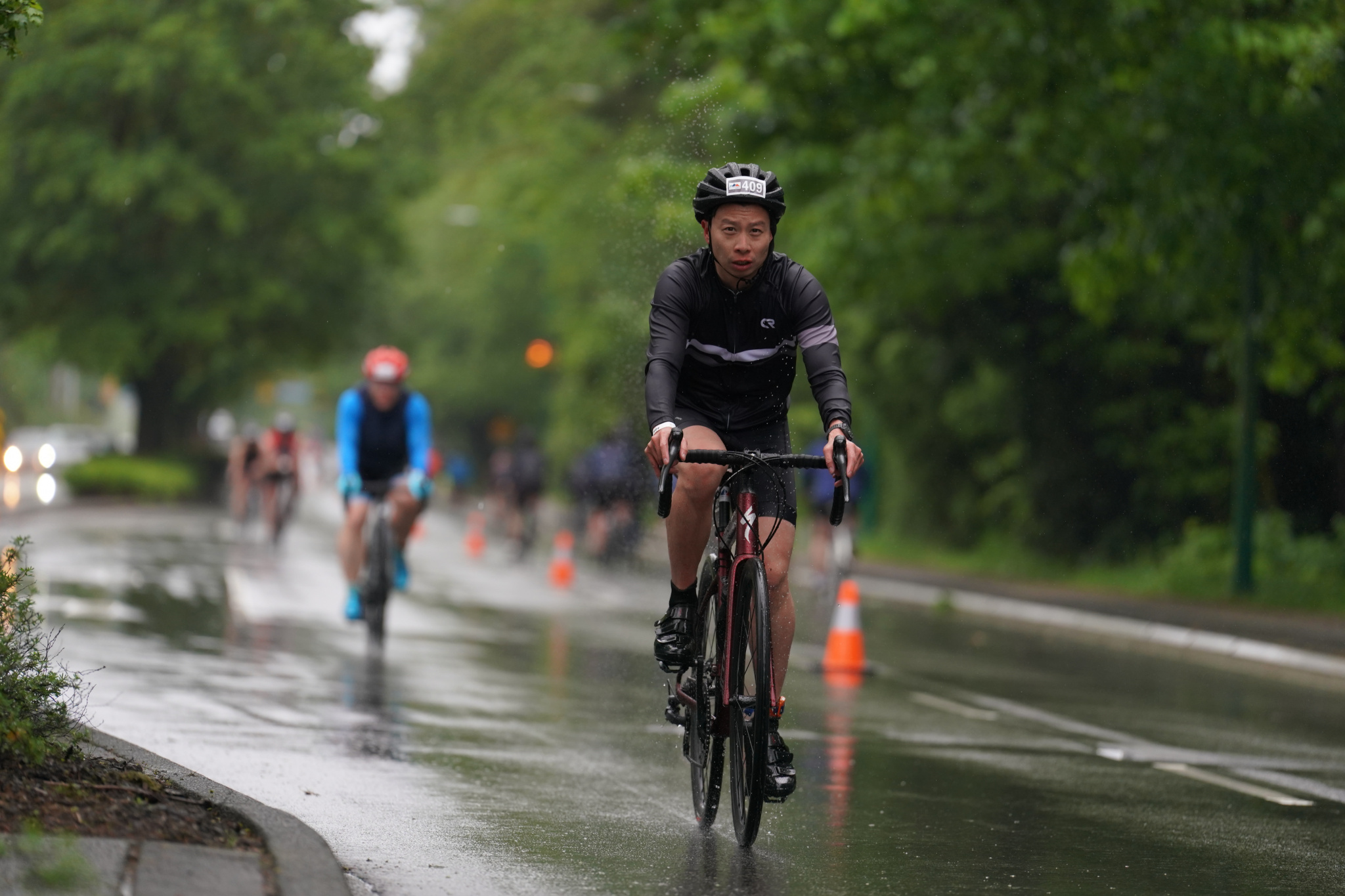
The day finally arrived: my first triathlon of 2025. In fitting conclusion to a chaotic training block, race day kicked off with a perfectly miserable, rainy morning.

There were plenty of challenges leading up to this moment—months of work, unexpected obstacles, and less-than-ideal conditions. But we don’t sign up for this because it’s easy.

In addition to swim, bike, and run logistics, there was one more wildcard: our dog, Petey. We’ve been training him to handle crowds and noise, and he’s made a lot of progress. Still, we knew race day would test him. That morning, we left him with my wife at the car while I made my way to the start line. I had about an hour to set up before go time.

This was my fifth triathlon, so by now, the usual gear-check panic had faded. No more obsessing over whether I packed everything or anxiety about setting up in transition. Still, right before the start, I always feel it—that churn in the stomach. Pushing yourself to the edge while trying to pace it right? That’s always nerve-wracking.

Speaking of my stomach, I wasn’t feeling 100% physically. Digestively. But maybe it’s all in my mind. I chalked it up to the general discomfort of standing around in the rain. Yes, it was a very messy morning. The trek to the pool was a mudfest.

The swim was supposed to be 444m like last year, but a week out, we got an email that it’d be shortened to 300m. Not ideal for an apples-to-apples comparison, but with the rain, nothing was going to be a perfect match. Still, it was a chance to improve.

Last year, I finished 126th out of 276. This year, my goal was to break into the top 100. Not always the healthiest mindset—comparing yourself to others—but this race uses a staggered start, so standings are kind of a mystery anyway. I decided to treat it like a solo time trial.

To position myself in the most ideal spot, I tested a 300m swim in training and estimated I’d come in around 6:40.  Last year, I guessed I could swim 444m in 10 minutes—it ended up taking me about 11, and I had to let a few people pass at the wall. This time, based on my test, I landed pretty close: 6:31 on my watch, and 7 minutes officially after running across the pool to hit the timing checkpoint.

As for the bike—there was no predicting that. I’d done a good chunk of zone two work leading up to the race, but not much hard outdoor riding lately. Still, my legs felt solid. The course was four laps on a rolling route with a 50m climb over 2km. Not brutal, but enough to require steady effort.

I went out a bit aggressively on lap one, eased off by lap two, and by lap three the rain was relentless. I started shivering on a descent and suddenly, my vision blurred. I literally had to shake my head to snap out of it.

I hadn’t trained much in rainy conditions, so from that point on, it was all about survival—just making it to the run.

Needless to say, I was relieved to finally get off the bike at 47 min and 18 seconds, which included both transition times. On my watch, I had 42 min and 42 seconds. A solid time, but I was completely out of it. I started the run with a group pacing around 4:30–4:45/km, which might’ve been fine on a good day—but not after that ride, and not in the state I was in. Once the hills kicked in, I knew I had to ease up.

The run course was no joke—lots of short, punchy climbs, with 128m of elevation packed into just under 5K. I didn’t have huge expectations. Sure, it would’ve been nice to match my 24-minute 5K from last month, but there was no pressure. I just wanted to give it everything I had.

And I think I did.

And just like that, it was over. Another race in the books. And to my surprise, I hit that arbitrary goal I set at the start. I cracked the top 100. Barely. 99th place.

The conditions were rough. The training block was fragmented and inconsistent. But I got through it, and now it’s a race I’ll remember fondly.

As for Petey? He didn’t quite share in my success. While I braved the rain, he opted for safety and comfort. My wife tried a few times to coax him out to spectate, but he preferred to wait it out in the warm car. After a bit of howling, he curled up in the backseat and took a nap.

Still, we all did our best. And I’m proud of the three of us for figuring it out—together.

There will be more attempts. There will be more challenges. Plenty more adventures ahead.

For more writing ideas and original stories, please sign up for my mailing list. You won’t receive emails from me often, but when you do, they’ll only include my proudest works.

Join my YouTube community for insights on writing, the creative process, and the endurance needed to tackle big projects. Subscribe Now!

Training for a Triathlon With My Rescue Dog: Our First 5K Run Race Together

I knew triathlon training this season would be tough, but you never really know how tough until you’re in it. One thing that’s made this block especially challenging is Petey, our new rescue dog. He’s well on his way to becoming a great, obedient training partner, but the fear and stress from being abandoned on the side of the highway and his time in the shelter don’t fade overnight. We’re working with him patiently, step by step.

Our goal is to eventually leave him home alone for a few hours, but we’re not there yet. While we could leave him with someone we trust, we’re still nervous—especially about how he might react early in the morning. As devoted helicopter dog parents, we’re trying to strike a balance. Sadly, the world can’t stand still and wait. 

Right now, that means adding Petey’s training to mine. Alongside preparing for my race, we’re also helping him get used to new experiences so he can join us at the event. We decided the best approach—for me, my wife, and Petey—is to go to the race together.

We know the environment could be overwhelming for him, but with gradual exposure, a little structure, and a lot of treats, we think we can make it a positive experience.

So, we set up a trial run. I signed up for a 5K at Rocky Point in Port Moody—the same place my wife and I got married. It’s a special spot for us, and now it’s tied to a new memory: Petey’s first race.

It was a small, inaugural event, which meant fewer people and a manageable crowd. After a warm-up walk, I headed to the start line while Petey busied himself sniffing a bush. Then it was up to my wife to keep him company—and for me to focus on the run.

I didn’t have a strict goal going in—this was mostly about training Petey—but I figured, why not aim for a personal record? My last 5K in 2023 was 25 minutes and 2 seconds. Those 2 seconds bugged me. So anything under 25 felt like a solid target.

I did it! Finished in 24 minutes and 1 second. Just shy of the minute mark—next time, maybe. Still, it was a strong run, especially on a hillier course than I expected. That’s a great sign heading into my upcoming sprint triathlon.

And Petey? He did amazing. Which really means my wife did amazing. She kept him calm the whole time I was running. A few months ago, having him in this kind of environment seemed out of the question. But today gave us hope. It was one more step closer to having a life filled with fun and adventures.

Of course, this was just a test—a short run. A triathlon is a whole different beast: longer, more chaotic, and way more logistically intense. It’ll be a challenge. But that’s the point, right? 

Thank you for joining us on this run. I’ll see you in the next one. 

Join my YouTube community for insights on writing, the creative process, and the endurance needed to tackle big projects. Subscribe Now!

For more writing ideas and original stories, please sign up for my mailing list. You won’t receive emails from me often, but when you do, they’ll only include my proudest works.

The Creative Triathlon: How I Stay Motivated with Art, Video & Writing

I think a lot about how momentum works. Not just in training—although yeah, I do love a good triathlon—but in creativity too.

When I’m training for a triathlon, I’m not just running every day. I swim. I bike. And I run. Each discipline works different muscles, keeps things fresh, and somehow… they all support each other. Like, I come out of a bike ride with stronger legs for the run.

And that’s kinda how I’m approaching my creative life too.

I don’t just write. I don’t just draw. I don’t just make videos. I move between all of them—and doing that actually helps me stay motivated and inspired. If I’m stuck in one, I switch to another. If I’m tired of reading, I pull out my camera. If I can’t sit down to draw, I cut up footage and express my creativity in a whole new way.

So today, I’m sharing something I call the Creative Triathlon. It’s a predetermined length of focused time on three different creative practices: illustrating, video creation, and writing.
One discipline at a time. No pressure. No multitasking. Just a way to find time to do what you enjoy. 


First leg: illustration. For the past 4 years, I’ve been working on this massive personal project—drawing every single Pokémon. Yeah. All of them. It’s been slow-going, not because I don’t love it, but because finding the time is hard. Life piles up. Other projects take priority. And as strange as it sounds, drawing Pokemon doesn’t pay the bills. 

But when I do this creative triathlon, it forces me to carve out time for it. Even just 25 minutes. And honestly? It’s kind of like swimming. At first, it takes a while to get ready. But once I start? I don’t want to stop. It’s peaceful. It’s focused. And there’s something really satisfying about seeing one more little creature take shape.

This leg always reminds me why I started this project in the first place: because I love it. Because it brings me back to that kid part of myself that used to draw these things on notebooks. 

I’m almost at 1000 Pokemon. I really want to finish before they add more. If you are interested in see the rest, check out this video in the cards and the instagram in the link in the description. 


Second leg: video creation. Right now, I’ve been making a series of YouTube Shorts where I highlight key takeaways from books I’ve read. It’s honestly become one of my favorite creative outlets.

What I love about it is that it’s a true mashup of all my past-time activities—reading, thinking, writing, editing—it all comes together in these tiny videos. It makes everything I do feel active. Reading no longer feels like a passive intake of ideas. By turning it into a video, I get to spend more time with what I’m reading. I get to sit with the concepts, rephrase them, visualize them. And because of that, the lessons stick. They become part of me. A little snapshot of my life.

Video creation is great that way. It lets you experience your own thoughts in a completely new medium. You go from absorbing to articulating, from quiet reflection to something that moves and speaks. Seeing an idea come to life on screen—it just never gets old. 


Final leg: writing. I’m currently editing the fifth draft of the first book in a trilogy I’ve been working on for years. And yeah—it’s a slog. A meaningful one, but a slog nonetheless.

It’s such a big project that most days, I’m just chipping away at it. I don’t always see progress. There’s no big “aha” moment, no flashy breakthrough. It’s slow, repetitive work. And honestly, it feels a lot like running. Not a sprint—a marathon. You get tired. You want to stop. But you don’t, because the work is worth it. The fatigue is part of the point. It’s what builds endurance. It’s what makes the story matter.

Working on something this big, this long—it becomes part of your life. It’s something you carry. And the beautiful thing about creativity is that it’s not like sports… there’s no finish line in the same way. It doesn’t end. But that’s why I love this Creative Triathlon practice—because it does give me small finish lines.

Instead of focusing on finishing the book, I just focus on finishing a session. That’s it. One 25-minute block. And when it’s done, I get this little burst of relief, a sense of accomplishment. Like I’ve closed a loop. It’s such a good feeling—being able to look back at my day and say, “I did something today.” No guilt. No disappointment.

So that’s my Creative Triathlon. Three disciplines, 25 minutes each for me today. It could be more on other days, but today was only 25 minutes. Which is enough to get a good chunk of work done. Know this, though, it’s not about finishing a masterpiece in an hour and a half—it’s about movement. It’s about momentum.

Just like in a real triathlon, each leg has its own rhythm. Some feel strong. Some feel slow. But they all carry me forward.

If you’re someone who loves multiple creative things—or if you’re feeling stuck—try this. Treat your creativity like a triathlon. Mix it up. Work different muscles. Let each practice breathe new life into the others.

Thanks for hanging out with me today. If you decide to try your own Creative Triathlon, let me know how it goes! And if you already have a different combo that works for you—maybe it’s music, painting, and cooking—drop it in the comments. I’d love to hear what you’re working on.

Join my YouTube community for insights on writing, the creative process, and the endurance needed to tackle big projects. Subscribe Now!

For more writing ideas and original stories, please sign up for my mailing list. You won’t receive emails from me often, but when you do, they’ll only include my proudest works.

Good Endurance vs. Bad Endurance, What to Push Through In Triathlon Training and Life

When we talk about endurance sports, we often hear about battling through pain. So much of the sport is about pushing our limits, and it’s in that process where we truly improve. When it gets hard, that’s when we’re challenged. That’s when we discover who we are. That’s when we endure.

That’s when we prove to ourselves: we are not quitters.

Don’t be a quitter.

Of course, this mindset isn’t just for sport. We can bring that kind of endurance to every part of life. Don’t give up on what you started. Follow through on what you said you’d do. As a creative, I know that struggle well. How many projects have I started only to abandon them halfway through?

In life and in triathlon, endurance is everything. When things get hard, scary, or painful, we have to push through. We have to keep going.

During this training block, I faced plenty of challenges—not just tough workouts, but all the resistance that comes with the sport. There are always reasons to stop.

Lately, I’ve been finding it hard to get on the bike for long rides. Not just because of the weather, but because of my schedule. This season doesn’t really allow me to be away for hours. And sure, I don’t need that long of a session for a sprint triathlon, but I still feel like I should be putting in the time. My new dog, my new job—life has been full, and it’s been keeping me off the bike.

But I’m still enduring. And enduring sometimes means problem-solving. Last year, I relied on Zwift for convenient indoor training. When it stopped connecting to my bike, I tried Rouvy. But I wasn’t riding enough to justify the cost, so I cancelled.  I thought I just had to tough it out with nothing but numbers on my watch, but that’s unnecessary suffering. I signed up for MyWhoosh last week, and suddenly, my excitement for biking returned.

Things go wrong. Equipment breaks. Problems arise. We have to endure that, too. This is the good kind of endurance—the kind that builds patience, confidence, resilience. Not just physical strength, but mental strength too.

Recently, my GPS watch started glitching. After just a year, the battery drains quickly, and the elevation tracking stopped working. I’m working with support to fix it, but it’s frustrating. When my gear isn’t working, my motivation drops. I love collecting data—tracking workouts, measuring progress. When the metrics are off, everything feels off. It’s like playing hockey with dull skates. But I kept going anyway. And good news: I discovered Strava has a “Correct Elevation” feature, so even if my watch is wrong, I can fix it.

This is what endurance really looks like—dealing with the little things. Because when you don’t deal with them, they pile up. It’s like cleaning your house—if you clean as you go, it’s easy. If you don’t, it becomes a mess. Maybe even a hoarder-level mess.

Good endurance is good habit. It’s confidence. It’s delayed gratification.

But not all endurance is good.

Bad endurance is ego. It’s pushing through when you shouldn’t. It’s training through injury. It’s ignoring your mind and body. It’s refusing to fuel or rest properly. It’s bottling up your feelings. It’s not asking for help when you need it.

Bad endurance is thinking you’re strong for holding your hand to the flame. Sure, it might impress someone in the short term—but long term, it only burns you. Physically, mentally.

Bad endurance is staying in toxic relationships or jobs. It’s putting up with bullying and gaslighting. That kind of endurance doesn’t make you stronger—it chips away at you. It erodes your confidence. It delays your healing.

After everything I’ve been through these last few years, I’m learning what’s worth enduring and what isn’t. What makes me stronger, and what just does damage. What’s worth waiting for, and what isn’t.

Triathlon is an endurance sport—but that doesn’t mean you should endure everything. There’s good endurance, and there’s bad endurance.

I remind myself of this whenever I feel like quitting. I take a moment to reflect on what’s really stopping me. Am I avoiding a problem I could solve? Am I just making an excuse? Or am I actually being fair and reasonable with myself?

That said, training is going well. After a few speed bumps with my health, I’m feeling good. So I’m trying something new: riding across the Lion’s Gate Bridge into West Van, down to Ambleside Beach. It was my first time doing that route, and let me tell you—the descent off the bridge is way steeper than I expected. But I stayed calm. I didn’t stop. I managed the panic.

And that, to me, is good endurance.

For more writing ideas and original stories, please sign up for my mailing list. You won’t receive emails from me often, but when you do, they’ll only include my proudest works.

Join my YouTube community for insights on writing, the creative process, and the endurance needed to tackle big projects. Subscribe Now!

Old Challenges and New Challenges of Triathlon Training

This is my third year training for triathlon. So many things that once felt new now feel like routine—but that doesn’t mean they feel old. A training plan stretches across months, and because life keeps moving—your schedule shifts, your body changes, the world changes around you—none of it ever stays the same. It’s like that saying: you never step into the same river twice. Even if the actions—swimming, cycling, running—are familiar, the route, the time of day, the body you’re moving in… none of it is exactly as it was before.

My body is in constant flux. Some days it’s tired, others it’s fresh. Sometimes I ache. Sometimes I feel strong.

Life throws a mix of old and new challenges. Things I’ve done before and continue to refine, and things I’m encountering for the first time. This season, like clockwork, allergies hit me hard. Hay fever, maybe a cold too—right during the week I had off before starting a new job. Not ideal timing.

The new job has been exciting—a fresh challenge, new systems to learn, new people to meet. It’s energized me, but it’s also demanded my focus, and that’s meant training has taken a back seat some days.

And then there’s Petey, our new rescue dog. It’s been three months now, and while he’s adjusting well, he doesn’t exactly make triathlon training easier. Every day is a puzzle of syncing his needs with mine and my wife’s schedules. On top of that, we’re trying to figure out what to do with him on race day—we don’t think we can leave him alone for that long. Ideally, we’d bring him with us.

That means, in a way, he’s training too. We’re slowly getting him used to more stimulating environments—other people, other dogs—but more importantly, we’re helping him get used to me leaving him. That’s been the hardest part. On walks, if I duck into a store or step away, he panics. So we’re working on that—teaching him to stay calm when I leave, helping him understand that I always come back. Patience, consistency, and making those moments feel safe are key.

There’s a lot going on. At times, more than I feel I can juggle. Priorities shift day to day. But strangely, all of this has helped me stay present. When I do get to train, it feels even more meaningful. Something I look forward to. Something that feels like mine.

I’ve done triathlon before. I’ve even raced this upcoming course before. But nothing about this season feels the same—and that’s what makes it thrilling.

Like today. I’m riding out to Burnaby to do what I call the Brentwood loop. I grew up in Burnaby North—a suburb just outside Vancouver—and this area is so familiar to me. But every time I return, something’s different. New buildings, new shops, new roads—but also, pieces of it stay the same.

Things shift—over years, over days, even from one moment to the next. One second it’s sunny, the next it’s raining. That’s just how it goes.

So: enjoy the ride.

For more writing ideas and original stories, please sign up for my mailing list. You won’t receive emails from me often, but when you do, they’ll only include my proudest works.

Join my YouTube community for insights on writing, the creative process, and the endurance needed to tackle big projects. Subscribe Now!

Finding Control in the Chaos, Week 1 of Triathlon Training

Finally back on the bike, and it feels so good. Starting a new training block, having a race to aim for—everything feels right. Even when the world seems like it’s spinning out of control, it’s such a relief to focus on my training. For a brief moment in this crazy life, I feel like I can take control back.

I remember why I started triathlon. Two years ago, during one of the darkest times in my life, I made the decision. It was the beginning of 2023, as we were finally coming out of the shadows of Covid and the world began to reopen. I had been locked up, living in a five-block radius, working in a windowless room. I was focusing all my energy on my creative projects and work, but it felt like the hours spent in front of a computer screen were slowly suffocating me.

I literally noticed that I was holding my breath for long periods while writing a stressful email or attending a Zoom call. 

I lost 20 pounds. Looking back at pictures from that time, I was so thin and sickly that there’s no other way to describe it but to say I felt bad—physically and mentally bad.

Change is nothing new to me. I’ve gone through phases in my life. If you had asked me in 2019 if I’d ever do any of the three sports in a triathlon, I would’ve laughed it off, made a joke, and everyone would’ve been laughing along. But no, triathlon wasn’t even on my radar.

So how did it come to this? Before Covid, travel was my source of excitement. It was a huge part of who I was. I took two or three trips a year—flying on planes, exploring new places, tasting different foods, paying in different currencies. That was my thing.

When Covid hit, that travel bug was crushed. And unlike the cockroaches that can survive an apocalypse, the travel bug didn’t really come back. Sure, it would be fun to travel again, but I no longer had that intense desire. But I still needed something to look forward to, something I could work toward. I needed an activity that would regularly take me outside the house.

My wife became a big source of inspiration. She’s been a marathon runner for years, and she’d always tell me about the places she ran to. It blew my mind that, as a hobby, she could end up in totally different parts of the city. I wanted that for myself.

Triathlon turned out to be the perfect sport for me because it’s three sports in one. Training for a marathon means repeating the same activity every day, but triathlon is varied. Every day is different, and I love that.

Little by little, I started learning the three sports, having never done any of them before. The progress is steady, but it’s happening. What I love about riding, running, or swimming is that at the end of each session, I return home. Work, whether creative or professional, often feels like an endless grind. But sports have a sense of closure—a run, a ride, a swim, and then it’s done. And I feel good.

That good feeling has been a lifesaver these past couple of years. Life isn’t always easy, of course. But on a sunny day, when I’m out on a ride like this one, preparing for something ahead, it gives me a sense of hope. It’s a personal journey, but it fills me with a simple desire to keep living.

The world can be a scary place. There are people out there who aren’t kind. And when you’re on a bike, you sometimes feel that—like you don’t belong, or you’re in someone’s way, or even that you’re breaking the rules — when you’re not! But that’s just life. Even when the world wants me to feel bad, I don’t. I feel good.

Today’s a good day. This week’s a good week. And it’s the start of something great. We’ll get there. For now, I’m riding Ontario Street in Vancouver, one of the main north-south corridors that takes you from the seawall downtown to the Fraser River on Marine Drive. From there, you’re just a stone’s throw from the airport. This is my first time riding all the way south—a 65-block journey. Enjoy!

Join my YouTube community for insights on writing, the creative process, and the endurance needed to tackle big projects. Subscribe Now!

For more writing ideas and original stories, please sign up for my mailing list. You won’t receive emails from me often, but when you do, they’ll only include my proudest works.