Before we talk about the events in Metalhead, let’s flashback to when this episode was first released: December 29, 2017
In 2017, Boston Dynamics founder Marc Raibert took the TED conference stage to discuss the future of his groundbreaking robots. His presentation sparked a mix of awe and unease.
Boston Dynamics has a long history of viral videos showcasing its cutting-edge robots, many of which were mentioned during the talk:
Big Dog is a four-legged robot developed by Boston Dynamics with funding from DARPA. Its primary purpose is to transport heavy loads over rugged terrain.
Then there’s Petman, a human-like robot built to test chemical protection suits under real-world conditions.
Atlas, a 6-foot-tall bipedal robot, is designed to assist in search-and-rescue missions.
Handle is a robot on wheels. It can travel at 9 mph, leap 4 feet vertically, and cover about 15 miles on a single battery charge.
And then there was SpotMini, a smaller, quadrupedal robot with a striking blend of technical prowess and charm. During the talk, SpotMini played to the audience’s emotions, putting on a show of cuteness.
In November 2017, the United Nations debated a ban on lethal autonomous weapons, or “killer robots.” Despite growing concerns from human rights groups, no consensus was reached, leaving the future of weaponized AI unclear.
Simultaneously, post-apocalyptic themes gained traction in 2017 pop culture. From the success of The Walking Dead to Blade Runner 2049’s exploration of dystopian landscapes, this pre-covid audience seemed enthralled by stories of survival in hostile worlds, as though mentally preparing for the worst to come.
And that brings us to this episode of Black Mirror, Episode 5 of Season 4: Metalhead.
Set in a bleak landscape, Metalhead follows Bella, a survivor on the run from relentless robotic “dogs” after a scavenging mission goes awry.
This episode taps into a long-standing fear humanity has faced since it first began experimenting with the “dark magic” of machinery. Isaac Asimov’s Three Laws of Robotics were designed to ensure robots would serve and protect humans without causing harm. These laws state that a robot must not harm a human, must obey orders unless it conflicts with the first law, and must protect itself unless this conflicts with the first two laws.
In Metalhead, however, these laws are either absent or overridden. This lack of ethical safeguards mirrors the real-world fears of unchecked AI and its potential to harm, especially in situations driven by survival instincts.
So, we’re left to ask: At what point does innovation cross the line into an existential threat? Could machines, once designed to serve us, evolve into agents of our destruction? And, most importantly, as we advance technology, are we truly prepared for the societal consequences that come with it?
In this video, we’ll explore three key themes from Metalhead and examine whether similar events have already unfolded—and if not, whether or not it’s still plausible. Let’s go!

Killer Instincts
Metalhead plunges us into a barren wasteland where survival hinges on outsmarting a robotic “dog”. Armed with advanced tracking, razor-sharp senses, and zero chill, this nightmare locks onto Bella, after her supply mission takes a hard left into disaster.
The robot dog’s tracking systems are similar to current military technologies. Autonomous drones and ground robots use GPS-based trackers and infrared imaging to locate targets. Devices like Lockheed Martin’s Stalker XE drones combine GPS, thermal imaging, and AI algorithms to pinpoint enemy movements even in dense environments or under cover of darkness.
With AI-driven scanning systems that put human eyesight to shame, it can spot a needle in a haystack—and probably tell you the needle’s temperature, too. Think FLIR thermal imaging cameras, which let you see heat signatures through walls or dense foliage, or Boston Dynamics’ Spot using Light Detection and Ranging (aka Lidar) and pattern recognition to map the world with precision.
Lidar works by sending out laser pulses and measuring the time it takes for them to bounce back after hitting an object. These pulses generate a detailed 3D map of the environment, capturing even the smallest features, from tree branches to building structures.
One of the most unsettling aspects of the robot in Metalhead is its superior auditory abilities. In the real world, acoustic surveillance technology, such as ShotSpotter, uses microphones and AI to detect and triangulate gunfire in urban areas. While it sounds impressive, its effectiveness is debated, with critics including a study by the University of Michigan pointing to false positives and uneven results.
Still, technology is quickly advancing in recognizing human sounds, and some innovations are already in consumer products. Voice assistants like Alexa and Siri can accurately respond to vocal commands, while apps like SoundHound can identify music and spoken words in noisy environments. While these technologies offer convenience, they also raise concerns about how much machines are truly able to “hear.”
This is especially true when advanced sensors—whether auditory, visual, or thermal—serve a darker purpose, turning their sensory prowess into a weapon.
Take robotics companies like Ghost Robotics, which have developed machines equipped with sniper rifles, dubbed Special Purpose Unmanned Rifles (SPURs). These machines, designed for military applications, are capable of autonomously identifying and engaging targets—raising profound ethical concerns about the increasing role of AI in life-and-death decisions.
Built for Speed
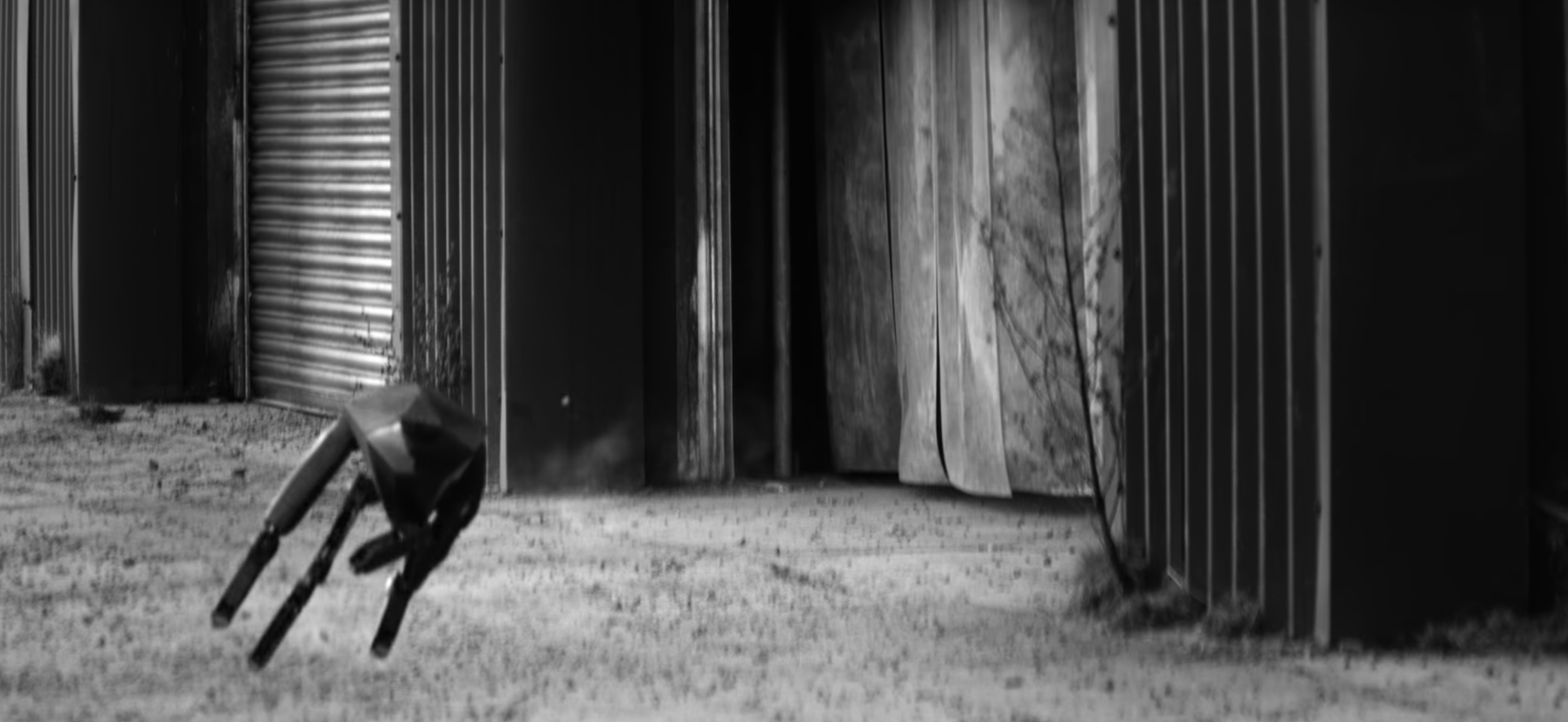
In this episode, the robot’s movement—fast, deliberate, and capable of navigating uneven terrain—resembles Spot from Boston Dynamics.
Spot can sprint at a brisk 5.2 feet per second, which translates to about 3.5 miles per hour. While that’s fairly quick for a robot navigating complex terrain, it’s still slower than the average human running speed. The typical human can run around 8 to 12 miles per hour, depending on fitness level and sprinting ability.
So while Spot may not outpace a sprinter, DARPA’s Cheetah robot can — at least on the treadmill. Nearly a decade ago, a video was released of this robot running 28.3 miles per hour on a treadmill, leaving even Usain Bolt in the dust.
But while the treadmill is impressive, the current record holder for the fastest land robot is Cassie—and she’s got legs for it! Developed by Oregon State University’s Dynamic Robotics Lab, Cassie sprinted her way into the record books in 2022, running 100 m in 24.73 seconds.
While today’s robots may not yet match the speed, adaptability, and relentless pursuit seen in the episode, the rapid strides in robotics and AI are quickly closing the gap. Like the tortoise slowly gaining ground on the overconfident hare, these technological advances, though not yet flawless, are steadily creeping toward a reality where they might outrun us in ways we hadn’t anticipated.

Charged to Kill
At a pivotal point in the story, Bella’s survival hinged on exploiting the robot’s energy source. By forcing it to repeatedly power on and off, she aims to drain its battery. Advanced machines, reliant on sensors, processors, and actuators, burn through significant energy during startup.
Today’s robots, like Spot or advanced military drones, run on rechargeable lithium-ion batteries. While these batteries offer excellent energy density, their runtime is finite—high-demand tasks like heavy movement or AI processing can drain them in as little as 90 minutes.
However, the latest battery innovations are redefining what’s possible and the automotive industry is leading the charge. Solid-state batteries, for example, offer greater capacity, faster charging, and longer lifespans than traditional lithium-ion ones. Companies like Volkswagen and Toyota have invested heavily in this technology, hoping it will revolutionize the EV market.
Self-recharging technologies, like Kinetic Energy Recovery Systems (KERS), are moving from labs to consumer products. KERS, used in Formula 1 cars, captures and stores kinetic energy from braking to power systems and reduce fuel consumption. It’s now being explored for use in consumer and electric vehicles.
Battery innovation is challenging due to several factors. Improving energy density often compromises safety and developing new batteries requires expensive materials and complex manufacturing processes.
Modern robots are pretty good at managing their power, but even the smartest machines can’t escape the inevitable—batteries that drain under intense demands. While energy storage and self-recharging tech like solar or kinetic systems may help, robots will always face the dreaded low-battery warning. After all, as much as we’d love to plug them into an infinite, self-sustaining energy source, the laws of physics will always say, “Nice try!”

Information Flow
When Bella throws paint to blind the robot’s sensors and uses sound to mislead it, her plan works—briefly. But the robot quickly adapts, recalibrating its AI to interpret new environmental data and adjust its strategy. Similarly, when Bella shoots the robot, it doesn’t just take the hit—it learns, retaliating with explosive “track bullets” that embed tracking devices in her body. This intelligent flexibility ensures that, even when temporarily disabled, the robot can still alter its approach and continue pursuing its objective.
In real life, robots with such capabilities are not far-fetched. Modern drone swarms, such as those tested by DARPA, can coordinate multiple drones for collective objectives. In some instances, individual drones are programmed to act as decoys or to deliberately draw enemy fire, allowing the remaining drones in the swarm to carry out their mission.
In October 2016 at China Lake, California, 103 Perdix drones were launched from three F/A-18 Super Hornets. During this test, the micro-drones exhibited advanced swarm behaviors, including collective decision-making, adaptive formation flying, and self-healing.
While the events in Metalhead are extreme, they are not entirely outside the realm of possibility. Modern robotics, AI, and machine learning are progressing at a staggering rate, making the robot’s ability to adapt, learn, and pursue its objective all too real.
The advancements in sensors, energy storage, and autonomous decision-making systems could one day allow machines to operate with the same precision seen in the episode.
So, while we may not yet face such an immediate threat, the seeds are sown. A future dominated by robots is not a matter of “if,” but “when.” As we step into this new frontier, we must proceed with caution, for once unleashed, these creations could be as relentless as any natural disaster—except that nothing about this will be natural.
For more writing ideas and original stories, please sign up for my mailing list. You won’t receive emails from me often, but when you do, they’ll only include my proudest works.
Join my YouTube community for insights on writing, the creative process, and the endurance needed to tackle big projects. Subscribe Now!

 Elliot Chan