I want to tell you a story. Not the one I’ve been writing, but the story of bringing it to life.
About five years ago, something sparked. A character showed up, then a scene, then a whole world. I remember thinking, This is it. This is the story I have to tell.
I had this image in my head of how it would go: sleepless nights, fast fingers, drafts piling up like magic. You know the stereotype, the fevered genius at the keyboard.
That didn’t happen.
Instead, writing this story turned into something slower. Quieter. Not a mad sprint, but more like wandering. I felt like a lost hiker, circling the same trees, passing the same landmarks, unsure if I was getting anywhere at all. But there was hope. Every plot breakthrough gave me energy—just long enough to run into the next wall.
In the beginning, everything buzzed. But the spark isn’t supposed to last.
At some point, the dialogue dries up. You lose the thread. You open your draft and just… sit there.
I told myself I was “thinking about the story,” when really, I was avoiding it. Because facing the page meant facing the fear that maybe this story wasn’t good. Or worse, that I wasn’t good.
That’s when I started to understand: inspiration might start the fire, but discipline keeps it going.
So I began showing up. On bad days. On tired days. For ten minutes at a time. I’d rewrite the same paragraph five times and still feel like I hadn’t moved. But that was progress, too.
Writers like George R. R. Martin have talked about the middle—the long slog—as the real heart of the work.
Eventually, I gave up on waiting for ideal conditions. I let go of perfect. Some days I wrote two pages. Other days, I added a single word only to cut it. That had to be enough.
What helped was remembering that no one reads the first version and that revision isn’t punishment—it’s a privilege.
Robert Jordan used to write sprawling, chaotic outlines just to figure out what he might say. Brandon Sanderson rewrote entire books. That gave me permission to take my time too.
Time wasn’t the enemy. It was the process.
There were moments I felt guilty for not writing. For thinking about quitting. For wondering if I should just start a new project with all that fresh, exciting energy again.
But there were also quiet wins: a chapter that finally clicked. A problem I solved after months of spinning. The story shifted. So did I. It stopped being about finishing fast and started being about building something I enjoyed.
Characters evolve not just in my drafts, but in my mind. Themes start to mean more. My voice changed. The world I wrote grows richer, not because I pushed, but because I lived with it.
That’s what chipping away builds. Not perfection. Not speed. But depth.
Every great epic—The Lord of the Rings, The Wheel of Time, A Song of Ice and Fire—wasn’t written overnight. They were sculpted. One patient, faithful, messy page at a time.
These days, I think of persistence as its own kind of art.
It’s not about grinding harder. It’s about staying close to the work. Trusting that something is happening, even when it feels slow. Especially when it feels slow.
So if you’re working on something long—something that keeps asking for your time and care—you’re not behind.
You’re not lost.
You’re an artist in motion.
Maybe you’ll finish the thing. Maybe you’ll shelf it. Maybe you’ll come back in a year with fresh eyes and finally crack it open. Whatever happens, the time wasn’t wasted.
If you’re in the middle of a project that’s taking longer than you expected. Keep chipping away.
And remember: art isn’t finished. It’s only ever abandoned. There is no end.
So maybe today’s the day you write one more sentence. Maybe that’s enough.
For more writing ideas and original stories, please sign up for my mailing list. You won’t receive emails from me often, but when you do, they’ll only include my proudest works.
Join my YouTube community for insights on writing, the creative process, and the endurance needed to tackle big projects. Subscribe Now!
I gave myself a lot of freedom when I started writing my novel four years ago, and it’s been great! Yes, four years is a long time, but I began this project with the intention for it to last. I’ve enjoyed every step — even though there were some dark times in between — but mostly, I love that I get to keep working on it. It’s a pleasure to see it evolve.
The project is a trilogy, totaling over 300,000 words. I’ve drafted all three books, and now it’s time to tie everything together. And I mean: EVERYTHING. The story has changed a lot since I started, so I need to go back and ensure consistency. It would have been ideal to get everything right the first time, but better now than never.
Yes, three separate manuscripts down and now going back to revise. That’s where I am. I’m all about slow progress with this project. But I understand not everyone is with theirs.
It’s crazy to recommend that other people take on something so big with complete abandonment like I did. But I really started working on this giant project without a blueprint and kinda just made my way as I went. I’m still alive and I’m confident that it’ll end up being something I’m proud of, and I have the patience and stamina to get it there. But if you are starting your journey, or you had done what I did, know this, it’s never too late to pause and do some planning.
Today, I’m going to share with you what I did when I started working on this project and talk about what I should have done. All of this will be framed around what is known as the 5 P’s of planning a novel.
If you are interested in learning more about the 5 P’s and how to fully complete a novel, check out this course by Reedsy. The folks at Reedsy had been friendly enough to reach out to me and allowed me to get a preview of this course and it definitely sparked a lot of ideas for me. Please use this affiliate link, if you want to learn more. Thank you so much!
The five P’s are key elements of your novel that you should consider before starting. You can dive in without any planning, as I did, or you can do the bare minimum to organize your thoughts. In my opinion, that means simply making some notes on the five P’s.
Now, you are probably asking what are the five P’s? Don’t worry, I’ll get to that. Let’s start with the first one: The Pitch.
The Pitch:
What I Did
I didn’t really think of the pitch when I started this novel process. I built my story around an event. Not the character or setting, but an event. A moment of intensity. The inciting incident. It all starts with a character losing a competition and then biting his competitor. From there the world falls apart around him. What does that mean? I did not know until I started writing.
I think this is exactly the reason why I swayed and had my story go in a broad direction. That’s why it grew in the telling, out of control.
I did not have a pitch. I didn’t even want to think about the pitch. The thought of marketing my story in anyway would have probably turned me off from writing it. But I was thinking of the pitch the wrong way.
What I Could Have Done
Yes, while the pitch is ultimately how I would be communicating the story to Netflix or people I’m stuck on the elevator with, it’s more than that. It’s understanding what my story is actually about.
The pitch is about story, not about theme or style. It’s about clearly defining the beginning, middle, and end of your book. A pitch is the most basic of outlines for the story, and a story is about change—what transformation does the character go through in the narrative?
A strong pitch is specific and driven by conflict. What is stopping the character from reaching those changes? If the outcome is uncertain, with a difficult choice at its core that adds tension and intrigue, that will be the ingredient that keeps the reader turning the pages.
While it’s certainly much easier to write now after I have my draft, what I should have done at the start was distill my novel into a few short sentences that served as a north star. Arguably, the most important sentences of our project is the pitch, but no pressure.
Here’s the pitch of book one of my trilogy:
“When a boy with dreams of glory loses a critical competition to his rival, his anger triggers a hidden power that shakes the very fabric of his confined world. As his uncontrollable abilities make him the prime suspect in a series of mysterious events, he becomes a target for those who see him as both a weapon and a threat. Torn between clearing his name and controlling his newfound powers, he must decide whether to embrace his role in an impending rebellion or risk losing everything he holds dear.”
The Protagonist:
What I Did
I started this project as a way to vent during the pandemic, so I didn’t need to delve too deeply to develop my protagonist. In many ways, the protagonist was my response to the world—a way to throw a tantrum without hurting anyone. Every bad thing I put the protagonist through as a writer, I experienced and responded to as myself.
What I Could Have Done
While I was pulling a lot of inspiration for my protagonist from my personal experience, what I should have identified was less of how my character would react to circumstance, but rather what were his wants and needs.
Understanding that would have helped me uncover the goals that drove him forward.
‘Want’ is something the character believes they deserve—often a false driver that can mislead them. It might push them down the wrong path, which acts as fuel for conflict in the story.
‘Need,’ on the other hand, is what the character fundamentally desires, even if they’re not fully aware of it. This deeper need may eventually compel them to change their goals and, in doing so, evolve as a person.
For example, my protagonist wants glory and power, but what he truly needs is to feel cared for and valued.
When it comes to character profiles, I didn’t focus on them until after I wrote the first draft. Surprisingly, I found this process enjoyable. Sometimes, I even took it a step further by imagining a famous actor playing the role. This helped me visualize the character more clearly and kept them consistent throughout the story. It would have been incredibly useful to do this during the planning stage, but I’m glad I discovered it along the way.
The Plot:
What I Did
I never really considered the plot in its entirety. Instead, I allowed the story to develop organically. I knew I wanted to bring the characters together in a dramatic, action-packed scene at the end, but I hadn’t thought about how I’d get there until I started writing. The only thing I was certain of was that the character would bite his rival, leading to chaos. Beyond that, I wasn’t sure what would happen next.
To be honest, I think too much planning would have made me stop writing altogether. The writing and discovery process was therapeutic for me, and if I had planned the plot in detail, the experience would have been different. It was the process itself that I enjoyed the most.
What I Could Have Done
Novels offer the freedom to structure stories in ways that aren’t always possible in movies or television shows, and I love that. I used to be caught up in traditional writing structures, like the hero’s journey, but I’ve realized that approach doesn’t work for me if I want to write freely.
Now, I have a new way of thinking about plot: it’s a symphony of change. Change is the protagonist’s journey, and by the end of the novel, the protagonist should be a different person. Understanding this process of change helps build the framework for the story..
The protagonist wants X, achieves X, but realizes it’s not enough. They learn that what they need Y, and ultimately achieve Y.
My protagonist wants glory and power, he achieves that, but realizes glory and power are not in his control. He learns that what he needs is friends, families, and allies. He ultimately finds people who care enough to save him from a dire situation.
Point of Views:
What I Did
I chose to write in the first person past tense. Although I sometimes consider this choice, I’m firm in my decision not to change it.
Writing in the first person was essential for me, especially during uncertain times. It allowed me to actively express myself. Was first person the right choice for storytelling? I honestly believe so. Without it, the story might have expanded into something entirely different. The first-person perspective imposed some limitations, keeping the narrative firmly within the character’s point of view.
Although I frequently think about the possibility of switching to third person, it’s tempting but not something I want to pursue. The first-person viewpoint compels me to be creative in how my main character discovers information, which I believe contributes to the unique style of the story. Of course, this is all in hindsight.
I felt most comfortable writing in the past tense. I knew that if I tried writing in the present tense, I would trip myself up. The project is just so big, and I needed to make it as easy as possible for myself. That’s all I considered when I picked POV and tense. What’s the easiest?
What I Could Have Done
Like I said, I didn’t spend much time considering the point of view initially, but I now realize I should have weighed the pros and cons of each POV and tense more thoroughly.
When deciding, it’s important to consider the balance between immediacy and depth. For me, depth is the more crucial factor. I value a deeper, more immersive exploration of the character’s inner world over the immediate impact of the narrative.
But all of that is based on my personal opinion. What I should have done was test it out a bit.
One useful exercise would be to write a few paragraphs from different viewpoints to see how each one affects the story. Does the chosen POV feel like the right fit? Answering that will bring so much clarity.
Of course, it’s something I can still experiment with, and it could serve as an interesting short story exercise. But it would have been nice to get that confirmation at the start, because at this point, I’m not going back to change the POV and tense. NOT GOING TO HAPPEN!
Although, I still wonder what if… what if I did write in third person…? That temptation of changing it still lingers because I never got that assurance.
The Place:
What I Did
My story grew in the telling, and so did the setting. Partway through drafting, I embarked on a world-building journey, which continues as I write and edit subsequent drafts today. It’s such a great experience seeing all of it come to life and get clearer and clearer.
Although my novel writing process began during the pandemic, it is not a pandemic story. I wanted to create a setting that was more challenging for the main character than the world of 2020. Therefore, I chose a dystopian, post-apocalyptic post-war future as the backdrop. What did that mean to me? I’m still trying to figure that out.
What I Could Have Done
I took some inspiration from the real world, but my world was fully fictional. And that left a lot of holes to be filled in and made things hard, especially while writing in first person. I would use metaphors but then go, wait… does my character know that?
To address this, I could have taken steps to better understand what my character knew or didn’t know by really getting some clarity of the setting. For example, I should have asked: What global events occurred prior to the story? What is the state of technology? What is the culture of the people? How close is he to a body of water? What is the weather like?
I also should have experimented with taking a real-world setting and making it fictional. Although I considered this approach, I didn’t delve deeply into the research and detail, so I abandoned it. Moving forward, I need to decide if my world is set on a fictional version of Earth or another planet altogether.
Either way, I should have started by gathering some inspirational pictures of real places and blending it with some fictional motifs on mood boards. Additionally, taking notes and involving some of the other senses, such as smell. For example, at one point I decided that the atmosphere in my setting is polluted and breathing is hard. How does that affect everyone who lives there?
There you have it, those are the Five P’s you should consider before starting your big project. If you found these tips helpful, I got them from the How to Write a Novel course by Reedsy. If you’re interested in learning more, check out the link in the description.
Even though I’m not a planner by nature, I found this planning exercise to be very helpful at my current stage, even though I’ve already completed the first drafts. For me, the real work happens during the editing stage, and now I feel better equipped to tackle it.
It might seem like the long way around, and perhaps if I had done this planning before starting, I wouldn’t be in this situation. But as you embark on your own journey or take time to regroup, you’ll find that there is no perfect method—what works is unique to you. So, I don’t dwell on missing any steps, because unlike assembling IKEA furniture, writing a novel isn’t so straightforward. Take what works, leave what doesn’t, and be flexible enough to move steps around.
Planning is valuable, but it doesn’t have to be confined to the beginning. Gaining insight at any stage is useful. That’s why it’s beneficial to check in and get advice from courses now and then, as they offer strategies and approaches to regroup after major milestones or writing sessions. So do check out this one from Reedsy!
For more writing ideas and original stories, please sign up for my mailing list. You won’t receive emails from me often, but when you do, they’ll only include my proudest works.
Join my YouTube community for insights on writing, the creative process, and the endurance needed to tackle big projects. Subscribe Now!
When J.R.R. Tolkien started working on The Lord of the Rings [Amazon], he thought it would be a straightforward sequel to The Hobbit [Amazon]. What began as a continuation of Bilbo Baggins’ adventures turned into an epic saga filled with new races and vast, unexplored lands.
George R.R. Martin experienced something similar with his A Song of Ice and Fire [Amazon] series. He initially envisioned a trilogy, but as he wrote, the story expanded into a massive, sprawling narrative with countless plots, rich histories, and a large cast of characters. It’s a story he has yet to finish—come on, George!
These legendary authors show us that sometimes, no matter how well we plan, our stories have a mind of their own. As we pour our thoughts onto the page and let our creativity run wild, something magical and sometimes maddening happens—the tale grows in the telling.
But what does that mean, exactly? It’s when your story expands beyond your initial vision, which often stems from a character, an event, or a theme. This organic growth can be a sign of your creativity flourishing, but it can also lead to a narrative that feels unwieldy and unfocused.
When you want a story to have a structured hero’s journey, a neatly tied-up beginning, middle, and end, and a fast-paced narrative, letting your story grow in the telling can be a bad thing.
But I love Tolkien and Martin. Creating something as expansive, rich in characters, and full of unpredictability as their worlds is what I aspire to do. It’s all about finding the right balance—allowing the tale to grow in the telling while staying the course and not getting too sidetracked. Tolkien and Martin definitely got sidetracked, telling stories about characters that don’t even influence the main plot but add another layer that the audience wasn’t previously invested in.
For example, while the main story of A Song of Ice and Fire focuses on the battle for the Iron Throne and the threat of the White Walkers, Martin decides to split A Feast for Crows and A Dance of Dragons, allowing the events in each book to happen simultaneously. This allowed Martin to introduce a whole batch of point of view characters that branched off from the original story. This brought in characters such as Aegor Rivers.
While Aegor was a great topic for discussion in online forums, with all his backstory, his role in the Blackfyre Rebellion, his founding of the Golden Company, and all his personal vendettas and ambitions. But does he really impact the main plot? Does his story even matter in the context of the current struggle for the throne or to any of the other characters that we spent 3 books getting invested in?
Perhaps he didn’t belong in A Song of Ice and Fire. If Tolkien had written it, maybe he would have stuck him in the Appendices. Either way, as a writer, it’s all about deciding what you want to do with extraneous details that don’t impact the plot. Think, director’s cut or deleted scenes for a movie. To make an informed decision, the first thing you need to do is understand key aspects that can expand as your story develops.
Here are five common areas that will grow as you write:
Characters As you write, your characters may take on new dimensions. They might develop unexpected backstories, acquire new traits, or form relationships you hadn’t planned. A minor character might suddenly demand more attention, becoming central to the plot. In “A Song of Ice and Fire,” Theon Greyjoy starts as a relatively minor character, but as the series progresses he becomes a significant player in Westeros.
History The world you’ve created has a past, and as you write, you become an archaeologist digging up new discoveries. You might find yourself exploring the origins of a society, the lineage of a royal family, or ancient events that shape your current narrative. Tolkien delves deep into the history of Middle-earth, especially with the tales of Númenor and the ancient conflicts between Sauron and the free peoples. This rich history provides a backdrop, but it’s also a rabbit hole.
Subplots New subplots can emerge organically as you write. These secondary storylines can add depth to your story, providing additional layers of intrigue and conflict. The storyline of Brienne of Tarth’s quest to find Sansa is a compelling B-story to “A Song of Ice and Fire.” Her journey and personal code of honor compliments the political and military strategizing of the main plot. A palate cleanser between major events.
Themes As your story evolves, themes can deepen or shift. You might start with a simple exploration of love but find yourself delving into themes of sacrifice, betrayal, or remorse. While the initial theme in “The Lord of the Rings” might be the fight against evil, deeper themes such as the corrupting influence of power, the importance of friendship and loyalty, the dangers of industrialization on the natural world, and the possibility of redemption (as seen in characters like Gollum) emerge.
SettingsThe settings of your story might expand, with new locations coming into play. A single city could become a sprawling world with diverse regions, each with its own culture, unique history, political dynamics, and conflicts. “A Song of Ice and Fire” begins in Winterfell but soon expands to include the Wall, King’s Landing, the Free Cities of Essos, and places beyond the Narrow Sea.
As you can see, these additions made the two epic sagas more captivating and engaging. It opens up more questions for the audience, enticing them to learn more. The key is finding that balance between intriguing and overwhelming. You must stick up for what you want to hold and at the same time not be afraid to cut when you need to.
But even when you cut, it doesn’t mean it needs to be deleted forever. Still we can learn from Tolkien and Martin.
Tolkien’s world-building in “The Lord of the Rings” laid the foundation for The Silmarillion [Amazon], a compendium of myths and legends that detail the ancient history of Middle-earth. Similarly, Martin’s extensive lore in “A Song of Ice and Fire” led to companion books like Fire & Blood [Amazon], which chronicles the history of the Targaryen dynasty from its inception in Valyria to its conquest and rule over Westeros.
In addition to “Fire & Blood,” Martin expanded his world with A Knight of the Seven Kingdoms [Amazon], a collection of three novellas following the adventures of Dunk (Ser Duncan the Tall) and his squire, Egg (the future King Aegon). Set nearly a century before “A Game of Thrones,” these stories provide a glimpse into a different era of Westeros.
And Tolkien had his fair share of companion novels as well including Beren and Lúthien [Amazon] and The Children of Húrin [Amazon], both of which were published posthumously.
What is written is never wasted. What is written can stand the test of time. So, when you trim your work, when you prune the gardens, don’t just throw away the discarded bits. They may be beautiful flowers worthy of a different venue, a different vase.
Extract subplots or character backstories that don’t fit your main narrative and develop them into standalone short stories. These can provide additional context and depth to your main work. Compile them as a collection or publish them independently. Short stories are also a great way to attract a new audience or re-engage old ones.
Use the expanded history and settings as lore to enrich your world-building. This can serve as background information that deepens the reader’s immersion. Build a Wiki for your world and open it up for dialogue, that is what good history does.
When the tale grows in the telling, it can lead to some of the most beautiful and unexpected moments in your writing. It’s a dance between structure and spontaneity, between planning and discovery. Embrace this growth, shape it, and let it enhance your story.
Having your world unfurl freely, as Tolkien and Martin did, allows you to create from a place of passion and authenticity. Even if the audience’s expectations aren’t fully met, the creative satisfaction you gain from exploring your story in depth can be invaluable. In the end, it’s your creative journey. Trust yourself, trust the process, and remember that every twist and turn is part of the adventure. Happy writing!
For more writing ideas and original stories, please sign up for my mailing list. You won’t receive emails from me often, but when you do, they’ll only include my proudest works.
Join my YouTube community for insights on writing, the creative process, and the endurance needed to tackle big projects. Subscribe Now!
Finding the time and motivation to write can be demoralizing. In 2023, I had a lot of trouble sitting down and putting pen to paper, even though I had a massive project I needed to make progress on. At the pace I was going – producing only two to three pages in a notebook per week – I realized that continuing in this manner would get me nowhere. It became clear that I needed to change my approach if I wanted to move on to the next phase anytime soon.
I had to get back to my roots and examine what I did before to succeed. In the past, I’ve shared my experience many times about working a little every day and that was the habit I needed to get back into. A 30-day writing streak proved to be the catalyst I needed to reignite my passion for writing and establish a sustainable routine. Write 1 page minimum every day. If I can do that, then there is hope.
Here’s a glimpse into my journey and the lessons I learned along the way.
1. Breaking Through the Resistance
Whether it’s battling writer’s block, self-doubt, or external distractions, the 30-day streak became my anchor through the tough times. Committing to writing daily forced me to confront obstacles head-on, transforming them from roadblocks into stepping stones. I know a lot of what I’ve written will be cut out in the editing phase, and that sucks, but I can’t worry about the tough parts in the future, I need to focus on the tough parts I’m going through now.
2. Excitement Rekindled
The monotony of daily life can dull the excitement that fuels our creativity. After working all day, I don’t want to spend another 30 min to an hour at my desk writing. If it’s not something I have to do, I’ll convince myself not to do it. But if it’s not a negotiation, then it changes my mindset — instead of dreading it, I can look forward to it. I find time to fit it in. I treat it like a meal. If I can’t cook for myself maybe I’ll order something, either way, I need to eat.
Embarking on a 30-day writing streak reignited that creative spark within me, because I don’t let the embers go out. Each day brought a new opportunity to explore ideas, even if they are as terrible as the food I cook for myself.
3. Momentum is Everything
Momentum played a crucial role in my writing streak. The initial days were challenging. When you are on day 4, and you give up, not a big deal, nothing was wasted. It’s really important to get through the first week with your streak intact. Once you do that, momentum picks up, and quitting ceases to be an option.
As I built momentum, the process became more natural and enjoyable. Momentum, I realized, is the key ingredient that propels you forward, making the act of writing a part of your daily routine.
4. Squeeze It In
One of the biggest challenges of a daily writing streak is finding time in a busy schedule. Squeezing in writing became a part of my day, but it’s not always easy. Things come up and it throws you off. You need to be flexible and prepared.
You won’t always get to write the same time every day. There will be mornings when you wake up late or evenings when you need to attend to some obligation. If you can get the writing out of the way as soon as possible, do that. If you can’t do that, then you will need to rely on your anticipation. Busy day tomorrow? Where are you going to eat lunch? It doesn’t matter, bring the notebook with you and write immediately after. Block off thirty minutes, that’s all you need to scribble some words on a page. If you commit to having the notebook with you, incredibly, you’ll find a way to make time for it.
5. Accountability Through Documentation
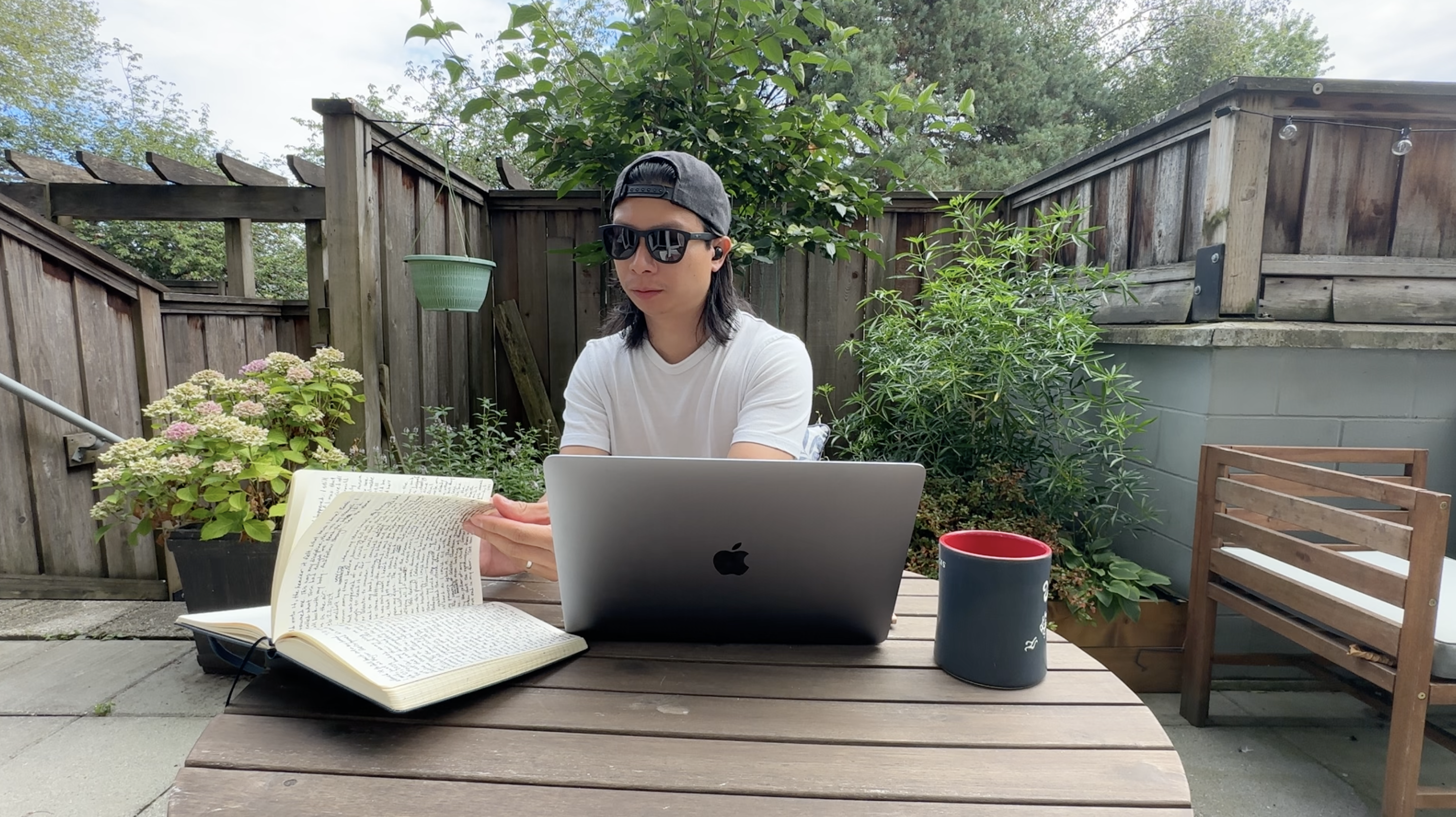
To ensure I stayed committed to my writing streak, I took an unconventional approach: filming myself. Creating a daily video log became a powerful accountability tool. Knowing that I had an audience, even if it was just future me, kept me honest and motivated to fulfill my writing commitment each day. The footage you are seeing now is me writing during the 30-day streak.
If you want to keep yourself accountable, you don’t need to film, there are other ways. You can take a photo, do it with a friend, post about it on social media, or just mark it on a calendar. I like filming because it’s relatively hands-off, I just set up the camera and let it run while I do the work. It doesn’t need to be fancy, and you don’t need to overthink it.
6. Don’t Kid Yourself
In the grand scheme of things, nobody needs me to write. It’s a selfish endeavor, driven by personal passion and a childhood dream. Acknowledging this fact eliminated any room for self-deception. If I want to write, I have to commit wholeheartedly, making it a daily habit for my own fulfillment. I can’t lie to myself and make myself feel righteous, and that all of this is for the benefit of humankind. No, this is for me. I want to do this. And that’s okay, but what’s not okay, is for me to keep bitching and being pissy that I have to do it. I don’t have to. I don’t have to find time for it. I’m choosing to. And any other attitude definitely doesn’t benefit anyone — not even myself.
So, I feel like I’m back on track. Things are happening.
Embarking on a 30-day writing streak proved to be a rejuvenating experience. A jump start I needed for my stalled vehicle. It pulled me out of a creative slump and instilled a sense of discipline in my day to day. If you’ve stopped doing something that you wanted to do, like writing, don’t hesitate—make it a habit, own it, and watch as the words and the days add up. That’s the best part.
For more writing ideas and original stories, please sign up for my mailing list. You won’t receive emails from me often, but when you do, they’ll only include my proudest works.
Join my YouTube community for insights on writing, the creative process, and the endurance needed to tackle big projects. Subscribe Now!
I’m currently working on a trilogy, and I’m well into the first draft of book 3.
I don’t usually outline my stories. And when I wrote the first drafts of book 1 and 2, as you may recall from these articles, I pants them… hard.
I see myself as a discovery writer. I have outlined in the past, but I don’t particularly like relying on it to write, because I find that it often creates restrictions in my workflow and I can’t be as fluid. I have to keep checking in on the outline to make sure I didn’t skip any key detail.
So why did I decide to outline this time?
Honestly, I don’t have much time these days to work on my creative projects. And with only a short amount of time available each day—like 3 to 4 sessions a week—I didn’t want to wait for inspiration to strike. With an outline, I can see where I left off and get straight to work on creating scenes, figuring out what happens next, or writing dialogues.
At least, that was my plan. But outlines are hard to follow and all it takes is for me to make one change and like pulling out a Jenga piece from the bottom, the whole tower is shaky and if I make too many changes, the whole thing collapses, rendering the outline useless.
Right now, I’ve completed nearly half of the first draft, and what I’m noticing is that, yes, I’m making changes. The specifics about the characters and events are definitely shifting from the outline. However, I also have a clear idea of where the story should ultimately lead. So, even if I veer away from what I initially planned, it’s not a problem. I can take detours, explore new ideas, be creative, enjoy the process, and eventually return to the important story beats I need to include.
For instance, I need my character to return to his hometown to kick off the second part of the story and then participate in a big battle during the third part. I have a good sense of the crucial scenes that need to happen between those points, but the way I choose to write those scenes is where I have room to experiment without feeling restricted by the outline.
That’s precisely what the outline provides me with. If I were journeying across the globe, the outline would represent all the flights I must catch in between destinations. What I do once I touch down is subject to change, but eventually, I’ll need to return to the airport and catch my next flight. The outline serves as my travel itinerary, not the schedule for every day of the trip.
I’m not particularly fond of using outlines, but I do need to bring this project to a conclusion at some point. By having the outline, I’m aware of the destinations I must reach to ultimately wrap this up. Now, if you’ve been keeping up with my progress, you’d be aware that I’m taking my time with this endeavor. But even though I’m not in a rush, it doesn’t mean I lack the desire to finish. During a journey, there comes a moment when you feel an urge to leave the beach and embark on a different activity. That’s where the outline comes into play. It tells me that I’ve lingered here too long and it’s time to get going to the next scene.
This is how I keep myself from getting too frustrated when I deviate from my outline. I don’t discard it entirely; I still find value in using it. Its central elements are what I require. I’m free to modify scenes as much as I want, but I must hit those key plot points. The crucial thing is staying on track to hit those points. I’m in control. I can always guide my story back on course even if I stray off it.
That’s where I stand currently. I’m exploring as I work on the first draft of book three. I’m mostly enjoying this drafting process for the final time in this trilogy, because after this step, there’s going to be a lot of editing ahead. As much as I’m anticipating that phase, the first draft has always been the part I’ve enjoyed the most. This is another reason why the outline holds significance. It will push me beyond my comfort zone to see it through.
Join my YouTube community for insights on writing, the creative process, and the endurance needed to tackle big projects. Subscribe Now!
For more writing ideas and original stories, please sign up for my mailing list. You won’t receive emails from me often, but when you do, they’ll only include my proudest works.
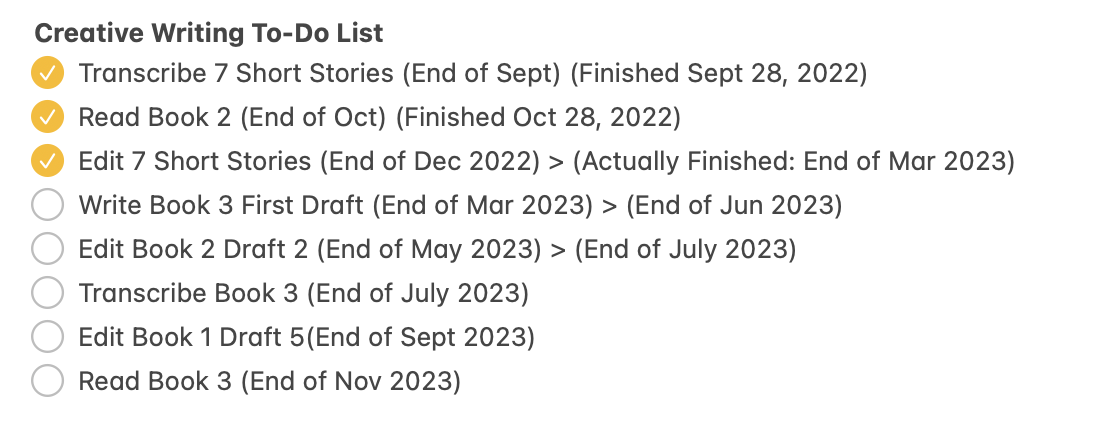
I had this checklist made around August to help me prioritize everything I wanted to do:
As you can see, things got delayed, but it’s not so bad. I just had to push a few tasks back 3 months. But the hope is by the end of this summer, I’ll be back on track.
The cause of all this is that editing each individual 5,000-6,000-word story took longer than I expected.
While time-consuming, writing seven short stories wasn’t a bad idea. But in terms of completing my trilogy, I didn’t make any progress since last fall.
However, I am working on a series, and there is a lot of world-building involved. These short stories are fun exercises at expanding the world through other storylines in different regions and at different times in history. This creative expedition allowed me to explore the world I’m building more deeply and introduce some lore.
It’s also nice to have written seven completed short stories. Having shorter works at my disposal allows me to stay active and attempt to get them published in a literary magazine or anthology. I don’t know, but there is something to be said about getting your work to a level where you feel comfortable sharing it.
Additionally, I’m also going to start looking for an editor for my series. The strategy is to use these short stories to audit editors and test different marketplaces. Whether I end up selling it or publishing it on my own, it’s good to have polished stories ready.
There is so much I can do with these shorter pieces that I don’t really feel like I’ve wasted my time even if nothing comes of them. Or perhaps this is the justification of a delusional man, and I’ve only added more layers to this already too-big project. In one way, I’ve doomed myself to failure. But in another way, I’m still working on it—all of it—so as long as I don’t stop… it’s not a failure.
Yes, it’s quite a predicament I’ve found myself in. I don’t recommend doing it this way, but if it works it works. I’m slowly chipping away at a giant project that just keeps growing. But I’m also comfortable at this speed. A lot is happening in my life, and I want to make sure I have time and energy for those things. Reading, exercising, and making these videos don’t come easily. I would love help, but getting help can sometimes be more work if I’m not ready to handle it. This year, I feel I’m going to reach that new level where I’m ready. I’ve created a solid foundation. I’m plateauing, so I need to push myself to the next level.
That’s very exciting.
Last year, I felt a lot of pressure to get this project launched. But this year, I plan to enjoy the process more. And by enjoying it, I hope to take more risks. Last year, I was so stressed. I was frustrated and angry. I still am in many ways, but this year, I want to get out of that state and not lean on my creative projects so much for my happiness. It sounds strange, but if it doesn’t have to be enjoyable, I can just enjoy it.
There’s a lot to do, and I’m on a long journey… so we’ll see what happens. This project has been with me through three crazy years, so I don’t feel a reason to stop. In many ways, I’m getting more fond of it. I haven’t lost any motivation to work on this project, I’m just mentally tired from the past few years, and I need to pace myself to avoid burning out. Little by little, I hope to get it done. We’ll see. That’s the theme of the rest of 2023: We’ll see. No pressure.
For more writing ideas and original stories, please sign up for my mailing list. You won’t receive emails from me often, but when you do, they’ll only include my proudest works.
Join my YouTube community for insights on writing, the creative process, and the endurance needed to tackle big projects. Subscribe Now!
My writing project is big. Too big. And it’s all my fault. Whatever writing advice told me to start small: start with short stories, master the fundamentals, and then move to bigger projects, I didn’t listen.
In one of my previous updates, I mentioned that I’m working on a novel. Guess what, it’s going to be more than a one-off. It’s at least two books, but probably going to be three. A trilogy. Maybe more. I’ve committed to a long game. I wanted a project that could pull me out of the Covid world and drop me on the other side. And I found it. Regardless of what this trilogy becomes, it’s going to be a significant part of my life. For that I’m lucky.
But what I want to talk about today is my awkward process. I’m currently editing the fourth draft of book one, while I’m writing the first draft of book two. It’s awkward because I feel like I’m looking into the future to write and I’m traveling back in time to edit. Unconventional as it may be, I do find it productive. At this very moment, where the world is in chaos and motivation is hard to come by, it’s easier to maintain productivity if I’m active in two separate phases: writing and editing.
When I’m writing, I’m using a different creative muscle from editing. I’m a pantser or a discovery writer, so I don’t do many outlines. My first draft is the outline and I just let it flow.
However, editing is a slog. I don’t take a lot of pleasure in editing. It’s the act of cleaning up the mess that the pantser-writer-me made, and in this project, it’s a big mess. In order to ensure I fully develop the world, understand my characters, and build out the story arc, I’m writing beyond my first book to gain clarity on what I should focus on while editing it.
I also want to keep the structure of my books the same and there was a fortuitous period of the process where I was writing the first and second acts of the sequel while editing the first and second acts of book one. This allowed me to see critical turning points in the stories from both books at the same time and try to spot and create parallels.
Ideally, I’d like this series to resemble each other in form even though the story changes as it goes. I want to be consistent where I can while letting my characters roam free and explore. This process also allowed me to go back and check on all the motivations and scenarios in the first book and make sure they support what the character will do in the second. I can even sneak some foreshadows or other storytelling devices in and hint at the events to come.
Now, I don’t recommend this as writing advice, it really does depend on your goals. For me, this writing while editing is most helpful for my editing process. I am still trying to strengthen the story in the first book and by writing beyond, I gain a better understanding of the world and characters. I can also discover whether or not the characters will achieve their goals so that I can set the tone properly. For example, if my character will face greater hardship in the second book, maybe I can lighten up in the first. Maybe I won’t. Maybe I want the lessons in the first to come into play in the second. These are all still options.
By starting my sequel before I finalize my first, I give myself room to experiment. Since I’m not an established author who has an impending deadline, this is a luxury. By doing this, with a bit of editing in the first book, I can ensure I won’t write myself into a trap I can’t escape from. Little by little, I’ll eventually bring my whole story to a close.
I will probably use this same process to complete the whole trilogy. It sickens me to think how much more I have to do, but getting started on the second book makes me feel like I’m happily invested. It proves to me that I enjoy writing this story. It makes me hopeful that I can reach the end if I just keep moving forward. At the very least I’d have it all written. Once it’s all written, then who knows… but that will be a while from now. After all, this is a big project and I’m in it for the long term.
There you have it. If you’re stuck editing your first book, try writing a sequel. Even if you don’t plan on publishing a sequel, it can help you flush out your story more. And hey, who knows, maybe you’ll discover a better ending. Maybe you’ll discover that the sequel is actually the story that matters.
For more writing ideas and original stories, please sign up for my mailing list. You won’t receive emails from me often, but when you do, they’ll only include my proudest works.
Join my YouTube community for insights on writing, the creative process, and the endurance needed to tackle big projects. Subscribe Now!


 Elliot Chan