Bungee Jumping vs Skydiving: Which One’s Actually Scarier?

Skydiving was something I always wanted to do. And this summer with the encouragement of my mother. We went and did it. 

It was a lot of fun, and the best way for me to describe that experience was that it’s like a dream, where you wake up and you still have fragments of that memory, and you are just trying to piece it all together and feel that same feeling again. I definitely see how it can be addictive. 

I felt pretty calm the whole time. The night before, I fell asleep listening to a podcast about D-Day and about how the paratroopers had to drop into France in the dead of night. I found that to be quite comforting as it allowed me to put that into perspective and come to terms with my own courage and how I’m doing it recreationally and not dropping into a war zone. 

My approach when it comes to doing something stressful like that, whether it’s bungee jumping or skydiving, is to turn my brain off. Once you do that, you just remember what you have to do. This is actually really easy for me, because as a job, I’m a marketing strategist. So I spend a lot of time during the workday thinking about things. A lot of things. 

So when I get an opportunity to turn off my brain, I enjoy it. When I get an opportunity, to follow some simple instructions like once the door to the airplane opens, pull your leg over, and just hang there. That’s easy. So yeah. 

Once I got flung out and into the free fall, that was a rush. It’s very windy, and the world feels so distorted and strange — it doesn’t even seem real. That’s the biggest difference from bungee jumping, because when you’re bungee jumping, the world comes right at you, and that feeling of plummeting toward the ground is so real and raw. When you’re falling from 10,000 feet, you don’t get that same experience.

When I was bungee jumping, especially when it’s your first time, my instincts just took over, and I started reaching out and grabbing things to stop myself, but there is obviously nothing. Doing that kind of pulled me off balance, and as you can see, I got twisting out of control. So fun. 

So yeah, back to skydiving. You’re just free-falling for a few seconds — probably between 10 and 30 — not long, before the parachute deploys. And that’s such a relief. It’s kind of the same feeling as when the bungee cord catches you and you don’t splat on the ground. There aren’t many feelings like that in life, so that was great.

From this point on, the experience is actually quite similar between skydiving and bungee jumping. You get this second ride — a second experience. With bungee jumping, you’re bouncing up and down, and the second bounce is almost as high as the first drop. That’s great because now you know the cord will hold you. With skydiving, it’s more like sightseeing — I was just trying to soak it all in.

But what really made me want to do it again was that my tandem partner, the instructor, gave me the handle to control the parachute, letting me steer. I didn’t know how to do it properly, but when you really pulled on it, it felt like a rollercoaster drop — you get swung sideways and really feel the Gs. That was awesome, and I would love to feel that again. I don’t get to go on too many rollercoasters these days, but that was incredible.

When it comes down to it, skydiving and bungee jumping often get clumped together, but they’re actually very different experiences. I’d say if you really want that “I’m going to die” feeling, bungee jumping is for you. I’ve done bungee jumping both forward and backward, and I’d recommend going forward so you can see the world coming at you — although backward is really scary too.

If you want more of a rollercoaster ride, then go skydiving. I don’t know if I can explain it any better. 

Both are so much fun, and I recommend giving both a try it’s so worth it! 

For more writing ideas and original stories, please sign up for my mailing list. You won’t receive emails from me often, but when you do, they’ll only include my proudest works.

Join my YouTube community for insights on writing, the creative process, and the endurance needed to tackle big projects. Subscribe Now!

The Creative Triathlon: How I Stay Motivated with Art, Video & Writing

I think a lot about how momentum works. Not just in training—although yeah, I do love a good triathlon—but in creativity too.

When I’m training for a triathlon, I’m not just running every day. I swim. I bike. And I run. Each discipline works different muscles, keeps things fresh, and somehow… they all support each other. Like, I come out of a bike ride with stronger legs for the run.

And that’s kinda how I’m approaching my creative life too.

I don’t just write. I don’t just draw. I don’t just make videos. I move between all of them—and doing that actually helps me stay motivated and inspired. If I’m stuck in one, I switch to another. If I’m tired of reading, I pull out my camera. If I can’t sit down to draw, I cut up footage and express my creativity in a whole new way.

So today, I’m sharing something I call the Creative Triathlon. It’s a predetermined length of focused time on three different creative practices: illustrating, video creation, and writing.
One discipline at a time. No pressure. No multitasking. Just a way to find time to do what you enjoy. 


First leg: illustration. For the past 4 years, I’ve been working on this massive personal project—drawing every single Pokémon. Yeah. All of them. It’s been slow-going, not because I don’t love it, but because finding the time is hard. Life piles up. Other projects take priority. And as strange as it sounds, drawing Pokemon doesn’t pay the bills. 

But when I do this creative triathlon, it forces me to carve out time for it. Even just 25 minutes. And honestly? It’s kind of like swimming. At first, it takes a while to get ready. But once I start? I don’t want to stop. It’s peaceful. It’s focused. And there’s something really satisfying about seeing one more little creature take shape.

This leg always reminds me why I started this project in the first place: because I love it. Because it brings me back to that kid part of myself that used to draw these things on notebooks. 

I’m almost at 1000 Pokemon. I really want to finish before they add more. If you are interested in see the rest, check out this video in the cards and the instagram in the link in the description. 


Second leg: video creation. Right now, I’ve been making a series of YouTube Shorts where I highlight key takeaways from books I’ve read. It’s honestly become one of my favorite creative outlets.

What I love about it is that it’s a true mashup of all my past-time activities—reading, thinking, writing, editing—it all comes together in these tiny videos. It makes everything I do feel active. Reading no longer feels like a passive intake of ideas. By turning it into a video, I get to spend more time with what I’m reading. I get to sit with the concepts, rephrase them, visualize them. And because of that, the lessons stick. They become part of me. A little snapshot of my life.

Video creation is great that way. It lets you experience your own thoughts in a completely new medium. You go from absorbing to articulating, from quiet reflection to something that moves and speaks. Seeing an idea come to life on screen—it just never gets old. 


Final leg: writing. I’m currently editing the fifth draft of the first book in a trilogy I’ve been working on for years. And yeah—it’s a slog. A meaningful one, but a slog nonetheless.

It’s such a big project that most days, I’m just chipping away at it. I don’t always see progress. There’s no big “aha” moment, no flashy breakthrough. It’s slow, repetitive work. And honestly, it feels a lot like running. Not a sprint—a marathon. You get tired. You want to stop. But you don’t, because the work is worth it. The fatigue is part of the point. It’s what builds endurance. It’s what makes the story matter.

Working on something this big, this long—it becomes part of your life. It’s something you carry. And the beautiful thing about creativity is that it’s not like sports… there’s no finish line in the same way. It doesn’t end. But that’s why I love this Creative Triathlon practice—because it does give me small finish lines.

Instead of focusing on finishing the book, I just focus on finishing a session. That’s it. One 25-minute block. And when it’s done, I get this little burst of relief, a sense of accomplishment. Like I’ve closed a loop. It’s such a good feeling—being able to look back at my day and say, “I did something today.” No guilt. No disappointment.

So that’s my Creative Triathlon. Three disciplines, 25 minutes each for me today. It could be more on other days, but today was only 25 minutes. Which is enough to get a good chunk of work done. Know this, though, it’s not about finishing a masterpiece in an hour and a half—it’s about movement. It’s about momentum.

Just like in a real triathlon, each leg has its own rhythm. Some feel strong. Some feel slow. But they all carry me forward.

If you’re someone who loves multiple creative things—or if you’re feeling stuck—try this. Treat your creativity like a triathlon. Mix it up. Work different muscles. Let each practice breathe new life into the others.

Thanks for hanging out with me today. If you decide to try your own Creative Triathlon, let me know how it goes! And if you already have a different combo that works for you—maybe it’s music, painting, and cooking—drop it in the comments. I’d love to hear what you’re working on.

Join my YouTube community for insights on writing, the creative process, and the endurance needed to tackle big projects. Subscribe Now!
For more writing ideas and original stories, please sign up for my mailing list. You won’t receive emails from me often, but when you do, they’ll only include my proudest works.

Watching the Audience: Why I Did Standup Comedy and Why I Stopped

Published November 22, 2015 on Medium.

Public speaking. What an irrational fear. Yet, we are all in one way or another are terrified of it. Some harness that fear and turn it into a skill set. Others retreat into the crevasses of society, taking on jobs and lifestyles that do not demand any formal public speaking. In a digital world, we as humans no longer rely on our voices; we rely on posts and tweets, images, and upvotes. We share our opinions not on soapboxes but in textboxes. We no longer stand up on stage and watch the audience.

I wanted to be an entertainer ever since I was in elementary school, and for many years, I considered it less of a yearning and more of a destiny. The class was my audience and my teachers were my toughest critics. I got as many laughs as I did detentions and it was becoming clear that I had a knack for timing — just not in terms of professionalism.

If you don’t hit the audience with a punch line at the appropriate time, you’ve lost the opportunity, the soul of the joke. A poorly timed joke is just a corny statement. There is no time to wait for a silent break in any conversation. As a thirteen-year-old kid, I knew if I didn’t shout out the funny thought in my head when I thought it was funny, it would be gone, and the world will continue spinning one laugh less.

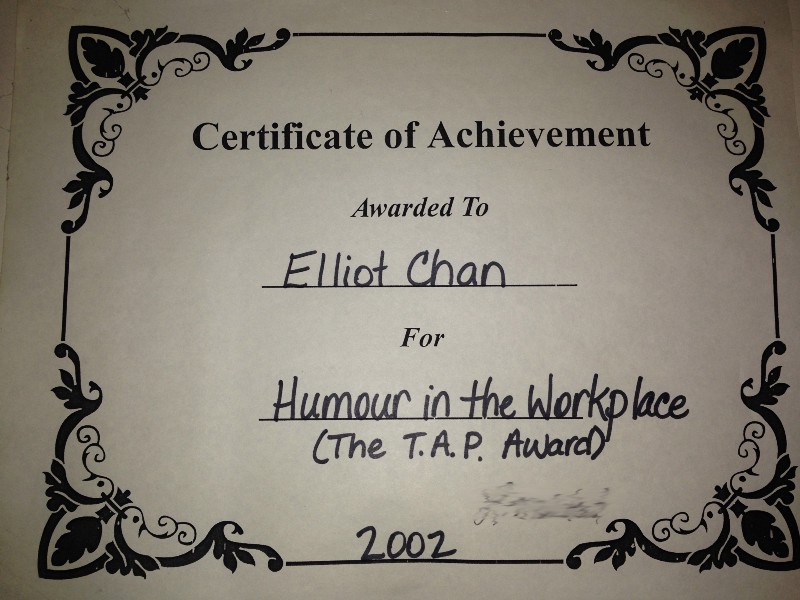
At the end of my seventh-grade experience, I was awarded the T.A.P. award. Never heard of it? Well, that is because it’s a bullshit award my teacher made in an effort to find something genuine to offer me in life. T.A.P. stood for “Time and Place” as in “There is a time and place for everything, and right now you should be quiet, Elliot.”

I accepted the award with pride, because it was something I earned. I remember looking around the class and seeing other students receive worthless, thoughtless certificates with horrendous compliments written by the teacher. Notable awards I’m making up but might as well have been given: “Most Lovely Shoes,” “The Best Teammate,” and “Genuine Friend.” Ugh! I wanted to vomit. I’ll keep my T.A.P. award, thanks.

My greatest achievement.

Perhaps it was kismet that I got into comedy: first as a fan, then as a hobbyist, and finally as a professional (the term “professional” is used loosely). But the thing about comedy is that it is not something that happens alone; performing comedy is a social act. You cannot tell jokes to yourself.

I really enjoyed making people laugh, but it came with a cost. The label. I sacrificed numerous things to be the funny guy, and one of them is credibility. After a while, people just assumed I was being sarcastic. In strenuous situations like a group project, my ideas would be shunned or taken as an unprompted attempt at humour. Later, once I started taking comedy seriously and told people about it, the intensity of other people’s preconceptions rose. “Tell me something funny!” is a line a comedian will hear often at social gatherings. Because 95% of people in the world think they themselves are funny, they’ll usually require proof that you are in fact what you claim to be. They are the best judges of humour after all. It’s the same way we all look at an attractive person and collectively go, “Yep! That person is attractive. Approved. Carry on.”

If it takes 10,000 hours to become proficient in anything, then I was 1.8% of the way to mastering comedy. An average of five minutes of stage time a week for one and a half years was hardly tenure. I was a Starbucks barista as long as I was a stand-up comedian, and Starbucks is very similar to comedy; after all, you acknowledge your audience and you behave accordingly. No need to think of entertaining, just be yourself. And like amateur stand-up comedy, the customers are not really there for your sake; they just want a drink, and you just so happen to be there.

When I told my friends and family that I have stopped doing stand up, many uttered grievances, sometimes in disappointment that they didn’t get to see me perform — in which they would tempt me to tell a joke — and others times with apprehension. “Oh… why did you stop? (Were you that bad?)”

My mother, who had once found my aspiration insufferable, had now become my number one fan. Passing up an opportunity to be a lawyer was one thing, but giving up on comedy now when so many doors were now closed, left a grave uncertainty in her life. After all, who would take care of her when she’s old if my stupid son is unemployed and not funny? Not Dane Cook that’s for sure. There wasn’t a final show where I bowed out. I just stopped asking for stage time. I told those booking shows that I was taking a break, trying to regroup.

I wonder what I would be if I didn’t stop. Would I be booking my own shows, headlining after performing at local bars and clubs for seven years, or would I just be another comedian like so many other comedians, spending my day in the back of the bar, waiting for my five minutes — still working at Starbucks during the day. I look back and I can’t image my success, which as someone who thought that entertainment was his destiny was a little heartbreaking. I was a carpenter in a world without lumber. I couldn’t help but ask: What happened to me?

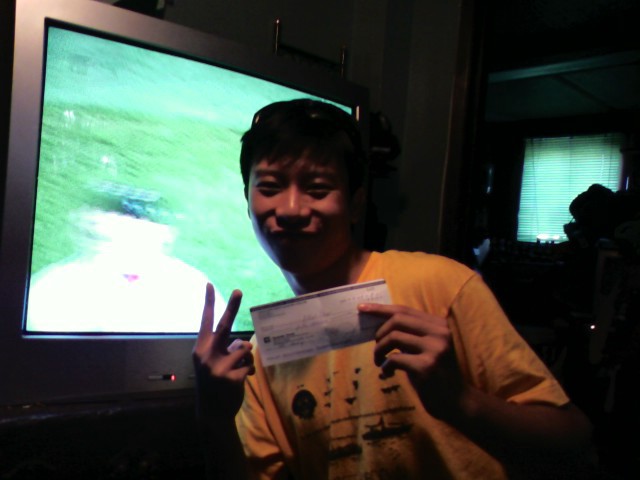
My first paycheck as a comedian. 50 big ones! (Photo taken in the Matrix where I’m famous)

There was a moment on stage, I remember; I had my audio recorder on a stool with a notebook full of notes, usually one random word followed by another, tracking the order of my set. I remember looking down at the list and reading the next word on it “Living room.”

I loved wordplay and comedy allowed me to explore it in the weirdest ways. “Living room” was one of those words that had so many meanings, but is so dramatic in a literal sense. It’s like how a scarecrow is actually there to scarecrows. The punch line of the joke comes after a ramble about how ridiculous the notion of a living room is, because “every room you’ve ever been in is a living room.” Bam! Comedy in my books. However, when I told that joke that day a part of my inside was dying. I guess I wasn’t in a living room anymore. Har har!

I stopped performing standup because I didn’t have any conviction to what I was saying. I stopped performing stand-up because what I was saying was irrelevant. I stopped doing standup because I didn’t want to waste people’s precious time with mindless wordplay and frictionless jokes. I wasn’t a good comedian because I wasn’t tackling any important issues. I was twenty years old and I had nothing to fight for except my own pride. Pride came in the form of laughter and applause. That is not what a comedian should do, that is not what any public speaker should do.

Public speaking, including comedy, is an act of influence. When an entertainer steps on stage they should bring more than their good looks and charms, they need to have something worth saying, something they are passionate about, something worth sharing. Jokes are delicious. Jokes are tasty. But jokes are cheap. It’s not hard to get a good laugh, but to be able to connect the laughter with something tangible, something genuine, well that is priceless.

I stopped doing standup because I didn’t have a reason to talk. It was elementary school all over again, but now I understood what my teacher was talking about. Time and Place.

Nevertheless, the time has changed and the place where I choose to communicate is not on stage in front of an audience, but instead in the written world, where I can pretend to have some proficiency in articulation.

There is little fear when we communicate online, the same way I had little fear when I spoke up in class. The consequence is light and so we continue to speak into the void. Sometimes people get annoyed, i.e. my teachers. Other times it’s so ephemeral that it goes unnoticed, i.e. my ramblings at the bar. Nevertheless, when we have something to say, we should make sure we are doing it at the right time and place. We should watch our audience and make certain that what we have to offer is more than reminding everyone that they are currently sitting in a living room. Although it’s hard to argue that it is an important reminder, sometimes.

Injustice and other unfairness of life

Image via Thinkstock

What is our relationship like with injustice?

By Elliot Chan, Opinions Editor
Formerly published in The Other Press. March 31, 2015

The world is full of injustice. It could be a driver taking your parking spot, a dickhead keying the side of your vehicle, or a tow truck pulling your car away. When we think of injustice we often think of those frustrating situations where our instinctual reaction is fight or flight. We get angry, we want to confront the person for cutting in line. We want to throw a punch at the clerk for overcharging us. We want to lash out because we treat injustice as a direct punishment for a crime we didn’t do. We are victims.

Life is full of these situations where we are left feeling helpless. There is no immediate solution; we simply have to rise above it. If our first thought when something bad happens is to make someone else’s life worse, then we are fuelling more injustice in the world. Your fury will not get you the parking spot you wanted, it won’t fix the side of your car, and it won’t carry you to the impound. We need to understand that there are people in the world who are pricks. They take their anger out on others and get satisfaction for it. We must stand up for ourselves, but we cannot become like them. We are the solution.

Mistreatment and unfortunate situations are a part of life. There is not a microscope on you catching you at your weakest and harming you when you least expect. We are all governed by the ebb and flow of fortune and sometimes we catch the bullshit in the face. Once we understand that everybody steps in a puddle or gets nudged in a crowded space, we can learn to operate with some self-preservation and human decency. We are the change.

We cannot control other people, we cannot control the malfunctioning mechanism of the universe, we cannot force an apology, but we can change our mindset. Our self-interest is a powerful force and it often clouds our perception. We must be well-adjusted people and handle injustice with grace and humility.

It’s unlikely that the man who cut in front of you to get the prime parking spot was rushing into the store to buy medicine for his wife, who had not left the bed in days—but it could be exactly what’s happening. He could have just come from work, where he is pressured to perform as cutbacks are being issued. He wants to get in and out as quickly as possible and return to his crappy life. He wants to relax, make dinner, and go to sleep early so that he can go back to work tomorrow ready to grind it out some more. Suddenly, your injustice seems like a childish tantrum. We are all victims.

Being an adult means being able to handle these injustices and transform them into knowledge, experiences, and wisdom. There is a reason for everything that happens, and perhaps the greatest injustice in the universe is when we don’t learn from the unfairness, so that we may prevent or at least mitigate it in the future.

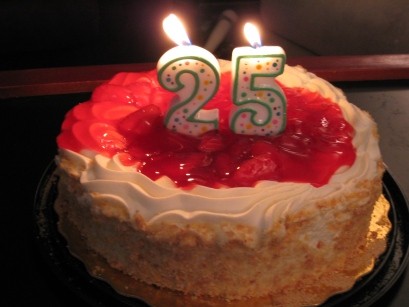
Twenty-five to life


OPINIONS_Cake

How I survived in perfect conditions

By Elliot Chan, Opinions Editor
Formerly published in The Other Press. Jan. 28, 2014

This year I turn 25. I don’t feel a day older than 18—that is, until I stand beside someone who just graduated from high school. I don’t feel that young either, until I stand next to someone with kids, a spouse, a mortgage, a pension plan, and a will. When I look back at all I have accomplished in my 25 years of life, I realize that my achievements are internal. For a quarter of a century, I’ve been living the Canadian dream and if I could go back in time and tell the six-year-old version of myself what I’ve done, I think he would be proud.

I dreamt big as a child, as most children do. I wanted to be an actor, or at least someone with the opportunity to be creative. Here I am—not an actor, but definitely creating. I feel pretty accomplished in that sense, not because I have achieved anything extraordinary (anyone with an opinion can write for the Other Press), but because I’m persistent and I’m staying true to my values.

Regardless of your age, I hope you are too, and that you’re not looking down on me for doing so.

I think reaching the 25-year mark still aiming for the goals I had as a child is remarkable. After all, think of all the other stuff getting in my way. Yes, the real life shit: money, education, relationships, entry-level jobs, parents, and peers. I see my high school friends, all of whom are turning 25 this year as well, moving out, getting engaged, and being promoted. They’re settling down with their lives, and it makes me so happy to see, because another trait I want as a 25-year-old is to be supportive—the same way I want my friends to support me and my silly choices.

But does that mean I’m a failure because I don’t have any of those things my friends have? Not at all, because like I said, what I have achieved is inside of me. It’s my own investment.

If the objective of life is to get a mortgage, then sure, I’m failing so far. And by the looks of it, I’ll continue to fail until, well, maybe my mid-life crisis. Yet, I have succeeded in recognizing that I would trade in a small two-bedroom house in exchange for travelling or writing a novel or getting a robust education. I believe when I’m 65, I’m going to be proud that I’ve indulged in life as a 25-year-old instead of taking roots in an existence I have no desire to grow old in.

I glance back on my successes and failures, and dwell a little bit on the failures. Yes, I wanted to be an actor and failed. I wanted to be a film director and failed. I wanted to be a standup comedian and failed. I made money as a dishwasher, a barista, a background performer, a sandwich board advertiser, and a door-to-door canvasser. I look back now and I can’t believe I did that—the same way I can’t believe I went bungee jumping. It’s weird what I’m proud of: not my successes, but my failures.I can’t believe they felt like the right decisions at some point. I can’t believe I did those things. But I did and I survived and it’s a part of me.

Up until now, my life has been a wrestle with adversity. But man, what an experience that’s been. What a great 25 years I’ve lived. What fantastic people I’ve met along the way. What wonderful privilege I had for being able to chase my dream and for being able to continue doing so. I don’t care what your age is, you should still be able to chase your dream. Or maybe I’m wrong. Maybe I’ll never grow up.

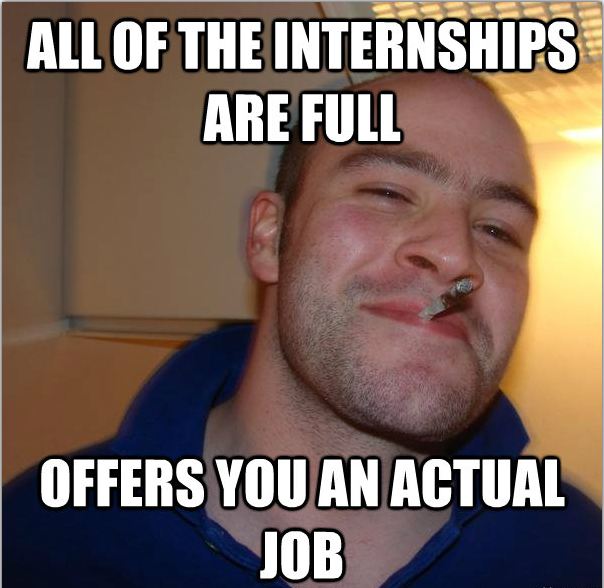
Nice guys finish last—but they get second chances

 NkcLxBc

Passion versus reputation

By Elliot Chan, Opinions Editor

Formerly published in The Other Press. Jan. 7, 2014

All through our upbringing, people have told us to behave nicely to each other, but there was always this voice in the back reminding us that perhaps we’re getting pushed around and being taken advantage of. We try to puff out our chests and keep our heads up high, but it always seems that when the time comes to make a complicated decision or to say no, we turn soft. For those of us who want to be successful, being nice might just be the one quality to hold us back—but I believe that opportunities are bountiful for those who are kind.

As Eminem sang, “You only get one shot, do not miss your chance to blow, this opportunity comes once in a lifetime, yo!” There is a general consensus that opportunities do not come around that often, so when one does arise, it’s important to seize it. It’s good to have goals and pursue them with a passion, but ambition can become a pretty ugly trait when you start pushing people over to achieve your academic, professional, or personal objectives.

Compassion may not be in the same category as work ethic or drive, but it’s a soft skill that will help you gain friends and supporters, rather than rivals and competitors. We always talk about getting a slice of the pie, but let’s be honest: if there is a pie, we aren’t getting a slice of it. We’re scurrying around under the table and we’re waiting for crumbs. It sounds pathetic, but that is how we live. Work together with those who may threaten your ability to move up, not against them. To quote Chinese general, Sun Tzu, and The Godfather: Part II, “keep your friends close and your enemies closer.”

Regardless of who succeeds in the end, having a tight network of friends is more valuable than having a one-track mind. Being a self-made man or woman is great, but it’s an illusion. Society is built upon a strong foundation, and that is constructed through kindness and shared opportunities—not through backstabbing and selfish acts.

The Bureau of Labor Statistics shows that on average, people change jobs approximately 11 times throughout the course of their lives. Meanwhile, research from Penn State University shows that 80 per cent of American students are uncertain about their majors, and over 50 per cent change their major at least once. That means what you want now might not actually be what you want later. So don’t fret, make friends, and learn more about yourself as you go before you act self-righteous, damage your reputation, and harm others.

It doesn’t matter if you end up being a leader of a small technology start-up company or the mayor of Toronto, it’s always important to have sympathy and kindness towards others. Life is not one destination, it’s a journey—if you waste all your energy reaching a once-in-a-lifetime opportunity, you’ll realize that you have wasted all you second chances on the petty little things.