The right to be racist

150616113043-donald-trump-super-169

Does honest hate equal harmony?

By Elliot Chan, Opinions Editor

How do we hold people accountable for their racist actions? Perhaps we can’t. Perhaps their racist actions are justified.

Everyone is a little racist. It doesn’t matter if you belong to a race with privilege or one without; you are a little racist. The thing is, racism doesn’t always come out as hate, very often the solidarity we exhume is an act of boorish racism—sure, it’s not oppression or violence, but acting like a whole coloured community needs your help is a brand of arrogance that sits on one end of the spectrum. I’m not calling you a racist, but I’m saying that if you are, that’s okay.

Sometimes I wonder why there is that divide. Why one brand of people is so intolerant and the other, so righteous. Perhaps it’s the old way of thinking versus the new way of thinking.

I grew up in a conservative Chinese family. My whole life I felt ashamed of the things my parents would say in Cantonese—out in public. They aren’t bad people. They don’t have an AK47 or a diabolical plan for genocide. They just don’t know too many people of different ethnicities, and those they do know have a history of taking advantage of them because they weren’t as well-versed in their “new” country. They see, they feel, they act—just like we all do.

I don’t blame my parents for their behaviour. They have the freedom to say whatever they want and they aren’t hurting anybody. So how can I blame other people for acting the same way?

The majority of my friends are Caucasians. In a way, I’m the token. I think they forget that I’m of a different race most of the time, which is why they are my friends. They rarely call me out and make me feel awkward (but they still do… rarely). However, now and then I catch them in a conversation where the topic falls upon race. I tend to sit back and watch them interact: talking, debating, and agreeing on what is a racist act and what isn’t. I wonder if white supremacists do the same thing but on a different scale. If that’s the case, don’t we all just create our own cultural norm?

If we look at racism not as a thing to eliminate but as a thing to be accountable for, I believe we would live in a more peaceful world. We don’t like everyone, and that’s fine. To not like someone because of his or her race is okay. To not like someone because of their weight, gender, and other factors they can’t control is okay. But own up to it, own up to being an imperfect, shallow person. And allow other people to make the same judgement about you.

We can never know what it feels like to be a different person with different challenges and upbringings. While you may want to call people out for being racist, your actions aren’t as justified as you think. You’ve happened to pick a side, just like how they did. Being tolerant of people means accepting that some people won’t see the world the way you do.

People have the freedom to be racist just like how you have the freedom to be righteous. If we start pulling freedom away from a group of people because they have a different belief, is that not oppression?

One day I hope to be in a room with a group of friends of all colours talking about what racism is to them. I hope, then, we can still all agree.
Your laws are too ‘precious’

Opinions_Gollum-Turkey

Why comparison of the Turkish president to Gollum is as ridiculous as fantasy

By Elliot Chan, Opinions Editor
Formerly published in The Other Press. Dec. 9, 2015

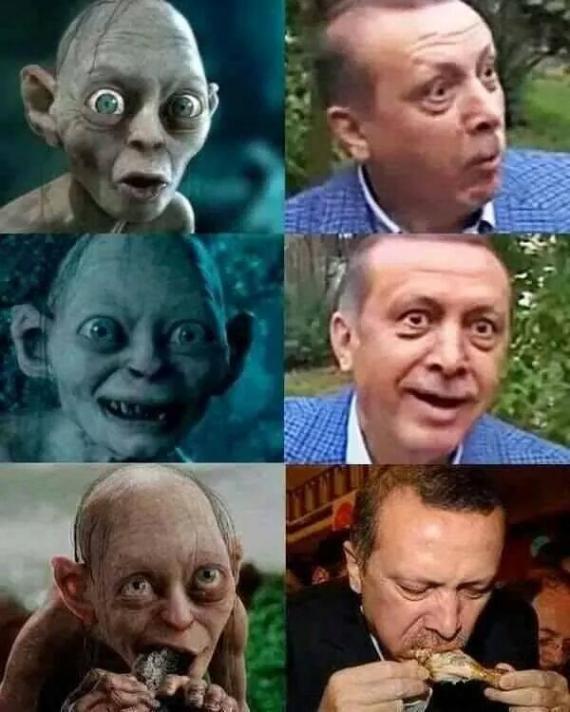
In Turkey, insulting, mocking, or showing any dissension to the president is against the law. This case was proven when Bilgin Çiftçi, a Turkish doctor, created a meme of President Recep Tayyip Erdoğan’s face side by side, matching expressions with Gollum, the despicable character from The Lord of the Rings.

Çiftçi has since been fired from his job, but now the courts are determining the next order of action. Since the chief judge—apparently too busy—has never seen any of The Lord of the Ring films, he and the court is turning to some experts of Tolkien’s epic tale in order to determine whether or not the comparison is indeed an insult. The argument in defence of Çiftçi is that Gollum is a hero of the story and therefore the meme was not an insult, but rather a compliment.

Now, I’m going to break this whole situation into two parts.

First off, Gollum, although he redeems himself (in a sense) at the end of the saga, is not a hero of the trilogy. He is a vile creature that succumbed to greed. Gollum is a victim, for sure, but at no point was he a hero. He killed his best friend, Déagol. Gollum is the epitome of a self-destructive addict.

I know what you are thinking: he ended up destroying the One Ring, doesn’t that make him a good guy? No! Because he bit off Frodo’s finger in an outburst of voracity and fell off the edge of Mt. Doom. He had no intention of destroying the ring. While it was the ring that corrupted poor Smeagol and morphed him into Gollum, we cannot honestly say that Gollum is a hero.

The second part of the situation that must be addressed is how stupid the law is. This proves that freedom of speech, no matter how benign it is, is still a luxury in many parts of the world. Moreover, the inability of some to show any sense of humour is even more disturbing than the law itself. The fact that Tayyip didn’t just brush it off and accept the little ball busting is kind of funny, too. You’d think a man with power could poke fun at the fact that his looks are comparable to, say, Orlando Bloom.

Let’s be honest, Çiftçi was not trying to plot Erdoğan’s downfall. Even if he disliked the President, the mere comparison to Gollum did very little harm to the President’s persona. All it did was call attention to the fact that Erdoğan shared similar features to a fictional character—which he totally does! Perhaps Peter Jackson didn’t need to utilize CGI or Andy Serkis. He could have just cast Erdoğan.

I’m sure many in Turkey found the comparison uncanny, too. But when a country has a law that makes it incapable of processing a joke, then it is that country that becomes the joke. Imagine a Canada where we weren’t allowed to satirize our leaders. That wouldn’t be the free country we know and love. Turkey is a beautiful place, one I wish to visit one day, but with a law like that it sounds more like Mordor than Rivendell.

Honouring ‘Charlie Hebdo’ and freedom of speech

Firefighters carry a victim on a stretcher at the scene after a shooting at the Paris offices of Charlie Hebdo, a satirical newspaper,

Where the line is drawn and where it is crossed

By Elliot Chan, Opinions Editor
Formerly published in The Other Press. January 13, 2015

The hostile take over of Charlie Hebdo, the French satirical left-wing magazine, and the massacre of nine employees and two National Police officers reminds us of the thin barrier protecting our freedom of speech and the fine line between poking fun and instigating attack.

The senselessness that occurred on January 7 gave strength to what many agree to be a dying medium. Publications across the globe banded together to acknowledge the bravery of those cartoonists who died so that we may continue to speak our mind and express our opinions.

Newspapers, magazines, and various other publications that hold the mirror upon society, showing all the blemishes, scars, and corruption, are the vehicles for democracy. Without them, without freedom of speech, without public and private institutions to speak up, we are doomed. And for that reason alone, I honour those who have lost their lives over the years—CharlieHebdo included—for our right to express ourselves.

Yet, such ruthlessness cannot be ignored. Forthright as I am, I am not eager to die for my craft. So I must ask, where is the line I must draw for myself? How will I know when I have crossed it? When should I cross it?

Those who know me know that I only view activism from the perimeter. I have yet to determine my stance. Should I fight against corporate giants like Kinder Morgan? Should I challenge government discourse, like those in Hong Kong did last year? Should I rally for legalization of marijuana? I know at some point I’ll have to pick a battle, because those who stand idly by give power to the enemy, whoever it is.

So I ask us all: What are we willing to die for? What change in the world do we wish to see for the next generation? What have we inherited from the sacrifice of those before us? Take a moment to learn about our history, whatever realm you are interested in—art, politics, civil rights, etc. You will find that what we have did not materialize overnight; what we have came from battles hard-fought. Unlike a war, but still a battle with casualties.

We should arm ourselves with open-mindedness and good intentions. We should not talk or write with the goal of being accurate, but with a whim of curiosity. Societal issues lie in a grey area.  What is right in our minds may be wrong somewhere else. We as artists, journalists, comedians, filmmakers, and other influencers must set the example. We too must not be close-minded. We too must see from our opposition’s point of view, understand where they are coming from, and why they are willing to risk their lives to defeat us.

Let’s harbour discussion to create a better world—one without intentions to provoke, one without intention to kill.