One Year with Petey | What One Year With a Rescue Dog Really Looks Like

We adopted Petey a year ago. At the time, we weren’t sure what to expect. He had come from a shelter and carried a lot of fear with him—fear of people, fear of other dogs, fear of every little sound. The first few months were a lot of learning, and honestly, a little bit of wondering if we were up to the challenge.


In those early months, it was all about getting used to home life. He barked at every noise and chewed on anything soft—blankets and pillows were his favorites. 

We tried having him sleep in a crate that first night. That was a mistake. We put a lot of effort into crate training, but it ended up doing more harm than good. We kept trying to help him gain some independence. But even when we left him alone in our room, he could never fully settle. After being abandoned on a highway and then locked up in a shelter, confinement was understandably hard for him.

The hardest part was taking him out for walks. My wife would wake up early just to take him out to do his business—beating the traffic, getting ahead of the neighborhood, before other people and dogs filled the sidewalks. Then she’d come back home, and Petey would crawl back into bed with me for a couple more hours. It was a strange period, one that now feels like another lifetime ago.

But slowly, things began to change. The house became familiar. Less scary. He started to understand that this was a safe space where no dog was going to sneak up behind him, and where he could actually relax and take a nap. The little wins felt huge. By the end of that quarter, Petey was settling in ways we never thought possible.

And maybe one of the biggest achievements in the first three months was being able to wean him completely off the medication he was on in the shelter. Without the drugs fogging him up or adding tension, his real personality slowly started to come through.

He still chewed blankets and pillows… but we’ll call that progress.


As spring arrived, Petey’s world began to stretch beyond a five-block radius. This is when the real tests started—park walks, new places, brief encounters with other dogs, and slowly, very slowly, being around strangers. But each time he made it through a hard moment, he came out with a little more confidence. Every new experience chipped away at the old ones, rewriting and replacing them.

We took him to events, hoping the exposure would help—and honestly, to run a few tests, since we had a lot planned for the summer. Some moments were rough: barking at passing dogs and people, or panicking when my wife or I walked away to step into a store. But over time, something shifted. He started to realize that the world isn’t always dangerous. That we would always come back. And what once felt unbearable slowly became just a mild inconvenience to him.

We noticed it most on our walks. Instead of staying on constant alert, he began to sniff more, linger a little longer, and actually enjoy his surroundings.

At home, there were fewer and fewer uncontrollable, crazy moments. During the first few months, the hours between 1pm and 4pm were Petey’s crazy hours, where it would rather demand constant attention, freak out over nothing, or chew on things. This made it hard for us to work. So we were glad that this was just a passing phase, something he was able to grow out of. 

Step by waddle-y step, Petey started trusting not just us, but the world around him too.


By the third quarter, it felt like Petey had found his stride. Summer arrived, and with it came longer walks, new trails, and lazy naps in the sun.

We had always believed that underneath the fear was a sweet personality waiting to come through. Over the summer, it finally did. He was now enjoying his life to the fullest.

We started leaving him home alone for short stretches—an hour at a time—watching him through our little security camera. We were relieved to see that after a few howls, he’d curl up in his bed. He wasn’t completely relaxed, but he wasn’t overwhelmed either. Mostly, he just seemed grumpy.

We took him on a few trips that summer, and each time he surprised us. He would sniff, explore, and often lead the way. One of those trips was to Pender Island, where he stayed in a hotel for the first time. It was challenging—for him and for us. 

The ferry ride was tough, and dog-friendly hotels come with a lot of dogs wandering around, which can still send him into a panic. It would have been easier, and definitely more relaxing, to leave him at home. But pushing him to come along ended up being another big step forward.

And we could see the difference afterward. The moments of uncontrollable fear were fewer and farther between. Back at home, he started napping more during the day. Watching him enjoy the small, ordinary joys of summer, he felt like a completely different dog from who he was six months earlier.


As the seasons changed again, Petey was looking so much healthier. We were starting to recognize all of his little irritabilities—his sensitive skin, his sensitive stomach, and his sensitive disposition. Shelter trauma still shows up from time to time. He still startles occasionally if a dog starts barking on the TV, and he still doesn’t exactly love it when kids run toward him.

We’ve also been able to leave him home alone for longer stretches without him getting anxious. What started as forty-five minutes has slowly grown into a few hours. We played chill music on YouTube while we were away, just so there was always some background sound. That way, bumps in the building, beeping in the alley, or random noises wouldn’t immediately send him into a fit. It meant our algorithm got completely taken over by lo-fi and jazzy playlists, but that’s a small sacrifice.

Walks feel more relaxed. He’s even gotten really good at walking with a loose leash. He still has his moments of stubbornness, but he’s becoming a dog who can enjoy life without constant fear. 

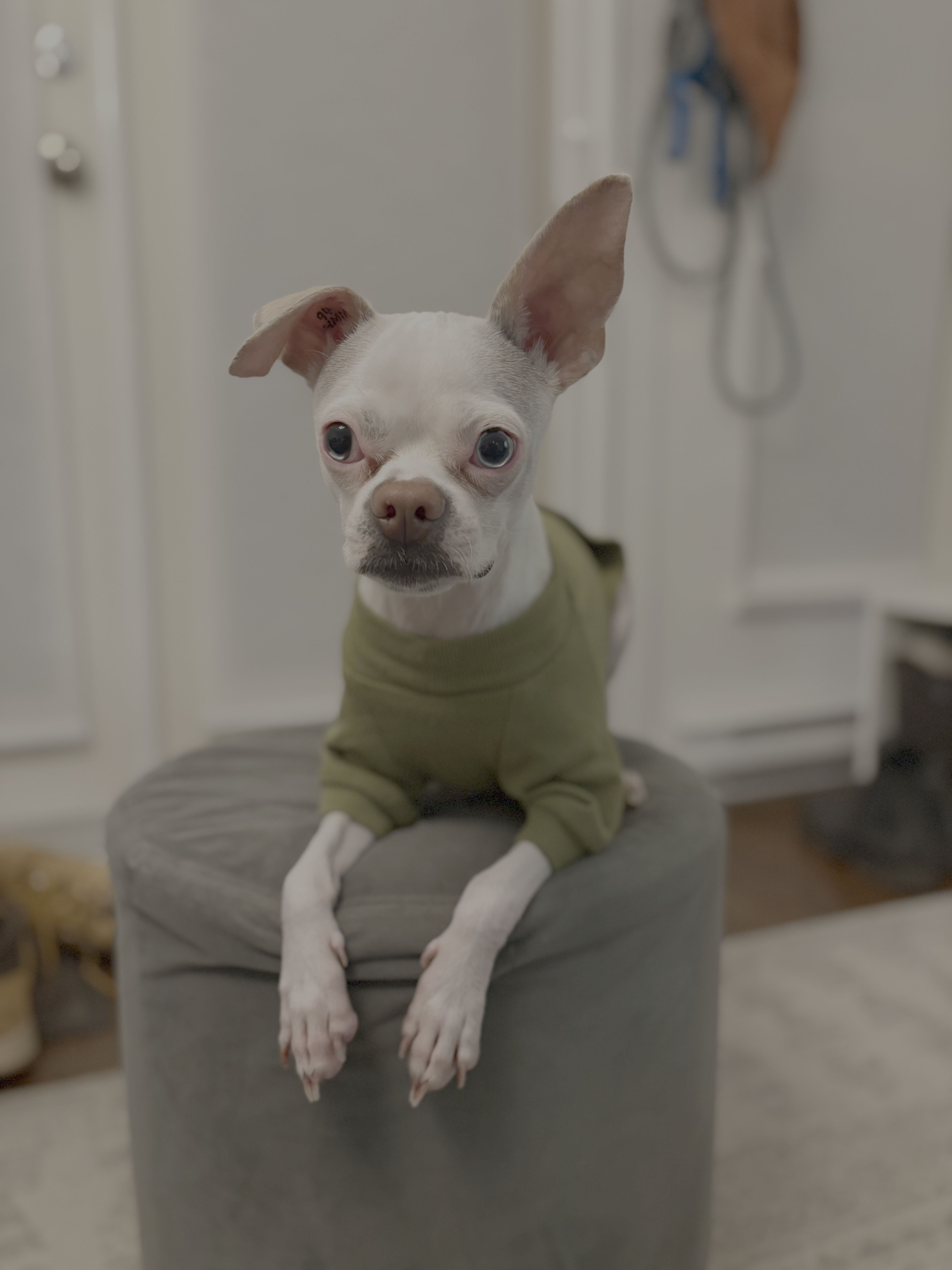
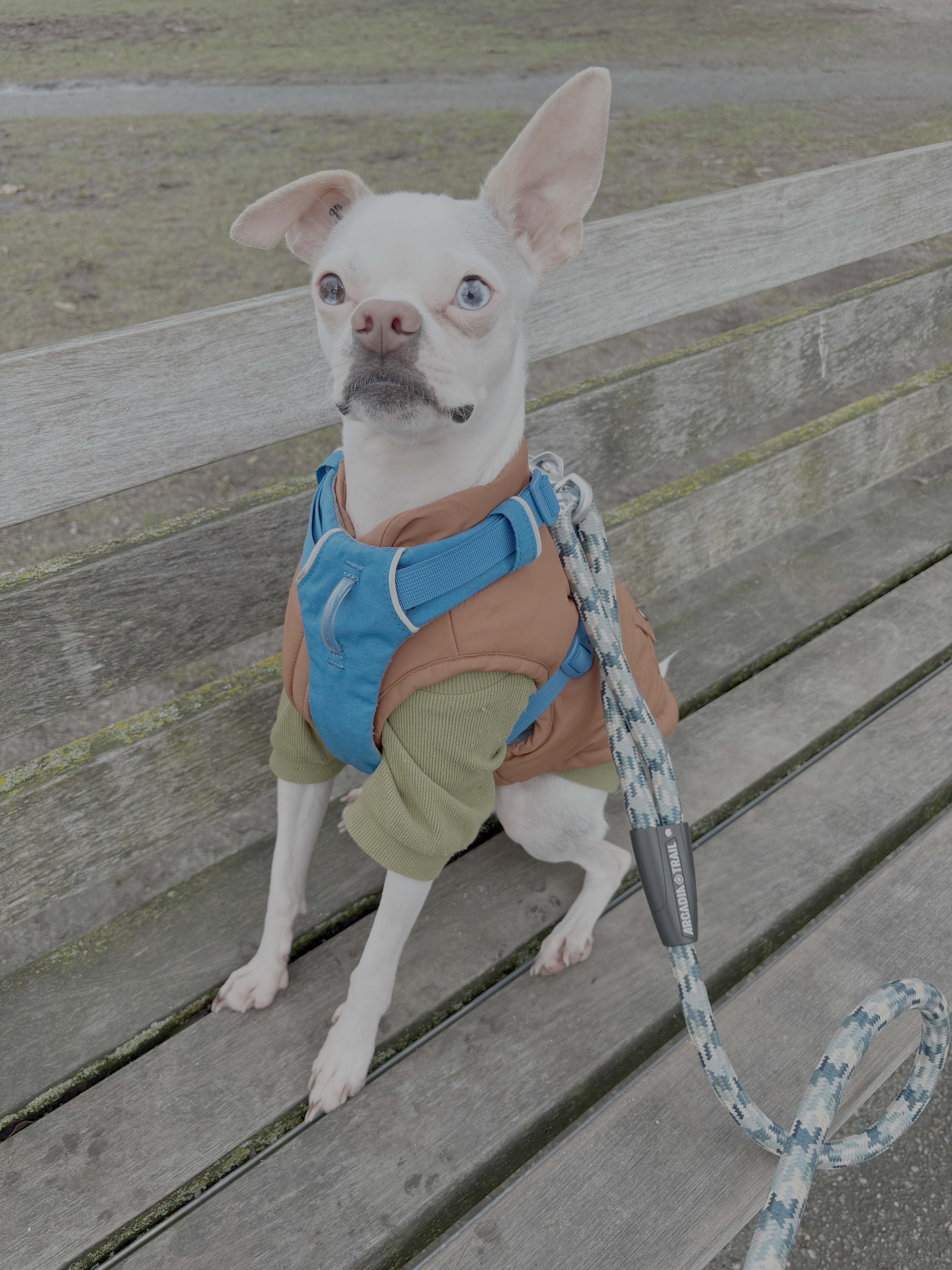
What surprised me the most this year was the change in his physical appearance, especially his eyes. It’s wild how much they’ve changed in a year. It really shows how stress, anxiety, fear, and abandonment can shape an animal, whether it’s a dog or a human. 

We used to joke that he just had Steve Buscemi eyes. Turns out, once he felt safe, they were more Zooey Deschanel eyes.


Looking back over this year, it’s hard to believe it’s the same dog. We were warned that adopting him would completely shake up our lives. And yes, the first few months were stressful—and yes, we still sometimes have to wake up in the middle of the night to take him for an urgent late-night poop or have to cross the street a few times to avoid dogs or loud families—but honestly, life with a dog has made us happier than life without one. 

We were told Petey might never be cuddly, might never learn anything new, and might never be able to go anywhere with us. None of that turned out to be true. Over the past year, we’ve watched him transform from an anxious, fearful little dog into a confident, happy sidekick. And this is just the first year.

Petey has shown us patience, resilience, and the joy of learning to trust a whole new world. If this year is any indication, he still has a lot more adventures—and growth—ahead of him.

For more writing ideas and original stories, please sign up for my mailing list. You won’t receive emails from me often, but when you do, they’ll only include my proudest works.

Join my YouTube community for insights on writing, the creative process, and the endurance needed to tackle big projects. Subscribe Now!
Adopting a Shelter Dog: 3 Months of Transformation with Petey

It’s been over three months since we adopted Petey from the shelter. When we first brought him home, we had an idea of what he’d been through and knew he had a lot of healing to do. But day to day, the progress was hard to see.

Now, looking back, it’s incredible to see how far he’s come in such a short time. It gives us so much hope that he can grow into his full potential—confident, obedient, and chill.

Of course, it’s still a work in progress, and there’s a long way to go. But at the three-month mark, there’s already so much to celebrate.

They say three months is a big milestone for a shelter dog—it’s when they start feeling truly comfortable in their new home, and their real personality starts to shine through.

And while we’ve seen some major wins in his behavior, the biggest surprise? His physical transformation.

Physical Changes:

When we first brought Petey home, he was emaciated—you could literally see the stress and anxiety on his face. He was always on high alert like some paranoid drug addict. On top of that, he had these concerning rashes on his elbows.

Petey doesn’t have a lot of hair, so his skin is extra vulnerable, but the rashes didn’t seem like they were from rubbing against anything. The vet recommended an elimination diet and prescribed a medical shampoo for his baths. We also got him some clothes—not just to protect him from the elements, but to stop him from licking himself raw.

Now, at the three-month mark, Petey has never looked better. He’s filled out, his face looks noticeably less stressed, and even the bags under his eyes have lightened—though he still has those signature Steve Buscemi eyes. His hair has thickened up a bit (even in the places we thought he couldn’t grow hair), and most importantly, the rashes on his elbows are completely gone.

We’re not 100% sure what did the trick—whether it was allergies, bacteria, or just the stress—but I’m leaning toward a bacterial infection. So, as much as he hates bath time, those medicated washes probably made the biggest difference.

Barking at Noises

Over the past three months, Petey has made huge progress when it comes to dealing with noises—whether it’s sounds from the alley, the hallway, or even the TV.

When we first brought him home, things like garbage trucks beeping or our neighbors coming and going would send him into a meltdown. In those early weeks, he’d bark like crazy and take anywhere from 10 to 30 minutes to calm down—which was frustrating.

But now? He still hears the sounds, but instead of instantly reacting, he actually pauses and thinks about it. And if he does decide to bark, we can stop him with just our voices and redirect him to something else.

That’s a huge win. It gives us hope that, soon enough, these noises won’t even phase him—he’ll be completely used to it.

Biting Blankets and Cushions

Petey loves biting soft things. But he also loves relaxing on soft things. And, well, that creates a bit of a dilemma.

In the first two months, he was fixated on chewing blankets and cushions. We got him a bed, but he just kept biting it—so we had to take it away. It was one of the biggest signs that he couldn’t be trusted alone.

To curb the destruction, we tried a chew-prevention spray—basically just bitter flavoring. Did it work? Yes, for a bit, but it wasn’t a permanent solution. 

Fast forward to today, and while Petey still has the occasional urge to chew, the difference is that now, when we tell him to stop, he actually listens. That’s a huge milestone. Before, I’d have to physically block him, which would just make him double down—his “shelter brain” would kick in, and sometimes, in the chaos, he’d bark, jump, and snap at me.

Now, the only time he really goes for our stuff is when he’s chewing one of his toys and—by pure coincidence—a cushion or a blanket corner ends up in his mouth. At that point, the temptation is just too strong. But even then, we can call him off with just our voices. 

Most recently, we’ve introduced the bed back into the equation and while he still has the urge to bite it, there are also occasions where he is able to control himself enough so that he is able to lie down and even take a nap in it. 

That’s huge progress.

Being Left Alone

Probably the biggest struggle with Petey right now is leaving him alone.

He has a lot of trauma from being locked in a crate, and if we put him in one, it takes just a few seconds before he starts freaking out. We can extend it to a few minutes with a Kong. But even just closing him in a room is a challenge. We set up a camera to see what he does when the door is shut, and… yeah, he just jumps at the door over and over until he’s exhausted.

This is one area where, honestly, we haven’t made a ton of progress. We worry about him getting himself into trouble—or worse, annoying the neighbors with his constant yapping.

So, we’re taking it slow. Little by little.

We’ll leave him in the living room while we work in our offices—he’ll nap on the couch while we do. He’s fine when we step away for a bathroom break. And occasionally, we’ll step outside to throw out the garbage while he stays in the living room.

It’s going to take patience—on both sides. But lately, thanks to some afternoon naps together, Petey has started to chill out a bit. There have even been times when he takes himself to the bedroom to rest on his own. We have faith that as he develops more confidence, he’ll start seeking more opportunities to be independent. 

While there is no hard date. We do have a timeline—there’s going to come a day when we have to leave him alone. So, we’re really hoping the next three months bring more progress than the first three. Fingers crossed.

Walks

When we first got Petey, walks were a whole thing.

The smallest things would spook him—someone walking down the street, a shadow from a tree, kids playing, a random bang from the construction site down the block. But nothing freaked him out more than other dogs.

In the past three months, he’s gotten way better with people walking by and random noises. And for the most part, he can handle dogs in the distance. What he can’t handle? A dog—or even a person—coming too close to our home. If another dog walks by our gate, he gets territorial, barking and charging like a little maniac.

One time, he actually pulled out of his leash on me—and I swear, that was the most terrified I have ever been in my entire life. Luckily, we both survived that ordeal. And honestly? We both grew from it.

The key on walks has been constant treats. The more he’s enjoying himself, the less likely he is to freak out. But we’ve still got work to do—especially when I’m walking him with my wife, and one of us has to duck into a store. That situation? Still a struggle.

The best part, though? I’ve started taking him on some runs. It’s not the most efficient workout for me yet, but I know it’s something we can keep practicing and get better at over time.

The Most Cuddly Boy

If there’s one thing we’ve learned about Petey in the past three months, it’s that he is one of the cuddliest dogs I’ve ever met—and honestly, we couldn’t be happier about it. He’s only gotten more cuddly over time, and it’s clear this isn’t just a phase. This is who he is.

And to think—at the shelter, there were discussions to euthanize this sweet guy. It’s almost unbelievable when I look at him now.

Petey is just this happy, fun-loving guy. If it weren’t for the rough start he had in life, he’d be an all-star dog. He’s super smart, pure-hearted, and the longer we have him, the more he reminds us of our first dog, Michael.

Like Michael, Petey is part Boston Terrier, and we’re starting to see those traits shine through. It feels like Michael’s spirit is guiding Petey in some way—and that thought just fills us with so much joy.

When I look at Petey in profile, I see Michael. It’s crazy how this dog found us, just like we found him. It couldn’t have worked out more perfectly for all three of us.

These past three months have been challenging, frustrating, and exhausting at times—but watching him heal, seeing his progress, and knowing how far he’s come? That makes it all worth it. We couldn’t be more proud.

Join my YouTube community for insights on writing, the creative process, and the endurance needed to tackle big projects. Subscribe Now!

For more writing ideas and original stories, please sign up for my mailing list. You won’t receive emails from me often, but when you do, they’ll only include my proudest works.

Only (child) the lonely

By Elliot Chan, Opinions Editor
Formerly published in The Other Press. March 4, 2014

I was a late-bloomer, in the social sense. As a child, most of my time was dedicated to television, artworks, or other solitary enjoyments. My parents were too busy with work to entertain me, and my cousins lived too far away for weekday visits. Yes, being an only child was a lonely endeavour. If it wasn’t for my imagination and my ability to outgrow my shyness, I would not have been able to survive my teenage years, let alone my adult years.

As I watch my parents age and my own responsibilities pile up, I wish I could turn to someone for support; a person who could relate to my family’s erratic behaviour and me; someone to talk to without having to explain a lengthy life story; someone who understands mom and dad’s expectations and their tendencies; someone to vent to without feeling the judgmental reverberations.

My parents rely on me for many things, and often times it seems unfair that all their hopes and dreams are now placed upon my shoulders. As an only child, I’m all the eggs in one basket—and they know it as well as I do. I know that having siblings comes with minor annoyances: you’ll have to wake up early to fight for the bathroom, you might not get seconds for dinner, and you might need to move out earlier because your parents can no longer support all of you financially. Those who are an only child face a psychological challenge. I call it “I never asked to be born” syndrome, where the child has to decide whether to do what their parents want them to do or to live their own life. That syndrome is evermore present in only children.

I’m well-aware that when mom and dad are gone, I might be the last branch extending out in an obtuse direction from our family tree. That’s a scary thought, one that only those without siblings can understand. All the affection, all the care, all the attention we received our whole lives will vanish. Memories of family dinners, vacations, and other snippets of normality growing up will be lost—should I allow it to be.

Now, I’m not saying that I want a brother or a sister. That is not a decision for a son to make, nor did I ever pressure my parents to conjure up a playmate for me. From my experience, it’s a flip of the coin on whether you’ll actually get along with your siblings. Regardless, I think a bond between siblings is sacred; they endure the test of time. I find myself attempting to replicate that relationship with my friends and my cousins, but since most of my friends and cousins have siblings and families of their own, the sensation is far from authentic.

A family has a gravitational force that pulls all the beings together. An only child suffers the fate of orbiting alone, like the moon around Earth. Insignificant to the universe, but vital to the planet, we can only wonder what life would be like if there was another.