It’s good to be back. After taking a month off from editing my novel trilogy, it feels great to return to it with fresh eyes. The last few months of summer were hectic, and I was running on fumes. As much as I wanted to power through, I knew a break was better than burning out.
Over the last few years, I’ve made a ton of progress — getting drafts of all three books down on paper was a huge milestone. But now I’m deep in the editing phase, making sure each story flows not just on its own, but as part of a bigger arc. Think of it like this: each book has its own beginning, middle, and end — but together, books one, two, and three form one larger story with the same structure.
It’s exciting, but it’s also a grind. I’m chipping away at it day by day while balancing the rest of life. By the end of summer, I was training for my triathlon and working full-time, and something had to give. I believe you can do everything — just not all at once. So, for a while, writing took a backseat.
I’ll admit, I was nervous about stepping away. I worried I’d lose momentum or that this would be the moment my project quietly died — that fear every long-term creator knows: put something down for “just a bit,” and never pick it up again.
But working on this project has been part of my life for five years now — it’s built into my routine, like cleaning the house or tending the garden. When I take a break, it’s not like quitting; it’s more like letting the plants grow wild for a bit. Eventually, I’ll come back to prune and tidy things up.
I didn’t even stop at a neat checkpoint — I was mid-edit, right in the middle of Chapter 3 of Book 2. That actually made it easier to return. There wasn’t a buildup or mental block. I just jumped back in where I left off.
So yeah, it might feel like starting over, but it’s not. It’s more like reconnecting with an old friend. You know that feeling when you haven’t seen someone in ages, and you wonder if it’ll be awkward — but then, as soon as you meet, you pick up right where you left off. That’s what returning to my writing felt like.
And as the saying goes, absence makes the heart grow fonder. I’m more excited about this project than ever. Is it going to be the greatest thing ever written? Probably not — but that’s not the goal. Nobody visits Italy thinking, “I’m going to be the best person to ever visit Italy.” You go because you love the experience. Writing is like that for me. With each revision, I see the story sharpen and come alive. I’m polishing the stone, adding color to the outline, and watching my vision take shape.
So here’s what’s next: to stay accountable, I’m starting a new monthly series documenting my progress — the writing, the challenges, the little breakthroughs.
It won’t be easy, but I’m committed. I feel refreshed, inspired, and ready to keep going. This years-long journey still fills me with an energy I can’t quite put into words.
My name’s Elliot. I make videos about the endurance of creativity and life in this wild, dystopian world.
If you’re working on your own story and want some support and inspiration along the way, follow this series, check out the playlist, and don’t forget to subscribe.
For more writing ideas and original stories, please sign up for my mailing list. You won’t receive emails from me often, but when you do, they’ll only include my proudest works.
Join my YouTube community for insights on writing, the creative process, and the endurance needed to tackle big projects. Subscribe Now!
I want to tell you a story. Not the one I’ve been writing, but the story of bringing it to life.
About five years ago, something sparked. A character showed up, then a scene, then a whole world. I remember thinking, This is it. This is the story I have to tell.
I had this image in my head of how it would go: sleepless nights, fast fingers, drafts piling up like magic. You know the stereotype, the fevered genius at the keyboard.
That didn’t happen.
Instead, writing this story turned into something slower. Quieter. Not a mad sprint, but more like wandering. I felt like a lost hiker, circling the same trees, passing the same landmarks, unsure if I was getting anywhere at all. But there was hope. Every plot breakthrough gave me energy—just long enough to run into the next wall.
In the beginning, everything buzzed. But the spark isn’t supposed to last.
At some point, the dialogue dries up. You lose the thread. You open your draft and just… sit there.
I told myself I was “thinking about the story,” when really, I was avoiding it. Because facing the page meant facing the fear that maybe this story wasn’t good. Or worse, that I wasn’t good.
That’s when I started to understand: inspiration might start the fire, but discipline keeps it going.
So I began showing up. On bad days. On tired days. For ten minutes at a time. I’d rewrite the same paragraph five times and still feel like I hadn’t moved. But that was progress, too.
Writers like George R. R. Martin have talked about the middle—the long slog—as the real heart of the work.
Eventually, I gave up on waiting for ideal conditions. I let go of perfect. Some days I wrote two pages. Other days, I added a single word only to cut it. That had to be enough.
What helped was remembering that no one reads the first version and that revision isn’t punishment—it’s a privilege.
Robert Jordan used to write sprawling, chaotic outlines just to figure out what he might say. Brandon Sanderson rewrote entire books. That gave me permission to take my time too.
Time wasn’t the enemy. It was the process.
There were moments I felt guilty for not writing. For thinking about quitting. For wondering if I should just start a new project with all that fresh, exciting energy again.
But there were also quiet wins: a chapter that finally clicked. A problem I solved after months of spinning. The story shifted. So did I. It stopped being about finishing fast and started being about building something I enjoyed.
Characters evolve not just in my drafts, but in my mind. Themes start to mean more. My voice changed. The world I wrote grows richer, not because I pushed, but because I lived with it.
That’s what chipping away builds. Not perfection. Not speed. But depth.
Every great epic—The Lord of the Rings, The Wheel of Time, A Song of Ice and Fire—wasn’t written overnight. They were sculpted. One patient, faithful, messy page at a time.
These days, I think of persistence as its own kind of art.
It’s not about grinding harder. It’s about staying close to the work. Trusting that something is happening, even when it feels slow. Especially when it feels slow.
So if you’re working on something long—something that keeps asking for your time and care—you’re not behind.
You’re not lost.
You’re an artist in motion.
Maybe you’ll finish the thing. Maybe you’ll shelf it. Maybe you’ll come back in a year with fresh eyes and finally crack it open. Whatever happens, the time wasn’t wasted.
If you’re in the middle of a project that’s taking longer than you expected. Keep chipping away.
And remember: art isn’t finished. It’s only ever abandoned. There is no end.
So maybe today’s the day you write one more sentence. Maybe that’s enough.
For more writing ideas and original stories, please sign up for my mailing list. You won’t receive emails from me often, but when you do, they’ll only include my proudest works.
Join my YouTube community for insights on writing, the creative process, and the endurance needed to tackle big projects. Subscribe Now!
I gave myself a lot of freedom when I started writing my novel four years ago, and it’s been great! Yes, four years is a long time, but I began this project with the intention for it to last. I’ve enjoyed every step — even though there were some dark times in between — but mostly, I love that I get to keep working on it. It’s a pleasure to see it evolve.
The project is a trilogy, totaling over 300,000 words. I’ve drafted all three books, and now it’s time to tie everything together. And I mean: EVERYTHING. The story has changed a lot since I started, so I need to go back and ensure consistency. It would have been ideal to get everything right the first time, but better now than never.
Yes, three separate manuscripts down and now going back to revise. That’s where I am. I’m all about slow progress with this project. But I understand not everyone is with theirs.
It’s crazy to recommend that other people take on something so big with complete abandonment like I did. But I really started working on this giant project without a blueprint and kinda just made my way as I went. I’m still alive and I’m confident that it’ll end up being something I’m proud of, and I have the patience and stamina to get it there. But if you are starting your journey, or you had done what I did, know this, it’s never too late to pause and do some planning.
Today, I’m going to share with you what I did when I started working on this project and talk about what I should have done. All of this will be framed around what is known as the 5 P’s of planning a novel.
If you are interested in learning more about the 5 P’s and how to fully complete a novel, check out this course by Reedsy. The folks at Reedsy had been friendly enough to reach out to me and allowed me to get a preview of this course and it definitely sparked a lot of ideas for me. Please use this affiliate link, if you want to learn more. Thank you so much!
The five P’s are key elements of your novel that you should consider before starting. You can dive in without any planning, as I did, or you can do the bare minimum to organize your thoughts. In my opinion, that means simply making some notes on the five P’s.
Now, you are probably asking what are the five P’s? Don’t worry, I’ll get to that. Let’s start with the first one: The Pitch.
The Pitch:
What I Did
I didn’t really think of the pitch when I started this novel process. I built my story around an event. Not the character or setting, but an event. A moment of intensity. The inciting incident. It all starts with a character losing a competition and then biting his competitor. From there the world falls apart around him. What does that mean? I did not know until I started writing.
I think this is exactly the reason why I swayed and had my story go in a broad direction. That’s why it grew in the telling, out of control.
I did not have a pitch. I didn’t even want to think about the pitch. The thought of marketing my story in anyway would have probably turned me off from writing it. But I was thinking of the pitch the wrong way.
What I Could Have Done
Yes, while the pitch is ultimately how I would be communicating the story to Netflix or people I’m stuck on the elevator with, it’s more than that. It’s understanding what my story is actually about.
The pitch is about story, not about theme or style. It’s about clearly defining the beginning, middle, and end of your book. A pitch is the most basic of outlines for the story, and a story is about change—what transformation does the character go through in the narrative?
A strong pitch is specific and driven by conflict. What is stopping the character from reaching those changes? If the outcome is uncertain, with a difficult choice at its core that adds tension and intrigue, that will be the ingredient that keeps the reader turning the pages.
While it’s certainly much easier to write now after I have my draft, what I should have done at the start was distill my novel into a few short sentences that served as a north star. Arguably, the most important sentences of our project is the pitch, but no pressure.
Here’s the pitch of book one of my trilogy:
“When a boy with dreams of glory loses a critical competition to his rival, his anger triggers a hidden power that shakes the very fabric of his confined world. As his uncontrollable abilities make him the prime suspect in a series of mysterious events, he becomes a target for those who see him as both a weapon and a threat. Torn between clearing his name and controlling his newfound powers, he must decide whether to embrace his role in an impending rebellion or risk losing everything he holds dear.”
The Protagonist:
What I Did
I started this project as a way to vent during the pandemic, so I didn’t need to delve too deeply to develop my protagonist. In many ways, the protagonist was my response to the world—a way to throw a tantrum without hurting anyone. Every bad thing I put the protagonist through as a writer, I experienced and responded to as myself.
What I Could Have Done
While I was pulling a lot of inspiration for my protagonist from my personal experience, what I should have identified was less of how my character would react to circumstance, but rather what were his wants and needs.
Understanding that would have helped me uncover the goals that drove him forward.
‘Want’ is something the character believes they deserve—often a false driver that can mislead them. It might push them down the wrong path, which acts as fuel for conflict in the story.
‘Need,’ on the other hand, is what the character fundamentally desires, even if they’re not fully aware of it. This deeper need may eventually compel them to change their goals and, in doing so, evolve as a person.
For example, my protagonist wants glory and power, but what he truly needs is to feel cared for and valued.
When it comes to character profiles, I didn’t focus on them until after I wrote the first draft. Surprisingly, I found this process enjoyable. Sometimes, I even took it a step further by imagining a famous actor playing the role. This helped me visualize the character more clearly and kept them consistent throughout the story. It would have been incredibly useful to do this during the planning stage, but I’m glad I discovered it along the way.
The Plot:
What I Did
I never really considered the plot in its entirety. Instead, I allowed the story to develop organically. I knew I wanted to bring the characters together in a dramatic, action-packed scene at the end, but I hadn’t thought about how I’d get there until I started writing. The only thing I was certain of was that the character would bite his rival, leading to chaos. Beyond that, I wasn’t sure what would happen next.
To be honest, I think too much planning would have made me stop writing altogether. The writing and discovery process was therapeutic for me, and if I had planned the plot in detail, the experience would have been different. It was the process itself that I enjoyed the most.
What I Could Have Done
Novels offer the freedom to structure stories in ways that aren’t always possible in movies or television shows, and I love that. I used to be caught up in traditional writing structures, like the hero’s journey, but I’ve realized that approach doesn’t work for me if I want to write freely.
Now, I have a new way of thinking about plot: it’s a symphony of change. Change is the protagonist’s journey, and by the end of the novel, the protagonist should be a different person. Understanding this process of change helps build the framework for the story..
The protagonist wants X, achieves X, but realizes it’s not enough. They learn that what they need Y, and ultimately achieve Y.
My protagonist wants glory and power, he achieves that, but realizes glory and power are not in his control. He learns that what he needs is friends, families, and allies. He ultimately finds people who care enough to save him from a dire situation.
Point of Views:
What I Did
I chose to write in the first person past tense. Although I sometimes consider this choice, I’m firm in my decision not to change it.
Writing in the first person was essential for me, especially during uncertain times. It allowed me to actively express myself. Was first person the right choice for storytelling? I honestly believe so. Without it, the story might have expanded into something entirely different. The first-person perspective imposed some limitations, keeping the narrative firmly within the character’s point of view.
Although I frequently think about the possibility of switching to third person, it’s tempting but not something I want to pursue. The first-person viewpoint compels me to be creative in how my main character discovers information, which I believe contributes to the unique style of the story. Of course, this is all in hindsight.
I felt most comfortable writing in the past tense. I knew that if I tried writing in the present tense, I would trip myself up. The project is just so big, and I needed to make it as easy as possible for myself. That’s all I considered when I picked POV and tense. What’s the easiest?
What I Could Have Done
Like I said, I didn’t spend much time considering the point of view initially, but I now realize I should have weighed the pros and cons of each POV and tense more thoroughly.
When deciding, it’s important to consider the balance between immediacy and depth. For me, depth is the more crucial factor. I value a deeper, more immersive exploration of the character’s inner world over the immediate impact of the narrative.
But all of that is based on my personal opinion. What I should have done was test it out a bit.
One useful exercise would be to write a few paragraphs from different viewpoints to see how each one affects the story. Does the chosen POV feel like the right fit? Answering that will bring so much clarity.
Of course, it’s something I can still experiment with, and it could serve as an interesting short story exercise. But it would have been nice to get that confirmation at the start, because at this point, I’m not going back to change the POV and tense. NOT GOING TO HAPPEN!
Although, I still wonder what if… what if I did write in third person…? That temptation of changing it still lingers because I never got that assurance.
The Place:
What I Did
My story grew in the telling, and so did the setting. Partway through drafting, I embarked on a world-building journey, which continues as I write and edit subsequent drafts today. It’s such a great experience seeing all of it come to life and get clearer and clearer.
Although my novel writing process began during the pandemic, it is not a pandemic story. I wanted to create a setting that was more challenging for the main character than the world of 2020. Therefore, I chose a dystopian, post-apocalyptic post-war future as the backdrop. What did that mean to me? I’m still trying to figure that out.
What I Could Have Done
I took some inspiration from the real world, but my world was fully fictional. And that left a lot of holes to be filled in and made things hard, especially while writing in first person. I would use metaphors but then go, wait… does my character know that?
To address this, I could have taken steps to better understand what my character knew or didn’t know by really getting some clarity of the setting. For example, I should have asked: What global events occurred prior to the story? What is the state of technology? What is the culture of the people? How close is he to a body of water? What is the weather like?
I also should have experimented with taking a real-world setting and making it fictional. Although I considered this approach, I didn’t delve deeply into the research and detail, so I abandoned it. Moving forward, I need to decide if my world is set on a fictional version of Earth or another planet altogether.
Either way, I should have started by gathering some inspirational pictures of real places and blending it with some fictional motifs on mood boards. Additionally, taking notes and involving some of the other senses, such as smell. For example, at one point I decided that the atmosphere in my setting is polluted and breathing is hard. How does that affect everyone who lives there?
There you have it, those are the Five P’s you should consider before starting your big project. If you found these tips helpful, I got them from the How to Write a Novel course by Reedsy. If you’re interested in learning more, check out the link in the description.
Even though I’m not a planner by nature, I found this planning exercise to be very helpful at my current stage, even though I’ve already completed the first drafts. For me, the real work happens during the editing stage, and now I feel better equipped to tackle it.
It might seem like the long way around, and perhaps if I had done this planning before starting, I wouldn’t be in this situation. But as you embark on your own journey or take time to regroup, you’ll find that there is no perfect method—what works is unique to you. So, I don’t dwell on missing any steps, because unlike assembling IKEA furniture, writing a novel isn’t so straightforward. Take what works, leave what doesn’t, and be flexible enough to move steps around.
Planning is valuable, but it doesn’t have to be confined to the beginning. Gaining insight at any stage is useful. That’s why it’s beneficial to check in and get advice from courses now and then, as they offer strategies and approaches to regroup after major milestones or writing sessions. So do check out this one from Reedsy!
For more writing ideas and original stories, please sign up for my mailing list. You won’t receive emails from me often, but when you do, they’ll only include my proudest works.
Join my YouTube community for insights on writing, the creative process, and the endurance needed to tackle big projects. Subscribe Now!
I’m currently working on a trilogy, and I’m well into the first draft of book 3.
I don’t usually outline my stories. And when I wrote the first drafts of book 1 and 2, as you may recall from these articles, I pants them… hard.
I see myself as a discovery writer. I have outlined in the past, but I don’t particularly like relying on it to write, because I find that it often creates restrictions in my workflow and I can’t be as fluid. I have to keep checking in on the outline to make sure I didn’t skip any key detail.
So why did I decide to outline this time?
Honestly, I don’t have much time these days to work on my creative projects. And with only a short amount of time available each day—like 3 to 4 sessions a week—I didn’t want to wait for inspiration to strike. With an outline, I can see where I left off and get straight to work on creating scenes, figuring out what happens next, or writing dialogues.
At least, that was my plan. But outlines are hard to follow and all it takes is for me to make one change and like pulling out a Jenga piece from the bottom, the whole tower is shaky and if I make too many changes, the whole thing collapses, rendering the outline useless.
Right now, I’ve completed nearly half of the first draft, and what I’m noticing is that, yes, I’m making changes. The specifics about the characters and events are definitely shifting from the outline. However, I also have a clear idea of where the story should ultimately lead. So, even if I veer away from what I initially planned, it’s not a problem. I can take detours, explore new ideas, be creative, enjoy the process, and eventually return to the important story beats I need to include.
For instance, I need my character to return to his hometown to kick off the second part of the story and then participate in a big battle during the third part. I have a good sense of the crucial scenes that need to happen between those points, but the way I choose to write those scenes is where I have room to experiment without feeling restricted by the outline.
That’s precisely what the outline provides me with. If I were journeying across the globe, the outline would represent all the flights I must catch in between destinations. What I do once I touch down is subject to change, but eventually, I’ll need to return to the airport and catch my next flight. The outline serves as my travel itinerary, not the schedule for every day of the trip.
I’m not particularly fond of using outlines, but I do need to bring this project to a conclusion at some point. By having the outline, I’m aware of the destinations I must reach to ultimately wrap this up. Now, if you’ve been keeping up with my progress, you’d be aware that I’m taking my time with this endeavor. But even though I’m not in a rush, it doesn’t mean I lack the desire to finish. During a journey, there comes a moment when you feel an urge to leave the beach and embark on a different activity. That’s where the outline comes into play. It tells me that I’ve lingered here too long and it’s time to get going to the next scene.
This is how I keep myself from getting too frustrated when I deviate from my outline. I don’t discard it entirely; I still find value in using it. Its central elements are what I require. I’m free to modify scenes as much as I want, but I must hit those key plot points. The crucial thing is staying on track to hit those points. I’m in control. I can always guide my story back on course even if I stray off it.
That’s where I stand currently. I’m exploring as I work on the first draft of book three. I’m mostly enjoying this drafting process for the final time in this trilogy, because after this step, there’s going to be a lot of editing ahead. As much as I’m anticipating that phase, the first draft has always been the part I’ve enjoyed the most. This is another reason why the outline holds significance. It will push me beyond my comfort zone to see it through.
Join my YouTube community for insights on writing, the creative process, and the endurance needed to tackle big projects. Subscribe Now!
For more writing ideas and original stories, please sign up for my mailing list. You won’t receive emails from me often, but when you do, they’ll only include my proudest works.
Nine months. That’s how long it takes to give birth to a baby. Writing a book can take much longer. The commitment to have a child has obvious correlations with creativity; they both bring something new into the world. Additionally, children and art are two ways we find fulfillment in life. However, human life and a creative project should not share the same level of seriousness.
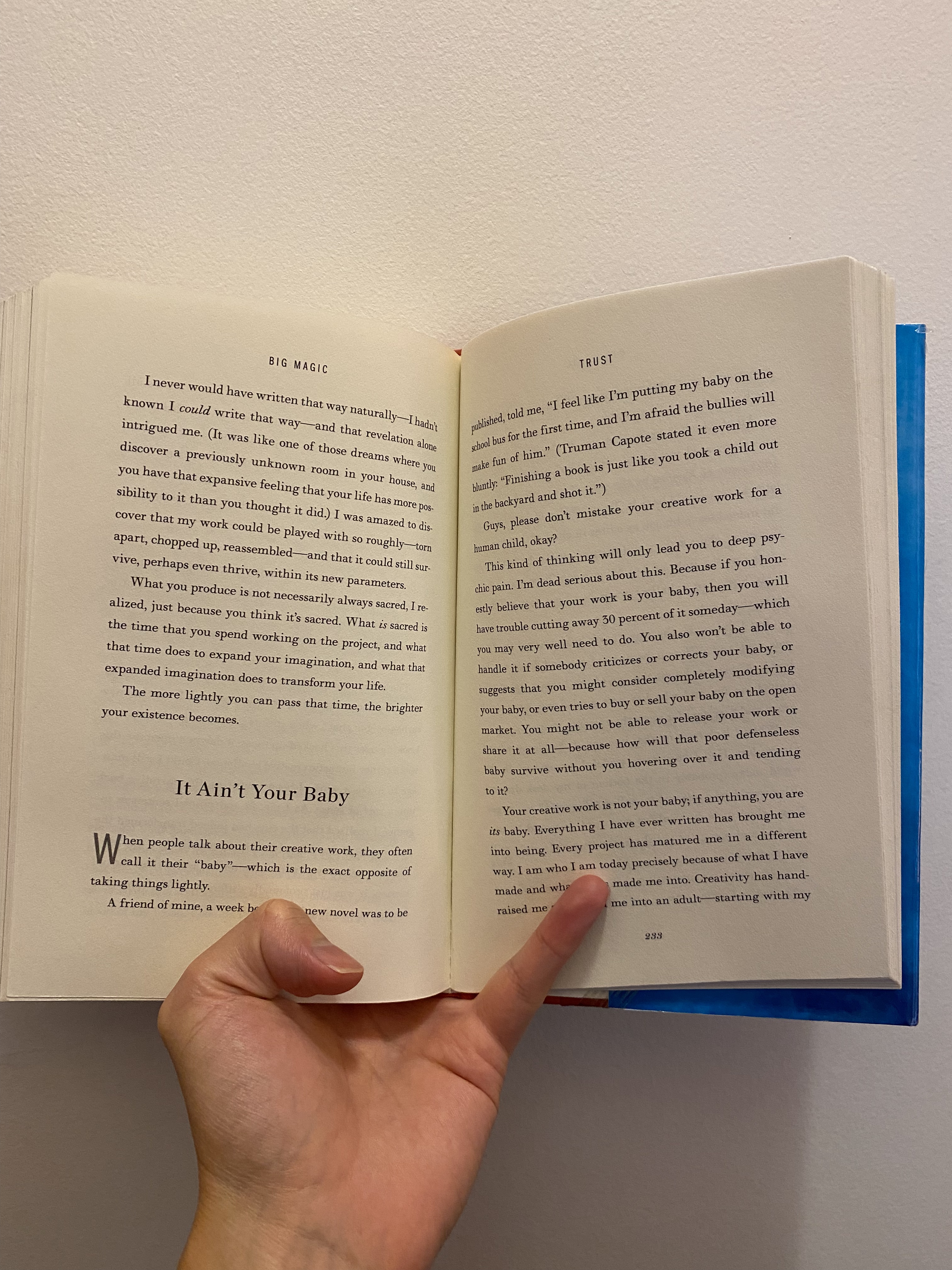
In Elizabeth Gilbert’s Big Magic (Amazon), she references a Truman Capote quote: “Finishing a book is just like you took a child out in the backyard and shot it.”
She then cautions us not to mistake our creative work for a baby. Associating creativity, career, or a personal purist with a living being will cloud our judgments.
As they say, you become too close to it. When you’re too close to your creative work, you don’t know what to change—or worse—you wouldn’t want to change anything. You probably heard the phrase: kill your darlings. This famous quote reminds us that in order to improve our work, we’ll need to cut out the parts we love the most.
If your work is as precious to you as your newborn, you won’t see all the imperfections. You nurture it and nurture it, but it doesn’t get better, and you wouldn’t create anything new because you spend all your time focused on polishing your one gem. You’d be reluctant to build, mold, and transform your work because it’s comforting the way it is, and there’s an expectation to love it unconditionally.
Have you ever seen a mother look at her ugly baby? She doesn’t think it’s ugly. She loves the child and genuinely believes that the hideous thing will grow to be a movie star or a supermodel. If you were to go up to the mother and criticize her infant, she would most likely bite your face off.
If you compare your creative work to your baby, you may not be able to see all her flaws. If you can’t see the problems, you can’t help. When called upon, you won’t be able to cut 30 percent of your work. When someone criticizes or corrects your child, you’d reject their words or go into a guilty, shameful spiral. Imagine someone telling you that your kid needs a facelift before they are willing to buy her.
Parents want to protect their babies; it’s instinctual. And while your creative work needs some nurturing, you may also coddle it for too long. Your reluctance to send it out will hinder your growth as a writer, and your work will never improve. But the reality remains. If you treat your work like a human, you can end up sheltering it in your drawers or on your hard drive for 18 years or more. By that time, you would have missed out on a lot of opportunities.
We give our blood, sweat, and tears to our creative work. We put everything we had into it. We sacrificed and endured to create a piece of art the same way we would for a son or daughter. Describing our work as our baby gives it a deeper meaning. In a way, it sounds endearing. You cast a soft light on your creation. You’ve put a lot of care into it, and that’s how you want to market it. This baby is handmade with love, not manufactured.
But on the backend, it causes too much emotional connection to the piece. Like a helicopter parent, this can end up doing more harm to the child than good.
Elizabeth Gilbert tells us to consider ourselves the baby to the creative work instead. We are not the ones who need to give birth and raise our creativity; it’s the creativity that gives life to us. It’s the creative act that teaches us, helps us grow, and shows us how to live. Each project we work on and complete becomes a snapshot of that moment. We become what we’ve made. We are not giving birth to our creative work; our creative work is giving birth to us—over and over again. As we look back, we see a trail from where we’ve come.
This way of thinking eliminates the pressure of a parent and offers us a chance to explore our childhood desires and express ourselves. We can be curious again. We should treat every project as a lesson, a continuum. It took that piece to get me here and it’ll take this piece to get me there.
Your creative work is not your baby. Your creative work doesn’t need to grow up to be a doctor, lawyer, or engineer. It doesn’t need to take care of you when you’re old. If you kill it, you won’t go to jail. Nobody will even notice. So lose that pressure. Finish your book, take it to the backyard, and enjoy the outdoors together. Nobody needs to shoot anything.
Join my YouTube community for insights on writing, the creative process, and the endurance needed to tackle big projects. Subscribe Now!
For more writing ideas and original stories, please sign up for my mailing list. You won’t receive emails from me often, but when you do, they’ll only include my proudest works.
The term sunk cost refers to the resources we’ve invested into a project that cannot be recovered. And the sunk cost fallacy is our reluctance to abandon a project because we’ve already put in so much. This mistake can cause us to spend more money, time, and effort on a piece that we have no pleasure working on and with costs continuing to add up.
A common sunk cost fallacy I face is when I start a book and feel the need to read it cover to cover. The thing is, if I’m reading something that I don’t enjoy or get value from, I’m not reading something that can actually benefit me. Persisting through isn’t the best use of my time and energy.
Sunk cost is more painful when it comes to writing. Writing takes much more effort than reading, and therefore, we invest so much more of ourselves into it. I have written so many stories that I kept tearing them apart over and over again trying to make them work. I tell myself one more time, revise it once more and see what happens. At some point, I question why I’m still working on that story. I have a million ideas in my head that I want to get to. When is it time to move on to something new?
Internally, there is a constant battle between reducing sunk cost and persistence. Whenever I return to a project I’ve invested a lot into already, I ask myself why I’m working on it. Am I working on it because I’ve already put in so much work, or am I working on it because I still believe in it? It’s not only a matter of mindset; it’s a matter of prioritization. Is it important for me to keep watering a plant that won’t grow, or is it worth sowing new seeds?
Managing sunk cost is desperately personal because time is so valuable to us. We cannot get more, no matter how hard we try. Investing in the wrong areas can end up killing us slowly. It’s easy to look at our writing and think, “Oh my god, I’ve wasted my life.” But remember, time was going to pass either way. And it wasn’t all wasted. Now you have a few drafts, a snapshot of your life. Go and do something else if that is what you want, but dwell on the sunk cost. You’ve brought it here, it exists, and you can always come back to it when the time is right.
Whenever I’m debating whether to abandon a project—especially a significant one that would only cost me more and more time—I remember all the expensive Hollywood projects that don’t see the light of day. Production companies would often develop a pilot episode to test whether it has any viability in the market before they make more. That is because the networks want to make something that audiences would watch and, more importantly, be profitable if they were to make more episodes.
One recent example is The Game of Thrones spin-off called Bloodmoon. This prequel was supposed to take place 8,000 years before the events involving Jon Snow and Tyrion Lannister—and cost $30 million to produce. Yes, $30 million.
How could HBO abandon such an expensive project? The Chief Content Officer said that the show would require more innovation. Bloodmoon didn’t simply require scripts, actors, and cameras, it required the whole network to figure out how to make it—and then make more. Additionally, this new show had a different feel from the original, which required more setup and may not appeal to some returning viewers. The risk was huge. Who knows how it would have all played out, but HBO decided to focus their attention on House of the Dragon. Which, in many ways, was a safer bet.
That’s how I see my projects now. I work on something, get it to a point where it’s good enough to show someone, and then send it out on a test—like a television pilot. When it comes back to me, with whatever feedback attached, I decide whether I want to take the gamble of revising it or focusing on another project. While it may be frustrating to be losing constantly like someone on a cold streak at a roulette table, I find joy in always having chips to make another bet.
Regardless of what project I’m working on, I’m grateful to be able to play the game. Maybe I won’t bet on the same horse every time, but it’s reassuring that I still have the time and money to do so. I can manage my sunk cost while persisting. I’m doing both. I’m HBO trying to make six different Game of Thrones spinoffs at the same time to determine which one to invest in long-term. It’s nice to know that one day I can make $30 million decisions around my work, but today, I just need to decide whether I want to put my novel on the shelf or return to it for another edit.
I’ll leave you with this. Whether you want to keep going or abandon your work, there is a quote, often attributed to Leonardo Da Vinci that really helps me, and it goes: Art is never finished, only abandoned.
I like it because, eventually, you’ll need to stop working on everything. So don’t feel so guilty when you abandon something. It’s bound to happen in one form or another.
Join my YouTube community for insights on writing, the creative process, and the endurance needed to tackle big projects. Subscribe Now!
For more writing ideas and original stories, please sign up for my mailing list. You won’t receive emails from me often, but when you do, they’ll only include my proudest works.
Is a scene not working? Are you failing to create intrigue, establish tone, or captivate an audience? Consider what narrative mode you’re using to tell your story.
If words are the building blocks then narrative modes are the design of your story. Whichever ones you pick will yield a different construction, and therefore, a different experience for your readers.
There are five narrative modes: description, dialogue, action, thought, and exposition. Today we will look at these five forms and how you can experiment while editing to determine which works best.
To put it in context, we’ll explore how different authors use varying narrative modes to start their stories—but this approach works anywhere: beginning, middle, or end. If something isn’t working, change the narrative mode and see what happens.
Let’s get into it!
Description
Descriptions are great for establishing a setting or character.
It’s most effective if it’s an intriguing image. If you waste too many words describing something obvious or mundane, you won’t hook your audience or keep them turning the pages. To write effective descriptions, activate the senses: what do you see, hear, smell, feel, or taste? What’s unusual?
Alternatively, you can use descriptions to establish context, for example, a before or after image. Take the beginning of The Hitchhiker’s Guide to the Galaxy by Douglas Adams (Amazon). He starts the story with a description of an average house before the chaos and destruction:
The house stood on a slight rise just on the edge of the village. It stood on its own and looked out over a broad spread of West Country farmland. Not a remarkable house by any means — it was about thirty years old, squattish, squarish, made of brick, and had four windows set in the front of a size and proportion which more or less exactly failed to please the eye. – The Hitchhiker’s Guide to the Galaxy by Douglas Adams
Dialogue
Starting a story with dialogue can grab the reader’s attention. It jumps right into the middle of a scene, introducing a character and building a connection. Hearing a character speak makes them more personable and is often more engaging than having the writer paraphrase what’s been said. When it’s well-written, dialogue can give a sense of who the character is, where they are, and what they want.
However, bad dialogue can confuse readers because they don’t know who’s talking or why they should care. Don’t begin with your characters making small talk or a boring conversation that the reader may have in their own life. If you’re opening your story or maintaining narrative momentum, make sure the dialogue is compelling. If you want to hit your reader with something unexpected, dialogue is a great way to do it. Check out how Douglas Coupland opens his novel Jpod (Amazon):
“Oh God. I feel like a refugee from a Douglas Coupland novel.”
“That asshole.”
“Who does he think he is?”
“Come on, guys, focus. We’ve got a major problem on our hands.”
– Jpod by Douglas Coupland
Action
In medias res is Latin for “in the midst of action” and that’s what you should consider when writing an action scene. Start your scene in the middle of an event and create stakes, tension, and strong pacing that will hook your reader while still giving them relevant details like time and place. It doesn’t mean you begin at the climax or the most intense part. It means you place your readers at a link in the continual chain of cause and effect: Because this is happening, this is happening — and because that happened, this is now happening.
In an energetic action sequence, use active voice and remove filter words, such as saw, felt, and thought. Writing a good action scene doesn’t need to include characters, although a goal or a conflict is necessary. Action is great, but always ask: Why should the readers care?
The trawler plunged into the angry swells of the dark, furious sea like an awkward animal trying desperately to break out of an impenetrable swamp. The waves rose to goliathan heights, crashing into the hull with the power of raw tonnage; the white sprays caught in the night sky cascaded downward over the deck under the force of the night wind. Everywhere there were the sounds of inanimate pain, wood straining against wood, ropes twisting, stretched to the breaking point. The animal was dying. – The Bourne Identity by Robert Ludlum
A story that opens with a thought, is a story that opens in the past, a reflection, a flashback. How is this effective?
Thoughts allow the readers to understand a character. By seeing how they think or relive a significant memory, readers learn about their motivations and personalities. We view the conflict from their perspectives. Thoughts allow the author to convey the theme quickly. With thoughts, you can establish a pivotal scene, like a murder, a love loss, or an important lesson, and have that guide the character for the rest of the story.
A great example of this is The Great Gatsby by F Scott Fitzgerald (Amazon). The narrator, Nick Carraway’s thought has nothing to do with the plot directly, but it shows his principles. The opening gives him the integrity he needs to tell the story and for us to trust him.
In my younger and more vulnerable years my father gave me some advice that I’ve been turning over in my mind ever since. ‘Whenever you feel like criticizing anyone,’ he told me, ‘just remember that all the people in this world haven’t had the advantages that you’ve had.’ – The Great Gatsby by F Scott Fitzgerald
Exposition
We are told that expositions should be avoided because they’re info dumps. Unskilled authors use them to give the readers all the information they need to understand some convoluted plot. Think of the opening crawl of any Star Wars movie where the floating text sets the stage for the galactic confrontation. Phantom Menace literally begins by explaining the details of space tax and trade routes.
While exposition has a bad reputation for pushing the readers out of an emotional or visceral experience, it’s a reliable mode for explaining a character, a historical event, or a critical mission. With that said, here are a few notes to consider when using expositions for your story:
Make sure the details are intriguing: don’t share information that the reader can assume.
Create a sense of place: ground your story and connect it with a specific scenario.
Pay attention to the tone and mood: Just because it’s an info dump, doesn’t mean it should take the reader out of the story. When writing ask: how do the characters feel about these details? Is it dark and scary, or is it hopeful like at the beginning of The Five People You Meet in Heaven by Mitch Albom (Amazon)?
This is a story about a man named Eddie and it begins at the end, with Eddie dying in the sun. It might seem strange to start a story with an ending. But all endings are also beginnings. We just don’t know it at the time. – The Five People You Meet in Heaven by Mitch Albom
Whether you’re editing the beginning, middle, or end of your story consider the narrative mode. Remember, you are not tearing down your house, you’re redesigning it so that everything works better together. If you’re stuck and a section isn’t working, consider changing how you deliver the information. Switching the narrative modes can give strength to different aspects of the story; you change the pace, mood, and intensity. Practice each one, because you never know when a dialogue scene can work better as an exposition, or an action can become a thought.
For more writing ideas and original stories, please sign up for my mailing list. You won’t receive emails from me often, but when you do, they’ll only include my proudest works.
Join my YouTube community for insights on writing, the creative process, and the endurance needed to tackle big projects. Subscribe Now!
My writing project is big. Too big. And it’s all my fault. Whatever writing advice told me to start small: start with short stories, master the fundamentals, and then move to bigger projects, I didn’t listen.
In one of my previous updates, I mentioned that I’m working on a novel. Guess what, it’s going to be more than a one-off. It’s at least two books, but probably going to be three. A trilogy. Maybe more. I’ve committed to a long game. I wanted a project that could pull me out of the Covid world and drop me on the other side. And I found it. Regardless of what this trilogy becomes, it’s going to be a significant part of my life. For that I’m lucky.
But what I want to talk about today is my awkward process. I’m currently editing the fourth draft of book one, while I’m writing the first draft of book two. It’s awkward because I feel like I’m looking into the future to write and I’m traveling back in time to edit. Unconventional as it may be, I do find it productive. At this very moment, where the world is in chaos and motivation is hard to come by, it’s easier to maintain productivity if I’m active in two separate phases: writing and editing.
When I’m writing, I’m using a different creative muscle from editing. I’m a pantser or a discovery writer, so I don’t do many outlines. My first draft is the outline and I just let it flow.
However, editing is a slog. I don’t take a lot of pleasure in editing. It’s the act of cleaning up the mess that the pantser-writer-me made, and in this project, it’s a big mess. In order to ensure I fully develop the world, understand my characters, and build out the story arc, I’m writing beyond my first book to gain clarity on what I should focus on while editing it.
I also want to keep the structure of my books the same and there was a fortuitous period of the process where I was writing the first and second acts of the sequel while editing the first and second acts of book one. This allowed me to see critical turning points in the stories from both books at the same time and try to spot and create parallels.
Ideally, I’d like this series to resemble each other in form even though the story changes as it goes. I want to be consistent where I can while letting my characters roam free and explore. This process also allowed me to go back and check on all the motivations and scenarios in the first book and make sure they support what the character will do in the second. I can even sneak some foreshadows or other storytelling devices in and hint at the events to come.
Now, I don’t recommend this as writing advice, it really does depend on your goals. For me, this writing while editing is most helpful for my editing process. I am still trying to strengthen the story in the first book and by writing beyond, I gain a better understanding of the world and characters. I can also discover whether or not the characters will achieve their goals so that I can set the tone properly. For example, if my character will face greater hardship in the second book, maybe I can lighten up in the first. Maybe I won’t. Maybe I want the lessons in the first to come into play in the second. These are all still options.
By starting my sequel before I finalize my first, I give myself room to experiment. Since I’m not an established author who has an impending deadline, this is a luxury. By doing this, with a bit of editing in the first book, I can ensure I won’t write myself into a trap I can’t escape from. Little by little, I’ll eventually bring my whole story to a close.
I will probably use this same process to complete the whole trilogy. It sickens me to think how much more I have to do, but getting started on the second book makes me feel like I’m happily invested. It proves to me that I enjoy writing this story. It makes me hopeful that I can reach the end if I just keep moving forward. At the very least I’d have it all written. Once it’s all written, then who knows… but that will be a while from now. After all, this is a big project and I’m in it for the long term.
There you have it. If you’re stuck editing your first book, try writing a sequel. Even if you don’t plan on publishing a sequel, it can help you flush out your story more. And hey, who knows, maybe you’ll discover a better ending. Maybe you’ll discover that the sequel is actually the story that matters.
For more writing ideas and original stories, please sign up for my mailing list. You won’t receive emails from me often, but when you do, they’ll only include my proudest works.
Join my YouTube community for insights on writing, the creative process, and the endurance needed to tackle big projects. Subscribe Now!
The comma is the most complicated punctuation mark in the English language. Not only does it have many uses, but it also has many misuses. In The Elements of Style by William Strunk Jr and EB White (Amazon), four punctuation principles were deemed most important and that “they should be so thoroughly mastered that their application becomes second nature.”
Now, if you’re ready, grab a pen and notebook, strap yourself in because we are going to quickly go through these 4 important punctuation rules:
1. Enclose parenthetical expressions with commas
Take this example:
The dog that ran away came back with a cat.
The fact that the dog ran away is extra information. But this information is also essential to the sentence.
It’s this essentialness, or restrictiveness, that determines the role commas play.
A parenthetical expression is a word or phrase that adds to the sentence to give extra information.
If the information is essential such as in:
The dog that ran away came back with a cat.
You may omit the commas.
However, you can add commas to separate, if the information is nonessential, such as in:
The dog, hungry for treats, came back with a cat.
So remember it this way, if the information is essential you may omit the commas, but if the information can be removed without influencing the meaning of the sentence then you should add the commas.
Another way to put it is to recognize nonrestrictive terms and clauses, as they will often require commas. In the middle of a sentence these nonrestrictive clauses are often preceded by “Which”, “When”, and “Where”: Such as:
The car, which was illegally parked, got towed.
Nonrestrictive clauses may also appear at the beginning of a sentence:
Parking the car illegally, the man hurried into the store.
To summarize:
You won’t need commas for a sentence like: The boy is a criminal.
But you will need one for: My son, Billy, stole my car.
How are we doing? A little confusing, eh? You’re not alone. This rule for me is one of the most challenging in the entire language because sometimes the importance of the information can feel subjective.
But don’t feel bogged down by all the commas, Strunk and White give you permission to omit them if the interruption is short.
If you are to remove the commas, however, don’t remove one but not the other.
If you are to remove the commas, however don’t remove one but not the other.
Personally, I always use commas to break up “however”, as well as dates: Saturday, June 4, 2022
According to Strunk and White: If the clauses in the sentence share the same subject, the subject is only expressed once, and the conjunction is “but” then adding a comma will be useful.
The robbers found a hiding spot, but forgot to take the money.
However, if the conjunction is “and” then omitting the comma will be okay as the two interlinking thoughts are closely related.
The police found the money in the car and decided to keep it for themselves.
3. Do not join independent clauses with a comma.
If you have two complete and separate thoughts with their own subject and verb, such as:
WRONG: The monster emerged from the swamp, the terrified campers climbed up the tree.
Do Not place a comma between them.
To correct it, you have a few options:
The first option is breaking it into two sentences and using a period — or an exclamation mark — while capitalizing the first letter of the following sentence:
The monster emerged from the swap. The terrified campers climbed up the tree.
The monster emerged from the swap! The terrified campers climbed up the tree.
Alternatively, you can combine the sentences by using a semi-colon or adding a comma and conjunction.
The monster emerged from the swap; the terrified campers climbed up the tree.
The monster emerged from the swap, so the terrified campers climbed up the tree.
As you can tell, changing the punctuation mark changes the relationship between the two statements. The better you understand this principle, the better control you’ll have of your writing style. Personally, I’m a comma/conjunction type of guy, but let me know which one you prefer in the comment below.
4. Do not break sentences in two.
Simply put, commas cannot replace periods and periods cannot replace commas. A period’s primary function is to separate complete sentences, so when you use it instead of commas, you’ll likely end up with sentence fragments. For example:
He was a wealthy man. Having earned all his money through buying and trading crypto.
It should be:
He was a wealthy man, having earned all his money through buying and trading crypto.
A complete sentence has a subject and verb, and while the first part can stand as an independent clause, the second half of that sentence is missing the subject.
An exception to this principle, which I’d recommend using sparingly, is to break the sentence when you want to emphasize a specific word. Such as:
He punched the wall. Hard.
There you have it! Those are four of the most important punctuation principles according to Strunk and White. Once you get a hang of them, you will be well on your way to being a proficient writer and editor with another tool in your tool belt.
For more writing ideas and original stories, please sign up for my mailing list. You won’t receive emails from me often, but when you do, they’ll only include my proudest works.
Join my YouTube community for insights on writing, the creative process, and the endurance needed to tackle big projects. Subscribe Now!
Tim Ferriss, the author and podcaster, is all about optimizing his performance in every way. His books The 4 Hour Chef (Amazon) and Tools of Titans (Amazon) have helped me tremendously, and when he spoke about his process of acquiring feedback, I knew his approach was tried and true.
In episode 538 of the Tim Ferriss Show, in a casual conversation with author Chris Hutchins, Tim explained how he gathered effective feedback, especially at the early stages of a project.
If you’ve ever asked a friend to read your work and give feedback, you know how stressful, time-consuming, and unproductive that process can be. This is especially true if all you’ve given them is the manuscript and vague instructions like “give me feedback” or “let me know what you think.” Such an experience could cause unnecessary tension between friends.
To avoid that scenario, allow me to share with you Tim’s method for getting clear, succinct, and useful feedback for his writing and interviews.
Break Chapters Into “Self-Sufficient” Pieces That Stand Alone
When writing, Tim makes sure that each of his chapters can stand on its own as a “kind of modular” like a “feature magazine article.”
If you’re writing non-fiction, each of your chapters can be treated like a blog post. If you’re writing fiction, each of your chapters could have a story arc and could be published as a short story.
With each chapter as an individual piece, Tim’s friends and editors only need to read one chapter, instead of a whole book, to have the context necessary to give useful feedback.
Share the Single Chapter with 3-4 Writer or Lawyer Friends
When picking who he would share his work with, Tim usually chooses friends who are writers or lawyers or those who have attended law school. He picks these people because they have the proper training in reviewing text and spotting ambiguity. These professionals also have a keen eye for superfluous details that should be cut.
While you might not have any writer or lawyer friends, who you choose to share your work with still matters. If your friend is not an avid reader or has no interest in your topic or genre, they can’t really help you. Understanding your network and the strengths and weaknesses of the individual is essential because you don’t want to waste time and get frustrated when the person sharing feedback isn’t qualified. In a scenario like that, it might be better to have no feedback at all.
Sharp, observant, and capable of proofreading are qualities you look for in beta readers — and writers and lawyers tend to have those traits
However, getting a diverse sample of feedback is also important. That is why Tim doesn’t only share it with one person, but with four.
Love It Or Hate It, It Can’t Be Confusing
Once Tim has a team of reviewers, he approaches them with one or two asks. For the first, Tim requests:
“Please read this. And if anything is confusing, please note that. You can love it. You can hate it. I’m fine with either of those, but if it’s confusing, it’s no good for anyone. So if anything’s confusing, please note. If your mind starts to wander, please note where that is.”
Whether with audio or text, the goal of the piece is to inform and captivate. If the reader or listener gets bored, distracted, or confused by a certain part, it’s important for Tim to know where that is so he could modify or remove it.
The point is not to get a rave review. The personal taste of the reader doesn’t matter at this point. The goal is to figure out whether it’s useful to anyone, and if it’s unclear or dull, it’s useless.
Ask: Which 20% Should I Cut?
His second and preferred request is to ask: “If I had to cut 20 percent, which 20 percent would I cut?”
Knowing what’s the core and what’s excess is important. This gives you an idea of where you should focus your attention when you’re editing. How concise and succinct can you make it? This forces you to take a closer look at the remaining 80% and examine the substance of your piece.
The thing is, when you ask four people, not all four will have the same opinion. So when a situation like that occurs, Tim has a firm rule.
If 1 Out Of 4 Love It, Keep It
If three people tell Tim to cut out a section, while one person says that they love that section, he will keep it. He does this because something that resonated so strongly with one person is a good enough reason to keep it. If he cut it, it might’ve saved some room, but it would have potentially failed to impact one out of every four people, which is a big percentage.
You cannot serve everyone, but when you know you can serve someone, serve them!
Don’t Ask For Feedback If You Don’t Plan On Taking It
Lastly, perhaps what I found to be the most important piece of advice, is to not ask for feedback if you don’t plan on using it in some way. If you know you’re not willing to make changes, then why bother taking up someone else’s time?
When Tim received his writer or lawyer friend’s feedback, and the suggestions are valid, he would apply it to his work and improve it.
If you’ve picked the right beta readers, respect their opinions, and trust that they have your best interest, why wouldn’t you keep an open mind? When receiving feedback we need to lose the ego, otherwise, it might be better not to ask for their thoughts at all.
When asking people for feedback, we’re requesting their time and energy. They’re doing us a favor and as such, we should be grateful. That is why I think Tim Ferriss’s process is solid because first, he makes the request digestible. Then he chooses those that are qualified for the job and ensures what he needs is clear. Finally, he prepares for how the feedback will be used so he doesn’t lose sight of the bigger picture, which is to provide captivating and valuable content to the largest group of people possible.
For more writing ideas and original stories, please sign up for my mailing list. You won’t receive emails from me often, but when you do, they’ll only include my proudest works.
Join my YouTube community for insights on writing, the creative process, and the endurance needed to tackle big projects. Subscribe Now!



 Elliot Chan