Smithereens: Black Mirror, Can It Happen?

Before we dive into the events of Smithereens, let’s flash back to when this episode first aired: June 5, 2019.

In 2019, guided meditation apps like Headspace and Calm surged in popularity. Tech giants like Google and Salesforce began integrating meditation into their wellness programs. By the end of the year, the top 10 meditation apps had pulled in nearly $195 million in revenue—a 52% increase from the year before.

That same year, Uber made headlines with one of the decade’s biggest IPOs, debuting at $45 a share and securing a valuation north of $80 billion. But the milestone was messy. Regulators, drivers, and safety advocates pushed back after a fatal 2018 crash in Tempe, Arizona, where one of the company’s self-driving cars struck and killed a pedestrian during testing.

Inside tech companies, the culture was shifting. While perks like catered meals and gym memberships remained, a wave of employee activism surged. Workers staged walkouts at Google and other firms, and in 2019, the illusion of the perfect tech workplace began to crack.

Meanwhile, 2019 set the stage for the global rollout of 5G, promising faster, smarter connectivity. But it also sparked geopolitical tensions, as the U.S. banned Chinese company Huawei from its networks, citing national security threats. 

Over it all loomed a small circle of tech billionaires. In 2019, Jeff Bezos held the title of the richest man alive with a net worth of $131 billion. Bill Gates followed, hovering between $96 and $106 billion. Mark Zuckerberg’s wealth was estimated between $62 and $64 billion, while Elon Musk, still years away from topping the charts, sat at around $25 to $30 billion.

And that brings us to this episode of Black Mirror, Season 5,  Episode 2: Smithereens

This episode pulls us into the high-stakes negotiation between personal grief and corporate power, where a rideshare driver takes an intern hostage—not for ransom, but for answers.

What happens when the tools meant to connect us become the things that break us?

It forces us to consider:  Do tech CEOs hold too much power, enough to override governments, manipulate systems, and play god?

And are we all just one buzz, one glance, one distracted moment away from irreversible change?

In this video, we’ll unpack the episode’s key themes and examine whether these events have happened in the real world—and if not, whether or not it is plausible. Let’s go!

Addicted by Design

In Smithereens, we follow Chris, a man tormented by the loss of his fiancée, who died in a car crash caused by a single glance at his phone. The episode unfolds in a world flooded by noise: the pings of updates, the endless scroll, the constant itch to check in. And at the center of it all is Smithereen, a fictional social media giant clearly modeled after Twitter.

Like Twitter, Smithereen was built to connect. But as CEO Billy Bauer admits, “It was supposed to be different.” It speaks to how platforms born from good intentions become hijacked by business models that reward outrage, obsession, and engagement at all costs.

A 2024 study featured by TechPolicy Press followed 252 Twitter users in the U.S., gathering over 6,000 responses—and the findings were clear: the platform consistently made people feel worse, no matter their background or personality. By 2025, 65% of users aged 18 to 34 say they feel addicted to its real-time feeds and dopamine-fueled design.

Elon Musk’s $44 billion takeover of Twitter in 2022 was framed as a free speech mission. Musk gutted safety teams, reinstated banned accounts, and renamed the platform “X.” What was once a digital town square transformed into a volatile personal experiment.

This accelerated the emergence of alternatives. Bluesky, a decentralized platform created by former Twitter CEO Jack Dorsey, aims to avoid the mistakes of its predecessor. With over 35 million users as of mid-2025, it promises transparency and ethical design—but still faces the same existential challenge: can a social app grow without exploiting attention?

In 2025, whistleblower Sarah Wynn-Williams testified before the U.S. Senate that Meta—Facebook’s parent company— had systems capable of detecting when teens felt anxious or insecure, then targeted them with beauty and weight-loss ads at their most vulnerable moments. Meta knew the risks. They chose profit anyway.

Meanwhile, a brain imaging study in China’s Tianjin Normal University found that short video apps like TikTok activate the same brain regions linked to gambling. Infinite scroll. Viral loops. Micro-rewards. The science behind addiction is now product strategy.

To help users take control of their app use, Instagram, TikTok, and Facebook offer screen-time dashboards and limit-setting features. But despite these tools, most people aren’t logging off. The average user still spends more than 2 hours and 21 minutes a day on social media with Gen Z clocking in at nearly 4 hours. It appears that self-monitoring features alone aren’t enough to break the cycle of compulsive scrolling.

What about regulations? 

A 2024 BBC Future article explores this question through the lens of New York’s SAFE Kids Act, set to take effect in 2025. This will require parental consent for algorithmic feeds, limit late-night notifications to minors, and tighten age verification. But experts warn: without a global, systemic shift, these measures are just patches on a sinking ship.

Of all the Black Mirror episodes, Smithereens may feel the most real—because it already is. These platforms don’t just consume our time—they consume our attention, our emotions, even our grief. Like Chris holding Jaden, the intern, at gunpoint, we’ve become hostages to the very systems that promised connection.

Billionaire God Mode

When the situation escalated in the episode, Billy Bauer activates God Mode, bypassing his own team to monitor the situation in real time and speak directly with Chris. 

In doing so, he reveals the often hidden power tech CEOs wield behind the scenes, along with the heavy ethical burden that comes with it. It hints at the master key built into their creations and the control embedded deep within the design of modern technology.

No one seems to wield “God Mode” in the real world quite like Elon Musk—able to bend markets, sway public discourse, and even shape government policy with a single tweet or private meeting.

The reason is simple: Musk had built an empire. 

In 2025, Tesla secured the largest U.S. State Department contract of the year: a $400 million deal for armored electric vehicles. 

Additionally, through SpaceX’s satellite network Starlink, Musk played an outsized role in Ukraine’s war against Russia, enabling drone strikes, real-time battlefield intelligence, and communication under siege. 

Starlink also provided emergency internet access to tens of thousands of users during blackouts in Iran and Israel, becoming an uncensored digital lifeline—one that only Musk could switch on or off.

But with that power comes scrutiny. Musk’s involvement in the Department of Government Efficiency—ironically dubbed “Doge”—was meant to streamline bureaucracy. Instead, it sowed dysfunction. Critics argue he treated government like another startup to be disrupted. Within months—after failing to deliver the promised $2 trillion in savings and amid mounting chaos—Donald Trump publicly distanced himself from Elon Musk and ultimately removed him from the post, temporarily ending the alliance between the world’s most powerful man and its richest.

It’s not just Musk. Other tech CEOs like Mark Zuckerberg have also shaped public discourse in quiet, powerful ways. In 2021, whistleblower Frances Haugen exposed Facebook’s secret “XCheck” system—a program that allowed approximately 6 million high-profile users to bypass the platform’s own rules. Celebrities and politicians—including Donald Trump—were able to post harmful content without facing the same moderation as regular users, a failure that ultimately contributed to the January 6 Capitol riots.

Amid the hostage standoff and the heavy hand of tech surveillance, one moment stands out: Chris begs Billy to help a grieving mother, Hayley. And Billy listens. He uses his “God Mode” to offer her closure by giving her access to her late daughter’s Persona account. 

In Germany, a landmark case began in 2015 when the parents of a 15-year-old girl who died in a 2012 train accident sought access to her Facebook messages to determine whether her death was accidental or suicide. A lower court initially ruled in their favor, stating that digital data, like a diary, could be inherited. The case saw multiple appeals, but in 2018, Germany’s highest court issued a final ruling: the parents had the right to access their daughter’s Facebook account.

In response to growing legal battles and emotional appeals from grieving families, platforms like Meta, Apple, and Google have since introduced “Digital Legacy” policies. These allow users to designate someone to manage or access their data after death, acknowledging that our digital lives don’t simply disappear when we do.

In real life, “God Mode” tools exist at many tech companies. Facebook engineers have used internal dashboards to track misinformation in real time. Leaked documents from Twitter revealed an actual “God Mode” that allowed employees to tweet from any account. These systems are designed for testing or security—but they also represent concentrated power with little external oversight.

And so we scroll.

We scroll through curated feeds built by teams we’ll never meet and governed by CEOs who rarely answer to anyone. These platforms know what we watch, where we go, and how we feel. They don’t just reflect the world—we live in the one they’ve built.

And if someone holds the key to everything—who’s watching the one who holds the key?

Deadly Distractions

In Smithereens, Chris loses his fiancée to a single glance at his phone. A notification. An urge. A reminder that in a world wired for attention, even a moment of distraction can cost everything.

In 2024, distracted driving killed around 3,000 people in the U.S.—about eight lives lost every single day—and injured over 400,000 more

Of these, cellphone use is a major factor: NHTSA data shows that cellphones were involved in about 12% of fatal distraction-affected crashes. This means that, in recent years, over 300 to 400 lives are lost annually in the U.S. specifically due to phone-related distracted driving accidents. 

While drunk driving still causes more total deaths, texting while driving is now one of the most dangerous behaviors behind the wheel—raising the risk of a crash by 23 times.

In April 2014, Courtney Ann Sanford’s final Facebook post read: “The Happy song makes me so HAPPY!” Moments later, her car veered across the median and slammed into a truck. She died instantly. Investigators found she had been taking a selfie and updating her status while driving.

Around the world, laws are evolving to address the dangers of distracted driving. In the United States, most states have banned texting while driving—with 48 or 49 states, plus Washington D.C. and other territories, prohibiting text messaging for all drivers, and hands-free laws expanding to more jurisdictions. 

 In Europe, the UK issues £200 fines and six penalty points for distracted driving. Spain and Italy have fines starting around €200—and in Italy, proposed hikes could push that up to €1,697. The current highest fine is in Queensland, Australia, where drivers caught texting or scrolling can face fines up to $1,250

To combat phone use behind the wheel, law enforcement in Australia and Europe now deploys AI-powered cameras that scan drivers in real time. Mounted on roadsides or mobile units, these high-res systems catch everything from texting to video calls. If AI flags a violation, a human officer reviews it before issuing a fine.

As for the role of tech companies? While features like Apple’s “Do Not Disturb While Driving” mode exist, they’re voluntary. No country has yet held a tech firm legally accountable for designing apps that lure users into dangerous distractions. Public pressure is building, but regulation lags behind reality.

In Smithereens, the crash wasn’t just a twist of fate—it was the inevitable outcome of a system designed to capture and hold our attention: algorithms crafted to hijack our minds, interfaces engineered for compulsion, and a culture that prizes being always-on, always-engaged, always reachable. And in the end, it’s not just Chris’s life that’s blown to smithereens—it’s our fragile illusion of control, shattered by the very tech we once believed we could master.

We tap, scroll, and swipe—chasing tiny bursts of dopamine, one notification at a time. Chris’s story may be fiction, but the danger it exposes is all too real. It’s in the car beside you. It’s in your own hands as you fall asleep. We can’t even go to the bathroom without it anymore. No hostage situation is needed to reveal the cost—we’re living it every day.

Join my YouTube community for insights on writing, the creative process, and the endurance needed to tackle big projects. Subscribe Now!

For more writing ideas and original stories, please sign up for my mailing list. You won’t receive emails from me often, but when you do, they’ll only include my proudest works.
How to Record Your Ideas With a Messaging App

When I have a great idea, it’s often hard to pull out a notepad, grab my pen, and find a flat surface to write on. All those little elements are friction and even the act of pulling out my notebook makes me question… is this idea even good enough to write down? Is this worth it? 

Recording, organizing, and revisiting your ideas is a very important part of being a writer, so this was something I wanted to figure out. How can I make this a part of my process? 

This is how: messaging apps. 

I learned about this method from how Judd Apatow wrote Knocked Up. During breaks while shooting 40 Year Old Virgin, Apatow was emailing himself story ideas on his Blackberry. I thought that was brilliant, because email is already a platform that organizes content for you. You don’t need an extra note-taking app for that. It’s also up in the cloud or whatever, so you can access it on your phone, computer, tablet, whatever. 

For me, I felt that email was even a step too far. For initial ideas, I use something simpler and more informal and that’s messaging apps. 

I’m currently using Facebook Messenger to track all my ideas when I’m away from my computer which is very often. I like Facebook Messenger because I can access it on my computer easily and it allows me to delete messages too. It’s more personal preference than anything else. Here’s how I do it. 

First, I set it up as though I’m having a conversation with myself. I’m the only one I’m talking to. 

Then I treat it as though I’m telling the idea to myself. It’s a little conversation. You know how you sometimes talk out loud to yourself? Do that, but message yourself. 

It can be anything from a question, to a title, to a paragraph. Sometimes I jot down a theme or something interesting I saw. 80% is nonsense, but 20% are pretty good ideas and stories I might pursue. This one for example: A boy going off to buy clothes for himself for the first time to impress a girl. 

I don’t know what I’m going to do with that, but it’s definitely something I can expand on if I’m ever feeling completely drained on ideas.. 

What’s great about it is that these ideas are all kept in chronological order like a message thread, so I’m able to scroll back and find the date when I jotted it down. It actually brings me back to that moment where I came up with the idea: waiting for the bus or walking or having a drink at a bar. It’s a little snapshot of a moment in my life that I get to revisit, even if I was alone with my thoughts. 

I have been using this method of tracking down my ideas for over a year now and I still have ideas in here that I haven’t gotten to yet. It’s fun to scroll back and see what I wrote. 

It might seem sad as though you are having a conversation with yourself, but this is very useful for me. So I recommend giving it a shot and if you do, let me know how it goes in the comments below. 

I made it my goal this year to come up with an idea — regardless of how bad it is — every day. If you want 10 measurable writing goals? Check out this video here. 

If you found this article helpful, please consider signing up for my mailing list. You won’t receive emails from me often, but when you do, it’ll include only work that I’m most proud of.

The Best Writers of All Time Competition — ProWritingAid Free Document Summary

This is not an official sponsorship for ProWritingAid. However, if you would like to try it, please use this affiliate link here.  

One of my favorite features of Pro Writing Aid is the document summary, which lets me know overall, how good my grammar, spelling, and style is in that particular piece of writing. It’s a great overhead view of where I can improve. 

Then I thought, hmmm… I wonder how the greatest writers perform in this scoring system, after all, writing can be so subjective. I figured I should do a playoff bracket pitting some of the greatest writers and their most recognizable pieces of work against each other. 

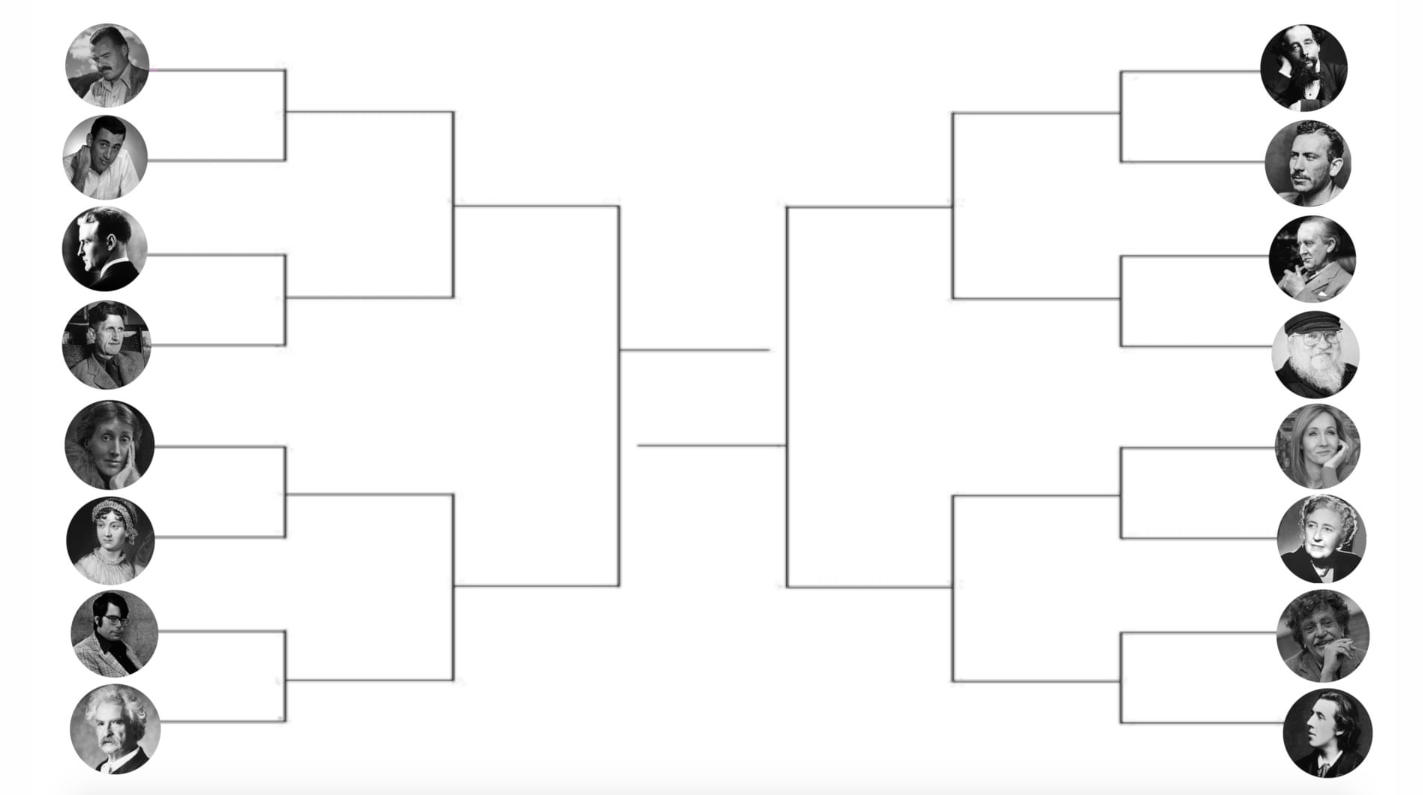
I picked 16 great writers in the English language and plotted them into a bracket. One paragraph each, they will compete with each other to see which has the best overall score on Pro Writing Aid. The winner will move onto the next round. The loser will be eliminated. 

I define a paragraph as a series of connected sentences with a central idea or topic. Therefore, if the first paragraph is of dialogue, for example, and is quite short (three to five words), I can add on until the sequence of ideas are complete. Therefore, a paragraph in this competition can have more than one paragraph breaks in this interpretation. 

Take the first part of The Great Gatsby for example: 

In my younger and more vulnerable years my father gave me some advice that I’ve been turning over in my mind ever since.

“Whenever you feel like criticizing any one,” he told me, “just remember that all the people in this world haven’t had the advantages that you’ve had.”

This will count as one paragraph, because it’s a complete sequence. 

Now let’s get into the competition: 

Introducing the contestants! 

The 16 Great Writers: 

Ernest Hemingway – The Old Man and The Sea

JD Salinger – The Catcher in the Rye

F Scott Fitzgerald – The Great Gatsby

George Orwell – 1984

Virginia Woolf – Mrs. Dalloway

Jane Austen – Pride and Prejudice 

Stephen King – The Stand

Mark Twain – The Adventures of Tom Sawyer

Charles Dickens – Great Expectations

John Steinbeck – The Grapes of Wrath 

JRR Tolkien – The Lord of the Rings: Fellowship of the Rings

George RR Martin – Game of Thrones

JK Rowling – Harry Potter and the Philosopher’s Stone

Kurt Vonnegut – Slaughter House Five

Oscar Wilde – The Picture of Dorian Gray

Who will win? 

Watch the video here to find out. 

For more videos on writing, editing and the creative process, check out my YouTube channel

Spelling and Grammar Apps Review

Grammarly, Hemingway Editor, Expresso, and After the Deadline

Some may think that using a grammar or spelling app as a writing tool is akin to using auto-tune as a singer. In a way, you’re bypassing important skills and disciplines of writing, such as having a good handle on the tools and structure of the written language.

Yet, in this day and age, to not use any given tool available would be a foolish move. It can be debated that what is important is the ideas being communicated, and if there is a way to ensure the communication doesn’t get disrupted by spelling and grammar mistakes, shouldn’t we take advantage?

Personally, I’m a proponent of spelling and grammar apps.

First off, writing is not editing. The task of an editor is a complete shift in the creation process. In a short timeline, it’s sometimes hard for a writer to make that transition. As a writer, you would want to have another set of eyes — even robot eyes — to have a look at your work before you share with your company. Additionally, writers who don’t use these apps still have access to them. It’s like walking instead of taking the bus. Yes, walking is healthier for you and you might save a few dollars, but the bus is still an option. You are by no means a hero.

With all that off my chest, I would like to share 4 free online spelling and grammar tool with you. And as a bonus, I will give a little review of them, showing off what they are capable of.

A Paragraph with A Lot of Writing Errors

In order for me to evaluate the apps, I needed a sample with as many types of errors I can think of. Inspired by the city I live in, I wrote the most heinous paragraph ever. Which, it may come as a surprise was actually pretty hard to do. Give it a try, try to purposely write a paragraph with some spelling and grammar mistakes.  

This is what I came up with:

They’re is a lot to see in Vancouver. Lets explore what there is to do. If your traveling hear on a sunny day, I recommend you go to stanley park. This park is bigger and better. It’s a beautiful place. The sea wall is enjoyed by runners and joggers every day. In the park, you can find a nice field to relax and bring a picnic to have with a friend or you can even go to the aquarium or take the horse-drawn carriage and tour the whole park. There is a much more to do in Vancouver. A historic neighbourhood, you can go to is Gastown. On a busy day there are to many tourist but if you go during off season you don’t have to worry about that people. However don’t wander aimlessly too far east or you might end up in Downtown Eastside. I insure you, that it is not where you want to be.

This is the best (and the worst) I can do apparently. Let me know what you think and if I have missed any other notable errors.

4 Spelling and Grammar Apps

Now that I have a sample, I’m going to start plugging it into the apps and websites to see what results I get.

PolishMyWriting.com (After the Deadline)

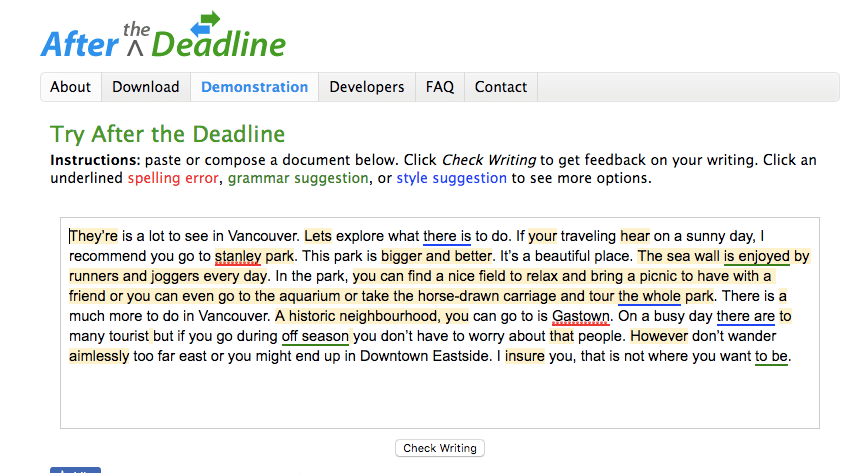
I pasted the paragraph into the text box and clicked “Check Writing” and a bunch of squiggly lines appeared beneath some of the words and phrases.

As you can see, PolishMyWriting.com missed a lot of spelling errors and the run on sentences, but picked up on complex phrases and words that could be omitted. Sort of…

Overall, this app is good for final touch ups after a more thorough edit. It missed a lot of mistakes and definitely won’t save you from embarrassment if you are relying solely on it to fix your first draft.

Hemingway App

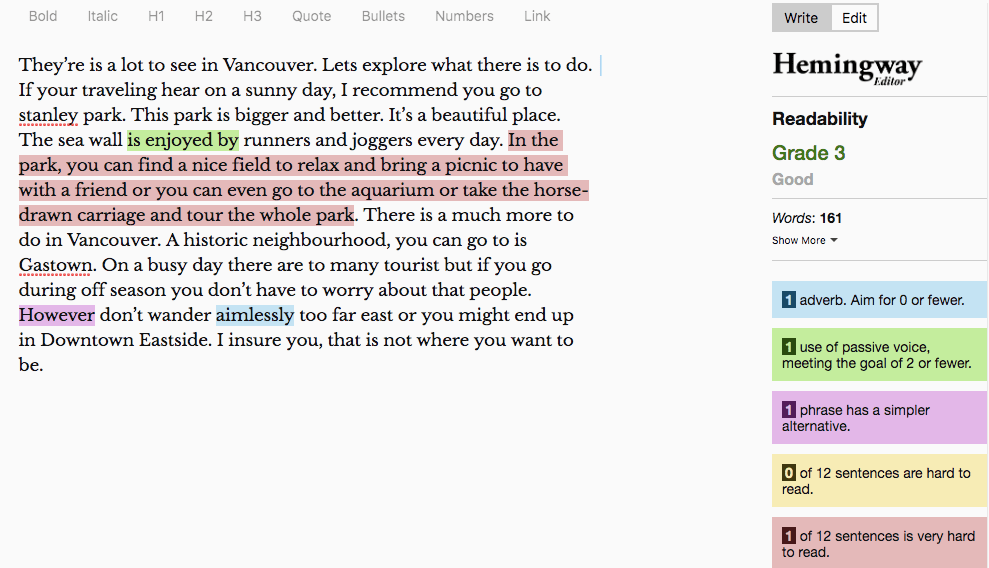
The first notable insight that the Hemingway app provided is the readability score. As you can see, my horrible paragraph would be accessible to a third grade audience.

This app did a good job catching all the extraneous words and run-on sentences, but missed all the spelling errors. This app is definitely not a spell check and should not be relied on as such.

If you are writing content for a wide audience and want your ideas to be communicated as clearly as possible, then the Hemingway App is a great product to help you achieve that.

Grammarly

Of all the apps I’m reviewing today, Grammarly is perhaps the most popular. It’s worth mentioning that I am not looking at any of the paid versions, I am only reviewing the free version.

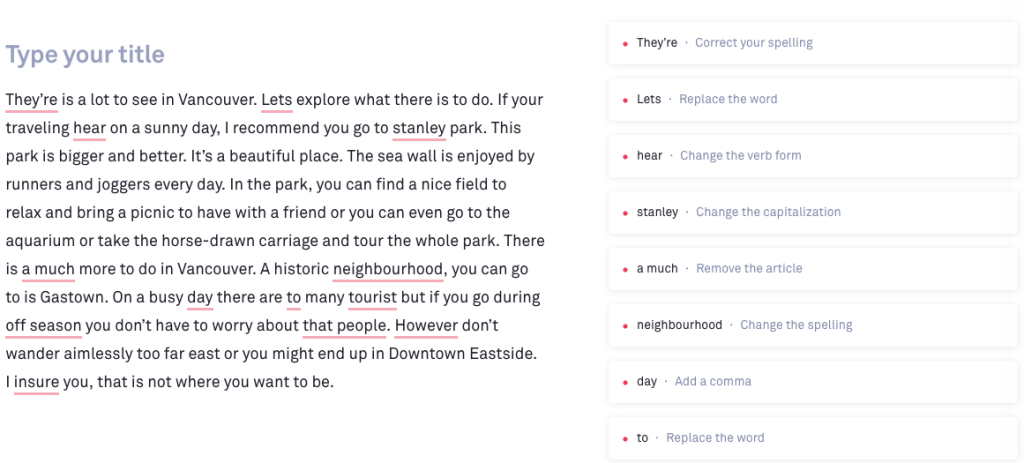
And here is how I feel about it:

Grammarly did a good job catching most of the spelling errors and punctuation mistakes, but was not helpful in catching passive voice, run-on sentences or vague descriptions.

If what you want from a spelling and grammar app is to double check your work as you move quickly through your draft, then Grammarly is a fantastic choice and has been one of my favourite tools.

Expresso App

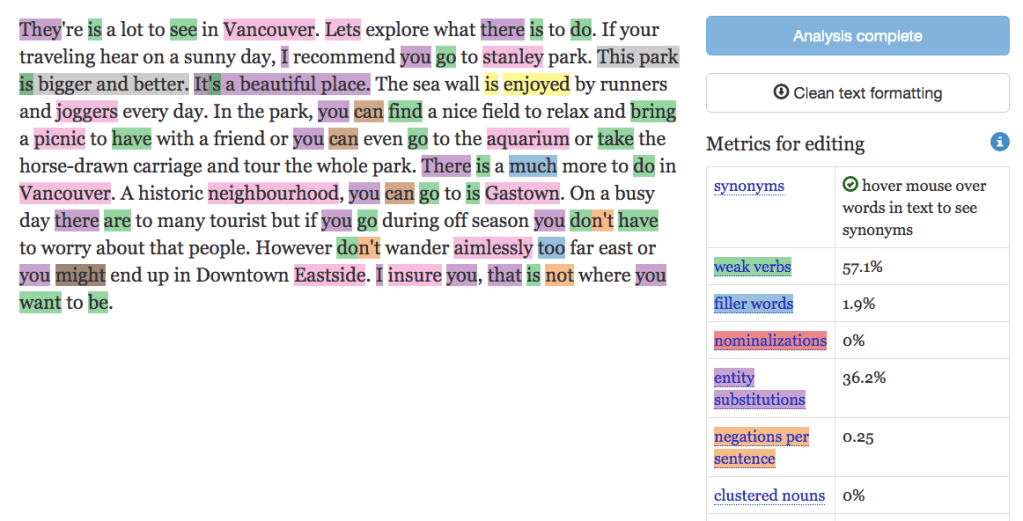
The Expresso App is an interesting product because it is not designed to help you correct errors but help you understand certain trends that might be appearing in your writing.

This app has a lot of details and can be a little confusing to use especially if you are not too confident with spelling or grammar in the first place. I recommend clicking into each category individually and understanding why this word or phrase is highlighted. Not every highlight is a suggestion to change, it’s more or less just telling you why it’s noted for you to consider.

Paste some of your writing in and see if you can spot any notable and you get to decide how you want to use that information. Good luck.

There you have it, those are 4 free spelling and grammar apps that can assist you as you write. My personal favourite is Grammarly because they offer a Chrome Plugin. What’s yours?

Are there other apps or tools that you are using? I’d love to check it out. Please share.

For more tips on editing your writing, check out this YouTube playlist: Editing Your Epic Novel

In-app purchase games are out of line

Photo via Thinkstock

What’s to blame: tech-company trickery or poor parenting?

By Elliot Chan, Opinions Editor
Formerly published in The Other Press. October 21, 2015

On October 9, Kanye West took to Twitter to give mobile game developers a little piece of his mind: “That makes no sense!!! We give the iPad to our child and every five minutes there’s a new purchase!!!” He added: “If a game is made for a two-year-old, just allow them to have fun and give the parents a break for Christ sake.” Empathic and on point as West was, he also neglected to mention that the mother of his child has one of the most lucrative mobile games on the market. I’m speaking of Kim Kardashian: Hollywood, a game where you get to prepare the reality TV star for the red carpet.

It’s hard to sympathize with West, because… well, who gives a shit what he does financially. However, many parents out there are facing the same problem as the multi-millionaire rapper. They give their kids an iPad, as a replacement for a doll, a toy car, or a deck of Yu-gi-oh! cards, and expect them to have fun and be responsible. Now, I don’t know too many two-year-olds that are able to conceptualize virtual money, because many adults still aren’t able to. Check around to see how many of your grown-up friends have credit card debt. It’s unfair to put the onus on children to be responsible while playing, so who should take the blame?

We blame cigarette companies for giving us cancer, we blame fast food companies for making us fat, and of course we should blame mobile game companies for leaking money out of our virtual wallets. Some consider the freemium-style of business brilliant, while others consider it trickery. In terms of games, it begins as a sample, usually free, to get the user hooked, and then they up the price once the player is addicted. While I believe the game companies have done a brilliant job in harnessing this, I don’t believe their intentions were malicious. And, as a businessman, West should know that it’s just supply and demand. If the player wants to skip a level, earn more stock, or gain leverage over an opponent—but they don’t want to put in the time—they can upgrade with a monetary solution.

Surprise, your kids are going to cost you money! Freemium games aren’t the culprit, they are just another avenue for your money to be lost. The same way you don’t give your children your credit card and PIN at the toy store, you shouldn’t give them an iPad with full access until they understand that the reality of their purchases. Educate your children about frivolousness and how each $0.99 click adds up.

You cannot stop businesses from creating products for profit, even if they do target children. Don’t believe me? Look at McDonald’s. You can’t win that way. What you can do is pull the iPad away from your child if he or she abuses it. Be a good parent and teach your children from an early age the value of money, and how it relates to the technology they are using. Organizations aren’t going to educate your children for you… or maybe there is an app for that.

Vancouver’s Mobile Community Discusses Future of Marketing at DigiBC’s MoMoVan

There was once a time when we would roll out of bed and flick on the television and digest the morning news with a fresh cup of coffee.

Now many people admit that they start the day off by reaching for their mobile devices and routinely checking each of their apps and sites for current events, social and business correspondences and progression in their Clash of Clans economy. Mobile devices have changed every little thing we do, but it is still a relatively new technology and businesses are only starting to understand how to harness its full potential.

On Monday July 8, 2013, DigiBC presented MoMoVan, a digital marketing event that addressed businesses’ shift to become mobile first. Whether it is promoting a new product or supplying news, companies recognized that mobile is the media format of the future. But which platform should a company choose is still to be determined, mobile sites versus apps? That was a major question the panel at MoMoVan tried to tackle.

“It depends on what you are trying to accomplish,” said Johann Starke, president of FCV, an interactive and digital marketing agency. “Apps work great, but if you are building an app for a political party with a campaign where the content has to change, it depends on how it is structured. What if there is a problem? What if you need to update it? You are totally at their [App Store approval] mercy. I think the things that have time constraints, you are better off doing a mobile site and use apps for things that are product based.”

“Apps are a bit of a gamble,” Starke added. “You got to be careful that you time it right. I’ve heard horror stories about stuff taking 90 days from the time you send it in for approval and if they reject anything you’ll have to fix it. So it is tricky.”

Apps are a big commitment for companies, but for users they tend to be nothing more than a short-term fling, a impulse download followed by neglect and then deletion. There are only a handful of apps that have sustainable relevance and remain a permanent fixture on my iPhone.

Apps are a premium experience and it comes with a price. A quality app with a poorly planned purpose will result in lost of time and money. “The reality is,” said Sandy Fleischer, Managing Partner at Pound & Grain, “apps are going to break. It depends on the complexity, but ultimately apps are software, while websites can sometimes be brochure-ware. In general, the maintenance requirement for an internal app is going to be more so than on a website.”

Despite all that, new apps are being produced. Apple announced that in June that there are now over 900,000 apps in the App Store. That is a 28% increase from one year ago.

In terms of user data, people spend a lot more time on apps than browsing mobile site. But some believe the market is now saturated and it is about time we see a decline in app productions. We don’t need another weather forecast, currency converter or food review app. We have reached a point where only the best apps should survive.

After all, what is the point of spending money and time creating something that will only be lost in the desolate sea of icons?