A love letter to the capital cursive G


Formerly published in The Other Press and Cupwire. Jan. 8 2013


From Elliot Chan

Dear Letter G,

I didn’t think much of you the first time we met. I was young and ignorant and you were just amongst the other 26 letters hidden somewhere in the middle, quiet and passive. I apologize now for the way I neglected you. Remembering all of those hours wasted with vowels—those damn popular vowels. Hell, I still find myself asking sometimes, “Why?” Why couldn’t I see something so obviously in front of me? Can you blame a fool for learning? It was as I matured that my view changed about you. Learning cursive was like seeing the tomboy dolled up on prom night.

Stunning. Suddenly the “Plain Jane ‘G’” I remembered as a child was all grown up. Your curves, your points, and the way you swoop up at the end when I write you. You are like no other letter in the alphabet. Nay, there is no other character in all of language like you. You are the perfect symbol, the perfect image, and the perfect mark. There is something about that little loop on your top left, like an eye. I know you see me, winking at me. I see you too, but you know that already.

I envy the Ginos, the Gunthers, and the Guys, because I too wish I had the privilege of scripting you every time I sign as myself. I’ll think of you in every cheque I write, in ever contract I receive, and in every credit card purchase I make. Sadly, you are a rarity and a treat. I find you in intimidating moments when I open sentences with “God,” “Gun,” or “Girl,” but then you sooth me with inspirations such as “Glorious,” “Great,” and “Glad.” Regardless of the meaning, every word with you in it is significant.

I can’t help but pity other letters. The lower case “A” with its ambiguous form, the loop, the vertical line on the right, but what about the arch above? Like many others I neglect that extra modification, but some believe lower case “A” needs cosmetics. Some letters are just the means to an end. Such as the cursive lower case “R” and lower case “N,” they always look the same when I write too fast. I see nothing in them. There is no other letter with your distinct characteristics, but that is not to say they don’t try.  There is the capital cursive “Q,” uncommon unless it is used as the number 2. The capital “Z” built with impressive curves, but it’s aesthetically a “J” that workouts. Your closest comparison is perhaps cursive capital “S”, but the extra flourish it requires takes away from its beauty. “G,” you remain my one and only.

I know it is crazy, because we are so different. You, the seventh letter in the alphabet, and me, a human man going through a complicated phase, but I believe we can make this work. Consider it a game or consider it growth, but whatever it is we are doing, I know you are write for me. So take a step back and look at the big picture. If your love is a prison, then I hope my sentence begins with the letter “G.”

From the tip of my pen,

E-Unit
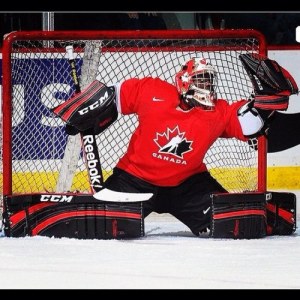
 

Canadian crease

cc7d2feaf7c825340730d3e2c22ca033

Formerly published in The Other Press. Jan. 8 2013

The future of goaltending for Team Canada

By Elliot Chan, Contributor

Imagine a golfer trying to sink a par three putt on a football field with a game in progress. In a sense, that is what goalies are—individuals playing their own sport in a larger game with all the pressure that nobody notices until they make or break. It is a unique position that requires mental and physical stability and that is what makes it difficult to pinpoint a consistent future for these athletes.

Malcolm Subban was the first goalie to be touted as the bona fide number one starter for Team Canada in the World Junior Championship since Carey Price in 2007. Needless to say, quality goaltenders don’t emerge often. Even when one does well in the World Juniors it doesn’t necessarily mean success in the NHL. For example, in 2006 Justin Pogge won the MVP and helped Team Canada capture their twelfth gold medal in the tournament, only to end up being shipped around from Toronto to Phoenix in his professional career without ever achieving the same level of accomplishment. Few goaltenders are able to savor a lengthy career, but those who do become legends.

As Martin Brodeur’s career wanes, all eyes are seeking the new fixture in Canada’s crease for the upcoming Olympics and World Championship tournaments. With the memories of Roberto Luongo’s 2010 gold medal performance tarnished by his inability to win the Stanley Cup, hockey fans can turn their attention to others remaining on the top notch. Cam Ward of the Carolina Hurricanes has a Stanley Cup ring, a Conn Smythe Trophy, and a gold medal from the 2007 World Championships. Marc-André Fleury also has a Stanley Cup ring and was the third string goalie in the 2010 Olympics. Many suspect that it will be his turn to take the helm and solidify his legacy as the starter in Sochi 2014. Finally, there is heavily ridiculed BC boy Carey Price, famous for mimicking Patrick Roy and telling hometown fans to relax. His stats aren’t as prestigious as the others, but I believe that team Canada would benefit from his fiery attitude.

Like any other profession, good consistent performance is what sets those who are great from those who are merely decent. Goaltending is no different. But when it comes down to a one game winner-takes-all, even the best rely on luck. On January 3, 2013, the USA defeated Canada in a 5-1 slaughter at the World Juniors. Subban was pulled after allowing four goals on 16 shots during the second period, far from top prospect caliber. For now, the Boston Bruins’ draft pick remains a prospect, but with mental and physical conditioning, I foresee Subban making a big impact with the Canadian squad for many years to come.

Other top goaltending prospects for Team Canada’s future include Braden Holtby of the Washington Capitals, Mike Smith of the Phoenix Coyotes, Devan Dubnyk of the Edmonton Oilers, Corey Crawford of the Chicago Blackhawks, Jonathan Bernier of the LA Kings, and Brian Elliott of the St. Louis Blues. The competition for Canada’s crease has never been so openly contested and it’ll be interesting to see who will step up and face the privilege of ultimate pressure.

Realistic resolutions

Opinions-new-years-resolutions

Formerly published in The Other Press. Jan. 8 2013

Achievable goals for the New Year

By Elliot Chan, Contributor

Here we are again—another year—and yes, I know what your plans are. I know you want to get back in shape, get out of debt, become involved in a steady relationship, and move forward in the world. Hey, maybe 2013 is your lucky year, but let’s be honest: 365 days might not be enough time to accomplish all of that. So let’s take a moment and have a look at some fulfilling and achievable goals. It might not be the overall objective, but it will be better than nothing.

Use technology as a bridge for human connection, not as the means. You’re a busy person and it’s obvious you love the new phone you got on Boxing Day. But don’t waste your life staring at the screen. Set a limit to how much you text someone throughout the course of the day. If you exceed the limit, force yourself to call the person or hell, pay them a visit.

 Quit complaining, or at least complain less. Develop a positive attitude for less than positive situations. Don’t huff and puff because there is a long line for coffee, or whine about the late bus or the idiots taking their sweet time making a left turn in traffic. The world is not out to get you, though sometimes it might feel that way. Complaining does not help. In fact, it makes every bad situation worse because you only focus on the negative. It’s time to change your perspective.

Try new food and music. Forget eating healthier, I have no intention of preaching about diets. I only want you to be aware that Vancouver has one of the biggest culinary communities in the world. You can walk down the promenade and order dishes from anywhere. It’s a shame to waste an appetite on McDonald’s or a granola bar. And don’t just listen to the radio where they force-feed you the mainstream rubbish. With websites like grooveshark.com and songza.com, there is no reason not to venture out of your genre and experiment. The discovery of good music is overwhelmingly satisfying.

Keep a sketchbook or a journal and stay creatively active. We worry so much about our physical health that we forget about our mental health. Keep your thoughts in shape by allowing them to be active during periods where your body is waiting to transport your brain somewhere else.

Relax and occasionally spoil yourself. The world won’t fall apart without you, despite what people make you believe. Take a siesta and wake up to work even harder. Instead of procrastinating, actually relax.

No matter what you end up doing, a good outlook and an open mind will help you achieve those high expectations. I wish you the best of luck, and I’ll check up on you again this time next year.


‘The Hobbit’: an unexpected trilogy

Formerly published in The Other Press. Jan. 8 2013

Better than the book!
By Elliot Chan, Contributor

4/5

Like most, I was skeptical when I heard that The Hobbit was being stretched from a 300-page children’s novel into three movies. But as the credits interrupted the story I was so engulfed in, I realized that I could have sat for six more hours. The rumour of Peter Jackson making The Hobbit into a trilogy to milk money out of loyal fans had been vanquished, for Jackson told the story the way it should have been told.

J. R. R. Tolkien can be referred to as many things: academic scholar, linguistic genius, an imaginative author, yet nobody reading his novels can ever say that he was a compelling storyteller. The Hobbit, though immensely popular, always read like a second draft awaiting Tolkien to fill in some key information. Since discovering Middle Earth at the ripe age of 11, I revisited the novel twice, each with a declining appreciation. But don’t get me wrong, I love Tolkien, and I am forever thankful that he created his fantastical world, only so that Jackson could make it one that generations to come can enjoy.

However, the new technology caused the film to lose some authenticity. Some may argue that combining 3D with the new 48FPS made for better image, but during dialogue scenes and sequences with little to no action the film felt jarred and sped up. Unlike The Lord of the Rings, where Jackson relied mainly on stunt actors for battle scenes, the over usage of CGI in The Hobbit cannot be ignored. Many of the generated characters were unimpressive, and caused the film to actually look dated.

Still, the flaws were few and far between—and most of them were caused by Tolkien’s eclectic storyline. The 13 dwarves were the most problematic, but Jackson coped by centering the plot on Thorin Oakensheild (played by Richard Armitage). Like Viggo Mortensen and Orlando Bloom, Jackson has a knack for finding talented heroes. After two decades in the film and television industry, the dues have finally been paid. At moments pitiful and others despicable, Armitage shows off his range as a brooding dwarf king determined to reclaim his home from a dragon named Smaug.

Another gem of the film is Martin Freeman’s performance as Bilbo Baggins. The long time British television star famous for playing alongside Ricky Gervais in The Officeand Benedict Cumberbatch in Sherlock, has the charm and sense of comedic timing that gives classical gags an organic feel.

From dwarven tomfoolery to tension-building riddles, the first installment of The Hobbit has raised the bar for the second and third. But with its cliffhanger ending, one can only imagine that the worst part of the up-coming movies would be the waiting, and not the walking.

ode to the Grinch?

How-the-Grinch-Stole-Christmas-christmas-movies-17366305-1067-800

Formerly published in The Other Press. Dec. 4 2012

Christmas traditions that should be eliminated

By Elliot Chan, Contributor

The word “tradition” brings a shiver down my spine. How can intelligent people be subjected to these mindless habits, and worse, why must they pass them on from generation to generation? It’s time for us to kill some traditions and move on, before they do the same to us.

As the holiday season approaches, I brace myself for all the shameful acts we’ll do just for the sake of tradition. Of course, I don’t have to look far. All I have to do is open my curtains and there they are: my neighbours’ Christmas lights hung from their rafters, rooflines, and porch railings to prove to the community that an upper middle class family resides within. Every block has an overzealous decorator, and while most houses are quietly conserving precious energy, these homeowners decide to add to the light pollution. Even with the new LED lights, the festive tradition is still a complete waste of energy. According to the Department of Energy, LED Christmas lights in an urban city still consume over 31,000 kilowatts (10 times less than incandescent) during the course of the holiday season. Considering that on a regular day a household only uses 16-20 kwh, we must prioritize our First World privileges. The only people worse than those who put up Christmas lights early are those who are too lazy to take them down. We’ll speak again in February.

I’m not a tree hugger, but seeing a young, healthy evergreen amputated from the earth and set to slowly rot in a living room doesn’t seem right. “But fake, plastic Christmas trees don’t have the fresh smell,” you say. I really wish that was a legitimate argument, but it isn’t. It can’t be, not in this day and age when we slap someone over the head for not recycling. Stop being so stubborn and at least make an effort. That’s not to say artificial trees are any better. Producing plastic creates by-products that are extremely harmful to the environment. These inauthentic trees leave a far more damaging carbon footprint than real ones. So dismiss the Christmas tree this year and take a sniff: “Ah… A fresh tradition.”

The generous act of giving is perhaps one of humanity’s most positive traits—surely that can’t be a bad tradition. It isn’t, but the fanatic desperation to find a gift is. There’s no such thing as a perfect gift. Eventually it’ll become garbage—broken down or shoved in the garage alongside the plastic tree. There are meaningful gifts, and then there are thoughtless gifts. Most of us can recognize one from the other, there’s no hiding it. The stress to find something meaningful turns generosity into unpleasant despair. There’s no reason for the shopping mall to become a war zone. Change this tradition. I’m tired of receiving knick-knacks and coupons for 10 per cent off after a $50 purchase. Share an experience with your loved ones. Take them out to dinner, go on a trip, and create a memory that doesn’t revolve around a stuffed animal or a box of chocolates.

It’s not my intention to ruin Christmas or the holiday season, but we must acknowledge that as the world changes, so must our traditions. If we’re going to preach about a better environment, a better community, and a better life, perhaps we should replace our white Christmas with a healthy green one.

The triumphant return of Georges St-Pierre


Formerly published in The Other Press. Nov. 27 2012

By Elliot Chan, Contributor

Canadian UFC fans all across the country were holding their breath as Georges St-Pierre returned to the octagon after a 19-month absence. After tearing his ACL while training for a welterweight title defense against Nick Diaz in UFC 143, GSP began his long road to recovery that involved surgery.

On November 17, St-Pierre and interim welterweight champion Carlos Condit headlined UFC 154. Condit replaced GSP in the fight against Diaz and took the unanimous decision. Condit had been waiting patiently for months for GSP to recover and at the Bell Centre in front of a packed house in Montreal, he finally had a chance to take home the undisputed title.

“Somebody asked me in the locker-room, ‘How’s Georges looking?’” said St-Pierre’s striking coach Phil Nurse prior to the event, “you know what? The last time I saw him like this is when he flattened Matt Serra at the same arena.”

Without missing a beat and appearing in full athletic form, St-Pierre took the valiant contender to five rounds, dictating the fight with a formidable ground game and regaining the title in unanimous fashion. Condit was only able to defend against St-Pierre’s take downs one in eight attempts.

“Obviously that’s not where I wanted to be, I didn’t want to be under Georges taking elbows,” said the challenger after the fight. An early strike to the temple caused Condit to bleed profusely late in the first round, when St-Pierre effortlessly got through his guard. However, despite looking like a horror movie victim, Condit did not back down. In the third round, he snuck in a high kick after a series of jabs. The left leg struck St-Pierre in the head and knocked the welterweight champion down to the mats. He would have lost the title then and there, had it not been for his flexibility and strength. “I thought I had him there,” said Condit.

But St-Pierre had spent many hours honing his ju-jitsu just for that situation. Eventually, the champion’s wrestling over matched Condit’s and he managed to get back to his feet with only visible damage to his face. But it was St-Pierre who landed the majority of significant strikes 71–36.

“I’m sure he feels like he got hit by a bus right now. I’m not even going to talk to him about it for a couple of weeks,” commented Dana White, President of UFC, when asked about the potential super fight with GSP against middle weight champion Anderson Silva. But he adds, “I think we can get it done.”

For years now, the debate has been raging on about who is in fact the best pound for pound fighter. Most loyal GSP fans will not change their mind, but Silva has yet to be challenged in his own weight class the way St-Pierre had with Condit. Although I am certain White could make the event happen, I don’t believe the match should. As skilled as St-Pierre is at the moment, a challenger like Silva may be too overwhelming, especially after an injury. I suggest that instead Silva should raise his weight to 186 lb and face light heavy weight champion Jon “Bones” Jones.

Movies for the history books


Formerly published in The Other Press. Nov. 20 2012

The best portrayals of historical figures in cinema
By Elliot Chan, Contributor

Portraying a historical figure is a right of passage for professional actors. The challenge tests their limits, gives them recognition, and might even win them an Academy Award. Every year notable actors morph themselves into famous politicians, celebrities, and athletes. This year in the movie Lincoln, Daniel Day-Lewis will take on the title role as the United States’ 16th president. With one of the most renowned actors playing the part of one of the most revered historical figures, the star power is bound to cause a cinematic supernova. Therefore, it only makes sense to look back and mention five history- making performances.

5. Johnny Depp as Raoul Duke in Fear and Loathing in Las Vegas (1998)

Raoul Duke was the pseudonym for gonzo journalist Hunter S. Thompson. It was Thompson’s alter ego, a character driven by a perpetual state of intoxication and in search of the elusive American dream. Depp was a close friend of Thompson prior to making the film—perhaps that was the only way to get into the mind of such a complex personality. One moment he’ll be exhibiting traits of a southern gentleman and the next he would be raging over a subject like a “manic beast.” Depp found reasonable qualities in a person that continues to puzzle the public and some might say that those Thompson traits still linger in Depp’s performances to this day.


4. Helen Mirren as Queen Elizabeth II in The Queen (2006)

In 2003, Mirren was dubbed a Dame in the courts of Buckingham Palace. Three years later, her performance in The Queen won her the Academy Award. Being the only actor to portray both Queen Elizabeths on film proves it, as she was able to bring sympathetic qualities to a seemingly emotionless figurehead, a mere image on our $20 bill. To do it all with respectable grace and dignity is a daunting feat, especially for a British decent.

3. Forest Whitaker as Idi Amin in The Last King of Scotland (2006)

Whitaker’s chilling transformation into the Ugandan president ranged from subtle exchanges to dynamic teeth clenching sequences. The Last King of Scotland was far from an action movie, but Whitaker’s performance knocked me to the edge of my seat. There were close up shots where you looked into the man’s eyes and saw only the deep dilemma, the perplexity, and recognized the depth of the once too real dire situation.

2. Ben Kingsley as Mahatma Gandhi in Gandhi (1982)

There are films that blend historical legacy with cinematic performances forever. A quality portrayal can allow the person, the message, and the memory to span the stretch of time. Kingsley’s Oscar-winning performance was both a triumph for cinema and humanity. We may watch superheroes and aspire to have special powers, but to watch a movie and inspire to be a better person—that is truly something else.

1. Bruno Ganz as Adolf Hitler in Downfall (2004)

Keeping the infamous YouTube Hitler meme from this film aside, this hauntingly heartfelt performance by Ganz as the Nazi dictator created a boundary many were not ready to cross: sympathy for the devil exemplified to the fullest potential. The world is used to viewing Hitler as the merciless villain upon the podium, but inDownfall we catch a glimpse of the monster cowering, whimpering, and anticipating the end. A man, a character, and a performance are a multi-dimensional configuration; recognizing those facets takes great skill and effort, but only then can an actor understand another person’s decisions—another person’s life.

BCGEU strike

c9a8c9c24a8e9a8f6a86e9ad49eb-500x375

Formerly published in The Other Press. Nov. 20 2012

Picketing for equal wages
By Elliot Chan, Contributor

On Wednesday November 14, a large group of support staff employees gathered outside of the empty Douglas College. After a resounding 77 per cent vote in favour for the strike earlier this month, BC Government and Service Employees’ Union members displayed their dissatisfaction on Royal Avenue and 8th Street with prominent yellow signs.

The union has been without a contract since June 30, 2010, and negotiations have been a slow process.

“We prefer to be at work,” said Kirk Pedersen, a web and social media specialist, “we don’t want to be out here.” A statement most picketers echoed on a clear autumn day. But many are hoping that the strike would call some attention to the issues.

“We want a livable wage,” said Tana Frie, a graphic designer, “there should be an equal wage within all universities and colleges.”

Currently Douglas College offers one of the lowest wages for service employees in the province. Although these workers are doing the same jobs as those from UBC and SFU, they are not receiving equal compensation. “Cost of living has increased,” said Bryan Hoff, a web designer, “[The government and college] need to catch up and help people financially.”

“Douglas College support staff deserve a fair and reasonable deal,” said BCGEU President Darryl Walker. “The monetary offer on the table at Douglas College is half what support staff at other post-secondary institutions such as UBC and SFU have settled for. That’s unfair and it’s not right.”

At the moment, the 304 support staff members at Douglas include registration staff, IT services, library assistants, bookstore clerks, student services, and financial aid advisers.

“It’ll probably happen again if it doesn’t get resolved,” said Pedersen, in regards to the strike’s longevity, “rotating strikes will continue from one district to the next.”

Sandra Mountain, the Bargaining Committee Chairperson for Douglas tries to view the future with optimism, “We are waiting. There is bound to be more activity.” But a fair solution still seems to be up in the air. “It is time to move on,” says Mountain, “There are other things that need to be focused on.”

The striking staff returned to work on Thursday. A renewed collective bargaining agreement remains to be negotiated.

Quayside to be brightened with ads

Formerly published in The Other Press. Nov. 14 2012

New Jumbotron set for approval overlooking Columbia Street
By Elliot Chan, Contributor

On October 24, Plaza 88, the condo and commercial property attached to the redeveloped New Westminster SkyTrain station, presented the concepts for a 732-square foot Jumbotron to the Quayside Community Board. For the past couple of years, New Westminster has been undergoing an extensive makeover. As cranes crowd the skyline and construction crews parade the streets, optimistic residence and business owners are anticipating a boom.

Yet the plan to incorporate the new ordainment does not come without obstacles. The New Westminster’s sign bylaw states that no sign can exceed 215-square foot and prohibits flashing or moving lights and animation. But Penny McIvor, president of QCB does not see a problem with the addition. “[The Jumbotron is] not facing a ton of residences, it’s facing the river and not people’s bedrooms,” said McIvor. “I can’t see it interfering.”

McIvor goes on and addresses the benefits of installing the sign. “We’re OK with it because we need to promote what’s in the mall to make sure the small business don’t fail,” she said, “We’d like to see one screen with all the businesses on it rather than 50 different signs and logos all over the building.”

Plaza 88, the city’s newest development incorporates a unique retail space encasing the New Westminster SkyTrain station. This economic use of space at a convenient location is now home to banks, travel agencies, dentists, small restaurants, cafes, as well as a Safeway. The future for Plaza 88 also includes a multiplex on the second floor.

The proposal for the new sign is still being processed by the council and is currently awaiting approval. The concern regarding the sign is that it can be a distraction for those in traffic, but more so for those who will move into the residential complexes when construction is completed. The parking lot at the front of the Inn at the Quay will eventually be renovated to accommodate both the shoppers and those who live there.

“We want the business to go in there to survive,” McIvor said. “90 per cent of those who live in New Westminster don’t even know there’s a shopping mall there.”

Idle ice

Formerly published in The Other Press. Nov. 6 2012

The storylines we’ll miss because of the NHL lockout
By Elliot Chan, Contributor

A lot was planned for the 2012-2013 NHL season and patient hockey fans might not see any of it. The damage is done and as soon as the millionaires finish bickering over dollar bills, we can get the game back on the ice and answer the questions we have been asking since early summer.

Aside from complaining about the weather, Canucks fanatics entertain each other with goaltending discussions. Well, I guess they can still blame Roberto Luongo for the storm clouds, but the main query on the burner is how much longer will they have their favorite scapegoat for. Trade speculations have been boiling ever since backup Cory Schneider took over in net late in last season’s first round playoff series. Rumors circulated about Luongo returning back to the Florida state or heading eastbound to Toronto, but here in Vancouver he remains blocking out the sun with no net to defend.

Yes, change is bound to happen, but one change Vancouver doesn’t want is their position on top of the NHL standings. For the second consecutive year, the Canucks have won the Presidents’ Trophy. It’s not the Stanley Cup, but it’s still something to be proud of. But they have been playing in a docile Division, the Northwest. While Calgary and Colorado fight just to make the playoffs, Edmonton and Minnesota linger at the bottom of the standings, collecting high draft picks. Vancouver has dominated in the past, but their time on the throne is ticking and experts believe this might be the last year the Canucks have before players in rival teams fully develop.

Elsewhere, the lockout halted many more entertaining scenarios. Blockbuster trades during the off-season created spectacles early on, but for now we can only imagine how game breakers fit into new teams. New York Rangers superstar Rick Nash, former captain of the Columbus Blue Jackets, is expected to be the last missing piece in the Rangers’ playoff success. In Carolina, the Hurricane’s captain Eric Staal welcomed his brother Jordan, former player of the Pittsburgh Penguins to play alongside him. What impact will their sibling connection have on the team’s chemistry?

There are new players and then there are old players. Detroit Red Wings fans are wondering how big Nicklas Lidström’s retirement will play in the grand scheme of things. While New Jersey Devils’ organization hopes that the last playoff run was not Martin Brodeur’s final gasp for glory.

The lockout is also holding back the return of many great players that have suffered injuries. Sidney Crosby, the captain of the Pittsburgh Penguins, has been ready for competition for months now. As for a player like Chris Pronger, future hall of famer and captain of Philadelphia Flyers, the question on returning still hangs in the air. After suffering from post-concussion symptoms at the ripe age of 38, is there anything left for him to return to?

If there are uncertain expectations for some, then there are high expectations for others. Players like Shea Webber, Alexander Ovechkin, Ilya Bryzgalov, and Erik Karlsson are expected to meet and exceed expectations after receiving new contracts or suffering from a subpar year.

The loss of a hockey season does not simply mean the absence of goals, saves, and numbers on a scoresheet. Storylines leave a permanent mark and that is what makes watching sports the ultimate reality television show.