Stars without a purpose

 Rádio-Expres-Hlasujme-spolu-za-Jara-Haláka-do-NHL-All-Star-game-2015-1024x632

Give the NHL All-Stars something to play for

By Elliot Chan, Opinions Editor
Formerly published in The Other Press. January 20, 2015

The format for selecting the top players to be involved in the annual NHL All-Star Game and Super Skills has been an experiment for many years. Fan voting, player drafts, and the executive choices from the NHL have all been tried. Not that the games themselves have any merit except a little bit of bragging rights for the players and some excitement for the fans. The selection process is often more surprising than the actual event itself. With all that being said, how can we give a little more life to a game that doesn’t matter?

From the old-fashioned World versus North America to the current Eastern versus Western Conference battles, we always see some key players left off the roster. With the fans in charge of selecting the top six players in each respective position this year, we can see a huge flaw within the voting system. Five out of the six players voted are from the Chicago Blackhawks and one player from the Buffalo Sabres. The NHL then went on to select the remaining 36 participants.

This fan voting system, however, leads itself to some less-than-serious picks. Nothing against Zemgus Girgensons of the Sabres (who?), but with over 1,500,000 votes, beating out players with double his point total, I must say he is occupying a spot that doesn’t belong to him. Thanks, fans! This reminds me of the year where the Canucks’ Rory Fitzpatrick nearly earned himself a spot on the All-Star roster with the help of fan voting and a Twitter campaign. Fitzpatrick was well-liked, but far from All-Star material. The conspiracy is that the NHL stepped in and voted Fitzpatrick out near the tail-end of the voting process.

Another problem just happens to be a publicity ploy. A fantasy draft format will take place on January 23 to decide the two teams. Nick Foligno of the host city, Columbus, will be the captain of one team and Jonathan Toews of Chicago, the captain of the other, will vie for the best suited players, or their own teammates and friends. As proven from the past years, this is a popularity contest and less of a serious team construction.

All-star games, currently jokes masqueraded as sporting events, could have some value. The MLB puts pressure on the game by giving playoff home-field advantage to the team that wins. The NHL could use this. Here’s a hypothetical example: if the Eastern Conference wins in the All-Star Game last year (if there was one), then in the Stanley Cup Finals, the New York Rangers would have the home-ice advantage instead of the LA Kings because of the All-Star Game victory, even though they were both seeded forth in their conference.

The All-Star Game is often a lacklustre event, full of showboating and antics. It’s barely a hockey game. Sure, the MVP gets a new car or something and the winning team gets a celebratory pat on the back, but what’s the point? Make them play for something.

The games should be about building an elite team to compete for an advantage that will come into play when it really matters. I agree that it would be a shame if a player were injured, but hell, I want to watch hockey, not figure skating!

Don’t let the sound of your own wheels drive you crazy

Opinions_dont burn out

Take it easy and don’t burn out too early in the year

By Elliot Chan, Opinions Editor
Formerly published by The Other Press. January 13, 2015

Pace yourself. For those who are working and going to school, taking a break periodically at the start of the year can do wonders. Let’s be honest, the holiday season is not as relaxing as you would have wanted it to be. In fact, some might say that running around, buying gifts, attending parties, and mingling with old friends and familiar relatives is as stressful as a communications project. Now that you are back into the groove, take a moment, breathe, and relish in the start without anticipating the finish.

If you have chronic stress or if you don’t want to develop it, there are few things you need to do: avoid exhaustion, stay motivated, dismiss cynicism, and get cognitive rest and take care of yourself.

We often overload our schedule early in the year or try to harness the momentum that dwindled a bit after the festivities. There is a bit of holiday hangover though, so although we are optimistic, we must also be realistic. While some people are busy making New Year’s resolutions, you may consider taking a break. Ease up, allow yourself time to soak in the new environment, new classrooms, new responsibilities, and new opportunities.

Why do we burn out in April when it’s exam season? Why do we feel overwhelmed and stressed? It’s because we weren’t taking care of ourselves earlier on. We weren’t preparing ourselves properly. Once activities and assignments pile up, there is no time to rest, but there is plenty to stress.

Instead of doing frivolous work or starting anything new, consider how far you’ve come since the previous year and maybe reassess your goals. Mark milestones you would like to hit throughout the year and plan. Planning an event in May will give you energy in March, so even if you start burning out in the latter half of the season, know that you’ll be rewarded by someone who cares: you.

Relaxing is serious business. While the grind up ahead seems daunting and preparation is a must, relaxation is the act of staying attuned with your body and mind. A body builder doesn’t go to the gym every day and doesn’t work the same muscles every day. Neither should you.

Trust in yourself that you will survive this year with grace. Exemplify vitality. Don’t beat yourself up for having a day where you get to sleep. Not every day needs to be productive, especially early on in the year. You’re about to climb a mountain, a mountain you have climbed many times before, a mountain that lasts 365 days. Look up, visualize all that you want to accomplish, and then take one step at a time. Most importantly, don’t forget to enjoy the view.

Lighthouse Labs Bridges Digital Literacy Gap with HTML500

Coding is a universal language; however, many find it daunting, confusing, or overwhelming. Like learning all new languages, the best way to become skilled is to engage with it socially. That is the environment The HTML500, a free one-day coding event hosted by Lighthouse Labs, has established.

“When you are learning in a room with 499 other people who don’t know how to code and being helped by 100+ mentors,” said Jeremy Shaki, co-founder of Lighthouse Labs, “the energy is fantastic and the room is engulfed by this buzz of people who want to learn and are seeing the instant results of their learning.”

The HTML500 will kick off 2015 in four Canadian cities: Vancouver (January 24), Calgary (January 31), London (February 7) and Toronto (February 22).

The value of coding stems further than getting a well-paying job (Canadian programmers can make over $50,000 annually), it can also give people the confidence to create projects that change the way we live.

Although coding is often recognized as a young person’s game, the best coders are those who are curious about technology and strive for logical solution-oriented thinking. The 2014 The HTML500 welcomed attendees ranging from 13 to 65 years old.

“Fluency in code for a non-developer can empower them to make their own lives and work more efficient,” said Khurram Virani, co-founder of Lighthouse Labs. “Personal and professional websites, macros in Excel, desktop and mobile apps are some common examples. At work, it will help them communicate better with their developers. And lastly, learning to code and coding can also serve as a great creative outlet.”

For many years, those who were interested in coding had to seek educational workshops and tutorials independently through online sources such as YouTube or apply to post secondary programs and private institutions. Few classes in elementary, middle and high school deal with the in-demand skill set in depth. Students will rather stumble into it or take initiative if they want to pursue programming and tech.

“A great, but telling, story from my partner Khurram is that when he was in Grade 10 he ended up essentially teaching his Computer Science class because the teacher was trying to teach something they didn’t understand,” said Shaki. “That’s still a reality in a lot of schools, and the only way to combat that is to bring awareness to the opportunities coding presents both the individual and the classroom and the ease of which it can be taught at basic levels.”

“The tech industry as a whole is rapidly growing,” said Virani, “resulting in higher demand for coders and there aren’t enough of them out there because as a country, we still haven’t placed a priority on digital literacy. If we are to support the growth of our tech industry here in Canada, we need to start teaching code in schools as a basic part of literacy.”

With numerous job opportunities in mind, The HTML500 encourages attendees to bring along their résumés. After the event in 2014, the organizers discovered that many companies were interested in hiring people for non-technical roles. This year, The HTML500 has partnered with Vancouver Economic Commission to host a career fair at all four events.

“If you think about what many tech companies are looking for when hiring for non-technical roles,” said Shaki, “they are seeking self-motivated people who strive to grow and learn, and who show an interest in tech. With all these participants giving up a Saturday to come and learn something on their own, they are checking off some key checkboxes as marketers, operations people, HR staff, etc.”

Companies participating range from startups to corporate companies, including some establish brands such as Techvibes Job Board regulars Hootsuite and Unbounce.

A one-day event is obviously not enough to tech everything about coding, but The HTML500 is hoping to give the attendees some comfort and confidence, in addition to creating a community for developers of all level.

“We strongly feel that everyone should know the fundamentals of software and how computers work, regardless of their profession,” said Virani. “The current education system has yet to consistently and sufficiently teach coding in schools so we decided to create The HTML500 as a great way to have companies and the developer community come together to bridge the digital divide.”

Honouring ‘Charlie Hebdo’ and freedom of speech

Firefighters carry a victim on a stretcher at the scene after a shooting at the Paris offices of Charlie Hebdo, a satirical newspaper,

Where the line is drawn and where it is crossed

By Elliot Chan, Opinions Editor
Formerly published in The Other Press. January 13, 2015

The hostile take over of Charlie Hebdo, the French satirical left-wing magazine, and the massacre of nine employees and two National Police officers reminds us of the thin barrier protecting our freedom of speech and the fine line between poking fun and instigating attack.

The senselessness that occurred on January 7 gave strength to what many agree to be a dying medium. Publications across the globe banded together to acknowledge the bravery of those cartoonists who died so that we may continue to speak our mind and express our opinions.

Newspapers, magazines, and various other publications that hold the mirror upon society, showing all the blemishes, scars, and corruption, are the vehicles for democracy. Without them, without freedom of speech, without public and private institutions to speak up, we are doomed. And for that reason alone, I honour those who have lost their lives over the years—CharlieHebdo included—for our right to express ourselves.

Yet, such ruthlessness cannot be ignored. Forthright as I am, I am not eager to die for my craft. So I must ask, where is the line I must draw for myself? How will I know when I have crossed it? When should I cross it?

Those who know me know that I only view activism from the perimeter. I have yet to determine my stance. Should I fight against corporate giants like Kinder Morgan? Should I challenge government discourse, like those in Hong Kong did last year? Should I rally for legalization of marijuana? I know at some point I’ll have to pick a battle, because those who stand idly by give power to the enemy, whoever it is.

So I ask us all: What are we willing to die for? What change in the world do we wish to see for the next generation? What have we inherited from the sacrifice of those before us? Take a moment to learn about our history, whatever realm you are interested in—art, politics, civil rights, etc. You will find that what we have did not materialize overnight; what we have came from battles hard-fought. Unlike a war, but still a battle with casualties.

We should arm ourselves with open-mindedness and good intentions. We should not talk or write with the goal of being accurate, but with a whim of curiosity. Societal issues lie in a grey area.  What is right in our minds may be wrong somewhere else. We as artists, journalists, comedians, filmmakers, and other influencers must set the example. We too must not be close-minded. We too must see from our opposition’s point of view, understand where they are coming from, and why they are willing to risk their lives to defeat us.

Let’s harbour discussion to create a better world—one without intentions to provoke, one without intention to kill.

Paul is dead

51st Annual GRAMMY Awards - Backstage and Audience

Relax, Kanye West fans will find out who Paul McCartney is sooner or later

By Elliot Chan, Opinions Editor
Formerly published by The Other Press. January 13, 2015

On New Year’s Day Kanye West and Sir Paul McCartney released a new song, “Only One,” in anticipation of West’s seventh album. Although this should have been an occasion of excitement, it turned into an Internet uproar of ignorance. West fans—perhaps in jest—asked, “Who is Paul McCartney?” and other questions suggesting that West is “shining a light on unknown artists.”

At my age, the notion of anybody not knowing who McCartney is or about the Beatles is insulting, perhaps more insulting than the cheap auto-tune song itself. If the statements are meant to be sarcastic then I’ll laugh along (because I get jokes), but a part of me is withering inside.

Those who are clueless to the Beatles are like people who have never seen an episode of The Simpsons. How?

For me, I went through the Beatles phase around high school. Before that, I thought it was music for old people. And if that was the case in the early 2000s, then “Let It Bet” must seem really ancient now. But there is a timelessness to the Beatles’ music, and that is why I feel it’s in a genre of its own. Like punk, blues, or electronic music, the indulgence in that art represents a phase in our lives we can revisit; the same goes with the Beatles.

I remember the first time I heard “Yesterday”—albeit it was during the Mr. Bean movie. I remember how I felt when I heard “Here Comes the Sun” and tried to replicate it on every instrument I had. Then I remember hearing “Revolution 9” and thought, now this is getting weird (drugs?). Unlike a lot of other artists, the Beatles were the soundtrack to early mornings, long nights, road trips, homework sessions, and many other scenarios. Then I grew up and I watched as the next generation discovered it; I realized that I was a part of a chain.

Not everybody listens to the music I like these days, and oftentimes I have to defend my taste. But people are drawn to the Beatles; everybody knows how their tunes go—even if they hate them. Whether it’s your cup of tea (British slang) or not, the Beatles are like Stephen King. They have influenced everybody in one way or another, but nobody should say, “Stephen King is my favourite author.” That’ll just make you look uncultured.

Like learning about history, the Beatles may be shoved down some young people’s throat. That will cause resistance for sure. But if they allow it to digest and savour what it really is, perhaps there is hope that the future will continue listening to the Beatles and McCartney without the help of a modern day artist or being sampled in a rap song.

Totally Real Food Review: Happy Lucky Dragon Smiling Restaurant

chinesefoodbowl

Chinese food that you eat with your mouth

By Elliot Chan, Opinions Editor
A satirical article, originally published in The Other Press.

The 7-Eleven of Chinese restaurants, Happy Lucky Dragon Smiling Restaurant never closes—not even for New Year’s Day or Christmas—making it a perfect last option for desperado foodies.

Located in the same complex as Money Mart, Lust Factory Adult Store, and Subway, Happy Lucky Dragon Smiling Restaurant’s parking lot is usually empty due to the swiftness of its neighbours’ clientele. This means you can stay as long as you want at Happy Lucky Dragon Smiling Restaurant without worrying about your car being towed. However, crime rate is up 12 per cent in the area, so be cautious—nevertheless, most of the crimes are just hate crimes and crimes of passion.

Inside Happy Lucky Dragon Smiling Restaurant, you’ll find chairs to sit on and tables to eat food on. The chairs have four legs and some have rips in them. This gives you an exclusive look at the browning inners of the cushion. The wallpaper is different from my home, because I decided at the last minute not to decorate it with water-stained flower patterns. But I think it’s pretty cool seeing the deterioration of the wallpaper; it reminds me that even though life is short, you can live long enough to see wallpaper get ugly. I think that’s beautiful. It’s like watching your grandmother do stuff, and you’re just like: “Oh grandma, just get out of the way. I’ll do it for you.”

Once I was done admiring the décor, I chose to sit by the window, offering a perfect view of the parking lot, which with my imagination kind of looked like a tennis court, but instead of tennis players there was just a lunatic.

The service was nice. The server was also the cook, which I believe should be how every restaurant should work. Imagine how nice it would be just to tell the cook what you want to eat and then he or she would just run back into the kitchen, which is pretty much right beside the table, and cook it for you. It’s like eating at your mom’s house, but without the resentment or guilt for not cooking the food yourself.

When the food arrived, I ate it with my mouth. It tasted hot. After a while it tasted cold, but some say there is no such thing as cold, and that cold is really just an absence of heat, so I guess it just tasted normal after awhile, which was okay.

Overall, Happy Lucky Dragon Smiling Restaurant is not the worst. If you end up there after an argument with your spouse about where the two of you should go for dinner on your anniversary, you should be happy that you are still alive. Happy Lucky Dragon Smiling Restaurant lives up to its name and reminds us of what it’s like to be a happy, lucky, dragon smiling at a restaurant. Few other restaurants are that honest. Maybe White Spot.

Let’s be smart

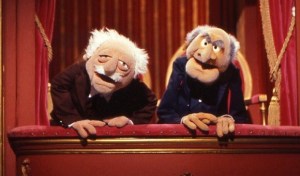
muppet-critics

Do we still need professional critics?

By Elliot Chan, Opinions Editor
Formerly published by The Other Press. January 6, 2015

What makes one person’s opinions more valuable than another? Why should some people get paid for their thoughts on entertainment, economics, and world news when other people can barely get an audience? In a world where everybody is shouting aimlessly, professional critics or critics with  credible reputations should be appreciated more than ever, right?

The thing is, the idea of an expert doesn’t materialize overnight. Although anyone can claim to be an expert and a critic, it takes a gifted person to add insight and not just spew jargon. Anybody can flip through a dictionary and find sophisticated words to describe the refined, yet robust taste of a bottle of wine. But that is just a façade. Anyone can hide behind a keyboard and type up their thoughts on any given subject and some points will undoubtedly hit a mark; anyone can do what I’m doing right now. Being an expert and a critic is no longer about judging, it’s about communicating. Experts who can express their ideas in a clear and intelligent fashion will be quoted, and the quotes are what make professional critics necessary.

A good critic does more than just critique a project or a topic; their work itself is an art form. Just take a look at the late-great Roger Ebert; he could present painful truths in an entertaining, witty manner. Ebert wrote in a review of 2009 failed comedy Old Dogs starring Robin Williams and John Travolta: “Old Dogs seems to have lingered in post-production while editors struggled desperately to inject laugh cues. It obviously knows no one will find it funny without being ordered to. How else to explain reaction shots of a dog responding to laugh lines?” Such an observation is commonly lost by amateurs or delivered in bad taste.

Few dream of becoming critics or experts as children. It’s hard to imagine a life judging stuff professionally or being called upon to comment on a specific area of interest. But if we live in a world where a social worker is a legitimate job title, then yes, professional critics should be as well. Because what they do is more than just researching, wasting time on a subject, or simply watching movies, they are summarizing sometimes complicated, sometimes idiotic ideas to us. And those deemed worthy of the job should be revered but also challenged. After all, experts are not always right.

We should all aim to be professional critics and experts. Although some have the fortune to be paid to spew their thoughts, we must remember that the reason why they are compensated for their words is because people are ready to listen. What makes people listen to you? What do people ask you about? Perhaps you can monetize that as well.

‘The Interview’ aftermath

Opinions_the interview

What Sony, North Korea, and hackers taught us about movies

By Elliot Chan, Opinions Editor
Formerly published in The Other Press. January 6, 2015

Terrorist threats, computer hackers, and harsh critics have all failed in killing The Interview this holiday season.

While the North Korean government is still bitter over the Christmas release, viewers rejoice knowing that we can all move on to award season without further controversy from the lacklustre film. Our freedom is still intact. We watched a movie without being executed. We won—sort of.

After all the buzz and scare, it’s safe to say that the movie will become a forgettable political satire. The Interview was pretty much Pineapple Express with a sympathetic villain, Kim Jong-Un. I’m not sure what the terrorists and hackers expected, perhaps a defamatory representation of their “god,” but the fact that they made us worried—even for a little bit—is a violation of our rights. For a moment there, we were intimidated. And we should never be intimidated in such a coercive manner.

Obviously President Obama’s statements after Sony pulled The Interview from theatres will not be the most memorable moment of his term, but it’s good to see that they wasn’t bypassed either. Censorship is a dangerous power, especially in a society that harbours freedom of speech. Enabling some foreign government to control our right to document, report, and create art to establish discourse is something every media company should be wary of, but shouldn’t give in to.

The whole scenario is a laughable one now, perhaps even funnier than the movie itself. I hope that Sony is no longer afraid of North Korea, and I hope other private media companies have learned from the incident and fortified their networks as well.

The fact that a movie can be considered a threat says a lot about that nation and the fact that we wavered when threats were uttered says a lot about us too. However, we’ve rebounded with grace and innovation, even teaching some of us to purchase and rent movies via online streams; meanwhile North Korea is shooting insults at the American president, using racial slurs and poor turns of phrase.

Although it was a bit annoying, it was also reassuring to see all the support on social media after The Interview was pulled from major theatre chains. It’s good to know that so many people out there understood the circumstances. It’s good to know that we are not easily swayed by terrorist threats. Sure safety is paramount, but doing something just because someone has a gun to our head is cowardly.

But then again, perhaps Sony already knew about all this. Perhaps, it was all a big publicity stunted written by a supreme leader and orchestrated by a corporate behemoth. The Interview will forever live in infamy. There will be college courses teaching the events of this film in years to come. Maybe Sony knew this. After all, the movie made over $15-million during the holiday weekend and ranks number one in online Sony films.

The Interview was not a threat; it’s a cinema-distributing pioneer. Because of it, YouTube and Google Play are now big players in the feature motion picture game. If there is going to be a censorship war, it’s going to take place in cyberspace, not in the movie theatre.

New year, old news

Opinions_new year predictions

A pessimistic look towards 2015

By Elliot Chan, Opinions Editor
Formerly published by The Other Press. January 6, 2015

Here’s to another new year—but let’s be honest, as much as things change, the next 365 days will probably contain some scenarios that will feels as though history is repeating itself. This is because numerous unresolved incidents, like lawsuits and wars, can just drag on and on. Other occurrences may seem spontaneous and random, but after the smoke clears, we’ll see that it’s much of the same.

I have high hopes for 2015, I think it’ll be a great one, but don’t be surprised if some of these scenarios occur without warning to derail our plans.

Death of a star: Each year we seem flabbergasted when we hear about tragic deaths of celebrities. It’s nothing new. Death is inevitable and stars burn out. Some might be aging legends, others are troubled individuals, and a few are just ill-fated tragedies.

At the start of 2014, none could have guessed that we’d lose Robin Williams, Philip Seymour Hoffman, and Joan Rivers. Shirley Temple, Lauren Bacall, and Richard Attenborough were not that surprising, although the pain lingers still. By the end of 2015, we’ll be recuperating from another year of mourning.

Health crisis: In 2014 Ebola scared medical workers, border guards, and pretty much everybody else in the world. Every few years we get an epidemic scare. Here’s a brief list of diseases we’ve survived so far: H1N1 (swine flu), E. coli, H5N1 (avian influenza), Listeriosis, mad-cow disease, SARS, etc. With that in mind, let’s be ready for the next one. It’s bound to happen with so much filth in the world. Let’s trust in the warning systems and the institutions that protect us. Let’s make good health practices and laugh in the face of death one more time.

Aircraft tragedy: Since 9/11 and the disappearance of Malaysia Airline’s aircrafts, getting on an airplane is a risky and stressful experience. While flying still remains the safest method of travel over great distances, aircraft tragedies have become an international crisis whenever they occur. Tenerife, Lokomotiv Yaroslavl, and Captain Sullenberger are all memorable stories that have made a significant mark in our lives and in the year when they occurred. Don’t be too shocked when another aircraft crash lands into our headlines and leaves us wondering what if.

Cyber controversy: The world of technology is an exploration people have just embarked on and we are all discovering the wonders and the horrors of the Internet and the devices we use. From newly implemented laws such as distracted driving to chilling crises like security breaches and hacks, 2014 was full of stories involving technology, proving that although we can send files across the globe we have yet to master this new tool. The celebrity nude images scandal and the Sony/North Korea hack were proof that the cloud and the ether are no safer than a dark alleyway. As we venture deeper, more awfulness will be discovered and hopefully vanquished.

Natural disaster: Finally, we come to natural disasters. Unlike 2012, 2015 does not have any prophesized apocalypse, and I hope Mother Nature knows that. Any act of God this year will undoubtedly be a shock whether it be an earthquake along the Pacific Ring of Fire, a volcano on an island nation, blizzards on the east coast of North America, or maybe even a wildfire close to home.

Bad things happen. They’re bound to happen and they’re probably happening already, but don’t let that ruin our year. We can rise above it; we have before. Here’s to a great year!

Strongbody Apparel Uses Nanotechnology from Ocean to Make Next Generation of Activewear

Posted by Elliot Chan on Nov 20, 2014

Originally published in Techvibes Media.


15805788566_cd1794353c_o
From high-intensity training to grocery shopping, Strongbody Apparel is ready to face any challenge.

The Vancouver-based athletic wear manufacturer is changing the way people think and wear their gym clothes. Gone are the days of jogging in a worn out hoodie á la Rocky Balboa: casual and professional athletes alike are seeking the next garment innovation that can endure the strain and sweat of training, as well as the functionality needed in order to reach their athletic pursuits.

“We never found anything that resonated with us,” explains Meghan Conyers, CEO and cofounder of Strongbody Apparel. “It was either not stylish or not functional. A lot of brands tout inspirational messages but don’t really live up to them. That is what we want to change.”

Strongbody Apparel spent almost three years researching and developing fabrics that can satisfy the fitness-driven public of tomorrow. The result is a product that combines enhanced functionality of active wear with sophistication of high-end fashion. Their unmatched innovative fabrics is suited with antibacterial nanotechnology—Chitosan, harnessed from crab and shrimp shells—that enables the garment to stay fresh over time, workout after workout, wash after wash, gym bag after gym bag.

“In Vancouver we wear our gear everywhere,” said Conyers. “We are always walking our dog. We are in coffee shops. We want it to be able to transition easily and be comfy wherever we are.”

There was a time when athletic wear in public was looked upon with the same distaste as those walking down the street in their pajamas. Now with a more active attitude towards fashion, wearing sporty apparel to run errands is the comfortable norm. Strongbody Apparel is reaching out to the market that grew up with athletic clothing and delivering a sense of practicality.

15209444254_b5db4fa0d9_b

“It’s like jeans,” says Conyers. “There used to be just Levi’s and now there are tons of higher end, smaller brands that are catering to a more educated consumer.”

Strongbody Apparel wants to be seen in a different light from those over-branded, neon coloured activewear seen on the racks of department stores. It doesn’t want to be another “knock-off” product. While big name brands have worked to build a slogan-spewing culture, Strongbody Apparel focused on innovation: breathable and moisture wicking, wrinkle and pill free fabrics, and zoned ventilation construction to name a few, earning the people’s trust in activewear back.

“We are the crossover of active wear into streetwear,” said Quincy Samycia, co-founder of Strongbody. “It’s one of those things that is happening that people don’t even realize it’s happening. We are on the front end of that and we are driving it home to people.”

Strongbody Apparel’s Kickstarter ends on December 4 and it has earned approximately $20,000, after achieving its goal with 24 days left.