When I have a great idea, it’s often hard to pull out a notepad, grab my pen, and find a flat surface to write on. All those little elements are friction and even the act of pulling out my notebook makes me question… is this idea even good enough to write down? Is this worth it?
Recording, organizing, and revisiting your ideas is a very important part of being a writer, so this was something I wanted to figure out. How can I make this a part of my process?
This is how: messaging apps.
I learned about this method from how Judd Apatow wrote Knocked Up. During breaks while shooting 40 Year Old Virgin, Apatow was emailing himself story ideas on his Blackberry. I thought that was brilliant, because email is already a platform that organizes content for you. You don’t need an extra note-taking app for that. It’s also up in the cloud or whatever, so you can access it on your phone, computer, tablet, whatever.
For me, I felt that email was even a step too far. For initial ideas, I use something simpler and more informal and that’s messaging apps.
I’m currently using Facebook Messenger to track all my ideas when I’m away from my computer which is very often. I like Facebook Messenger because I can access it on my computer easily and it allows me to delete messages too. It’s more personal preference than anything else. Here’s how I do it.
First, I set it up as though I’m having a conversation with myself. I’m the only one I’m talking to.
Then I treat it as though I’m telling the idea to myself. It’s a little conversation. You know how you sometimes talk out loud to yourself? Do that, but message yourself.
It can be anything from a question, to a title, to a paragraph. Sometimes I jot down a theme or something interesting I saw. 80% is nonsense, but 20% are pretty good ideas and stories I might pursue. This one for example: A boy going off to buy clothes for himself for the first time to impress a girl.
I don’t know what I’m going to do with that, but it’s definitely something I can expand on if I’m ever feeling completely drained on ideas..
What’s great about it is that these ideas are all kept in chronological order like a message thread, so I’m able to scroll back and find the date when I jotted it down. It actually brings me back to that moment where I came up with the idea: waiting for the bus or walking or having a drink at a bar. It’s a little snapshot of a moment in my life that I get to revisit, even if I was alone with my thoughts.
I have been using this method of tracking down my ideas for over a year now and I still have ideas in here that I haven’t gotten to yet. It’s fun to scroll back and see what I wrote.
It might seem sad as though you are having a conversation with yourself, but this is very useful for me. So I recommend giving it a shot and if you do, let me know how it goes in the comments below.
I made it my goal this year to come up with an idea — regardless of how bad it is — every day. If you want 10 measurable writing goals? Check out this video here.
If you found this article helpful, please consider signing up for my mailing list. You won’t receive emails from me often, but when you do, it’ll include only work that I’m most proud of.
During a college creative writing course, Kevin Kwan wrote a poem entitled “Singapore Bible Study”. The poem was about a study group — but there was more gossiping and showing off new jewelry than studying. A few years later, he began rewriting that poem into a scene. That scene ended up being chapter 2 of Crazy Rich Asians.
It was that chapter that gave Kwan the momentum to write a novel. Yet, it was a story he was brought up to never talk about — at least to avoid sharing with those on the outside. He was unaware of his status. With a wealthy family tree that had roots all the way back to the year 946, Kwan lived a privileged childhood, although not to the extent of those characters in his imagination. And it wasn’t until he moved to America that he understood what luxury he came from.
In 2010, his father passed away — and Kwan felt it was the right time to reconnect with his past. It was perhaps a morbid reason, but Kwan, who was currently working as a creative consultant in New York, didn’t know how much time he (or anyone) would have left.
It was through heartbreak and history that emboldened Kwan to write Crazy Rich Asians — and ignite the flame for Asian American authors and filmmakers for the coming generations. This is how Crazy Rich Asians went from bestseller to blockbuster hit.
The Novel
Kevin Kwan’s families consisted of three major clans: the Hus, the Ohs, and the Kwans. They had a hand in inventing Tiger Balm, founding Singapore’s oldest bank (the Overseas-Chinese Banking Corporation), and establishing the Hinghwa Methodist Church. Among many accolades, his paternal grandfather was even knighted by Queen Elizabeth II for his philanthropies. In addition, they lived in some of the grandest homes in Singapore including an estate previously occupied by the sultan of Johor, the ruler of Malaysia.
During this time, wealthy Chinese families were educated in English colleges and universities, and that included Kevin Kwan himself. He studied at the Anglo-Chinese School, and didn’t speak a word of Mandarin, and neither did his parents, who worked as an engineer and a pianist.
Kwan’s family was indeed wealthy, but the old money that had been trickling down for generations had mostly dried up by the time Kevin was born. While he was privileged, he was not on the same level as some of the characters in Crazy Rich Asians. Nevertheless, he remembered his home in Singapore when growing up. It was on a hill with a panoramic view. From his bedroom, he could see for miles. Sadly, that estate that housed multiple generations of Kwan’s family no longer exists. As Singapore’s development expanded in the 90s, Kwan’s family home was demolished and four separate homes now occupy the property.
At the age of 11, his family, along with his two older brothers, immigrated to Clear Water, Texas. Kevin Kwan missed many aspects of his Singaporean lifestyle, but there was one key person that he missed the most: his journalist aunt. It was his aunt that invited interesting characters to the house: painters, sculptors, and writers. She also had regular lunches with fascinating people such as royalty, business people, and art collectors. It was she that brought Kevin into that world and opened his imagination.
This perhaps encouraged Kwan to pursue the arts. After graduating from the University of Houston-Clear Lake with a BA in Media Studies, Kwan moved to Manhattan and earned a BFA in Photography at Parsons School of Design. Afterward, Kwan was employed by Andy Warhol’s Interview Magazine and Martha Stewart Living, as well as working at — famous graphic designer, Tibor Kalman’s design firm — M&Co. In 2000, Kwan opened his own creative consulting company which served high-profile clients that included TED, Museum of Modern Arts and The New York Times.
When his father was diagnosed with cancer, Kwan took 18 months off work and returned to Texas to take care of him. He had to drive his father back and forth to daily doctor appointments in Houston. There the two of them spent the time while commuting recounting old family memories and the days back in Singapore. It was during those conversations he realized that there was so much he didn’t know about his family’s history. To contain all his thoughts, explore his ancestry, and mourn his father during that emotional time, Kwan wrote.
In two years, he completed half the manuscript, but it was his literary agent Alexandra Machinist that encouraged him to write the ending with a timeline of 2 months. Kwan was able to accomplish that and the timing could not have been better.
He noticed there was a gap in contemporary Asian literature. Most of what he saw on the market involving Asian culture was historical fiction or Asian-American identity. Asia had changed a lot since the 20th century. There has been a lot of financial reports in magazines such as Forbes announcing that there are more billionaires in Asia than anywhere else in the world. While reports may show the numbers, Kwan wanted to show the family aspect, or as he puts it, he wanted to tell the story of the Downton Abbey of Asia
The challenge was to make the story approachable to an American audience. He didn’t think it would be a book people in Asia would be interested in. He said, “They have their own stories, this is old hat for them.” That was how Crazy Rich Asians focused on an Asian American visiting Singapore. Telling the story from the eyes of Rachel Chu, a New York university economics teacher and an Asian outsider allowed him to bridged the gap between worlds. An Asian American may think she knows what she is getting herself into, but she has no idea.
On June 11, 2013, Crazy Rich Asians was published and received overall positive reviews. A New York Times review claims, “Mr. Kwan knows how to deliver guilty pleasures.” Yet, it was not the Asian community that initially embraced the novel, and Kwan somewhat anticipated that. He claimed that Asian Americans were so used to being disappointed by anything portraying their culture that they naturally approached anything as such with suspicion. The title, of course, didn’t help either.
It was the fashion industry and the community in the Upper East Side of Manhattan that became an ambassador for Kwan’s novel. One strategy implemented was to leave copies of Crazy Rich Asians on every seat of the Hampton Jitney, a charter bus service for Manhattanites who don’t have private planes, as Kwan puts it.
Perhaps the most notable promotion for Crazy Rich Asians, was when Anna Wintour, the editor-in-chief of Vogue, published an excerpt of the novel in an issue of the magazine. This brought the novel to new heights. Crazy Rich Asians will continue its rise from there. But not without some friction.
The Movie
As the story was gaining interest in Hollywood, Kwan remembered a movie producer reaching out with a proposal for a movie deal and a request to turn the main character, Rachel into a white girl. Kwan never responded.
That wouldn’t be the only offer for Kwan. The calls began to pour in. One of the first was movie producer and investors of Snapchat, Uber, and Warby Parker, Wendi Deng Murdoch who received an early manuscript from Vanity Fair editor, Graydon Carter.
Then there was this surreal “beauty contest” day in 2013 that Kwan and his agent remembered well. A creative consultant that worked with Oprah Winfrey and Kate Spade flew them to Los Angeles where they met with executives from major studios such as Fox and Lionsgate.
But in the end, it was producer Nina Jacobson that won over Kwan with her passion and acquired the rights to adapt Crazy Rich Asians into a film.
In 2007, after Jacobson was terminated from her role as president of Disney’s Buena Vista subdivision, she partnered with Brad Simpson to start an independent film studio, Color Force. Up to this point, Color Force’s most notable releases were the Diary of a Wimpy Kid series and the Hunger Games series, two other literary adaptations.
At first, Jacobson considered financing the movie outside of the American studio system. This would give them the freedom to have an all-Asian cast, but the risk of doing so may cause the movie to fall out of relevancy and be unseen. Luckily, by 2014, Ivanhoe Pictures have signed on with Color Force to fund the picture. Previous productions for Ivanhoe Pictures include: Kite Runner, United 93, and MoneyBall — as well as other foreign pictures from Asia.
President of Ivanhoe Pictures, John Penotti had little doubts about signing on. It was what Ivanhoe Pictures was all about. While other studios were worried about an all-Asian cast, this was the type of movie that he and his organization were eager to make. Greenlit and ready to go with a budget of $30 million, the two studios set off to make North American cinema history.
Screenwriter Peter Chiarelli, known for The Proposal and Now You See Me 2, was hired to script Crazy Rich Asians. He was brought on before a director was hired. It took until May 2016, until the studios entered negotiation with director Jon M. Chu, who had directed the sequel to Step It Up, Jem and the Hologram, and Now You See Me 2, where he worked with Chiarelli.
Incidentally, Chu was loosely mentioned in Kwan’s novel, as Kwan knew Chu’s cousin Vivian and passingly regarded them in the book as the Chu’s of Silicon Valley. But that wasn’t the reason Jon Chu won the job. Chu gave a presentation to Color Force and Ivanhoe Pictures describing his experience as a first-generation Asian-American. His presentation included a picture of himself as a little boy and his family. His dad owned a renowned Chinese restaurant in Palo Alto and as Jacobson recalled, he and his four siblings were all dressed like the Kennedy’s. Identifying as an American but having the visual knowledge of Asia, Chu got the trust of the studios and for the first time as a director felt as though he would be working on a project that will bring his name to the forefront.
One of the first action Chu took once getting the gig as the director was to hire a writer of Asian descent to go over Chiarelli’s script. Adele Lim, Malaysian-American screenwriter, who spent most of her career writing for television, including shows such as Las Vegas, One Tree Hill, and Dynasty, was considered perfect not because of her writing experiences but rather her life experiences: Lim’s parents live in Singapore and her husband is caucasian. Chiarelli was said to have focused the script on the plot while Lim added specific cultural details to the story.
It was this distinction that ended up causing a divide between her and the studio, who were paying Chiarelli significantly more than Lim: at a rate of approximately 8 to 10 times more. The studio claims that the rates are based upon industry standards, which evaluate the experience of the writer. To make an exception for Lim during the negotiation for the Crazy Rich Asians sequels was to set a bad precedent. Lim took it as a slight from the studio, viewing her contribution to be merely “soy sauce” on top of a meal, and declined the partnership with Chiarelli again.
There was indeed something empowering when working on this movie. A Hollywood romantic comedy with an all-Asian cast was the first of its kind, but filling the roles was not easy for Chu. Before casting began, Chu offered up a dream list or what he called “The Avengers of Asian Actors,” included on the list was martial arts legend, Michelle Yeoh most notable for her role in Crutching Tiger, Hidden Dragon; rising star of British television series Humans, Gemma Chan; Silicon Valley’s Jimmy O. Yang, Daily Show correspondent, Ronny Chieng; and Fresh Off the Boat’s Constance Wu.
In 2016, Constance Wu auditioned for the role of Rachel. Jon Chu as good as offered the part to her, but due to a scheduling conflict with her television series, Wu was put in a tough position. Contractually, she would have to turn Crazy Rich Asians down. But Wu didn’t give up — how could she? She remembered 10 years of her life waitressing in order to make ends meet. She now played an important role for Asian American actors on television — as Fresh Off the Boat was the first American sitcom with a core Asian cast — and couldn’t simply pass on an opportunity to experience the same impact on cinema.
Wu wrote a letter to Chu expressing her connection to the character of Rachel. “Dates are dates,” she wrote, “and if those are immovable, I understand. But I would put all of my heart, hope, humor, and courage into the role.” Her passion wasn’t ignored by Chu, who would go on and delay production of Crazy Rich Asians by approximately 5 months to April 2017. And with that, the role of Rachel was cast.
Next was to find someone to play the male lead, Nick Young. This was a major challenge for Jon Chu. After looking through all the finalists in a Los Angeles and China audition, he wasn’t able to find someone who could deliver Nick’s British accent as described in the novel. Chu was beginning to feel the pressure, so much so, he decided to launch a social media campaign to not only fill the role of Nick Young but also for all the Asian characters in the story. Candidates from around the world posted a two-minute video audition on Facebook, Twitter, and YouTube with #CrazyRichAsiansCasting. Thousand of videos were submitted and once again we see that Crazy Rich Asians was a movie that intended to break away from traditions, in an effort to remove the gatekeepers that were holding many Asian actors back.
Perhaps it was this reason that made it so upsetting to many when Malaysian-English actor, Henry Golding was cast in the lead role of Nick. Golding was brought to Chu’s attention by the production company’s accountant: Lisa-Kim Ling Kuan. With minimal experience in the industry and zero Hollywood credit on his resume, all Golding could do was charm Chu with his personality and accent — which he did.
The criticism was simple: for a movie that was claiming to go all-in with an Asian cast, with a critical role, they decided to pull back and fold. To many, Golding was not Asian enough. And it’s fair: Golding was biracial, there was no hiding that. Many felt that casting Golding was simply to make the movie more digestible for an audience that was used to white actors on the screen.
Japanese-English-Argentine actress, Sonoya Mizuno who earned the role as Araminta Lee, would also face the heat for not being full Asian, meanwhile, Korean-born actress, Jamie Chung, who was declined a role in the movie for not being ethnically Chinese made everyone wonder where the line was being drawn.
As hurt as Golding was about all the comments concerning his legitimacy as an Asian, he acknowledge the validity of the criticisms and encourage more conversations around the topic. Whether you agree with the casting or not… whether you think Henry Golding is Asian enough to play the role of Nick Young or not, all Asian actors can agree that it was one small step for Asians; and one giant step for Asian-American cinema. Because of Crazy Rich Asians, many Asian actors are working that wouldn’t have been otherwise.
Much like casting, one of the most pivotal decisions Chu and the studio had to make was regarding the distribution rights. In late 2016, Netflix began aggressively bidding for the worldwide rights to the project, including the sequels. They offered full “creative freedom,” and an upfront seven-figure-minimum payout for all the stakeholders. Such an offer was hard to ignore — because everyone involved would be instant millionaires. But a Netflix exclusive release, would ultimately diminish the impact of the all-Asian movie.
Sure some Netflix movies do get theatrical releases, but since it’s streaming at the same time, few theatres would put it up on screen. In the end, in order to make any cultural impact, Crazy Rich Asians went with Warner Bros. to bring the movie to the theaters.
On August 15, 2018, Crazy Rich Asians was released and grossed $174.5 million in the US and Canada, and $64 million internationally. This ended up being an incredibly profitable gamble for the studios. However, the reception from the Chinese audience was lackluster, much to the disappointment of Warner Bros. The Chinese didn’t find novelty in seeing Asians on screen, they watch Chinese dominated entertainment all the time. Additionally, the plot surrounding those with excess was off-putting to many movie-goers in China.
Then there were the critics, who were not all on the same page. While many celebrated the film for making history, for being visually appealing with its glitz and glamour, and for stand-out performances from Michelle Yeoh, Ken Jeong; and rapper-turned-actress, Awkwafina — others had problems with the movie.
Some said it was a cliche North American rom-com with all the same tropes and archetypal characters. It wasn’t bad per se, but it’s about as revolutionary as 2002’s My Big Fat Greek Wedding.
Then there were those that felt the movie didn’t help the Asian reputation, stating that the movie, right from the title, reinforces the stereotype that “Asians are rich, vulgar and clueless.”
Lastly, others deemed Crazy Rich Asians to have committed the ultimate sin. Hypocrisy. With a story that was meant to bridge racial divides, the movie might have done otherwise simply for some laughs. Singapore is an ethnically diverse country with not only those of Chinese descent, but also those from Malaysia, India, and many more regions of the world. In the scene where Rachel and Peik Lin arrive at the mansion, they get frightened by some Sikh security guards. This scene has no explanation and was a clear glossing over of a troubled racial political climate in the country, where Indians are marginalized. In the novel, the guards are described as some of the finest warriors in the world, but in the movie, they were relegated to comic relief at best.
It might not have been a grand slam, but it was at least a triple with two runs batted in. Crazy Rich Asians did a lot right. For one, it increased tourism to Singapore, particularly to a few on-screen locations including the Marina Bay Sands and Raffles Hotel. Next, it increased book sales for Kwan’s novel by over 300% in 2018 after the release of the movie. And lastly, since 1993’s The Joy Luck Club based on the novel by Amy Tan, there hasn’t been a modern movie with an ensemble Asian cast that captured the attention of the North American public.
The adaptation of Crazy Rich Asians happened at the perfect time during a cultural shift. What the world needs now are more Asian artists in all fields to feed off the spark that had been ignited. Unlike The Joy Luck Club, Asian creators cannot wait another 25 years for another at-bat. As race continues to be a hot button in Hollywood and the rest of the world is eager and watching, Asian artists need to bring everything they have to the table, because whether others agree or not, they are now in the game thanks to Crazy Rich Asians. However, the question remains: Is Crazy Rich Asians a trial blazing movie? Or is it an outlier?
What are your thoughts on the cultural merits of Crazy Rich Asians? Do you think it helped the public perception of an all-Asian cast? Or was it just another cookie-cutter movie, albeit a fortune cookie? Let me know in the comments below.
If you enjoyed this article, please consider signing up for my mailing list. You won’t receive emails from me often, but when you do, it’ll include only work that I’m most proud of.
You’ve written a story over and over again. You’ve written many stories over and over again. You’ve persisted as long as you could and you cannot handle another rejection. You feel it’s time to quit.
That’s a very natural feeling. When we try to do something that is very hard it’s easy to feel as though we are wasting time or that it’s no longer fulfilling and we are not seeing progress. We are essentially beating our head against a brick wall, torturing ourselves to make something that nobody else wants to consume.
You’ve given it your best shot, but you are still so far from your writing goals.
Before you quit, hear me out. It is completely fine to quit. I’ve quit many things in my life and when I quit something I hate doing, I found myself gravitating to something I enjoy. So quiting is good! But understand why you want to quit. Are you quitting because you hate doing it? Or are you quitting because you feel as though you are not good enough to advance to the next level?
I didn’t start out wanting to be a writer. I wanted to be a director and an actor. The thing is, the more I did that: the more I hated being on set and memorizing lines. I put three full years into pursuing those two careers, but in the end, I came to the realization that I didn’t even know what those jobs required to begin with. It took the doing for me to understand the industry I was getting into.
See, I was thinking about that as a job, something I HAVE to do every day. Something to pay for all my expenses. Thinking of it as a job sucked the life out of it, especially when I was starting out. It placed so much pressure on me because I wanted to do well and impress people so they will hire me again. Not everything you do needs to be a job!
I like to play hockey. And I’m at the age where it’s incredibly obvious that I’ll never play it in any professional manner. I’m too old and I’m not that good. Still, I like to play it. I’m a part of a beer league and it’s a big part of who I am. Does anyone aside from my team care if we win or lose? No! Sometimes I feel like we don’t even care. We just like playing.
The same goes for writing.
Not everything you write needs to be for a professional reason or to get published. You can still do it! You can still be a writer and not publish your work. You can still be a writer and not share it with anyone. You can just write because it’s something you enjoy doing.
Don’t let external pressure force you to stop doing something you enjoy. If you have a day job and you want to write on your free time, do it without considering where you are going to publish it. People watch movies and play video games and scroll social media. So don’t feel guilty for wasting your time doing something you enjoy. Do it for yourself. Everything you do, do it for yourself.
And the beauty of writing is, it’s not like hockey, there is no age limit or physical requirement. You can do it until you are old and withered.
What challenges are you facing as a writer? Please let me know in the comments below.
For more writing and editing resources, please consider signing up for my mailing list. You won’t receive emails from me often, but when you do, it’ll include only work that I’m most proud of.
You can learn something from every book you read, regardless of its merits. Great writing teaches you what’s effective and poor writing helps identify issues in your own work.
Last year I started my journey to read a book in every subgenre of every genre, starting in fantasy. This had been a great reading motivator. I recommend you take up this life-long challenge yourself.
If you’ve read these books before and are interested in seeing my novel discussions, please check out this video playlist — or each individual video below:
Even though fantasy was a genre I’m familiar with, this project introduced me to a whole new world of stories I wouldn’t have found otherwise.
In doing so, I read some novels that surprised me and some that disappointed me. Having to share my thoughts about the book during and after finishing it helped me understand what I’ve enjoyed and what I didn’t. In the end, I read 10 books across the spectrum of fantasy, and here are 10 nuggets of insight I’ve unearthed from them.
1) Use Creative Verisimilitude: (American Gods by Neil Gaiman)
One way to colour your story is by bringing realism into your writing. This can be as simple as having your characters drink Coca Cola or eat at McDonald’s, but in American Gods, Neil Gaiman showed that you can push verisimilitude to the limits by understanding common human habits and traditions. Some things never change — at least, it doesn’t change that much. Take something that exists, something we all understand, and warp it a bit. Traditions have roots in every country and every culture. In American Gods, the characters find themselves in a town with a Groundhog Day-esque tradition. A beat-up car is driven out onto a frozen lake and citizens take bets on when the car will fall through the lake, and thus commencing spring. If you told me that such a tradition existed, I’d believe you because it’s as crazy as some of the traditions that do exist.
2) Leave Parts Open For Interpretation: (Alice’s Adventures in Wonderland by Lewis Carrol)
While a good story is believable that doesn’t mean you can’t include mystery and surrealism to it. Like life, not every aspect of your story needs to be explained. Leaving parts up for interpretations creates intrigue and gives your readers something to ponder after they close the book. Nonsense, when crafted in a way that’s interesting, becomes a puzzle for your readers to solve. Readers today are still offering their own interpretation of Alice’s Adventure in Wonderland. Take for example the riddle posed by the Mad Hatter: “How is a raven like a writing desk?” It’s never answered in the story, so it’s up to the reader to figure it out on their own, almost like a mental souvenir of the story.
3) Comedy is Best When It’s Relatable: (The Colour of Magic by Terry Pratchett)
If you want to write comedy, then you need to relate to your readers. This doesn’t mean you need to know all your readers’ interests and hobbies, but rather share an experience that is common to your audience. You know why stand-up comedians always make jokes about airports? It’s because most people have been to an airport. If nobody had been to an airport… it wouldn’t be funny. Nobody would “get it.” While reading The Colour of Magic, I found that the parts that made me smile and chuckle were the parts where I could relate to. For example, Twoflower is an insurance salesman on vacation in a magical world — I know what it’s like to take time off after working an unglamourous job to travel to a tumultuous destination. And for Rincewinder, the wizard, he’s always reminiscing about his time in university, which is an experience of my modern life that I too think about often. It’s with these relatable connections that support the comedy.
4) Use Foil Characters: (Soon I Will Be Invincible by Austin Grossman)
To show off the strengths and weaknesses of a character, you can use another character with opposing traits to highlight the differences. These are called foil characters. In Soon I Will Be Invincible, a story about superheroes, we find that the hero and the villain are both intelligent, but it’s how they’re treated by their high school peers that sets them apart. Corefire was popular, while Doctor Impossible was an outcast. This helped develop the relationship between those two characters as well as establishing the roots of the characters’ motivations.
5) Every Character Serves a Purpose: (Shades of Milk and Honey by Mary Robinette Kowal)
When we think of fantasies, we often think of epic worlds with an enormous cast of characters, but I respect a story that has restraints. Being economical and ensuring that each character and each scene moves the story forward is a mastery that I hope to achieve one day. Shades of Milk and Honey is a localized story and each character (some of them foil characters) does exactly what’s needed to provoke conflicts, reveal details, or address solutions. There is no wasted energy or time introducing a character for the sake of it… there is always a payoff — and that type of creative control, I respect.
6) How to Show the History of a World: (Throne of Glass by Sarah J. Maas)
It’s easy to get carried away with world-building, especially in a fantasy novel. There is so much to deal with: the geography, the history, the language, etc. How do you share these scenic aspects of your story without pulling the cart completely off the rails? Well… in Throne of Glass, the story begins with a travel scene and then is continuously interjected with the character studying the history of the world. The world-building is scattered throughout the novel and is never unloaded all at once. The readers aren’t responsible for consuming the details on their own, but rather, they’re seeing their world from the character’s eyes. The discovery happens alongside the character as opposed to straight-up exposition.
7) Challenge Your Readers: (Swordspoint by Ellen Kushner)
Give your readers the tools, but don’t build it for them. There is something gratifying when you read a complex story with a bunch of stray dots and you’re able to connect them on your own. It’s like building a piece of IKEA furniture perfectly. A story that treats the reader as an intelligent person and reveals only the details necessary — leaving little bread crumbs or clues — without hand-holding offers a reading experience that feels so much more than merely an escape. As a writer, we should have confidence to challenge our readers. Don’t be afraid of tripping them up now and then as long as you can trust your writing to catch them before they fall. In Swordspoint, something as simple as giving different names to the same characters is enough to add another layer of complexity to the story.
8) Use Different Format: (The Wind-up Bird Chronicle by Haruki Murakami)
I often think of a novel like a musical album. It’s a collection of different songs with different styles created by the same artist. That is why I love it when a novel includes different prose or poetic styles. In The Wind-up Bird Chronicle, we see the story being told in letters, interviews, text on a screen, etc. These change-ups in the middle of a novel can behave like an act break or even create an unsettling feeling for the reader. Change is often unnerving and this type of disturbance is effective when applied at the right place and at the right time.
9) Transition Between Time: (It by Stephen King)
If nothing else, It was a great textbook on how to make dramatic timeline shifts. Going from present-day to flashback in a seamless way — especially repeatedly through a thousand-page epic — is not an easy feat. What King did was find unique ways to blur the time jumps. Instead of making a hard cut in-between time, what you can do is mimic the technique King used and that’s by transitioning right in the middle of a sentence. Have a character do or say something that is connected to something they will (or they have done) do or say in the future (or the past), and cut right at the end. This technique is common in movies (often known as a match cut) but it’s not that common in books.
10) Limit Your Scenes: (Stormfront by Jim Butcher)
Don’t overload your readers with too much information in the first act. In Stormfront, during the first half of the novel, each chapter took place in a single location and had the main character, Harry Dresden interacting with another key character. This type of confined scene establishes the relationship between the characters and their environments. How Harry Dresden relates to one character is different from another just like how we wear different masks in different situations. Slowly, one chapter at a time, the reader gets to go one layer deeper into the character and the plot.
There you go, those are 10 writing tips I learned from reading 10 fantasy books. I am continuing with my reading journey. Currently, I’m in the throes of reading the sci-fi sub-category with the suffix “punk.” Such genres include cyberpunk, steampunk, etc.
Follow me on YouTube to see how everything unfolds. And if you want to recommend some fantasy, “punk,” or any other genre of books to me, please share in the comments!
Leonard planned the funeral when his mother passed away. Near the end, there was this moment at the crematorium where he was assigned to push the button that initiated the furnace that would torch his mother’s corpse turning it from flesh and bones to ash.
At that moment, all he could think about was the button and whether it was real. Did it actually do anything, or was it all a show for his relatives all of which were standing behind him… sobbing. Leonard was not sobbing. He looked at his father, who was weeping quietly in his wheelchair. He looked at his aunt, who was breaking down into the chest of her husband. Friends and family all gathered to watch him push this button. They were all in different states of grief. So he took a deep breath and he did it. He pushed the button.
The crematory initiated. His mother’s coffin disappeared behind the oven’s door. A blind to the window looking into the crematorium was lowered. The show ended. Leonard and the rest of his family returned home. He will never see his mother’s face again.
A month later, Leonard goes on a date with a former co-worker of his, Sarah. She wanted to see this Academy Award-nominated movie. Dramas were not Leonard’s thing, but he was willing to compromise. He’ll get to pick the movie next time. They bought tickets and popcorn and Leonard held Sarah’s hand as the movie started.
At the one hour twenty-two minute mark, Leonard clenched his teeth and pursed his lips. He even placed his finger up against his mouth. This was unusual. He didn’t usually cry in movies. But here he was…
On the screen was a hospital scene. The adult children were looking down at their dying mother as she told them all about her regrets. The tragedies of her life. Her missed opportunities. Her unrequited love. She tells them how she had let them down. How she wished she could have been a better mother to them. How she wanted to be a better listener. It was all too late.
As the first drop of tears left Leonard’s eyes, an image flashed in his mind. The button. While the rest of his family had been sobbing, he was stoic. Now, in the theater… the floodgates opened.
What Leonard was experiencing as he sat there holding his date in one hand and keeping himself from crying out loud with his other, is catharsis.
Catharsis is the process in which we release our pent-up emotions. Some define it as a purification or purgation of emotions, as though it is some sort of cleansing. It’s as though we have poured Drain-O through our response system, unclogging the months and years of built-up feelings, so it can function properly again.
Works of literature, television, cinema, and music that are deemed cathartic are often praised for being good for the human soul. It is often seen as therapeutic, as many of us like Leonard have repressed memories that we have not properly come to terms with. In this way, the artform allows us to “let it all out.”
While Leonard had certainly felt sad that his mother had died, he was immediately tasked with coordinating her funeral. He had to call friends and family members and fulfill all his mother’s wishes. Letting it out then simply wasn’t a priority. There was no time for it. And so it goes with many of our own emotions.
After the adrenaline of a car accident, we are immediately faced with dealing with insurance and maintenance. After losing our jobs, we are immediately faced with the pressure to get a new one. And on it goes: with every emotional experience, we are often expected to respond with another action, and rarely are we offered the luxury of time to assess what we’ve just been through. These moments afterward, can often compound in dangerous ways as we bury the feelings or deny them. We hold them tight and pretend like they aren’t there. We stuff them into a compartment in the back of our brain like a messy miscellaneous drawer.
There is no time to clean that drawer. How selfish would it be… especially when we know what’s in there can’t be changed. No amount of crying will bring Leonard’s mother back, so why bother? Especially now that he had so much to deal with. Real life comes rushing back. Where was he supposed to find time to cry? In the morning before work? While brushing his teeth at night? No… there’s simply no time to be emotional about that stuff. There is no point.
If this is the case, emotions can erupt at inopportune times. That is why people break down at the office. This is why we see people sobbing in the milk aisle as the sudden memory of a brand of milk triggers something about a long-lost cat.
What cathartic work can do is allow us to unselfishly release these emotions in a controlled environment. To experience what the characters in the story are experiencing as opposed to ones of our own, we are given a separation. We are allowed to feel the feelings without having to dig within ourselves. Leonard could cry about the dying mom on screen and not have to think directly about his own. It is true that when it comes to these deep seeded emotions, it’s often easier to feel someone else’s.
As Leonard and Sarah leave the theater, they give each other a hug and a kiss. She tells him how much she enjoyed the movie. He tells her about the hospital scene. She listens quietly as Leonard talks, and he feels a weight lifted from him. The conversation about the movie transitions to his mother and how they have grown apart in the last few years. He told her about how honoured he was that she wanted him to manage her final wishes. He wished there was a way he could have told her that. Sarah held Leonard’s arm as they walked towards the bus station. She looked forward to the movie he’d pick next time.
Was there a piece of art that made you feel cathartic? Let me know in the comments below. For more videos about writing and the creative process, please subscribe to my YouTube channel.
And for more in this series, check out these articles here:
All writers need notebooks. Even if you do the majority of your writing on the computer, you’ll want something physical to jot down your ideas. I find notebooks to be a fantastic way of qualifying an idea. It’s how I decide whether there is juice in it worth squeezing.
If you talk to 10 different writers and you’ll find 10 different ways of using a notebook. But what is the best notebook? Two brand comes to mind: Moleskine and Leuchtturm1917.
I’ve always wanted a really nice notebook, but I’ve never allowed myself to splurge on one — and I know a lot of you feel the same way. But then I thought, hey! I’m a writer. My expenses are pretty low (pen and paper, is really all I need), if I can afford it — and I feel like I’m going to use it all the way through, why shouldn’t I have a nice one.
So, if you have that thought as well, now you get to pick: Do I want a Moleskine or do I want a Leuchtturm1917? Well… I did splurge and I bought both of them and I want to share my experiences so far with you.
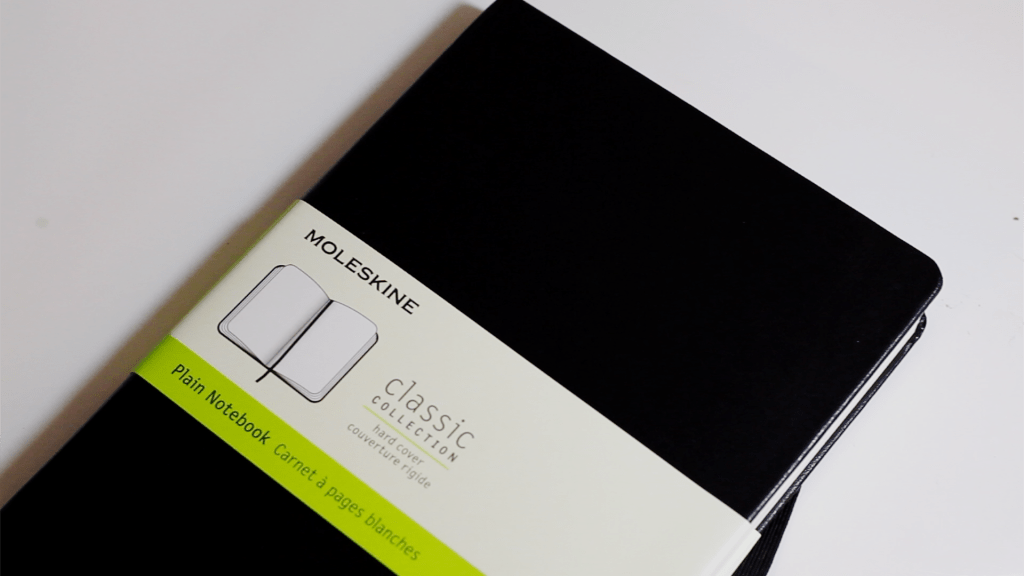
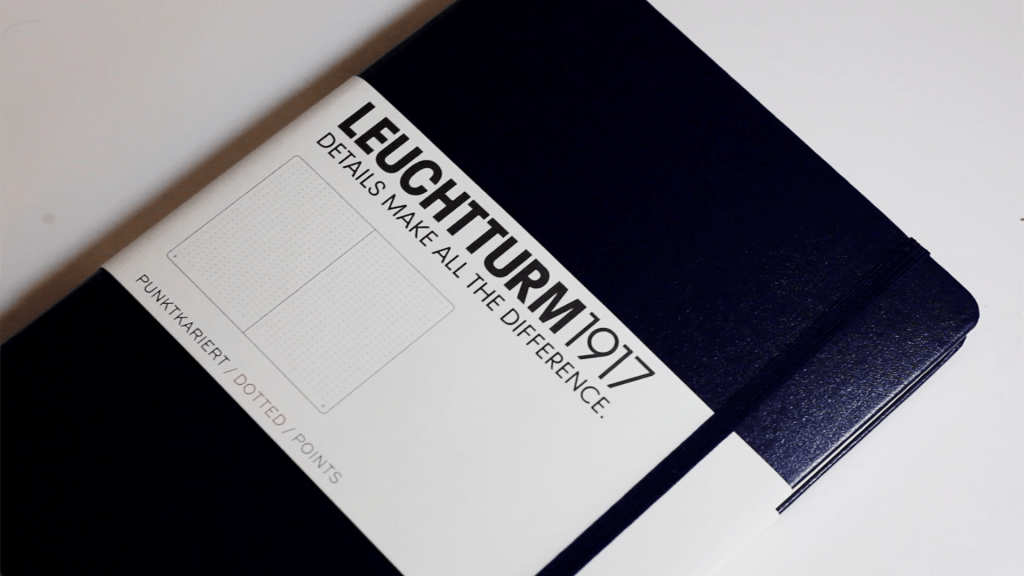
Behind the label, it has this area for you to record your travels, so this notebook is clearly designed for someone traveling… although they didn’t market that on the front. It has one string bookmark and a foldable pocket in the back with a pamphlet that includes the history of Moleskine.
It feels nice in my hand and is pretty solid and sturdy. I’m sure it can take a beating in my bag and survive, but honestly, the texture of the cover is a little underwhelming. Perhaps I expected it to be a bit softer, but maybe that’s just me. It has the standard elastic band strap to keep the book closed and like I mentioned the pages are all blank, which as a writer with messy writing, it’s not super ideal.
When I open it, I find that the binding is a little tough. But I’m being knit-picky with that as the more I use it the more it’ll give. The paper, however, is a little thinner than I hoped for, but once again, I’m knit picky. Overall, it’s a pretty good looking notebook. $24, I don’t know.
This is the Leuchtturm 1917 notebook with 251 dotted pages, and here’s the bonus: the pages are numbered. It’s 14.5 cm x 21 cm, so it’s slightly bigger than the Moleskine. The retail price is also $24 CAD.
It also includes a lot of features including a table of contents, which I don’t think I’ll ever use because my notebooks are never organized in any logical way, as well as: 12 perforated sheets, 2 bookmark strings, stickers, and expandable pockets, much like the Moleskine.
Honestly, off the bat, I like the feel of this one a lot more. The cover does feel a bit softer which is what I like. However, I don’t necessarily want it to be bigger, but it is… The texture of the pages is less smooth than the Moleskine one so I can grip it and turn it a little bit easier. And the dots does help me write straight. I also feel that it folds open a bit better than the Moleskine one too, which is nice because I don’t have to break it in.
I’m very impressed by this Leuchtturm1917 notebook to be honest. I hear a lot of good stuff about Moleskine, but for writers, I think this one may be my go to from now on. But I’m getting ahead of myself.
Pen Test
Let’s put these two books through the pen test.
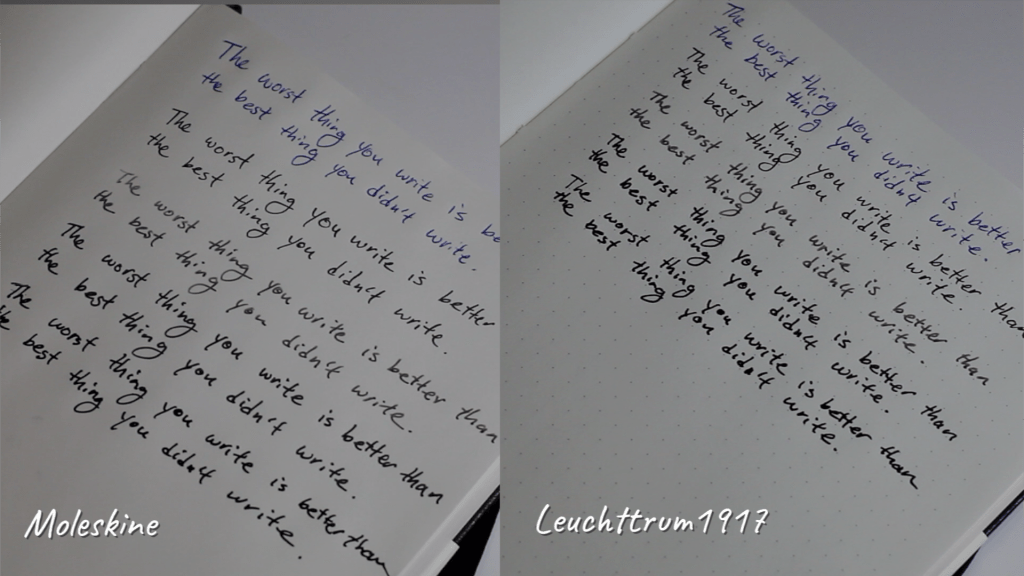
I used 5 different types of pens on the book to see how each of them performs.
Surprise: The Bic ballpoint pen wrote delightfully well on both notebooks. It’s almost surprising how well it performed. If you spend all your money on this notebook, you don’t have to worry about the pen.
Disappointment: The erasable gel pen was unpleasant to write with on both notebooks. Unless you are really worried about the condition of your notebook that you need to erase things instead of scratching them out like a chaotic good person like me, then go with another writing tool.
Best: The best writing experience is with the Energel metal point rollerball gel pen. It’s so smooth, it looked and felt like I was writing with the fountain pen, but without the mess that comes with the fountain pen.
Ghosting
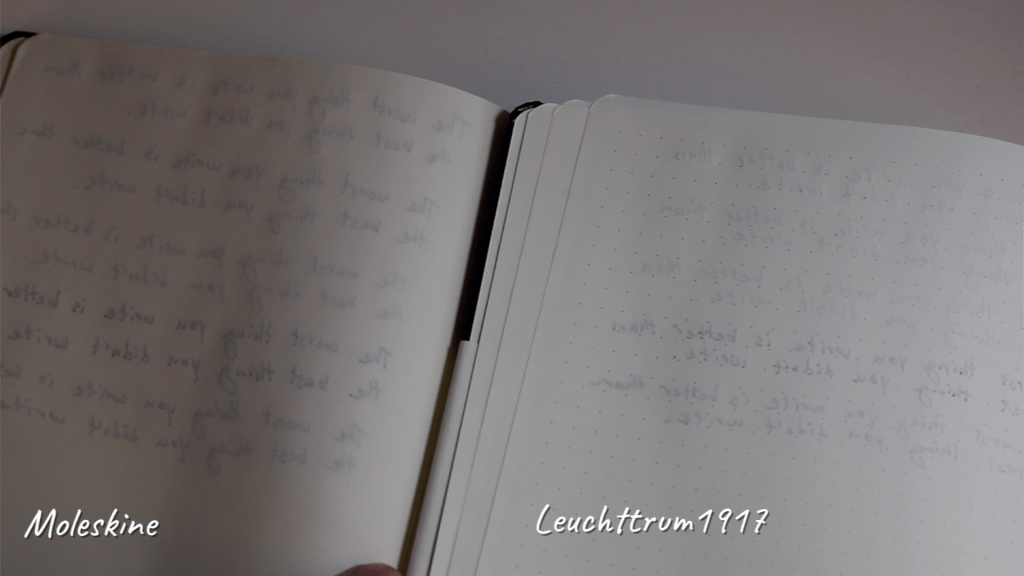
However, with the pages, this is the ultimate test, the ghosting on the other side. If you plan on writing on both sides of your notebook, then this is important to know which holds the ink better.
Here is what it looks like on the Moleskine. As you can see, all the pens are visible, but the one that got through the most is the Energel metal point rollerball gel pen.
On the Leuchtturm1917, to me, performed a little bit better. The Energel metal point rollerball gel pen was still the one that got through the most. Overall, it’s just a little bit fainter than the Moleskine.
At $24 CAD each, these are two pricey notebooks. To me, it is clear that the Leuchtturm 1917 gives me much more value for the same price. I feel like Moleskine has a lot of clout, maybe because they have a brand name that is easier to say, I don’t know. But when I’m done using these two books and I was to get another one, I am certain I will get a Leuchtturm 1917 again.
As a writer, it’s everything I need and more. I’m really looking forward to filling it up with my dumb thoughts.
For more writing and editing resources, please consider signing up for my mailing list. You won’t receive emails from me often, but when you do, it’ll include only works that I’m most proud of.
This is my YouTube channel. I make videos about writing, about authors, screenwriters, and filmmakers — you know, creative stuff. Why? Why would I do that when my ultimate goal is to write stories? Shouldn’t I focus on writing stories?
There is certainly a lot of advice out there from experts and “successful” people talking about the importance of focus. Focus on one thing, get really good at it, and then transition to something else after. I’m certain that is a great strategy for many, but I also learned a lot about myself over the course of my life. I’ve discovered that I need a balance of inspiration and motivation to keep me productive. I can genuinely say that if it weren’t for my YouTube channel, I might have stopped writing completely.
Here is how making videos have improved my writing:
Pairing: By doing two things that are semi-related, such as writing and making videos, I use one to push the other one forward. Writing supports my passion for making videos, because each video needs a script and a story.
Community: I’m not lucky enough to have a core group of people with time to motivate me, so I want to create one. Making videos and posting them online allows me to reach people across the world that have the same interest as me. Instead of waiting for someone to invite me to a workshop or anything like that, I get to create my own platform and anyone who is interested is welcomed.
Accountability: It forces me to be a part of the culture. It forces me to be accountable to not only enjoy entertainment but analyze it critically. Making video allows me to not only be a passive consumer but become an active critic. It forces me to think critically and creatively while analyzing a piece of work be it a novel, as I would do in a book review video, or about a creative choice, as I would in my longer-form research piece such as my exploration of The Shining adaptation video.
Presentation: It forces me to read my writing out loud. Reading and communicating is a skill and it takes practice. What is art but a means of communication? In the grand scheme of things, I want to be a good communicator and one of my most powerful tools as a storyteller is my voice. Unfortunately, I don’t have a live audience to listen to my tales so, in order for me to train for my eventual TedTalk, I must make videos and read my words out loud.
Pleasure: I enjoy making videos as much as I enjoy writing. It’s two things I enjoy doing. I would not be completely happy if I’m not doing both. If I never end up being a successful writer, because I spent too much time making videos, that’s fine, because I spent my days doing something I enjoy. But let’s be honest, I don’t think I’ll be writing if I’m not making videos about it. That’s simply self-awareness on my end. Maybe it comes across as not being focus to some.
Find ways to combine activities you enjoy. I find it to be a great motivator to do more. If you want more information about combining two activities to be more productive, check out this post about Warren Buffet’s 5/25 rule and my alterations with it.
Not only is it the end of another year, but it’s also the end of the decade. This is a good time for us to take a moment to recalibrate. It’s a good time to look back and see what we’ve accomplished and what we want to achieve in the coming years.
Goal setting is so important, especially if they are personal goals. The thing about personal goals is that there are no deadlines. Nobody is going to chase after us to write that novel or submit that story. There is no boss or manager nagging us to get our drafts done. If there is something you want to achieve, you have to set the goal and timeline yourself.
However, you don’t want to set goals that would discourage you. Don’t set goals that are out of your control. Don’t be vague with goals and separate wants from goals.
Example:
Want = I want to be a published writer
Goal = I will submit my novel to an agency
Today, I want to offer 10 measurable writing goals for you to consider in 2020 and beyond. None of these goals alone will guarantee you a successful career in writing, but committing to one of them will ensure you’ll take one step closer to completing a piece of work that makes you proud.
Write a paragraph every day: A little every day adds up. With a busy schedule, we cannot expect to always have time to pound out a chapter in an afternoon. But with consistent habit and even writing one paragraph every day, by the end of 2020, you have a substantial piece of work. Developing a habit is more valuable than an occasional sprint.
Come up with a new idea every day: Want better ideas to write about? Well, start coming up with bad ones. The more ideas you have, the more selective you will be and the better you’ll become at conceptualizing interesting topics that you are passionate about. Coming up with a new idea doesn’t have to be painful. Look out the window and jot down what you see or record the essence of a conversation you had with a coworker. Once you have a lot of ideas, you can start bringing them to life. Here’s an article on how you can approach selecting your top ideas.
Submit a story in a contest: What did Michael Scott say? You miss 100% of the shots you don’t take. It’s true. But it’s not only about winning. I find that writing contests are a great motivator for writing and polishing a piece of work I have. Writing contests also have a clear deadline. Parkinson’s Law states that a project will take as long as the timeline allows. Here is a list of some of the writing contests in 2020.
Finding your weakness to improve: Everyone has a weakness and the sooner you recognize what it is, you can start focusing on improving it. If you have issues with creating believable characters, take 2020 to practice character development. If you have trouble ending your story in a satisfying way, find examples of stories with powerful endings and analyze it. This year get 1% better.
Find a critiquing partner: An alpha or beta reader that you can rely on is worth the price of gold. This is someone who you can share your writing with and get feedback, and in return, they can depend on your criticism as well. Finding someone that will challenge and motivate you will help you be a better writer and editor. If you don’t already have someone in your life who you feel comfortable and confident sharing your writing with, then 2020 is the time to find them. They could be your friend or family, or you can explore online and in-person writing groups — or even a workshop or a creative writing class. I’ll speak more about that in goal #8.
Learn a skill that compliments writing: Writers should be constantly learning. To write about someone that resonates with your readers, you need to be able to understand the workings of the wider world. Anything you learn while you aren’t putting pen to paper or typing on your keyboard can inspire you. Whether it’s making music, painting pictures, or making videos, you can apply those skills back to writing. Learn to cook a new recipe or try a new sport. Learn a new language or interview a family member. Learn something and then write about it. I wrote an article about the concept of pairing, which talks about the value of finding two closely related activities to keep improving.
Read 20 books: By now, I feel I don’t need to convince you about the importance of reading for writers. However, with all the writing you are planning to do in 2020, you mustn’t forget to read as well. Make time for it! Whether you are a fast or slow reader, reading 20 books a year is a very achievable goal. Try reading books on different topics to diversity your consumption. Start now, make a list of 20 books you want to read this coming year. This very act should fill you with excitement. If you don’t want to read, why even be a writer?
Attend a conference or workshop: In the end, it all comes down to the people you know. By showing up to events and workshops, you will be introduced to those who are already in the industry. Sure, you can read my blog posts and watch my videos and get some insights, but I’m just one guy. When you attend an event with a whole collection of like-minded individuals with similar goals, you can start to learn different processes and techniques. This is also a great way to be apart of a community, and being a part of a community is a wonderful motivator to write. You will feel accountable to share something in a workshop or have a piece be critiqued by a professional at a conference.
Revisit an old piece of writing: One of the best ways to gauge your own improvement is to look back and see how far you’ve come. Yes, it might be painful, but revisiting your own work with a critical eye can help you see where you have developed and give you a sense of “oh, I know how to fix it now.” Don’t dwell on the imperfection. The piece of work was a snapshot of where you were months or years ago. It should offer you the same sensation of looking at an old picture: I was young and naive, now I’m more experienced now.
Find your mission: When of the most awkward experience for writers is when they are asked what they write: “a little of everything…” tends to be the lame response. This leads to us feeling embarrassed about what we actually do. This year, consider your mission as a writer. What do I want my writing to do? The moment you discover how you want to change the world, the society, the culture, or just your reader, is the moment you feel empowered. This year, find your mission.
Those are 10 clear and measurable goals for you to consider in 2020. Is there one that you particularly like? Let me know in the comments, I’d love to hear what you plan on achieving this coming year!
For more writing and editing resources, please consider signing up for my mailing list. You won’t receive emails from me often, but when you do, it’ll include only work that I’m most proud of.
If you like this article, you might consider buying me a mocha, it helps to keep me writing.
Read a lot and write a lot. That is the hot tip established writers will tell aspiring writers. Except, how do you balance the two? Should you split your reading and writing time 50/50?
So here’s the dilemma, you have this idea for a novel… but you also have that book over there that you want to read. What would be more valuable for your time? Reading? Or Writing?
This is a problem I have because my TBR list keeps growing and so does my list of story ideas… I’m known for biting off more than I can chew. Nevertheless, here is how I approach balancing reading and writing.
I like to think of it in the same way as exercising and dieting.
Ask yourself, what is your goal? Is your goal to finish writing a novel or submit to a writing contest? If so, then prioritize writing. Or is your goal to more intuitive? For example, if you want to write a blog that requires you to make commentary, then perhaps you need to read more to be perceptive.
Just like your physical health where you have to decide whether you are losing weight or gaining muscle, you need to start aligning your reading/writing habits to meet those goals. If you want to lose weight, you wouldn’t just be working out and if you want to gain muscle you wouldn’t just be eating salads.
First, figure out your goals and then slowly design a routine that enables you to write and read in order to meet it.
Reading is the healthy food you eat. TV or surfing the Internet or playing video games are less-than-healthy food when you are trying to be a writer. You can have your cheat days, but on most writing days, you need to refuel with a book.
So the two activities have to work together. It doesn’t have to be a perfect 50/50 balance. You can write more and read less one day and then read more and write less another. The key is to cut out all the other activities that don’t nourish you or doesn’t motivate you to write.
When you wake up: write, when you are on lunch break: read, when you get home from work: write, before you go to bed: read. Find little pockets of time here and there to commit to becoming a better writer.
Drain the well and then refill it. Exercise and then eat a hearty meal. Don’t think of your reading time as time you should be writing, but rather a necessary part of the writing process. You only have 24 hours in the day, so it’s not about picking one or the other, it’s about eliminating the other activities so you have more time to read AND write.
I like to read a few different books at the same time. I find it helps me motivated to read more and it generally inspires me to write a lot.
Don’t get too distracted, but here is my YouTube channel filled with writing inspirations and ideas to help with your creative process. Check it out!
For more writing and editing resources, please consider signing up for my mailing list. You won’t receive emails from me often, but when you do, it’ll include only work that I’m most proud of.
Submitting to a contest is a great way to stay consistent with your writing. After all, nobody is nagging you to finish that short story — it’s a personal project and you need to motivate yourself. Writing contests give you deadlines, pushing you to write and polish the draft so that it is reader ready.
Additionally, entering writing contests is a fantastic way to support the literary community, and who knows, you might even win some money for your stories.
So let’s get right to it! Make a goal to submit to one of these literary contests in 2020.
Now for the writing contest (contest details are subject to change):
Submission: Stories previously published in print, electronic, and online in 2019. PRINT refers to stories published in a hard copy form. ELECTRONIC refers to stories published ONLINE ONLY, regardless of whether a publication is primarily a print or online publication.
Know of any other Canadian writing contest? Please share it in the comments.
For more writing and editing resources, please consider signing up for my mailing list. You won’t receive emails from me often, but when you do, it’ll include only work that I’m most proud of.




 Elliot Chan