Why retailers’ preconceptions are insulting to the customers
By Elliot Chan, Opinions Editor
Formerly published in The Other Press. Jan 6, 2016
Just browsing, I’m always just browsing—at least I used to be. I tend to panic a little when a retail clerk pops out from behind a rack of clothes and inquires: “Can I help you look for anything?” Nope, just browsing. However, recently I’ve started making some bigger purchases, and I’m not talking about televisions, hockey gear, or computer software. I’m talking about appliances, furniture, and an engagement ring. Not exactly kid’s stuff, these are bona fide adult purchases. It’s a next step understandably, and hey, I’m proud to be making strides.
My problem is not with having to grow up and buy expensive things seldom advertised as “action packed,” my problem is with the service I get upon buying them. It’s subtle, but like all forms of discrimination, it’s apparent. I look younger than I am, I’ll admit it—and if I don’t, people will insist that I do. It’s a gift and a curse. Whenever a liquor store employee doesn’t ask me for identification, I feel they should be fired. Yes, I look young and so in many adult situations, I’m treated that way.
It doesn’t matter how old I look, though. It doesn’t matter how much money I may have. What matters is that I should feel welcomed and be kindly guided through the shopping or buying process without feeling like a kid taking food from the adult’s table.
Many retailers make status a commodity in their stores. If you are seen buying something there, you are of a higher class or tax bracket. When young people enter the store, they are perceived with suspicion. It’s uncomfortable and that’s probably why they do it. Capitalism has turned retailers into machines that only focus on those who have and ignore those who don’t. And sometimes when those who do have look like those who don’t, they experience a less than satisfactory customer service. It’s as if a server at a restaurant only served those who tip well and disregarded those who don’t. That’s kind of a shitty way to deal with customer service—as if it’s a commodity, sometimes with a monetary value.
To the people working in retail, I say this: don’t ever assume that someone doesn’t have money to buy your product. Don’t ever make it sound like they need help paying for it. They might, but they might not. Your job is to facilitate a sale, not to make assumptions about their livelihood. While statistics and data on a given demographic are useful in determining marketing strategies, isolating or alienating outliers—discriminating against age and wealth—is not.
Public speaking. What an irrational fear. Yet, we are all in one way or another are terrified of it. Some harness that fear and turn it into a skill set. Others retreat into the crevasses of society, taking on jobs and lifestyles that do not demand any formal public speaking. In a digital world, we as humans no longer rely on our voices; we rely on posts and tweets, images, and upvotes. We share our opinions not on soapboxes but in textboxes. We no longer stand up on stage and watch the audience.
I wanted to be an entertainer ever since I was in elementary school, and for many years, I considered it less of a yearning and more of a destiny. The class was my audience and my teachers were my toughest critics. I got as many laughs as I did detentions and it was becoming clear that I had a knack for timing — just not in terms of professionalism.
If you don’t hit the audience with a punch line at the appropriate time, you’ve lost the opportunity, the soul of the joke. A poorly timed joke is just a corny statement. There is no time to wait for a silent break in any conversation. As a thirteen-year-old kid, I knew if I didn’t shout out the funny thought in my head when I thought it was funny, it would be gone, and the world will continue spinning one laugh less.
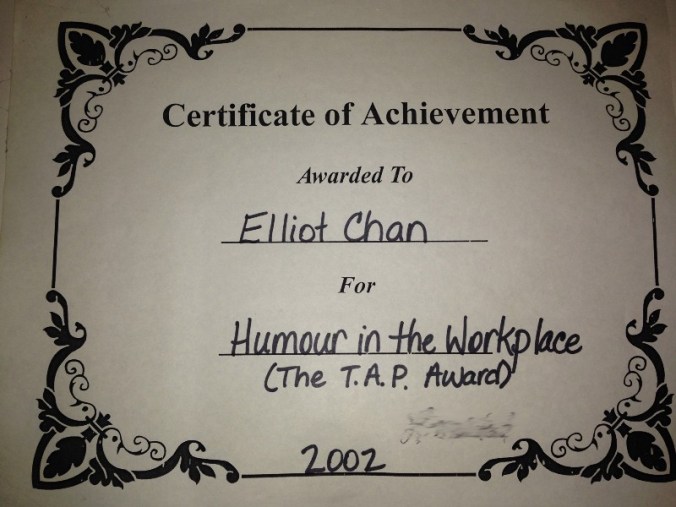
At the end of my seventh-grade experience, I was awarded the T.A.P. award. Never heard of it? Well, that is because it’s a bullshit award my teacher made in an effort to find something genuine to offer me in life. T.A.P. stood for “Time and Place” as in “There is a time and place for everything, and right now you should be quiet, Elliot.”
I accepted the award with pride, because it was something I earned. I remember looking around the class and seeing other students receive worthless, thoughtless certificates with horrendous compliments written by the teacher. Notable awards I’m making up but might as well have been given: “Most Lovely Shoes,” “The Best Teammate,” and “Genuine Friend.” Ugh! I wanted to vomit. I’ll keep my T.A.P. award, thanks.
My greatest achievement.
Perhaps it was kismet that I got into comedy: first as a fan, then as a hobbyist, and finally as a professional (the term “professional” is used loosely). But the thing about comedy is that it is not something that happens alone; performing comedy is a social act. You cannot tell jokes to yourself.
I really enjoyed making people laugh, but it came with a cost. The label. I sacrificed numerous things to be the funny guy, and one of them is credibility. After a while, people just assumed I was being sarcastic. In strenuous situations like a group project, my ideas would be shunned or taken as an unprompted attempt at humour. Later, once I started taking comedy seriously and told people about it, the intensity of other people’s preconceptions rose. “Tell me something funny!” is a line a comedian will hear often at social gatherings. Because 95% of people in the world think they themselves are funny, they’ll usually require proof that you are in fact what you claim to be. They are the best judges of humour after all. It’s the same way we all look at an attractive person and collectively go, “Yep! That person is attractive. Approved. Carry on.”
If it takes 10,000 hours to become proficient in anything, then I was 1.8% of the way to mastering comedy. An average of five minutes of stage time a week for one and a half years was hardly tenure. I was a Starbucks barista as long as I was a stand-up comedian, and Starbucks is very similar to comedy; after all, you acknowledge your audience and you behave accordingly. No need to think of entertaining, just be yourself. And like amateur stand-up comedy, the customers are not really there for your sake; they just want a drink, and you just so happen to be there.
When I told my friends and family that I have stopped doing stand up, many uttered grievances, sometimes in disappointment that they didn’t get to see me perform — in which they would tempt me to tell a joke — and others times with apprehension. “Oh… why did you stop? (Were you that bad?)”
My mother, who had once found my aspiration insufferable, had now become my number one fan. Passing up an opportunity to be a lawyer was one thing, but giving up on comedy now when so many doors were now closed, left a grave uncertainty in her life. After all, who would take care of her when she’s old if my stupid son is unemployed and not funny? Not Dane Cook that’s for sure. There wasn’t a final show where I bowed out. I just stopped asking for stage time. I told those booking shows that I was taking a break, trying to regroup.
I wonder what I would be if I didn’t stop. Would I be booking my own shows, headlining after performing at local bars and clubs for seven years, or would I just be another comedian like so many other comedians, spending my day in the back of the bar, waiting for my five minutes — still working at Starbucks during the day. I look back and I can’t image my success, which as someone who thought that entertainment was his destiny was a little heartbreaking. I was a carpenter in a world without lumber. I couldn’t help but ask: What happened to me?
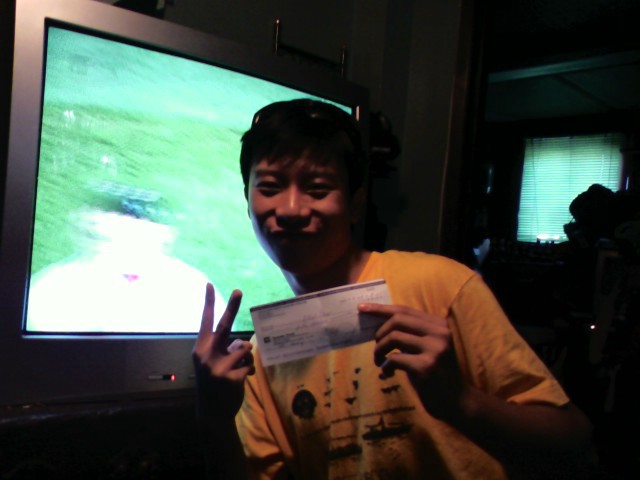
My first paycheck as a comedian. 50 big ones! (Photo taken in the Matrix where I’m famous)
There was a moment on stage, I remember; I had my audio recorder on a stool with a notebook full of notes, usually one random word followed by another, tracking the order of my set. I remember looking down at the list and reading the next word on it “Living room.”
I loved wordplay and comedy allowed me to explore it in the weirdest ways. “Living room” was one of those words that had so many meanings, but is so dramatic in a literal sense. It’s like how a scarecrow is actually there to scarecrows. The punch line of the joke comes after a ramble about how ridiculous the notion of a living room is, because “every room you’ve ever been in is a living room.” Bam! Comedy in my books. However, when I told that joke that day a part of my inside was dying. I guess I wasn’t in a living room anymore. Har har!
I stopped performing standup because I didn’t have any conviction to what I was saying. I stopped performing stand-up because what I was saying was irrelevant. I stopped doing standup because I didn’t want to waste people’s precious time with mindless wordplay and frictionless jokes. I wasn’t a good comedian because I wasn’t tackling any important issues. I was twenty years old and I had nothing to fight for except my own pride. Pride came in the form of laughter and applause. That is not what a comedian should do, that is not what any public speaker should do.
Public speaking, including comedy, is an act of influence. When an entertainer steps on stage they should bring more than their good looks and charms, they need to have something worth saying, something they are passionate about, something worth sharing. Jokes are delicious. Jokes are tasty. But jokes are cheap. It’s not hard to get a good laugh, but to be able to connect the laughter with something tangible, something genuine, well that is priceless.
I stopped doing standup because I didn’t have a reason to talk. It was elementary school all over again, but now I understood what my teacher was talking about. Time and Place.
Nevertheless, the time has changed and the place where I choose to communicate is not on stage in front of an audience, but instead in the written world, where I can pretend to have some proficiency in articulation.
There is little fear when we communicate online, the same way I had little fear when I spoke up in class. The consequence is light and so we continue to speak into the void. Sometimes people get annoyed, i.e. my teachers. Other times it’s so ephemeral that it goes unnoticed, i.e. my ramblings at the bar. Nevertheless, when we have something to say, we should make sure we are doing it at the right time and place. We should watch our audience and make certain that what we have to offer is more than reminding everyone that they are currently sitting in a living room. Although it’s hard to argue that it is an important reminder, sometimes.
Talking less and asking more will make you more interesting
By Elliot Chan, Opinions Editor
Formerly published in The Other Press. Dec. 9, 2015
Every person in the world is filled with his or her own experiences, problems, and knowledge; therefore, everyone in the world is interesting. However, in a social environment we are often put on the spot and are required to present ourselves in the most “interesting” way possible. That’s a lot of pressure. After all, we are all so interesting, and life is but a competition.
It’s natural to list off the most unique things about yourself—things other people wouldn’t have done—in an effort to appear interesting. You’ll talk about the places you’ve traveled, all the cool hobbies you have, and even the accomplishments you’ve made. While it’s important to be entertaining, you must also remember that your interests are one-dimensional. In a conversation, it’s not something you can truly share.
It’s reflex to talk about yourself when you are in a crowd, because that is what you know best. You may feel like the celebrity of the party, but in reality, you are probably dominating the conversation. You’re keeping everybody hostage, and that may taint their engagement with you.
The best way to appear interesting is not to stand centre stage, but rather to sit in the audience. Yes, your backpacking trip to South America is interesting. But learning about your friend’s new computer program may be as interesting, at least to him.
An interesting person is not one that goes off on a tangent, but rather connects interesting topics together, so search for ways to segue into your topics from theirs. While there may not seem to be a link between your vacation and your friend’s computer program, there is, because we are all part of this planet, we all follow human customs, and we all kill boredom with interests. “How does he work on his computer program when he is on vacation?” you may wonder, and therefore, you should ask.
A great way to be interesting is by being around people who are different from you. It may feel like you are on the verge of an argument sometimes, but that is perhaps just a passionate discussion. So you are not religious, but you want to learn. Find someone willing to share his or her faith with you and don’t just talk about how you don’t believe it.
Life is full of little mysteries and each person is a clue. The more people you meet, the more you learn, and the more interesting you become. Being interesting is not the experience that you have alone, but rather what you can learn from other people. Appear open minded, with the capacity to acknowledge other people’s interests. That is more interesting than dressing funny, buying expensive items, and surrounding yourself with people who agree that you are awesome.
Why nobody needs to know that you are a hard worker
By Elliot Chan, Opinions Editor
Formerly published in The Other Press. Dec. 9, 2015
You think you work hard. Well guess what? Nobody cares. Nobody cares how hard you work. People care if you get the work done or not. How hard you work is your business, and even then it’s just your own perception of yourself, and we know how often that is flawed.
It’s a competitive world out there and hard work doesn’t go unnoticed. However, when you start advertising your efforts as if what you’re doing is so much more significant than everybody else, you are putting a target on your back. You think announcing your hard work will get you praise, but rarely is that the case. Telling someone you’ve worked hard, even if you did, is like a pretty skinny person telling you that they are attractive. On the other hand, if you tell someone that you’ve worked hard and they found flaws in your project, then don’t you look like an idiot?
Wanting people to know that you’ve spent significant time on something is natural. We live in an age where sharing information—regardless of how mundane—is as normal as sharing an elevator. But when you are telling people that you work hard all the time, what you convey is that you are stressed out and under pressure all the time. Many people see hard working people, not as inspiring, but as pitiful. They have to work harder, because they suck at what they are doing. Other people with the same job and same assignment as you are getting it done with ease, but here you are, working hard. Pfft! Don’t make a job sound hard; make a job sound enjoyable and painless.
You might think that your boss wants you to work hard, but that’s not true. Your boss wants you to bite off what you can chew and swallow it well. The Canadian workforce loses $16.6 billion a year in sick days. Keeping you healthy and working consistently is better than having you breaking your back and winding up out of commission. Working recklessly doesn’t impress anyone, not even the person paying you to do so.
If you work hard, the product will speak for itself, and nobody will ever be able to take it away from you. It’s true—sometimes, hard work doesn’t pay off immediately. You can play a great game and still lose. But if you are genuinely putting in the effort, with a set goal in mind, you are not after the praise. You probably don’t even care what other people think. You want to do your best. How you get to your accomplishment doesn’t matter, the key is that you get there.
How do we hold people accountable for their racist actions? Perhaps we can’t. Perhaps their racist actions are justified.
Everyone is a little racist. It doesn’t matter if you belong to a race with privilege or one without; you are a little racist. The thing is, racism doesn’t always come out as hate, very often the solidarity we exhume is an act of boorish racism—sure, it’s not oppression or violence, but acting like a whole coloured community needs your help is a brand of arrogance that sits on one end of the spectrum. I’m not calling you a racist, but I’m saying that if you are, that’s okay.
Sometimes I wonder why there is that divide. Why one brand of people is so intolerant and the other, so righteous. Perhaps it’s the old way of thinking versus the new way of thinking.
I grew up in a conservative Chinese family. My whole life I felt ashamed of the things my parents would say in Cantonese—out in public. They aren’t bad people. They don’t have an AK47 or a diabolical plan for genocide. They just don’t know too many people of different ethnicities, and those they do know have a history of taking advantage of them because they weren’t as well-versed in their “new” country. They see, they feel, they act—just like we all do.
I don’t blame my parents for their behaviour. They have the freedom to say whatever they want and they aren’t hurting anybody. So how can I blame other people for acting the same way?
The majority of my friends are Caucasians. In a way, I’m the token. I think they forget that I’m of a different race most of the time, which is why they are my friends. They rarely call me out and make me feel awkward (but they still do… rarely). However, now and then I catch them in a conversation where the topic falls upon race. I tend to sit back and watch them interact: talking, debating, and agreeing on what is a racist act and what isn’t. I wonder if white supremacists do the same thing but on a different scale. If that’s the case, don’t we all just create our own cultural norm?
If we look at racism not as a thing to eliminate but as a thing to be accountable for, I believe we would live in a more peaceful world. We don’t like everyone, and that’s fine. To not like someone because of his or her race is okay. To not like someone because of their weight, gender, and other factors they can’t control is okay. But own up to it, own up to being an imperfect, shallow person. And allow other people to make the same judgement about you.
We can never know what it feels like to be a different person with different challenges and upbringings. While you may want to call people out for being racist, your actions aren’t as justified as you think. You’ve happened to pick a side, just like how they did. Being tolerant of people means accepting that some people won’t see the world the way you do.
People have the freedom to be racist just like how you have the freedom to be righteous. If we start pulling freedom away from a group of people because they have a different belief, is that not oppression?
One day I hope to be in a room with a group of friends of all colours talking about what racism is to them. I hope, then, we can still all agree.
The pursuit of dream may not be the same journey as the pursuit of happiness
By Elliot Chan, Opinions Editor
Happiness is not getting everything we want. Happiness is accepting what we have.
We all want glory and success. As children, we dream of our achievements as adults and all the possibilities. People will ask what we want to be when we grow up and we’ll list off all the options: actor, athlete, astronaut, doctor, etc. At some point, we need to face reality; perhaps our childhood desires are not what we want forever.
Having a dream is having a goal. When you are young you have all the potential in the world. Nothing seems impossible. You can become a doctor if you want. It’s like buying a lottery ticket, and you are anxiously awaiting the draw. You haven’t lost yet. You haven’t won either. As you grow older, you might realize that you aren’t that interested in medicine, and studying makes you sick. Pursuing a career as a doctor—not only dedicating time and money but also excelling in the programs—is likely to be torturous if that’s the case. So I ask: is it worth it for a well-paying job?
When we talk about dream jobs, we aren’t really talking about the job itself, we are talking about being successful in one particular field. The problem is that our society only shines the spotlight on certain roles, placing them on a higher pedestal than others. The CEO gets the spotlight, the lead actor gets the spotlight, the star athlete gets the spotlight, but we ignore the supporting cast. Rarely do children dream of being part of the pit crew. They want to be the driver.
We want to take our interest and transform it into a lifestyle. The problem with turning hobbies and interests into work is that we turn something we enjoy—music for example—into something tedious. Putting pressure onto anything may often destroy it. And so it goes with dreams.
We chase our dreams, but what we should do is chase our passion. Dreams are a fabrication, while our passions aren’t. Once we accept that, regardless of what we do, we’ll have to work hard, we can then hone in and identify what actually makes us happy—or not. That’s the thing about passion, it changes, and we can allow it to.
It’s not a crime to give up on your dreams. We are lucky to have an opportunity to pursue it, so don’t feel guilty. Not everyone is built to climb Mt. Everest and to be stupid enough to believe you can without the hard work is irresponsible. Dream is a finish line. Happiness is the desire to improve and seek progress. Dreams just happen. Happiness requires work. Find work that makes you happy and that may mean changing paths now.
Why comparison of the Turkish president to Gollum is as ridiculous as fantasy
By Elliot Chan, Opinions Editor
Formerly published in The Other Press. Dec. 9, 2015
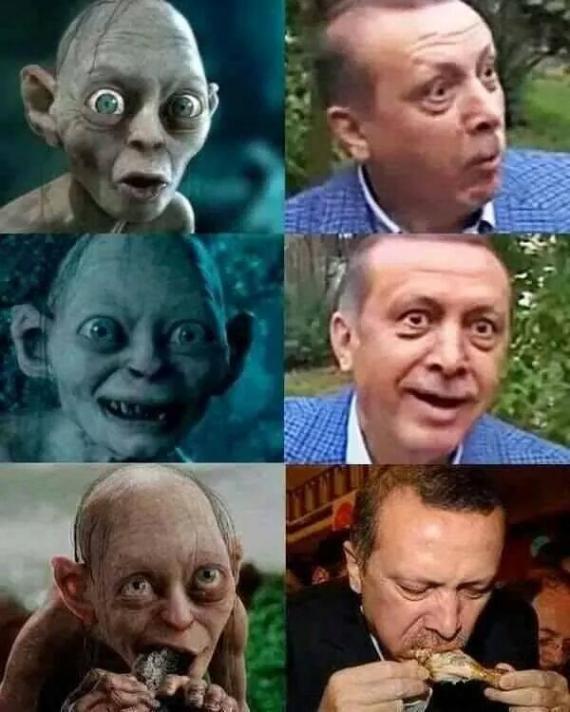
In Turkey, insulting, mocking, or showing any dissension to the president is against the law. This case was proven when Bilgin Çiftçi, a Turkish doctor, created a meme of President Recep Tayyip Erdoğan’s face side by side, matching expressions with Gollum, the despicable character from The Lord of the Rings.
Çiftçi has since been fired from his job, but now the courts are determining the next order of action. Since the chief judge—apparently too busy—has never seen any of The Lord of the Ring films, he and the court is turning to some experts of Tolkien’s epic tale in order to determine whether or not the comparison is indeed an insult. The argument in defence of Çiftçi is that Gollum is a hero of the story and therefore the meme was not an insult, but rather a compliment.
Now, I’m going to break this whole situation into two parts.
First off, Gollum, although he redeems himself (in a sense) at the end of the saga, is not a hero of the trilogy. He is a vile creature that succumbed to greed. Gollum is a victim, for sure, but at no point was he a hero. He killed his best friend, Déagol. Gollum is the epitome of a self-destructive addict.
I know what you are thinking: he ended up destroying the One Ring, doesn’t that make him a good guy? No! Because he bit off Frodo’s finger in an outburst of voracity and fell off the edge of Mt. Doom. He had no intention of destroying the ring. While it was the ring that corrupted poor Smeagol and morphed him into Gollum, we cannot honestly say that Gollum is a hero.
The second part of the situation that must be addressed is how stupid the law is. This proves that freedom of speech, no matter how benign it is, is still a luxury in many parts of the world. Moreover, the inability of some to show any sense of humour is even more disturbing than the law itself. The fact that Tayyip didn’t just brush it off and accept the little ball busting is kind of funny, too. You’d think a man with power could poke fun at the fact that his looks are comparable to, say, Orlando Bloom.
Let’s be honest, Çiftçi was not trying to plot Erdoğan’s downfall. Even if he disliked the President, the mere comparison to Gollum did very little harm to the President’s persona. All it did was call attention to the fact that Erdoğan shared similar features to a fictional character—which he totally does! Perhaps Peter Jackson didn’t need to utilize CGI or Andy Serkis. He could have just cast Erdoğan.
I’m sure many in Turkey found the comparison uncanny, too. But when a country has a law that makes it incapable of processing a joke, then it is that country that becomes the joke. Imagine a Canada where we weren’t allowed to satirize our leaders. That wouldn’t be the free country we know and love. Turkey is a beautiful place, one I wish to visit one day, but with a law like that it sounds more like Mordor than Rivendell.
It’s 2015, and still whitewash casting in movies exists
By Elliot Chan, Opinions Editor
Formerly published in The Other Press. Dec. 9, 2015
Ethnicity in the film industry has always been a problem. In an attempt to reach the broadest American market, the film industry often omits the idea of diversity and simply casts well-known (white) actors. Think of an actor, any actor—odds are, that person is white. The Jake Gyllenhaals, the Johnny Depps, and the Christian Bales dominate the industry. It’s not a bad thing. They are phenomenal artists and they deserve to work. However, when they are taking the role of some Middle Eastern, Asian, or Aboriginal actor, then there is a clear problem.
I would also understand if these actors were stretching their acting chops. But they aren’t. They are just wearing a costume. So a movie that depicts Egyptian gods now has American actors with spray tans. And it’s all because the studios fear people of ethnicity with power, even when it is in the fantastical realm of film.
This problem is rotting the core of entertainment. It eliminates whatever artistic value the film actually has, discredits all the hard work thousands of people do, and makes it a power move that keeps the minority outside the gates of legitimacy.
There are so many struggling ethnic actors working their asses off for minor roles. They are as skilled in the craft as any Academy Award nominated actors. All they need is a break. Change cannot happen from the outside. Criticisms about casting choices have almost zero effect on the overall decision of the film.
In Aziz Ansari’s Master of None, he perfectly illustrates the fight ethnic actors have with the industry, and how powerless they feel. In an episode entitled Indians on TV, Ansari’s character, Dev, combats the decision to take on a role that would further his career, while also furthering the stereotypes that hold other Indian actors back. It’s a conversation about race, but more prominently, it’s a conversation about money and success. If he doesn’t do it, someone else will.
So it goes in the film industry. Someone else will always sink low enough for the scraps, and they’ll call it luck. It doesn’t matter what race the actors are, the studios will follow through with their plans. It’s not the actors that need to change. It’s the overall way of thinking. But the movement needs to happen internally. White actors need to stop accepting roles that are clearly not designed for them. And ethnic actors need to stop being swayed by the power of money. They need to band together and condemn stereotypes with the same discrimination the industry has shown for them.
By Elliot Chan, Opinions Editor
Formerly published in the Other Press. Dec. 2, 2015
We can’t live our lives in fear. Terrorists want to instill fear into us, and as a whole it’s working. In the wake of a tragedy, we can all feel that fear. We all sympathize with the victims, and worry about our own safety. What’s stopping an attack from happening here, close to home? The answer: nothing.
Yet we all believe that there is a solution. We believe that if we can work together and put aside all our differences, we can fix everything.
When people talk about terrorism, what I hear is a situation akin to a natural disaster. But instead of earthquakes, hurricanes, and diseases, we suffer the wrath of people, Mother Nature’s most notorious killer. We understand the shift of tectonic plates, but we have yet to understand these “people.” We want to fight them, but can we fight a way of thinking? Can we fight a hurricane?
When I hear people talk about terrorism, I think about all the bad people in world—or merely those who we consider bad. I wonder what made them this way. I wonder how safe I am from becoming one of those people. How thin is that line from being the person running away from a bomb to being the person wearing the bomb?
The media presents terrorism through the lens of fear and anger. And so we fear it and we are angry at it. Yet, we seldom prepare for it. We expect it to stop somehow, as if that tragic time before will be the last time. We all know that earthquakes are never going to stop. Should one happen and we are caught unaware, we have nobody to blame. However, when a terrorist attack occurs and we are caught unprepared, we blame the act itself. We don’t blame the earthquake for being an earthquake?
Perhaps it’s time we react to terrorism as a continuous problem, one that is as natural as the movement of the earth, the temperature shift of the atmosphere, and our own poor health. We keep addressing terrorism as the terrorists’ problem—they are the ones that need to change. They are the ones that need to die, before they kill us. It is not their problem; it is our problem. If a fire takes place in our house, it is not the fire’s job to put itself out. It’s our problem. We need to know immediately what to do after the flame goes out of control.
What I hear when we talk about terrorism? I hear us trying to solve a problem that has existed forever. People killing other people. It’s a virus that lives within our humanity. In one form or another, it’ll continue to happen. It’s natural. Terrorist attacks, school shootings, mass murders: to stop these problems is, in a way, to stop being humans.
By Elliot Chan, Opinions Editor
Formerly published in the Other Press. Dec. 9, 2015
The holidays are a perfect time to get all your loved ones together and share in the merriment that is the end of a year. However, getting a group of people together—at an optimal time for everybody—is not always as simple as creating a Facebook event. While it makes sense to break apart your schedule and share it with those you love, you must also remember that the holidays are a time for yourself. You too need a break.
If you are a proactive person, you’ll know that free time fills up pretty quickly. You might even try to slot a couple events into one day just so you can fill your holiday socializing obligations. But this is also the perfect time for you to forget about people and get ahead on all the stuff you didn’t have time for during the hurly burly of the year.
It’s easy to lose track of time. Getting lunch with a couple friends can easily turn into a full-day affair. Not that the time was wasted, but the book you were meaning to read, the project you were planning to work on, and all the activities you finally had time for will be pushed back. We often mistake motion with progress. The act of doing something, anything, feels like accomplishment enough. The fact that we got out of the bed today was a victory. However, our time is valuable, even during the holidays, and should be treated as such.
Now, I understand that the last thing anybody wants to do during the holiday is live by a schedule, but if you want some structure in your life, building a schedule does it—it keeps you accountable. Nobody else has to know about this schedule but you. Still, it must be treated sacredly. It matters. On the schedule, map out all the stuff you want to accomplish by the end of your break. You can be as ambitious or lax as you want, but the key is to have goals. It can be as simple as finishing a book, jogging an extra mile, or even something more ambitious like learning a new language. Then plot these activities into the calendar and treat those days as if they are work.
The fear is that you’ll fall into indolence and lose all the momentum you had during the year. Of course you are allowed to sleep in, and those days are as important as the party nights or the productive days. Keeping the ball rolling is awesome, but remember that not every day needs to be productive. You set days for focusing on certain tasks; you should also set days for rest. It’s like a workout calendar. Rest days are the days you leave completely empty. These are the days when you find stillness in your life. These are the days you can stay in your pajamas, read a book, watch a movie, or have lunch with one or two friends. These are the days where you are forbidden from going around running errands. These are the treats of the holidays, and you can be as selfish as you want.









 Elliot Chan