Nearly four years I’ve been working on this project, and it just feels like I’m getting started. It’s a crazy feeling and I know I should be somewhat demoralized, but I’m actually more excited than ever because my story is actually starting to make sense.
During the midst of the pandemic, I wanted to work on a big project, something that will be with me through the good and bad times, a place I’m always welcomed, characters that can stay with me, a story that I can build upon and evolve as I do. I did that. The pandemic came and went and here I am now with pages upon pages of words. Three books in a trilogy. All at different stages of completion.
As I wrote, I loaded so many ideas into the story. It was something of a journal. It was therapy. Anything that I was feeling, anything that was happening in the world, anything that I wanted to learn more about, I put it into the story. Naturally, things went in many different directions.
One can say that I was undisciplined, unorganized, and simply writing by the seed of my pants, and that was all true. I started writing with only one idea, and as I sent the character through trials and tribulations, more and more ideas arised. And I embraced it all, because — even though I had a sense of where I wanted it to end — I didn’t know how I wanted to get there, and more importantly, I was experimenting with the tone and style and flavor of the story.
Now that I have all the drafts in front of me, I see what I want to do clearly. Not only do I know how to style this project, I know what my next projects will be and beyond. But before all of that, there is a lot of work left on this one. Like I said, although there are thousands and thousands of words on the page, many of those words are not the right ones. I think of them as stand-ins for a more specific story that I want to tell. A story that is more focused, more clear. A story that doesn’t meander around like someone at a supermarket with nothing they need to buy.
In other words, I am going to be rewriting everything. From book one which I last left off at draft five to book three which I have just finished writing the first draft long hand and am now transcribing.
I am going to go from beginning to end, from the first word to 300,000th word and make sure that it is all serving the main story that I want to tell. The skeleton is there. It took me 4 years to get it, and it was necessary, because without it, I would have nothing at all. And I cannot say that I could have gotten to this point without all the work I’ve put in previously. So, no, I don’t think that 4 years of work is down the drain, although a more pessimistic side of me would certainly want me to think that.
About a year and a half ago, I came close to abandoning this project, like I have done for many before. But after getting the ending down, and really thinking through what kind of writer I want to be, and what stories I want to tell now and in the future. I’m rejuvenated. I have never felt more clarity than I do now with my creative projects. And I just want it all to happen fast.
Then I remind myself that it took 4 years to get here, and it might take another 4 years to get to the finish line. Which gives me a bit of peace. There is no rush. Maybe some of you out there are waiting for it, but heck, there is a lot of other stuff to read in the meantime. So patience.
Most importantly, I’m enjoying the process again. This project is my highest priority and I’m glad to be able to spend even a few minutes working on it every day. Little by little. Which is all I can ask for as I try to balance work, exercise, mental health, and rest with everything else in life.
I know it’s not interesting to hear someone talk about their unfinished project for over 4 years, but hey, that’s the creative process that is often rarely acknowledged. It’s not exciting. It’s a slow grind. It’s endurance. It’s doing it even when everything else is telling you to stop.
So, that’s where I am. I know where it needs to go now, more than ever. I know the path to take. I know all that. It’s just about going all the way back to the beginning and doing it all over again. Like an actor taking it from the top, so it goes with this project.
Join my YouTube community for insights on writing, the creative process, and the endurance needed to tackle big projects. Subscribe Now!
For more writing ideas and original stories, please sign up for my mailing list. You won’t receive emails from me often, but when you do, they’ll only include my proudest works.
Before we discuss the events in “Men Against Fire,” let’s rewind to the day it was released: October 21, 2016.
In 2016, unmanned Aerial Vehicles, commonly known as drones, underwent significant advancements worldwide, enhancing capabilities for reconnaissance, surveillance, and strike missions.
ISIS employed drones equipped with cameras to gather intelligence on enemy positions, troop movements, and strategic targets, including military installations and civilian areas. By late 2016, ISIS started weaponizing drones, namely against Peshmerga and Western soldiers in Northern Iraq.
This increased fear, as the terrorist group was responsible for over 40 major attacks in 2016, such as those in Brussels, Istanbul, Baghdad, and Nice, resulting in numerous casualties and highlighting their ability to carry out terrorism on a global scale.
But the US army had been using drones for over a decade, and they had some pretty powerful ones, including the MQ-9 Reaper. Equipped with advanced sensors and targeting systems, this $31million aircraft is capable of conducting long-endurance missions and precision airstrikes against ground targets, particularly in counterterrorism operations.
These drones played a crucial role in disrupting ISIS’s operations and eliminating key leaders, such as Hafiz Saeed Khan, stopping him from expanding the terrorist group’s capabilities in Afghanistan and Pakistan. However, drone strikes have also led to the deaths of countless innocent lives. Transparency and accountability are lacking in drone operations, raising concerns about adherence to international law and human rights standards.
Speaking of war and lack of transparency, we must speak of Russia. In December 2016, with Russian support, the Syrian government achieved substantial gains in eastern Aleppo, leading to the evacuation of rebel fighters and civilians to northern Syria, marking a pivotal moment in the conflict.
Of course, Russia was involved in other conflicts, most namely in eastern Ukraine, which was initiated by the annexation of Crimea in 2014. While the Western world was focused elsewhere, Russia was supporting separatist forces despite ceasefire attempts and diplomatic negotiations.
In Afghanistan, the U.S. continued Operation Freedom’s Sentinel in 2016, focusing on counterterrorism efforts against groups like the Taliban and al-Qaeda, while supporting Afghan government stabilization efforts.
The Afghanistan War, beginning in 2001 in response to the 9/11 attacks, stands as the longest war in American history. Under the Biden Administration, the United States officially withdrew its military forces from Afghanistan on August 31, 2021, marking the end of its nearly 20-year military involvement.
Estimates by the Costs of War project at Brown University’s Watson Institute for International and Public Affairs indicate the war’s total cost exceeded $2 trillion from 2001 to 2021, encompassing direct military spending, interest payments on war-related debt, and long-term care for veterans.
And that’s what brings us to this episode of Black Mirror, episode 5 of season 3, Men Against Fire. This episode doesn’t only trigger discussions about the use of technology in combat, and the psychological toll on soldiers — it makes us question the reason for the war itself. Who is leading us down these paths? Why is the momentum of war so hard to stop? And in the end ask, what does victory even look like?
In this video, we’ll explore 3 themes of this episode and determine whether similar events have happened — and if not, whether they are still plausible.
The Optimization of War
In “Men Against Fire,” we’re thrust into a war-torn landscape where soldiers like Stripe are deployed against a mysterious enemy known as the Roaches. The vague reasoning to exterminate them was because they allegedly carried contagious sickness. It’s not until Stripe’s Mass malfunctions that the facade of duty crumbles, revealing a grim reality, the Roaches were people too.
This often overlooked episode resonates with today’s global uncertainties. We’re teetering on the edge of World War III and the enemy is increasingly ambiguous. Warfare is a recurring TV series, renewed each season as long as there’s public support. Governments, whether democratic or dictatorship, rely on propaganda to justify military interventions, stirring fear and rallying citizens to perceived threats from across the border.
Propaganda appeals to patriotism, nationalism, and loyalty as a duty to defend one’s country and uphold its values. Currently in the midst of an invasion, Russia employs a multifaceted approach to garner support for its military actions, both domestically and internationally. Through tightly controlled state-owned media outlets, the government disseminates narratives supportive, framing attacks as necessary measures to protect national interests, counter external threats, and restore stability.
By portraying Russia as a defender of traditional values and a bulwark against perceived Western aggression posed by NATO and geopolitical rivals, Vladimr Putin justifies military actions as preemptive measures to safeguard its interests.
In 2022, the Kremlin spent approximately $1.9 billion in propaganda. It is not cheap to manipulate public opinion, spread misinformation, and undermine trust in Western institutions. But as we will learn, nothing about war is.
According to the U.S. Department of Veterans Affairs , about 11-20% of veterans who served in Operations Iraqi Freedom and Enduring Freedom are diagnosed with PTSD in a given year. Additionally, approximately 12% of Gulf War veterans experience PTSD at some point in their lives, and about 30% of Vietnam veterans have had PTSD.
As of 2022, there are currently 16.2 million veterans in the United States, which makes 20%, 3.24 million people.
In 2023, $139 million of US government spending was invested in Veterans Affairs research programs and $16.6 billion in the Medical Care program to improve access to mental healthcare. Furthermore, the budget allocates $559 million to preventing veteran suicide. There’s no argument about the need for resources, but it’s also a big price to pay to keep the business running.
In 1961, President Dwight D. Eisenhower coined the term the military-industrial complex, which encompasses the symbiotic relationship between the military establishment, defense contractors, and government agencies involved in defense and national security affairs. It perpetuates wars through a combination of profit incentives, political influence, institutional inertia, and security imperatives. Defense contractors benefit financially from ongoing conflicts and arms sales, exerting pressure on policymakers to prioritize military interventions and increase defense budgets.
In this episode, the psychologist Arquette tells Stripe that in the wars of the past, most soldiers don’t fire their weapons on duty, thus extending the war — decreasing he demand for bullets. The Mass was introduced to speed up the process of killing.
The optimization of war is an ongoing development, however, it’s also a double-edged sword, no wait, more like an atomic bomb.
Want to 10x war? Nuke them.
The atomic bomb’s development intensified the arms race between the United States and the Soviet Union during the Cold War era, driving both superpowers to expand their nuclear arsenals and develop more advanced weapons systems. Fight fire with fire.
Quite a conundrum. How can we optimize war without destroying ourselves? How do we find this perfect equilibrium? Surely great leadership will be required. Because the weapon is available and should any of the nuclear powers become backed into a corner, then in order to save itself, there hardly seems to be a reason not to use it. And so it goes with any new weaponry developments.
The challenge remains to hold governments and political powers accountable for their actions and reactions. The momentum of war can leave many victims and there’s not much that public protest can do when the enemies, out for revenge, are knocking at the gates.
This episode of Black Mirror reminds us that when it comes down to it, we don’t get to pick our enemies. They are hardwired into our very existence. We are programmed to hate, fear, and be repulsed by them. But even when we see the light. Even if we become woke, so to speak, it’s too late to stop the waves from crashing. Because even if you are no longer controlled, your perceived enemies are. And in dystopia and war, it’s not a battle of bees. It’s a battle of hives. And sacrifice is necessary to make a return on investment.
Constructing the Others
When Stripe encounters a Roach family, the MASS implant distorts his perception, presenting them as savage creatures instead of individuals pleading for mercy. To protect himself, he slaughters them. This manipulation reduced the soldiers’ sense of guilt or remorse when committing violent acts against the Roaches, resembling real-world tactics where psychological conditioning is employed to rationalize atrocities.
Politicians regularly cultivate an “us vs. them” mentality to create a sense of solidarity among the populace. They use dehumanizing language, stereotypes, and negative portrayals to depict the adversary as inferior, barbaric, or morally reprehensible.
During a speech in Wisconsin on April 2, 2024, Presidential candidate Donald Trump perfectly demonstrates this by using such language to describe migrants from Mexico: “The Democrats say, ‘Please don’t call them animals. They’re humans.’ I said, ‘No, they’re not humans, they’re not humans, they’re animals.”
America is not alone. Europe has also been engulfed by social tensions, xenophobia, and intergroup conflicts.
Perhaps the most dramatic example is the weaponization of migrants at the Belarus-Poland border in 2021. Migrants, predominantly from the Middle East and North Africa, have amassed at the border seeking entry into EU territory, meanwhile Belarusian authorities are accused of enticing or coercing these migrants, aiding their movement to the border under false promises of easier access to the EU. This strategy, attributed to Belarus’s President Alexander Lukashenko, is viewed as a retaliatory measure against EU sanctions imposed on Belarus.
Fear is a great motivator. And diseases are scary. When we see another culture as a disease that can stain generations, then we begin to understand how followers of dictators think.
Before any guns are fired, before any bombs are dropped, it starts as a battle of ideas: fire against fire. Ideas too can spread like diseases. We don’t have to look far, just remember all the arguments we had during the height of COVID-19.
Remember the politicians deflecting blame and responsibility for the spread of the corona virus by scapegoating certain groups? This has included blaming foreign countries, immigrants, ethnic minorities, religious communities, or political opponents for the outbreak or for failing to contain the virus effectively. By portraying these groups as the “other” responsible for the pandemic, politicians gained public support through fear and xenophobia.
Blame is a powerful way of constructing the other. We saw that during COVID, and we saw that on March 22, 2024.
After a Moscow concert hall was attacked by a group of terrorists which led to the death of 137 people, Vladimir Putin pointed the finger to Ukraine, despite the off-shoot of ISIS claiming responsibility. We see this clearly from afar that Putin was relishing in another attempt to maintain his invasion in Ukraine.
However, the West is not above using the blame game for ulterior motives either. An example of this is how the USA used public anger after 9/11 to justify the war in Iraq in search of weapons of mass destruction.
There are few motivations more powerful than revenge. We can trace every critical event through history as one domino piece falling upon another. We saw this after the Oct 7, 2023 attack in Israel from the Islamic militant group, Hamas which has escalated the war in Gaza. We saw this in the decade long war in the Central African Republic. We saw this in the Rohingya Crisis in Myanmar. We see the cause and effect of revenge taking form in all parts of the globe.
Yes, blame is easy when the enemy looks a certain way, but what do we do when the enemies look like us? This is a notable question that the episode poses.
The resurgence of anti-semitism is a concerning one in America, as it encapsulated the cultural descent into darkness.
Despite vows to never allow the atrocities of WWII to happen again, 1 in 5 Americans don’t believe that 6 million Jewish people were murdered during the holocaust. Some thought the number was lower. Others don’t think it happened at all.
On Oct 8, 2022, a sleepy Kanye West went on Twitter and posted about going Defcon 3, a military combat command, on the Jewish people, and then confusingly implies that Jewish people have used their power to bring down anyone who opposes them.
While Kayne’s comment was another piece of evidence of his mental breakdown and personal short-comings, it also emboldened anti semitic groups that seemed to have been living in the shadows waiting in dormant until the time was right for them to rise again. At last, they can openly blame their scapegoat again for all their problems.
Holocaust denial, minimization, and distortion contribute to the normalization of antisemitism and undermine efforts to combat prejudice and intolerance. Pro-Palestine protests across US university campuses are now receiving criticism for walking that fine line.
Facts and lies are both ideas. And in a battle of ideas that is going to last generations, both have an equal chance of winning.
There is no problem in this world that is caused by one group of people. None. Therefore, any solution based around getting rid of or holding captive a group of people will at the end fail to resolve anything more than some personal or political gain.
A strategy built upon blame is often nothing more than a distraction tactic, diverting public attention away from domestic issues, governance failures, or systemic problems within the country.
This episode of Black Mirror is revealing. If you find yourself blaming others or attacking others for life not going your way, you must ask what the governing powers are saying. Are they blaming others to maintain power? Are they using hate to fuel personal gains? As long as we are fighting enemies, we don’t have time to challenge ourselves. We won’t be able to see the monsters we’ve become. We fail to realize that we have only been destroying ourselves the whole time.
Pleasure Dreams and Tortured Memories
In sleep, Stripe is rewarded with a dream sequence depicting intimate moments with his lover as positive reinforcement for his performance in combat. However, after his Mass got infected, it becomes evident that these dreams are tools to maintain soldiers’ loyalty and compliance, blurring the lines between reality and manufactured fantasies.
Sigmund Freud, often regarded as the father of psychoanalysis, made significant contributions to the study of dreams with his groundbreaking work “The Interpretation of Dreams,” published in 1899.
One of Freud’s central concepts in dream analysis is the idea of wish fulfillment. He proposed that dreams serve as a way for the unconscious mind to fulfill repressed wishes or fantasies that are unacceptable or unattainable in waking life. In that, there is great reward for one to tap into the ability to control their dreams.
The term “lucid dreaming” was first coined by Dutch psychiatrist and writer Frederik van Eeden in 1913. Van Eeden used the term “lucid” to describe dreams in which the dreamer is aware of being in a dream state while the dream is occurring. He documented his own experiences with lucid dreaming and described various aspects of this phenomenon in his writings, one of which was a vivid flying experience.
One key aspect of lucid dreaming is reality testing, where individuals question their waking reality by performing checks like looking at their hands or trying to read text. This habit can extend into dreams, enabling lucid dreamers to recognize when they are dreaming and take control of their dream experiences.
If we can learn to control our dreams, then what is the likelihood that machines can control our dreams?
Research into the effects of non-invasive brain stimulation techniques, such as transcranial electrical stimulation (tES) and transcranial magnetic stimulation (TMS), on dreaming has shown potential modulation of dream recall, intensity, and emotional content.
Electroencephalography (EEG) technology, used by institutions like The Society for Neuroscience (SfN), allows researchers to monitor sleep-related brain activity, providing insights into sleep stages and patterns, although it does not directly reveal dream content.
Government-funded organizations such as the United States Army Medical Research and Development Command (USAMRDC) and the Defense Advanced Research Projects Agency (DARPA) focus on researching various aspects of sleep, including sleep disorders, sleep optimization, and the impact of sleep on cognitive and physical performance in military personnel.
Sleep is critically important for soldiers due to its multifaceted impact on their physical recovery, cognitive function, emotional resilience, situational awareness, physical performance, and overall health. While the military wants to reward good sleep for their soldiers, they can also deprive sleep as a weapon.
Sleep deprivation is a powerful torture technique. Prolonged sleep deprivation leads to physical and mental exhaustion, weakening resistance to stress and increasing vulnerability to coercion. Hallucinations and psychosis may occur, exacerbating the individual’s distress and compromising their ability to discern reality.
During the Cold War, Soviet KGB agents were known to use sleep deprivation extensively as a method of breaking down detainees’ resistance and extracting information. Such methods to keep detainees awake include continuous interrogation, physical discomfort, noise and light exposure, temperature manipulation, threats, food and water deprivation, physical stress, and psychological manipulation.
Similarly, in more recent times, reports have emerged of sleep deprivation being used as a tactic in Guantanamo Bay and other detention facilities during the War on Terror.
If one can control our dreams to instill pleasure, then they can use nightmares for punishment.
Nightmares can disrupt sleep, cause emotional distress upon waking, and may be associated with underlying psychological issues, stress, trauma, or anxiety disorders. While nightmares can be triggered by PTSD, the most plausible method a third-party can apply to control your nightmares would be with drugs.
Some medications, including antidepressants, antipsychotics, and beta-blockers, may have side effects that contribute to the occurrence of nightmares or oneiroid syndromes, where a person is trapped in a dream-like experience often unable to move or distinguish between what is real and what is a hallucination.
One example was of a 67-year-old woman with a history of prolonged depression, untreated for over a year, was prescribed a daily dose of 20 mg paroxetine. However, after 16 days, she required hospitalization due to behavioral disruptions and delusional beliefs that she was being pursued by malicious individuals. Further evaluation revealed that these delusions stemmed from recurring nightmares and an oneiroid state.
This episode is a great reminder that our brains are easily influenced. How we interact with others, what we see in the media, and other ways we feed our minds in wakefulness and rest may lead us to salvation or doom.
While it may be a scary thought that technology can tap into our brains and manipulate our senses, looking at the world around us, and seeing the horrors committed on a daily basis, one can say that advanced technology isn’t even necessary. There are already many existing methods of controlling a person, radicalizing them to turn against their own.
While Men Against Fire is an often forgotten episode, it is so relevant because it touches on the theme of dehumanization. In today’s context, where misinformation, social media echo chambers, and targeted content can distort reality and fuel polarization, the message about the power of perception and manipulation is particularly poignant.
It serves as a cautionary tale about the dangers of unchecked influence, the importance of critical thinking, and the ethical considerations surrounding technology and perception management in our increasingly digital and interconnected world.
So before you sign the next contract, before you get a loan, before you vote, or make a commitment, ask yourself, who’s pushing you to do so?
Join my YouTube community for insights on writing, the creative process, and the endurance needed to tackle big projects. Subscribe Now!
For more writing ideas and original stories, please sign up for my mailing list. You won’t receive emails from me often, but when you do, they’ll only include my proudest works.
I’m a bit of a masochist. Putting myself through a painful race in Zwift has been surprisingly enjoyable, but… I know it will be so much better if all the effort can result in a win… or something close.
The something close at the moment is just to stay in the lead pack so that I can even contend for the win at the end. There’s a long way to go. That’s why I started this four-race project where I aim to “Close the Gap” whenever it emerges and analyze my performance to make improvements each week.
Hopefully, by the end of these four races, I’ll either be able to keep up with the lead pack or, at the very least, figure out what I’m doing right or wrong. I want to understand how far I am from reaching that goal and what training I’ll need to do to get there eventually.
I call this Project: Don’t Get Dropped.
Let’s begin.
Chapter 1: The Ups and Downs
Race: Stage 1: Race Like A Champ (C) – Rolling Highlands in Scotland
The race started off really fast. I had to hit over 300 watts to catch up with the lead group. My strategy for this one was to focus on a high cadence and hopefully that will make it easier to maintain higher power. Let’s see if it works.
After catching the peloton, my focus shifted to conserving energy wherever possible. Still, the pace was fast and I constantly teetered on the edge of losing the pack, so I was really saying my prayers at this point. With two laps, this race was going to be a grind and didn’t want to blow up too early.
At the 6:45 mark of the race, the pace increased as we went up an incline. I spun as quickly as I could but the lead was getting away. A minute later, the lead pack was gone, out of sight, and I was left with a small group chasing.
There were about 10 of us and we got nice and cozy with each other. It seemed that we were all content hitting this pace. I was far from content, I was at my threshold. I’m really kicking myself for pressing so hard to chase the lead pack up that hill because now I’ll need to exert so much energy just to keep with this small group. A lot of wasted energy in this race already, but at least I wasn’t alone.
My current objective was to secure the highest possible position. This meant outlasting the racers beside me, so I accelerated when necessary and conserved energy whenever possible.
In this course, there were a few hilly sections. Based on my experience of getting dropped at the beginning, I understood that these hills would be where breaks occurred and my fate would be determined.
When I got a feather power up, I saved it for the bigger hills coming up to attack, namely the one that came at the 18:39 mark when we had to climb up into the castle to end the first lap. Now I knew, a hill will certainly decide my fate, and while I hoped I’d be attacking at the very end, I was also preparing myself to defend as well. So I stayed in the group, not wanting to make any dramatic moves.
Then it happened. Around the 24-minute mark, I sensed that the group was beginning to struggle to stay together. When the elastic stretched, it really stretched, giving me the impression that some individuals in the group were fresher than others. To be honest, I was feeling generally good. Not great, but I still believed I had the energy to keep going. I could indeed attack!
When a break occurred at the 25-minute mark, I moved to the front and then let the group catch up. I played this game for a bit where I surged ahead and then allowed them to catch me. My aim was to gauge the strength of the other racers and entice them into making a move with over 6 kilometers to go. However, they didn’t take the bait, so the 10 of us stayed together.
Then we began catching racers who were ahead of us, including those who had been dropped from the lead pack. We were swallowing them. And this felt good! This was really motivating and it really helped me push to another level. So I was like, “good bye, group, I’m going to start eating the rest of them.” I’m using each person ahead as a little carrot to chase and so I went.
At the 30-minute mark, I’m climbing up the hill, using my feather power-up in an attempt to break away from the chase pack once and for all. It’s every person for themselves now. We are chasing going as fast as we can, and I start moving up the ranks. Then, I find myself alone at the front. It was a mistake. Now, these two guys are riding my wheel, and there’s nothing I can do about it.
I’m pushing hard, leading the way, and I’m a bit frustrated because this guy is using his draft power-up on me. I knew I had to keep going, but I felt taken advantage of. To make matters worse, the guy who used me moved ahead and started receiving Ride Ons. All I could do was laugh.
The race was really on now. It was just me against these three guys. They seemed to have plenty left in the tank as they powered up the hill. This was it, the moment where the game would be decided. I pushed hard up the hill, using my feather power-up.
I was really feeling it, with music pumping in my ears, giving it everything I had. But my two nemesis were ahead. I tried my best to catch up, and with 800 meters left, I managed to pull even. But it was short-lived. They zoomed past me again. It was heartbreaking. I’ve burned a significant match. There was no way I could reel them back in now. All I could do was hold onto my position. That’s all that mattered in the final 500 meters — not letting anyone pass me. So, I dug deep, pushing through the last 300 meters with a cadence of 138, determined to maintain my place.
This was one of the most intense efforts I’ve ever pushed myself through on Zwift so far. So much so that I had to shout at the very end. It took everything and the punishment felt good. Despite being dropped during the race, I managed to claw my way to a result that I consider respectable. I finished 35/83 and 27/46 on Zwift Power. Respectable.
However, it also dawned on me just how difficult this project is. After all, I was only able to keep up with the lead group for just under 7 minutes, which was less than a third of the race. Therefore, my goal for the next race is clear: I hope to stay with the lead group for a longer duration.
Chapter 2: The Hangover
Race: Stage 2: Race Like A Champ (C) -Richmond Rollercoaster in Richmond
This was the first race that I didn’t want to do.
The night before, I was drinking — and although you’ll never be able to tell — I woke up slightly hungover. With all that being said, I was not expecting a stellar performance.
Look, I take these races as seriously as I can, but one thing I want to make clear is that I’m not trying to be some professional athlete. I want to be an athlete that is able to do everything. A dilettante-athelete of sorts. I want to be able to go out drinking and wake up the next morning and still race the best race I can under those realistic circumstances. Now that the excuses are out of the way, let’s get to the starting line.
The race took off and I felt pretty good. But that feeling only lasted about 2 and a half minutes. That was when we started to ascend this hill that went as high as 11%. My strategy of maintaining a high cadence wasn’t effective. Similar to the last race, I found myself struggling on the climbs, and despite my light weight, this aspect is becoming my Achilles’ heel. Whatever approach I’m currently using to tackle these hills isn’t working.
Although I managed to recover from being dropped on the first hill, the second hill caused the race to stretch out too much. The lead pack had disappeared, and despite my efforts to descend quickly, even with my aero power-up, I couldn’t catch up with them. At least not today.
I was pretty frustrated by the time we got onto the straight stretch leading into the fan flat section. I allowed a small group of Canadian and German riders from behind to catch up with me and the six of us rode together in hope of picking off a few stragglers such as this Polish rider at 12:29.
Perhaps there was a chance to catch up with the pack that was about 10-15 seconds ahead. I believed that if we truly worked together, we could have closed the gap. However, there wasn’t much collaboration within this group. It seemed like most of them were content to maintain the current pace.
I was frustrated because I wanted to chase… but I knew I couldn’t do it alone. Every time I surged to the front, I could feel them drafting behind me, especially Schuster. If I pushed too hard on my own, I’d risk burning out, and they seemed all too happy to let that happen.
At the 18:21 mark, we lost our chance to catch up, and seeing them comfortably enjoying my draft only made me angrier. Fine, I thought. We won’t chase. That’s when my attitude turned vindictive. My goal shifted from merely avoiding being dropped to beating Schuster. It was the first time my frustration had blinded me from forming any real strategy.
We all stayed together right until the final kilometer. I bided my time, keeping a close watch on Schuster. The break occurred with 500 meters to go, and it was intense. The Polish rider made a move, followed by Schuster. Unbelievable! I increased my pace, and for a moment, we managed to reel everyone back in. Then, with 300 meters left, Hemming and the Polish rider pulled away. It was just me with the other two Canadians, and Schuster trailing behind.
With 200 m left, I dug deep. My cadence soared to 134, and my watts peaked at 338. That effort propelled me across the finish line, second to last in the group… beating Schuster. I felt good for only a short moment. I realized that hey, Schuster was probably suffering as much as I was, and there was never a reason I should have been frustrated with him. While he was the one riding my wheel at that moment, the whole group ended up beating us. I was focused on the wrong person, and that was a mental mistake.
I finished 29th in the race, but on Zwift Power, I placed 23rd. It wasn’t a bad result; in fact, it was my best in Group C. However, this race didn’t unfold as I had planned. The Richmond Rollercoaster, being an event-only route, wasn’t one I could preview beforehand. While I anticipated some hills, I didn’t expect them to be so challenging.
Not good at climbs. Not good at hills. This race was an eye-opener for me. If the goal of this project is to avoid getting dropped, then I really need to focus on the climbs, because that’s where I’m losing the group.
Now that I know this, how I use this information is crucial. I’m throwing away the high cadence strategy. Instead, I’m going to concentrate on generating more power at a lower cadence, particularly when climbing hills. Let’s see if this adjustments make a difference. To be continued.
Chapter 3: The Race That Almost Didn’t Happen
Race: Stage 3: Race Like A Champ (C) The Muckle Yin in Scotland
This race almost didn’t happen.
Allow me to get things going and then I’ll tell the story. Off we go.
Two days ago, when I was getting ready to ride on Zwift, I ran into a problem: my bike couldn’t connect properly to the app. I tried restarting the bike computer, deleting and reinstalling the Zwift app, even downloading Zwift on different devices. But no matter what I did, whenever I tried to connect the Power, Resistance, and Cadence to the bike, it would start glitching out, turning itself on and off. I reached out to the bike company’s customer support, but all they offered was to send them an email. Either way, I was pretty choked that I might not be able to continue with this project.
Then the next day, I continued troubleshooting the bike with a fresh mind. I returned to Zwift. I turned on only Power, and it worked. Next, I added Cadence, and it worked too. However, when I attempted to activate Resistance, it didn’t work. That’s the problem. Apparently the Resistance was causing the bike to trip out. Why? I don’t know. Could it be related to the clicking sounds in the previous video? Maybe. Eitherway, I didn’t want to troubleshoot it any more. Everything works except that I can no longer use the Resistance feature. Well, there you have it. C’est la vie.
Needless to say, I was relieved to be able to ride this race, and that I’m on Zwift at all.
Anyways, back to the action. During my test ride of The Muckle Yin, I discovered that there will be two big hill climbs in this course that can absolutely blow up the race. My plan this time was to grind hard on the hills, give it full power with a low cadence. During the last race I found that high cadence and lower gear didn’t give me enough. So this time let’s try the opposite.
I’m pretty pleased with how I managed to keep up with the pack this time, especially during that first decent-sized climb around the 4.5km mark. It’s actually the longest I’ve ever managed to stick with the lead pack in Cat C, but… I wasn’t feeling great. My heart rate was already over 180 bpm, and with two big climbs still ahead, I knew I was in trouble. My plan to push as hard as I could up the big hill might not even be doable. Still, I hung in tight, allowed myself to chill a bit and give it my best shot when the climb came.
And it happened around the 13 minute mark. I did exactly what I had planned: lower cadence, bigger gears. I pushed as hard as I could, even activated the Featherweight power, and suddenly found myself leading the pack. My power shot up to 280, but then, as I turned a corner, I made a fatal mistake. I eased off the gas. That gave the racers at the back a chance to catch up. To keep up with the pack that was now pulling away, I had to burn a big match, pushing myself up to 300 watts. Although I managed to hang on for a bit, I knew deep down it was over. Slowly but surely, the race started slipping away from me. I was getting dropped on the descent.
The elastic band stretched out, and just like that I found myself at the tail end of it. I’m rapidly losing positions. I had once been ahead, now I’m in 26. And those climbs just kept coming. I pushed hard, but I’ve been burning matches since the climb began. My heart rate is at 185, and now I’m all by myself. I could push as hard as I wanted, but there was no catching the lead group. The saga of me riding solo continues.
The funny thing about this race was, there wasn’t even a chase pack trying to catch up with me. It felt like everyone was spread out so far, and unless you were right up front, you were pretty much on your own. Three of these lone riders managed to pass me along the way: one at the 18-minute mark, another at 20 minutes, and finally one more at 29 minutes. But other than them, I was alone the rest of the time.
I was fried at this point. Even though I had dropped my watts significantly for the last 10 minutes, I just couldn’t catch a second wind. All I could manage was to keep the fourth guy from passing me. That was all the motivation I had at this point, but NO! Literally. He caught me at 33 min and then dropped me as we climbed the second big hill. So, in the final stretch of the race, I couldn’t afford to think about the people ahead of me. It was all about damage control now. I had to fend off Santos and Stickman, who were hot on my tail just 3 seconds behind.
At 35 minutes, Stickman suddenly surged ahead of me. I pushed harder—I couldn’t let him slip away. I even deployed my featherweight power-up. But no matter how much effort I put in, he kept getting smaller and smaller in the distance. How many more matches did I have to burn? Just one more? I knew I had to save that one for now.
As we entered Glasgow, I was more than ready for this race to be over. It’s funny how that works sometimes with endurance sports. I was so worried I wouldn’t even get to participate, but now that I’m here, I’m just eager for it to end. That was how I felt going into the final two km of this race. I spent so much of it alone and just killing myself. I just wanted it to be over. That’s what fueled me. The faster I go, the better chance I have of beating Santos, sure, but also the sooner I can stop altogether.
In the final stretch, I felt the urgency and use up that last match I’d been holding onto. Even though Santos was 10 seconds behind, I pretended he was right on my tail. I pushed harder. I was just done.
What an absolutely grueling race. Possibly one of the toughest I’ve ever endured. The crazy part is, it began so promising but ended in disappointment. Yet, the results weren’t all that terrible: unofficially 28th out of 65, and 22nd out of 38 on Zwift Power. Maybe I deserved a better outcome, but truthfully, I just didn’t pace myself correctly. I pushed too hard early on, burnt myself out, and couldn’t bounce back, so it was pure agony for the remainder of the race.
While it seemed like a solid strategy to go all out on the hill, it turned out I wasn’t quite ready to pull it off effectively, so it’s back to the drawing board for me. Pushing as hard as I could for as long as I could just isn’t possible. I had to break the race down into parts, keeping gas in the tank, and just tackle each hill at my own pace. A lot to think about before the next and final race in this series. I really want to see an improvement.
Chapter 4: Interval Training
Stage 4: Race Like a Champ (C) Knickerbocker in New York
I was quite annoyed by this Series, not only did they have all these hills, exposing a weakness that I didn’t know I had, it also cancelled a race that I had scheduled.
Zwift had initially stated that the Race Like A Champ series would run until March 3, but on Feb 26, any races from this Series after Feb 29 disappeared without warning.
Alright, fine. No big deal, I thought. I just had to reschedule it for a Wednesday evening. It wasn’t the most ideal timing, considering I’d have already worked a full day, but adapting to unforeseen circumstances is just part of this whole project. Yes, I was getting dropped left and right, both in-game and out.
Anyways, after the terrible experience last race, my main goal this time was simply to feel better during the second half. I needed a clear plan that would keep me competitive but also allow me to survive the latter part with some energy left.
There were several challenges I faced. First, the race wasn’t scheduled at an ideal time, as I mentioned earlier. Plus, the course featured a massive climb right in the middle. That climb would ultimately determine how the race went for me. I realized I needed to change my mindset. Instead of viewing it solely as a race, I had to approach it more like a workout. After all, I knew I could get through a workout.
The race began, and I managed to stick with the group. Great! Now, it was time to put my plan into action. I wasn’t racing; I was doing interval training. I’d push hard for 15-20 seconds, then give myself a moment to rest, reassess the race situation, and then push hard again for another 15-20 seconds. If I do this the whole way through I should be able to survive.
At 4:30 in, as the lead pack approached a climb, I timed it perfectly to push hard just as we hit the incline. However, the front of the pack still broke away with about 15 riders, leaving me behind. “Not again,” I thought. I could have kept chasing after them, but that would have meant abandoning my interval training plan and likely burning out quickly. “No,” I decided, “I will stick with my plan, and when I come to the big KOM at the middle of the race, I would be thankful.”
So I kept going, pushing hard and then giving myself a rest. I’d push all the way into the upper 200s and then ease off, dropping back down to the lower 200 watts and allowing my heart rate to come down to the 170s. This approach was proving effective, as I managed to secure 12th place at the start of the KOM. I considered this to be a respectable position. Anything more now will be a bonus.
I stuck with my strategy: push hard, then ease up. I’m genuinely amazed by how well it’s working, and it’s incredibly satisfying to catch a few racers along the way. It would have been tempting to keep pushing hard, but whenever I felt like I was nearing my limit, I dialed it back. Before I knew it, I found myself in 10th place, feeling energized. Climbing suddenly felt more manageable.
At the 16-minute mark, I caught sight of Blake and Castro. They appeared to be really strong riders, and I was amazed that after the initial break, I was able to catch up to them. Now, I was determined to stick with my interval training. Even if I let up and they passed me again, I knew I could surge and catch up with them. That’s exactly what I did with Blake—and then Castro. With them now in the rearview mirror, I felt good. But what next? The next rider was over 20 seconds ahead, and the climb was over. My hope was that I could make up some ground on the descent. This posed a new challenge for me because I needed the descent to recover.
I activated the Anvil power-up. Never having used it before, I thought the best time for it would be during the descent. However, I soon learned that might not be the case. By the time I reached the bottom of the climb, I hadn’t closed the gap on the rider ahead at all. At this point, I was kind of mad at myself because once again, I found myself all alone. This sucks. While my interval strategy had worked, it seemed this was as good as it could get me. My effort was waning, and being alone after such an emotional climb left me feeling a little discouraged, especially since I could feel Blake and Castro hot on my tail.
At the 25:50 mark of the race, the two of them caught up with me. The big move I made on the climb to drop them now didn’t matter. They clawed their way back, and they were pushing harder than I wanted to. I returned to my strategy. Intervals.
Just like before, each time I caught them on a hill, I’d push past them. Then, on the descent, they would catch up. My goal was for them to try to keep up with me on the climb, allowing me to wear them out before I exhausted myself. This course was full of these little climbs on the last stretch, and each time I pushed hard, I felt like I was a boxer throwing a punch at an opponent.
However, each time they pulled ahead, I felt like I was backed against the ropes. It almost seemed like Castro and Blake were teaming up against me. I understand—I’m the one trying to outpace them on the climbs.
On and on we went, attack, counterattack, defense. Defense. I was fading as we closed in on the last mile. No more intervals; I needed to prepare myself for the final sprint. It happened at the 300-meter mark: the two of them pulled away together, and they both activated the Anvil! What? I didn’t even think to use that power-up at the sprint. It was a rookie mistake. I should have saved that power-up, and if I had, I might have caught up with them. I pushed all the way into the 400s, but it wasn’t enough.
I finished 10th out of 32 and 9th out of 17 on Zwift Power. Very respectable results. But somehow, losing that sprint at the end left a sour taste in my mouth. I nearly executed the plan as perfectly as I could, but an unexpected detail cost me the race. I should have done more research on what the Anvil power-up did and how to best use it.
Props to Castro and Blake. It was nice racing against other riders who clearly have a different set of strengths. And that’s something I’m learning from these races; it’s not just about riding as hard as possible. You need to adjust according to everything that’s happening, and pushing too hard at the wrong point can be costly.
There you have it Project: Don’t Get Dropped was a failure, but not without a lot of valuable insight and experience. I have a pretty good idea of where my weaknesses are now, which is pretty much everywhere, but with that being said, I’m also seeing progress. I’m trying things and iterating. This has been a really fun experiment this way, and it’s nice having the data to validate what is working and what isn’t.
While there are some takeaways I can apply to my next race, I recognize that what I really need is more practice and training. A game plan can only take me so far. When it comes to sports, sometimes you just need to be more fit.
Shortly after this project, Zwift stopped connecting to my bike. According to the bike company, due to some software update, Zwift thinks the bike is a treadmill. Until another update is available, I will need to use another indoor cycling app.
So, to be continued…
Join my YouTube community for insights on writing, the creative process, and the endurance needed to tackle big projects. Subscribe Now!
For more writing ideas and original stories, please sign up for my mailing list. You won’t receive emails from me often, but when you do, they’ll only include my proudest works.
Flash back to early 2021. We were still in the midst of covid, the world felt like it was falling apart, and NFTs were the latest thing. While many people got into NFTs for the non fungible aspect of the token, I was most inspired by the digital art.
The one that captivated my imagination the most was, of course, Beeple and his Everydays. I aspired to pursue something similar myself, perhaps not constrained to the daily format of Everydays, but a creative endeavor like that sounded so rewarding.
March 7, 2021 I started this project as nothing more than to practice drawing. I bought myself the cheapest tablet [Amazon] I could from Amazon and off I went. Drawing Pokemon.
While I haven’t reached the end just yet, it feels like I’m already on my victory lap. I’m going to finish—I will finish. And I’m already contemplating life after this project. I believe that creating this video to commemorate how far I’ve come will spur me to double my efforts and reach the finish line before they introduce another generation.
Admittedly, what began as a commitment to draw every day has somewhat waned in priority over the past few months. Because here’s the truth, I’m ready to draw something else.
So, what is this video about?
Well, I want to share how I’ve reached this point by highlighting the 9 phases I went through to draw these 900 Pokémon. I’ll delve into the various styles I’ve chosen, the techniques I’ve learned, and how they’ve sustained me throughout the project thus far. Let’s start at the beginning.
1. The crude phase:
When I began this project, I wanted to dive in fast. Looking back, I see I could’ve put more effort into those early stages. But I also knew that to tackle such a big project, I needed to get the ball rolling. That’s always been my style when starting something new: seize the moment and make the most of it while you’re feeling motivated.
Reflecting on it now, I didn’t completely rush through them, I did spend quite some time on these crude drawings, just easing into the whole experience of using a drawing tablet. While I’ve used Photoshop before for photo manipulation, I’ve never used it for illustration. It took me a bit to stumble upon the fact that in Photoshop, I could tap into new brushes, and once I did, it was like unlocking thousands of new possibilities. This phase was an exciting start.
After the first 100 or so, I was getting pretty obsessed with trying as many different brushes as I could. At the same time, I was playing around with the format, adding backgrounds, and experimenting with composite images and integrating them into the drawings. This phase saw me coloring the Pokemon on separate layers, which really sharpened everything up.
Eventually, I came across a brush that clicked for me. It’s this thick, inky wet one that feels incredibly satisfying to use— the thickness varies based on how much pressure I apply. I really liked it. It was around this point that I realized I was fully committed to this project, and I knew there was no turning back.
At the beginning of this phase, I noticed a shift. The initial excitement surrounding the project had dwindled, and despite sharing it with others, there was little in the way of fanfare or recognition. From here on, it was going to be a slog— just me, myself, and the next Pokémon to draw.
To inject some interest into the process, I began timing myself to see how fast I could complete each drawing. By adding this extra layer of pressure, I turned the practice into a game. It added some excitement, and for a while, I gauged progress not only by style, technique, or quality, but also by the time it took to create each piece.
Over 250 days into the project, I worked up the courage to try Adobe Illustrator. It took me a while to grasp the intricacies of this new tool. It fundamentally altered my perspective on illustrating, shifting my focus from lines to shapes and seeing art — and life — in a completely different way. Throughout this phase, I found myself toggling between Photoshop and Illustrator, exploring and determining which format, style, and software suited me best.
Some of my most memorable illustrations were made during this time, but I sometimes forget which software I used until I look harder. This discovery proved that working with Illustrator is not only faster but also more consistent compared to Photoshop when using my cheap Amazon drawing tablet. Additionally, I started testing the waters of animation around this time, and Illustrator just gave me more control.
The animation phase wasn’t a long one but it was big one for me. I learned to use Adobe Animate and it was some of the most fun I had. While I thoroughly enjoyed the animation process, it added complexity to the daily task, making it more time-consuming. Still, I’m glad I was able to use this project to learn this technique and test out the software.
This phase was a mix of everything, Photoshop, Illustrator, different brushes, some with lines some without. I was searching for my style at this point and I couldn’t really pick one. So I just bounced around, practicing old tricks and trying new stuff.
That’s how I kept myself invested. This leg of the project was all about having the freedom to do whatever I wanted and adjusting whenever I felt the image would look better in a certain way. And with this freedom, I saw a lot of progression during this time, which gave me confidence to branch out further to find my style.
I found myself devoting increasingly more time to Illustrator and less to Photoshop at this stage. The next significant leap for me was delving into the 3D effects filters in Illustrator. This was a lot of fun and I really got a kick out of it. During this phase, I had the ambition to learn Blender, but I hit a roadblock and I couldn’t even get through making the Donut.
Following the 3D effects, I began incorporating the Grain effect more frequently and experimenting with the Transparency effect to add texture to the illustrations. I really enjoyed how a lot of these turned out, but there were a lot of misses during this phase as well.
Arguably the most extensive phase of this entire project thus far is what I’ve dubbed the “3 Point Stroke” phase, where I used the level 3 setting for line thickness. It was hard to say that this was becoming my style, but I did enjoy using this line thickness aesthetically and I don’t know, I was also kind of over experimenting at this point. I simply wanted to find my rhythm and maintain consistency. The daily time commitment was wearing out, especially considering I had been immersed in this project for over 2 years by this point.
It was also during this generation of Pokémon where they became more detailed and harder to draw. This meant that some took considerably more time to create. While there were Pokémon that were essentially circles with eyes, there were also ones like Celesteela.
Finally, we arrive at the current phase. No, I’m not using AI to draw my Pokemon. I am still handcrafting each and every one using mostly the Point 3 Stroke thickness, however, I am also now returning to my experimental ways, and I’m doing that by incorporating AI into my creations.
I want to just stay in the loop and see the capabilities of Adobe’s built-in tools. This way, when the time comes to transition to other projects, I’ll be well-versed in them. Initially, I started with generating random images, but now I’m getting the hang of prompting backgrounds that don’t look awful. They are far from perfect, but they are pretty cool and it is interesting to see what the future holds.
The goal of this project was to do something consistently and hopefully get something out of it. Like the Pokemon themselves, this experience has been an evolution. So much of my life has changed, but this project has been a constant, something I could always fall back on when I get the overwhelming feeling, this restlessness that I have when I need to do something, but not sure what to do first. Drawing a Pokemon was always an option that didn’t require too many decisions. It’s nice knowing that I’ll always have another one lined up.
It has also been a reliable platform for me to try new things. There was no right or wrong when doing this. If I make a mistake and the Pokemon turns out awful, no problem, there will always be tomorrow. I make a conscious effort not to retract and edit a picture once it’s published. Once it’s out there, it’s out there.
So, 900 Pokemons down, a little over a hundred to go. The journey continues, this reflection is a nice little boost to keep me going. The big question now is: What will be my final phase of drawing Pokemon?
Join my YouTube community for insights on writing, the creative process, and the endurance needed to tackle big projects. Subscribe Now!
For more writing ideas and original stories, please sign up for my mailing list. You won’t receive emails from me often, but when you do, they’ll only include my proudest works.
I have this voice in my head. Everyday, I wake up and it starts talking at me. Sometimes the voice sounds like my parents, sometimes it sounds like a teacher, sometimes it sounds like the bully in high school, but most of the time, it disguises itself as a well-intentioned friend. But this voice is not friendly. This voice is not caring. This voice is hurtful, destructive, and patronizing.
Every day, I battle this voice in my head. Some days, I win and some days, there is no victory, there is only survival, and I come to the end of the day wounded and weak, only capable of going to sleep and hoping to go to war again the next day.
Today, I’m going to share what the negative voice in my head tells me, as an act of recognition, of retaliation, and then share approaches to silence them. These tactics don’t always work, but as much as we need to focus on honing our craft and developing hard skills, we also need to strengthen our mental muscles. Doing so enables us to break free from the self-fulfilling prophecy that society has conditioned us to accept, which keeps us weak and compliant. I hope this helps you.
1. Everyone hates you:
It’s easy to fall into the trap of believing that everyone is against you, that the world is conspiring to bring you down. But pause for a moment and consider: Is it truly everyone? Or is it perhaps a few voices amplified by your own insecurities? Remember, perception isn’t always reality.
Don’t waste energy trying to win favors or impress those that will never be on your side. An away team doesn’t try to get the fans in the arena to cheer for them, they know that they are playing for the people back home. And so it goes, find your home team. Instead of dwelling on imagined hatred, focus on nurturing genuine connections with those who uplift you.
2. You’re not good enough:
Ah, the relentless refrain of self-doubt. The voice in my head loves telling me how I’m not as good as this person and that I’m not as rich as that person, and that so-and-so did that when they were half my age.
Yes, it’s easy to get caught up in the comparison game, measuring our worth against arbitrary standards of success. But here’s the thing: My value isn’t contingent upon accolades or achievements. While what’s her name or whosits did this or that, they haven’t lived my life, gone through my struggles, overcame my challenges, and done everything that I’ve done. What is good enough anyways? I want to ask the voice. It’s human nature to always want more. That’s why we must embrace our strengths, acknowledge our flaws, and remember that enough is enough.
3. Everyone is laughing at you:
My special power is that I don’t get embarrassed, however, when you are laughed at in public, it really affects your social standings. Suddenly, you become the butt of jokes and your opinions hold no sway.
That’s why the voice in my head reminds me that being laughed at is awful and that I should question my every move. But here’s the truth: Most people are too preoccupied with their own lives to spend time laughing at yours. And even if someone does find your actions, your dreams, and your ambitions funny, their opinions hold no power over you either. Embrace vulnerability, knowing that it takes courage to be authentic in a world that often values conformity.
4. You should apologize for what you did:
All my life I have gotten in trouble because someone with authority thought that I was out of bounds. Their voices echo in my head today, demanding that I feel shame for merely existing and that I should apologize to anyone and everyone around me as my life is a nuisance.
Owning up to our mistakes is a vital part of personal growth, but there’s a fine line between accountability and self-flagellation. I continue to walk this line everyday, knowing that any misstep I take may be called out and suddenly I’m back in sixth grade detention. The fact of the matter is, I will make mistakes and I may never do better. The voice in my head knows this and it tortures me. But… I’ll try… I’ll try to be kind to myself as I try to learn from my mistakes. And for that I’m not sorry.
5. You haven’t accomplished anything:
Feeling stuck, like you’re not going anywhere while others move forward, can be suffocating. In a world where success often means achieving specific goals, it’s easy to think your efforts are pointless if you haven’t reached those milestones.
But success comes in different forms, and it’s not just about getting awards or recognition from others. It’s not about owning a house or getting some fancy title at work. It’s not about having kids in some prestigious university or traveling the world.
Take a moment to think about your journey so far. Maybe you haven’t achieved everything you hoped for, but think about the tough times you’ve gone through, the obstacles you’ve conquered, and the lessons you’ve learned. Every experience, whether good or bad, has helped shape who you are today. The voice in your head tends to overlook those things when criticizing you.
6. Stop bragging:
Oh the voice in my head loves telling me to stop talking about everything I’ve done, because god forbid someone else feels jealous. I enjoy speaking of my achievements, who doesn’t? But the voice in my head does a good job diminishing my work, especially having heard countless people tell me throughout my life not to be such a show-off.
Only now, I’m reminding myself that celebrating your achievements isn’t bragging; it’s acknowledging your hard work and resilience. Don’t shrink yourself to make others feel comfortable. Your successes are worthy of celebration, and sharing them can inspire others to pursue their own dreams. Remember, humility isn’t about downplaying your accomplishments; it’s about recognizing that we’re all works in progress, learning and growing along the way.
7. You always give up:
The voice of defeat can be the loudest of them all, convincing us that we’re destined to fail before we even begin. Yes, it’s true, I have given up on a lot during my years. I have made choices and I’ve often associated them with failures. But setbacks are not synonymous with failure; they’re new opportunities. Detours aren’t the wrong way, it’s just another way around. Perseverance isn’t about never faltering; it’s about picking yourself up each time you stumble and pressing onward with renewed determination.
8. You’re wasting your time:
The insidious whisper of doubt, telling you that every effort expended is futile, every moment spent a wasted opportunity. Even as I’m working on this project, there is the voice in my head saying, “Why are you even making this video, you could be resting. You could be watching tv. Nobody is going to watch this anyways. They will be watching something better on Netflix. Go watch Netflix!”
But wouldn’t watching Netflix be a greater waste of time? I ask. This usually shuts the voice up for a bit and it reminds me that time is not merely a currency to be spent, but a precious resource to be savored and invested wisely.
Pause and reflect on the moments that have brought you joy, the pursuits that have ignited your passion, the connections that have enriched your life. Are they truly wasted, simply because they aren’t how other people want to spend their time? Whether anyone watches my videos, reads my stories, or sees my illustrations, it doesn’t matter. The value of an experience isn’t measured solely by its tangible outcomes, but by the intangible lessons learned, the memories made, and the growth nurtured along the way.
The voice in my head has a lot to say, but you know what? So do I. And while my battle against my negative self-talk will likely be a lifelong endeavor, I won’t give up. On top of that, I’m going to keep talking. I’m going to keep doing what I do. I’m going to try new things that excite me and pursue projects with no end in sight. I’m going to drown out that little voice with everything I do. The voice in my head will not shut me up.
What does the voice in your head tell you? What do you do about it? Let me know in the comments.
For more writing ideas and original stories, please sign up for my mailing list. You won’t receive emails from me often, but when you do, they’ll only include my proudest works.
Join my YouTube community for insights on writing, the creative process, and the endurance needed to tackle big projects. Subscribe Now!
I joined Zwift in January 2024 to prep for 3 triathlons I have coming up this year, and I’ve really come to enjoy the racing aspect of the platform. I use them mainly to toughen up mentally and stay cool when the going gets tough. Plus, with competition, it really becomes a solid kill-yourself type of workout. Which is just what I need to punish myself with after a long week.
Zwift splits racers into different categories, E, D, C, B and A. After a week of riding Zwift, I got placed in D to start. But you know what? If I can take on stronger competition, why not? How hard could it really be? What happens when I tackle races in all four categories available to me? Can I win? How badly will I lose? Time to find out. I call this Project: Get Humbled
In this post, I’ll share my experiences in my first 4 races, increasing the category level each time. With one week to recover, I believe this will be a good baseline test that I can use to reference maybe a year, or two years from now. Well, that’s the idea, simple enough, let’s get sweating and kick off with my first race. My maiden voyage, if you will.
This was Race 1:
Group D. Stage 2 of The Flat is Fast: Series: The Fan Flat in Richmond
I call this chapter: The Naive
As the first race counted down, I felt a surge of excitement. Having done a test ride of the course the day before, I was eager to see how I’d stack up against competitors worldwide. Yet, unexpectedly, nerves crept in. My goal was simple: finish the race and establish a baseline performance. I hoped nothing beyond my control would knock me out, given the unpredictability of technology. If I was going down, I wanted it to be under my power. This was all so new to me… just watch me navigate the interface, adjusting my camera angles, not even understanding what’s going on.
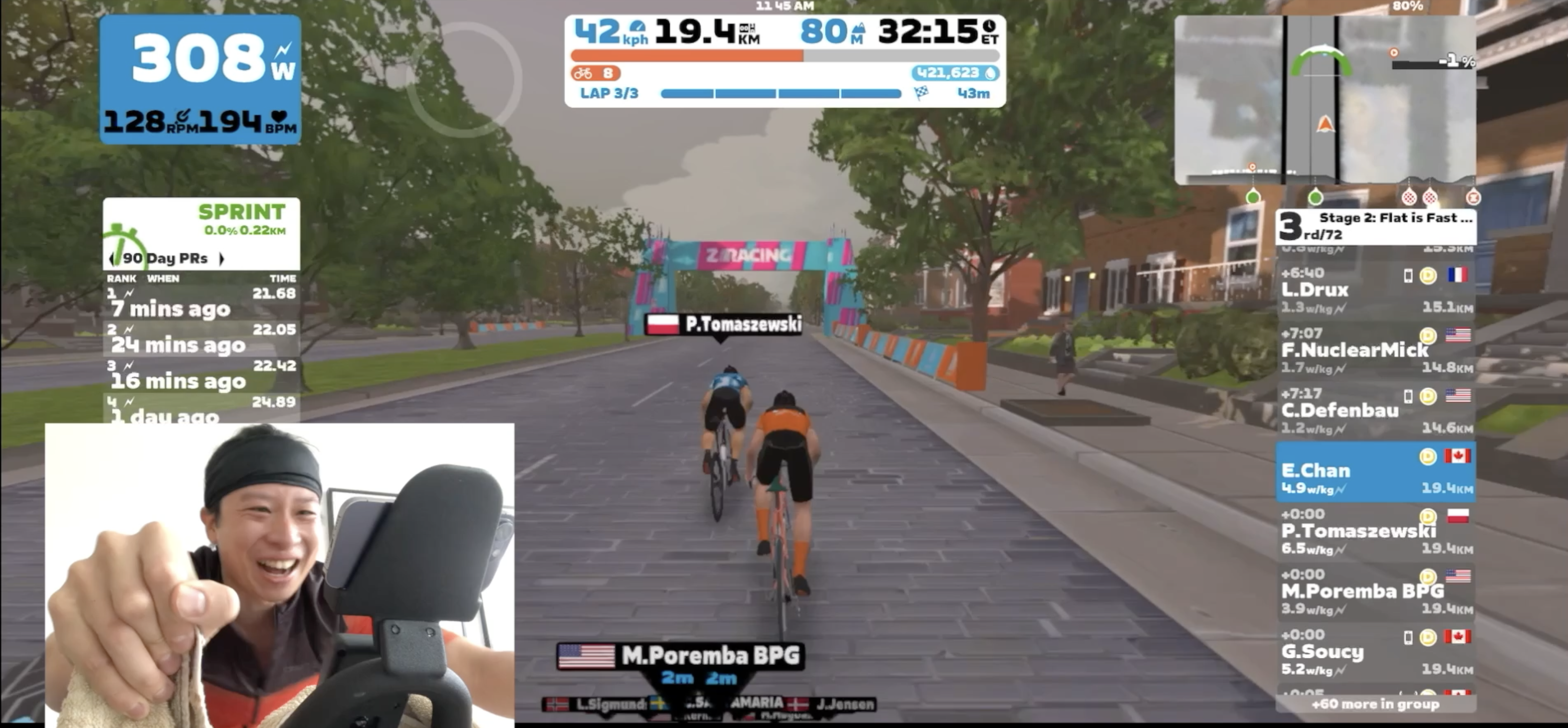
When the race started, I repeated my plan in my head. All the research I’d done emphasized the importance of giving it your all early on to keep up with the pack, and that’s precisely what I aimed to do. My sole focus was to hang on tight and maintain a position as close to the front as possible—— even accidentally launching myself to the lead a few times.
Keeping with the pack felt good here. I was pushing myself, yet it didn’t feel like I was exhausting all my energy reserves. In the early stages, I felt confident. I could truly hold my ground here. As long as I stuck with this group, anything seemed achievable. And that’s exactly what I did.
I kept pace with them until the third lap, then I began to assess my condition. It was likely a mistake, as I found myself at the forefront of the pack. I was putting a lot of watts in. And for my size, this was strategically a bad idea. I was really pushing the limits in terms of my watts per kilogram, and I was about to push even harder.
At the 24th-minute mark, a break occurred, and five cyclists surged ahead. The chase was on. I could see them rapidly distancing themselves, potentially becoming unreachable. Faced with a decision, I had to choose between playing it safe and sticking with the chase group or ramping up my watts even further to pursue them. I opted for the latter, pushing myself to maintain up to 4 watts per kilogram in pursuit.
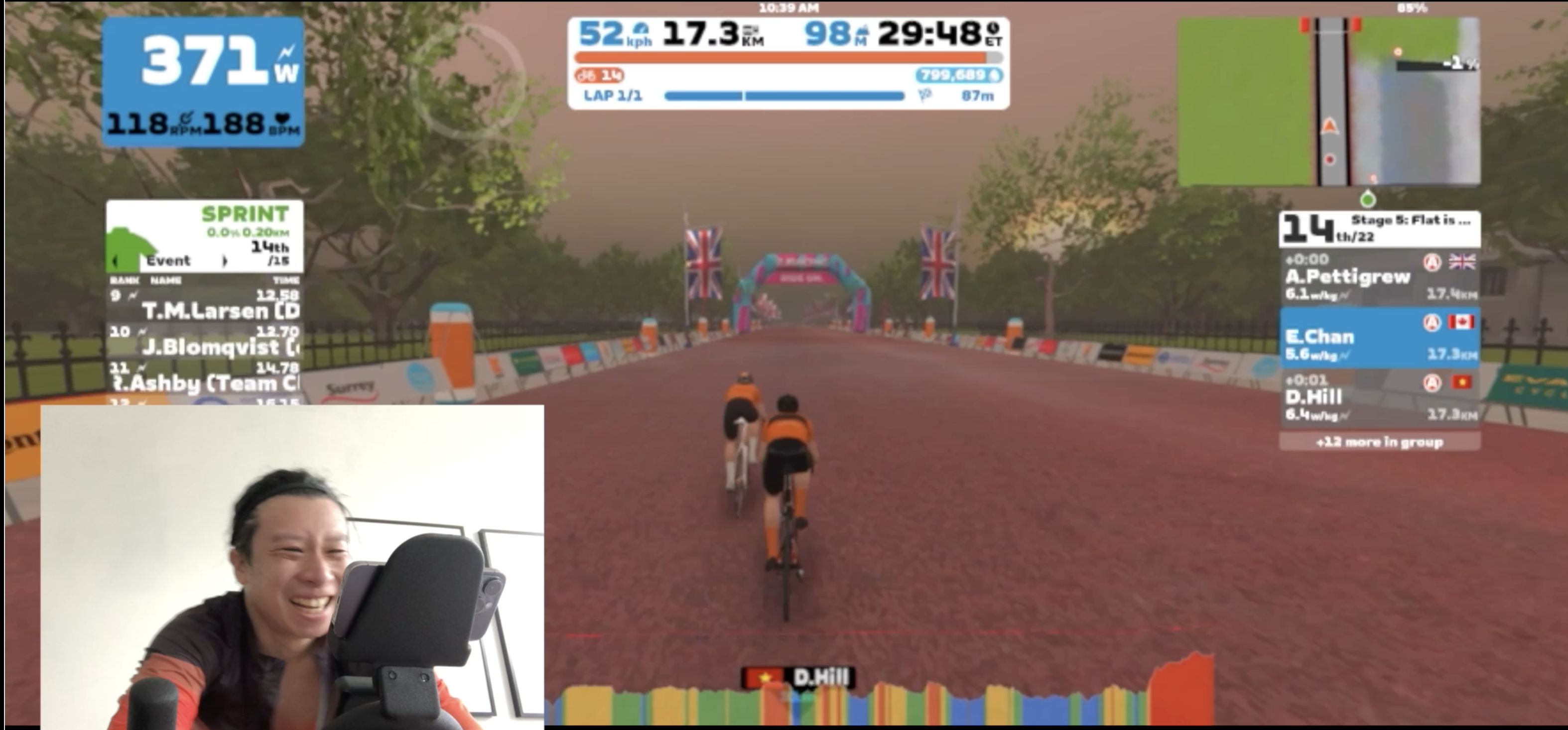
Guess what? I managed to catch up with the three cyclists breaking away. The podium was within reach, and I understood that this might be a once-in-a-lifetime opportunity, even though it was my first race. I realized I had to shake off any doubts right away. I was going all in. The top four of us powered through the last three-quarters of the lap together—sprinting hard, pushing each other to the limits. I went all out. I gave it everything I had to secure the win.
The number of km left slowly went down. I found myself in the lead. It was time to lower my heart rate and prepare for the final sprint in the last kilometer or so. I needed to bide my time. I could see the two cyclists behind me, but I wasn’t sure if others had caught up. I waited, perhaps too long, allowing them to make the first move. I should have been the one to push harder initially; gaining momentum would have made all the difference.
Now, I was the one chasing, with less than a kilometer to go. We surged forward, and I was overtaken. Then it happened again. I settled into third place. Fine. Hold onto it, I urged myself. Hold it. With just under 200 meters to go, I closed in. But it was not meant to be, my Cinderella story was dashed, with only 50 meters left, another cyclist blew past me right at the finish line. Fourth place! Unbelievable. Gut-wrenching!
But wait… on the official Zwift Power website. I came in third! Huge! Due to that performance, I was bumped up into the C category. My first race. I overdid it. It would have been nice to do another race in D, but… I guess if Zwift wants to challenge me… challenge accepted.
This was not easy. I put everything I had into this race. I got my HR up to 190 for god sake. I really thought I could win. That was how naive I was. Well… now I can never race in Cat D again. On to the future. I’m ready.
Now let’s get into the second race.
Which was…
Stage 3 of the Flat is Fast Series in Group C: The Volcano Flat in Watopia
The title of this race is Stay Calm
Heading into the second race, I felt much better than I did during the first one. I was warmed up and had a solid game plan in mind. But, as they say, everyone has a plan until they get punched in the face—and let me tell you, I definitely got punched in the face.
The race opened at a fast pace, but I managed to hang on, and I was genuinely proud of my effort. I dug in, stayed focused, and didn’t hesitate to push my watts into the 300s. Deep down, I knew I couldn’t sustain that level of intensity, but I hoped and prayed that the pace would ease up, allowing me to maintain a steady rhythm.
If by some miracle, I could stick with the lead group, that would be fantastic. My primary goal was simply not to get dropped, a real concern less than a minute into the race. Then, unexpectedly, I found myself at the front. There was a glimmer of hope. Regardless, I experienced some back-and-forth movement for a while, but overall, I felt good about my performance.
Then disaster struck. Well, disaster is not the right word, but something did go wrong.I began to notice a clicking sound coming from my spin bike. Initially, it was sporadic, but soon it occurred with every rotation. It was unsettling, and I kept checking, hoping to find a loose screw or some visible issue that I could fix. However, everything appeared to be fine. The persistent clicking made me nervous because I didn’t want to damage my bike during the race. It really messed with my head, and I could feel my mental focus slipping.
I was getting dropped, and the clicking sound from my bike became increasingly difficult to ignore. About a quarter of the way into the race, after over 10 minutes had passed, I realized I couldn’t ignore the issue any longer. I had to address it. At 11:18, I made a quick decision to step off the bike, seizing an opportunity during a downhill stretch. Unsure of what to do, I attempted to tighten up the pedal.
Fortunately, by sticking with the lead group from the beginning, I created some space to address the issue. I could see that I had a gap before the chase group caught up, allowing me some breathing room. I resumed pedaling and got back on the bike at 12:02, spending nearly 40 seconds without pedaling. By the time I got back on, the chase group had caught up.
Now, the game plan has completely changed. My objective now was to stick with this chase group and hopefully make it to the end in one piece, both myself and my bike.
The clicking sound persisted throughout the remainder of the first lap, and I was coordinating with my wife, who was watching, to troubleshoot the issue. At that moment, I contemplated whether to dismount completely and abandon the race to address the bike problem. However, I’m pleased with how I managed to stay calm, collected myself, and pressed on.
Here’s the thing about technology and mechanical issues: sometimes they just fix themselves. Not always—sometimes they completely fall apart. But today, to my relief, the clicking sound stopped for the second lap.
Now, I was just trying to stay with this chase pack and hopefully finish in the top 50. So we stuck together for the majority of the last lap.
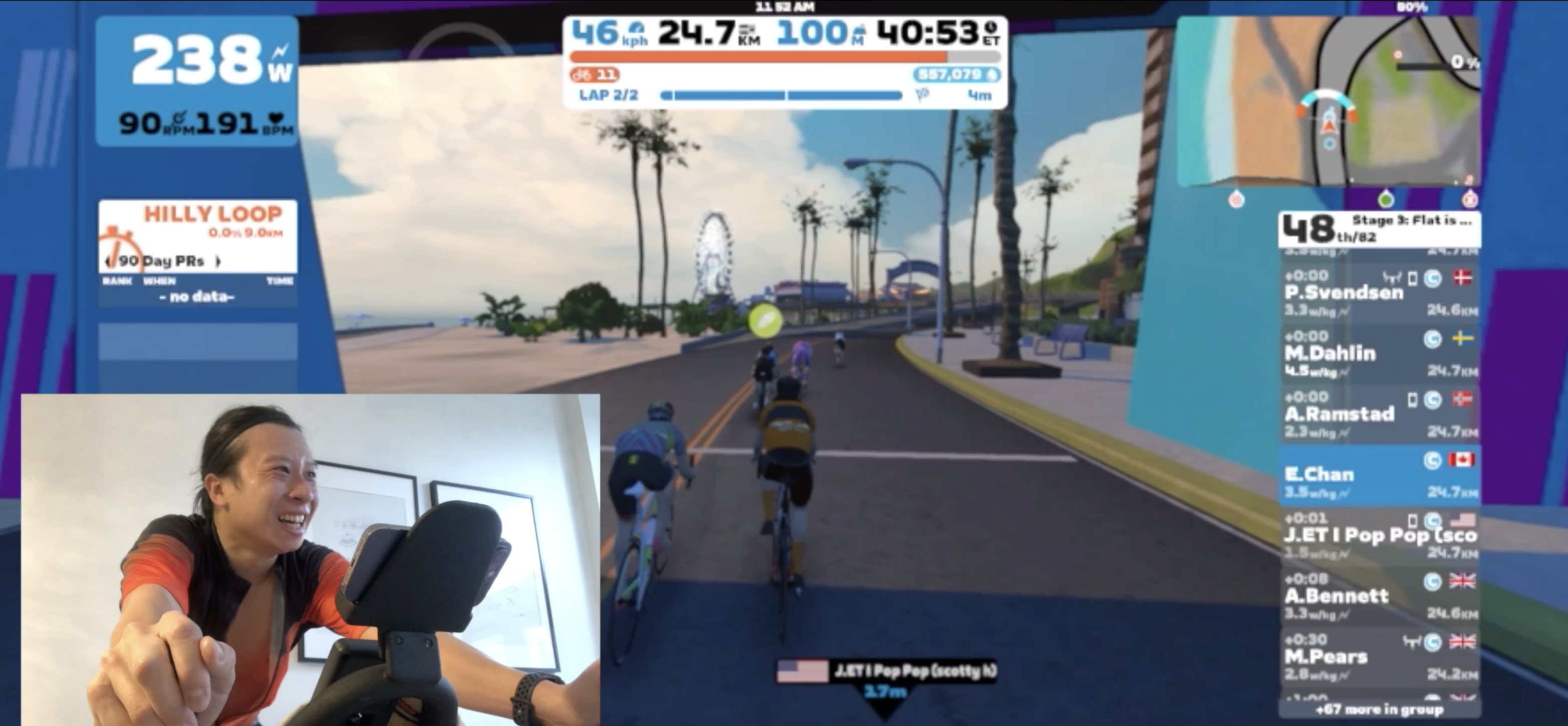
The second lap was brutal. It took everything for me to keep up. Just look at me. I’m dying. But I hung in there. With a km left, I was hanging on for dear life and anytime I had to push over 200 wats, I felt it. I didn’t have many matches left to burn. I was in pain, drenched in sweat, giving it my all. I wasn’t sure how much longer I could hold on. But you know me—I’m always up for one final push and a sprint to the finish. It was an emotional race, and I was determined to give it everything I had to finish in the top fifty.
49… 49… 48.. At the very last moment. I got it!
Even better, the official results had me in 24.
Given everything that went wrong, including the need to dismount the bike, I would consider the outcome a success. Needless to say, Group C was significantly more challenging than D. There appears to be a noticeable divide between the top and bottom of C. I believe there should be another category in between, as our group finished well over 2-3 minutes behind the lead group.
This result has left me eager to race in Group C again because I feel I now have a better understanding of what to expect. What if my bike hadn’t started making that clicking sound? Would I still have been dropped? Most likely. However, I’m curious about how long I could have kept up with the lead group and what impact it would have had on my overall time.
Sadly, before I could answer that question about group C, I now had to get ready for my race in group B.
Stage 4 of the Flat is Fast Series in Group B: Douce France in France
It’s my 3rd Race, and I call this one: Still Breathing
In my last two races, I competed on Sunday mornings Pacific time. However, this week, I had to reschedule my Zwift race to Friday evening because I’ll be running a half marathon on Sunday.
Friday evenings typically see less activity on Zwift, and there weren’t as many participants in this particular race. I’m also aware that as I advance through the categories, the number of competitors in the race will likely decrease as well. Initially, this gave me hope. Perhaps I could perform well in a smaller group.
But there is no reason to believe I would because having a smaller group means there are fewer people to keep up with if a break occurs early. And what do you know, less than 2 minutes in, a break happened. I pushed as hard as I could, maintaining around the mid-200 watts, but the lead pack was gone.
My bike started making the clicking sound again, but it stopped a few minutes later. So I’m going to leave it as a mystery. Regarding the race, my hope of even being a contender was dashed right away. The dream was dead.
However, I wasn’t stranded. I managed to stay with a small group of 4 riders. In this group, we pushed each other, just because we were at the tail didn’t mean we were going easy. Whatever was happening in the lead pack didn’t matter anymore. Four minutes in, my focus shifted to maintaining my position within this group. I cannot get dropped by them.
That was hard! At some points, I went as high as 300 watts, not sustainable. I knew that to even stay in this chase pack, I would need to give everything I got. And this thought was happening early on, at about 5 minutes.
Big shoutout to the 4 riders I was cycling with during this stretch—they really pushed my limits. As I crossed over the aqueduct around the 18-minute mark, I was fading. But something else was happening. Other racers were either getting caught or dropping out altogether. A glimmer of hope. If I couldn’t out ride them, I’d try to outlast them. I was determined to stay in the race until the very end.
Around the 17 km mark of the race, nearly 30 minutes in, the group began to spread out. My watts were decreasing, and I knew it was something I had to accept. While some riders had dropped out by this point, those ahead of me were starting to create insurmountable separation. Suddenly, I found myself with just one other rider: Fujino from Japan.
Now, Fujino was my sole focus. My last goal in this race was to avoid being completely left behind. This was me hanging on by my fingertips.
Everyone was gone. My effort was at max. My watts were however going down. I couldn’t hold it anymore. Reality was sinking in. With all the drop outs… I was now officially the last racer still in the race. There wasn’t much I could do about it, except give everything I could in the final sprint to get past Fujino. But he was not making it easy for me.
Then came the final kilometer. I needed to choose the right moment to make my move. That came with 700 meters to go. I unloaded, but I couldn’t gain any ground. Fujino activated his Aero power-up, and if anything, he pulled further ahead. It seemed hopeless… but not quite. I dug deep with 100 meters left, but the race was over.
I finished 17th out of 29, but the official time on Zwift Power says it all: 14th out of 14. Last place, just as I had anticipated. It was an incredibly humbling experience. But I’m proud of my performance. I persevered. I didn’t give up. And I was only 4 minutes and 30 seconds behind the winner. That seems achievable someday.
To be honest, attempting to win Group C feels as challenging as trying to win Group B at this stage. The gap is so significant either way. Racing in Group B almost takes the pressure off in that sense and you can just do your best. Even if I don’t level up, I see myself participating in a Group B race again, hopefully in one with more competitors.
Speaking of competitors.
Stage 5 of the Flat is Fast Series in Category A: Greater London Flat in London
Final chapter: A Lonely Road
This big race took place after a busy, exhausting week, but I won’t make any excuses. Nevertheless, it’s important to note that just seven days ago, I ran a half marathon… so needless to say, I didn’t come into this event feeling fresh.
No, as I lined up, it was the first time I felt fear. I dreaded the pain that was about to come. Having pushed myself to the limit in previous races, I knew that today would be no different.
Before I could even calm my heart rate down, the gun fired, and off we went… well, everyone else did. In less than a minute, I was dropped. I found myself completely alone, in no man’s land. With nearly a 5 km lead-in, this race was going to be long and mentally taxing.
The reason I participate in these races is to train both my mental and physical endurance. I must constantly adapt my strategy based on how I feel and what unfolds during the race. Now that I was all alone, I had to create challenges to stay motivated, as there was no one in sight. So, I focused on the numbers. My new objective was to stay ahead of those behind me, and surprisingly, there were people behind me — Pettigrew and Hill.
Struggling to maintain even 200 watts, I knew it wasn’t going to be easy. The race seemed endless. That’s the feeling when you’re alone, and the only carrot you have is the projected distance between you and the competitors chasing you. It’s tough because part of you wants them to catch up so you’ll have company, but you know that if they do catch you, it’s game over.
I was grappling with my inner demons, pushing my power as high as I could, when the rain started to pour down on the course at the 11 km mark, with a third of the race still ahead.
This was where I knew the inevitable was going to happen. Gradually, Pettigrew and Hill began to reel me in. What was once a gap of well over 20 seconds had now dwindled to 10 seconds and was decreasing. Then, at the 13.5 km mark, they caught up with me. In a way, I felt relieved that the solo struggle was over. I could now hang with them and play this cat and mouse game, chasing and dropping back so I can get some draft. I recalibrated. New goal. I couldn’t let them get away.
So the three of us rode together, swapping positions, taking turns in the lead. As we reached the point where there was only 1 km left, I knew I needed to make my move soon. But I was tired… so I waited… I hesitated… with 800 m left, I held back until Hill came up right behind me, pressuring.
Then, with 500 m left, I made my move. It was me and Pettigrew all the way. I pushed and pushed. But I just couldn’t take it to the next level. My heart rate spiked to 191. But I simply didn’t have the power to compete, and Pettigrew beat me by a wheel’s length. Once again, another sprint finish lost.
Unofficially, I finished 14th out of 22, but once again, I found myself last on Zwift Power. I have to give credit to Pettigrew and Hill, even though they didn’t rank officially, they meant everything to me in this race. As much as it sucked that they caught me, they made the finish interesting, and, I can’t help but feel humbled. So shout out to them… and I guess, everyone else ahead of us.
Conclusion
There you have it. Those were my first four races in Zwift, covering all four categories available for me to compete in. Here’s another look at the results, which are pretty consistent in terms of the stats and serve as a good indicator of my current power level.
I called this Project: Get Humbled and I think I did just that. It’s incredible how strong some people are on the bike. When you push yourself beyond your limits to compete with them, and still lose so badly, it’s just impressive.
On the flip side of the coin, this project was very inspiring. I feel positive about the progress I’ve made on the bike so far. I’ve already increased my power by nearly 60 watts since I started including the stationary bike in my training about two months ago, so the sky’s the limit.
With that being said, I’m also glad that it’s over now, and I can spend some time resting my legs and preparing for more achievable challenges. So stay tuned for more Zwift and endurance adventures and be sure to subscribe to my channel so you don’t miss them.
Join my YouTube community for insights on writing, the creative process, and the endurance needed to tackle big projects. Subscribe Now!
For more writing ideas and original stories, please sign up for my mailing list. You won’t receive emails from me often, but when you do, they’ll only include my proudest works.
We’ve all been there – that exhilarating moment when a brilliant idea hits. It’s going to be the next big story, a blockbuster movie, or a groundbreaking business that will make you rich. However, as many of us have experienced, there’s often a gap between the ideas in our heads and the written words in front of us. Why?
It’s the Language
When you have an idea in your head, it seems clear and well-thought-out because you naturally understand it. But when you try to explain it in words, you realize that it’s not as clear as you thought. Writing needs a level of precision and organization that thinking alone doesn’t.
Language has its limits, and not all ideas can be expressed perfectly in words. Especially with abstract or complex concepts, finding the right words can be tricky.
That’s why in writing we often hear the advice to write evocatively. This means that we need engage our senses by only using words.
In your head, you can see the full moon beautifully. But on paper, simply writing “a beautiful moon” doesn’t capture the scene. You need to write something like: Fireflies danced in a mesmerizing ballet, creating a spectacle of ethereal lights against the backdrop of the silent, moonlit meadow.
Your thoughts are dynamic and can change rapidly. However, when you write something down, it’s only a static representation of your thoughts at a particular moment. Unlike the real-time editing and refinement possible in your mind, the act of communicating your ideas through words will never capture this aspect effectively.
For example, have you ever listened to someone telling you a long-winded story, maybe about their dream? By their tone, they are really into it but it doesn’t go anywhere. It’s just a series of events without a climax. That’s the trouble with words. In our heads, all the events flow seamlessly together without wasted time or energy. But as thought transforms into sentences, words, and syllables, the effort the listener expends to hold attention adds up.
When it comes down to it, words are just symbols. Symbols that may mean different things to different people. Therefore, to get your idea fully into someone’s head will require something closer to telepathy — a near-impossible feat. Nobody can fully see the idea in your head no matter how great of a storyteller you become.
But we can’t blame it all on language. A part of the reason why our ideas are often better in our heads is that we haven’t fully flushed out the concept yet.
The Idea is Unfinished
In your mind, you may explore multiple facets of an idea, but when you write it down, you may find it difficult to capture all the nuances and details. You’ve got all these dots on a page, but you can’t connect them.
Writing often requires a more linear and structured presentation, forcing you to organize your thoughts in a logical manner. The act of arranging information helps clarify the relationships between settings, characters, and events, making it easier to comprehend the overall story. In this way, you see holes and inconsistencies.
Have you ever heard of the concept that the best way to learn something is to teach it? It’s the same. The best way to understand something is to communicate it.
You believe your idea can be fully formed in the process of translation, but rarely it is.
Simply put…
You’re Not as Brilliant As You Think
There is a cognitive bias known as the positivity bias, which leads individuals to focus more on positive aspects and overlook potential flaws in their ideas. When an idea is in your head, it might seem brilliant because it exists in an idealized form. It’s safe in your head.
However, when writing, the fear of judgment or criticism creeps in. This fear can impact your ability to express yourself freely and can lead to a sense that the written expression falls short. Now that it is out there then it can be attacked and broken apart. This is commonly what happens in a writing workshop, where ideas are put to the communal test.
Overcoming this challenge often requires practice, revision, and recognizing that writing is iterative. It’s normal for the first draft to be less satisfying than the idea in your head. But through editing and refining, you can bridge the gap between your thoughts and the words on the page, making your ideas clearer and more compelling.
The first draft is a stage where writers explore their ideas, characters, and plots for the first time without the pressure of perfection. It’s a phase of discovery and experimentation, which may result in writing that feels unpolished — because it is.
It’s only an illusion that the idea is better in your head than on paper. Don’t let it trick you. Your idea is not as good as you think, and your idea is not as bad as you think. Until you bring it out into the physical world, there is no way to examine it properly.
So don’t be afraid to bring your idea into the real world and put it to the test. Let’s see where it breaks. You shouldn’t waste your life counting fool’s gold, saving up your great ideas like a miser, because they won’t be as great as you’ve thought. Instead, take your best ideas and take your worst ideas — whichever ones inspire you to take action — and run with them, expand on them, go off on tangents, just keep creating knowing that whatever you’ve made is better than an idea. And some day, with enough practice and luck, you’d be able to connect all the dots that you’ve made. A creation that matches your imagination.
For more writing ideas and original stories, please sign up for my mailing list. You won’t receive emails from me often, but when you do, they’ll only include my proudest works.
Join my YouTube community for insights on writing, the creative process, and the endurance needed to tackle big projects. Subscribe Now!
In September 2023, I participated in my first sprint-distance triathlon in Vancouver’s Stanley Park. The race comprised a 750m swim starting from Second Beach, followed by a 20k bike ride—two laps around Stanley Park—and concluding with a 5 km run to Burrard Bridge and back to Second Beach.
Before training for this race, I had close to zero experience with all three disciplines. I had swimming lessons when I was a kid, but I was only good enough to save myself from drowning… temporarily. That’s about it. Like many, I came into the sport most nervous about the first leg of the race: the swim.
However, my cycling history wasn’t much better. I didn’t grow up with a bike; I learned to ride one at the age of 13 while hanging out with schoolmates. My most vivid cycling memories involve biting off more than I can chew—whether it’s renting a bike on vacation and venturing too far up a volcano or commuting too far in the city and finding myself needing to navigate a sketchy, heavy-traffic route home. Naturally, I associate cycling with near-death experiences. But I was really more concerned about the mechanical aspect of the sport.
Finally, there is the run. I’m not particularly fond of running; I used to jest that the only way to get me to run was by giving me a bus to chase. Running for anything more than a quick sprint didn’t appeal to me, and I certainly didn’t take it seriously. Before registering for the triathlon, I had only participated in one 10k race—that’s the extent of my running experience.
So, that was my background before the triathlon. Not only was I a novice in the sport, but I was essentially a beginner in all three disciplines. I found a certain charm in that. I didn’t have to pick favorites; there was a wealth of learning in each of them, and learn I did. In my rebellious manner, I learned through making mistakes. While, yes, there were errors, there were also some small wins along the way.
Today, I’m going to share three things that went right during my training and race, and three things that went wrong.
The first thing to go right is that…
I gave myself a lot of time in training
As mentioned, the race took place over Labor Day weekend in September, and I registered for it in March, providing me with a little over 180 days to prepare. It took about a week or two to find my comfort zone on the bike and a couple of months to control my breathing technique in the swim. Not only that, it gave me time to recover from pushing my body like I have never before. The sudden training led to shin splints, sidelining me from hard running for a week in March.
Having enough time on my hands also let me join a few smaller races in between. I did a 10k in April, a 5k in June, and another 10k in August. These races were great for getting used to the mindset of competing with others, which is tough to simulate in regular training. It helped me figure out how I’d respond when someone faster passes me—would I speed up? I wanted to practice the mental side of things too, and that required real-life experience.
I’d say, if you are starting out. Give yourself as much time as possible. Commit to it early on and just make a year out of it.
Now let’s talk about something that didn’t go well:
Going too fast on the swim during choppy water
Everyone told me to go easy on the swim. I heard that advice, and I was planning to follow it. The only issue was, I wasn’t exactly sure how slow I should go, and I didn’t know what might happen if I didn’t follow the advice correctly. Sometimes there’s only one way to find out.
On race day, the water was unusually choppy. I had practiced swimming the race course three times before the event, and each time, I felt quite comfortable. However, on that particular day, the conditions were wild.
Still, I wasn’t discouraged. When the race began, I joined the group at the starting line and just went for it. The first 200m went well, and I felt great keeping up with everyone. But things changed at the first turn; there was a bottleneck, and a wave hit me, making me swallow a lot of salt water. Despite people swimming around me, I had to keep moving, but getting around the corner was tough with the waves beating on me. I got exhausted and struggled to breathe. This was the result of starting too fast; I didn’t have the energy to recover.
After making the turn, I was now swimming with the waves hitting me from the side I usually breathe on, my left side. It was a critical moment in the race, and I thought about stopping many times. But I remembered all the hard work to get to this point. Quitting after just a 300m swim wasn’t okay. I had to keep going. It was a struggle, but eventually, I turned back toward the beach, and the waves helped propel me forward. The worst was over, and I made it through.
Now for something that went right… and this is a big one:
I finished the race
That was the only goal I had going in. Finishing the race. Getting that benchmark time and having a better sense of what needed improving.
Many things could have gone wrong and stopped me from finishing. The tough swim was one worry, and my bike falling apart was another. I also had the fear of getting disqualified in my mind.
During the race, there were times when things could go wrong. I saw someone crash on the bike course, which affected me mentally, and the first kilometer of the run was painful, and I had to adjust a lot. The interesting part was figuring out how to balance everything rather than just pushing hard all the way to the finish.
Something that went wrong that I didn’t anticipate or practice was:
Racking my bike…
Returning to transition after the cycling portion of the race, I had to put my bike back onto the rack. I had so much trouble getting it on. First off, not that this was a problem, but I noticed that my bike saddle was crocked when I got to the race. I’m not sure how it got damaged. It might have been because of a crash a few weeks before (I’ll get more into that later).
Anyway, I recall standing there, grappling with my bike, rolling it over my wetsuit and attempting to get it back onto the rack. Not only did I waste 10-20 seconds doing that, but I also expended a considerable amount of energy. To add to the chaos, I entered through the wrong side of the rack. Once I finally managed to rack my bike, scratching up my new shifter in the process, I had to run around to put on my running shoes. My transition 2 was not impressive.
Sticking with another thing that went wrong:
My bike itself…
Look, I still think I made a good decision getting the bike I did because I was close to getting an even worse bike.
I didn’t want to invest in a pricey bike only to discover that I wasn’t fully committed to the sport.
This is a $500 hybrid bike, also the nicest bike I’ve owned so far. I pushed this bike to its limits during training, and a few components began to show wear, with the shifter being the most notable. Approximately a month before the race, every time I hit a bump, the left shifter would unexpectedly drop gears, which became super annoying.
My initial plan was to complete my first two races with this bike and then upgrade to a road bike. I’m honestly relieved that it managed to hold up and get me through the race. Because a week after, I noticed a clunking sound every time I pedaled. It turned out that the freewheel had broken.
I must have pushed it too far during the race itself.
This little bike had a lot of action in a short amount of time and I’ve paid a lot since to maintain it. But after my first race, I decided to retire it from racing and purchase an entry-level road bike to take over. As for my old one, I use it as a commuter bike and it’s great for that. Despite not everything going perfectly, and a few stressful days, I wouldn’t change a thing.
Something that went right from beginning to end was my pleasure for
Tracking progress
I got into this sport because it’s not just about fitness and gear; it’s also analytical. I enjoy tracking each workout, noting improvements or areas to work on. Using this data helps me adjust my effort and tweak my plan. Seeing myself get better gradually—swimming, cycling, and running longer and faster over time on a spreadsheet—brings me an abnormal amount of joy.
Second only to enjoying a beautiful summer day outdoors, observing my progress is my favorite aspect. It’s incredibly motivating to reflect on the beginning and recall how challenging it was to swim 200 meters. I vividly remember that version of myself, and it’s astonishing that in less than a year, I’ve gained so much more confidence in the sport.
Without a doubt, if I hadn’t tracked my progress in some way, it would have been harder to remember where I came from and my commitment would have waned, and I likely would have given up, or at the very least, not signing up for another race.
That’s correct—I’m currently fully invested in triathlon as my recreational pastime. It’s been a welcome counterbalance to the extensive time I spend at a computer. I recommend it to most people with a sedentary job.
If you’re thinking about signing up for a triathlon and haven’t before, just know it’s a commitment. Starting with nothing, I spent at least $2000 getting ready for my first race, but the time I put into training made it worthwhile. It’s become a stress reliever I look forward to, and it broke up my day nicely.
It can become quite an obsession, but when you’re working on a novel like I am, it’s more pleasant to share that you’re doing a triathlon rather than writing a novel. Both are braggy lines you can boast about, but at least with the triathlon, you don’t have to bore people with the details of your dystopian fantasy.
Well, those are three things that I believe I did well and three things that didn’t go as expected when I signed up for a triathlon. If you’re feeling inactive, going through an existential crisis, or just frustrated with the world, consider giving triathlon a try. Above all, it has been therapeutic, and I think that’s a good thing.
For more writing ideas and original stories, please sign up for my mailing list. You won’t receive emails from me often, but when you do, they’ll only include my proudest works.
Join my YouTube community for insights on writing, the creative process, and the endurance needed to tackle big projects. Subscribe Now!
Finding the time and motivation to write can be demoralizing. In 2023, I had a lot of trouble sitting down and putting pen to paper, even though I had a massive project I needed to make progress on. At the pace I was going – producing only two to three pages in a notebook per week – I realized that continuing in this manner would get me nowhere. It became clear that I needed to change my approach if I wanted to move on to the next phase anytime soon.
I had to get back to my roots and examine what I did before to succeed. In the past, I’ve shared my experience many times about working a little every day and that was the habit I needed to get back into. A 30-day writing streak proved to be the catalyst I needed to reignite my passion for writing and establish a sustainable routine. Write 1 page minimum every day. If I can do that, then there is hope.
Here’s a glimpse into my journey and the lessons I learned along the way.
1. Breaking Through the Resistance
Whether it’s battling writer’s block, self-doubt, or external distractions, the 30-day streak became my anchor through the tough times. Committing to writing daily forced me to confront obstacles head-on, transforming them from roadblocks into stepping stones. I know a lot of what I’ve written will be cut out in the editing phase, and that sucks, but I can’t worry about the tough parts in the future, I need to focus on the tough parts I’m going through now.
2. Excitement Rekindled
The monotony of daily life can dull the excitement that fuels our creativity. After working all day, I don’t want to spend another 30 min to an hour at my desk writing. If it’s not something I have to do, I’ll convince myself not to do it. But if it’s not a negotiation, then it changes my mindset — instead of dreading it, I can look forward to it. I find time to fit it in. I treat it like a meal. If I can’t cook for myself maybe I’ll order something, either way, I need to eat.
Embarking on a 30-day writing streak reignited that creative spark within me, because I don’t let the embers go out. Each day brought a new opportunity to explore ideas, even if they are as terrible as the food I cook for myself.
3. Momentum is Everything
Momentum played a crucial role in my writing streak. The initial days were challenging. When you are on day 4, and you give up, not a big deal, nothing was wasted. It’s really important to get through the first week with your streak intact. Once you do that, momentum picks up, and quitting ceases to be an option.
As I built momentum, the process became more natural and enjoyable. Momentum, I realized, is the key ingredient that propels you forward, making the act of writing a part of your daily routine.
4. Squeeze It In
One of the biggest challenges of a daily writing streak is finding time in a busy schedule. Squeezing in writing became a part of my day, but it’s not always easy. Things come up and it throws you off. You need to be flexible and prepared.
You won’t always get to write the same time every day. There will be mornings when you wake up late or evenings when you need to attend to some obligation. If you can get the writing out of the way as soon as possible, do that. If you can’t do that, then you will need to rely on your anticipation. Busy day tomorrow? Where are you going to eat lunch? It doesn’t matter, bring the notebook with you and write immediately after. Block off thirty minutes, that’s all you need to scribble some words on a page. If you commit to having the notebook with you, incredibly, you’ll find a way to make time for it.
5. Accountability Through Documentation
To ensure I stayed committed to my writing streak, I took an unconventional approach: filming myself. Creating a daily video log became a powerful accountability tool. Knowing that I had an audience, even if it was just future me, kept me honest and motivated to fulfill my writing commitment each day. The footage you are seeing now is me writing during the 30-day streak.
If you want to keep yourself accountable, you don’t need to film, there are other ways. You can take a photo, do it with a friend, post about it on social media, or just mark it on a calendar. I like filming because it’s relatively hands-off, I just set up the camera and let it run while I do the work. It doesn’t need to be fancy, and you don’t need to overthink it.
6. Don’t Kid Yourself
In the grand scheme of things, nobody needs me to write. It’s a selfish endeavor, driven by personal passion and a childhood dream. Acknowledging this fact eliminated any room for self-deception. If I want to write, I have to commit wholeheartedly, making it a daily habit for my own fulfillment. I can’t lie to myself and make myself feel righteous, and that all of this is for the benefit of humankind. No, this is for me. I want to do this. And that’s okay, but what’s not okay, is for me to keep bitching and being pissy that I have to do it. I don’t have to. I don’t have to find time for it. I’m choosing to. And any other attitude definitely doesn’t benefit anyone — not even myself.
So, I feel like I’m back on track. Things are happening.
Embarking on a 30-day writing streak proved to be a rejuvenating experience. A jump start I needed for my stalled vehicle. It pulled me out of a creative slump and instilled a sense of discipline in my day to day. If you’ve stopped doing something that you wanted to do, like writing, don’t hesitate—make it a habit, own it, and watch as the words and the days add up. That’s the best part.
For more writing ideas and original stories, please sign up for my mailing list. You won’t receive emails from me often, but when you do, they’ll only include my proudest works.
Join my YouTube community for insights on writing, the creative process, and the endurance needed to tackle big projects. Subscribe Now!
Before we discuss the events of San Junipero, let’s first take a look back to when this episode was released: Oct 21, 2016.
In 2016, consumer-grade VR headsets like Oculus Rift, HTC Vive, and PlayStation VR became widely available, making virtual reality more accessible to the masses.
In the same year, VR found applications in healthcare, particularly for pain management during medical procedures. This was often called “Virtual Reality Distraction” or “VR Distraction Therapy,” where VR headsets created immersive experiences to distract patients from pain.
Mobile dating apps became the dominant platform for online dating in 2016, making the dating process more convenient. The concept of casual dating and hookup culture gained popularity, with apps like Tinder associated with short-term, non-committal relationships.
However, Tinder and its algorithm faced criticism for allegedly perpetuating racial and gender biases in online dating, which raised concerns about fairness and inclusivity.
2016 was a notable year for global equality, with countries like Colombia legalizing same-sex marriage. However, in the U.S., debates on transgender rights and bathroom access intensified due to North Carolina’s “bathroom bill”.
Tragically, the Pulse nightclub shooting in Orlando, Florida on June 12, 2016, targeted the LGBTQ community, resulting in 49 deaths and numerous injuries, making it one of the deadliest mass shootings in America.
Brittany Maynard’s 2014 case continued to influence the euthanasia and right-to-die conversation as it inspired discussions on end-of-life autonomy. In June 2016, California’s “End of Life Option Act” went into effect, allowing terminally ill adults to request medical aid in dying, making California the fifth U.S. state to legalize physician-assisted suicide.
2016 marked a transition year, with technology becoming integrated into various aspects of life, offering opportunities and challenges. This year set the stage for a more connected and digital society, impacting dating, healthcare, and our ability to cope with loss.
And that’s what brings us to this episode of Black Mirror: Episode 4 of Season 3: San Junipero, an iconic episode that invites us to contemplate the implications of a digital afterlife.
In this video, we’ll explore 3 themes of this episode and determine whether similar events have happened — and if not, whether they are still plausible.
Til Death Do Us Part
The episode begins with Yorkie navigating the bustling Tucker’s nightclub, where she crosses paths with Kelly, who encourages her to dance. This encounter sets the stage for a deeper connection beyond the surface allure of San Junipero’s neon-lit nightlife.
The 1980s was an interesting time. While there was progress in the women’s rights movement, traditional gender roles still persisted in many areas. Women were often expected to balance a career with homemaking, and men faced pressure to conform to traditional masculinity. Those who didn’t conform to societal norms often faced stigmatization. This included individuals with alternative lifestyles, like the LGBTQ community.
The American Psychiatric Association declassified homosexuality as a mental disorder in its diagnostic manual in 1973, but the emergence of the HIV/AIDS epidemic in the 1980s sparked fear and amplified existing stigma.
While HIV and AIDS remain a concern, medical advances and a better understanding of the virus have improved the outlook for those affected. HIV today is no longer a death sentence, with approximately 39 million people globally living with the virus in 2022.
Acceptance is a major theme in this episode. Acceptance is also the final stage of grief. While Yorkie’s family never accepted her after she came out and after her accident, Kelly struggles to accept her husband’s death and the end of their marriage, despite her enduring love for him.
Aging, loss, injustice, and differing viewpoints are all factors we must accept. While we may start with denial, anger, and depression, we can’t grow without eventually finding a way to accept and live with these realities.
In the 1980s, mental health issues were not openly accepted, and individuals facing such challenges were sometimes viewed as weak or even dangerous. People often believed that those with depression could overcome it by “cheering up” or “snapping out of it.”
In the same vein, conversion therapy, also known as “reparative therapy” or “ex-gay therapy” aims to change the sexual orientation of a person who identifies as LGBTQ. It was based on the belief that like being depressed, someone’s sexual orientation was a choice and could be “cured.”
There is evidence now to suggest that genetics may play a role. Studies of identical twins have shown a higher likelihood of shared sexual orientation compared to fraternal twins.
Today, while not universal, many LGBTQ individuals experience greater acceptance and support from their families and social circles, with same-sex marriage legally recognized in much of the Western world.
In 2000, Vermont became the first U.S. state to introduce civil unions for same-sex couples, offering legal recognition and benefits but not full marriage rights. It took four more years before Massachusetts made history by legalizing same-sex marriage, granting equal rights and privileges to same-sex couples.
But the war for acceptance still continues. In 2023, the battleground is the education system, where acceptance and inclusion are key to a new generation of LGBTQ feeling safe. Across North America, protestors and counter-protesters clashed at the steps of suburban elementary schools over the teachings of gender and sexual orientation. Should such topics be excluded from school curricula, leaving such education solely to parents? One side demands it. But what if those parents hold intolerant beliefs, similar to Yorkie’s parents? Where can children find support?
Approximately 41% of transgender individuals have reported attempting suicide at some point in their lives. Additionally, the suicide attempt rate among LGBTQ adults is nearly 12 times higher than that of the general population. The rise of social media has enabled us to share messages, raise awareness, and learn from others, but it has also made it more challenging to find contentment in our own lives due to constant comparisons. Research conducted by the Pew Research Center revealed that about 60% of social media users in the United States experience feelings of inadequacy when they see others’ posts showcasing their accomplishments.
Social media feeds are filled with idyllic depictions of flawless marriages, dream vacations, picture-perfect families, and enchanting love stories, creating an endless popularity contest. However, it is crucial to recognize that the notion of a flawless life is a fallacy; such flawlessness does not exist in the real world.
And that is something we need to accept.
Ghosted
During their dance, despite their contrasting personalities, Yorkie and Kelly share a joyful moment. However, when Yorkie becomes overwhelmed, she leaves the dance floor, and outside, Kelly makes a sexual proposition to her, to which Yorkie declines by telling her that she’s engaged.
The following week, Yorkie returns, and in the restroom, Kelly once again propositions her sexually. This time Yorkie accepts.
But on the third week, Kelly is nowhere to be found at Tucker’s. Yorkie searches for her at the Quagmire, a BDSM nightclub, and bumps into Wes, the man Kelly had been avoiding. Wes, like Yorkie, expected Kelly to adhere to their relationship, but it becomes evident that Kelly has chosen to avoid the pain and complexity of such commitments by ghosting them.
Ghosting, which involves suddenly cutting off communication without explanation, became more prevalent in the mobile dating app scene, often leaving users hurt and frustrated. This phenomenon is emblematic of modern dating culture, where the ease of online connection and reduced face-to-face interaction can lead to less personal and sometimes inconsiderate approaches to ending relationships.
According to a 2023 Forbes study, 76% of participants have experienced either ghosting or being ghosted in a dating context. Nearly 60% of individuals report having been ghosted, while 45% acknowledge ghosting someone else.
After their intimate night together, Kelly experiences complex emotions. Her initial encounter with Yorkie at the nightclub was more about enjoying the moment and having fun. While she has developed genuine feelings for Yorkie, she also grapples with her internal conflict.
According to Business of Apps, as of 2022, over 337 million people worldwide are using dating apps. And not all of them are necessarily looking for a soulmate.
The dating app market is nearly a $5 billion industry that caters to diverse needs. For instance, Grindr is there for the LGBTQ community, Bumble empowers women to initiate conversations, and OkCupid lets users specify their intentions, whether it’s casual flings, short-term dating, or long-term relationships.
Time was referenced often in this episode, and does indeed play a crucial role in relationships and life. The intense passion in the early stages of romance are evolutionary mechanisms to help individuals form connections and reproduce, but they typically fade as relationships mature, causing us to question whether they were real at all.
In San Junipero, at midnight, those who are trialing the platform must return to their physical bodies. This serves as a metaphor for how we must confront the physical and mental challenges that come with aging, as well as our capacity for love. Kelly’s hesitation in forming deep emotional connections is partly due to the guilt she carries from her years of devoted love to someone she lost. Letting go of that love is a daunting prospect for her.
Meanwhile, Yorkie sees being with Kelly as a chance to finally experience the richness of life and love that had been withheld from her in her previous existence.
In this way, to love each other is to let their past lives die.
People now have the freedom to choose their experiences and relationships. Apps like Tinder popularized the concept of swiping right to like or left to dislike profiles, turning the search for potential matches into a game.
However, the fundamental human experience remains unchanged. We still grapple with the passage of time, knowing that every decision we make and every opportunity we miss may come back to affect us. And so, it raises questions: What if there’s something better out there? What if we never find something as good again? Dating apps are games, where we create our own characters and hope that the chosen one leads to a happy ending.
Second Life or After Life
At the end of the episode, Kelly faces a significant choice. Her decision centers around joining her late husband and daughter in the afterlife or staying in San Junipero with Yorkie and embracing digital eternity.
The Internet has made the preservation of memories complicated. For those still alive, managing their digital legacy is a growing concern, and various apps and platforms help them plan the distribution of their digital assets and online accounts after their passing. Services like Everplans and Cake offer such support.
Some people may choose to leave more than assets and accounts behind. They want to create digital versions of themselves. Technologies like Replika, an AI chatbot, engage in conversations with users, preserving their thoughts and stories for future generations.
But the notion of permanent existence in another world raises questions not just for the afterlife but for our present lives. Many living individuals now opt to spend time in entertainment realms, where they can create avatars that reflect their personality more than their physical appearance. This mirrors Yorkie’s born-again experience, transformed by the Tucker technology.
One popular form of this digital second life is the game with the namesake: Second Life, where players create avatars and explore a user-generated 3D environment with various activities, from socializing to designing virtual items. As of 2022, there are 64.7 million active users on Second Life.
Online platforms provide safe spaces for people to explore and express their identities, and LGBTQ+ communities on social media, games, and apps have shown to offer support and acceptance.
While the hype for the Metaverse had simmered down for consumers, industries are still bullish about its potential. We see this with technology companies like Nvidia designing “digital twins”, a virtual representation of a physical object for use in constructing automobiles, infrastructure, energy, and more.
The Metaverse is not going away, despite companies like Disney and Microsoft shutting down projects. In 2023, we saw Apple joining the market by announcing their headset, Apple Vision Pro. While it may seem laughable that we would be wearing those giant goggles all day, tech companies are betting that soon people will buy in.
The hope is by then, governments and policymakers will have a better understanding of the regulatory and ethical aspects of the Metaverse, especially concerning digital identity, data privacy, and virtual economies.
This leads to the topic of a second life as an afterlife. While digital immortality is not yet possible, it sparks debates, especially around a speculative concept called mind uploading. This involves transferring a person’s mental state, including consciousness and memories, from a biological brain to a non-biological or digital form.
There are a number of companies already embarking on this venture, such as Nectome and Alcor Life Extension. But as of 2023, there doesn’t seem to be any advancement beyond preserving the bodies and brains of the deceased.
If mind uploading ever becomes possible, its development will hinge on scientific progress, societal acceptance, and ethical frameworks, making it a complex and multifaceted journey.
James Hughes, American sociologist and bioethicist, raises a fundamental question: “The pursuit of digital immortality opens up a realm of ethical concerns. Who owns the digital copies of our minds, and what rights do they have?”
San Junipero is an emotional ride. The episode beautifully explores themes of love, identity, and the nature of existence. It’s known for its captivating blend of nostalgia, romance, and thought-provoking questions about life and death in a digital age.
While rewatching this episode, I was surprised by how moved I got at the end. Perhaps now, I have gotten older. The past few years have revealed the potential bleakness of the world. Although I have made many commitments, the fear is not that time will stop, but that I may squander it by clinging to something fleeting.
Join my YouTube community for insights on writing, the creative process, and the endurance needed to tackle big projects. Subscribe Now!
For more writing ideas and original stories, please sign up for my mailing list. You won’t receive emails from me often, but when you do, they’ll only include my proudest works.