I gave myself a lot of freedom when I started writing my novel four years ago, and it’s been great! Yes, four years is a long time, but I began this project with the intention for it to last. I’ve enjoyed every step — even though there were some dark times in between — but mostly, I love that I get to keep working on it. It’s a pleasure to see it evolve.
The project is a trilogy, totaling over 300,000 words. I’ve drafted all three books, and now it’s time to tie everything together. And I mean: EVERYTHING. The story has changed a lot since I started, so I need to go back and ensure consistency. It would have been ideal to get everything right the first time, but better now than never.
Yes, three separate manuscripts down and now going back to revise. That’s where I am. I’m all about slow progress with this project. But I understand not everyone is with theirs.
It’s crazy to recommend that other people take on something so big with complete abandonment like I did. But I really started working on this giant project without a blueprint and kinda just made my way as I went. I’m still alive and I’m confident that it’ll end up being something I’m proud of, and I have the patience and stamina to get it there. But if you are starting your journey, or you had done what I did, know this, it’s never too late to pause and do some planning.
Today, I’m going to share with you what I did when I started working on this project and talk about what I should have done. All of this will be framed around what is known as the 5 P’s of planning a novel.
If you are interested in learning more about the 5 P’s and how to fully complete a novel, check out this course by Reedsy. The folks at Reedsy had been friendly enough to reach out to me and allowed me to get a preview of this course and it definitely sparked a lot of ideas for me. Please use this affiliate link, if you want to learn more. Thank you so much!
The five P’s are key elements of your novel that you should consider before starting. You can dive in without any planning, as I did, or you can do the bare minimum to organize your thoughts. In my opinion, that means simply making some notes on the five P’s.
Now, you are probably asking what are the five P’s? Don’t worry, I’ll get to that. Let’s start with the first one: The Pitch.
The Pitch:
What I Did
I didn’t really think of the pitch when I started this novel process. I built my story around an event. Not the character or setting, but an event. A moment of intensity. The inciting incident. It all starts with a character losing a competition and then biting his competitor. From there the world falls apart around him. What does that mean? I did not know until I started writing.
I think this is exactly the reason why I swayed and had my story go in a broad direction. That’s why it grew in the telling, out of control.
I did not have a pitch. I didn’t even want to think about the pitch. The thought of marketing my story in anyway would have probably turned me off from writing it. But I was thinking of the pitch the wrong way.
What I Could Have Done
Yes, while the pitch is ultimately how I would be communicating the story to Netflix or people I’m stuck on the elevator with, it’s more than that. It’s understanding what my story is actually about.
The pitch is about story, not about theme or style. It’s about clearly defining the beginning, middle, and end of your book. A pitch is the most basic of outlines for the story, and a story is about change—what transformation does the character go through in the narrative?
A strong pitch is specific and driven by conflict. What is stopping the character from reaching those changes? If the outcome is uncertain, with a difficult choice at its core that adds tension and intrigue, that will be the ingredient that keeps the reader turning the pages.
While it’s certainly much easier to write now after I have my draft, what I should have done at the start was distill my novel into a few short sentences that served as a north star. Arguably, the most important sentences of our project is the pitch, but no pressure.
Here’s the pitch of book one of my trilogy:
“When a boy with dreams of glory loses a critical competition to his rival, his anger triggers a hidden power that shakes the very fabric of his confined world. As his uncontrollable abilities make him the prime suspect in a series of mysterious events, he becomes a target for those who see him as both a weapon and a threat. Torn between clearing his name and controlling his newfound powers, he must decide whether to embrace his role in an impending rebellion or risk losing everything he holds dear.”
The Protagonist:
What I Did
I started this project as a way to vent during the pandemic, so I didn’t need to delve too deeply to develop my protagonist. In many ways, the protagonist was my response to the world—a way to throw a tantrum without hurting anyone. Every bad thing I put the protagonist through as a writer, I experienced and responded to as myself.
What I Could Have Done
While I was pulling a lot of inspiration for my protagonist from my personal experience, what I should have identified was less of how my character would react to circumstance, but rather what were his wants and needs.
Understanding that would have helped me uncover the goals that drove him forward.
‘Want’ is something the character believes they deserve—often a false driver that can mislead them. It might push them down the wrong path, which acts as fuel for conflict in the story.
‘Need,’ on the other hand, is what the character fundamentally desires, even if they’re not fully aware of it. This deeper need may eventually compel them to change their goals and, in doing so, evolve as a person.
For example, my protagonist wants glory and power, but what he truly needs is to feel cared for and valued.
When it comes to character profiles, I didn’t focus on them until after I wrote the first draft. Surprisingly, I found this process enjoyable. Sometimes, I even took it a step further by imagining a famous actor playing the role. This helped me visualize the character more clearly and kept them consistent throughout the story. It would have been incredibly useful to do this during the planning stage, but I’m glad I discovered it along the way.
The Plot:
What I Did
I never really considered the plot in its entirety. Instead, I allowed the story to develop organically. I knew I wanted to bring the characters together in a dramatic, action-packed scene at the end, but I hadn’t thought about how I’d get there until I started writing. The only thing I was certain of was that the character would bite his rival, leading to chaos. Beyond that, I wasn’t sure what would happen next.
To be honest, I think too much planning would have made me stop writing altogether. The writing and discovery process was therapeutic for me, and if I had planned the plot in detail, the experience would have been different. It was the process itself that I enjoyed the most.
What I Could Have Done
Novels offer the freedom to structure stories in ways that aren’t always possible in movies or television shows, and I love that. I used to be caught up in traditional writing structures, like the hero’s journey, but I’ve realized that approach doesn’t work for me if I want to write freely.
Now, I have a new way of thinking about plot: it’s a symphony of change. Change is the protagonist’s journey, and by the end of the novel, the protagonist should be a different person. Understanding this process of change helps build the framework for the story..
The protagonist wants X, achieves X, but realizes it’s not enough. They learn that what they need Y, and ultimately achieve Y.
My protagonist wants glory and power, he achieves that, but realizes glory and power are not in his control. He learns that what he needs is friends, families, and allies. He ultimately finds people who care enough to save him from a dire situation.
Point of Views:
What I Did
I chose to write in the first person past tense. Although I sometimes consider this choice, I’m firm in my decision not to change it.
Writing in the first person was essential for me, especially during uncertain times. It allowed me to actively express myself. Was first person the right choice for storytelling? I honestly believe so. Without it, the story might have expanded into something entirely different. The first-person perspective imposed some limitations, keeping the narrative firmly within the character’s point of view.
Although I frequently think about the possibility of switching to third person, it’s tempting but not something I want to pursue. The first-person viewpoint compels me to be creative in how my main character discovers information, which I believe contributes to the unique style of the story. Of course, this is all in hindsight.
I felt most comfortable writing in the past tense. I knew that if I tried writing in the present tense, I would trip myself up. The project is just so big, and I needed to make it as easy as possible for myself. That’s all I considered when I picked POV and tense. What’s the easiest?
What I Could Have Done
Like I said, I didn’t spend much time considering the point of view initially, but I now realize I should have weighed the pros and cons of each POV and tense more thoroughly.
When deciding, it’s important to consider the balance between immediacy and depth. For me, depth is the more crucial factor. I value a deeper, more immersive exploration of the character’s inner world over the immediate impact of the narrative.
But all of that is based on my personal opinion. What I should have done was test it out a bit.
One useful exercise would be to write a few paragraphs from different viewpoints to see how each one affects the story. Does the chosen POV feel like the right fit? Answering that will bring so much clarity.
Of course, it’s something I can still experiment with, and it could serve as an interesting short story exercise. But it would have been nice to get that confirmation at the start, because at this point, I’m not going back to change the POV and tense. NOT GOING TO HAPPEN!
Although, I still wonder what if… what if I did write in third person…? That temptation of changing it still lingers because I never got that assurance.
The Place:
What I Did
My story grew in the telling, and so did the setting. Partway through drafting, I embarked on a world-building journey, which continues as I write and edit subsequent drafts today. It’s such a great experience seeing all of it come to life and get clearer and clearer.
Although my novel writing process began during the pandemic, it is not a pandemic story. I wanted to create a setting that was more challenging for the main character than the world of 2020. Therefore, I chose a dystopian, post-apocalyptic post-war future as the backdrop. What did that mean to me? I’m still trying to figure that out.
What I Could Have Done
I took some inspiration from the real world, but my world was fully fictional. And that left a lot of holes to be filled in and made things hard, especially while writing in first person. I would use metaphors but then go, wait… does my character know that?
To address this, I could have taken steps to better understand what my character knew or didn’t know by really getting some clarity of the setting. For example, I should have asked: What global events occurred prior to the story? What is the state of technology? What is the culture of the people? How close is he to a body of water? What is the weather like?
I also should have experimented with taking a real-world setting and making it fictional. Although I considered this approach, I didn’t delve deeply into the research and detail, so I abandoned it. Moving forward, I need to decide if my world is set on a fictional version of Earth or another planet altogether.
Either way, I should have started by gathering some inspirational pictures of real places and blending it with some fictional motifs on mood boards. Additionally, taking notes and involving some of the other senses, such as smell. For example, at one point I decided that the atmosphere in my setting is polluted and breathing is hard. How does that affect everyone who lives there?
There you have it, those are the Five P’s you should consider before starting your big project. If you found these tips helpful, I got them from the How to Write a Novel course by Reedsy. If you’re interested in learning more, check out the link in the description.
Even though I’m not a planner by nature, I found this planning exercise to be very helpful at my current stage, even though I’ve already completed the first drafts. For me, the real work happens during the editing stage, and now I feel better equipped to tackle it.
It might seem like the long way around, and perhaps if I had done this planning before starting, I wouldn’t be in this situation. But as you embark on your own journey or take time to regroup, you’ll find that there is no perfect method—what works is unique to you. So, I don’t dwell on missing any steps, because unlike assembling IKEA furniture, writing a novel isn’t so straightforward. Take what works, leave what doesn’t, and be flexible enough to move steps around.
Planning is valuable, but it doesn’t have to be confined to the beginning. Gaining insight at any stage is useful. That’s why it’s beneficial to check in and get advice from courses now and then, as they offer strategies and approaches to regroup after major milestones or writing sessions. So do check out this one from Reedsy!
For more writing ideas and original stories, please sign up for my mailing list. You won’t receive emails from me often, but when you do, they’ll only include my proudest works.
Join my YouTube community for insights on writing, the creative process, and the endurance needed to tackle big projects. Subscribe Now!
I’m Elliot, and I’m here to improve my cycling skills. To achieve this, I’m embarking on a project I call FTP Builder, inspired by the workout I’ll be taking on in Rouvy. This series will be told in five parts. This is the conclusion, entitled: The Gains
We’ve made it! What a journey. At last, we are here at the final part of this project. When I began, I was confident that after going through this training plan and racing the race, I would emerge as a better cyclist. I knew that if I put in the work, I’d see positive results in the end.
But as we know with sports, there are no guarantees. You can trust in the process and do every workout perfectly, but the only thing that matters is what happens on the day. And that’s what I love about it.
So, I returned to Stanley Park, both the virtual version and the real one, after a couple of weeks of recovery. In Part 2 of this series, I ran two time trials, to give myself a baseline number of one lap around the Stanley park course. As you may recall, I am training for a race later this year that will require me to do four laps of this course. So this remains to be appropriate training.
The goal in this episode is to do the time trials all over again and then compare my results. Did I improve? Do I have a proper strategy for when I have to do this in a competitive environment with other racers around me? What areas of my cycling abilities should I focus on after this? Where are my weaknesses still? These are all questions I have in the back of my mind as I return to the start line of the Stanley Park course.
Let’s begin!
Here I am once more in Rouvy. Last time I took on this course in the virtual environment, I had a feeling that I might not have given it my 100%, that in the end, I might have left a bit in the tank. Of course, in the moment, I was probably thinking about pacing appropriately, building up as I went, and aiming for a negative split.
This time, I wanted to try something different. I started off a little more aggressively, aiming to hold a steady pace for the whole course.
I immediately got my watts into the 200s, aiming for around 220, which is just around my FTP. This was about 40-50 watts faster than my first attempt. Things were looking good!
About 3 minutes into the time trial, I was just under 200 meters ahead—not far enough to feel comfortable. My ghost could still catch up, even though I was pushing much more power. But as more time passed and I maintained the pace, I was able to keep building the gap, which was exactly what I intended to do.
One interesting point to note was my heart rate. During my first attempt, my heart rate was about 15 bpm faster than in my second attempt, even though I was pushing harder the second time. This was good news, though it could also mean my heart rate monitor wasn’t working properly. Who knows?
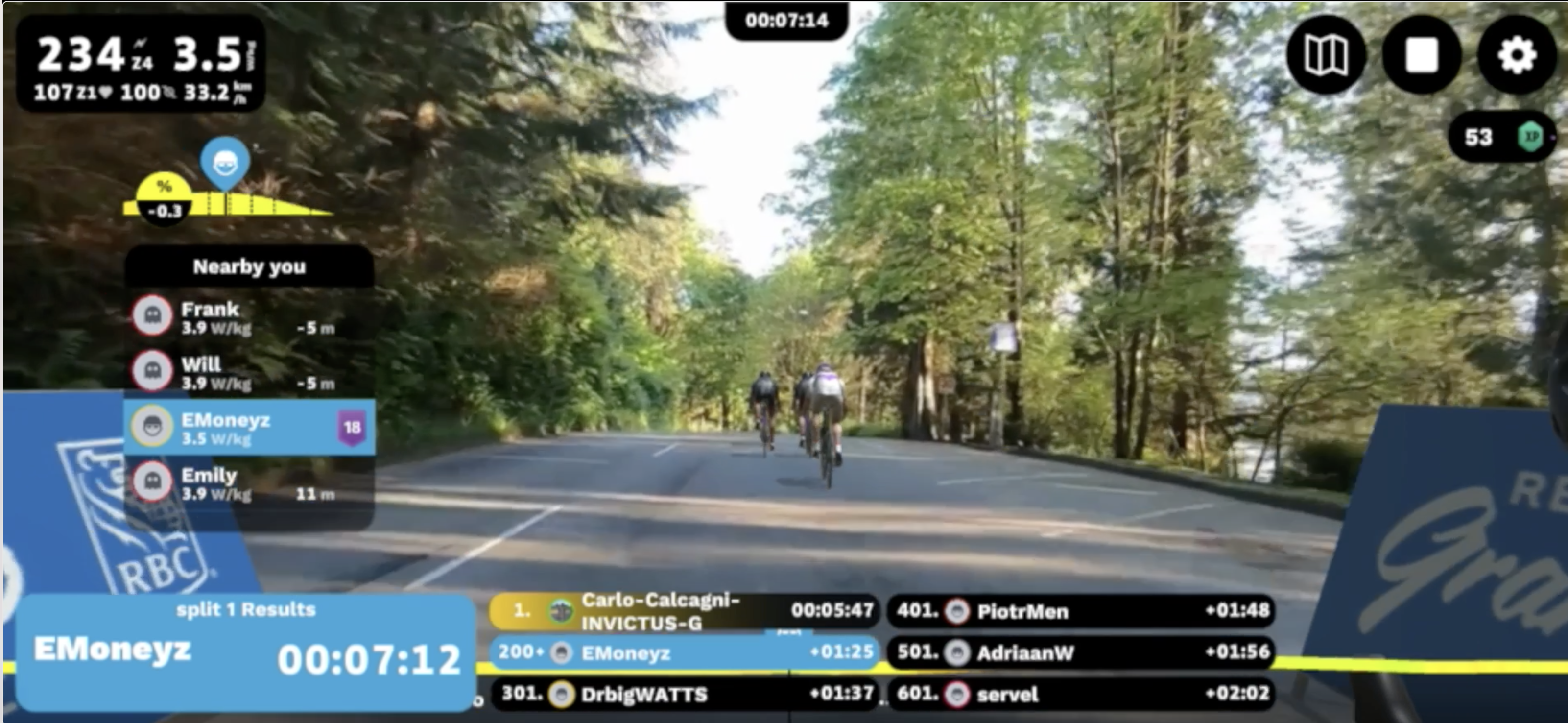
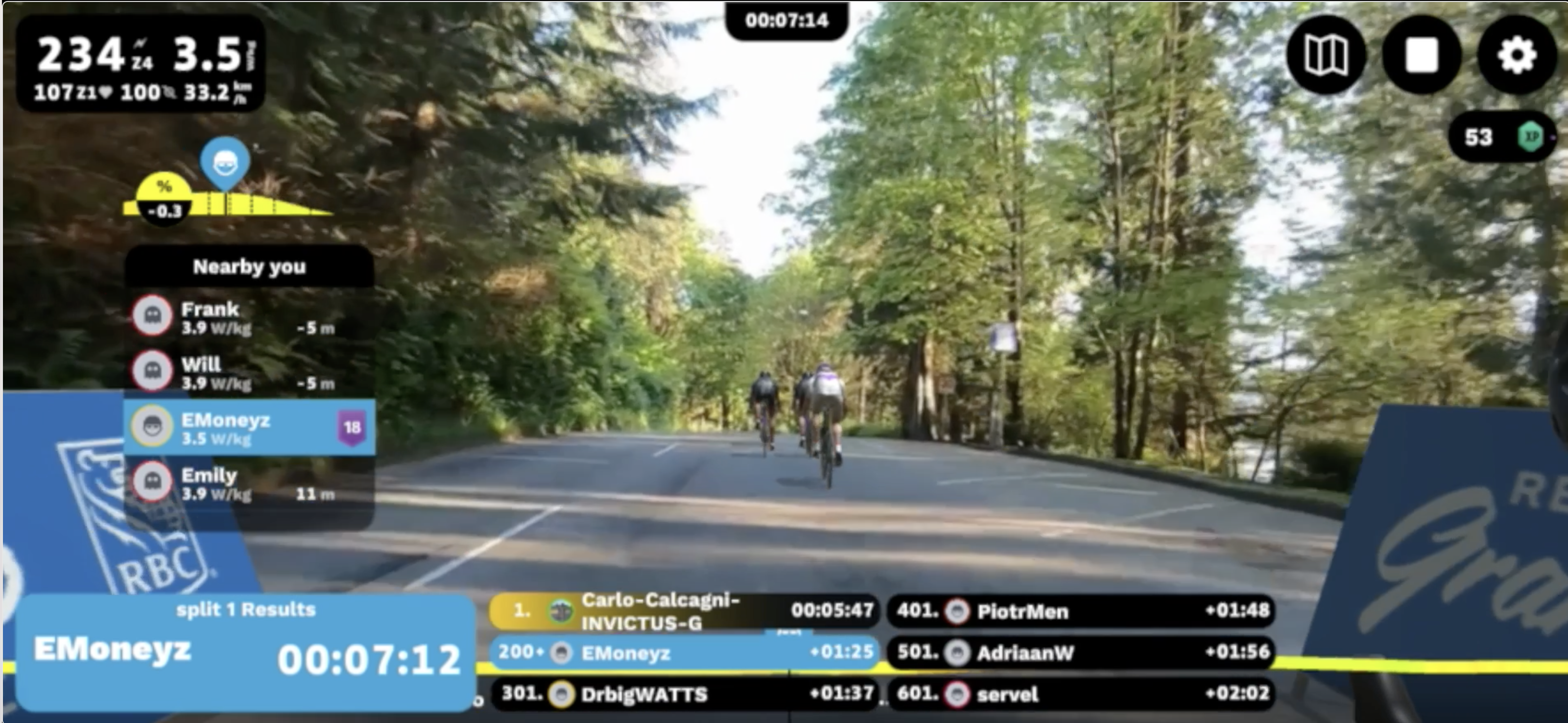
I reached the first split at 7:12 in my second attempt, 42 seconds faster than my first attempt, which was 7:54. I was on pace to break my record and still felt relatively good as I approached the hill.
There was no sign of me slowing down at this point—I was full steam ahead. At the climb, my heart rate rose, but compared to my first attempt, it was still at a moderate zone 2 level. Yeah, something must not have been right, so we’ll take that metric with a grain of salt.
It’s incredible to see the difference in the power I was putting in. I remember that during the climb in my first attempt, I decided to turn it on, pacing myself for most of the race but pushing it now. I did the same in my second attempt. Finally, my heart rate shot up to 177, reaching zone 6 by the end of the climb. It seemed to at last calibrate appropriately. I was indeed giving it my all as I approached the descent, where I continued to put down the watts. I wanted to ensure there was no denying that I had improved.
By the end of the climb in my first attempt, my heart rate was only in zone 4. There was no doubt I had some left in the tank, and I had picked this point to really increase my effort. But it was too late. There is something to be said about being able to go steady and hard the whole way through.
In my second attempt, I was almost done by the time my first attempt finished the climb. I flew down the descent and finished at 15:17.9, beating my previous record of 16:38.7 by 1 minute and 21 seconds. I was on average 3 km/hour faster and pushed an average of 37 watts more. It’s safe to call it an improvement.
But wait, the experiment is not over. What about the real world?
So much had happened in the two months between the two attempts. Yes, I went through the training plan, but I also had a couple of crashes that messed up my confidence. I had low expectations this go. I knew beating my original time was possible, but I wasn’t willing to do anything too risky. My arm, although it felt much better, still wasn’t 100%, and I couldn’t shake the image of myself crashing on the descent. Nevertheless, I approached the start line with determination to try my best. It was all I could do.
Like my indoor ride, on my second attempt outside, I went out a lot harder at the start. If my training worked as it had shown, I shouldn’t hold back as much. I needed to go for it! This was especially true if I anticipated being a bit nervous on the descent later on. I wanted to give myself as much running room as possible.
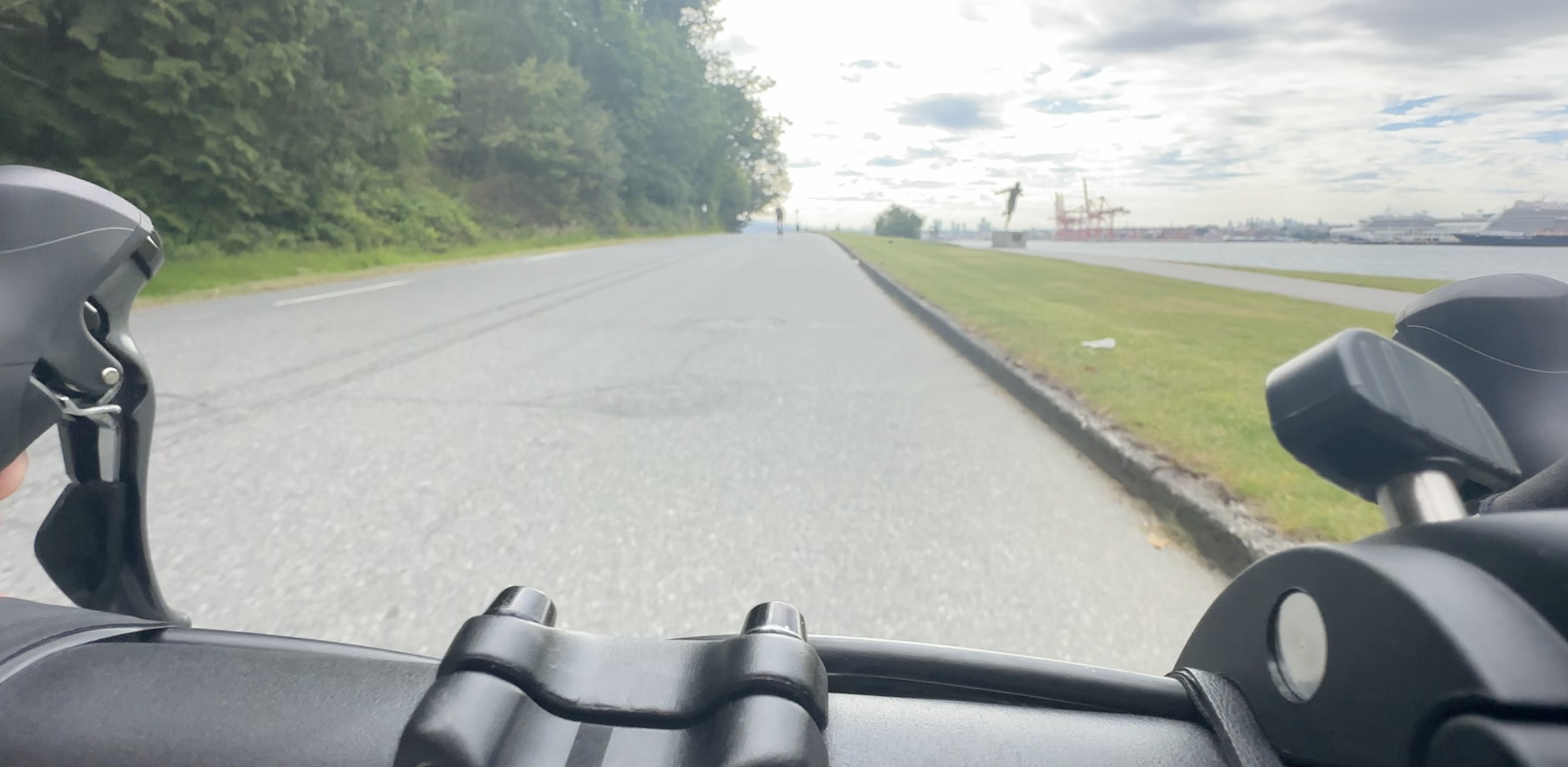
My first checkpoint was the turn into Stanley Park, where I had to slow down a bit to anticipate traffic. I counted that I was about 8 seconds faster than my previous time. If I continued at this pace, I could build upon it, so I kept rolling.
I could feel myself moving a lot faster this time, but I also knew it was not going to be easy. Unlike my first indoor time trial, the last time I rode the course outdoors, I really was giving it my all.
Luckily, there were a few riders that day on my second attempt who were really flying, especially this guy. I used him as a bit of a carrot to chase, and he actually helped pace me. That guy was going fast, and if I could at least keep him in sight, I knew I could beat my previous record. But he was moving. It goes to show that as much as I have improved, there are still so many people who are better.
At the midway point, I counted about 20 seconds ahead of my previous time. This gave me a slight bit of comfort, but like I mentioned, the hard part was still to come: the hill.
Thanks to all my training, the hill didn’t seem that hard this time. Yes, it was still hard, and you can hear it in my breathing, but I managed to catch the guy who had zoomed ahead of me, and that made it feel easier. I knew I was on pace, I just couldn’t blow up now.
Looking at this footage, it’s interesting to see how green the park got in the past few months. That’s something that certainly isn’t replicated in the virtual version.
I got to the top of the hill about 36 seconds faster than my previous attempt. That hill climb allowed me to extend my lead by an additional 10-15 seconds. Now all I needed to do was stick the landing, get down the descent at a moderate pace, and I would beat my time. Good thing the guy I passed on the climb passed me again. It was nice to have him on the descent because it made the experience feel less lonely. Then another rider joined us. We were a group now, which really erased all my worries, and I could just follow their lead.
I did it! Got all the way down and I ended up beating my time by 45 seconds, finishing at 20:13 compared to 20:58. This was far better than I expected! I thought I was only going to squeak through with a few seconds left, but 45 seconds is substantial.
So in a matter of a couple of months, I improved my indoor time by nearly a minute and a half and my outdoor time by almost a minute. After my crashes, a part of me thought I might give up completely and find a new hobby where I could stay inside bubble-wrapped. I am thrilled that I stuck with it and saw an improvement. But I know this is only the beginning. There is so much more to learn and improve on. What fun projects I have ahead!
Thank you all for joining me on this journey. I hope you enjoyed the ride with all its ups and downs. I assure you there is more to come in my triathlon adventures, so if you don’t want to miss it, please subscribe.
Join my YouTube community for insights on writing, the creative process, and the endurance needed to tackle big projects. Subscribe Now!
For more writing ideas and original stories, please sign up for my mailing list. You won’t receive emails from me often, but when you do, they’ll only include my proudest works.
Hi, I’m Elliot, and I’m here to improve my cycling skills. To achieve this, I’m embarking on a project I call FTP Builder, inspired by the Build My FTP workout I’ll be taking on in Rouvy. This series will be told in five parts. This is Part 4, entitled: Race and Recovery
One week before I was to race in a Sprint triathlon, I took a spill off my bike. Crashing right into the curb. This was partly caused by the fact that I was still recovering from a previous fall I had two weeks before. Needless to say, at this point my nerves were a bit shaken, my confidence was compromised, and my bike had some new scratches to remind me of my ambitions — and errors.
I had intended to finish the Build My FTP training plan with one week to taper, but that plan is now out the window.
I did one more test run on my road bike just to keep the feel, but the most important thing was not to do anything risky. There was no point in pushing it anymore. This race will not be about performance and personal records but rather about enjoying myself. My goal now is simply to finish the workouts I committed to, not in 4 weeks but in 6, with the last workout taking place 2 days before the race.
Final Workout:
The final workout for the Build My FTP training plan was an easy ride that lasted just under 30 minutes. It was steady most of the way with 2 significant bursts at the 3 quarter mark.
Overall my legs felt great. When I consider how strong they feel, it’s hard to believe that I won’t be able to use them to their full potential. The thought of descending fast or taking a sharp turn still made me nervous. All the indoor training had been great, but having lost so much confidence outside was just disappointing.
Sadly, injuries are a part of the sport. Like I said, coming out with just a sore elbow, a few scratches on my body, and minor damage to my bike was really a lucky outcome. It could have been much worse.
In the end, the accident was a good learning experience. I’m the type of person who needs to learn from making mistakes. I can hear advice all I want, but experiencing an injury that compromises my performance in a race is something I will carry with me into the future. For that, I am grateful. Give me a diploma for that!
North Shore Sprint Triathlon Race:
The sprint triathlon race I participated in was hosted in North Vancouver. The course started in a community pool with a 444-meter swim, featuring a staggered start with the fastest swimmers going first.
I had a hard time predicting my speed, as my right arm was still only about 75% healed. When I tried to pull, I couldn’t generate much power on that side. Overconfident as usual, I positioned myself too far ahead and ended up letting 8-10 people pass me along the way. This short swim was much harder than I expected due to one end being super shallow and choppy. Anyway, all is good, and I survived.
I had been dreading the bike course. Anything can happen, and I was still nervous about my cycling abilities. So, I took my time preparing at T1, making sure I had everything I needed. I took a gel and got up the initial hill into the course, which was an out-and-back that I had to complete 4 times.
Heading out was a moderate hill, nothing too crazy, but it did allow me to coast a bit on the way back. The tricky thing was the two hairpin turns at either end. With my nerves, I might have hit a cone on the last lap out. Luckily, I didn’t fall off my bike this time and embarrass myself. I’m genuinely pretty happy with the way it went. Confidence up 10%!
Once the bike leg was done. The run was a piece of cake. Even though it was a hilly course, with over 90 m of elevation gain, I felt great and finished strong. if I came in 100%, I’m honestly not sure how much better I could have done. Maybe a minute faster in the swim? Maybe another minute on the bike? We’ll never know.
In the end, I finished somewhere in the middle of the pack and the race worked out in its own unique way, and that’s all you can ask with this stuff sometimes.
Returning from Injury:
When it was over, I took a week off from riding outdoors, and started loosening up and preparing myself for my A-race in September. An Olympic distance triathlon in Stanley Park. I honestly felt pretty shaky getting back up to speed. Parked cars and curbs made me nervous. Doing simple things like descending or riding one hand to drink from my water bottle was really tricky. I was worried about pulling too hard on the brakes again and flying over the handlebars.
I couldn’t help replaying the accidents in my head. So I considered the best way to confront my fears, and that was to return to the scene of my accidents. Riding past where I had crashed and seeing how innocuous the road was, I wondered how I even fell the first time. I chalk it up to just having a lack of focus that one time. A one time thing. Let’s move on.
After a month of just getting back into the groove with safe indoor riding and light runs, I prepare myself for the final chapter of this project. At the start, I gathered some baselines numbers for this experiment.
In the conclusion of Project FTP Builder, I’ll return there and see if I can beat my time.
Stay tuned for the final installment… and subscribe so you do not miss it!
For more writing ideas and original stories, please sign up for my mailing list. You won’t receive emails from me often, but when you do, they’ll only include my proudest works.
Join my YouTube community for insights on writing, the creative process, and the endurance needed to tackle big projects. Subscribe Now!

 Elliot Chan