This is part two in the series. Read part one.
As a part of the process of gauging my current cycling level, I decided to do a time trial ride on one of Rouvy’s courses and compare it with the same route in real life. For this experiment, I chose the iconic Stanley Park loop in Vancouver, British Columbia.
Stanley Park is a beloved destination for cyclists in Vancouver. The loop around the park is about 10 kilometers of scenic beauty, featuring coastal views, a hollow tree, and glimpses of the city skyline and the Lion’s Gate Bridge. It’s one of my favorite outdoor spots in the city and just another reason why it’s so great to live in Vancouver. .
And it’s perfect, because for my Olympic distance triathlon later this year, I will be doing four loops of this course, so this is very appropriate training for me.
So let’s get started.
The Virtual Ride: Stanley Park on Rouvy
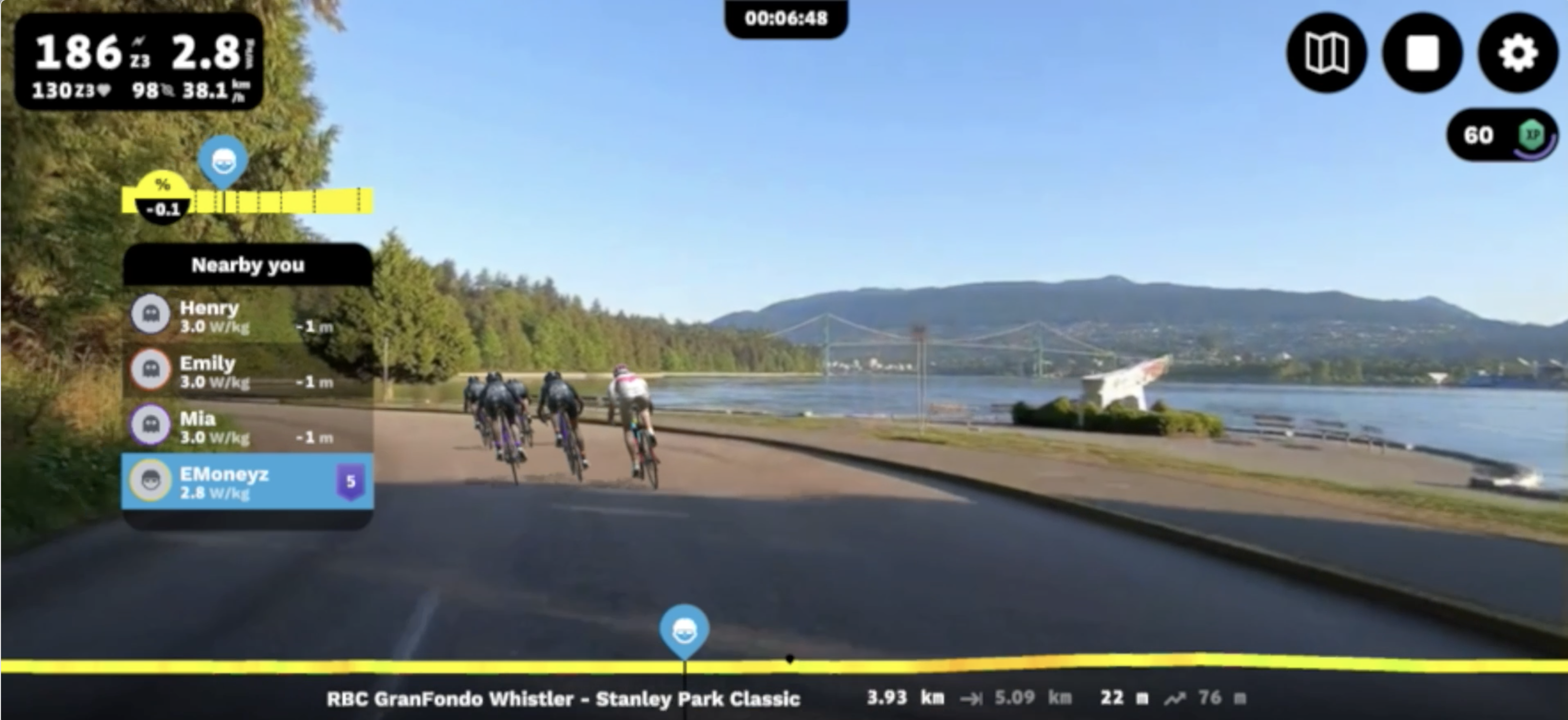
I decided to start with the virtual ride on Rouvy.
I’ve taken the Stanley Park loop many times before, but doing it virtually was new. My first impression was a good one, the virtual representation was impressively accurate. As I pedaled, I recognized all the turns along the way leading in, and for the first time, I didn’t have to look over my shoulder while cutting across the road.
One major advantage of riding on Rouvy is that I didn’t have to worry about traffic. There were no cars to navigate around, no tourists stepping into the bike lane, and none of the usual park hazards like potholes, speed bumps, or horse droppings. The virtual course was smooth and uninterrupted, allowing me to focus entirely on my performance.
Additionally, I didn’t have to worry about the big hill’s challenging incline or my handling on the big descent. The effort was consistent and controlled, which made it easier to maintain my target power output at about mid 180s, all the way until I reached the hill, where I began pushing it up to the mid 220s. With all that I ended up completing the course in 16:38.7, which is an average speed of 32.5 km/hour.
Not bad, but there is definitely room for improvement, and I can’t help feeling that I might have held back a little.
I do love all the data I get right in front of me on my virtual rides. You see, I don’t have a power meter on my road bike, and I can’t just magically appear at the start line at Stanley Park, I’ll need to ride about 10km to get there, so all of that will play a factor in my performance in real life.
But hey, no excuses.
The Real-Life Ride: Stanley Park in Person
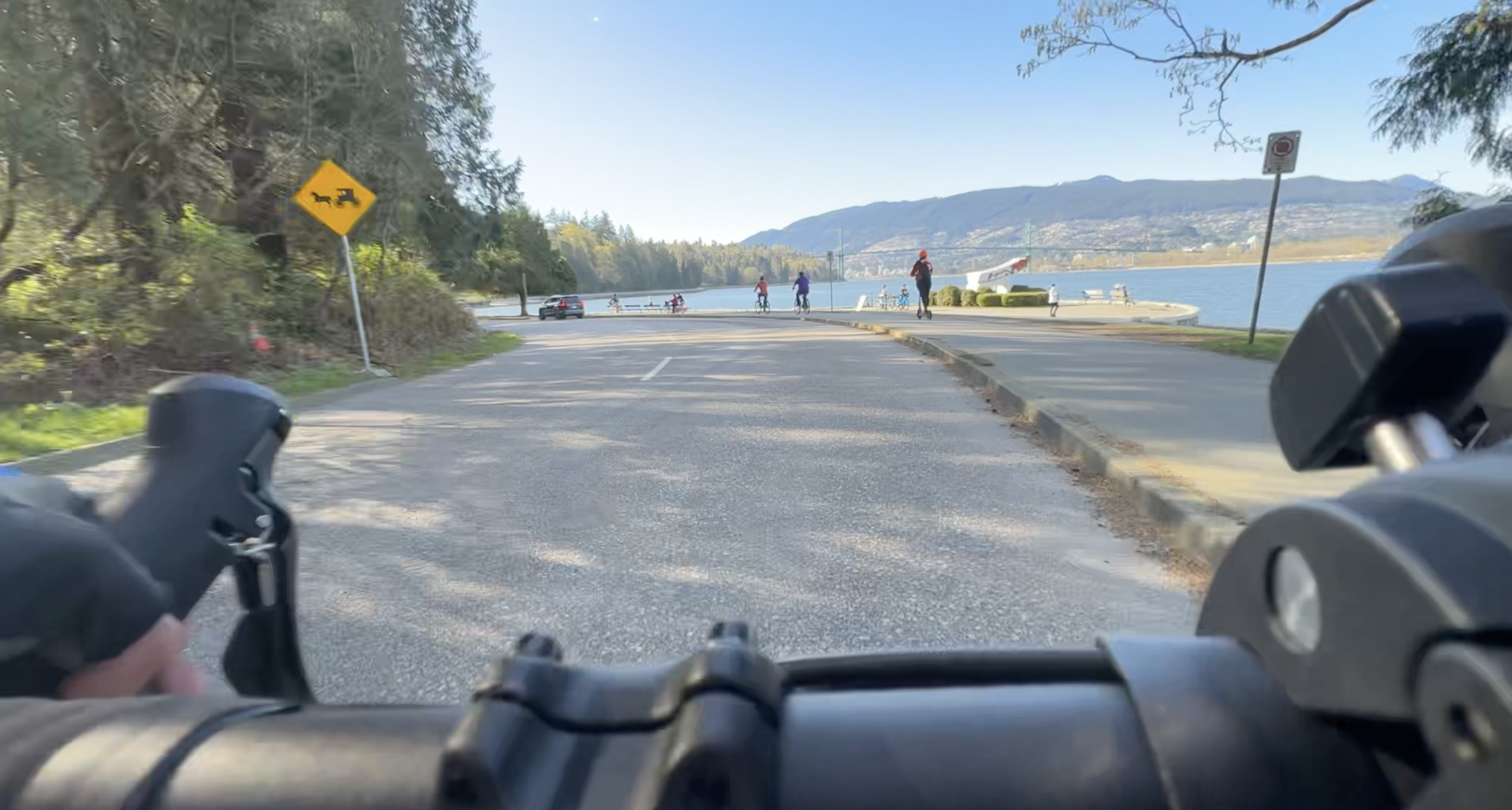
A few days later, I took my bike to Stanley Park to ride the loop in real life. The experience was, as always, invigorating. It’s so nice to get away from the desk and the screens and be outside. However, going all-out on a time trial came with some challenges.
To start, I had to deal with traffic along the first half of the ride. Navigating around cars that were clearly there to do some sight seeing added an extra layer of complexity. I happened to choose a Friday afternoon for this ride, so really it’s my fault.
Additionally, my front chainring was making an annoying sound, which was a constant distraction as I entered the park and started to accelerate.
As I continued, I encountered other riders who were out for a casual ride but were blowing past me effortlessly. This was somewhat demoralizing, especially when I was trying to push as hard as I could, taking this time trial as seriously as I could.
Yes, I was attempting to do this familiar course as quickly as possible, but riding in the real world means being aware of my surroundings and the potential hazards. Other riders, pedestrians, parked cars, little bumps in the road, I’m not skilled enough to just bury my head and push power.
In the real world, I cannot just step off my bike and lie down in bed. I had to gauge how hard to push myself because I didn’t want to blow up halfway and still needed to get home.
Then came the hill. This is the most challenging part of this course, but it was also the section that made this loop so enjoyable. I both look forward to it and dread it.
Here was where I could really put down some effort and make a difference in time, as I usually take this part as lightly as I could to conserve energy. This time, I caught a couple of causal riders on my way up, which gave me some confidence as I headed towards the decent. Even though this was the fastest I’ve ever done the decent, at the end, another rider just flew past me. It goes to show that I had a long way to go.
Still nothing beats the rollercoaster feeling of soaring down that hill. I love it. It’s such a nice rush and — it’s free, all it cost was the power to get up.
In the end, I finished the Stanley Park loop, exactly where the Rouvy course started at just under 21 minutes. 20:58, if I’m not mistaken.
That’s a difference of 4 minutes 20 seconds between Rouvy vs the real world, which to be honest, is pretty good!
I thought with all the factors of the real world, that my time would be much slower.
I’m pretty glad that Rouvy has a virtual course that is local to me as well. Since I will have to do this Stanley Park loop 4 times for my Olympic distance race at the end of the summer, I’m happy that I will have it accessible to practice, and that I can use the real world vs indoor experience to gauge where I am in my training.
If you live close to a Rouvy course, I really recommend you giving this benchmark test a try.
Both Rouvy and real-life rides have their unique advantages. Rouvy is great for its convenience, detailed data analysis, and consistent training conditions, making it perfect for structured workouts and tracking fitness.
On the other hand, riding outside provides a richer experience and there is something to be said about physically moving through space and seeing the world pass by. And it’s important to experience the thrill of travelling over 30 km/hr in real life.
Now that I have my benchmarks, I’m ready to move to the next phase of this project, which is actually going through the workouts. Like I mentioned before, I will be doing the Rouvy FTP Builder workout, which will last 4 weeks. At a glance, it seems pretty hard, but I look forward to it and hopefully, it’ll all be worth it and in the end, I’ll be fitter and more capable on the bike.
Stay tuned! Thanks for joining me on this ride—if you want to follow along on this journey, hit subscribe and check out this playlist right here.
For more writing ideas and original stories, please sign up for my mailing list. You won’t receive emails from me often, but when you do, they’ll only include my proudest works.
Join my YouTube community for insights on writing, the creative process, and the endurance needed to tackle big projects. Subscribe Now!
 Elliot Chan