Vancouver’s viaduct variables

11418461

What shall we do with the Georgia and Dunsmuir Viaduct?

By Elliot Chan, Opinions Editor
Formerly published in The Other Press. November 11, 2015

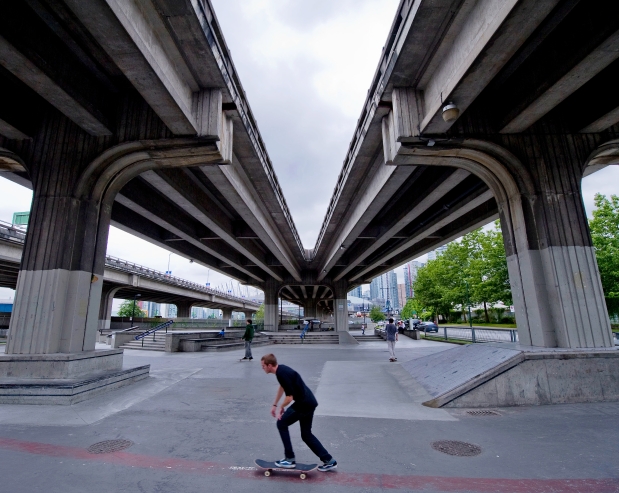
Now that the filming of Ryan Reynolds’ Deadpool has ended, I guess we can start talking about how awful the Vancouver viaducts are. If you are unfamiliar with these viaducts, they are the two roads that connect Prior Street, Strathcona to Expo Boulevard, Stadium/Downtown. It’s the big concrete bridge that runs alongside the SkyTrain from Chinatown to Rogers Arena.

Built in the 1970s, the viaducts were designed to be an entry point into the urban core of Vancouver. I’ve taken it to and from the city as long as I can remember, and it has never—ever—been a pleasant experience. Now, with the inception of the bike lanes, the viaducts are hazards left, right, and centre. And let’s not forget about it also being a seismic calamity waiting to happen. So when the city council voted to replace the ultra thin, unsettling Hot Wheel tracks with a six-lane, ground-level road that offers neighbouring areas more space for parks, residential, and commerce, I was all in.

But once the viaducts are torn down, what will ultimately take their place will be high rises. Let’s not lie to ourselves, we are running out of room in Vancouver, and building upward seems to be the only feasible solution. While some people have a problem with that initiative, I don’t. Done correctly, buildings can be as beautiful as the waterfront. Buildings can become the ripples of the city, where the waves are the ripples of the ocean; both can be majestic and encapsulating to look upon.

The problem with so many big cities is that their infrastructures end up fencing people from one corner away from people in another corner. Basically, crossing the road becomes a great hassle, so people don’t do it. This creates a divide, which eliminates cross-community engagements. The viaduct truly makes it difficult to traverse. Nevertheless, we should not make the same mistake. The great big cities of the world—London, Paris, and New York—have channels that connect pedestrians, not just vehicles. In Hong Kong, people never have to touch the solid ground; there are walkways connecting to every part of the city, some call it a “pop-up city.” I digress; we shan’t be one of those, albeit it does sound cool to live in such a futuristic metropolis.

Those designing the new roadway systems are assuring us that it is going to be better. I believe them, because honestly, I don’t see how it could be worse. I fear that one day we are going to be like Los Angeles with layers upon layers of highways. With the demolition of the viaducts, I can feel relieved that at least for the moment we are taking a step away from that.
What is war (and I) good for? Absolutely nothing!

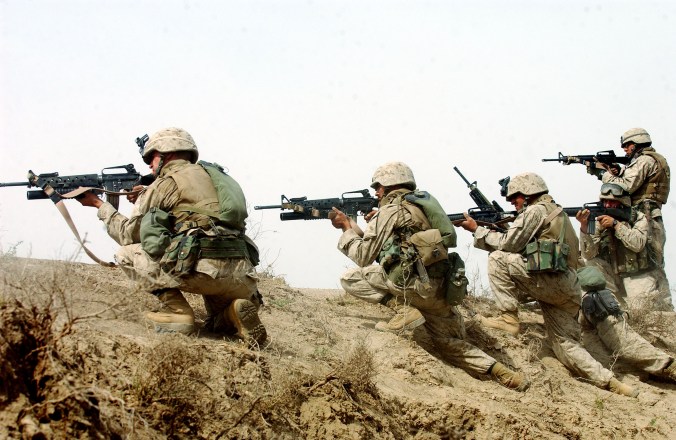
U.S. marines fire on a group of insurgents shortly after they launched a rocket propelled grenade at their 7-ton truck while on a 'movement-to-contact mission in order to flush out insurgents operating in the Fallujah area  south of Fallujah on Thursday, April 15, 2004 in Iraq.  The marines are part of the 3rd Battalion, 4th marine regiment, which saw heavy combat at the beginning of the war last year, and is now back in Iraq embroiled in intense fighting with the resistance.  Today, the men of the 3rd Battalion were ambushed half a dozen times while they patrolled the palm groves and wheat fields around fallujah, and the marines killed at least 10 insurgents, and suffered only minor injuries. (Credit: Lynsey Addario/ Corbis, for The New York Times)

Would I become a soldier if there was a war to fight?

By Elliot Chan, Opinions Editor
Formerly published in The Other Press. November 11, 2015

There was a time when refusing to fight in a war was an act of cowardice. Conscientious objectors were often shunned for being “unpatriotic” and “disgraceful.” Many of them in the past were even considered criminals. Thank god we don’t live in those times anymore. As Remembrance Day approaches, I’m often left with a bitter, remorseful feeling, because I know, I’ll never make such a sacrifice—I won’t!

Those who serve on the front line today demand respect. However, that does not necessary make them “heroes.” The way I see it, it makes them victims. I respect them not because of their training, but how their training and their experiences have corrupted them. Hate begets hate. War does not elevate kindness, tolerance, and benevolence in people; it pulverizes it with fear and righteousness. Post-traumatic stress disorder is chalked up as a workplace hazard for soldiers like carpal tunnel is for office workers.

We are currently living in the most peaceful time in the history of humanity. Yes, there are countless wars taking place on this planet, but most of them are civil wars or wars between countries separated by a thin border, far from where I am. These wars are feuds between neighbours that have lasted generations upon generations. If I were to pick a battle to fight, it would be an intrusion. Me sticking my nose in something I truly don’t understand.

One nearsighted saying I hear from those who are willing to join the army is this: I fight so my children won’t have to. First off, your children will do whatever the hell they want to; they’re their lives. Secondly, if you truly care about your children, you should teach them acceptance, rather than aggression. Teach them that there is more to a war than simply good guys fighting bad guys. Thirdly, if you think there is anything to gain from becoming a pawn, you are right, there is. There is a lot of profit, but don’t be surprised if it all goes to corporations—not to you or your children.

It might sound selfish of me to say that I wouldn’t defend my country. But what does it mean to defend my country? Does it mean entering someone else’s home and killing innocent people there until I find the few that are doing wrong to the true north strong and free? I hope not. In Canada, wherever we send our troops, we say we they are there for “peacekeeping” reasons. I don’t know how peaceful I can be waltzing into a battle zone.

We need to appear strong in the face of adversity. We need to have muscle so that the world at large won’t push us around. But the thing I never understood about our military, and those of our allies, is this: How will our guns stop their guns? How will our blood wash away their blood?

I’ll support our troops by taking off my hat during ceremonies, but man, there has got to be a better way.

Book Review – This One Summer

Formerly published in Ricepaper Magazine

51pPqSnhtBL._SY344_BO1,204,203,200_THIS ONE SUMMER
By Mariko Tamaki and Jillian Tamaki

Groundwood Books (May 6, 2014)
320 Pages, $17.99 (Paperback Graphic Novel)


REVIEWED BY ELLIOT CHAN


Awago Beach has been a summer sanctuary for Rose and her parents for as long as she can remember. Fresh air, a private lakeside cabin, and Rose’s friend, Windy, make up for the monotonous humdrum of childhood vacations. But, this one summer, Rose dares to overstep her boundaries. Fueled by fascination, naive yearning, and repressed angst, Rose becomes entrenched with the complicated lives of the local teenagers and her parents themselves—in addition to bingeing on candy and horror movies.

This One Summer flows like a dreamy, lazy July afternoon, the kind that doesn’t last forever, unless in our memories. The humorous yet meditative storytelling plays on the reader’s nostalgia, while the illustrations offer a vantage of yesteryears that many of us are beginning to misremember. The coming-of-age graphic novel is sincere, captivating, and poignant, but most of all it is a faithful rendering of both ephemeral and intense moments that makes up a season in a life.

Mariko and Jillian Tamaki skillfully capture the subtleties of adolescence, teenage-hood, and even adulthood. With a few simple frames and some indispensible words, the hesitation of youth, the dynamic of a modern family, and the consequences of reckless decisions are fully presented with a heartfelt attitude that is pure and powerful.

This One Summer is the Tamaki cousins’ second full-length collaboration. In 2008 their graphic novel, Skim, a story about the culture and conflicts at an all-girl Catholic school, received wide acclaim for its equally passionate presentation of the younger generation. There is no doubt that there is a harmonized understanding between the two artists. The ability to place the microscope on such a tender corner of existence is an element that is often absent in most of life’s maturing ventures.

Mariko and Jillian remind us in This One Summer that new experiences have no age restrictions, and that coming of age is actually a lifelong endeavour. Although the focal point of the story is on Rose, she is in fact the supporting character to the real drama of those around her. We have all stood where she stood, at the perimeter of other’s lives, helpless to assist, and powerless to disengage. We ride the turbulent waves, while witnessing the ebb and flow of those around us. This stunningly candid graphic novel, in the end, encourages us all to stand by those we love and overcome the adversity of another fleeting summer.

To be reviewed

Screenshot from 'South Park'

Are crowd-source reviews still effective?

By Elliot Chan, Opinions Editor
Formerly published in The Other Press. November 4, 2015

The recent South Park episode “You’re Not Yelping” shone a light on the power of public opinion. Review sites such as Yelp, Zomato, and Rotten Tomatoes have given regular everyday folks like you and me the power to vote up or down virtually anything. This type of social governance seems to be democracy at its finest, since everyone who has a voice is encouraged to use it. But are we really getting honest reviews or are we—as pseudo-experts—trying to sway people away from their own authentic experience with our biased perceptions?

Ultimately, all reviews are biased. It doesn’t matter if you are getting them from Roger Ebert or your mother; regardless, the review is a product of the person’s life, thoughts, and opinions. This is great, because freedom of speech is wonderful. But not everyone is posting reviews. In fact, only an incredibly small percentage of people actually create content on review sites. Journalist Susan Kuchinskas informed us of an interesting statistic, known as the “1/9/90 Rule.” The rule states that only one per cent of people write reviews. Nine per cent of people will drop in on those reviews and rate them. The 90 per cent are solely readers, swayed by those reviews by the one per cent.

I’m opinionated, but I’m not a reviewer. I have never written a review on Yelp, or any other site that encourages me to. Why should I? I don’t believe people should do or not do anything based on my opinion and experience. Don’t listen to what I say, because what I’ll say is go watch Jack and Jill starring Adam Sandler and come to your own opinion on whether it’s good or not. Don’t simply look at the ratings on IMDB.com and automatically write it off. Make your own discovery, not just an easy conclusion via crowd-sourced reviews.

They say professional reviewers are dying out, and I believe that makes sense—not because reviews don’t have some substance though. Quality ones are introspective commentary on pieces of art or experiences. It’s—in its own way—literary. However, consumers don’t want introspection. Consumers want yay or nay: should I go here, or should I keep searching?

The Internet influences so many of our spending decisions. I say we should turn that off for a bit and come to our own conclusions. Let’s not listen to that one per cent for a little while and see what we can discover on our own. It’s a risk, sure, but I know we have clear judgement, capable of distinguishing between good and bad. I encourage you, the next time you are scrolling on your smartphone looking for a place to eat, ignore the star ratings and reviews, and just give a restaurant a chance. How can you know what is good when you are constantly avoiding bad?

This returns us to the ultimate question: are crowd-sourced reviews still effective? I don’t know, but they’re probably as effective as this article.