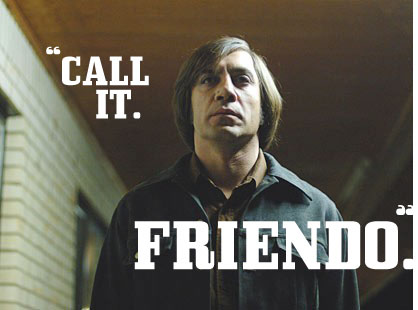
Called it—maybe

friendo

Should we be praised for our predictions? 

By Elliot Chan, Opinions Editor
Formerly published in The Other Press. April 1, 2014

Whether it’s a sporting event, the weather, or the end of the world, people love to predict the future. Some rely on the science of probability and statistics, but many predict by guessing out of speculation—and surprisingly, it’s as effective as any other method. Because when the dice are cast and the coins are flipped, chances play the largest factor in prediction. So, if you haven’t called it recently, you are bound to at some point.

We make thousands of predictions daily. We predict the arrival time of the bus, the mark we got on our exams, and the emotion we’ll feel when we see our friends at the end of the night. We get a lot of joy from predicting correctly, even though the guesses might not be in our best interest.

“The bus is always late,” you’ll say before you even leave the house. This isn’t a daring assumption compared to gambling, and it isn’t as rewarding either, but it satisfies you in the same way—if to a lesser degree. This type of prediction allows you to feel good whether the bus comes on time or not. You either called it, or find the nice surprise of a punctual bus.

People predict both out of confidence and a lack thereof; in other words, a need to cover their asses. It reduces the hurt of possible disappointment, while entertaining them lightly during mundane events. By predicting, we can make a high-stake event out of something that has little interest. Sports and awards shows are great examples of this cognitive hypothesizing. One of the teams will win, and odds are we might be able to guess it.

Uncertainty is scary, really scary. Imagine if we lived a life where we didn’t understand the concept of death; that death wasn’t an inevitable end to our lives. How differently would we live if not fearing death? But we are aware, and are therefore very capable of predicting every possible situation that will kill us, even if that means predicting the apocalypse or a new pandemic.

No matter how good at forecasting the future you might think you are, you’re powers are useless, because foresight, although it has value for yourself, is completely useless for most other people. If you are right about the apocalypse, it’s the apocalypse and we’re all dead anyways, but if there isn’t an apocalypse, then you’re a crazy, stupid person. If you called the result of a hockey game, great job! You might get a high-five from me, but it doesn’t make you superior in any way.

Predictions are made to satisfy you alone. We all have the ability to predict, so we don’t need other people to do it for us. We all like feeling smart, but when we confuse a lucky guess with knowledge, then we’re bound to misinform and tarnish our credibility. So if you think you know what you are saying, go ahead. Call it, friendo.
Sweetening the deal with a ‘honey’

Microsoft offers PC users $100 to upgrade

By Elliot Chan, Opinions Editor
Formerly published by The Other Press. April 1, 2014

Marketing ploys by big name companies are nothing uncommon. We get coupons, discounts, and bargains all the time—if we look for them. So it seems that Microsoft’s recent incentive for consumers is nothing to go crazy about, right? Right. In fact, their $100 store credit seems more like  bait than a real great deal.

Until June 15, Microsoft will be offering current Windows XP users a $100 discount to upgrade to the new Windows 8.1 computer. In other words, Microsoft wants users to continue spending money on their new products instead of riding out their old ones.

This marketing strategy is similar to their console-war strategy earlier this year, when the PlayStation 4 was duking it out with the Xbox One for gaming supremacy. PlayStation owners can go to a Microsoft dealership and exchange their PS4 for a Xbox One and receive a $100 off. For financially strapped individuals, this may sound like a great deal, but on a closer look, you’ll realize that you would just be paying roughly the same amount for the Xbox One as you had for a PS4 (approximately $500).

We often shun and make fun of those who have inferior technology, as if high-end and new electronics are a status symbol worthy of pride. Computers are built to break, like cellphones, automobiles, and microwaves. Yet, computers are one of those things where we, as a society, don’t say, “If it ain’t broke… yadda yadda!”

Right now, my iPhone is telling me to update my software, while my MacBook Pro is informing me that there is a new OS X update available (whatever that means). I don’t want to update. I updated last week, last month, last year—just let me use my computer without forcing me to restart it. It’s not broken; you don’t need to fix it!

Know this: it’s not worth keeping pace with such minor advancements when we live in a world where today’s state-of-the-art technology is tomorrow’s laughable artifact. There will always be a newer version of whatever.

Don’t be swayed to pay extra fees to upgrade, unless it’s something you actually want, it’s at your convenience, or it’s absolutely necessary. We all want the newest version of whatever, and we all want the top-of-the-line products in our house, but purchasing blindly, just because it’s financially appealing, is not the right move.

Microsoft wants to tell you that your old computer is out of fashion. Well, Microsoft doesn’t understand that we aren’t all crazy about the latest updates and computers—we just need them to be working properly. Sure, the $100 is a nice thank you for your loyalty and that should be commended. But why not just offer that $100 into improving what is already working instead of forcing the user to buy a new $599 to $2,299 computer?

The new Windows 8.1 might be newer and shinier, but after 13 years of using the same operating system, you can’t just lure consumers out with a little bribe.