Textbooks: the other tuition

The relationship between students and their textbooks

By Elliot Chan, Staff Reporter

Formerly published in the Other Press. Aug. 13, 2013

NEWS_texbooks_final

As Douglas College classrooms fill up for a new academic year, students are emptying out their wallets for the exact same reason. Regardless of how much students organize their educational finances, the textbook monopoly will take a big chunk out of their limited funds. It’s the way the game is played—but are textbooks a good investment, or are they simply a luxury tax? A 900-page burden, or an instructional baton waiting to be passed on to the next wary student seeking discounts?

Postings for used textbooks cover the bulletin board on the first floor at the New Westminster campus. It’s obvious that most students have little intention of keeping their expensive textbooks for future reference. Students are simply doing what students do best—being obedient.

“I want to spend as little as possible,” said third-year business student Haleen Mullhi. “But I’ll end up spending between $300 and $400, which adds up to $2,000 each semester.”

Music and accounting have consistently produced some of the priciest textbooks in the store. But the bookstore itself only receives a 25 per cent margin, which Ryan Hill, bookstore supervisor, considers low.

“We are retail, but we are also a service department in the college,” said Hill. “After covering shipping and overhead, the bookstore makes a low profit.”

It’s not always easy to see the gain in textbooks when all you hear about are students trying to offload them and the bookstores accepting refunds.

When asked whether or not she will sell her textbook at the end of semester, Mullhi confidently said, “Yes, I’ll post it out on the board and see if anyone wants them.”

Students don’t have many options when the course is done. The textbooks age and become irrelevant, so even though they might not be studying marketing, they still have to be salespeople and attempt to make some money back while clearing off their bookshelves. Many consider open postings on the bulletin board, but be forewarned: although that option might feel like a free-for-all, it can also be a stressful bidding war. Buybacks are the alternative, but students often find the compromise of 10 per cent or less insulting—that’s if the bookstore even decides to take it back.

“We don’t run any stats, so it is tough to say which program has the most textbooks returned,” said Hill. “It is all pretty balanced, because I believe most students have the same mentality—rather they have found another source or they dropped a class.”

The current refund policy only allows for students to return their books in the first month of the semester, within 14 days of their purchase. They must have the sales receipt and may need picture ID.

It’s difficult to tell which program yields the most returns, but Hill noticed that ESL textbooks often come back because of the language barrier and classes are commonly mistaken.

Although price is a deterrent, most students really don’t mind investing in a textbook if they know the course will put it to good use.

“If teachers actually read the textbook and assign homework from them,” said Joyce DesLauris, a first-year nursing student, “and give them credit—it would be worth having.”
Repeat in Russia

Will Canada strike gold in Sochi 2014?

By Elliot Chan, Staff Writer

Sports_Sochi-hockey

Formerly published in the Other Press. Aug. 6, 2013

Remember that day in February 2010? Remember the city—the country bursting with jubilation? Wouldn’t it be great to relive it?

Sure, the Olympics in Sochi is months away, but it’s never too early to talk about international hockey—especially since the NHL has now confirmed that its players will be able to compete in the prestigious tournament.

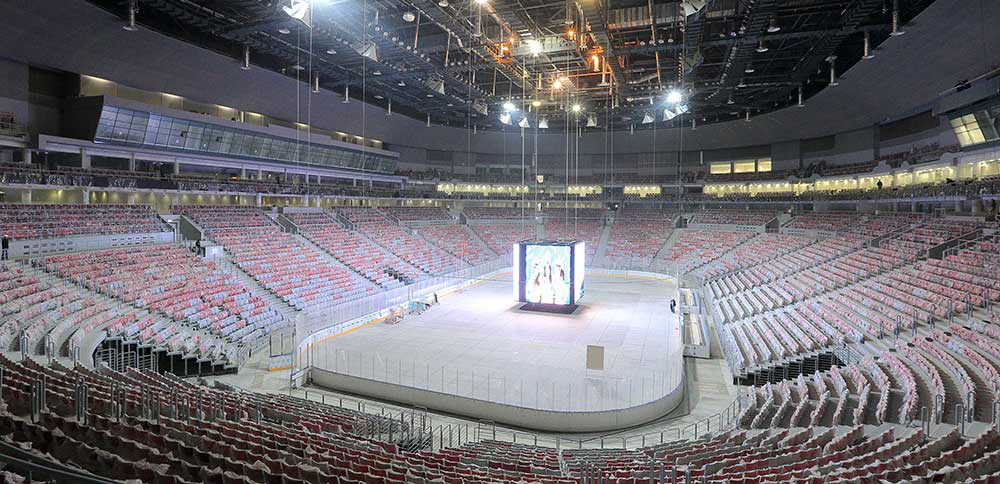
The most notable change in Sochi in comparison with Vancouver is the rink size. The two Canadian ice hockey gold medals in 2002 and 2010 were won on NHL-sized ice (61m by 26m). In Russia, the Canadians will be competing on international-sized ice, which is (61m by 30.5m). Rink sizes have posed challenges before, especially against speedy teams like Russia who can take advantage of the open ice.

The home team is the favourite going into the tournament, but Canada, Sweden, and the United States shouldn’t be intimidated by the jeers they’re expecting when they step onto the ice against superstars such as Pavel Datsyuk, Alexander Ovechkin, and former NHLer turned KHLer Ilya Kovalchuk.

Since the days of the Soviet Union and the Unified Team in 1992, Russia itself has never won a gold medal. But there was a period in history when the red army dominated international ice. But like the Cold War, those days are long gone and though Russia has a barrage of talent, they haven’t been able to make the podium since 2002.

The question that hangs on everyone’s lips is will Canada be able to repeat? I hope I eat my own words, but I don’t believe they will. There hasn’t been an Olympic ice hockey repeat since the Soviets did it in the late ‘80s. Canada might be good, but we have never been dominant. The fact that we won in 2010 was not a miracle, but it was definitely a hard fought game that came down to one key moment. We could easily be talking about USA’s chance of repeating right now if it wasn’t for Sidney Crosby’s heroics.

In 2006, Canada followed up their gold medal victory in Salt Lake City with a demoralizing seventh place finish in Turin. By relying on players that had experience, but were way past their prime like Kris Draper, Adam Foote, and Todd Bertuzzi, the team was doomed from the start. Selecting the perfect team is difficult, since it’s about assigning roles to elite players. With Mike Babcock, head coach of Detroit Red Wings returning to serve another term as team Canada’s bench boss, the players and fans will know they are in good hands. Sidney Crosby, Jonathan Toews, and Shea Weber can all be expected on the roster come February 12, 2014, but the number one goaltender is still unknown.

Martin Brodeur will also be stepping down this year from the international limelight. Roberto Luongo will likely get a few games just because of his reputation, while Carey Price, Cam Ward, and Marc-Andre Fleury will fight for the last two spots.

As excited as I am for the beginning of the NHL season, there is something about Olympic hockey that can make a grown man giddy. The NHL season will pause their schedule from February 9 to February 25 for what should be some epic games in the Motherland.

All eyes on new realignment

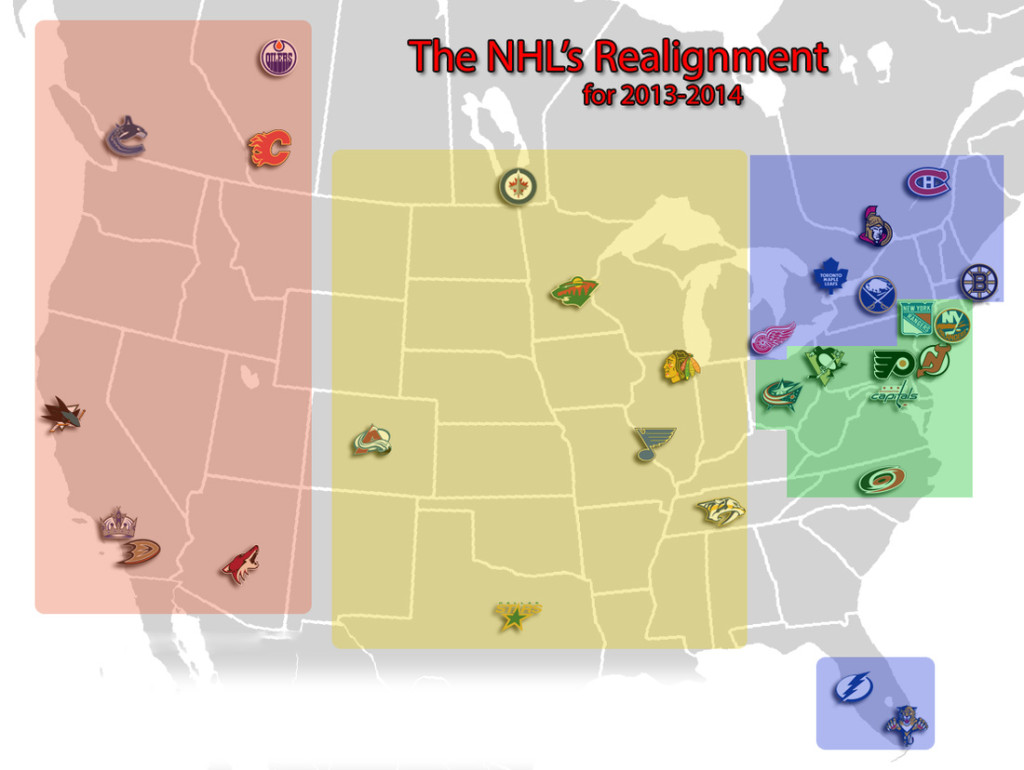
Sports_NHLs-new-regions-1024x770NHL’s new division format intensifies geographical rivalries

By Elliot Chan, Staff Writer.

Formerly published in the Other Press. Aug. 6, 2013

The Vancouver Canucks and the rest of the Western Conference are saying goodbye to Detroit and Columbus, and hello to the Winnipeg Jets.

This time last year, we were all anticipating a NHL lockout; the scenario this season is much more hopeful. As summer ends and the hockey season commences, all eyes are on the year-long experiment—the realignment. The NHL board of governors approved the new divisions and playoff format in July when the 2013/2014 schedule was released.

The Western Conference will now have 14 teams split geographically into the Pacific and Central divisions. The Eastern Conference will have 16 teams split into Atlantic and Metropolitan. The most significant change is Detroit joining the Atlantic division facing-off with three other original six teams, Montreal, Toronto, and Boston. Columbus and Winnipeg swapped conferences, with the Blue Jackets now playing in the Metropolitan division against Sidney Crosby and the Pittsburgh Penguins and Alexander Ovechkin and the Washington Capitals. The West Coast will get a few more chances to see the young Jets team and BC born players Evander Kane and Andrew Ladd.

The two main objectives for the realignment is to shorten travel times and build rivalries. It’s hard to see a downside to this change, since it was inevitable.

“It’s much better for us,” said Dallas Stars defenseman, Stephane Robidas. “It’s less travel, fewer trips out west—the time zones, the amount of time you spend on the plane after games. You don’t have to wait in [Los Angeles], you can come back after games. It’s all little things in the long run I think will help our team.”

The only two teams separated from their division in terms of geography are the two Florida teams. The Lightning and the Panthers are in the Atlantic division, but they have the whole Metropolitan division separating them from the rest of their division rivals.

“From a business standpoint, I think this is probably really good for both Florida teams,” said Commissioner Gary Bettman. “Competitively they may have their own issues, travel-wise they may have issues, but based on where Florida is from a geographic standpoint, whatever we did wasn’t going to be perfect.”

For the Canucks, it’ll be interesting seeing them battle for a post-season spot against consistent playoff contending teams such as the LA Kings, San Jose Sharks, and the Anaheim Ducks.

The Stanley Cup Playoff’s intensity may stay the same, but the route getting there is going to be slightly different. Eight teams in each division will make it to the post-season. The top three teams in each one will take the first 12 spots and the other four will try to land the wildcard position regardless of their divisions.

Though the stage for this season is set, many still see problems in the geographical layout of the league. The main problem lies in the Western Conference, where all the teams are scattered. I foresee (and hope) for a two-team expansion. Perhaps we will see another change next year with, dare I say it, a team in Seattle and Portland?

Smart phones for dummies

Are smart phones a necessity or an addiction in school?

By Elliot Chan, Staff Writer

recultured

Formerly published in The Other PressAug. 6, 2013

Smart phone ownership has grown significantly in the past few years. In a survey conducted by Google, 56 per cent of adults are now using smart phones—a 33 per cent increase from last year.

This comes as a result of the way we live now. We wake up, roll out of bed, and instantly have our phone in our hands before a toothbrush or a cup of coffee. It might sound alarming to be so reliant on a device that commonly runs out of battery halfway through the day, but is it an addiction or is it a tool? Where does a smart phone rank with the other important things in our lives, especially for students?

Let’s admit it; most of us aren’t business executives conducting big money deals. Most students just use smart phone for casual communication and research.

“Smart phones are not really necessary for school,” said Jordan McChesney, an Asian Studies student. “All we really need is an Internet connection.” He added, “I intentionally leave my phone at home sometimes so I can’t be contacted. I can use Facebook messenger.”

Although some can detach themselves from a smart phone, others find the technology to be a multipurpose solution to everyday monotony. A smart phone is not a textbook. It is something we enjoy looking at, it is a relief for students during the trails of a school day.

“I cannot go on transit without my music,” said Chris Pereira, hospitality management student. “I’ve run home before and missed the bus.”

“It is an addiction for me,” admitted Solange Valverde, university-transfer student. “I use my phone a lot.”

Smart phones can be considered an addiction, but for now they are merely a lifestyle choice. Eight out of 10 smart phone users admit that they will not leave their house without their phone. The average smart phone user has approximately 30 apps installed and uses about 12 consistently in a month.

“It helps with involvement for sure,” said McChesney. “It helps with involvements in clubs and allows you to be more social. You can also use it to prove the teachers wrong.”

Although it may seem rude to be texting or scrolling through Facebook while in a real life conversation with someone else, nobody will condemn you for it—not yet, at least. We have already banned handheld devices while driving, in theatres, and in certain classrooms and workplaces, but when will we start treating it like a real addiction? No texting three metres in front of doorways, no tweeting at the dinner table, and no Instagramming during working hours— can there be any mitigation for smart phones’ eventual take over?

Technology is constantly evolving, and with the new Google Glass gadgets gradually making their way into consumers’ homes we should all address the consequences of the tech-dependent lifestyle to which we are adopting.

“A smart phone is not food or air,” said McChesney. “It can make you more socially-active and give you more options to contact people, but it is like a cup of coffee. We don’t really need it.”